Matrix Metalloproteinases
in Cardiovascular disease
Moderator: Prof Kim Vaiphei
Outline of class
 What are matrix metalloproteinases?
 Types of MMPs
 Tissue inhibitors of Metalloproteinases
 Role in atherosclerosis
 Role in plaque rupture
 Role in heart failure
 Diagnostic and Prognostic utility
 Therapeutic potential
 Summary
What are Matrix Metalloproteinases?
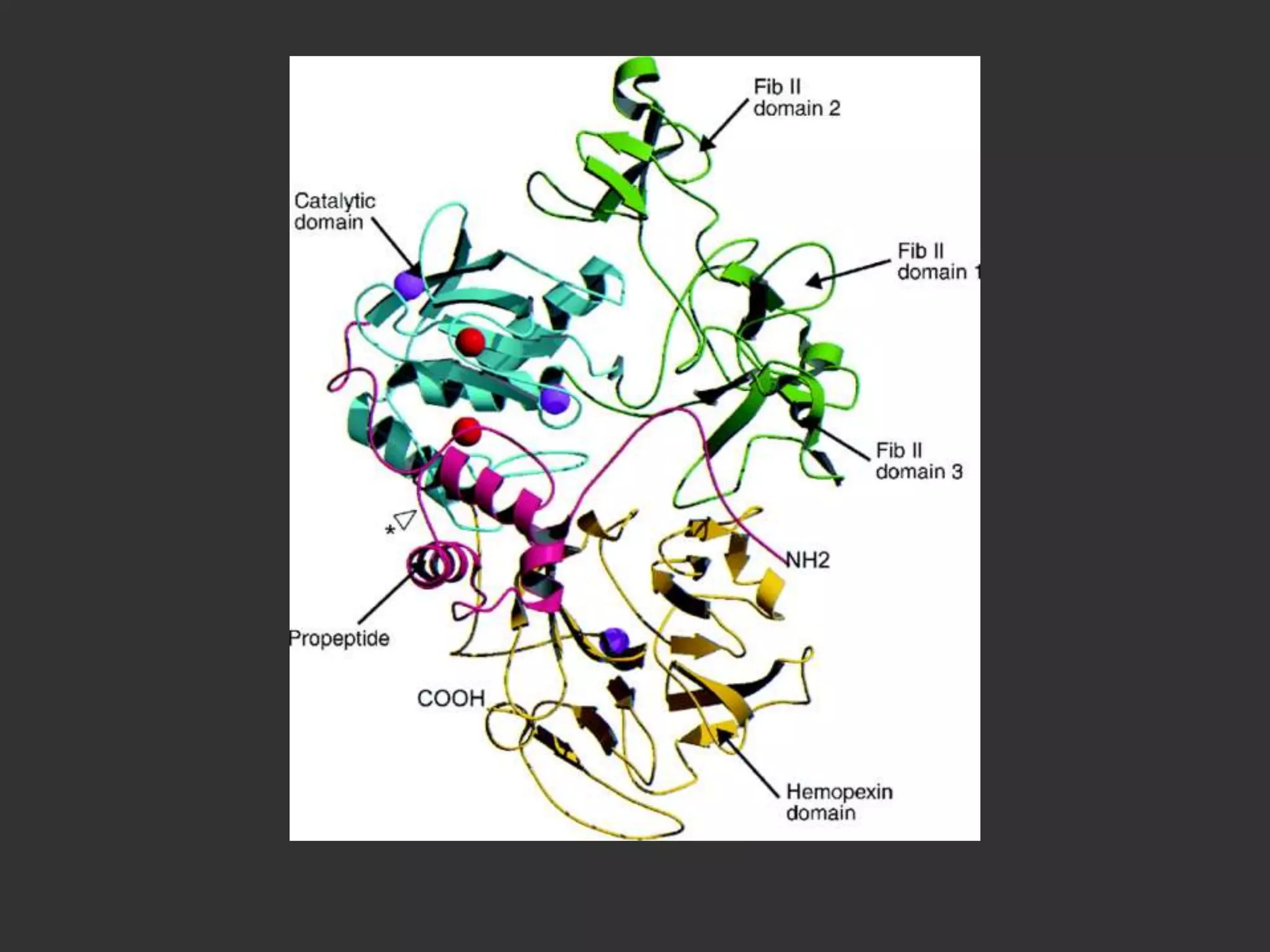
 Metal linked enzymes
 Zn – Needed for protease activity
 Ca – Stability and execution of action
 Proenzyme : Latent due to pro-peptide domain
 Hydrolysis of cysteine bond – uncovers enzymatic
site
 Potent protein degradation and modifying
enzymes
Nagase H et al. Cardiovascular Research. 2006: 562-573
Types
Enzyme name MMP class
Collagenases MMP-1, MMP-8, MMP-13
Gelatinases MMP-2, MMP-9
Stromelysins MMP-3, MMP-10, MMP-11
Membrane type-MMPs MMP-14, MMP-15, MMP-16,
MMP-17, MMP-24, MMP-25
MT-MMPs process signalling peptides - cytokines
Intra-cellular MMP – actin-myosin interface
Liu P et al. Advances in Vascular Biology. 2006:22
Production and Regulation
Cells which produce Regulators of transcription
Smooth muscle cells TNF-
Myocytes Interleukins
Fibroblasts PDGF
Endothelial cells CD40 ligands
Monocytes / Macrophages
T-cells
Chen Q et al. Mediators of Inflammation. 2013:1-14
Activation signals
 Oxygen free radicals
 Ischemic triggers - thrombin and chymase
 Angiotension-converting enzyme
 Plasminogen activators
 Plasmin
Gaffney J. Matrix Biology. 2015:44-46
Inhibitors
 Tissue inhibitors of metalloproteinases
 Physiological : TIMP – I to 4
 Artificial : Tetracycline family of antibiotics,
synthetic inhibitors
Castro M et al. Pharmacological Research.2011:511-560.
Liu P et al. Advances in Vascular Biology. 2006:22
Role of extracellular matrix
 Structural integrity of heart and blood vessels
 Framework for cell anchoring and function
 Mediates cell adhesion, cell phenotype and cell-cell
communication
 Integrates mechanical force and lines of force transmission
 Mediates diastolic stiffness
 Promotes cell survival or apoptosis
 Reservoir of growth factors and cytokines
Liu P et al. Advances in Vascular Biology. 2006:22
MMP in atherosclerosis
 Plaque – Lipid core + external fibrous cap + macrophages
 Fibrous cap matrix – collagen (strength) + elastin (flexibility)
 MMP role in remodelling - resorbed and re-deposited
 In stable conditions – remodelling is balanced
 MMP-9 & MMP-3 in advancing edge of plaque
 TIMPs increased in areas of calcification – Natures way of
stabilising remodelling process
Liu P et al. Advances in Vascular Biology. 2006:22
MMPs in plaque rupture
 Proinflammatory conditions
 Remodelling shifted in favour of resorption of matrix – weakness of
fibrous cap
 Result in plaque rupture
 MMPs increased at sites of potential weakness
Newby A. Matrix Biology. 2015:157-166
Risk factors – activate MMPs
 Smoking
 Diabetes
 Homocysteine Increased oxidative stress
 Increased lipids
 Smoking
 Diabetes
 Homocysteine Increased oxidative stress
 Increased lipids
Ruddy JM et al. Journal of Vascular Research.2016:1-16
MMPs in following infarction
 MMP activity – increase in progression of heart failure
 MMPs increased within hours of the infarction – followed by fall in
levels
 Second wave of MMP activation – ventricular dilation and heart
failure
 TNF- related to the increased production of MMP-9 & MMP-2
Pennell KY et al. Progress in Mol Biology and Translational Science. 2017:75-
100
MMPs as diagnostic or
prognostic markers
 MMPs are released into blood – Can be quantified
 MMP-9 – most efficient prognostic information
 But lacks conclusive predictive value
Halade GV et al. Pharmacology & Therapeutics. 2013:32-40
MaAloon CJ et al. Heart failure and cardiomyopathies.. 2017:639
MMPs –stem cell mobilisers
 MMP-9 in bone marrow – releases stem cells into circulation
Jane HP et al. Vascular Health and Risk Management. 2012:99-114
Therapeutic opportunities
 Elastase inhibition in viral myocarditis – decrease cardiomyopathy
 In setting of A-V fistula – MMP inhibitor effectively decrease cardiac
dilation and preserve ventricular function
 Problem of fibromyalgia as a side effects
 Hence, indirect inhibition of activation of MMPs- ACE inhibitors,
statins, acetylsalicylic acid, TNF inhibitors
Take home messages
 MMPs are a family of potent matrix digesting enzymes
 Pro form in matrix secreted by many types of cells
 Activators, regulators and inhibitors
 Role in atherosclerosis, plaque rupture and myocardial
remodelling
 Not a good biomarker for routine practice
 Role in mobilising stem cells
 Therapeutic benefits are from indirect methods of preventing
activation of MMPs
Doubts … Questions ….

Mmp in cvd

  • 1.
    Matrix Metalloproteinases in Cardiovasculardisease Moderator: Prof Kim Vaiphei
  • 2.
    Outline of class What are matrix metalloproteinases?  Types of MMPs  Tissue inhibitors of Metalloproteinases  Role in atherosclerosis  Role in plaque rupture  Role in heart failure  Diagnostic and Prognostic utility  Therapeutic potential  Summary
  • 3.
    What are MatrixMetalloproteinases?  Metal linked enzymes  Zn – Needed for protease activity  Ca – Stability and execution of action  Proenzyme : Latent due to pro-peptide domain  Hydrolysis of cysteine bond – uncovers enzymatic site  Potent protein degradation and modifying enzymes Nagase H et al. Cardiovascular Research. 2006: 562-573
  • 5.
    Types Enzyme name MMPclass Collagenases MMP-1, MMP-8, MMP-13 Gelatinases MMP-2, MMP-9 Stromelysins MMP-3, MMP-10, MMP-11 Membrane type-MMPs MMP-14, MMP-15, MMP-16, MMP-17, MMP-24, MMP-25 MT-MMPs process signalling peptides - cytokines Intra-cellular MMP – actin-myosin interface Liu P et al. Advances in Vascular Biology. 2006:22
  • 6.
    Production and Regulation Cellswhich produce Regulators of transcription Smooth muscle cells TNF- Myocytes Interleukins Fibroblasts PDGF Endothelial cells CD40 ligands Monocytes / Macrophages T-cells Chen Q et al. Mediators of Inflammation. 2013:1-14
  • 7.
    Activation signals  Oxygenfree radicals  Ischemic triggers - thrombin and chymase  Angiotension-converting enzyme  Plasminogen activators  Plasmin Gaffney J. Matrix Biology. 2015:44-46
  • 8.
    Inhibitors  Tissue inhibitorsof metalloproteinases  Physiological : TIMP – I to 4  Artificial : Tetracycline family of antibiotics, synthetic inhibitors Castro M et al. Pharmacological Research.2011:511-560.
  • 9.
    Liu P etal. Advances in Vascular Biology. 2006:22
  • 10.
    Role of extracellularmatrix  Structural integrity of heart and blood vessels  Framework for cell anchoring and function  Mediates cell adhesion, cell phenotype and cell-cell communication  Integrates mechanical force and lines of force transmission  Mediates diastolic stiffness  Promotes cell survival or apoptosis  Reservoir of growth factors and cytokines Liu P et al. Advances in Vascular Biology. 2006:22
  • 11.
    MMP in atherosclerosis Plaque – Lipid core + external fibrous cap + macrophages  Fibrous cap matrix – collagen (strength) + elastin (flexibility)  MMP role in remodelling - resorbed and re-deposited  In stable conditions – remodelling is balanced  MMP-9 & MMP-3 in advancing edge of plaque  TIMPs increased in areas of calcification – Natures way of stabilising remodelling process Liu P et al. Advances in Vascular Biology. 2006:22
  • 12.
    MMPs in plaquerupture  Proinflammatory conditions  Remodelling shifted in favour of resorption of matrix – weakness of fibrous cap  Result in plaque rupture  MMPs increased at sites of potential weakness Newby A. Matrix Biology. 2015:157-166
  • 14.
    Risk factors –activate MMPs  Smoking  Diabetes  Homocysteine Increased oxidative stress  Increased lipids  Smoking  Diabetes  Homocysteine Increased oxidative stress  Increased lipids Ruddy JM et al. Journal of Vascular Research.2016:1-16
  • 15.
    MMPs in followinginfarction  MMP activity – increase in progression of heart failure  MMPs increased within hours of the infarction – followed by fall in levels  Second wave of MMP activation – ventricular dilation and heart failure  TNF- related to the increased production of MMP-9 & MMP-2 Pennell KY et al. Progress in Mol Biology and Translational Science. 2017:75- 100
  • 17.
    MMPs as diagnosticor prognostic markers  MMPs are released into blood – Can be quantified  MMP-9 – most efficient prognostic information  But lacks conclusive predictive value Halade GV et al. Pharmacology & Therapeutics. 2013:32-40 MaAloon CJ et al. Heart failure and cardiomyopathies.. 2017:639
  • 18.
    MMPs –stem cellmobilisers  MMP-9 in bone marrow – releases stem cells into circulation Jane HP et al. Vascular Health and Risk Management. 2012:99-114
  • 19.
    Therapeutic opportunities  Elastaseinhibition in viral myocarditis – decrease cardiomyopathy  In setting of A-V fistula – MMP inhibitor effectively decrease cardiac dilation and preserve ventricular function  Problem of fibromyalgia as a side effects  Hence, indirect inhibition of activation of MMPs- ACE inhibitors, statins, acetylsalicylic acid, TNF inhibitors
  • 21.
    Take home messages MMPs are a family of potent matrix digesting enzymes  Pro form in matrix secreted by many types of cells  Activators, regulators and inhibitors  Role in atherosclerosis, plaque rupture and myocardial remodelling  Not a good biomarker for routine practice  Role in mobilising stem cells  Therapeutic benefits are from indirect methods of preventing activation of MMPs
  • 22.