Non-invasive Imaging for Management of
        Cardiovascular Diseases


           Dr. Muhammad Ayub, FCPS
                 Diplomate Certification Board of Nuclear Cardiology
             Diplomate Board of Cardiovascular Computed Tomography

           Department of Cardiovascular Imaging
          Punjab Institute of Cardiology Lahore
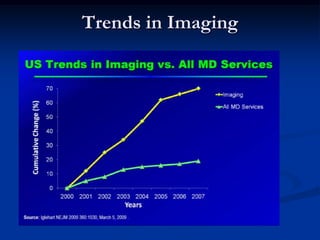
Trends in Imaging
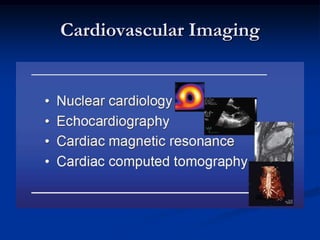
Cardiovascular Imaging
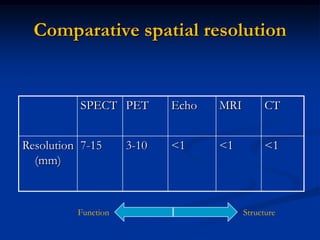
Comparative spatial resolution


          SPECT PET         Echo   MRI         CT


Resolution 7-15      3-10   <1     <1          <1
  (mm)


          Function                       Structure
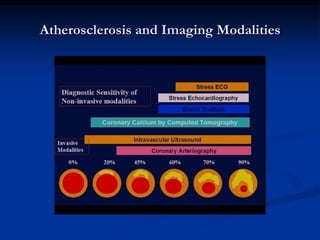
Atherosclerosis and Imaging Modalities
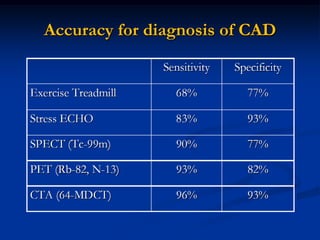
Accuracy for diagnosis of CAD
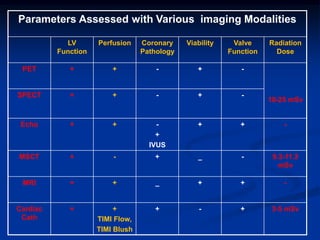
Parameters Assessed with Various imaging Modalities

            LV       Perfusion    Coronary    Viability    Valve     Radiation
          Function                Pathology               Function     Dose

 PET         +           +            -          +           -


SPECT        +           +            -          +           -
                                                                     10-25 mSv


 Echo        +           +            -          +           +           -
                                      +
                                    IVUS
MSCT         +           -           +           _           -        9.3-11.3
                                                                        mSv

 MRI         +           +           _           +           +           -


Cardiac      +            +          +            -          +        3-5 mSv
 Cath                TIMI Flow,
                     TIMI Blush
Applications of Nuclear Cardiology

   Coronary Artery Disease
   Assessment of LV /RV function
   Cardiomyopathy /Myocarditis
   Valvular Heart Disease
   Cardiac Shunts
   Secondary Hypertension
   Pulmonary Hypertension
   Assessment of Cardiac Transplant
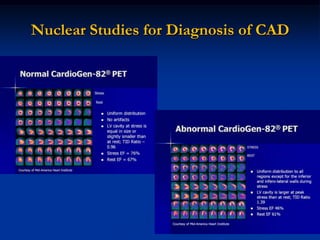
Nuclear Studies for Diagnosis of CAD
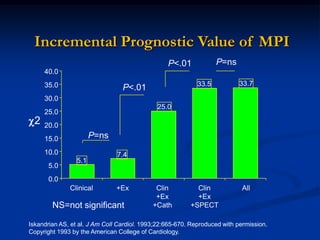
Incremental Prognostic Value of MPI
                                                 P<.01             P=ns
     40.0
     35.0                                                   33.5          33.7
                                 P<.01
     30.0
                                             25.0
     25.0
2   20.0
     15.0              P=ns
     10.0                      7.4
                 5.1
       5.0
       0.0
              Clinical         +Ex           Clin          Clin             All
                                             +Ex           +Ex                          N = 316
        NS=not significant                  +Cath        +SPECT

Iskandrian AS, et al. J Am Coll Cardiol. 1993;22:665-670. Reproduced with permission.
Copyright 1993 by the American College of Cardiology.
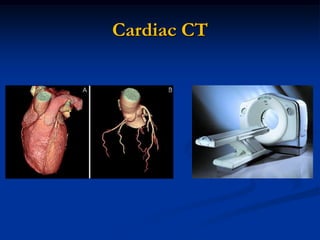
Cardiac CT
Applications of Cardiac CT
   Diagnosis of Coronary Artery Disease (intermediate probability)
   Suspected Coronary Anomalies
   Assessment of grafts prior to redo CABG
   Assessment of complex congenital heart disease (difficult echo)
   Suspected Aortic Dissection
   Suspected Pulmonary Embolism
   Assessment of Cardiac masses (difficult echo)
   Assessment of pericardial conditions (difficult echo)
   Assessment of pulmonary veins prior to radiofrequency ablation
   Assessment of coronary veins prior to biventricular pacing
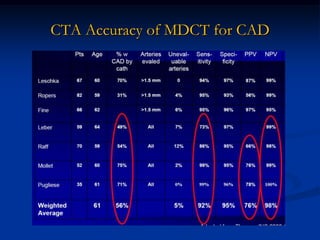
CTA Accuracy of MDCT for CAD
CTA Limitations

   Rapid (>80 bpm) and irregular HR
   High calcium scores (>800-1000)
   Stents
   Contrast requirements (Cr > 2.0 mg/dl)
   Small vessels (<1.5 mm) and collaterals
   Obese and uncooperative patients
   RADIATION EXPOSURE
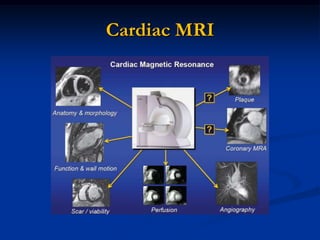
Cardiac MRI
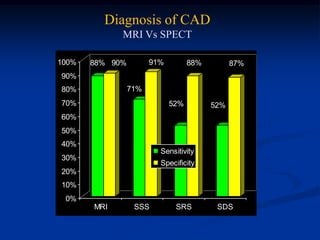
Diagnosis of CAD
             MRI Vs SPECT

100%   88% 90%         91%         88%         87%
90%
80%              71%
70%                          52%         52%
60%
50%
40%
                         Sensitivity
30%
                         Specificity
20%
10%
 0%
       MRI        SSS         SRS         SDS
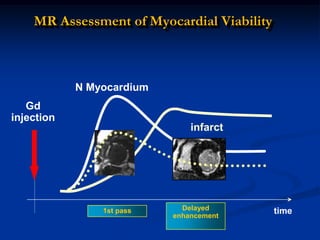
MR Assessment of Myocardial Viability


            N Myocardium
   Gd
injection
                               infarct


                1st pass     Delayed        time
                           enhancement
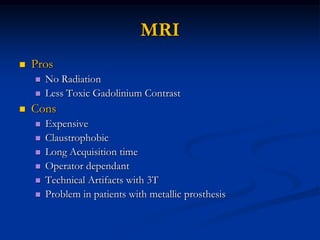
MRI
   Pros
       No Radiation
       Less Toxic Gadolinium Contrast
   Cons
       Expensive
       Claustrophobic
       Long Acquisition time
       Operator dependant
       Technical Artifacts with 3T
       Problem in patients with metallic prosthesis
Diagnostic Testing According to Clinical Need
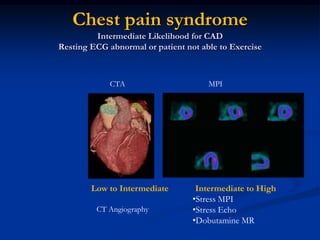
Chest pain syndrome
         Intermediate Likelihood for CAD
Resting ECG abnormal or patient not able to Exercise


             CTA                      MPI


        Low to Intermediate        Intermediate to High
                                  •Stress MPI
         CT Angiography           •Stress Echo
                                  •Dobutamine MR
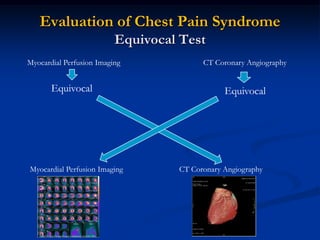
Evaluation of Chest Pain Syndrome
                          Equivocal Test
Myocardial Perfusion Imaging             CT Coronary Angiography


       Equivocal                               Equivocal


Myocardial Perfusion Imaging       CT Coronary Angiography
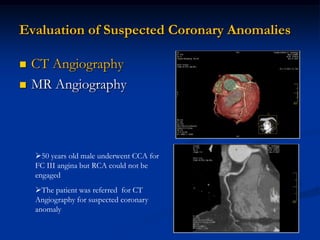
Evaluation of Suspected Coronary Anomalies

   CT Angiography
   MR Angiography


    50 years old male underwent CCA for
    FC III angina but RCA could not be
    engaged
    The patient was referred for CT
    Angiography for suspected coronary
    anomaly
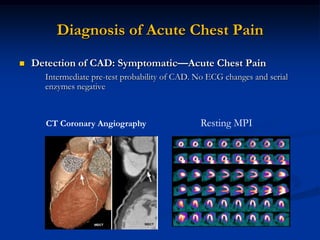
Diagnosis of Acute Chest Pain
   Detection of CAD: Symptomatic—Acute Chest Pain
      Intermediate pre-test probability of CAD. No ECG changes and serial
      enzymes negative


      CT Coronary Angiography                   Resting MPI
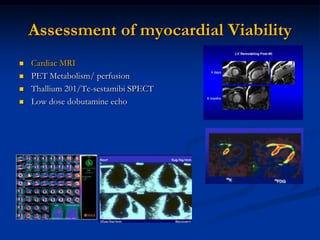
Assessment of myocardial Viability
   Cardiac MRI
   PET Metabolism/ perfusion
   Thallium 201/Tc-sestamibi SPECT
   Low dose dobutamine echo
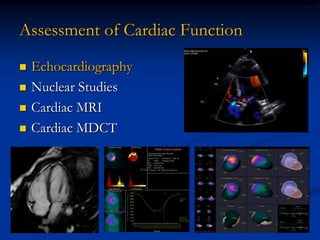
Assessment of Cardiac Function
   Echocardiography
   Nuclear Studies

   Cardiac MRI
   Cardiac MDCT
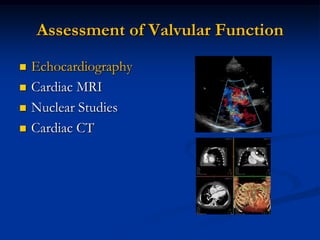
Assessment of Valvular Function
   Echocardiography
   Cardiac MRI
   Nuclear Studies
   Cardiac CT
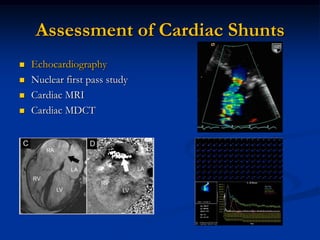
Assessment of Cardiac Shunts
   Echocardiography
   Nuclear first pass study
   Cardiac MRI
   Cardiac MDCT
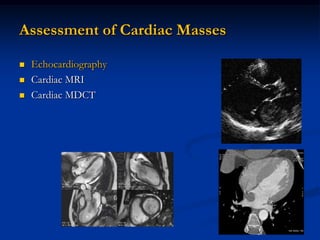
Assessment of Cardiac Masses

   Echocardiography
   Cardiac MRI
   Cardiac MDCT
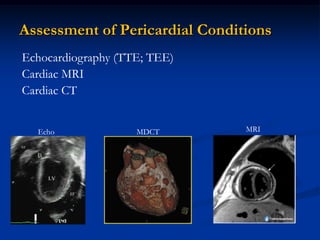
Assessment of Pericardial Conditions
Echocardiography (TTE; TEE)
Cardiac MRI
Cardiac CT


  Echo              MDCT        MRI
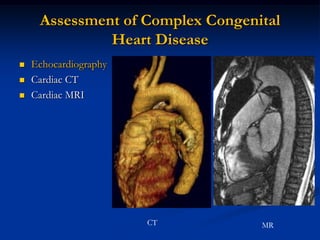
Assessment of Complex Congenital
              Heart Disease
   Echocardiography
   Cardiac CT
   Cardiac MRI


                       CT         MR
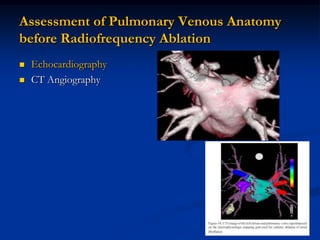
Assessment of Pulmonary Venous Anatomy
before Radiofrequency Ablation
   Echocardiography
   CT Angiography
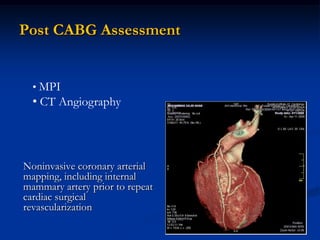
Post CABG Assessment


  • MPI
  • CT Angiography


Noninvasive coronary arterial
mapping, including internal
mammary artery prior to repeat
cardiac surgical
revascularization
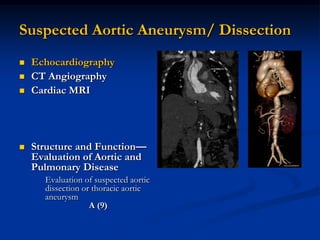
Suspected Aortic Aneurysm/ Dissection
   Echocardiography
   CT Angiography
   Cardiac MRI


   Structure and Function—
    Evaluation of Aortic and
    Pulmonary Disease
      Evaluation of suspected aortic
      dissection or thoracic aortic
      aneurysm
                   A (9)
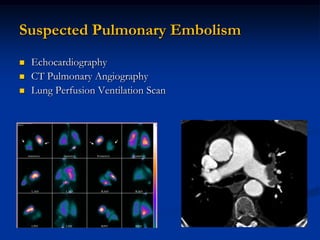
Suspected Pulmonary Embolism
   Echocardiography
   CT Pulmonary Angiography
   Lung Perfusion Ventilation Scan
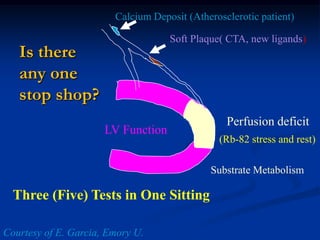
Calcium Deposit (Atherosclerotic patient)

                                    Soft Plaque( CTA, new ligands)
   Is there
   any one
   stop shop?
                                                 Perfusion deficit
                      LV Function
                                               (Rb-82 stress and rest)

                                             Substrate Metabolism

  Three (Five) Tests in One Sitting

Courtesy of E. Garcia, Emory U.
Conclusions
   No simple Recipe
   Appropriate Usage of all available technologies
    according to clinical need
Thank you for listening

Cardiovascular Imaging

  • 1.
    Non-invasive Imaging forManagement of Cardiovascular Diseases Dr. Muhammad Ayub, FCPS Diplomate Certification Board of Nuclear Cardiology Diplomate Board of Cardiovascular Computed Tomography Department of Cardiovascular Imaging Punjab Institute of Cardiology Lahore
  • 2.
  • 3.
  • 4.
    Comparative spatial resolution SPECT PET Echo MRI CT Resolution 7-15 3-10 <1 <1 <1 (mm) Function Structure
  • 5.
  • 6.
  • 7.
    Parameters Assessed withVarious imaging Modalities LV Perfusion Coronary Viability Valve Radiation Function Pathology Function Dose PET + + - + - SPECT + + - + - 10-25 mSv Echo + + - + + - + IVUS MSCT + - + _ - 9.3-11.3 mSv MRI + + _ + + - Cardiac + + + - + 3-5 mSv Cath TIMI Flow, TIMI Blush
  • 8.
    Applications of NuclearCardiology  Coronary Artery Disease  Assessment of LV /RV function  Cardiomyopathy /Myocarditis  Valvular Heart Disease  Cardiac Shunts  Secondary Hypertension  Pulmonary Hypertension  Assessment of Cardiac Transplant
  • 9.
    Nuclear Studies forDiagnosis of CAD
  • 10.
    Incremental Prognostic Valueof MPI P<.01 P=ns 40.0 35.0 33.5 33.7 P<.01 30.0 25.0 25.0 2 20.0 15.0 P=ns 10.0 7.4 5.1 5.0 0.0 Clinical +Ex Clin Clin All +Ex +Ex N = 316 NS=not significant +Cath +SPECT Iskandrian AS, et al. J Am Coll Cardiol. 1993;22:665-670. Reproduced with permission. Copyright 1993 by the American College of Cardiology.
  • 11.
  • 12.
    Applications of CardiacCT  Diagnosis of Coronary Artery Disease (intermediate probability)  Suspected Coronary Anomalies  Assessment of grafts prior to redo CABG  Assessment of complex congenital heart disease (difficult echo)  Suspected Aortic Dissection  Suspected Pulmonary Embolism  Assessment of Cardiac masses (difficult echo)  Assessment of pericardial conditions (difficult echo)  Assessment of pulmonary veins prior to radiofrequency ablation  Assessment of coronary veins prior to biventricular pacing
  • 13.
    CTA Accuracy ofMDCT for CAD
  • 14.
    CTA Limitations  Rapid (>80 bpm) and irregular HR  High calcium scores (>800-1000)  Stents  Contrast requirements (Cr > 2.0 mg/dl)  Small vessels (<1.5 mm) and collaterals  Obese and uncooperative patients  RADIATION EXPOSURE
  • 15.
  • 16.
    Diagnosis of CAD MRI Vs SPECT 100% 88% 90% 91% 88% 87% 90% 80% 71% 70% 52% 52% 60% 50% 40% Sensitivity 30% Specificity 20% 10% 0% MRI SSS SRS SDS
  • 17.
    MR Assessment ofMyocardial Viability N Myocardium Gd injection infarct 1st pass Delayed time enhancement
  • 18.
    MRI  Pros  No Radiation  Less Toxic Gadolinium Contrast  Cons  Expensive  Claustrophobic  Long Acquisition time  Operator dependant  Technical Artifacts with 3T  Problem in patients with metallic prosthesis
  • 19.
  • 20.
    Chest pain syndrome Intermediate Likelihood for CAD Resting ECG abnormal or patient not able to Exercise CTA MPI Low to Intermediate Intermediate to High •Stress MPI CT Angiography •Stress Echo •Dobutamine MR
  • 21.
    Evaluation of ChestPain Syndrome Equivocal Test Myocardial Perfusion Imaging CT Coronary Angiography Equivocal Equivocal Myocardial Perfusion Imaging CT Coronary Angiography
  • 22.
    Evaluation of SuspectedCoronary Anomalies  CT Angiography  MR Angiography 50 years old male underwent CCA for FC III angina but RCA could not be engaged The patient was referred for CT Angiography for suspected coronary anomaly
  • 23.
    Diagnosis of AcuteChest Pain  Detection of CAD: Symptomatic—Acute Chest Pain Intermediate pre-test probability of CAD. No ECG changes and serial enzymes negative CT Coronary Angiography Resting MPI
  • 24.
    Assessment of myocardialViability  Cardiac MRI  PET Metabolism/ perfusion  Thallium 201/Tc-sestamibi SPECT  Low dose dobutamine echo
  • 25.
    Assessment of CardiacFunction  Echocardiography  Nuclear Studies  Cardiac MRI  Cardiac MDCT
  • 26.
    Assessment of ValvularFunction  Echocardiography  Cardiac MRI  Nuclear Studies  Cardiac CT
  • 27.
    Assessment of CardiacShunts  Echocardiography  Nuclear first pass study  Cardiac MRI  Cardiac MDCT
  • 28.
    Assessment of CardiacMasses  Echocardiography  Cardiac MRI  Cardiac MDCT
  • 29.
    Assessment of PericardialConditions Echocardiography (TTE; TEE) Cardiac MRI Cardiac CT Echo MDCT MRI
  • 30.
    Assessment of ComplexCongenital Heart Disease  Echocardiography  Cardiac CT  Cardiac MRI CT MR
  • 31.
    Assessment of PulmonaryVenous Anatomy before Radiofrequency Ablation  Echocardiography  CT Angiography
  • 32.
    Post CABG Assessment • MPI • CT Angiography Noninvasive coronary arterial mapping, including internal mammary artery prior to repeat cardiac surgical revascularization
  • 33.
    Suspected Aortic Aneurysm/Dissection  Echocardiography  CT Angiography  Cardiac MRI  Structure and Function— Evaluation of Aortic and Pulmonary Disease Evaluation of suspected aortic dissection or thoracic aortic aneurysm A (9)
  • 34.
    Suspected Pulmonary Embolism  Echocardiography  CT Pulmonary Angiography  Lung Perfusion Ventilation Scan
  • 35.
    Calcium Deposit (Atheroscleroticpatient) Soft Plaque( CTA, new ligands) Is there any one stop shop? Perfusion deficit LV Function (Rb-82 stress and rest) Substrate Metabolism Three (Five) Tests in One Sitting Courtesy of E. Garcia, Emory U.
  • 36.
    Conclusions  No simple Recipe  Appropriate Usage of all available technologies according to clinical need
  • 37.
    Thank you forlistening