Portfolio in Educational Technology II
“Teaching in the
Internet age means we
must teach tomorrow’s
skills today.” – Jennifer
Fleming
OUTLINE
oThe Student
oWhat is Educational Technology?
oTechnology: Boon or Bane?
oSystematic Approach to Teaching
oThe Rules of Educational Technology in
Learning
oRoles of Technology in Learning
oCone of Experience
oLearning through Educational Technology II
oConceptual Model of Learning
oThe Student after Educational Technology II
THE
STUDENT
Eee
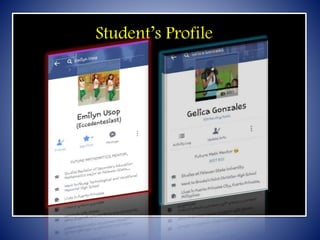
Emilyn Usop
Angelica Gonzales
Student’s Profile
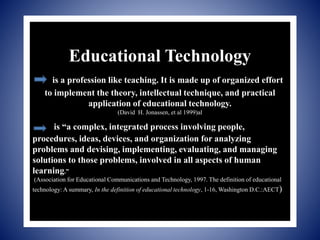
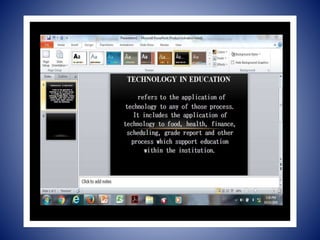
Educational Technology
is a profession like teaching. It is made up of organized effort
to implement the theory, intellectual technique, and practical
application of educational technology.
(David H. Jonassen, et al 1999)al
is “a complex, integrated process involving people,
procedures, ideas, devices, and organization for analyzing
problems and devising, implementing, evaluating, and managing
solutions to those problems, involved in all aspects of human
learning.”
(Association for Educational Communications and Technology, 1997. The definition of educational
technology: A summary, In the definition of educational technology, 1-16, Washington D.C.:AECT)
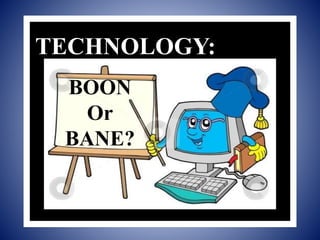
BOON
Or
BANE?
TECHNOLOGY:
Point of View
“I think that technologies are morally neutral until we apply them. It’s only when we
use them for good or for evil that they become good or evil.”
---William Gibson
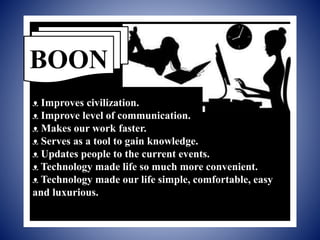
ᴥ Improves civilization.
ᴥ Improve level of communication.
ᴥ Makes our work faster.
ᴥ Serves as a tool to gain knowledge.
ᴥ Updates people to the current events.
ᴥ Technology made life so much more convenient.
ᴥ Technology made our life simple, comfortable, easy
and luxurious.
BOON
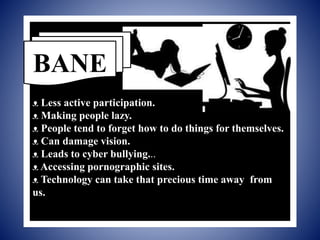
ᴥ Less active participation.
ᴥ Making people lazy.
ᴥ People tend to forget how to do things for themselves.
ᴥ Can damage vision.
ᴥ Leads to cyber bullying...
ᴥ Accessing pornographic sites.
ᴥ Technology can take that precious time away from
us.
BANE
SYSTEMATIC
APPROACH
TO
TEACHING
● The focus of systematic
instructional planning is the
student.
● It tells about the systematic
approach to teaching in which
the focus in the teaching is
the student.
THE RULES
Of
EDUCATIONAL
TECHNOLOGY In
LEARNING
Seven Principle for smart use of
technology in education:
1. Educational problem first. Start with the
problem, not the technology.
2. Added value. Make sure that the technology will
add value to other existing solutions.
3. Sustainability. Will the project be relevant and
accessible with the passage of time, or will
external factors or lack of relevance eventually
lead those involved to abandon it?
4. Multiple uses. Select a technology and design an
intervention so that the technology can be used
for multiple purposes/classes.
5. Lowest cost. If a lower-cost technology is
available to solve a particular problem, even
though it might be less “politically sexy”, it
should be used.
6. Reliability. Ensure that the technology is reliable
and will not rapidly breakdown.
7. Easy of use. Excessively complicated
technologies present barriers to implementation
and the ultimate success of intervention.
(site: gettingsmart.com)
“Technology makes the world a
new place.”
ROLES
OF
TECHNOLOGY
IN
LEARNING
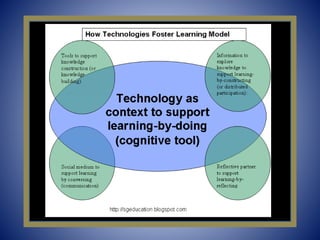
o
௦ for representing learners’ ideas,
understandings and beliefs, and
௦ for producing organized, multimedia
knowledge bases by learners.
Technology as tools to support
knowledge construction:
௦ for accessing needed information, and
௦ for comparing perspectives, beliefs, and
world views.
Technology as information
vehicles for exploring knowledge
to support learning-by
constructing:
௦ for representing and simulating meaningful
real-world problems, situations and contexts
௦ for representing beliefs, perspectives,
arguments, stories of others, and
௦ for defining a safe, controllable problem
space for student thinking.
Technology as context to support
learning-by-doing:
௦ for collaborating with others
௦ for discussing, arguing, and building
consensus among members of a
community, and
௦ for supporting discourse among
knowledge-building communities
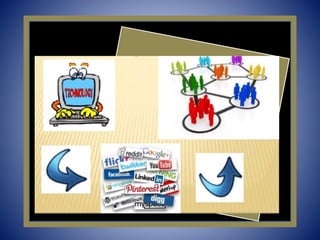
Technology as a social medium to
support learning by conversing:
௦ for helping learners to articulate and represent what
they know
௦ for reflecting on what they have learned and how they
come to know it
௦ for supporting learners ‘internal negotiations and
meaning making
௦ for constructing personal representations of meaning
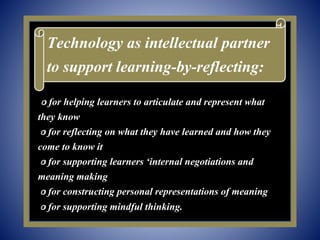
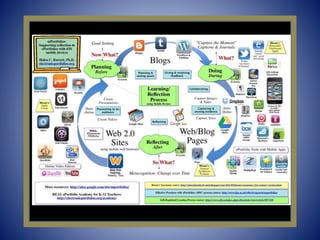
௦ for supporting mindful thinking.
Technology as intellectual partner
to support learning-by-reflecting:
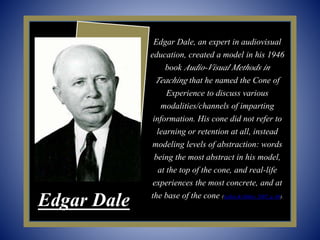
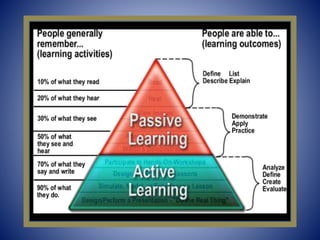
Edgar Dale, an expert in audiovisual
education, created a model in his 1946
book Audio-Visual Methods in
Teaching that he named the Cone of
Experience to discuss various
modalities/channels of imparting
information. His cone did not refer to
learning or retention at all, instead
modeling levels of abstraction: words
being the most abstract in his model,
at the top of the cone, and real-life
experiences the most concrete, and at
the base of the cone (Lalley & Miller, 2007, p. 68).
Edgar Dale
LEARNING
THROUGH
EDUCATIONAL
TECHNOLOGY II
Learning through educational technology was really one of the
terrifying yet enjoyable thing as we have experienced. Terrified
because one day we might just woke up anticipating how
dependent we are already on those technologies and enjoyable
because we’ve discovered a lot through learning educational
technology and not just that we also learned the significance of
those social medias that we thought are just for pleasure. And
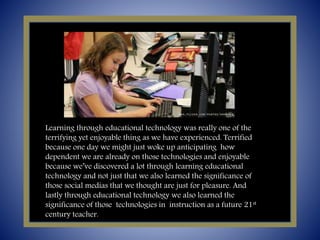
lastly through educational technology we also learned the
significance of those technologies in instruction as a future 21st
century teacher.
CONCEPTUAL MODEL
OF LEARNING
There exists a number of models and theories about learning that is
ideal in achieving instructional goals through preferred application of
Educational Technology
Meaningful Learning
Discovery Learning
Generative Learning
Constructivism
If the traditional learning environment gives stress to rote learning and
simple memorization, meaningful learning gives focus to new
experience that departs from the learning of a sequence of words but
gives attention to meaning.
It assumes that :
● students already have prior knowledge that is relevant to new
learning, and
● students are willing to perform class work to final connection
between what they already know and what they can learn.
In the learning process, the learner is encouraged to recognize relevant
experiences. A reward structure is set so that the learner will have both
interest and confidence.
In the classroom, hands-on activities are introduced to as to simulate
learning in everyday living.
Meaningful
Learning
This is a differentiated from reception (meeting point of meaningful
and discovery learning) in which ideas are presented to students in a
well-organized ay, such as through detailed set of instructions to
complete an experiment.
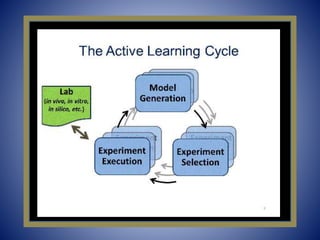
In discovery learning, students perform tasks to uncover what is to be
learned. New ideas and new decisions are generated in the learning
process, regardless of the need to move on and depart from the
structured lesson previously set.
In here, is important that the students become personally engaged and
NOT subjected by the teacher.
Discovery Learning
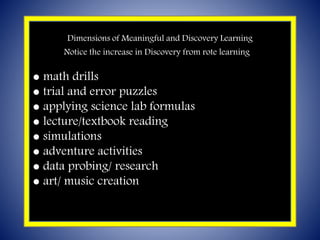
Dimensions of Meaningful and Discovery Learning
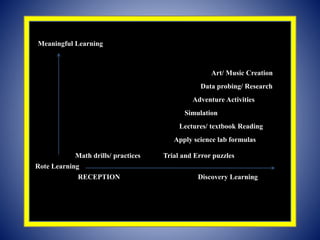
Notice the increase in Discovery from rote learning
● math drills
● trial and error puzzles
● applying science lab formulas
● lecture/textbook reading
● simulations
● adventure activities
● data probing/ research
● art/ music creation
RECEPTION
Rote Learning
Discovery Learning
Meaningful Learning
Math drills/ practices Trial and Error puzzles
Apply science lab formulas
Lectures/ textbook Reading
Simulation
Adventure Activities
Data probing/ Research
Art/ Music Creation
Here, we have active listeners who attend to learning
events and generate meaning from this experience and
draw inferences thereby creating a personal model of
explanation to the new experience in the context of existing
knowledge.
This is viewed as different from the simple process of
storing information. Motivation and responsibility are
crucial to this domain of learning.
This gives emphasis to what can be done with the pieces of
information not only on access to them.
Generative
Learning
C
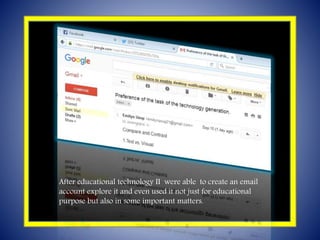
After educational technology II were able to create an email
account explore it and even used it not just for educational
purpose but also in some important matters.
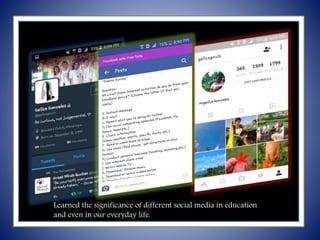
Learned the significance of different social media in education
and even in our everyday life.
f
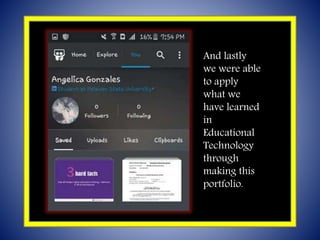
And lastly
we were able
to apply
what we
have learned
in
Educational
Technology
through
making this
portfolio.
Thank You for viewing.

Portfolio in Educational Technology 2

  • 1.
    Portfolio in EducationalTechnology II “Teaching in the Internet age means we must teach tomorrow’s skills today.” – Jennifer Fleming
  • 2.
    OUTLINE oThe Student oWhat isEducational Technology? oTechnology: Boon or Bane? oSystematic Approach to Teaching oThe Rules of Educational Technology in Learning oRoles of Technology in Learning oCone of Experience oLearning through Educational Technology II oConceptual Model of Learning oThe Student after Educational Technology II
  • 3.
  • 4.
  • 5.
  • 7.
    Educational Technology is aprofession like teaching. It is made up of organized effort to implement the theory, intellectual technique, and practical application of educational technology. (David H. Jonassen, et al 1999)al is “a complex, integrated process involving people, procedures, ideas, devices, and organization for analyzing problems and devising, implementing, evaluating, and managing solutions to those problems, involved in all aspects of human learning.” (Association for Educational Communications and Technology, 1997. The definition of educational technology: A summary, In the definition of educational technology, 1-16, Washington D.C.:AECT)
  • 9.
  • 10.
    Point of View “Ithink that technologies are morally neutral until we apply them. It’s only when we use them for good or for evil that they become good or evil.” ---William Gibson
  • 11.
    ᴥ Improves civilization. ᴥImprove level of communication. ᴥ Makes our work faster. ᴥ Serves as a tool to gain knowledge. ᴥ Updates people to the current events. ᴥ Technology made life so much more convenient. ᴥ Technology made our life simple, comfortable, easy and luxurious. BOON
  • 12.
    ᴥ Less activeparticipation. ᴥ Making people lazy. ᴥ People tend to forget how to do things for themselves. ᴥ Can damage vision. ᴥ Leads to cyber bullying... ᴥ Accessing pornographic sites. ᴥ Technology can take that precious time away from us. BANE
  • 13.
  • 14.
    ● The focusof systematic instructional planning is the student. ● It tells about the systematic approach to teaching in which the focus in the teaching is the student.
  • 16.
  • 17.
    Seven Principle forsmart use of technology in education: 1. Educational problem first. Start with the problem, not the technology. 2. Added value. Make sure that the technology will add value to other existing solutions. 3. Sustainability. Will the project be relevant and accessible with the passage of time, or will external factors or lack of relevance eventually lead those involved to abandon it?
  • 18.
    4. Multiple uses.Select a technology and design an intervention so that the technology can be used for multiple purposes/classes. 5. Lowest cost. If a lower-cost technology is available to solve a particular problem, even though it might be less “politically sexy”, it should be used. 6. Reliability. Ensure that the technology is reliable and will not rapidly breakdown. 7. Easy of use. Excessively complicated technologies present barriers to implementation and the ultimate success of intervention. (site: gettingsmart.com)
  • 19.
    “Technology makes theworld a new place.” ROLES OF TECHNOLOGY IN LEARNING
  • 20.
    o ௦ for representinglearners’ ideas, understandings and beliefs, and ௦ for producing organized, multimedia knowledge bases by learners. Technology as tools to support knowledge construction:
  • 22.
    ௦ for accessingneeded information, and ௦ for comparing perspectives, beliefs, and world views. Technology as information vehicles for exploring knowledge to support learning-by constructing:
  • 24.
    ௦ for representingand simulating meaningful real-world problems, situations and contexts ௦ for representing beliefs, perspectives, arguments, stories of others, and ௦ for defining a safe, controllable problem space for student thinking. Technology as context to support learning-by-doing:
  • 27.
    ௦ for collaboratingwith others ௦ for discussing, arguing, and building consensus among members of a community, and ௦ for supporting discourse among knowledge-building communities Technology as a social medium to support learning by conversing:
  • 29.
    ௦ for helpinglearners to articulate and represent what they know ௦ for reflecting on what they have learned and how they come to know it ௦ for supporting learners ‘internal negotiations and meaning making ௦ for constructing personal representations of meaning ௦ for supporting mindful thinking. Technology as intellectual partner to support learning-by-reflecting:
  • 31.
    Edgar Dale, anexpert in audiovisual education, created a model in his 1946 book Audio-Visual Methods in Teaching that he named the Cone of Experience to discuss various modalities/channels of imparting information. His cone did not refer to learning or retention at all, instead modeling levels of abstraction: words being the most abstract in his model, at the top of the cone, and real-life experiences the most concrete, and at the base of the cone (Lalley & Miller, 2007, p. 68). Edgar Dale
  • 33.
  • 36.
    Learning through educationaltechnology was really one of the terrifying yet enjoyable thing as we have experienced. Terrified because one day we might just woke up anticipating how dependent we are already on those technologies and enjoyable because we’ve discovered a lot through learning educational technology and not just that we also learned the significance of those social medias that we thought are just for pleasure. And lastly through educational technology we also learned the significance of those technologies in instruction as a future 21st century teacher.
  • 37.
  • 38.
    There exists anumber of models and theories about learning that is ideal in achieving instructional goals through preferred application of Educational Technology Meaningful Learning Discovery Learning Generative Learning Constructivism
  • 39.
    If the traditionallearning environment gives stress to rote learning and simple memorization, meaningful learning gives focus to new experience that departs from the learning of a sequence of words but gives attention to meaning. It assumes that : ● students already have prior knowledge that is relevant to new learning, and ● students are willing to perform class work to final connection between what they already know and what they can learn. In the learning process, the learner is encouraged to recognize relevant experiences. A reward structure is set so that the learner will have both interest and confidence. In the classroom, hands-on activities are introduced to as to simulate learning in everyday living. Meaningful Learning
  • 40.
    This is adifferentiated from reception (meeting point of meaningful and discovery learning) in which ideas are presented to students in a well-organized ay, such as through detailed set of instructions to complete an experiment. In discovery learning, students perform tasks to uncover what is to be learned. New ideas and new decisions are generated in the learning process, regardless of the need to move on and depart from the structured lesson previously set. In here, is important that the students become personally engaged and NOT subjected by the teacher. Discovery Learning
  • 41.
    Dimensions of Meaningfuland Discovery Learning Notice the increase in Discovery from rote learning ● math drills ● trial and error puzzles ● applying science lab formulas ● lecture/textbook reading ● simulations ● adventure activities ● data probing/ research ● art/ music creation
  • 42.
    RECEPTION Rote Learning Discovery Learning MeaningfulLearning Math drills/ practices Trial and Error puzzles Apply science lab formulas Lectures/ textbook Reading Simulation Adventure Activities Data probing/ Research Art/ Music Creation
  • 43.
    Here, we haveactive listeners who attend to learning events and generate meaning from this experience and draw inferences thereby creating a personal model of explanation to the new experience in the context of existing knowledge. This is viewed as different from the simple process of storing information. Motivation and responsibility are crucial to this domain of learning. This gives emphasis to what can be done with the pieces of information not only on access to them. Generative Learning
  • 45.
    C After educational technologyII were able to create an email account explore it and even used it not just for educational purpose but also in some important matters.
  • 46.
    Learned the significanceof different social media in education and even in our everyday life.
  • 47.
    f And lastly we wereable to apply what we have learned in Educational Technology through making this portfolio.
  • 48.
    Thank You forviewing.