Jierlyn R. Basilisco
BSEd – HET 3
•The Student
•Educational Technology 1&2
•Learning through Educational
Technology 1&2
• The Student after Educational
Technology
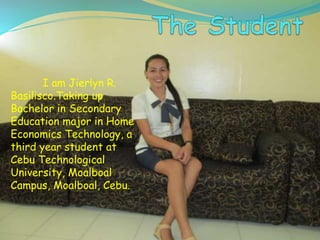
I am Jierlyn R.
Basilisco.Taking up
Bachelor in Secondary
Education major in Home
Economics Technology, a
third year student at
Cebu Technological
University, Moalboal
Campus, Moalboal, Cebu.
This portfolio serve as the Final
Requirement of the student in
Educational Technology. The learning of
the student after the subject which can
really help him/her in the future as an
Educator.
The word technology comes from two Greek words,
techne and logos.
Techne means art, skill, craft, or the way, manner, or
means by which a thing is gained.
Logos means word, the utterance by which inward
thought is expressed, a saying, or an expression.
So, literally, technology means words or discourse
about the way things are gained.
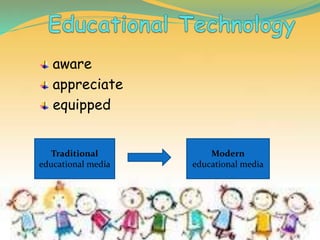
aware
appreciate
equipped
Traditional
educational media
Modern
educational media
•Is the effective use of technological tools
in learning.
•Is a combination of the process and tools
involved in addressing educational needs and
problems with emphasis on applying the most
current tools; computers and their related
techniques.
Is a profession like teaching. It is made up of organized effort.
Is a method for engaging learning such as cognitive learning
strategies and critical thinking.
A complex, integrated process involving people, procedures, ideas,
devices and problems involved in human learning.
A theory about how problems in human learning are identified and
solved.
Is a field study which is concerned with the practice of using
educational methods and resources.
•Is a practice of educating students about different
technology and engineering concept as they relate to
he “ human made” world.
•It is the application of technology to any of those
processes involved in operating the institutions which
house the educational enterprise.
An educational technology which refers to those
aspects of educational technology that are concerned
with instructions as contrasted to designs and operations
of educational institutions.
The use of technology tools in general
content areas in education in order to allow
students to apply computer and technology skills
to learning and problem- solving. Generally
speaking, the curriculum drives the use of
technology and not vice versa.
Is any type of media use to
educate someone on a topic. It can
be used at home or in the classroom
to supplement lessons and formal
education.
When we say Boon?
It means a blessing.
Example:
 Students are expressing their thoughts about the
impact of internet towards their studies using the
BlogSpot.
When we say Bane?
It means a curse.
Example:
 The learner is made to accept as gospel
truth information they get from the internet.
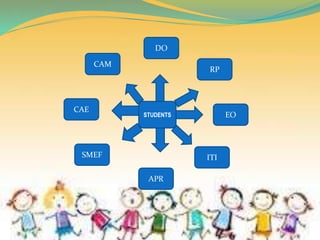
DO
CAE
CAM
STUDENTS
RP
EO
SMEF ITI
APR
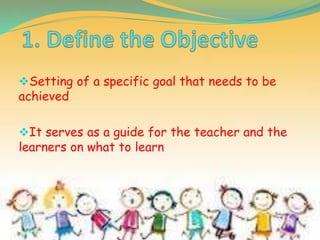
Setting of a specific goal that needs to be
achieved
It serves as a guide for the teacher and the
learners on what to learn
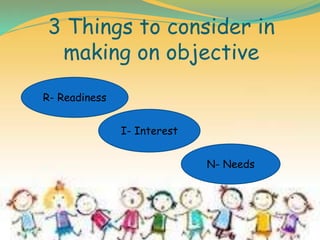
3 Things to consider in
making on objective
R- Readiness
I- Interest
N- Needs
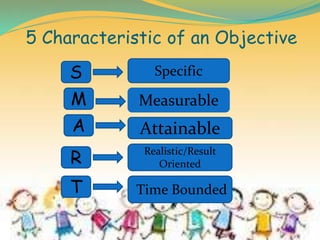
5 Characteristic of an Objective
Specific
Measurable
Attainable
Realistic/Result
Oriented
Time Bounded
S
M
A
R
T
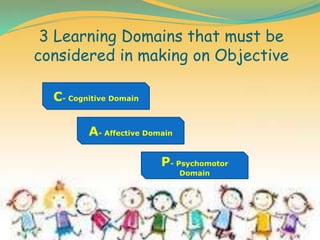
3 Learning Domains that must be
considered in making on Objective
C- Cognitive Domain
A- Affective Domain
P- Psychomotor
Domain
Selecting the appropriate methods of teaching
invluding the strategies and technique that you will
use
Will you use Inductive or Deductive approach?,
specific to general or general to specific?
Selecting the appropriate experience for the
students.
Selecting the right learning activities for the
students.
Ex. Reading, Writing , Playing, Baking, Dancing, Etc.
Selecting the appropriate materials, equipment
and even facilities you will use in achieving your
objective.
Selecting the best instructional material to
achieved the best learning outcome.
•Assigning or delegating task to
the person in charge to help you
meet your objective.
•Application of all the things you planned and prepared
in order to meet you objective
•Engaging with the students
•Lesson proper
 Evaluating the outcome of the discussion for
us to know if the objective is achieved or not.
 It can be written evaluation or oral evaluation.
 It is a process wherein if the students passed
the evaluation and you achieved your objective
then you ca proceed to the new lesson and if the
objective is not met or achieved then you will
again go back to the process.
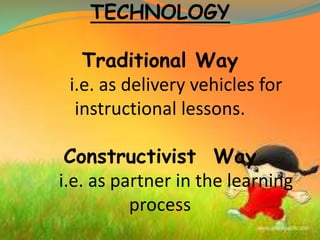
TECHNOLOGY
Traditional Way
i.e. as delivery vehicles for
instructional lessons.
Constructivist Way
i.e. as partner in the learning
process
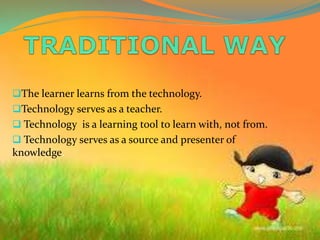
The learner learns from the technology.
Technology serves as a teacher.
 Technology is a learning tool to learn with, not from.
 Technology serves as a source and presenter of
knowledge.
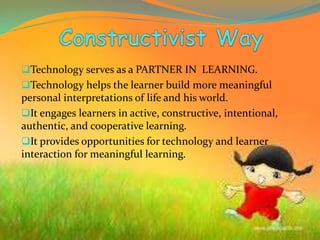
Technology serves as a PARTNER IN LEARNING.
Technology helps the learner build more meaningful
personal interpretations of life and his world.
It engages learners in active, constructive, intentional,
authentic, and cooperative learning.
It provides opportunities for technology and learner
interaction for meaningful learning.
ROLES OF
TECHNOLOGY
IN
LEARNING…
• For presenting learner’s ideas, understanding,
and beliefs
•For producing organized, multimedia, knowledge
bases by learners
For accessing needed information
For comparing perspectives, beliefs
and world views.
 For presenting and simulating meaningful
real-world problems, situations and
contexts
 For representing beliefs, perspectives,
arguments and stories of others
 For defining a safe, controllable problem
space for student thinking
For collaborating with others
For discussing, arguing and building
consensus among members of a community
For supporting discourse among knowledge-
building communities
For helping what learners to articulate and represent
what they know
For reflecting on what they have learned and how they
came to know it
For supporting learners internal negotiations and
meaning making
For constructing personal representations of meaning
For supporting mindful thinking
1. Augments motivation to learn;
2. Encourages collaborative learning;
3. Supports the development of critical thinking skills; and
4. Supports the development of problem solving skills
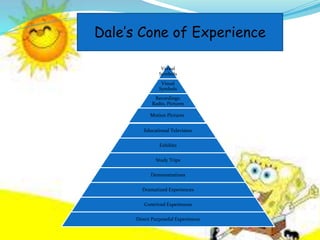
Contrived
Experiences
Verbal
Symbols
Visual
Symbols
Recordings:
Radio, Pictures
Motion Pictures
Educational Television
Exhibits
Study Trips
Demonstrations
Dramatized Experiences
Contrived Experiences
Direct Purposeful Experiences
Dale’s Cone of Experience
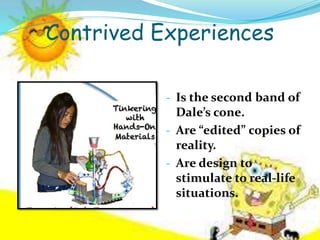
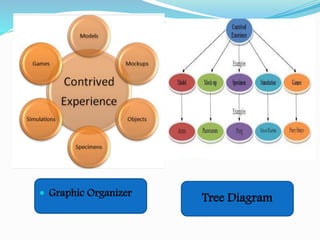
Contrived Experiences
- Is the second band of
Dale’s cone.
- Are “edited” copies of
reality.
- Are design to
stimulate to real-life
situations.
 Graphic Organizer
Tree Diagram
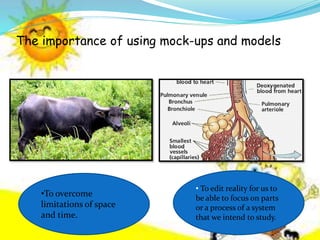
The importance of using mock-ups and models
• To edit reality for us to
be able to focus on parts
or a process of a system
that we intend to study.
•To overcome
limitations of space
and time.
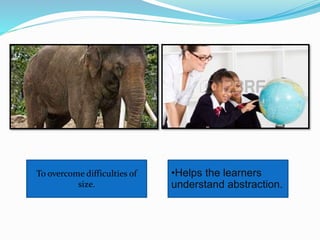
To overcome difficulties of
size.
•Helps the learners
understand abstraction.
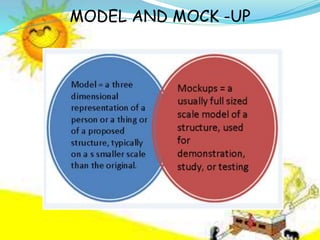
MODEL AND MOCK -UP
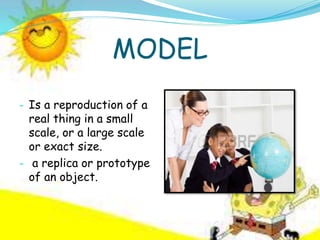
MODEL
- Is a reproduction of a
real thing in a small
scale, or a large scale
or exact size.
- a replica or prototype
of an object.
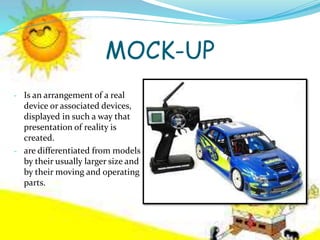
MOCK-UP
- Is an arrangement of a real
device or associated devices,
displayed in such a way that
presentation of reality is
created.
- are differentiated from models
by their usually larger size and
by their moving and operating
parts.
“Integrating Technology into Teaching and Learning.”
This course aims to infuse technology in the
student- teacher training, helping them to adapt and
meet rapid and continuing technological changes
particularly in the thriving global information and
communication technology (ICT) environment.
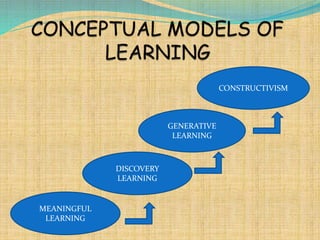
MEANINGFUL
LEARNING
DISCOVERY
LEARNING
GENERATIVE
LEARNING
CONSTRUCTIVISM
It gives focus to new experienced
departs from that is related to
what the learners already knows
 Is differentiated from reception
learning in which ideas are
presented directly to student in a
well- organized way.
 We have active learners who attend to
learning events and generate meaning
from this experience and draw inferences
thereby creating a personal model or
explanation to the new experience in the
context of existing knowledge.
 The learner builds a personal
understanding through
appropriate learning activities
and a good learning
environment.
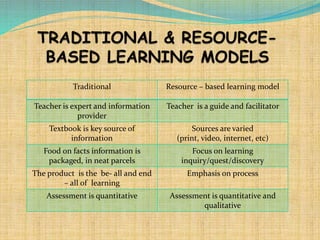
Traditional Resource – based learning model
Teacher is expert and information
provider
Teacher is a guide and facilitator
Textbook is key source of
information
Sources are varied
(print, video, internet, etc)
Food on facts information is
packaged, in neat parcels
Focus on learning
inquiry/quest/discovery
The product is the be- all and end
– all of learning
Emphasis on process
Assessment is quantitative Assessment is quantitative and
qualitative
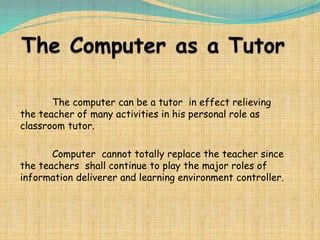
The computer can be a tutor in effect relieving
the teacher of many activities in his personal role as
classroom tutor.
Computer cannot totally replace the teacher since
the teachers shall continue to play the major roles of
information deliverer and learning environment controller.
“Technology is just a tool. In terms of
getting the kids working together and
motivating them, the teacher is the most
important.”
- Bill Gates -
` To teach better best, to improve
creativity of learners, and for them to
develop higher order thinking skills with
the help of technology. It is the best
value I learn about Educational
Technology.
As a future educator, it is very important to
make our visual aids or instructional materials
interesting and full of entertainment to catch the
attention of our students. Instructional materials
must be well designed and to get the attention of the
students and the information must be reliable enough
because we don’t want to give wrong knowledge to our
students. In designing our instructional materials we
must consider the topic that we will use. We must
relate the design to the topic that we are going to
discuss because if its not it will be just a distraction
of the learners.
In Educational Technology 2 is all about Integrating
technology. I learned that the teacher become more effective
with the use of technology in teaching. It is easy to catch the
learner’s attention using technology because in our generation
students are really into technology nowadays.
Therefore, Educational Technology is a huge help to the
teachers job because technology help the teachers to lessen
their jobs as well as giving a good quality of education.
The wide variety of technology that can
easily and effectively be incorporated into a
classroom offers every teacher a venue into the
technological world. The 21st Century Learners
learns differently from those before.
As a future educator this course helps me
to be competent enough so as to be able to meet
the changing needs and demands of my future
students.
The course has lend me to understand
that the technological advancement of the
21st century learner has a positive implication
for the teaching and learning process while
the changes in behavior has result in strict
policies being implemented to limit the
behavior of the students.
Educational Technology challenges the
students and the teacher to prepare their
selves in the new teaching- learning process in
the 21st century. The Filipinos teacher shall
be empowered to meet the technology
challenges of the 21st century digital age.
I am equipped with
knowledge and skills, when
and how to use technology.
This portfolio summarizes my work, learning and
efforts in Educational Technology. It shows that
technology is really now part of the education. As a future
educator this subject helps me on how to cope on the
changing world, how to utilize the technology
appropriately, and the most important is how to be an
affective teacher on the future.
Because of educational
technology , teaching have been
made easy and more interesting
to students.
Thank you for watching   

Educational technology

  • 1.
  • 2.
    •The Student •Educational Technology1&2 •Learning through Educational Technology 1&2 • The Student after Educational Technology
  • 3.
    I am JierlynR. Basilisco.Taking up Bachelor in Secondary Education major in Home Economics Technology, a third year student at Cebu Technological University, Moalboal Campus, Moalboal, Cebu.
  • 4.
    This portfolio serveas the Final Requirement of the student in Educational Technology. The learning of the student after the subject which can really help him/her in the future as an Educator.
  • 5.
    The word technologycomes from two Greek words, techne and logos. Techne means art, skill, craft, or the way, manner, or means by which a thing is gained. Logos means word, the utterance by which inward thought is expressed, a saying, or an expression. So, literally, technology means words or discourse about the way things are gained.
  • 6.
  • 7.
    •Is the effectiveuse of technological tools in learning. •Is a combination of the process and tools involved in addressing educational needs and problems with emphasis on applying the most current tools; computers and their related techniques.
  • 8.
    Is a professionlike teaching. It is made up of organized effort. Is a method for engaging learning such as cognitive learning strategies and critical thinking. A complex, integrated process involving people, procedures, ideas, devices and problems involved in human learning. A theory about how problems in human learning are identified and solved. Is a field study which is concerned with the practice of using educational methods and resources.
  • 9.
    •Is a practiceof educating students about different technology and engineering concept as they relate to he “ human made” world. •It is the application of technology to any of those processes involved in operating the institutions which house the educational enterprise.
  • 10.
    An educational technologywhich refers to those aspects of educational technology that are concerned with instructions as contrasted to designs and operations of educational institutions.
  • 11.
    The use oftechnology tools in general content areas in education in order to allow students to apply computer and technology skills to learning and problem- solving. Generally speaking, the curriculum drives the use of technology and not vice versa.
  • 12.
    Is any typeof media use to educate someone on a topic. It can be used at home or in the classroom to supplement lessons and formal education.
  • 13.
    When we sayBoon? It means a blessing. Example:  Students are expressing their thoughts about the impact of internet towards their studies using the BlogSpot.
  • 14.
    When we sayBane? It means a curse. Example:  The learner is made to accept as gospel truth information they get from the internet.
  • 16.
  • 17.
    Setting of aspecific goal that needs to be achieved It serves as a guide for the teacher and the learners on what to learn
  • 18.
    3 Things toconsider in making on objective R- Readiness I- Interest N- Needs
  • 19.
    5 Characteristic ofan Objective Specific Measurable Attainable Realistic/Result Oriented Time Bounded S M A R T
  • 20.
    3 Learning Domainsthat must be considered in making on Objective C- Cognitive Domain A- Affective Domain P- Psychomotor Domain
  • 21.
    Selecting the appropriatemethods of teaching invluding the strategies and technique that you will use Will you use Inductive or Deductive approach?, specific to general or general to specific?
  • 22.
    Selecting the appropriateexperience for the students. Selecting the right learning activities for the students. Ex. Reading, Writing , Playing, Baking, Dancing, Etc.
  • 23.
    Selecting the appropriatematerials, equipment and even facilities you will use in achieving your objective. Selecting the best instructional material to achieved the best learning outcome.
  • 24.
    •Assigning or delegatingtask to the person in charge to help you meet your objective.
  • 25.
    •Application of allthe things you planned and prepared in order to meet you objective •Engaging with the students •Lesson proper
  • 26.
     Evaluating theoutcome of the discussion for us to know if the objective is achieved or not.  It can be written evaluation or oral evaluation.
  • 27.
     It isa process wherein if the students passed the evaluation and you achieved your objective then you ca proceed to the new lesson and if the objective is not met or achieved then you will again go back to the process.
  • 29.
    TECHNOLOGY Traditional Way i.e. asdelivery vehicles for instructional lessons. Constructivist Way i.e. as partner in the learning process
  • 30.
    The learner learnsfrom the technology. Technology serves as a teacher.  Technology is a learning tool to learn with, not from.  Technology serves as a source and presenter of knowledge.
  • 31.
    Technology serves asa PARTNER IN LEARNING. Technology helps the learner build more meaningful personal interpretations of life and his world. It engages learners in active, constructive, intentional, authentic, and cooperative learning. It provides opportunities for technology and learner interaction for meaningful learning.
  • 32.
  • 33.
    • For presentinglearner’s ideas, understanding, and beliefs •For producing organized, multimedia, knowledge bases by learners
  • 34.
    For accessing neededinformation For comparing perspectives, beliefs and world views.
  • 35.
     For presentingand simulating meaningful real-world problems, situations and contexts  For representing beliefs, perspectives, arguments and stories of others  For defining a safe, controllable problem space for student thinking
  • 36.
    For collaborating withothers For discussing, arguing and building consensus among members of a community For supporting discourse among knowledge- building communities
  • 37.
    For helping whatlearners to articulate and represent what they know For reflecting on what they have learned and how they came to know it For supporting learners internal negotiations and meaning making For constructing personal representations of meaning For supporting mindful thinking
  • 38.
    1. Augments motivationto learn; 2. Encourages collaborative learning; 3. Supports the development of critical thinking skills; and 4. Supports the development of problem solving skills
  • 39.
  • 41.
    Verbal Symbols Visual Symbols Recordings: Radio, Pictures Motion Pictures EducationalTelevision Exhibits Study Trips Demonstrations Dramatized Experiences Contrived Experiences Direct Purposeful Experiences Dale’s Cone of Experience
  • 42.
    Contrived Experiences - Isthe second band of Dale’s cone. - Are “edited” copies of reality. - Are design to stimulate to real-life situations.
  • 43.
  • 44.
    The importance ofusing mock-ups and models • To edit reality for us to be able to focus on parts or a process of a system that we intend to study. •To overcome limitations of space and time.
  • 45.
    To overcome difficultiesof size. •Helps the learners understand abstraction.
  • 46.
  • 47.
    MODEL - Is areproduction of a real thing in a small scale, or a large scale or exact size. - a replica or prototype of an object.
  • 48.
    MOCK-UP - Is anarrangement of a real device or associated devices, displayed in such a way that presentation of reality is created. - are differentiated from models by their usually larger size and by their moving and operating parts.
  • 49.
    “Integrating Technology intoTeaching and Learning.” This course aims to infuse technology in the student- teacher training, helping them to adapt and meet rapid and continuing technological changes particularly in the thriving global information and communication technology (ICT) environment.
  • 50.
  • 51.
    It gives focusto new experienced departs from that is related to what the learners already knows
  • 52.
     Is differentiatedfrom reception learning in which ideas are presented directly to student in a well- organized way.
  • 53.
     We haveactive learners who attend to learning events and generate meaning from this experience and draw inferences thereby creating a personal model or explanation to the new experience in the context of existing knowledge.
  • 54.
     The learnerbuilds a personal understanding through appropriate learning activities and a good learning environment.
  • 55.
    Traditional Resource –based learning model Teacher is expert and information provider Teacher is a guide and facilitator Textbook is key source of information Sources are varied (print, video, internet, etc) Food on facts information is packaged, in neat parcels Focus on learning inquiry/quest/discovery The product is the be- all and end – all of learning Emphasis on process Assessment is quantitative Assessment is quantitative and qualitative
  • 56.
    The computer canbe a tutor in effect relieving the teacher of many activities in his personal role as classroom tutor. Computer cannot totally replace the teacher since the teachers shall continue to play the major roles of information deliverer and learning environment controller.
  • 57.
    “Technology is justa tool. In terms of getting the kids working together and motivating them, the teacher is the most important.” - Bill Gates -
  • 58.
    ` To teachbetter best, to improve creativity of learners, and for them to develop higher order thinking skills with the help of technology. It is the best value I learn about Educational Technology.
  • 59.
    As a futureeducator, it is very important to make our visual aids or instructional materials interesting and full of entertainment to catch the attention of our students. Instructional materials must be well designed and to get the attention of the students and the information must be reliable enough because we don’t want to give wrong knowledge to our students. In designing our instructional materials we must consider the topic that we will use. We must relate the design to the topic that we are going to discuss because if its not it will be just a distraction of the learners.
  • 60.
    In Educational Technology2 is all about Integrating technology. I learned that the teacher become more effective with the use of technology in teaching. It is easy to catch the learner’s attention using technology because in our generation students are really into technology nowadays. Therefore, Educational Technology is a huge help to the teachers job because technology help the teachers to lessen their jobs as well as giving a good quality of education.
  • 61.
    The wide varietyof technology that can easily and effectively be incorporated into a classroom offers every teacher a venue into the technological world. The 21st Century Learners learns differently from those before. As a future educator this course helps me to be competent enough so as to be able to meet the changing needs and demands of my future students.
  • 62.
    The course haslend me to understand that the technological advancement of the 21st century learner has a positive implication for the teaching and learning process while the changes in behavior has result in strict policies being implemented to limit the behavior of the students.
  • 63.
    Educational Technology challengesthe students and the teacher to prepare their selves in the new teaching- learning process in the 21st century. The Filipinos teacher shall be empowered to meet the technology challenges of the 21st century digital age.
  • 64.
    I am equippedwith knowledge and skills, when and how to use technology.
  • 65.
    This portfolio summarizesmy work, learning and efforts in Educational Technology. It shows that technology is really now part of the education. As a future educator this subject helps me on how to cope on the changing world, how to utilize the technology appropriately, and the most important is how to be an affective teacher on the future.
  • 66.
    Because of educational technology, teaching have been made easy and more interesting to students.
  • 67.
    Thank you forwatching   