Educational Technology in a
Nutshell
In this course, learners are oriented towards averting the
dangers of dehumanization which technology brings into societies.
There are areas where learners are oriented with and needs to be
aware of:
Ideological propaganda
Pornography
Financial fraud
Other exploitative used of technology
Student Profile
Name: JEWIN M. OMAR
BEED III, Block I
School: PALAWAN STATE UNIVERSITY Brookes Point Campus
Name: REY MARK E. ABIS
BEED III, Block I
School: PALAWAN STATE UNIVERSITY Brookes Point Campus
Name: RITCHAN ADLIMA
BEED III, Block I
School: PALAWAN STATE UNIVERSITY Brookes Point Campus
What is Ed. Tech?
• The study and ethical practice of facilitating learning and improving
performance by creating, using, and managing appropriate technological
processes and resources.
• Refers to the use of both physical hardware and educational theoretic’s. It
encompasses several domains, including learning theory, computer-based
training, online learning, and, where mobile technologies are used.
Technology: Boon or Bane?
I agree that technology is more of boon than a bane as it offers many different advantages
and disadvantages. It depends on how a person uses the technology that is being given to the
user and how the user puts the technology to proper use. Example of technology includes
social networking sites such as Facebook and Twitter. People can also advertise for their
business on such sites as many people uses them and it will attract attention from the users
from that sites. People can also connect with their friends locally or globally on such social
networking sites as they are easily accessible via smartphones or computers that are widely used.
By using this site users can add friends that they know and they can also share about things that
are happening or updating their statuses. Thus the friend that they add will be able to read and
get the latest information on what their friends are doing. With this, I conclude that technology
is more of a boon than a bane if it is placed on proper uses.
Systematic Approach to Teaching
• The focus of systematic instructional planning is the student. Instruction
begins with the definition of instructional objectives that consider the
students’ needs, interest, and readiness. On the basis of this objective, the
teacher selects the appropriate teaching methods to be used and, in turn,
based on the teaching method selected, the appropriate learning experiences
and appropriate materials, equipment and facilities will also be selected.
Some examples of learning resources that can
be use in Ed. Tech. are.
• Laptop/Computer
• Monitor/Lcd
• Speaker
• Cellphones
Role of Ed. Tech in Learning
• Technologies help in promoting opportunities of knowledge sharing throughout the
world. These can help the teachers and students having up-to-date information and
knowledge. Accurate and right information is necessary for effective teaching and
learning; and information technologies are “set of tools that can help provide the
right people with the right information at the right time.” Students are independent
and they can make best decisions possible about their studies, learning time, place
and resources.
• Students are able to work in collaborative and interactive learning environments
effectively communicating, sharing information and exchanging ideas and learning
experiences with all in the environment.
Roles of Technology in Education
• From the traditional point of view, technology serves as source and presenter of
knowledge. It is assumed that “knowledge is embedded in the technology (e.g. the
content presented by films and tv programs or the teaching sequence in
programmed instruction) and the technology presents that knowledge to the
student”. (David H. Jonassen, et al, 1999)
• From the constructivist point of view, educational technology serves as learning
tools that learners learn with. It engages learners in “active, constructive, intentional,
authentic, and cooperative learning. It provides opportunities for technology and
learner interaction for meaningful learning. In this case, technology will not be mere
delivery vehicle for content. Rather it is used as facilitator of thinking and
knowledge construction.
Whether used from the traditional or constructivist point of view, when
used effectively, research indicates that technology “increases students”
learning, understanding and achievement but also arguments motivation to
learn, encourages collaborative learning and supports the development of
critical thinking and problem-solving skills.” (Schater and Fagno, 1999) Russell
and Sorge (1999) also claims that the proper implementation of technology in
the classroom gives students more “control of their own learning and tends to
move classrooms from teacher-dominated environments to ones that are more
learner-centered. The use of technology in the classroom enables the teacher to
do differentiated instruction considering the divergence of student’s readiness
levels, interest, multiple intelligences and learning styles. Technology also helps
students become lifelong learners.
The Cone of Experience
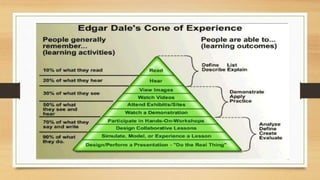
• Dale’s Cone of Experience is a visual model that is composed of eleven (11)
stages starting from concrete experiences at the bottom of the cone then it
becomes more and more abstract as it reach the peak of the cone. Also,
according to Dale, the arrangement in the cone is not based on its difficulty
but rather based on abstraction and on the number of senses involved. The
experiences in each stages can be mixed and are interrelated that fosters
more meaningful learning.
Conceptual Models of Learning
Meaningful Learning
This gives focus to new experience that is related to what the learner already knows.
A new experience departs from the learning of a sequence of words or memorization
through rote memory but gives attention to meaning. It assumes that:
- Students already have some knowledge that is relevant to new learning
- Students are willing to perform class work to find connections between what they already
know and what they can learn.
In the learning process, the learner is encouraged to recognize relevant personal
experiences. A reward structure is set so that the learner will have both interest and
confidence, and this incentive system gives positive reinforcement to learning.
Discovery Learning
This kind of learning is differentiated from reception learning in which ideas are
presented directly to students in a well-organized way, such as through a detailed set of
instructions to complete an experiment or task. To make a contrast, in discovery learning
students perform tasks to uncover what is to be learned. New ideas and new decisions are
generated in the learning process, regardless of the need to move on and depart from
organized set-off activities. In discovery learning, it is important that the student become
personally involved and not subjected by the teacher to procedures he/she is not allowed to
depart from.
In applying technology, the computer can present a tutorial process by which the learner
is given key concepts and the rules learning are directly presented for receptive type of learning.
But aside from that, the computer has other uses. In a computer simulation process, for
example, the learner himself is made to identify key concepts by interacting with a responsive
virtual environment. The learner thus discovers the concepts from the experience the virtual
environment provides.
Generative Learning
In generative learning we have active learners who attend to learning events and generate
drawing from this experience and draw inferences thereby creating a personal model or
explanation to the new experience in the context of existing knowledge. Generative learning is
viewed as different from the simple process of storing information for motivation and
responsibility is said to be crucial to this domain of learning. Examples of this in the area of
language comprehension are activities such as writing paragraph, summaries, developing
answers and questions, drawing pictures, creating paragraph titles, organizing ideas/concepts,
and others. In sum, generative learning gives emphasis to what can be done with the pieces of
information not only just an access to them.
Constructivism
In constructivism, the learner builds a personal understanding through appropriate
learning activities and a good learning environment. The two accepted principles are:
• Learning consists of what a person can actively assemble for himself and not what he can receive
passively.
•The role of learning is to help the individual live/adapt to his personal world.
With these two principles in turn lead to three practical implications: The learner is directly
responsible for learning. He creates personal understanding and transforms information into
knowledge. The teacher plays an indirect role by modeling effective learning, assisting,
facilitating, and encouraging learners.
The context of meaningful learning consists in the learner “connecting” his school activity
with real life.
The purpose of education is acquisition of practical and personal knowledge, not abstract
or universal truths.
Learning through Educational Technology II
We know that during the traditional time, teachers uses the old visual
materials like chalkboard, paper and pencil, book and others but as time goes
by instruction nowadays had become more modern we already using the power
point presentation in discussion, through it we are motivating students to listen,
to focus with the discussion. Students become computer literate that’s why
technology now a days help teacher get most of the attention of every student
which makes things easier for them to facilitate in class and with the help of
technology student do focus and participate which makes thing easier.
Reflection as a Group
We all know the saying that, ‘’too much is bad’’. Just like the technology
it is good to have and use technology, so as a future educator we must guide
our learners to use technology in proper way. The technology which I
recommend most to guide our learners are those technology which uses
internet for it is one of the most influential thing now a days. Yes technology is
good to its extent but not to the extent of every websites that might affect our
learners in negative way. At their young age we must teach them the difference
of good and bad. For we believe that planting a tree is not enough, we need to
nature for good and of course for the good of the future user of technologies.
Thank You…. =)

Education Technology in a Nutshell

  • 1.
  • 2.
    In this course,learners are oriented towards averting the dangers of dehumanization which technology brings into societies. There are areas where learners are oriented with and needs to be aware of: Ideological propaganda Pornography Financial fraud Other exploitative used of technology
  • 3.
    Student Profile Name: JEWINM. OMAR BEED III, Block I School: PALAWAN STATE UNIVERSITY Brookes Point Campus
  • 4.
    Name: REY MARKE. ABIS BEED III, Block I School: PALAWAN STATE UNIVERSITY Brookes Point Campus
  • 5.
    Name: RITCHAN ADLIMA BEEDIII, Block I School: PALAWAN STATE UNIVERSITY Brookes Point Campus
  • 6.
    What is Ed.Tech? • The study and ethical practice of facilitating learning and improving performance by creating, using, and managing appropriate technological processes and resources. • Refers to the use of both physical hardware and educational theoretic’s. It encompasses several domains, including learning theory, computer-based training, online learning, and, where mobile technologies are used.
  • 7.
    Technology: Boon orBane? I agree that technology is more of boon than a bane as it offers many different advantages and disadvantages. It depends on how a person uses the technology that is being given to the user and how the user puts the technology to proper use. Example of technology includes social networking sites such as Facebook and Twitter. People can also advertise for their business on such sites as many people uses them and it will attract attention from the users from that sites. People can also connect with their friends locally or globally on such social networking sites as they are easily accessible via smartphones or computers that are widely used. By using this site users can add friends that they know and they can also share about things that are happening or updating their statuses. Thus the friend that they add will be able to read and get the latest information on what their friends are doing. With this, I conclude that technology is more of a boon than a bane if it is placed on proper uses.
  • 8.
    Systematic Approach toTeaching • The focus of systematic instructional planning is the student. Instruction begins with the definition of instructional objectives that consider the students’ needs, interest, and readiness. On the basis of this objective, the teacher selects the appropriate teaching methods to be used and, in turn, based on the teaching method selected, the appropriate learning experiences and appropriate materials, equipment and facilities will also be selected.
  • 9.
    Some examples oflearning resources that can be use in Ed. Tech. are. • Laptop/Computer • Monitor/Lcd • Speaker • Cellphones
  • 10.
    Role of Ed.Tech in Learning • Technologies help in promoting opportunities of knowledge sharing throughout the world. These can help the teachers and students having up-to-date information and knowledge. Accurate and right information is necessary for effective teaching and learning; and information technologies are “set of tools that can help provide the right people with the right information at the right time.” Students are independent and they can make best decisions possible about their studies, learning time, place and resources. • Students are able to work in collaborative and interactive learning environments effectively communicating, sharing information and exchanging ideas and learning experiences with all in the environment.
  • 11.
    Roles of Technologyin Education • From the traditional point of view, technology serves as source and presenter of knowledge. It is assumed that “knowledge is embedded in the technology (e.g. the content presented by films and tv programs or the teaching sequence in programmed instruction) and the technology presents that knowledge to the student”. (David H. Jonassen, et al, 1999) • From the constructivist point of view, educational technology serves as learning tools that learners learn with. It engages learners in “active, constructive, intentional, authentic, and cooperative learning. It provides opportunities for technology and learner interaction for meaningful learning. In this case, technology will not be mere delivery vehicle for content. Rather it is used as facilitator of thinking and knowledge construction.
  • 12.
    Whether used fromthe traditional or constructivist point of view, when used effectively, research indicates that technology “increases students” learning, understanding and achievement but also arguments motivation to learn, encourages collaborative learning and supports the development of critical thinking and problem-solving skills.” (Schater and Fagno, 1999) Russell and Sorge (1999) also claims that the proper implementation of technology in the classroom gives students more “control of their own learning and tends to move classrooms from teacher-dominated environments to ones that are more learner-centered. The use of technology in the classroom enables the teacher to do differentiated instruction considering the divergence of student’s readiness levels, interest, multiple intelligences and learning styles. Technology also helps students become lifelong learners.
  • 13.
    The Cone ofExperience • Dale’s Cone of Experience is a visual model that is composed of eleven (11) stages starting from concrete experiences at the bottom of the cone then it becomes more and more abstract as it reach the peak of the cone. Also, according to Dale, the arrangement in the cone is not based on its difficulty but rather based on abstraction and on the number of senses involved. The experiences in each stages can be mixed and are interrelated that fosters more meaningful learning.
  • 15.
    Conceptual Models ofLearning Meaningful Learning This gives focus to new experience that is related to what the learner already knows. A new experience departs from the learning of a sequence of words or memorization through rote memory but gives attention to meaning. It assumes that: - Students already have some knowledge that is relevant to new learning - Students are willing to perform class work to find connections between what they already know and what they can learn. In the learning process, the learner is encouraged to recognize relevant personal experiences. A reward structure is set so that the learner will have both interest and confidence, and this incentive system gives positive reinforcement to learning.
  • 16.
    Discovery Learning This kindof learning is differentiated from reception learning in which ideas are presented directly to students in a well-organized way, such as through a detailed set of instructions to complete an experiment or task. To make a contrast, in discovery learning students perform tasks to uncover what is to be learned. New ideas and new decisions are generated in the learning process, regardless of the need to move on and depart from organized set-off activities. In discovery learning, it is important that the student become personally involved and not subjected by the teacher to procedures he/she is not allowed to depart from. In applying technology, the computer can present a tutorial process by which the learner is given key concepts and the rules learning are directly presented for receptive type of learning. But aside from that, the computer has other uses. In a computer simulation process, for example, the learner himself is made to identify key concepts by interacting with a responsive virtual environment. The learner thus discovers the concepts from the experience the virtual environment provides.
  • 17.
    Generative Learning In generativelearning we have active learners who attend to learning events and generate drawing from this experience and draw inferences thereby creating a personal model or explanation to the new experience in the context of existing knowledge. Generative learning is viewed as different from the simple process of storing information for motivation and responsibility is said to be crucial to this domain of learning. Examples of this in the area of language comprehension are activities such as writing paragraph, summaries, developing answers and questions, drawing pictures, creating paragraph titles, organizing ideas/concepts, and others. In sum, generative learning gives emphasis to what can be done with the pieces of information not only just an access to them.
  • 18.
    Constructivism In constructivism, thelearner builds a personal understanding through appropriate learning activities and a good learning environment. The two accepted principles are: • Learning consists of what a person can actively assemble for himself and not what he can receive passively. •The role of learning is to help the individual live/adapt to his personal world. With these two principles in turn lead to three practical implications: The learner is directly responsible for learning. He creates personal understanding and transforms information into knowledge. The teacher plays an indirect role by modeling effective learning, assisting, facilitating, and encouraging learners. The context of meaningful learning consists in the learner “connecting” his school activity with real life. The purpose of education is acquisition of practical and personal knowledge, not abstract or universal truths.
  • 19.
    Learning through EducationalTechnology II We know that during the traditional time, teachers uses the old visual materials like chalkboard, paper and pencil, book and others but as time goes by instruction nowadays had become more modern we already using the power point presentation in discussion, through it we are motivating students to listen, to focus with the discussion. Students become computer literate that’s why technology now a days help teacher get most of the attention of every student which makes things easier for them to facilitate in class and with the help of technology student do focus and participate which makes thing easier.
  • 20.
    Reflection as aGroup We all know the saying that, ‘’too much is bad’’. Just like the technology it is good to have and use technology, so as a future educator we must guide our learners to use technology in proper way. The technology which I recommend most to guide our learners are those technology which uses internet for it is one of the most influential thing now a days. Yes technology is good to its extent but not to the extent of every websites that might affect our learners in negative way. At their young age we must teach them the difference of good and bad. For we believe that planting a tree is not enough, we need to nature for good and of course for the good of the future user of technologies.
  • 21.