Educational Technology
in a nutshell
The student
My name is Jessa mae Conales. I’m
19 years old. I’m taking up Bachelor of
Elementary Education, major in General
Education in Palawan State University.
What is educational Technology?
 The word “technology” comes
from 17th century. < Greek
tekhnologia "systematic
treatment" < tekhnē "art, skill"]
 Educational Technology refers to
the art or craft of responding to
our educational needs.
Base from the definition of ed. tech
Educational technology is a
“complex”. integrated process
involving people, procedures, ideas,
devices and organization for analyzing
problems and devising. Implementing,
evaluating and managing solution to
those problems, involved in all aspects
of human learning.
Based from David H. Jonassen
Educational Technology “consists
of designs and environments that
engage learners … and reliable
technique and method for engaging
learning such as cognitive learning
strategies and critical thinking skills.”
• It is a theory about how problems
in human learning are identified and
solved. Is a field involved in applying
a complex, integrated process to
analyze and solve problems in human
learning.
Based from Lucido and Borabo
Educational Technology is a field
study which is concerned with the
practice of using educational
methods and resources for the
ultimate goal of facilitating the
learning process.
Technology: Boon or Bane?
It is a Boon when the technology is :
use for researching in important info.
Use for sending purposive emails
Use to motivate the learnres
Use to give information
Use to integrate the learning of students
Use to communicate people
Send (upload) or receive (down load)
files between computers.
Participate in discussion groups, such
as mailing lists and newsgroups.
It is a bane when technology is use for:
 Playing games(non sense games)
 Watching porn videos
 We become more dependent on
technologies
 The people become self – reliant
 People become lazy
 Gives more important in technologies
than or families.
Systematic Approach To Teaching.
“A plan that emphasizes the parts may
pay the cost of failing to consider the
whole, and a plan that emphasizes the
whole must pay the cost of failing to
get down to the real depth with respect
to the parts.
The role of ed. Tech in learning
 tools knowledge construction: for
representing learners’ ideas,
understandings and beliefs for
producing organized, multimedia
knowledge bases by learners
learning.
 As information vehicles for
exploring knowledge to support
learning-by-constructing: for
accessing needed information for
comparing perspectives, beliefs
and world views.
As context to support learning-by-
doing: for representing and
simulating meaningful real-world
problems, situations and context, for
representing beliefs, perspectives,
arguments and stories of others, for
defining a safe, controllable problem
space for student thinking.
 As a social medium to support
learning by conversing: for
collaboration with others, for
discussing, arguing and building
consensus among members of a
community, for supporting
discourse among knowledge-
building communities Learning.
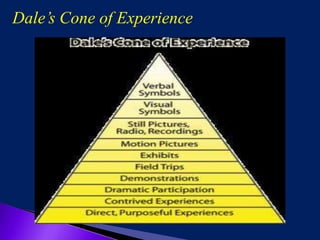
Cone of experience
 The cone is a visual analogy and like all
analogies, it does not bear an exact and detailed
relationship to the complex elements it present.”
- Edgar Dale
 The Cone of Experience is a visual model, a
pictorial device that presents bans of experience
arranged according to degree of abstraction and
not degree of difficulty. The farther you go from
the bottom of the cone, the more abstract the
experience becomes.
 Roles of technology in Education
Senthil Kumar
 Educational Technology is bound to
improve the teachers considerably. In
the absence of working knowledge of
this growing discipline, the teacher
will find himself lagging far behind in
the modern system of teaching-
learning.
Dale’s Cone of Experience
Conceptual model of learning
There exists a number of models
and theories about learning that is
ideal in achieving instructional goals
through preferred application of Ed.
Tech. These are :
 Meaningful Learning
 Discovery Learning
 Generative Learning
 Constructivism
Meaningful Learning
If the traditional learning
environment gives stress to rote
learning and simple memorization,
meaningful learning gives focus to
new experience that departs from
the learning of a sequence of words
but gives attention to meaning.
. Meaningful Learning, it assumes
that:
Students already have prior
knowledge that is relevant to new
learning.
Students are willing to perform
class work to find connection
between what they already know and
what they can learn
Meaningful Learning In the learning
process, the learner is encouraged
to recognize relevant experiences. A
reward structure is set so that the
learner will have both interest and
confidence. In the classroom,
hands-on activities are introduced
so as to simulate learning in
everyday living.
Discovery Learning
This is differentiated from
reception (meeting point of
meaningful and discovery learning) in
which ideas are presented to students
in a well-organized way, such as
through detailed set of instructions to
complete an experiment. Ever recalled
why you are so nervous, yet very
excited in doing experiments? It is
because of the idea that you are about
to discover something first hand.
Discovery Learning
In discovery learning, students
perform tasks to uncover what is to
be learned. New ideas and new
decisions are generated in the
learning process, regardless of the
need to move on and depart from the
structured lesson previously set. In
here, it is important that the students
become personally engaged and NOT
subjected by the teacher.
Dimensions of Meaningful &Discovery
Learning Notice the increase in
Discovery from rote learning
Math Drills
Trial & Error puzzles
Applying science lab formulas
Lecture/textbook reading
Simulations
Adventure activities
Data probing / research
Art / music creation
Meaningful Learning Art / music
Creation Scientific Research Data
probing Adventure activities
Simulation Lectures/textbook
Reading Apply science lab formulas
Math drills/practices Trial and Error
puzzles Rote Learning RECEPTION
Discovery Learning.
Generative Learning
Here, we have active listeners who
attend to learning events and generate
meaning from this experience and
draw inferences thereby creating a
personal model of explanation to the
new experience in the context of
existing knowledge. This is viewed as
different from the simple process of
storing information. Motivation and
responsibility are crucial to this
domain of learning.
Generative Learning
Examples are result driven;
creativity and resiliency. This gives
emphasis to what can be done with
the pieces of information not only on
access to them.
Constructivism
Here, the learner builds a personal
understanding through appropriate
learning activities and a good learning
environment. The most accepted
constructivism principles are:
Learning consists in what a person
can actively assemble for himself and
not what he can just ask from
someone else. Role of learning is to
help the individual live to his personal
world
Implications of Constructivism
The learner is directly responsible
for learning. He creates personal
understanding and transforms it into
knowledge.
The context of meaningful learning
consists in the learner “connecting”
his school activity with real life.
The purpose of education is the
acquiring of practical and personal
knowledge and not the abstract or
trivial truths.
Through this new conceptual models
of learning, we now know that :
There are better ways to learn other
than rote learning or memorization
Learning is for use not only in school
but in real life. Now we are prepared
to see how these theories of learning
can be more specifically applied
through the integration of
Educational Technology.
Learning through ed. tech 2
The things that I’ve learned in
Educational Technology 2 are making
different accounts in social media.
I learned to used it in educational
purposes, such as sending emails,
posting my opinion about extra judicial
killings, and using of technology
integrated to learning.
The student after educational Technology
2
After this Ed. Tech, I Improved my
skills in using social medias, handling
computers, and on how to manage my
time while using technology.
Thank you
Prepared by
Jessa mae Conales

My portfolio in educational 2

  • 1.
  • 2.
    The student My nameis Jessa mae Conales. I’m 19 years old. I’m taking up Bachelor of Elementary Education, major in General Education in Palawan State University.
  • 3.
    What is educationalTechnology?  The word “technology” comes from 17th century. < Greek tekhnologia "systematic treatment" < tekhnē "art, skill"]  Educational Technology refers to the art or craft of responding to our educational needs.
  • 4.
    Base from thedefinition of ed. tech Educational technology is a “complex”. integrated process involving people, procedures, ideas, devices and organization for analyzing problems and devising. Implementing, evaluating and managing solution to those problems, involved in all aspects of human learning.
  • 5.
    Based from DavidH. Jonassen Educational Technology “consists of designs and environments that engage learners … and reliable technique and method for engaging learning such as cognitive learning strategies and critical thinking skills.” • It is a theory about how problems in human learning are identified and solved. Is a field involved in applying a complex, integrated process to analyze and solve problems in human learning.
  • 6.
    Based from Lucidoand Borabo Educational Technology is a field study which is concerned with the practice of using educational methods and resources for the ultimate goal of facilitating the learning process.
  • 7.
  • 8.
    It is aBoon when the technology is : use for researching in important info. Use for sending purposive emails Use to motivate the learnres Use to give information Use to integrate the learning of students Use to communicate people Send (upload) or receive (down load) files between computers. Participate in discussion groups, such as mailing lists and newsgroups.
  • 9.
    It is abane when technology is use for:  Playing games(non sense games)  Watching porn videos  We become more dependent on technologies  The people become self – reliant  People become lazy  Gives more important in technologies than or families.
  • 10.
    Systematic Approach ToTeaching. “A plan that emphasizes the parts may pay the cost of failing to consider the whole, and a plan that emphasizes the whole must pay the cost of failing to get down to the real depth with respect to the parts.
  • 11.
    The role ofed. Tech in learning  tools knowledge construction: for representing learners’ ideas, understandings and beliefs for producing organized, multimedia knowledge bases by learners learning.  As information vehicles for exploring knowledge to support learning-by-constructing: for accessing needed information for comparing perspectives, beliefs and world views.
  • 12.
    As context tosupport learning-by- doing: for representing and simulating meaningful real-world problems, situations and context, for representing beliefs, perspectives, arguments and stories of others, for defining a safe, controllable problem space for student thinking.
  • 13.
     As asocial medium to support learning by conversing: for collaboration with others, for discussing, arguing and building consensus among members of a community, for supporting discourse among knowledge- building communities Learning.
  • 14.
    Cone of experience The cone is a visual analogy and like all analogies, it does not bear an exact and detailed relationship to the complex elements it present.” - Edgar Dale  The Cone of Experience is a visual model, a pictorial device that presents bans of experience arranged according to degree of abstraction and not degree of difficulty. The farther you go from the bottom of the cone, the more abstract the experience becomes.
  • 15.
     Roles oftechnology in Education Senthil Kumar  Educational Technology is bound to improve the teachers considerably. In the absence of working knowledge of this growing discipline, the teacher will find himself lagging far behind in the modern system of teaching- learning.
  • 16.
    Dale’s Cone ofExperience
  • 17.
    Conceptual model oflearning There exists a number of models and theories about learning that is ideal in achieving instructional goals through preferred application of Ed. Tech. These are :  Meaningful Learning  Discovery Learning  Generative Learning  Constructivism
  • 18.
    Meaningful Learning If thetraditional learning environment gives stress to rote learning and simple memorization, meaningful learning gives focus to new experience that departs from the learning of a sequence of words but gives attention to meaning.
  • 19.
    . Meaningful Learning,it assumes that: Students already have prior knowledge that is relevant to new learning. Students are willing to perform class work to find connection between what they already know and what they can learn
  • 20.
    Meaningful Learning Inthe learning process, the learner is encouraged to recognize relevant experiences. A reward structure is set so that the learner will have both interest and confidence. In the classroom, hands-on activities are introduced so as to simulate learning in everyday living.
  • 21.
    Discovery Learning This isdifferentiated from reception (meeting point of meaningful and discovery learning) in which ideas are presented to students in a well-organized way, such as through detailed set of instructions to complete an experiment. Ever recalled why you are so nervous, yet very excited in doing experiments? It is because of the idea that you are about to discover something first hand.
  • 22.
    Discovery Learning In discoverylearning, students perform tasks to uncover what is to be learned. New ideas and new decisions are generated in the learning process, regardless of the need to move on and depart from the structured lesson previously set. In here, it is important that the students become personally engaged and NOT subjected by the teacher.
  • 23.
    Dimensions of Meaningful&Discovery Learning Notice the increase in Discovery from rote learning Math Drills Trial & Error puzzles Applying science lab formulas Lecture/textbook reading Simulations Adventure activities Data probing / research Art / music creation
  • 24.
    Meaningful Learning Art/ music Creation Scientific Research Data probing Adventure activities Simulation Lectures/textbook Reading Apply science lab formulas Math drills/practices Trial and Error puzzles Rote Learning RECEPTION Discovery Learning.
  • 25.
    Generative Learning Here, wehave active listeners who attend to learning events and generate meaning from this experience and draw inferences thereby creating a personal model of explanation to the new experience in the context of existing knowledge. This is viewed as different from the simple process of storing information. Motivation and responsibility are crucial to this domain of learning.
  • 26.
    Generative Learning Examples areresult driven; creativity and resiliency. This gives emphasis to what can be done with the pieces of information not only on access to them.
  • 27.
    Constructivism Here, the learnerbuilds a personal understanding through appropriate learning activities and a good learning environment. The most accepted constructivism principles are: Learning consists in what a person can actively assemble for himself and not what he can just ask from someone else. Role of learning is to help the individual live to his personal world
  • 28.
    Implications of Constructivism Thelearner is directly responsible for learning. He creates personal understanding and transforms it into knowledge. The context of meaningful learning consists in the learner “connecting” his school activity with real life.
  • 29.
    The purpose ofeducation is the acquiring of practical and personal knowledge and not the abstract or trivial truths.
  • 30.
    Through this newconceptual models of learning, we now know that : There are better ways to learn other than rote learning or memorization Learning is for use not only in school but in real life. Now we are prepared to see how these theories of learning can be more specifically applied through the integration of Educational Technology.
  • 31.
    Learning through ed.tech 2 The things that I’ve learned in Educational Technology 2 are making different accounts in social media. I learned to used it in educational purposes, such as sending emails, posting my opinion about extra judicial killings, and using of technology integrated to learning.
  • 32.
    The student aftereducational Technology 2 After this Ed. Tech, I Improved my skills in using social medias, handling computers, and on how to manage my time while using technology.
  • 33.
  • 34.