GHANA TECHNOLOGY UNIVERSITY COLLEGE (GTUC)
PROGRAMME: MASTERS IN TELECOMs ENGINEERING - MTE
TITLE COURSE: RF & MICROWAVE COMMUNICATION
(COMPONENTS & DEVICES)
COURSE CODE: MTE 508
LECTURER: DR. D.M.O. ADJIN
HEAD/FACULTY OF ENGINEERING
E-MAIL: dadjin@gtuc.edu.gh
MOBILE: ++233 20 2698 175
© JANUARY 2016
 COURSE OBJECTIVES
• This Course Presents The Fundamental Knowledge & Skills In The
Theory, Design & Implementation Of RF & Microwave Systems.
• Upon completion of this course, Students Will Be Able To
Understand:
• The Basics Of Microwave Engineering;
• Key Aspects Of Microwave Circuits, TX’ssion Lines, Antennas &
Propagation Of Radio Waves;
• The Techniques To Solve Real Problems In Microwave System
Design & Implementation.
TABLE OF CONTENTS
 CHAPTER ONE: OVERVIEW OF RF AND MICROWAVE TECHNOLOGY
• Development history of RF & microwave Technology,
• Microwave components & devices: active & passive devices.
CHAPTER TWO: MICROWAVE DIODES AND MICROWAVE BIPOLAR
TRANSISTOR
• 2.1 p-i-n Diodes, Schottky Diodes, Varactor Diodes & Tunnel Diodes
Components & Their Applications in microwave circuits.
• Bipolar Transistors & Heterojunction Bipolar Transistors Components &
• Their Applications in microwave circuits
CHAPTER TWO:
MICROWAVE SYSTEM COMPONENTS & DEVICES
2.1 Overview
2.2 Passive Microwave Circuits & Devices
2.3 Active Microwave Circuits & Devices
2.4 Microwave Transmission Lines
2.5 Waveguides
 CHAPTER THREE: MICROWAVE FIELD EFFECT TRANSISTORS
Background Knowledge In:
•FETs-JFET,
•MESFET,
•MOSFET,
•HEMT of JFET,
•MOSFET Devices & Their Applications In MW Circuits.
•CHAPTER FOUR: TRANSFERRED ELECTRON DEVICES AVALANCHE
TRANSIT-TIME DEVICES
•
•4.1 Gunn effect. Differential Negative Resistance,
•4.2 Two-Valley Model Theory, Microwave generation,
amplification and applications.
•
4.3 IMPATT Diodes, TRAPATT Diodes and BARITT Diodes
Components,
• Their Principles of operation, characteristics & Applications in
microwave circuits.
 CHAPTER FIVE: MICROWAVE TUBES
Klystrons
Travelling-Wave Tubes
Magnetrons Devices
Principles of operation and characteristics.
CHAPTER SIX: MICROWAVE NETWORK ANALYSIS
6.1 Transmission Line Equations & Solutions
6.2 Smith Chart
6.3 ABCD Matrix
6.4 S-Parameter Matrix
6.5 Signal Flow Graphs
CHAPTER SEVEN: IMPEDANCE
TRANSFORMATION AND MATCHING
7.1 Impedance Measurements
7.2
Single-stub Matching,
7.3
Double-stub Matching
7.4
Matching with Lumped Elements
CHAPTER EIGHT: WAVEGUIDE COMPONENTS
8.1 Rectangular Waveguide, Bends and Twists
8.2 Microwave Attenuators & Phase Shifters
8.3 Circular Polarizers
8.4 Directional Couplers
8.5 Hybrid Junctions
8.6 Ferrites
8.7 Faraday Rotation
8.8 Isolators
8.9 Circulators
8.10 Cavity Resonators
8.11 Coaxial-to-Waveguide Transitions
8.12 Microwave Switches.
CHAPTER NINE: COAXIAL COMPONENTS
9.1 Two-wire line
9.2 Coaxial Cables, Terminations, Connectors and
Transitions
9.3 Coaxial Attenuators:
•Phase Shifters
•Baluns.
CHAPTER 10: STRIPLINE CIRCUITS
10.1 Substrate Materials
10.2 Stripline, Coupled Stripline, Microstrip, Coupled Microstrip,
Coplanar Stripline
10.3 Stripline Terminations, Attenuators, Couplers, Power Dividers,
Circulators, Isolators & Resonators
• 10.4 Lowpass Filters, Bandstop Filters, Bandpass Filters, Wideband
Filters.
•CHAPTER ELEVEN: SOME MICROWAVE
MEASUREMENTS
•11.1 Microwave Power,
•11.2 Network: Scalar Network Analyzer, Vector
Network Analyzer, VSWR Bridge,
•11.3 Calibration Techniques,
•11.4 Time-Domain Analysis,
•11.5 IP3, Noise Measurements & Phase Noise
CHAPTER ONE: OVERVIEW OF RF & MICROWAVE TECHNOLOGY
 Development History of RF & Microwave Technology
Synopsis
• The Course Is Focused On The Basic Principles & Apps Of Mw Devices & Circuits
• Mw Techniques Have Been Increasingly Adopted In Such Diverse Appns As:
• Radio Astronomy,
• Long-distance Communications,
• Space Navigation,
• Radar Systems,
• Medical Equipment, &
• Missile Electronic Systems.
Synopsis Cont’d
•As A Result Of The Accelerating Rate Of Growth Of Mw
Technology In Research & Industry:
•Students Who Are Preparing Themselves For, &
Electronics Engineers Who Are Working In, The Mw
Area,
•Are Faced With The Need To Understand The
Theoretical, Experimental Design & Analysis Of
Microwave Devices & Circuits.
MICROWAVE FREQUENCIES
• The Term Mw Freqs Is Generally Used For Those Wavelengths Measured In
Centimeters, Roughly From 30 cm To 1 mm (1 To 300 Ghz).
• However, Microwave Really Indicates The Wavelengths In The Micron Ranges.
• This Means Mw Freqs Are Up To Infrared & Visible-light Regions.
• Mw Freqs Refer To Those From 1 Ghz Up To 106 Ghz.
• The Microwave Band Designation Was Derived From World War II Radar
Security Considerations.
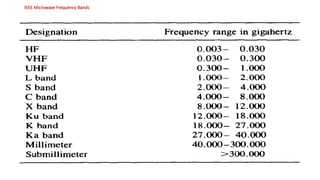
• The IEEE recommended new microwave band designations shown Below
IEEE Microwave Frequency Bands
MICROWAVE DEVICES
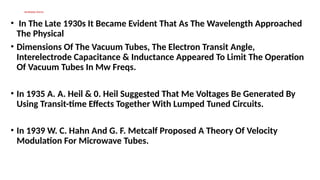
• In The Late 1930s It Became Evident That As The Wavelength Approached
The Physical
• Dimensions Of The Vacuum Tubes, The Electron Transit Angle,
Interelectrode Capacitance & Inductance Appeared To Limit The Operation
Of Vacuum Tubes In Mw Freqs.
• In 1935 A. A. Heil & 0. Heil Suggested That Me Voltages Be Generated By
Using Transit-time Effects Together With Lumped Tuned Circuits.
• In 1939 W. C. Hahn And G. F. Metcalf Proposed A Theory Of Velocity
Modulation For Microwave Tubes.
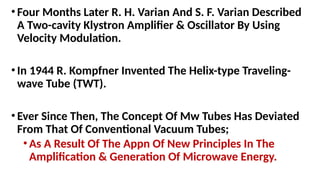
•Four Months Later R. H. Varian And S. F. Varian Described
A Two-cavity Klystron Amplifier & Oscillator By Using
Velocity Modulation.
•In 1944 R. Kompfner Invented The Helix-type Traveling-
wave Tube (TWT).
•Ever Since Then, The Concept Of Mw Tubes Has Deviated
From That Of Conventional Vacuum Tubes;
•As A Result Of The Appn Of New Principles In The
Amplification & Generation Of Microwave Energy.
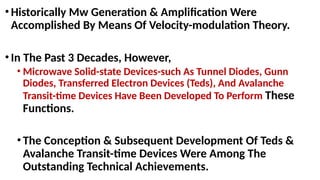
•Historically Mw Generation & Amplification Were
Accomplished By Means Of Velocity-modulation Theory.
•In The Past 3 Decades, However,
• Microwave Solid-state Devices-such As Tunnel Diodes, Gunn
Diodes, Transferred Electron Devices (Teds), And Avalanche
Transit-time Devices Have Been Developed To Perform These
Functions.
•The Conception & Subsequent Development Of Teds &
Avalanche Transit-time Devices Were Among The
Outstanding Technical Achievements.
• B. K. Ridley And T. B. Watkins In 1961 And C. Hilsum In 1962
Independently Predicted That;
• “The Transferred Electron Effect Would Occur In GaAs” (Gallium
Arsenide).
• In 1963 J. B. Gunn Reported His "Gunn Effect."
• The Common Characteristic Of All Mw Solid State Devices Is The Negative
Resistance That Can Be Used For Mw Oscillation & Amplification.
• The Progress Of Avalanche Transit-time Devices Has Been So Swift
That:
• Today, They Are Firmly Established As One Of The Most Important Classes
Of Mw Solid-state Devices.
• A Mw System Normally Consists Of A Transmitter Subsystem,
Including:
• A Microwave Oscillator,
• Waveguides, A Transmitting Antenna,
• And A Receiver Subsystem
• The Rx’er Subsystem Includes:
• A Receiving Antenna,
• Transmission Line Or Waveguide,
• A Microwave Amplifier, &
• A Receiver.
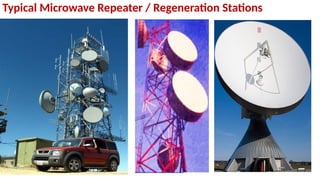
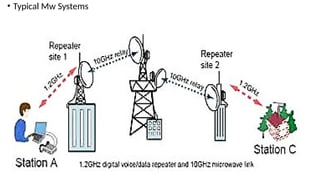
Typical Microwave Repeater / Regeneration Stations
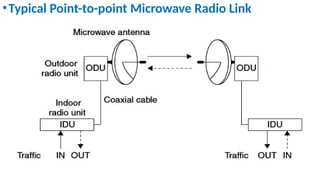
•Typical Point-to-point Microwave Radio Link
• Typical Mw Systems
•In Order To Design A Mw System & Conduct A Proper Test
Of It, An Adequate Knowledge Of The Components Involved
Is Essential.
•Besides Mw Devices, This Course Thus Describes Mw
Components, Such As:
• Resonators,
• Cavities,
• Microstrip Lines, Hybrids, And
• Microwave Integrated Circuits.
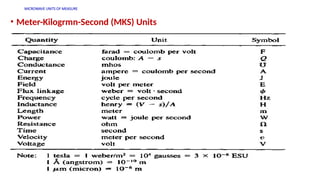
MICROWAVE UNITS OF MEASURE
• Meter-Kilogrmn-Second (MKS) Units
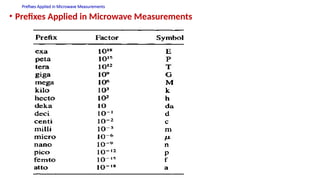
Prefixes Applied in Microwave Measurements
• Prefixes Applied in Microwave Measurements
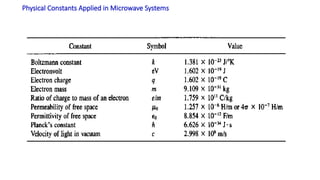
Physical Constants Applied in Microwave Systems
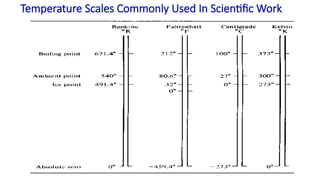
Temperature Scales Commonly Used In Scientific Work
MICROWAVE COMPONENTS & DEVICES: ACTIVE & PASSIVE DEVICES
•Microwave Waveguides
•
•Microwave Cavities
•Microwave Hybrid Circuits
•Directional Couplers
•Circulators & Isolators,
• Microwave Linear-Beam Tubes (Klystrons, Helix Traveling-
Wave Tubes (TWTs)),
• STRIP LINES: Microstrip Lines, Parallel Strip Lines,
Coplanar Strip Lines,
• Monolithic Microwave Integrated Circuits (MOSFET,
NMOS, CMOS, Hybrid Integrated-Circuit), Etc.
• Microwave Bipolar Transistors:
• Heterojunction Bipolar Transistors (Hbts),
• Microwave Tunnel Diodes,
• Junction Field-Effect Transistors (Jfets),
• Metal-Semiconductor Field-Effect Transistors (Mesfets),
• High Electron Mobility Transistors (Hemts),
• Metal-Oxide-Semiconductor Field-Effect Transistors (Mosfets),
• MOS Transistors & Memory Devices,
• Charge-Coupled Devices (CCDs),
• Transferred Electron Devices (Teds),
• LSA Diodes,
• Inp Diodes, CDTE Diodes,
• Avalanche Transit-Time Devices,
• IMPATI Diodes,
• TRAPATT Diodes,
• BARITT Diodes,
• Parametric Devices,
THE END OF CHAPTER ONE

LECTURE 1.pptxEngineeringEngineeringEngineering

  • 2.
    GHANA TECHNOLOGY UNIVERSITYCOLLEGE (GTUC) PROGRAMME: MASTERS IN TELECOMs ENGINEERING - MTE TITLE COURSE: RF & MICROWAVE COMMUNICATION (COMPONENTS & DEVICES) COURSE CODE: MTE 508 LECTURER: DR. D.M.O. ADJIN HEAD/FACULTY OF ENGINEERING E-MAIL: dadjin@gtuc.edu.gh MOBILE: ++233 20 2698 175 © JANUARY 2016
  • 3.
     COURSE OBJECTIVES •This Course Presents The Fundamental Knowledge & Skills In The Theory, Design & Implementation Of RF & Microwave Systems. • Upon completion of this course, Students Will Be Able To Understand: • The Basics Of Microwave Engineering; • Key Aspects Of Microwave Circuits, TX’ssion Lines, Antennas & Propagation Of Radio Waves; • The Techniques To Solve Real Problems In Microwave System Design & Implementation.
  • 4.
    TABLE OF CONTENTS CHAPTER ONE: OVERVIEW OF RF AND MICROWAVE TECHNOLOGY • Development history of RF & microwave Technology, • Microwave components & devices: active & passive devices. CHAPTER TWO: MICROWAVE DIODES AND MICROWAVE BIPOLAR TRANSISTOR • 2.1 p-i-n Diodes, Schottky Diodes, Varactor Diodes & Tunnel Diodes Components & Their Applications in microwave circuits. • Bipolar Transistors & Heterojunction Bipolar Transistors Components & • Their Applications in microwave circuits
  • 5.
    CHAPTER TWO: MICROWAVE SYSTEMCOMPONENTS & DEVICES 2.1 Overview 2.2 Passive Microwave Circuits & Devices 2.3 Active Microwave Circuits & Devices 2.4 Microwave Transmission Lines 2.5 Waveguides
  • 6.
     CHAPTER THREE:MICROWAVE FIELD EFFECT TRANSISTORS Background Knowledge In: •FETs-JFET, •MESFET, •MOSFET, •HEMT of JFET, •MOSFET Devices & Their Applications In MW Circuits.
  • 7.
    •CHAPTER FOUR: TRANSFERREDELECTRON DEVICES AVALANCHE TRANSIT-TIME DEVICES • •4.1 Gunn effect. Differential Negative Resistance, •4.2 Two-Valley Model Theory, Microwave generation, amplification and applications. • 4.3 IMPATT Diodes, TRAPATT Diodes and BARITT Diodes Components, • Their Principles of operation, characteristics & Applications in microwave circuits.
  • 8.
     CHAPTER FIVE:MICROWAVE TUBES Klystrons Travelling-Wave Tubes Magnetrons Devices Principles of operation and characteristics.
  • 9.
    CHAPTER SIX: MICROWAVENETWORK ANALYSIS 6.1 Transmission Line Equations & Solutions 6.2 Smith Chart 6.3 ABCD Matrix 6.4 S-Parameter Matrix 6.5 Signal Flow Graphs
  • 10.
    CHAPTER SEVEN: IMPEDANCE TRANSFORMATIONAND MATCHING 7.1 Impedance Measurements 7.2 Single-stub Matching, 7.3 Double-stub Matching 7.4 Matching with Lumped Elements
  • 11.
    CHAPTER EIGHT: WAVEGUIDECOMPONENTS 8.1 Rectangular Waveguide, Bends and Twists 8.2 Microwave Attenuators & Phase Shifters 8.3 Circular Polarizers 8.4 Directional Couplers 8.5 Hybrid Junctions 8.6 Ferrites 8.7 Faraday Rotation 8.8 Isolators 8.9 Circulators 8.10 Cavity Resonators 8.11 Coaxial-to-Waveguide Transitions 8.12 Microwave Switches.
  • 12.
    CHAPTER NINE: COAXIALCOMPONENTS 9.1 Two-wire line 9.2 Coaxial Cables, Terminations, Connectors and Transitions 9.3 Coaxial Attenuators: •Phase Shifters •Baluns.
  • 13.
    CHAPTER 10: STRIPLINECIRCUITS 10.1 Substrate Materials 10.2 Stripline, Coupled Stripline, Microstrip, Coupled Microstrip, Coplanar Stripline 10.3 Stripline Terminations, Attenuators, Couplers, Power Dividers, Circulators, Isolators & Resonators • 10.4 Lowpass Filters, Bandstop Filters, Bandpass Filters, Wideband Filters.
  • 14.
    •CHAPTER ELEVEN: SOMEMICROWAVE MEASUREMENTS •11.1 Microwave Power, •11.2 Network: Scalar Network Analyzer, Vector Network Analyzer, VSWR Bridge, •11.3 Calibration Techniques, •11.4 Time-Domain Analysis, •11.5 IP3, Noise Measurements & Phase Noise
  • 16.
    CHAPTER ONE: OVERVIEWOF RF & MICROWAVE TECHNOLOGY  Development History of RF & Microwave Technology Synopsis • The Course Is Focused On The Basic Principles & Apps Of Mw Devices & Circuits • Mw Techniques Have Been Increasingly Adopted In Such Diverse Appns As: • Radio Astronomy, • Long-distance Communications, • Space Navigation, • Radar Systems, • Medical Equipment, & • Missile Electronic Systems.
  • 17.
    Synopsis Cont’d •As AResult Of The Accelerating Rate Of Growth Of Mw Technology In Research & Industry: •Students Who Are Preparing Themselves For, & Electronics Engineers Who Are Working In, The Mw Area, •Are Faced With The Need To Understand The Theoretical, Experimental Design & Analysis Of Microwave Devices & Circuits.
  • 18.
    MICROWAVE FREQUENCIES • TheTerm Mw Freqs Is Generally Used For Those Wavelengths Measured In Centimeters, Roughly From 30 cm To 1 mm (1 To 300 Ghz). • However, Microwave Really Indicates The Wavelengths In The Micron Ranges. • This Means Mw Freqs Are Up To Infrared & Visible-light Regions. • Mw Freqs Refer To Those From 1 Ghz Up To 106 Ghz. • The Microwave Band Designation Was Derived From World War II Radar Security Considerations. • The IEEE recommended new microwave band designations shown Below
  • 19.
  • 20.
    MICROWAVE DEVICES • InThe Late 1930s It Became Evident That As The Wavelength Approached The Physical • Dimensions Of The Vacuum Tubes, The Electron Transit Angle, Interelectrode Capacitance & Inductance Appeared To Limit The Operation Of Vacuum Tubes In Mw Freqs. • In 1935 A. A. Heil & 0. Heil Suggested That Me Voltages Be Generated By Using Transit-time Effects Together With Lumped Tuned Circuits. • In 1939 W. C. Hahn And G. F. Metcalf Proposed A Theory Of Velocity Modulation For Microwave Tubes.
  • 21.
    •Four Months LaterR. H. Varian And S. F. Varian Described A Two-cavity Klystron Amplifier & Oscillator By Using Velocity Modulation. •In 1944 R. Kompfner Invented The Helix-type Traveling- wave Tube (TWT). •Ever Since Then, The Concept Of Mw Tubes Has Deviated From That Of Conventional Vacuum Tubes; •As A Result Of The Appn Of New Principles In The Amplification & Generation Of Microwave Energy.
  • 22.
    •Historically Mw Generation& Amplification Were Accomplished By Means Of Velocity-modulation Theory. •In The Past 3 Decades, However, • Microwave Solid-state Devices-such As Tunnel Diodes, Gunn Diodes, Transferred Electron Devices (Teds), And Avalanche Transit-time Devices Have Been Developed To Perform These Functions. •The Conception & Subsequent Development Of Teds & Avalanche Transit-time Devices Were Among The Outstanding Technical Achievements.
  • 23.
    • B. K.Ridley And T. B. Watkins In 1961 And C. Hilsum In 1962 Independently Predicted That; • “The Transferred Electron Effect Would Occur In GaAs” (Gallium Arsenide). • In 1963 J. B. Gunn Reported His "Gunn Effect." • The Common Characteristic Of All Mw Solid State Devices Is The Negative Resistance That Can Be Used For Mw Oscillation & Amplification. • The Progress Of Avalanche Transit-time Devices Has Been So Swift That: • Today, They Are Firmly Established As One Of The Most Important Classes Of Mw Solid-state Devices.
  • 24.
    • A MwSystem Normally Consists Of A Transmitter Subsystem, Including: • A Microwave Oscillator, • Waveguides, A Transmitting Antenna, • And A Receiver Subsystem • The Rx’er Subsystem Includes: • A Receiving Antenna, • Transmission Line Or Waveguide, • A Microwave Amplifier, & • A Receiver.
  • 25.
    Typical Microwave Repeater/ Regeneration Stations
  • 26.
  • 27.
  • 28.
    •In Order ToDesign A Mw System & Conduct A Proper Test Of It, An Adequate Knowledge Of The Components Involved Is Essential. •Besides Mw Devices, This Course Thus Describes Mw Components, Such As: • Resonators, • Cavities, • Microstrip Lines, Hybrids, And • Microwave Integrated Circuits.

  • 29.
    MICROWAVE UNITS OFMEASURE • Meter-Kilogrmn-Second (MKS) Units
  • 30.
    Prefixes Applied inMicrowave Measurements • Prefixes Applied in Microwave Measurements
  • 31.
    Physical Constants Appliedin Microwave Systems
  • 32.
    Temperature Scales CommonlyUsed In Scientific Work
  • 33.
    MICROWAVE COMPONENTS &DEVICES: ACTIVE & PASSIVE DEVICES •Microwave Waveguides • •Microwave Cavities •Microwave Hybrid Circuits •Directional Couplers •Circulators & Isolators,
  • 34.
    • Microwave Linear-BeamTubes (Klystrons, Helix Traveling- Wave Tubes (TWTs)), • STRIP LINES: Microstrip Lines, Parallel Strip Lines, Coplanar Strip Lines, • Monolithic Microwave Integrated Circuits (MOSFET, NMOS, CMOS, Hybrid Integrated-Circuit), Etc.
  • 35.
    • Microwave BipolarTransistors: • Heterojunction Bipolar Transistors (Hbts), • Microwave Tunnel Diodes, • Junction Field-Effect Transistors (Jfets), • Metal-Semiconductor Field-Effect Transistors (Mesfets), • High Electron Mobility Transistors (Hemts), • Metal-Oxide-Semiconductor Field-Effect Transistors (Mosfets), • MOS Transistors & Memory Devices, • Charge-Coupled Devices (CCDs), • Transferred Electron Devices (Teds), • LSA Diodes, • Inp Diodes, CDTE Diodes, • Avalanche Transit-Time Devices, • IMPATI Diodes, • TRAPATT Diodes, • BARITT Diodes, • Parametric Devices,
  • 36.
    THE END OFCHAPTER ONE