BY
T.MITHRAA
2016601602
 Stable
 Unambiguous
 Not easily changeable
 Chemical data may be obtained from any part of the
plant
 Chemical information may be used for description or
identification of plants, or for establishing
relationships
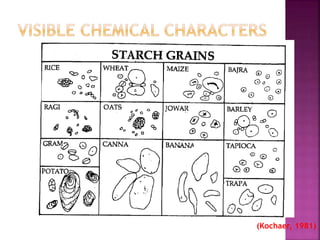
(Kochaer, 1981)
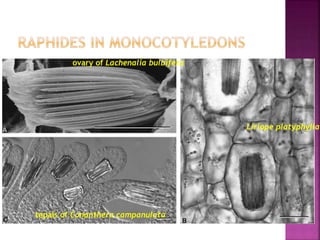
 Raphides - crystals of calcium oxalate which are
present in large cells in different plant tissues
 They are long needle shaped crystals, pointed at
both ends and usually occur in bundles, thus being
easily identified.
 Observed in as many as 35 families of angiosperms.
 Several families of the Order Centrospermae and
the Family Cactaceae show the presence of
raphides
ovary of Lachenalia bulbifera
Liriope platyphylla
tepals of Conanthera campanulata
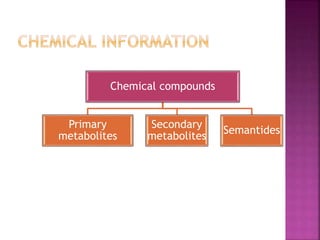
Chemical compounds
Primary
metabolites
Secondary
metabolites
Semantides
 Molecules involved in vital metabolic pathways.
 Universal occurrence
 Not very significant in chemotaxonomy
 Eg: Sugar containing carbohydrate ‘sedoheptulose' is
stored in large quantities as a reserve food in the
genus Sedum
 Amino acids
 Secondary plant products are those macromolecules
that lack nitrogen
 Restricted occurrence
 Greater taxonomic importance
 Includes different kinds of compounds such as
phenolics, alkaloids, terpenoids, etc.
 They are usually not involved in vital functions and
are largely storage products or pigments.
 Flavonoids – Phenolic compounds of leaves
 Monocots & Dicots
 Structural variability and chemical stability
besides widespread distribution.
 Rapid and easy identification
 80 species of plants from the family Ulmaceae
 A majority of the species contain flavonols, but a few
species have glyco-flavonols.
 These two types of flavonoid compounds are never
present together in any species.
 Ulmaceae is divided into two subfamilies called
Ulmoideae and Celtoideae
 Family Ulmaceae characterised by the presence of
flavonols, and family Celtaceae. characterised by the
presence of glyco-flavonols
(Ciannasi ,1978).
 In the genus Salvia, 19 species could be
distinctly identified and classified on the
basis of their monoterpenes
 Triterpenes and sesquiterpenes were useful
in the classification of the families
Cucurbitaceae and Compositae (Asteraceae),
respectively
 DNA (primary semantide)
 RNA (secondary semantide)
 Proteins (tertiary semantide) - most favoured
Electrophoresis - storage proteins of tetraploid wheat,
Triticum dicoccum and the diploid grass Aegilops
Squarrosa
Serological analysis - different amount of serological
activity in members of different plant families may be
interpreted as a reflection of the evolutionary
differences in the primary structure of the proteins
Several tuber-producing species of Solanum were studied
to understand the evolution of the cultivated potato
Solanum tuberosum (Hawks, 1960)
 Betalains – nitrogeneous anthocyanins
 Steriods
 Iridoid compounds – Monoterpenoid cyclopentanoid
lectones
 Alkaloids - nitrogen containing organic compounds with
a heterocyclic ring
 Glucosinolates – mustard oil glucosides
 Lipids and waxes
 Cyanogenic compounds

CHEMOTAXONOMY

  • 1.
  • 2.
     Stable  Unambiguous Not easily changeable  Chemical data may be obtained from any part of the plant  Chemical information may be used for description or identification of plants, or for establishing relationships
  • 3.
  • 4.
     Raphides -crystals of calcium oxalate which are present in large cells in different plant tissues  They are long needle shaped crystals, pointed at both ends and usually occur in bundles, thus being easily identified.  Observed in as many as 35 families of angiosperms.  Several families of the Order Centrospermae and the Family Cactaceae show the presence of raphides
  • 5.
    ovary of Lachenaliabulbifera Liriope platyphylla tepals of Conanthera campanulata
  • 6.
  • 7.
     Molecules involvedin vital metabolic pathways.  Universal occurrence  Not very significant in chemotaxonomy  Eg: Sugar containing carbohydrate ‘sedoheptulose' is stored in large quantities as a reserve food in the genus Sedum  Amino acids
  • 8.
     Secondary plantproducts are those macromolecules that lack nitrogen  Restricted occurrence  Greater taxonomic importance  Includes different kinds of compounds such as phenolics, alkaloids, terpenoids, etc.  They are usually not involved in vital functions and are largely storage products or pigments.
  • 9.
     Flavonoids –Phenolic compounds of leaves  Monocots & Dicots  Structural variability and chemical stability besides widespread distribution.  Rapid and easy identification
  • 10.
     80 speciesof plants from the family Ulmaceae  A majority of the species contain flavonols, but a few species have glyco-flavonols.  These two types of flavonoid compounds are never present together in any species.  Ulmaceae is divided into two subfamilies called Ulmoideae and Celtoideae  Family Ulmaceae characterised by the presence of flavonols, and family Celtaceae. characterised by the presence of glyco-flavonols (Ciannasi ,1978).
  • 12.
     In thegenus Salvia, 19 species could be distinctly identified and classified on the basis of their monoterpenes  Triterpenes and sesquiterpenes were useful in the classification of the families Cucurbitaceae and Compositae (Asteraceae), respectively
  • 13.
     DNA (primarysemantide)  RNA (secondary semantide)  Proteins (tertiary semantide) - most favoured Electrophoresis - storage proteins of tetraploid wheat, Triticum dicoccum and the diploid grass Aegilops Squarrosa Serological analysis - different amount of serological activity in members of different plant families may be interpreted as a reflection of the evolutionary differences in the primary structure of the proteins Several tuber-producing species of Solanum were studied to understand the evolution of the cultivated potato Solanum tuberosum (Hawks, 1960)
  • 14.
     Betalains –nitrogeneous anthocyanins  Steriods  Iridoid compounds – Monoterpenoid cyclopentanoid lectones  Alkaloids - nitrogen containing organic compounds with a heterocyclic ring  Glucosinolates – mustard oil glucosides  Lipids and waxes  Cyanogenic compounds