ATAXIA
BY-Dr. Shyam Kartikey Dwivedi
Guide-Dr. Meenakshi Girish
DEFINING ATAXIA
• Ataxia is a symptom, not a specific disease or
diagnosis.
• Ataxia means poor coordination of movement.
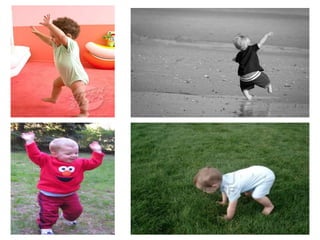
• The term ataxia is most often used to describe
walking that is uncoordinated and unsteady.
Ataxia can affect coordination of fingers, hands,
arms, speech (dysarthria) and eye movements
(nystagmus).
MECHANISM OF DEVELOPING ATAXIA
• ANATOMY OF CEREBELLUM
- LOBES
- AFFERENTS
- EFFERENTS
- FUNCTIONS
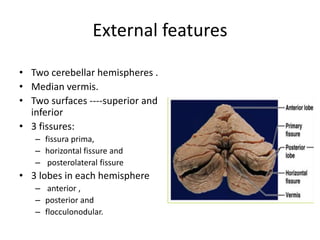
External features
• Two cerebellar hemispheres .
• Median vermis.
• Two surfaces ----superior and
inferior
• 3 fissures:
– fissura prima,
– horizontal fissure and
– posterolateral fissure
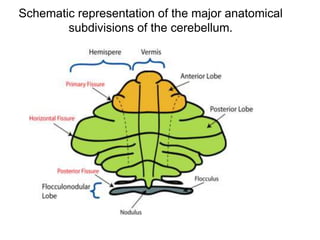
• 3 lobes in each hemisphere
– anterior ,
– posterior and
– flocculonodular.
Schematic representation of the major anatomical
subdivisions of the cerebellum.
ANATOMICAL FUNCTIONAL AREAS OF
THE CEREBELLUM
There are 3 lobe:-
Anterior lobe
Posterior lobe
Flocculonodular lobe
Longitudinal functional division of anterior &
posterior lobes
Vermis – control axial body, neck ,shoulder &
hip
Intermediate zone- controls the contraction of
the distal portion of upper & lower limb
especially hand, finger, feet & toes
Lateral zone- controls the overall planning of
sequential motor movement
• Abnormality in vermis of cerebellum, then child
cannot sit still but constantly move the body to
& fro & bob the head.
• abnormality in cerebellar hemisphere causes
tendency to veer in the direction of affected side
with dysmetria & hypotonia in the ipsilateral
limbs.
Cardinal features - Cerebellar pathology
– Stance and gait
– Poor regulation and coordination of skilled
movements (Dysmetria and dysdiadokinesia)
– Eye movement disturbances
– Altered Muscle tone (Hypotonia)
– Speech (Dysarthria)
Core Symptoms
• Difficulty with balance of gait
• Clumsiness of hands
• Dysarthria
• Gaze problems
Manifestations- Stance and gait
–Wide based stance & Gait
–Gait- staggering, irregular steps, lateral
veering.
–Cerebellar gait -visible or more prominent
–Sudden turn, Abrupt stops , Tandem
walking
• Impairment of joint position sense resulting
from interruption of afferent nerve fibers in
the peripheral nerves, posterior roots, or
posterior columns of the spinal cord. The
effect of these lesions is to deprive the
patients of the knowledge of the position of
their limbs
–Ataxic sensory gait
• brisk leg movements
• legs placed far apart to correct instability
• steps of variable length
• need for carefully watching the ground.
• +ve Romberg's sign .
• Most of the autosomal recessive and
dominant ataxias and with a known genetic
defect are characterized by the coexistence of
cerebellar and sensory ataxia
Limb coordination
• Asynergia- movements are broken into isolated
subsequent steps , lack easiness/ smoothness
• Dysdiadochokinesia- impaired rapidly
alterating movement
• Dysmetria. there is an abnormal excursion in
movements and errors in reaching a precise
target
• Tests
–finger-to nose,the finger-chase
tests for the upper limbs
–heel-to-knee and heel-to-tibia
tests for the lower limbs.
Muscle tone
• Hypotonia is a typical cerebellar sign.
• Wider excursion of hands on shaking the
arms.
In ataxic patient, the hypotonia is
not a constant clinical sign.
Speech- Dysarthria
• Altered articulation of words
• Abnormal fluency of speech.
• Scanning Dysarthria
• Slurring
• Disorder may be a simple slowing of speech or
may manifest as a slurring and scanning
Dysarthria called because the words are
broken into syllables.
• As the disease progresses, both slurring and
slowness may occur and words might become
difficult to understand
Scenario
• 2 yr girl
• Acute onset of not able to walk since morning
• No fever
• No erythema, no pain with palpation of
extremities
• H/o normal development, walking for 8
months.
• Awake and alert, but fussy
Refusal to Walk (or abnormal
gait/limp)
• Infections – septic arthritis, osteomyelitis,
discitis, myositis
• Inflammatory – transient synovitis
• H/o Trauma
• Bony deformity/problem – slipped
epiphysis, hip dysplasia, asceptic necrosis
(legg-calve-perthes), vaso-occlusive crisis,
osteochondrosis, tumors.
• Abdominal pain – appendicitis, PID, abscess
• Neurologic – weakness (muscular dystrophy,
NMJ, GBS, TM), ataxia, infections – meningitis,
spinal abscess.
• Psychogenic - conversion
History
• When was walking last normal; onset of
symptoms?
• Any trauma?
• Vitals? Fever?
• Any LOC or abnormal movements?
• nausea/vertigo/posterior fossa symptoms?
• Why is walking altered? - pain, weakness,
numbness, imbalance, can't say?
Neurologic Exam – walk
refusal/abnormal walk
• CN – pupils, eye movements (abnormal
movements, opsoclonus), CN 8 (ear exam,
tinnitus, hearing loss) – peripheral vestibular
neuropathy/labrynthitis
• Motor – strength – weakness –>
myopathy/NMJ/peripheral nerve/UMN
• Reflexes – absent? -->GBS, increased?->UMN
• Sensory – uncommon reason in kids – B12,
tabes dorsalis, diabetic peripheral neuropathy
• Cerebellar – Rapid alternating movements ,
Finger-nose-finger, heel-knee-shin, other
rhythmic movements-clapping, also listen to
speech.
• Gait – romberg, tandem – think of different
abnormal gait types.
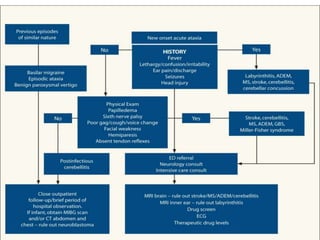
ACUTE EPISODIC CHRONIC
ATAXIA
Causes of ataxia:ACUTE
Drug ingestion(antiepileptic,antihistamine)
acute postinfectious cerebellitis(varicella)
Brain tumor
Neuroblastoma
Head-trauma
Vertebrobasilar dissection/stroke
ADEM
Opsoclonus-Myoclonus-Ataxia
Acute Cerebellar Ataxia
– GBS
– Miller Fisher
syndrome(ataxia,ophthalmoplegia,areflexia)
– Tick paralysis
– Infections – encephalitis, cerebellar abscess,
acute labrynthitis
– Toxicities – alcohol, lead
– Conversion reaction
Causes of Ataxia : EPISODIC
• Basilar artery migraine (benign paroxysmal
vertigo)
• Epileptic ataxia(pseudoataxia)
• Dominant paroxysmal ataxia( episodic ataxia
type-1 & type-2
Causes of Ataxia : EPISODIC
• Metabolic:
– Hypoglycemia
– Hyperammonemia
– Organic acid disorders , Maple syrup
– Hartnup ,hyperpyruvic acidemia
– Refsum’s
– Porphyria
• Chronic
– Congenital anomaly of posterior fossa
• Dandy-walker, chiari, cerebellar
dysplasias, Basilar impression
– Hereditary ataxias
• Freidrich ataxia, ataxia-telangectasia,
spinocerebellar ataxia,
– Neurodegenerative
• abetaliproteinemia, vitamin E deficiency,
Refsum, Niemann-Pick,
tumors
Posterior fossa tumor -cerebellar astrocytoma,
brain stem glioma, ependymoma,
medulloblastoma
Cerebellar Hemangioblastoma (VHL)
DEPENDING ON AGE OF
PRESENTATION
• Ataxia in children before 1 year of age:-
Congenital malformation
Mild arrested hydrocephalus
Cerebral palsy
Marinesco- Sjogren syndrome(cerebellar
ataxia,MR,congenital cataract)
• Ataxia in children between 1-5 years of age:-
Drug ingestion
Acute cerebellar ataxia
Myoclonic encephalopathy & neuroblastoma
Inborn errors of metabolism
Brain tumors
Ataxia telangiectasia
refsum’s disease
• Ataxia in children between 5-10 years:-
Drug ingestion
Acute cerebellar ataxia
Brain tumors
Wilson’s disease
Adrenoleukodystrophy
Hereditary ataxias
• Ataxia in children above 10 years:-
Friedreich’s ataxia
Miller Fisher syndrome
Cerebellar hemorrhage
Multiple sclerosis
Olivopontocerebellar degeneration
Hereditary ataxias
INVESTIGATIONS:
 CBC, electrolytes, glucose, BUN,
creatinine
 ANA
 Thyroid function tests
 Alpha-FP
 Immunoglobulins (IgE, IgA)
 Drug screen
 Vitamins B12 and E
 MRI
 Electrodiagnostic
• Nerve conduction velocities
• ECG
• ECHO
EMG
Imaging
 CT
 MRI
 PET
 Cerebellum, brainstem atrophy, enlarged IV
ventricle
 Above +  T2 signal putamen, substantia nigra,
inferior olive, pontine & dentate nuclei
 Glucose utilization in cerebellar hemisphere,
frontal, prefrontal area,brainstem
Treatment
Identify treatable causes of ataxia
No proven therapy for SCAs
Some patients with paraneoplastic cerebellar
syndrome improve following removal of
tumour and immunotherapy
Genetic counselling can reduce risk in future
generations
Treatable causes of ataxia
Hypothyroidism
Vitamin B12 deficiency
Refsum’s disease
Wilson’s Disease
Ataxia with anti-gliadin antibodies and gluten
senstive enteropathy
Ataxia due to malabsorption syndromes
Lyme’s disease
Mitochondrial encephalomyopathies,
aminoacidopathies, Leukodystrophies and
urea cycle abnormalities
Phytanic acid -hydroxylase deficiency
• Clinical features:
– Retinitis pigmentosa
– cardiomyopathy
– hypertrophic neuropathy
– Ichythiosis
• Treatment:
– Dietary restriction of Phytanic acid
Treatable causes of inherited ataxia
Refsum’s disease
Abetalipoproteinemia
• Clinical features:
– Acanthocytosis
– Retinitis pigment
– Fat malabsorption
• Treatment:
– Vitamin E
Treatable causes of inherited ataxia
Copper accumulation
• Clinical features:
– Kayser-Fleischer ring
– Liver involvement
• Treatment:
– Chelators: Penicillamine, BAL , EDTA
Treatable causes of inherited ataxia
Wilson’s Disease
Tryptophan malabsorption
• Clinical features:
– Pellagra rash
– intermittent ataxia
• Treatment:
– Niacin
Treatable causes of inherited ataxia
Hartnup’s disease
Dominant Recurrent Ataxia:
• Types -EA1 & EA2
• Age-5-7 years
• Episodic attacks of ataxia
• t/t-acetazolamide & antiepileptic
TYPES OF ATAXIA
1. CEREBELLAR
2. SENSORY
3. VESTIBULAR
4. FRONTAL LOBE ATAXIA
5. MIXED
6. PSYCHOGENIC
7. PSEUDO ATAXIA
8. MISCELLANEOUS
ACUTE CEREBELLAR ATAXIA
• Age -2 to 7 years
• Ataxia maximal at onset,sudden
• Ataxia varies from mild unsteadiness while
walking to complete inability to stand or walk.
• Tendon reflex, nystagmus +/-
• Diagnosis-drug screening, brain imaging & LP if
encephalitis
• t/t-self limited disease
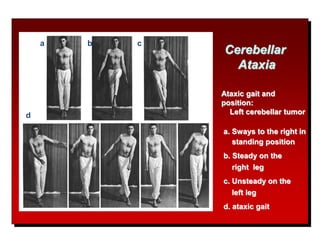
Cerebellar
Ataxia
Ataxic gait and
position:
Left cerebellar tumor
a. Sways to the right in
standing position
b. Steady on the
right leg
c. Unsteady on the
left leg
d. ataxic gait
a b c
d
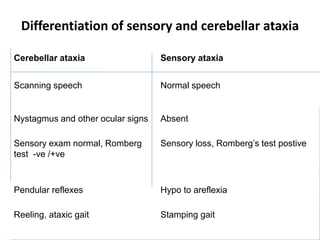
• SENSORY- Sensory disturbances can also on
occasion simulate the imbalance of cerebellar
disease; with sensory ataxia, imbalance
dramatically worsens when visual input is removed
(Romberg sign).
• VESTIBULAR – ataxia associated with vestibular
nerve or labyrinthine disease results in a disorder
of gait associated with a significant degree of
dizziness, light-headedness, or the perception of
movement
• PSEUDO ATAXIA- Mild Pyramidal weakness &
Extrapyramidal disorders, weakness of
proximal leg muscles mimics cerebellar
disease
• PSYCHOGENIC – Extremely anxious patients
Differentiation of sensory and cerebellar ataxia
Cerebellar ataxia Sensory ataxia
Scanning speech Normal speech
Nystagmus and other ocular signs Absent
Sensory exam normal, Romberg
test -ve /+ve
Sensory loss, Romberg’s test postive
Pendular reflexes Hypo to areflexia
Reeling, ataxic gait Stamping gait
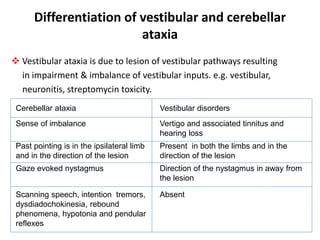
Differentiation of vestibular and cerebellar
ataxia
Cerebellar ataxia Vestibular disorders
Sense of imbalance Vertigo and associated tinnitus and
hearing loss
Past pointing is in the ipsilateral limb
and in the direction of the lesion
Present in both the limbs and in the
direction of the lesion
Gaze evoked nystagmus Direction of the nystagmus in away from
the lesion
Scanning speech, intention tremors,
dysdiadochokinesia, rebound
phenomena, hypotonia and pendular
reflexes
Absent
 Vestibular ataxia is due to lesion of vestibular pathways resulting
in impairment & imbalance of vestibular inputs. e.g. vestibular,
neuronitis, streptomycin toxicity.
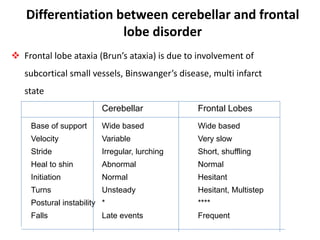
Differentiation between cerebellar and frontal
lobe disorder
Cerebellar Frontal Lobes
Base of support Wide based Wide based
Velocity Variable Very slow
Stride Irregular, lurching Short, shuffling
Heal to shin Abnormal Normal
Initiation Normal Hesitant
Turns Unsteady Hesitant, Multistep
Postural instability * ****
Falls Late events Frequent
 Frontal lobe ataxia (Brun’s ataxia) is due to involvement of
subcortical small vessels, Binswanger’s disease, multi infarct
state
Important points in history
Age at onset
Mode of onset
Precipitating factors
Rate of progression
Symptoms of raised ICP
Presence of systemic symptoms
Drug history and toxin exposure
Family history
Examination
Neck tilt and titubation
Nystagmus and other ocular movement
abnormalities
Dysarthria
Intention tremor
Hypotonia
Past pointing
Rebound phenomenon
Macrographia
Stance
Ataxic Gait
Pendular knee jerk
A 4 year old boy presents to the emergency department with
balance problems. He had been previously healthy, but his walking
has worsened progressively for the past 2 days, with staggering and
lurching.
On PE, the boy is cooperative and alert. His muscles are not tender,
and his joints are not red, swollen or tender. His vision seems
functionally normal, but there is end-gaze nystagmus in all
directions. When sitting independently, his head and trunk bob. His
strength appears normal, and his reflexes are normal. When asked
to stand with his hands outstretched, a symmetric tremor is evident,
and worsens as he approaches this target on finger-to-nose testing.
His gait is broad-based. A urine toxicology screen reveals normal
results. Brain magnetic resonance imaging shows no tumors or other
gray or white matter lesions. Lumbar puncture shows 3 WBCs, 2
RBCs, protein 20, glucose 50.
Of the following, you are MOST likely to advise the
child's mother that:
A. Intravenous steroids significantly reduce
recurrence risk
B. Neuroblastoma is a common cause of these
symptoms
C. Repeat lumbar puncture is needed in 2 days
D. Symptoms may resolve in weeks to months
E. Symptoms usually resolve after antibiotic
treatment
D. Symptoms may resolve in
weeks to months
-Cerebellar ataxia
-Cerebellar findings on exam: Lateral end gaze
nystagmus, dysmetria, ataxia, titubation.
-Subacute onset with normal mental status
suggests acute cerebellar ataxia
-Usually acquired after infection or immunization
-MRI shows lesion
-
Regarding other choices:
A. Intravenous steroids significantly reduce
recurrence risk: They don't
B. Neuroblastoma is a common cause of these
symptoms: not as common
C. Repeat lumbar puncture is needed in 2 days: no
new information
E. Symptoms usually resolve after antibiotic
treatment: Not a primary infectious process
1. A horizontal gaze evoked nystagmus in which the direction of the
fast phase reverses with sustained lateral gaze or beats transiently in
the opposite direction when the eyes return to primary position is
called
A. Periodic alternating nystagmus
B. Seesaw nystagmus
C. Rebound nystagmus
D. Dysconjugate nystagmus
1. A horizontal gaze evoked nystagmus in which the direction of the
fast phase reverses with sustained lateral gaze or beats transiently in
the opposite direction when the eyes return to primary position is
called
A. Periodic alternating nystagmus
B. Seesaw nystagmus
C. Rebound nystagmus
D. Dysconjugate nystagmus
2. The typical signs of cerebellar herniation include the following
EXCEPT
A. Stiff neck
B. Alteration of consciousness
C. Ptosis and pupillary abnormality
D. Cardiac and respiratory abnormalities
2. The typical signs of cerebellar herniation include the following
EXCEPT
A. Stiff neck
B. Alteration of consciousness
C. Ptosis and pupillary abnormality
D. Cardiac and respiratory abnormalities
3. Romberg’s sign is positive in which type of lesion :
A. Cerebellar
B. Posterior column
C. Hysterical
D. Vestibular
3. Romberg’s sign is positive in which type of lesion :
A. Cerebellar
B. Posterior column
C. Hysterical
D. Vestibular
5. Which statement is not true of Friedreich’s ataxia?
A. Recessive inheritance
B.Dysarthria
C. Flexor plantar response
D. Absent ankle jerk
5. Which statement is not true of Friedreich’s ataxia?
A. Recessive inheritance
B.Dysarthria
C. Flexor plantar response
D. Absent ankle jerk
6. Alcoholic cerebellar degeneration is characterized by :
A. Gaze evoked nystagmus
B. Limb ataxia
C. Gait ataxia
D. Action myoclonus
6. Alcoholic cerebellar degeneration is characterized by :
A. Gaze evoked nystagmus
B. Limb ataxia
C. Gait ataxia
D. Action myoclonus
7. Cerebellar ataxia can result from intoxication with :
A. Lead
B. Mercury
C. Manganese
D. Gold
7. Cerebellar ataxia can result from intoxication with :
A. Lead
B. Mercury
C. Manganese
D. Gold
References
• Fenichel
• Forfar
• Swaimann
• Nelson
`

Ataxia seminar

  • 1.
    ATAXIA BY-Dr. Shyam KartikeyDwivedi Guide-Dr. Meenakshi Girish
  • 3.
    DEFINING ATAXIA • Ataxiais a symptom, not a specific disease or diagnosis. • Ataxia means poor coordination of movement. • The term ataxia is most often used to describe walking that is uncoordinated and unsteady. Ataxia can affect coordination of fingers, hands, arms, speech (dysarthria) and eye movements (nystagmus).
  • 4.
    MECHANISM OF DEVELOPINGATAXIA • ANATOMY OF CEREBELLUM - LOBES - AFFERENTS - EFFERENTS - FUNCTIONS
  • 5.
    External features • Twocerebellar hemispheres . • Median vermis. • Two surfaces ----superior and inferior • 3 fissures: – fissura prima, – horizontal fissure and – posterolateral fissure • 3 lobes in each hemisphere – anterior , – posterior and – flocculonodular.
  • 6.
    Schematic representation ofthe major anatomical subdivisions of the cerebellum.
  • 7.
    ANATOMICAL FUNCTIONAL AREASOF THE CEREBELLUM There are 3 lobe:- Anterior lobe Posterior lobe Flocculonodular lobe
  • 8.
    Longitudinal functional divisionof anterior & posterior lobes Vermis – control axial body, neck ,shoulder & hip Intermediate zone- controls the contraction of the distal portion of upper & lower limb especially hand, finger, feet & toes Lateral zone- controls the overall planning of sequential motor movement
  • 9.
    • Abnormality invermis of cerebellum, then child cannot sit still but constantly move the body to & fro & bob the head. • abnormality in cerebellar hemisphere causes tendency to veer in the direction of affected side with dysmetria & hypotonia in the ipsilateral limbs.
  • 10.
    Cardinal features -Cerebellar pathology – Stance and gait – Poor regulation and coordination of skilled movements (Dysmetria and dysdiadokinesia) – Eye movement disturbances – Altered Muscle tone (Hypotonia) – Speech (Dysarthria)
  • 11.
    Core Symptoms • Difficultywith balance of gait • Clumsiness of hands • Dysarthria • Gaze problems
  • 12.
    Manifestations- Stance andgait –Wide based stance & Gait –Gait- staggering, irregular steps, lateral veering. –Cerebellar gait -visible or more prominent –Sudden turn, Abrupt stops , Tandem walking
  • 13.
    • Impairment ofjoint position sense resulting from interruption of afferent nerve fibers in the peripheral nerves, posterior roots, or posterior columns of the spinal cord. The effect of these lesions is to deprive the patients of the knowledge of the position of their limbs
  • 14.
    –Ataxic sensory gait •brisk leg movements • legs placed far apart to correct instability • steps of variable length • need for carefully watching the ground. • +ve Romberg's sign .
  • 15.
    • Most ofthe autosomal recessive and dominant ataxias and with a known genetic defect are characterized by the coexistence of cerebellar and sensory ataxia
  • 16.
    Limb coordination • Asynergia-movements are broken into isolated subsequent steps , lack easiness/ smoothness • Dysdiadochokinesia- impaired rapidly alterating movement • Dysmetria. there is an abnormal excursion in movements and errors in reaching a precise target
  • 17.
    • Tests –finger-to nose,thefinger-chase tests for the upper limbs –heel-to-knee and heel-to-tibia tests for the lower limbs.
  • 18.
    Muscle tone • Hypotoniais a typical cerebellar sign. • Wider excursion of hands on shaking the arms. In ataxic patient, the hypotonia is not a constant clinical sign.
  • 19.
    Speech- Dysarthria • Alteredarticulation of words • Abnormal fluency of speech. • Scanning Dysarthria • Slurring
  • 20.
    • Disorder maybe a simple slowing of speech or may manifest as a slurring and scanning Dysarthria called because the words are broken into syllables. • As the disease progresses, both slurring and slowness may occur and words might become difficult to understand
  • 21.
    Scenario • 2 yrgirl • Acute onset of not able to walk since morning • No fever • No erythema, no pain with palpation of extremities • H/o normal development, walking for 8 months. • Awake and alert, but fussy
  • 22.
    Refusal to Walk(or abnormal gait/limp) • Infections – septic arthritis, osteomyelitis, discitis, myositis • Inflammatory – transient synovitis • H/o Trauma • Bony deformity/problem – slipped epiphysis, hip dysplasia, asceptic necrosis (legg-calve-perthes), vaso-occlusive crisis, osteochondrosis, tumors.
  • 23.
    • Abdominal pain– appendicitis, PID, abscess • Neurologic – weakness (muscular dystrophy, NMJ, GBS, TM), ataxia, infections – meningitis, spinal abscess. • Psychogenic - conversion
  • 24.
    History • When waswalking last normal; onset of symptoms? • Any trauma? • Vitals? Fever? • Any LOC or abnormal movements? • nausea/vertigo/posterior fossa symptoms? • Why is walking altered? - pain, weakness, numbness, imbalance, can't say?
  • 25.
    Neurologic Exam –walk refusal/abnormal walk • CN – pupils, eye movements (abnormal movements, opsoclonus), CN 8 (ear exam, tinnitus, hearing loss) – peripheral vestibular neuropathy/labrynthitis • Motor – strength – weakness –> myopathy/NMJ/peripheral nerve/UMN • Reflexes – absent? -->GBS, increased?->UMN
  • 26.
    • Sensory –uncommon reason in kids – B12, tabes dorsalis, diabetic peripheral neuropathy • Cerebellar – Rapid alternating movements , Finger-nose-finger, heel-knee-shin, other rhythmic movements-clapping, also listen to speech. • Gait – romberg, tandem – think of different abnormal gait types.
  • 27.
  • 28.
    Causes of ataxia:ACUTE Drugingestion(antiepileptic,antihistamine) acute postinfectious cerebellitis(varicella) Brain tumor Neuroblastoma Head-trauma Vertebrobasilar dissection/stroke ADEM Opsoclonus-Myoclonus-Ataxia Acute Cerebellar Ataxia
  • 29.
    – GBS – MillerFisher syndrome(ataxia,ophthalmoplegia,areflexia) – Tick paralysis – Infections – encephalitis, cerebellar abscess, acute labrynthitis – Toxicities – alcohol, lead – Conversion reaction
  • 30.
    Causes of Ataxia: EPISODIC • Basilar artery migraine (benign paroxysmal vertigo) • Epileptic ataxia(pseudoataxia) • Dominant paroxysmal ataxia( episodic ataxia type-1 & type-2
  • 31.
    Causes of Ataxia: EPISODIC • Metabolic: – Hypoglycemia – Hyperammonemia – Organic acid disorders , Maple syrup – Hartnup ,hyperpyruvic acidemia – Refsum’s – Porphyria
  • 32.
    • Chronic – Congenitalanomaly of posterior fossa • Dandy-walker, chiari, cerebellar dysplasias, Basilar impression – Hereditary ataxias • Freidrich ataxia, ataxia-telangectasia, spinocerebellar ataxia, – Neurodegenerative • abetaliproteinemia, vitamin E deficiency, Refsum, Niemann-Pick,
  • 33.
    tumors Posterior fossa tumor-cerebellar astrocytoma, brain stem glioma, ependymoma, medulloblastoma Cerebellar Hemangioblastoma (VHL)
  • 34.
    DEPENDING ON AGEOF PRESENTATION • Ataxia in children before 1 year of age:- Congenital malformation Mild arrested hydrocephalus Cerebral palsy Marinesco- Sjogren syndrome(cerebellar ataxia,MR,congenital cataract)
  • 35.
    • Ataxia inchildren between 1-5 years of age:- Drug ingestion Acute cerebellar ataxia Myoclonic encephalopathy & neuroblastoma Inborn errors of metabolism Brain tumors Ataxia telangiectasia refsum’s disease
  • 36.
    • Ataxia inchildren between 5-10 years:- Drug ingestion Acute cerebellar ataxia Brain tumors Wilson’s disease Adrenoleukodystrophy Hereditary ataxias
  • 37.
    • Ataxia inchildren above 10 years:- Friedreich’s ataxia Miller Fisher syndrome Cerebellar hemorrhage Multiple sclerosis Olivopontocerebellar degeneration Hereditary ataxias
  • 40.
    INVESTIGATIONS:  CBC, electrolytes,glucose, BUN, creatinine  ANA  Thyroid function tests  Alpha-FP  Immunoglobulins (IgE, IgA)  Drug screen  Vitamins B12 and E
  • 41.
     MRI  Electrodiagnostic •Nerve conduction velocities • ECG • ECHO EMG
  • 42.
    Imaging  CT  MRI PET  Cerebellum, brainstem atrophy, enlarged IV ventricle  Above +  T2 signal putamen, substantia nigra, inferior olive, pontine & dentate nuclei  Glucose utilization in cerebellar hemisphere, frontal, prefrontal area,brainstem
  • 43.
    Treatment Identify treatable causesof ataxia No proven therapy for SCAs Some patients with paraneoplastic cerebellar syndrome improve following removal of tumour and immunotherapy
  • 44.
    Genetic counselling canreduce risk in future generations
  • 45.
    Treatable causes ofataxia Hypothyroidism Vitamin B12 deficiency Refsum’s disease Wilson’s Disease Ataxia with anti-gliadin antibodies and gluten senstive enteropathy Ataxia due to malabsorption syndromes Lyme’s disease Mitochondrial encephalomyopathies, aminoacidopathies, Leukodystrophies and urea cycle abnormalities
  • 46.
    Phytanic acid -hydroxylasedeficiency • Clinical features: – Retinitis pigmentosa – cardiomyopathy – hypertrophic neuropathy – Ichythiosis • Treatment: – Dietary restriction of Phytanic acid Treatable causes of inherited ataxia Refsum’s disease
  • 47.
    Abetalipoproteinemia • Clinical features: –Acanthocytosis – Retinitis pigment – Fat malabsorption • Treatment: – Vitamin E Treatable causes of inherited ataxia
  • 48.
    Copper accumulation • Clinicalfeatures: – Kayser-Fleischer ring – Liver involvement • Treatment: – Chelators: Penicillamine, BAL , EDTA Treatable causes of inherited ataxia Wilson’s Disease
  • 49.
    Tryptophan malabsorption • Clinicalfeatures: – Pellagra rash – intermittent ataxia • Treatment: – Niacin Treatable causes of inherited ataxia Hartnup’s disease
  • 50.
    Dominant Recurrent Ataxia: •Types -EA1 & EA2 • Age-5-7 years • Episodic attacks of ataxia • t/t-acetazolamide & antiepileptic
  • 51.
    TYPES OF ATAXIA 1.CEREBELLAR 2. SENSORY 3. VESTIBULAR 4. FRONTAL LOBE ATAXIA 5. MIXED 6. PSYCHOGENIC 7. PSEUDO ATAXIA 8. MISCELLANEOUS
  • 52.
    ACUTE CEREBELLAR ATAXIA •Age -2 to 7 years • Ataxia maximal at onset,sudden • Ataxia varies from mild unsteadiness while walking to complete inability to stand or walk. • Tendon reflex, nystagmus +/- • Diagnosis-drug screening, brain imaging & LP if encephalitis • t/t-self limited disease
  • 53.
    Cerebellar Ataxia Ataxic gait and position: Leftcerebellar tumor a. Sways to the right in standing position b. Steady on the right leg c. Unsteady on the left leg d. ataxic gait a b c d
  • 54.
    • SENSORY- Sensorydisturbances can also on occasion simulate the imbalance of cerebellar disease; with sensory ataxia, imbalance dramatically worsens when visual input is removed (Romberg sign). • VESTIBULAR – ataxia associated with vestibular nerve or labyrinthine disease results in a disorder of gait associated with a significant degree of dizziness, light-headedness, or the perception of movement
  • 55.
    • PSEUDO ATAXIA-Mild Pyramidal weakness & Extrapyramidal disorders, weakness of proximal leg muscles mimics cerebellar disease • PSYCHOGENIC – Extremely anxious patients
  • 56.
    Differentiation of sensoryand cerebellar ataxia Cerebellar ataxia Sensory ataxia Scanning speech Normal speech Nystagmus and other ocular signs Absent Sensory exam normal, Romberg test -ve /+ve Sensory loss, Romberg’s test postive Pendular reflexes Hypo to areflexia Reeling, ataxic gait Stamping gait
  • 57.
    Differentiation of vestibularand cerebellar ataxia Cerebellar ataxia Vestibular disorders Sense of imbalance Vertigo and associated tinnitus and hearing loss Past pointing is in the ipsilateral limb and in the direction of the lesion Present in both the limbs and in the direction of the lesion Gaze evoked nystagmus Direction of the nystagmus in away from the lesion Scanning speech, intention tremors, dysdiadochokinesia, rebound phenomena, hypotonia and pendular reflexes Absent  Vestibular ataxia is due to lesion of vestibular pathways resulting in impairment & imbalance of vestibular inputs. e.g. vestibular, neuronitis, streptomycin toxicity.
  • 58.
    Differentiation between cerebellarand frontal lobe disorder Cerebellar Frontal Lobes Base of support Wide based Wide based Velocity Variable Very slow Stride Irregular, lurching Short, shuffling Heal to shin Abnormal Normal Initiation Normal Hesitant Turns Unsteady Hesitant, Multistep Postural instability * **** Falls Late events Frequent  Frontal lobe ataxia (Brun’s ataxia) is due to involvement of subcortical small vessels, Binswanger’s disease, multi infarct state
  • 59.
    Important points inhistory Age at onset Mode of onset Precipitating factors Rate of progression
  • 60.
    Symptoms of raisedICP Presence of systemic symptoms Drug history and toxin exposure Family history
  • 61.
    Examination Neck tilt andtitubation Nystagmus and other ocular movement abnormalities Dysarthria Intention tremor Hypotonia
  • 62.
  • 64.
    A 4 yearold boy presents to the emergency department with balance problems. He had been previously healthy, but his walking has worsened progressively for the past 2 days, with staggering and lurching. On PE, the boy is cooperative and alert. His muscles are not tender, and his joints are not red, swollen or tender. His vision seems functionally normal, but there is end-gaze nystagmus in all directions. When sitting independently, his head and trunk bob. His strength appears normal, and his reflexes are normal. When asked to stand with his hands outstretched, a symmetric tremor is evident, and worsens as he approaches this target on finger-to-nose testing. His gait is broad-based. A urine toxicology screen reveals normal results. Brain magnetic resonance imaging shows no tumors or other gray or white matter lesions. Lumbar puncture shows 3 WBCs, 2 RBCs, protein 20, glucose 50.
  • 65.
    Of the following,you are MOST likely to advise the child's mother that: A. Intravenous steroids significantly reduce recurrence risk B. Neuroblastoma is a common cause of these symptoms C. Repeat lumbar puncture is needed in 2 days D. Symptoms may resolve in weeks to months E. Symptoms usually resolve after antibiotic treatment
  • 66.
    D. Symptoms mayresolve in weeks to months -Cerebellar ataxia -Cerebellar findings on exam: Lateral end gaze nystagmus, dysmetria, ataxia, titubation. -Subacute onset with normal mental status suggests acute cerebellar ataxia -Usually acquired after infection or immunization -MRI shows lesion -
  • 67.
    Regarding other choices: A.Intravenous steroids significantly reduce recurrence risk: They don't B. Neuroblastoma is a common cause of these symptoms: not as common C. Repeat lumbar puncture is needed in 2 days: no new information E. Symptoms usually resolve after antibiotic treatment: Not a primary infectious process
  • 68.
    1. A horizontalgaze evoked nystagmus in which the direction of the fast phase reverses with sustained lateral gaze or beats transiently in the opposite direction when the eyes return to primary position is called A. Periodic alternating nystagmus B. Seesaw nystagmus C. Rebound nystagmus D. Dysconjugate nystagmus
  • 69.
    1. A horizontalgaze evoked nystagmus in which the direction of the fast phase reverses with sustained lateral gaze or beats transiently in the opposite direction when the eyes return to primary position is called A. Periodic alternating nystagmus B. Seesaw nystagmus C. Rebound nystagmus D. Dysconjugate nystagmus
  • 70.
    2. The typicalsigns of cerebellar herniation include the following EXCEPT A. Stiff neck B. Alteration of consciousness C. Ptosis and pupillary abnormality D. Cardiac and respiratory abnormalities
  • 71.
    2. The typicalsigns of cerebellar herniation include the following EXCEPT A. Stiff neck B. Alteration of consciousness C. Ptosis and pupillary abnormality D. Cardiac and respiratory abnormalities
  • 72.
    3. Romberg’s signis positive in which type of lesion : A. Cerebellar B. Posterior column C. Hysterical D. Vestibular
  • 73.
    3. Romberg’s signis positive in which type of lesion : A. Cerebellar B. Posterior column C. Hysterical D. Vestibular
  • 74.
    5. Which statementis not true of Friedreich’s ataxia? A. Recessive inheritance B.Dysarthria C. Flexor plantar response D. Absent ankle jerk
  • 75.
    5. Which statementis not true of Friedreich’s ataxia? A. Recessive inheritance B.Dysarthria C. Flexor plantar response D. Absent ankle jerk
  • 76.
    6. Alcoholic cerebellardegeneration is characterized by : A. Gaze evoked nystagmus B. Limb ataxia C. Gait ataxia D. Action myoclonus
  • 77.
    6. Alcoholic cerebellardegeneration is characterized by : A. Gaze evoked nystagmus B. Limb ataxia C. Gait ataxia D. Action myoclonus
  • 78.
    7. Cerebellar ataxiacan result from intoxication with : A. Lead B. Mercury C. Manganese D. Gold
  • 79.
    7. Cerebellar ataxiacan result from intoxication with : A. Lead B. Mercury C. Manganese D. Gold
  • 80.
  • 81.