Myotonic
Muscular
Dystrophies
By / Lobna Ahmed
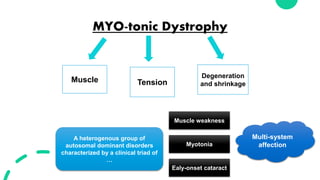
MYO-tonic Dystrophy
Muscle Tension
Degeneration
and shrinkage
A heterogenous group of
autosomal dominant disorders
characterized by a clinical triad of
…
Muscle weakness
Myotonia
Ealy-onset cataract
Multi-system
affection
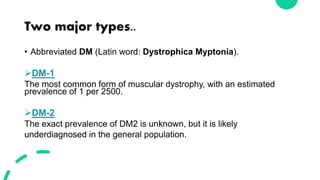
Two major types..
• Abbreviated DM (Latin word: Dystrophica Myptonia).
DM-1
The most common form of muscular dystrophy, with an estimated
prevalence of 1 per 2500.
DM-2
The exact prevalence of DM2 is unknown, but it is likely
underdiagnosed in the general population.
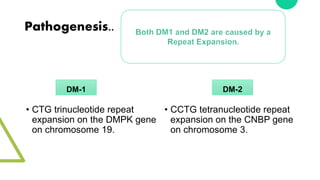
Pathogenesis..
DM-1
• CTG trinucleotide repeat
expansion on the DMPK gene
on chromosome 19.
DM-2
• CCTG tetranucleotide repeat
expansion on the CNBP gene
on chromosome 3.
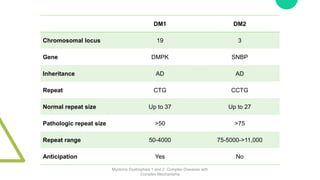
DM1 DM2
Chromosomal locus 19 3
Gene DMPK SNBP
Inheritance AD AD
Repeat CTG CCTG
Normal repeat size Up to 37 Up to 27
Pathologic repeat size >50 >75
Repeat range 50-4000 75-5000->11,000
Anticipation Yes No
Myotonic Dystrophies 1 and 2: Complex Diseases with
Complex Mechanisms
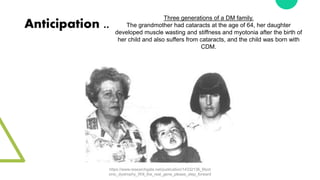
Anticipation ..
Three generations of a DM family.
The grandmother had cataracts at the age of 64, her daughter
developed muscle wasting and stiffness and myotonia after the birth of
her child and also suffers from cataracts, and the child was born with
CDM.
https://www.researchgate.net/publication/14332136_Myot
onic_dystrophy_Will_the_real_gene_please_step_forward
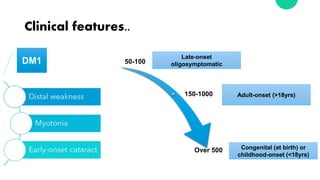
Clinical features..
50-100
150-1000
Over 500
DM1
Late-onset
oligosymptomatic
Adult-onset (>18yrs)
Congenital (at birth) or
childhood-onset (<18yrs)
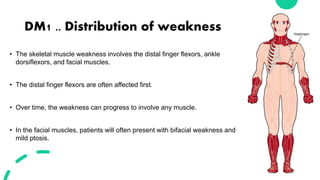
DM1 .. Distribution of weakness
• The skeletal muscle weakness involves the distal finger flexors, ankle
dorsiflexors, and facial muscles.
• The distal finger flexors are often affected first.
• Over time, the weakness can progress to involve any muscle.
• In the facial muscles, patients will often present with bifacial weakness and
mild ptosis.
• Myotonia can be prominent in DM1, and often involves the hands and tongue.
• Patients may describe myotonia as muscle stiffness or delayed muscle relaxation.
• The myotonia is often worse with cold or stress and may improve with use.
• It may be seen on physical examination by asking the patient to squeeze his or her hand tightly for 5
seconds and then open quickly, with the clinician monitoring for delayed relaxation.
• Percussion of the thenar eminence, forearm extensors, or tongue may also produce myotonia.
• Insertion of an EMG needle into the muscle may result in the characteristic “dive-bomber” sound of
waxing and waning myotonia.
Congenital and
childhood
onset DM1
• If the symptoms begin at birth, it is called
congenital myotonic dystrophy.
• The neonatal manifestations often include
hypotonia, respiratory failure, feeding problems,
and talipes equinovarus (clubfoot).
• Childhood-onset myotonic dystrophy is defined as
symptoms after the age of 1 and before the age of
10.
• These early childhood symptoms often include
intellectual impairment and gastrointestinal
symptoms.
• Muscle weakness is predominantly proximal rather than distal
and includes the neck flexors, hip flexors, and hip extensors.
• Myotonia is less common in DM2 and can be more difficult to
detect on physical examination but can be seen proximally.
• Pain is prominent and severe in DM2. The pain is also proximal
and often described as aching or stiff.
• The pain fluctuates in intensity and can be provoked by exercise,
palpation, or cold temperature.
• It is possible that this pain may be diagnosed as fibromyalgia in the
absence of other DM2-associated features
DM2
Myotonic dystrophy is more than muscle
disease ..
Multi-systemic
• The development of cataracts before the age of 50 is a cardinal feature of
DM1.
• These cataracts may be either anterior or posterior subcapsular in nature and
are often described as “Christmas tree” cataracts.
• In addition to the cataracts, corneal abrasions may occur because of an inability
to close the eyes at night due to the bifacial weakness.
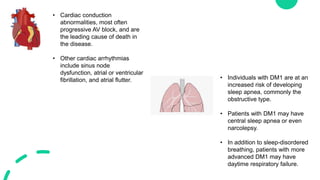
• Cardiac conduction
abnormalities, most often
progressive AV block, and are
the leading cause of death in
the disease.
• Other cardiac arrhythmias
include sinus node
dysfunction, atrial or ventricular
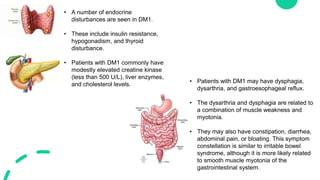
fibrillation, and atrial flutter. • Individuals with DM1 are at an
increased risk of developing
sleep apnea, commonly the
obstructive type.
• Patients with DM1 may have
central sleep apnea or even
narcolepsy.
• In addition to sleep-disordered
breathing, patients with more
advanced DM1 may have
daytime respiratory failure.
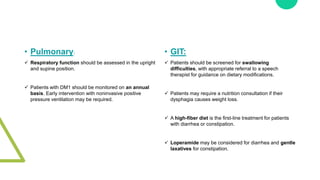
• A number of endocrine
disturbances are seen in DM1.
• These include insulin resistance,
hypogonadism, and thyroid
disturbance.
• Patients with DM1 commonly have
modestly elevated creatine kinase
(less than 500 U/L), liver enzymes,
and cholesterol levels.
• Patients with DM1 may have dysphagia,
dysarthria, and gastroesophageal reflux.
• The dysarthria and dysphagia are related to
a combination of muscle weakness and
myotonia.
• They may also have constipation, diarrhea,
abdominal pain, or bloating. This symptom
constellation is similar to irritable bowel
syndrome, although it is more likely related
to smooth muscle myotonia of the
gastrointestinal system.
• The cognitive impairment in DM1 can vary widely. Patients may range from having
no cognitive impairment to global intellectual impairment.
• Most commonly, executive function and visuospatial processing are impacted.
• In addition to the cognitive symptoms, patients may have an avoidant personality
disorder and apathy, as well as a higher risk of depression.
• Brain MRI may reveal atrophy, particularly of the frontal and parietal regions, and
white matter lesions are also commonly seen.
Diagnosis and Genetic Counseling
• The gold standard test for both DM1 and DM2 is DNA testing to identify the CTG or CCTG repeat expansions in the
blood.
• However, as this is an autosomal dominant disorder, many clinicians will defer genetic testing in first-degree family
members with associated symptoms and signs.
• Electrodiagnostic testing can be useful in these situations, as electrical myotonia may be present even without clinical
myotonia
• In patients with DM1, muscle biopsy may demonstrate increased central nuclei, angular fibers, atrophy, and pyknotic
clumps, while in DM2, the muscle biopsy is often normal or may demonstrate fiber size variation.
Skeletal Muscle and Myotonia Management
• Patients with DM1 or DM2 should be evaluated on an annual basis for difficulty with mobility and screened for falls.
Both patients with DM1 and patients with DM2 benefit from moderate-intensity aerobic exercise.
• Myotonia may be treated with several different agents that target skeletal muscle sodium channels. The best studied is
mexiletine, which has been shown to reduce the myotonia in patients with DM1. (potential cardiac side effects).
• Evidence exists for the use of medications such as phenytoin, carbamazepine, amitriptyline, and acetazolamide.
• While the myotonia in DM2 is often less prominent, it can be treated with the same approach.
Checkups..
• Cardiac:
 It is recommended that patients have an ECG at
diagnosis and annually thereafter.
 Patients should be screened for the presence of
palpitations, chest pain, or recurrent syncope.
 The presence of a prolonged PR interval (most
common) or other changes should result in an
evaluation by a cardiologist.
• Sleep:
 It is important to screen both for the presence of central
or OSA.
 Patients should have a sleep study at baseline and
when prompted by symptoms of excessive daytime
sleepiness.
 Noninvasive positive pressure ventilation may be
warranted when the sleep study demonstrates apnea.
 Stimulant therapy with either modafinil or armodafinil
may be considered when the excessive daytime
sleepiness impairs function.
• Pulmonary:
 Respiratory function should be assessed in the upright
and supine position.
 Patients with DM1 should be monitored on an annual
basis. Early intervention with noninvasive positive
pressure ventilation may be required.
• GIT:
 Patients should be screened for swallowing
difficulties, with appropriate referral to a speech
therapist for guidance on dietary modifications.
 Patients may require a nutrition consultation if their
dysphagia causes weight loss.
 A high-fiber diet is the first-line treatment for patients
with diarrhea or constipation.
 Loperamide may be considered for diarrhea and gentle
laxatives for constipation.
• Ocular:
Patients with DM1 or DM2 are at high risk
of developing early-onset cataracts.
Therefore, an annual slit-lamp
examination to screen for cataracts is
recommended.
Symptomatic cataracts should be
removed as appropriate
• Endocrine System:
Patients with DM1 or DM2 require annual
screening for thyroid deficiency.
Thyroid hormone replacement should be
considered as appropriate.
Periodic screening for insulin resistance,
hyperlipidemia, or testosterone
deficiency (in men) is also
recommended.
• Anesthesia:
Patients with DM1 are at increased risk
with administration of general anesthesia.
Complications include a hypersensitivity
to opiate medications and a paradoxical
reaction to muscle-depolarizing agents.
Risks also include postoperative apnea
requiring a prolonged ventilator wean.
• Monitoring for Neoplasms:
While the increased risk of cancer is
clearly identified in DM1 and DM2, the
current recommendations remain to
counsel patients to stay up-to-date on
routine screenings for their age and sex.
Clinicians should be aware of this risk so
that new symptoms, such as profound
weight loss, are given appropriate
attention.
Special situations Pregnancy..
• Patients with DM1 are at risk of increasing myotonia and weakness, among other disease manifestations, during
pregnancy.
• Prior survey results suggest that these symptoms typically improve following delivery, although it is possible women
may experience a permanent progression in their disease.
• Women with DM2 report increased pain and weakness during the course of pregnancy and were less likely to report a
return to prior function following pregnancy.
• Women with DM1 or DM2 are at risk of a number of complications during pregnancy, including preeclampsia, prolonged
labor, peripartum hemorrhage, and worsening of the symptoms of myotonia and fatigue during pregnancy.
Thank you

Myotonic muscular dystrophy

  • 1.
  • 2.
    MYO-tonic Dystrophy Muscle Tension Degeneration andshrinkage A heterogenous group of autosomal dominant disorders characterized by a clinical triad of … Muscle weakness Myotonia Ealy-onset cataract Multi-system affection
  • 3.
    Two major types.. •Abbreviated DM (Latin word: Dystrophica Myptonia). DM-1 The most common form of muscular dystrophy, with an estimated prevalence of 1 per 2500. DM-2 The exact prevalence of DM2 is unknown, but it is likely underdiagnosed in the general population.
  • 4.
    Pathogenesis.. DM-1 • CTG trinucleotiderepeat expansion on the DMPK gene on chromosome 19. DM-2 • CCTG tetranucleotide repeat expansion on the CNBP gene on chromosome 3.
  • 5.
    DM1 DM2 Chromosomal locus19 3 Gene DMPK SNBP Inheritance AD AD Repeat CTG CCTG Normal repeat size Up to 37 Up to 27 Pathologic repeat size >50 >75 Repeat range 50-4000 75-5000->11,000 Anticipation Yes No Myotonic Dystrophies 1 and 2: Complex Diseases with Complex Mechanisms
  • 6.
    Anticipation .. Three generationsof a DM family. The grandmother had cataracts at the age of 64, her daughter developed muscle wasting and stiffness and myotonia after the birth of her child and also suffers from cataracts, and the child was born with CDM. https://www.researchgate.net/publication/14332136_Myot onic_dystrophy_Will_the_real_gene_please_step_forward
  • 7.
    Clinical features.. 50-100 150-1000 Over 500 DM1 Late-onset oligosymptomatic Adult-onset(>18yrs) Congenital (at birth) or childhood-onset (<18yrs)
  • 8.
    DM1 .. Distributionof weakness • The skeletal muscle weakness involves the distal finger flexors, ankle dorsiflexors, and facial muscles. • The distal finger flexors are often affected first. • Over time, the weakness can progress to involve any muscle. • In the facial muscles, patients will often present with bifacial weakness and mild ptosis.
  • 9.
    • Myotonia canbe prominent in DM1, and often involves the hands and tongue. • Patients may describe myotonia as muscle stiffness or delayed muscle relaxation. • The myotonia is often worse with cold or stress and may improve with use. • It may be seen on physical examination by asking the patient to squeeze his or her hand tightly for 5 seconds and then open quickly, with the clinician monitoring for delayed relaxation. • Percussion of the thenar eminence, forearm extensors, or tongue may also produce myotonia. • Insertion of an EMG needle into the muscle may result in the characteristic “dive-bomber” sound of waxing and waning myotonia.
  • 10.
    Congenital and childhood onset DM1 •If the symptoms begin at birth, it is called congenital myotonic dystrophy. • The neonatal manifestations often include hypotonia, respiratory failure, feeding problems, and talipes equinovarus (clubfoot). • Childhood-onset myotonic dystrophy is defined as symptoms after the age of 1 and before the age of 10. • These early childhood symptoms often include intellectual impairment and gastrointestinal symptoms.
  • 11.
    • Muscle weaknessis predominantly proximal rather than distal and includes the neck flexors, hip flexors, and hip extensors. • Myotonia is less common in DM2 and can be more difficult to detect on physical examination but can be seen proximally. • Pain is prominent and severe in DM2. The pain is also proximal and often described as aching or stiff. • The pain fluctuates in intensity and can be provoked by exercise, palpation, or cold temperature. • It is possible that this pain may be diagnosed as fibromyalgia in the absence of other DM2-associated features DM2
  • 12.
    Myotonic dystrophy ismore than muscle disease .. Multi-systemic
  • 13.
    • The developmentof cataracts before the age of 50 is a cardinal feature of DM1. • These cataracts may be either anterior or posterior subcapsular in nature and are often described as “Christmas tree” cataracts. • In addition to the cataracts, corneal abrasions may occur because of an inability to close the eyes at night due to the bifacial weakness.
  • 14.
    • Cardiac conduction abnormalities,most often progressive AV block, and are the leading cause of death in the disease. • Other cardiac arrhythmias include sinus node dysfunction, atrial or ventricular fibrillation, and atrial flutter. • Individuals with DM1 are at an increased risk of developing sleep apnea, commonly the obstructive type. • Patients with DM1 may have central sleep apnea or even narcolepsy. • In addition to sleep-disordered breathing, patients with more advanced DM1 may have daytime respiratory failure.
  • 15.
    • A numberof endocrine disturbances are seen in DM1. • These include insulin resistance, hypogonadism, and thyroid disturbance. • Patients with DM1 commonly have modestly elevated creatine kinase (less than 500 U/L), liver enzymes, and cholesterol levels. • Patients with DM1 may have dysphagia, dysarthria, and gastroesophageal reflux. • The dysarthria and dysphagia are related to a combination of muscle weakness and myotonia. • They may also have constipation, diarrhea, abdominal pain, or bloating. This symptom constellation is similar to irritable bowel syndrome, although it is more likely related to smooth muscle myotonia of the gastrointestinal system.
  • 16.
    • The cognitiveimpairment in DM1 can vary widely. Patients may range from having no cognitive impairment to global intellectual impairment. • Most commonly, executive function and visuospatial processing are impacted. • In addition to the cognitive symptoms, patients may have an avoidant personality disorder and apathy, as well as a higher risk of depression. • Brain MRI may reveal atrophy, particularly of the frontal and parietal regions, and white matter lesions are also commonly seen.
  • 18.
    Diagnosis and GeneticCounseling • The gold standard test for both DM1 and DM2 is DNA testing to identify the CTG or CCTG repeat expansions in the blood. • However, as this is an autosomal dominant disorder, many clinicians will defer genetic testing in first-degree family members with associated symptoms and signs. • Electrodiagnostic testing can be useful in these situations, as electrical myotonia may be present even without clinical myotonia • In patients with DM1, muscle biopsy may demonstrate increased central nuclei, angular fibers, atrophy, and pyknotic clumps, while in DM2, the muscle biopsy is often normal or may demonstrate fiber size variation.
  • 19.
    Skeletal Muscle andMyotonia Management • Patients with DM1 or DM2 should be evaluated on an annual basis for difficulty with mobility and screened for falls. Both patients with DM1 and patients with DM2 benefit from moderate-intensity aerobic exercise. • Myotonia may be treated with several different agents that target skeletal muscle sodium channels. The best studied is mexiletine, which has been shown to reduce the myotonia in patients with DM1. (potential cardiac side effects). • Evidence exists for the use of medications such as phenytoin, carbamazepine, amitriptyline, and acetazolamide. • While the myotonia in DM2 is often less prominent, it can be treated with the same approach.
  • 20.
    Checkups.. • Cardiac:  Itis recommended that patients have an ECG at diagnosis and annually thereafter.  Patients should be screened for the presence of palpitations, chest pain, or recurrent syncope.  The presence of a prolonged PR interval (most common) or other changes should result in an evaluation by a cardiologist. • Sleep:  It is important to screen both for the presence of central or OSA.  Patients should have a sleep study at baseline and when prompted by symptoms of excessive daytime sleepiness.  Noninvasive positive pressure ventilation may be warranted when the sleep study demonstrates apnea.  Stimulant therapy with either modafinil or armodafinil may be considered when the excessive daytime sleepiness impairs function.
  • 21.
    • Pulmonary:  Respiratoryfunction should be assessed in the upright and supine position.  Patients with DM1 should be monitored on an annual basis. Early intervention with noninvasive positive pressure ventilation may be required. • GIT:  Patients should be screened for swallowing difficulties, with appropriate referral to a speech therapist for guidance on dietary modifications.  Patients may require a nutrition consultation if their dysphagia causes weight loss.  A high-fiber diet is the first-line treatment for patients with diarrhea or constipation.  Loperamide may be considered for diarrhea and gentle laxatives for constipation.
  • 22.
    • Ocular: Patients withDM1 or DM2 are at high risk of developing early-onset cataracts. Therefore, an annual slit-lamp examination to screen for cataracts is recommended. Symptomatic cataracts should be removed as appropriate • Endocrine System: Patients with DM1 or DM2 require annual screening for thyroid deficiency. Thyroid hormone replacement should be considered as appropriate. Periodic screening for insulin resistance, hyperlipidemia, or testosterone deficiency (in men) is also recommended.
  • 23.
    • Anesthesia: Patients withDM1 are at increased risk with administration of general anesthesia. Complications include a hypersensitivity to opiate medications and a paradoxical reaction to muscle-depolarizing agents. Risks also include postoperative apnea requiring a prolonged ventilator wean. • Monitoring for Neoplasms: While the increased risk of cancer is clearly identified in DM1 and DM2, the current recommendations remain to counsel patients to stay up-to-date on routine screenings for their age and sex. Clinicians should be aware of this risk so that new symptoms, such as profound weight loss, are given appropriate attention.
  • 24.
    Special situations Pregnancy.. •Patients with DM1 are at risk of increasing myotonia and weakness, among other disease manifestations, during pregnancy. • Prior survey results suggest that these symptoms typically improve following delivery, although it is possible women may experience a permanent progression in their disease. • Women with DM2 report increased pain and weakness during the course of pregnancy and were less likely to report a return to prior function following pregnancy. • Women with DM1 or DM2 are at risk of a number of complications during pregnancy, including preeclampsia, prolonged labor, peripartum hemorrhage, and worsening of the symptoms of myotonia and fatigue during pregnancy.
  • 25.