


Stella Maris Polytechnic
Mother Patern College of Health Sciences
Presented by:
Mr. Abraham G. Dayklee
Lecturer, Department of Biology
Mother Patern College of Health Sciences
February 18, 2019
Laboratory Outline
Overview of the Laboratory
Laboratory Safety Rules
 General Precuations
 Handling Chemicals
 Handling Glassware
 Heating Substances
 In-case Of Injury
Laboratory Report Format
Introduction to Laboratory Apparatus
Learning Objectives
Upon completion, the learner will be able to:
Overview of Laboratory
• A laboratory (Lab, from Medieval
Latin labōrātōrium workshop, Latin
labōrā (re) to labor + tōrium –tory)
• It is a facility that provides
controlled conditions in which
scientific, technological research;
experiments, and measurement
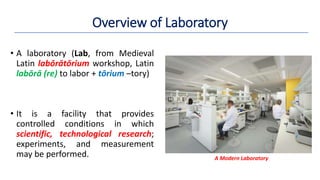
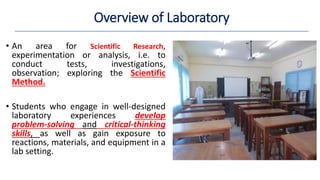
may be performed. A Modern Laboratory
• An area for Scientific Research,
experimentation or analysis, i.e. to
conduct tests, investigations,
observation; exploring the Scientific
Method.
• Students who engage in well-designed
laboratory experiences develop
problem-solving and critical-thinking
skills, as well as gain exposure to
reactions, materials, and equipment in a
lab setting.
Overview of Laboratory
• It focuses on the development of the
students Skills, Knowledge and
Behaviours/Attitudes
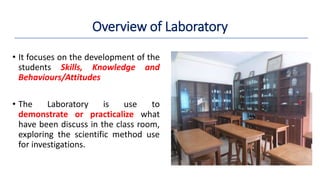
• The Laboratory is use to
demonstrate or practicalize what
have been discuss in the class room,
exploring the scientific method use
for investigations.
Overview of Laboratory
Laboratory Safety Rules
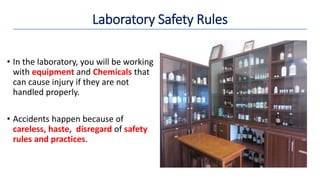
• In the laboratory, you will be working
with equipment and Chemicals that
can cause injury if they are not
handled properly.
• Accidents happen because of
careless, haste, disregard of safety
rules and practices.
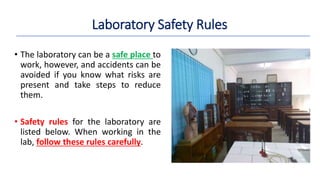
• The laboratory can be a safe place to
work, however, and accidents can be
avoided if you know what risks are
present and take steps to reduce
them.
• Safety rules for the laboratory are
listed below. When working in the
lab, follow these rules carefully.
Laboratory Safety Rules
Laboratory Safety
Rules • Carefully follow all Written and Oral
instructions.
• Perform only those activities
assigned by your instructor
• Notify your teacher if you have any
medical problems that might be
affected by lab work, such as
Allergies or Asthma
GENERAL PRECAUTIONS:
 Be prepared to work when
you arrive at the lab.
 Familiarize yourself with
the Lab procedure before
beginning the Lab
 Never do anything in the
lab that is not called for in
the lab procedure or by
your instructor.
Laboratory Safety Rules
• Never work in the Lab without
supervision
• Never eat or drink in the
Laboratory
• Never smoke in the Laboratory
• Keep your area clean and tidy
at all times.
• Only notebooks and Lab manual
or written Lab procedures should
be brought to work area
• Wear appropriate clothing for
working in the Lab. Remove
jackets, ties, and other loose
garments
• Roll up or secure long sleeves.
Laboratory Safety Rules
• Remove Jewry, such as dangling
neckless, chains, and bracelets,
that might present hazard in the
lab
• Tie back or cover long hair,
especially in the vicinity of an
open flame.
• Never wear open shoes or
sandals in the lab
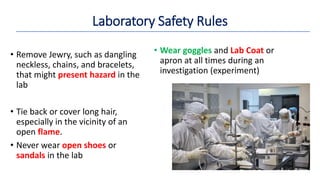
• Wear goggles and Lab Coat or
apron at all times during an
investigation (experiment)
Laboratory Safety Rules
• Set up apparatus as described in
the written lab procedures or by
your instructor.
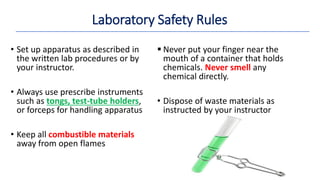
• Always use prescribe instruments
such as tongs, test-tube holders,
or forceps for handling apparatus
• Keep all combustible materials
away from open flames
 Never put your finger near the
mouth of a container that holds
chemicals. Never smell any
chemical directly.
• Dispose of waste materials as
instructed by your instructor
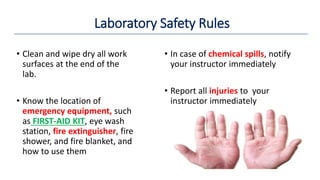
• Clean and wipe dry all work
surfaces at the end of the
lab.
• Know the location of
emergency equipment, such
as FIRST-AID KIT, eye wash
station, fire extinguisher, fire
shower, and fire blanket, and
how to use them
• In case of chemical spills, notify
your instructor immediately
• Report all injuries to your
instructor immediately
Laboratory Safety Rules
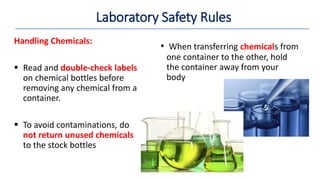
• When transferring chemicals from
one container to the other, hold
the container away from your
body
Handling Chemicals:
 Read and double-check labels
on chemical bottles before
removing any chemical from a
container.
 To avoid contaminations, do
not return unused chemicals
to the stock bottles
Laboratory Safety Rules
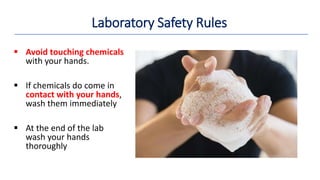
 Avoid touching chemicals
with your hands.
 If chemicals do come in
contact with your hands,
wash them immediately
 At the end of the lab
wash your hands
thoroughly
Laboratory Safety Rules
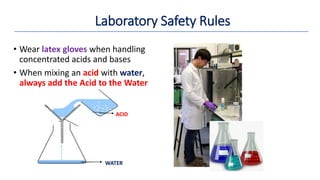
• Wear latex gloves when handling
concentrated acids and bases
• When mixing an acid with water,
always add the Acid to the Water
Laboratory Safety Rules
WATER
ACID
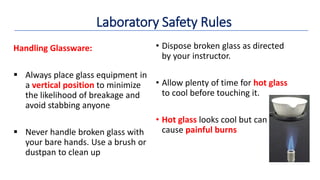
• Dispose broken glass as directed
by your instructor.
• Allow plenty of time for hot glass
to cool before touching it.
• Hot glass looks cool but can
cause painful burns
Handling Glassware:
 Always place glass equipment in
a vertical position to minimize
the likelihood of breakage and
avoid stabbing anyone
 Never handle broken glass with
your bare hands. Use a brush or
dustpan to clean up
Laboratory Safety Rules
Laboratory Safety
Rules
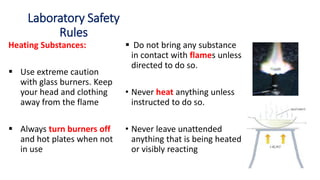
 Do not bring any substance
in contact with flames unless
directed to do so.
• Never heat anything unless
instructed to do so.
• Never leave unattended
anything that is being heated
or visibly reacting
Heating Substances:
 Use extreme caution
with glass burners. Keep
your head and clothing
away from the flame
 Always turn burners off
and hot plates when not
in use
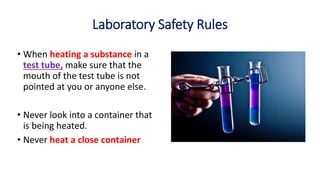
• When heating a substance in a
test tube, make sure that the
mouth of the test tube is not
pointed at you or anyone else.
• Never look into a container that
is being heated.
• Never heat a close container
Laboratory Safety Rules
 IN-CASE OF INJURY:
• If any injury should occur, it is important to remain calm
• Notify your instructor immediately
• Be familiar with the first-aid practices that are to be
followed
• Know how to use emergency equipment
• Know how to summon assistance
Laboratory Safety Rules
Laboratory Report Format
 Students will write an individual or group Laboratory Report at the
discretion of the Instructor.
 Include the following information in your laboratory report, due at
the beginning of the Laboratory period next week.
‘Get a Lab Copy Book’
• Title: Title of the experiment; sometimes your name, your
partner's name and the date the laboratory experiment was
performed. Example: ‘Acid-base Titration’
• Introduction: This will be your opportunity to practice writing
introductions. The introduction to the Lab should be about
chemical reactions in general.
Laboratory Report Format
• Aim: What you hope to achieve after the investigation or
experiment. Example
‘Determining the Concentration of a solution of
Hydrochlorolic Acid’
• Apparatus/Equipment: List the apparatus or equipment
needed to carry out or perform the experiment and draw
just a few; the major ones.
Laboratory Report Format
• Experimental Details/Procedure: A step-by step description of the
procedure you followed to produce the experimental data and results.
Usually written in an instructional format, instructing someone to do
the investigation, avoid first and third person pronouns
• Observation: Key findings. During the investigation or experiment,
issues that sprung up, or issues that you experienced during the
course of your investigation. All the reactions observed
Laboratory Report Format
• Results: The outcome of the investigation. A table or
tables of your experimental data clearly labelled with the
proper units.
• Conclusion: A deductive/inductive reasoning about the
investigation
Laboratory Report Format
Intoduction to Laboratory Safety Rules

Intoduction to Laboratory Safety Rules

  • 1.
    Stella Maris Polytechnic MotherPatern College of Health Sciences Presented by: Mr. Abraham G. Dayklee Lecturer, Department of Biology Mother Patern College of Health Sciences
  • 2.
  • 3.
    Laboratory Outline Overview ofthe Laboratory Laboratory Safety Rules  General Precuations  Handling Chemicals  Handling Glassware  Heating Substances  In-case Of Injury Laboratory Report Format Introduction to Laboratory Apparatus
  • 4.
    Learning Objectives Upon completion,the learner will be able to:
  • 5.
    Overview of Laboratory •A laboratory (Lab, from Medieval Latin labōrātōrium workshop, Latin labōrā (re) to labor + tōrium –tory) • It is a facility that provides controlled conditions in which scientific, technological research; experiments, and measurement may be performed. A Modern Laboratory
  • 6.
    • An areafor Scientific Research, experimentation or analysis, i.e. to conduct tests, investigations, observation; exploring the Scientific Method. • Students who engage in well-designed laboratory experiences develop problem-solving and critical-thinking skills, as well as gain exposure to reactions, materials, and equipment in a lab setting. Overview of Laboratory
  • 7.
    • It focuseson the development of the students Skills, Knowledge and Behaviours/Attitudes • The Laboratory is use to demonstrate or practicalize what have been discuss in the class room, exploring the scientific method use for investigations. Overview of Laboratory
  • 8.
    Laboratory Safety Rules •In the laboratory, you will be working with equipment and Chemicals that can cause injury if they are not handled properly. • Accidents happen because of careless, haste, disregard of safety rules and practices.
  • 9.
    • The laboratorycan be a safe place to work, however, and accidents can be avoided if you know what risks are present and take steps to reduce them. • Safety rules for the laboratory are listed below. When working in the lab, follow these rules carefully. Laboratory Safety Rules
  • 10.
    Laboratory Safety Rules •Carefully follow all Written and Oral instructions. • Perform only those activities assigned by your instructor • Notify your teacher if you have any medical problems that might be affected by lab work, such as Allergies or Asthma GENERAL PRECAUTIONS:  Be prepared to work when you arrive at the lab.  Familiarize yourself with the Lab procedure before beginning the Lab  Never do anything in the lab that is not called for in the lab procedure or by your instructor.
  • 11.
    Laboratory Safety Rules •Never work in the Lab without supervision • Never eat or drink in the Laboratory • Never smoke in the Laboratory • Keep your area clean and tidy at all times. • Only notebooks and Lab manual or written Lab procedures should be brought to work area • Wear appropriate clothing for working in the Lab. Remove jackets, ties, and other loose garments • Roll up or secure long sleeves.
  • 12.
    Laboratory Safety Rules •Remove Jewry, such as dangling neckless, chains, and bracelets, that might present hazard in the lab • Tie back or cover long hair, especially in the vicinity of an open flame. • Never wear open shoes or sandals in the lab • Wear goggles and Lab Coat or apron at all times during an investigation (experiment)
  • 13.
    Laboratory Safety Rules •Set up apparatus as described in the written lab procedures or by your instructor. • Always use prescribe instruments such as tongs, test-tube holders, or forceps for handling apparatus • Keep all combustible materials away from open flames  Never put your finger near the mouth of a container that holds chemicals. Never smell any chemical directly. • Dispose of waste materials as instructed by your instructor
  • 14.
    • Clean andwipe dry all work surfaces at the end of the lab. • Know the location of emergency equipment, such as FIRST-AID KIT, eye wash station, fire extinguisher, fire shower, and fire blanket, and how to use them • In case of chemical spills, notify your instructor immediately • Report all injuries to your instructor immediately Laboratory Safety Rules
  • 15.
    • When transferringchemicals from one container to the other, hold the container away from your body Handling Chemicals:  Read and double-check labels on chemical bottles before removing any chemical from a container.  To avoid contaminations, do not return unused chemicals to the stock bottles Laboratory Safety Rules
  • 16.
     Avoid touchingchemicals with your hands.  If chemicals do come in contact with your hands, wash them immediately  At the end of the lab wash your hands thoroughly Laboratory Safety Rules
  • 17.
    • Wear latexgloves when handling concentrated acids and bases • When mixing an acid with water, always add the Acid to the Water Laboratory Safety Rules WATER ACID
  • 18.
    • Dispose brokenglass as directed by your instructor. • Allow plenty of time for hot glass to cool before touching it. • Hot glass looks cool but can cause painful burns Handling Glassware:  Always place glass equipment in a vertical position to minimize the likelihood of breakage and avoid stabbing anyone  Never handle broken glass with your bare hands. Use a brush or dustpan to clean up Laboratory Safety Rules
  • 19.
    Laboratory Safety Rules  Donot bring any substance in contact with flames unless directed to do so. • Never heat anything unless instructed to do so. • Never leave unattended anything that is being heated or visibly reacting Heating Substances:  Use extreme caution with glass burners. Keep your head and clothing away from the flame  Always turn burners off and hot plates when not in use
  • 20.
    • When heatinga substance in a test tube, make sure that the mouth of the test tube is not pointed at you or anyone else. • Never look into a container that is being heated. • Never heat a close container Laboratory Safety Rules
  • 21.
     IN-CASE OFINJURY: • If any injury should occur, it is important to remain calm • Notify your instructor immediately • Be familiar with the first-aid practices that are to be followed • Know how to use emergency equipment • Know how to summon assistance Laboratory Safety Rules
  • 22.
    Laboratory Report Format Students will write an individual or group Laboratory Report at the discretion of the Instructor.  Include the following information in your laboratory report, due at the beginning of the Laboratory period next week. ‘Get a Lab Copy Book’
  • 23.
    • Title: Titleof the experiment; sometimes your name, your partner's name and the date the laboratory experiment was performed. Example: ‘Acid-base Titration’ • Introduction: This will be your opportunity to practice writing introductions. The introduction to the Lab should be about chemical reactions in general. Laboratory Report Format
  • 24.
    • Aim: Whatyou hope to achieve after the investigation or experiment. Example ‘Determining the Concentration of a solution of Hydrochlorolic Acid’ • Apparatus/Equipment: List the apparatus or equipment needed to carry out or perform the experiment and draw just a few; the major ones. Laboratory Report Format
  • 25.
    • Experimental Details/Procedure:A step-by step description of the procedure you followed to produce the experimental data and results. Usually written in an instructional format, instructing someone to do the investigation, avoid first and third person pronouns • Observation: Key findings. During the investigation or experiment, issues that sprung up, or issues that you experienced during the course of your investigation. All the reactions observed Laboratory Report Format
  • 26.
    • Results: Theoutcome of the investigation. A table or tables of your experimental data clearly labelled with the proper units. • Conclusion: A deductive/inductive reasoning about the investigation Laboratory Report Format