Mother Patern College of Health Sciences
UN Drive/RandallStreet,Monrovia-Liberia
HumanAnatomy (Zoology 411)
Presentation
Mr.Abraham G. Dayklee
Presenter
• Includes all the glands of the body and the hormones produced by those glands
The Endocrine System:
 Secrete their products into body fluids directly
rather than ducts as in the exocrine glands.
 The study and treatment of the endocrine system
is called ENDOCRINOLOGY
 Cellular metabolism
 Reproduction
 Sexual reproduction
 Heart rate
 Digestion
 Plus other processes regulated
by reactions of hormones
Generally they regulate metabolic
processes or regulated by
hormones action.
Characterized by:
 Ductless nature
 Vascularity
 Presence of intercellular vacuoles
of granules for hormone storage
 It has an unusually high density of
blood capillaries (fenestrated
capillaries)
 Are chemical messengers that are secreted into the bloodstream and
stimulate responses in distant organs
 They affect only their targeted cells with specific receptor.
 Classified into two (2) base on the chemical makeup and solubility:
 Lipid Soluble Hormones (Steroid Hormones)
 Water Soluble Hormones (Non-steroid Hormones)
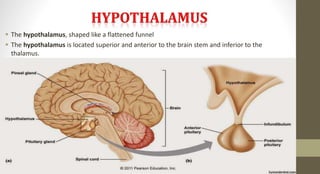
 The hypothalamus, shaped like a flattened funnel
 The hypothalamus is located superior and anterior to the brain stem and inferior to the
thalamus.
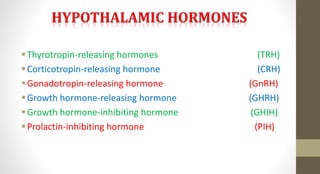
Thyrotropin-releasing hormones (TRH)
Corticotropin-releasing hormone (CRH)
Gonadotropin-releasing hormone (GnRH)
Growth hormone-releasing hormone (GHRH)
Growth hormone-inhibiting hormone (GHIH)
Prolactin-inhibiting hormone (PIH)
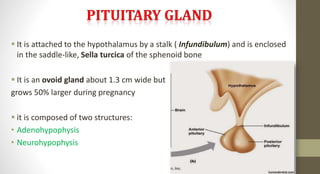
 It is attached to the hypothalamus by a stalk ( Infundibulum) and is enclosed
in the saddle-like, Sella turcica of the sphenoid bone
 It is an ovoid gland about 1.3 cm wide but
grows 50% larger during pregnancy
 it is composed of two structures:
• Adenohypophysis
• Neurohypophysis
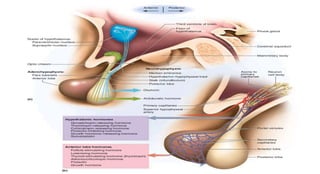
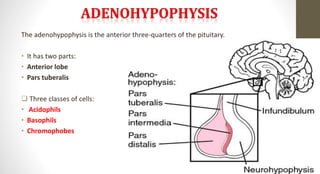
The adenohypophysis is the anterior three-quarters of the pituitary.
• It has two parts:
• Anterior lobe
• Pars tuberalis
 Three classes of cells:
• Acidophils
• Basophils
• Chromophobes
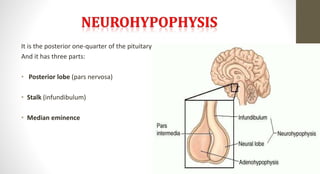
It is the posterior one-quarter of the pituitary
And it has three parts:
• Posterior lobe (pars nervosa)
• Stalk (infundibulum)
• Median eminence
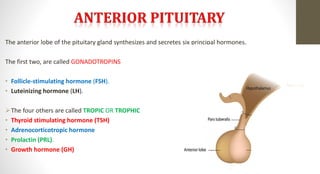
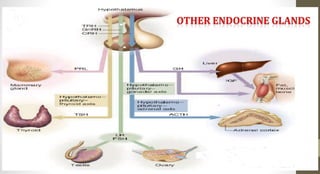
The anterior lobe of the pituitary gland synthesizes and secretes six principal hormones.
The first two, are called GONADOTROPINS
• Follicle-stimulating hormone (FSH).
• Luteinizing hormone (LH).
The four others are called TROPIC OR TROPHIC
• Thyroid stimulating hormone (TSH)
• Adrenocorticotropic hormone
• Prolactin (PRL).
• Growth hormone (GH)
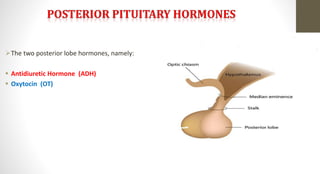
The two posterior lobe hormones, namely:
 Antidiuretic Hormone (ADH)
 Oxytocin (OT)
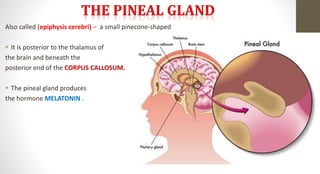
Also called (epiphysis cerebri) – a small pinecone-shaped
 It is posterior to the thalamus of
the brain and beneath the
posterior end of the CORPUS CALLOSUM.
 The pineal gland produces
the hormone MELATONIN .
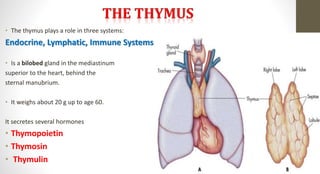
• The thymus plays a role in three systems:
Endocrine, Lymphatic, Immune Systems
• Is a bilobed gland in the mediastinum
superior to the heart, behind the
sternal manubrium.
• It weighs about 20 g up to age 60.
It secretes several hormones
• Thymopoietin
• Thymosin
• Thymulin
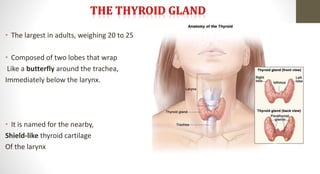
• The largest in adults, weighing 20 to 25
• Composed of two lobes that wrap
Like a butterfly around the trachea,
Immediately below the larynx.
• It is named for the nearby,
Shield-like thyroid cartilage
Of the larynx
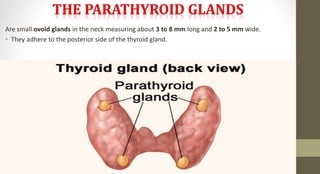
Are small ovoid glands in the neck measuring about 3 to 8 mm long and 2 to 5 mm wide.
• They adhere to the posterior side of the thyroid gland.
Also known as Suprarenal gland is
attached to the superior to medial aspect
of each kidney. Include 2 types:
• The right adrenal gland is more or less
triangular and rests on the superior pole
of the kidney.
• The left adrenal gland is more crescent-
shaped and extends from the medial
indentation (hilum) of the kidney to its
superior pols.
• Like the kidneys, the adrenal glands are
retroperitoneal, lying side the peritoneal
cavity between the peritoneum and post
body wall.
• In adults, is measures about 5 cm high, 3
cm wide and 1 cm from anterior to
posterior. It weighs 7 to 10 g.
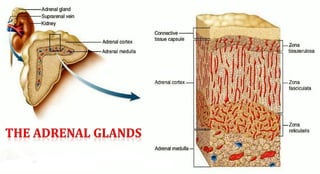
It contains two parts, namely;
ADRENAL MEDULLA and ADRENAL CORTEX
• Adrenal medulla - which is the inner core
and is about 10% to 20% of the gland.
• Adrenal cortex - the thicker portion
constituting 80% to 90% of the mass
THE ADRENAL MEDULLA
 It has a dual nature, acting as both an
endocrine gland and a ganglion of the
sympathetic nervous system
 They secrete a mixture of EPINEPHRINE,
NOREPINEPHRINE, and DOPAMINE
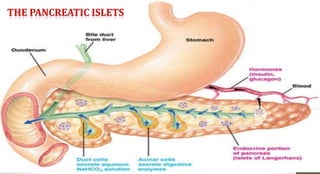
 An elongated, spongy gland located below
and behind the stomach, mostly superficial
to the peritoneum.
 It is approximately 15 cm long and 2.5 cm
thick
 There are about 1 to 2 million endocrine cell
clusters called the Pancreatic Islets
(ISLETS OF LANGERHANS)
 There are about 1 to 2 million
endocrine cell clusters called the
pancreatic islets (islets of
Langerhans)
 The major effect of these
hormones is to regulate
GLYECMIA, the concentration of
glucose in the blood.
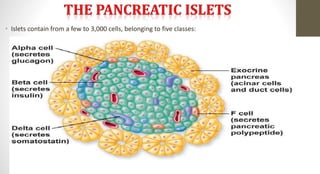
• Islets contain from a few to 3,000 cells, belonging to five classes:
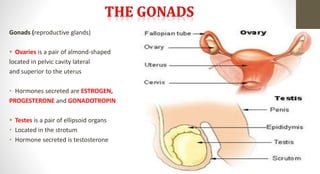
Gonads (reproductive glands)
 Ovaries is a pair of almond-shaped
located in pelvic cavity lateral
and superior to the uterus
• Hormones secreted are ESTROGEN,
PROGESTERONE and GONADOTROPIN
 Testes is a pair of ellipsoid organs
• Located in the strotum
• Hormone secreted is testosterone
 The skin produces CHOLECALCIFEROL.
 The liver involved in the production of at
least five hormones.
 The kidneys secrete most (85%) of the
body’s erythropoietin.
 The heart secretes NATRIURETIC
PEPTIDES.
 Adipose tissue secrete LEPTIN.
 Placenta secrets
ESTROGEN, PROGESTERONE, and other
hormones.
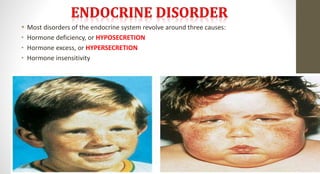
 Most disorders of the endocrine system revolve around three causes:
• Hormone deficiency, or HYPOSECRETION
• Hormone excess, or HYPERSECRETION
• Hormone insensitivity
For more Information:
abrahamdaylee25@gmail.com
adayklee@yahoo.com
Contact: 0880760020/0776782278
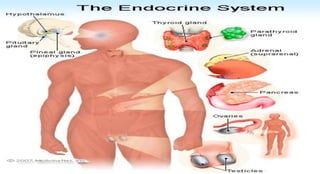
The Endocrin System

The Endocrin System

  • 1.
    Mother Patern Collegeof Health Sciences UN Drive/RandallStreet,Monrovia-Liberia HumanAnatomy (Zoology 411) Presentation Mr.Abraham G. Dayklee Presenter
  • 2.
    • Includes allthe glands of the body and the hormones produced by those glands
  • 3.
    The Endocrine System: Secrete their products into body fluids directly rather than ducts as in the exocrine glands.  The study and treatment of the endocrine system is called ENDOCRINOLOGY
  • 4.
     Cellular metabolism Reproduction  Sexual reproduction  Heart rate  Digestion  Plus other processes regulated by reactions of hormones Generally they regulate metabolic processes or regulated by hormones action.
  • 5.
    Characterized by:  Ductlessnature  Vascularity  Presence of intercellular vacuoles of granules for hormone storage  It has an unusually high density of blood capillaries (fenestrated capillaries)
  • 6.
     Are chemicalmessengers that are secreted into the bloodstream and stimulate responses in distant organs  They affect only their targeted cells with specific receptor.  Classified into two (2) base on the chemical makeup and solubility:  Lipid Soluble Hormones (Steroid Hormones)  Water Soluble Hormones (Non-steroid Hormones)
  • 8.
     The hypothalamus,shaped like a flattened funnel  The hypothalamus is located superior and anterior to the brain stem and inferior to the thalamus.
  • 9.
    Thyrotropin-releasing hormones (TRH) Corticotropin-releasinghormone (CRH) Gonadotropin-releasing hormone (GnRH) Growth hormone-releasing hormone (GHRH) Growth hormone-inhibiting hormone (GHIH) Prolactin-inhibiting hormone (PIH)
  • 10.
     It isattached to the hypothalamus by a stalk ( Infundibulum) and is enclosed in the saddle-like, Sella turcica of the sphenoid bone  It is an ovoid gland about 1.3 cm wide but grows 50% larger during pregnancy  it is composed of two structures: • Adenohypophysis • Neurohypophysis
  • 12.
    The adenohypophysis isthe anterior three-quarters of the pituitary. • It has two parts: • Anterior lobe • Pars tuberalis  Three classes of cells: • Acidophils • Basophils • Chromophobes
  • 13.
    It is theposterior one-quarter of the pituitary And it has three parts: • Posterior lobe (pars nervosa) • Stalk (infundibulum) • Median eminence
  • 14.
    The anterior lobeof the pituitary gland synthesizes and secretes six principal hormones. The first two, are called GONADOTROPINS • Follicle-stimulating hormone (FSH). • Luteinizing hormone (LH). The four others are called TROPIC OR TROPHIC • Thyroid stimulating hormone (TSH) • Adrenocorticotropic hormone • Prolactin (PRL). • Growth hormone (GH)
  • 15.
    The two posteriorlobe hormones, namely:  Antidiuretic Hormone (ADH)  Oxytocin (OT)
  • 17.
    Also called (epiphysiscerebri) – a small pinecone-shaped  It is posterior to the thalamus of the brain and beneath the posterior end of the CORPUS CALLOSUM.  The pineal gland produces the hormone MELATONIN .
  • 18.
    • The thymusplays a role in three systems: Endocrine, Lymphatic, Immune Systems • Is a bilobed gland in the mediastinum superior to the heart, behind the sternal manubrium. • It weighs about 20 g up to age 60. It secretes several hormones • Thymopoietin • Thymosin • Thymulin
  • 19.
    • The largestin adults, weighing 20 to 25 • Composed of two lobes that wrap Like a butterfly around the trachea, Immediately below the larynx. • It is named for the nearby, Shield-like thyroid cartilage Of the larynx
  • 20.
    Are small ovoidglands in the neck measuring about 3 to 8 mm long and 2 to 5 mm wide. • They adhere to the posterior side of the thyroid gland.
  • 21.
    Also known asSuprarenal gland is attached to the superior to medial aspect of each kidney. Include 2 types: • The right adrenal gland is more or less triangular and rests on the superior pole of the kidney. • The left adrenal gland is more crescent- shaped and extends from the medial indentation (hilum) of the kidney to its superior pols. • Like the kidneys, the adrenal glands are retroperitoneal, lying side the peritoneal cavity between the peritoneum and post body wall. • In adults, is measures about 5 cm high, 3 cm wide and 1 cm from anterior to posterior. It weighs 7 to 10 g.
  • 22.
    It contains twoparts, namely; ADRENAL MEDULLA and ADRENAL CORTEX • Adrenal medulla - which is the inner core and is about 10% to 20% of the gland. • Adrenal cortex - the thicker portion constituting 80% to 90% of the mass THE ADRENAL MEDULLA  It has a dual nature, acting as both an endocrine gland and a ganglion of the sympathetic nervous system  They secrete a mixture of EPINEPHRINE, NOREPINEPHRINE, and DOPAMINE
  • 24.
     An elongated,spongy gland located below and behind the stomach, mostly superficial to the peritoneum.  It is approximately 15 cm long and 2.5 cm thick  There are about 1 to 2 million endocrine cell clusters called the Pancreatic Islets (ISLETS OF LANGERHANS)  There are about 1 to 2 million endocrine cell clusters called the pancreatic islets (islets of Langerhans)  The major effect of these hormones is to regulate GLYECMIA, the concentration of glucose in the blood.
  • 26.
    • Islets containfrom a few to 3,000 cells, belonging to five classes:
  • 27.
    Gonads (reproductive glands) Ovaries is a pair of almond-shaped located in pelvic cavity lateral and superior to the uterus • Hormones secreted are ESTROGEN, PROGESTERONE and GONADOTROPIN  Testes is a pair of ellipsoid organs • Located in the strotum • Hormone secreted is testosterone
  • 28.
     The skinproduces CHOLECALCIFEROL.  The liver involved in the production of at least five hormones.  The kidneys secrete most (85%) of the body’s erythropoietin.  The heart secretes NATRIURETIC PEPTIDES.  Adipose tissue secrete LEPTIN.  Placenta secrets ESTROGEN, PROGESTERONE, and other hormones.
  • 29.
     Most disordersof the endocrine system revolve around three causes: • Hormone deficiency, or HYPOSECRETION • Hormone excess, or HYPERSECRETION • Hormone insensitivity
  • 30.