
Presented By
Prof. Dr. Poonam Nilesh Chougule
HOD & Associate Professor
Pharmacognosy Department
AMCP- Peth-Vadgaon.
The Multidisciplinary Nature Of
Environmental Studies
Content
• The Multidisciplinary nature of environmental studies:
Natural Resources
• Renewable and non-renewable resources
• Natural resources and associated problems
a) Forest resources;
b) Water resources;
c) Mineral resources;
d) Food resources;
e) Energy resources;
f) Land resources.
Role of an individual in conservation of natural resources.
Introduction to Environmental Studies (EVS):
• Environmental Studies (EVS) is a multidisciplinary
subject that explores the relationship between humans
and their natural surroundings. It combines knowledge
from science, social studies, and ethics to understand
environmental issues and promote sustainable living.
EVS helps us learn about the importance of air, water,
soil, plants, animals, and ecosystems. It also
encourages us to take care of the environment,
conserve resources, and make responsible choices to
protect our planet for future generations.
Definition
• EVS (Environmental Studies) is the study of
the environment and how living and non-living
things interact with it. It helps us understand
nature, protect natural resources, and solve
environmental problems.
• It is basically a versatile or we can say an
associative approach that make us realize about
our natural world and value on its truthfulness.
Why is it important to study Environmental Studies (EVS)?
Studying EVS is important for several reasons:
1. Awareness: It helps us understand the environment and the challenges
it faces, such as pollution, climate change, deforestation, and loss of
biodiversity.
2. Responsibility: EVS teaches us how human activities affect nature and
encourages us to take responsibility for protecting the environment.
3. Sustainability: It promotes the sustainable use of natural resources so
that future generations can also enjoy a healthy planet.
4. Problem Solving: EVS helps us develop solutions to environmental
problems through knowledge, innovation, and action.
5. Healthy Living: Understanding the environment helps us live
healthier lives by ensuring clean air, water, and food.
Scope of Environmental Studies (EVS):
The scope of EVS is wide and includes everything related to the natural and
human-made environment.
 Understanding Ecosystems: Studying how living organisms interact with each
other and with their surroundings (like forests, rivers, oceans, and deserts).
 Natural Resources: Learning about the use and conservation of natural
resources such as air, water, soil, minerals, and energy.
 Environmental Issues: Exploring problems like pollution, climate change,
global warming, deforestation, and loss of biodiversity.
 Environmental Management: Learning how to manage waste, reduce
pollution, and develop eco-friendly technologies.
 Laws and Policies: Understanding environmental laws, acts, and international
agreements that help protect nature.
 Human and Environmental Interaction: Studying how human activities
impact the environment and how we can live sustainably.
 Environmental Education: Spreading awareness and encouraging positive
actions to protect nature.
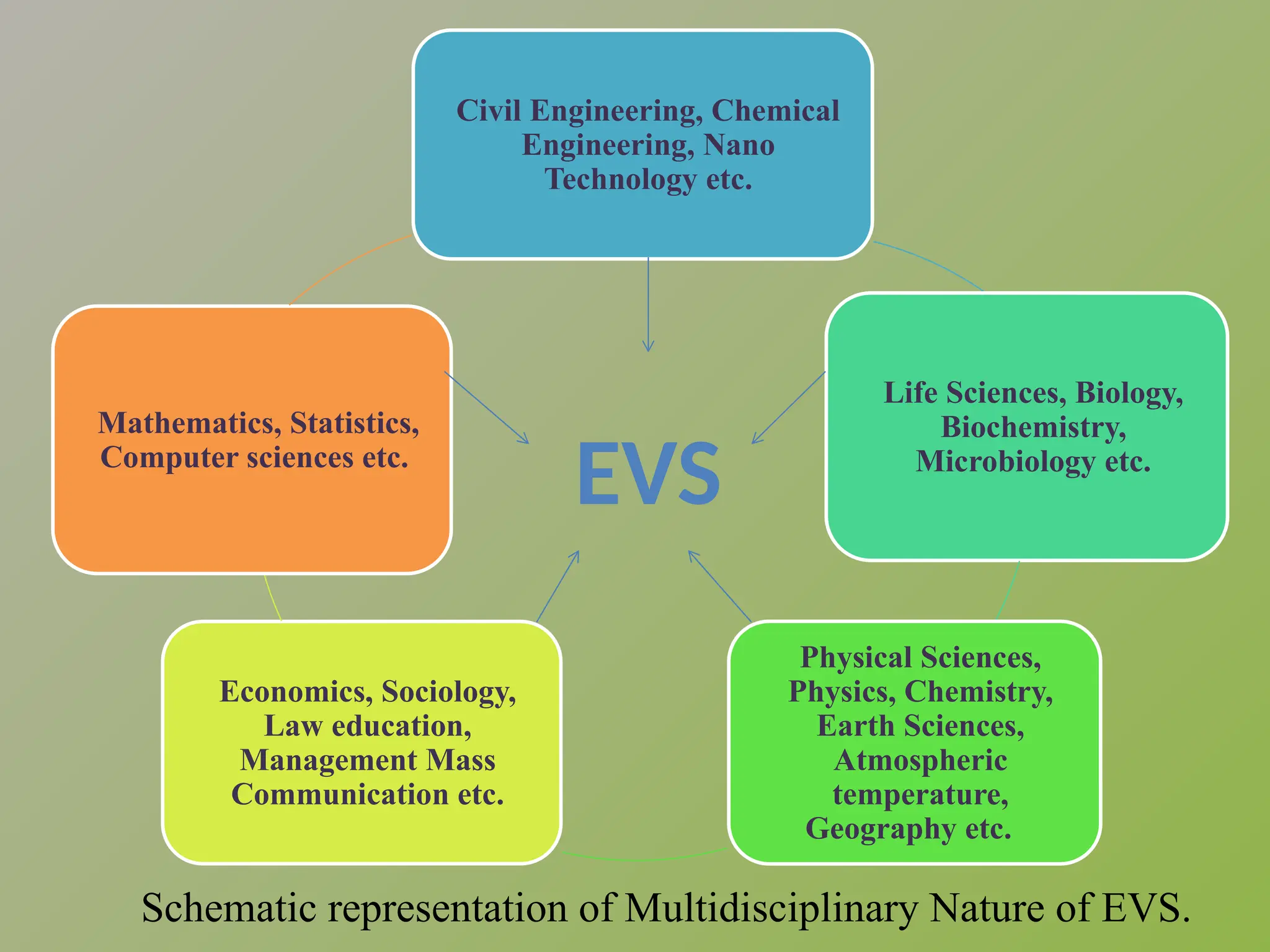
Schematic representation of Multidisciplinary Nature of EVS.
Civil Engineering, Chemical
Engineering, Nano
Technology etc.
Life Sciences, Biology,
Biochemistry,
Microbiology etc.
Physical Sciences,
Physics, Chemistry,
Earth Sciences,
Atmospheric
temperature,
Geography etc.
Economics, Sociology,
Law education,
Management Mass
Communication etc.
Mathematics, Statistics,
Computer sciences etc.
EVS
Significance of Environmental Studies:
 Environmental Studies plays a vital role in our lives. Here’s why it is significant:
 Creates Environmental Awareness: EVS helps us understand the importance of
nature and the need to protect it.
 Promotes Sustainable Development: It teaches us how to use resources wisely,
ensuring they are available for future generations.
 Encourages Responsible Behavior: EVS inspires individuals and communities
to adopt eco-friendly habits and reduce their environmental impact.
 Solves Environmental Problems: It provides knowledge and tools to address
issues like pollution, climate change, and waste management.
 Improves Quality of Life: A clean and healthy environment contributes to better
health and overall well-being.
 Supports Policy Making: EVS knowledge helps in forming laws and policies for
environmental protection and resource conservation.
 Interdisciplinary Learning: It connects science, economics, ethics, and social
studies, giving a complete understanding of environmental issues.
 In summary, EVS is significant because it helps us live in harmony with nature,
protect the planet, and ensure a better future for all.
Renewable and non-renewable resources
Introduction to Renewable and Non-Renewable Resources:
• Natural resources are materials found in nature that are used by humans for
various needs like food, energy, shelter, and transportation. These resources
are broadly classified into renewable and non-renewable based on their
availability and ability to regenerate.
• Renewable Resources:
These are resources that can be naturally replenished or regenerated over
time. Examples include sunlight, wind, water, and biomass. They are
generally considered sustainable because they are available continuously or
can be regenerated quickly.
• Non-Renewable Resources:
These are resources that take millions of years to form and cannot be replaced
once they are used up. Examples include coal, petroleum, natural gas, and
minerals. These resources are limited and can eventually run out if not used
wisely.
• Let’s see one by one…..
Forest Resources
Introduction:
Forest resources refer to the various products and benefits that we obtain from
forests. Forests are one of the most important natural resources on Earth, covering
about 31% of the planet's land area. They are rich in biodiversity and play a key role
in maintaining ecological balance.
Types of Forest Resources:
• Timber and Wood Products:
Used for furniture, construction, paper, and fuel.
• Non-Timber Forest Products (NTFPs):
Includes fruits, nuts, honey, medicinal plants, gum, and resins.
• Habitat for Wildlife:
Forests provide shelter and food for a wide variety of animal and plant species.
• Ecological Functions:
– Absorb carbon dioxide and release oxygen
– Prevent soil erosion
– Maintain the water cycle
– Control floods and droughts.
Significances of forest resources:
• Forests are one of the most valuable natural resources on Earth.
They are often referred to as the "lungs of the planet" because of
their crucial role in producing oxygen and maintaining the balance
of gases in the atmosphere. The significance of forest resources is
vast, covering ecological, economic, social, and cultural aspects of
human life.
• Firstly, forests play a vital role in maintaining ecological balance.
They absorb carbon dioxide and release oxygen, helping to reduce
the impact of global warming and climate change. Forests also
regulate the water cycle by attracting rainfall and preventing water
runoff, which is essential for maintaining groundwater levels. In
addition, they protect against natural disasters such as floods,
droughts, and soil erosion by holding the soil firmly with their
roots and maintaining moisture levels in the air and ground.
• Secondly, forests are a rich source of biodiversity. They
provide a habitat for countless species of plants, animals,
birds, and microorganisms. Many of these species are found
only in forest ecosystems and play an important role in the
functioning of food chains and ecological processes. The
protection of forests is essential to prevent the extinction of
these species and to preserve biodiversity.
• Economically, forests provide a wide range of forest
products that are essential to our daily lives. These include
timber for construction, fuelwood, paper, rubber, and
various non-timber products such as medicinal plants,
fruits, nuts, resins, and oils. Forests also contribute
significantly to the economy through industries like wood
processing, herbal medicine, and tourism.
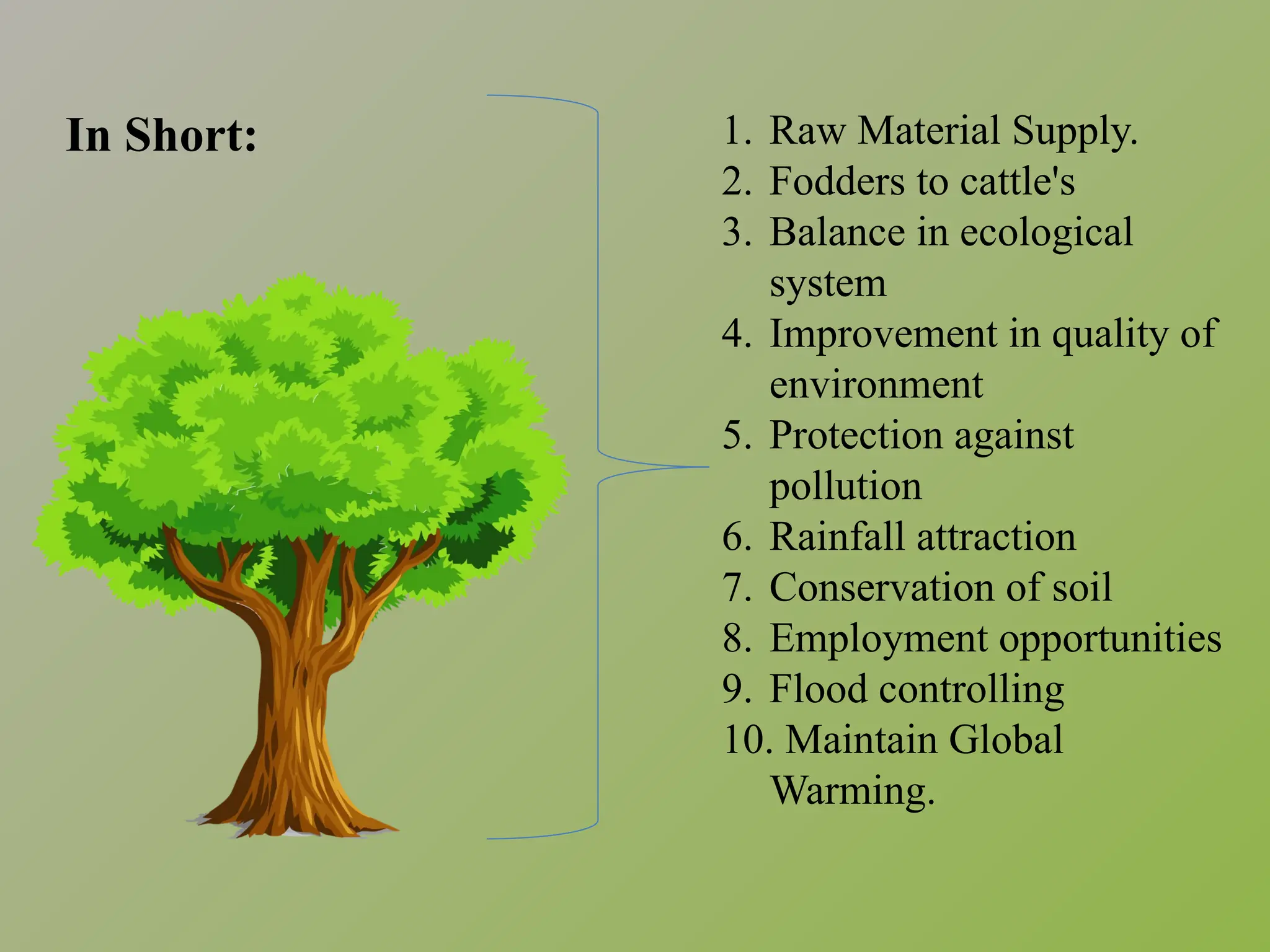
1. Raw Material Supply.
2. Fodders to cattle's
3. Balance in ecological
system
4. Improvement in quality of
environment
5. Protection against
pollution
6. Rainfall attraction
7. Conservation of soil
8. Employment opportunities
9. Flood controlling
10. Maintain Global
Warming.
In Short:
Importance of Forest Resources:
• Support biodiversity
• Provide livelihood to millions of people
• Help combat climate change
• Maintain environmental balance
Conservation of Forests: Due to deforestation and overuse,
forest resources are under threat. Conservation methods
include afforestation, reforestation, sustainable logging,
wildlife protection laws, and awareness programs.
In summary, forest resources are vital for life on Earth, and
their protection is essential for a healthy and sustainable
environment.
Forest Coverage Status in India:
As per the India State of Forest Report (ISFR) 2023, India's total forest and tree cover
has reached 827,357 square kilometers, which is about 25% of the country's
geographical area. This marks an increase of approximately 1,445.8 sq km
compared to the previous assessment in 2021 .​The Times of India+1Deccan Herald+1
Forest Cover Statistics (2023):
• Total Forest Cover: Approximately 715,343 sq km, constituting 21.76% of
India's geographical area .​Deccan Herald
• Tree Cover: Around 112,014 sq km, accounting for 3.24% of the geographical
area.​
Top States by Forest Area:
• Madhya Pradesh: 77,073 sq km​Press Information Bureau
• Arunachal Pradesh: 65,882 sq km ​
Press Information Bureau+1Drishti IAS+1
• Chhattisgarh: 55,812 sq km ​
Press Information Bureau
States with Highest Forest Cover Percentage (relative to their area):
• Lakshadweep: 91.33%​Press Information Bureau
• Mizoram: 85.34%​
• Andaman & Nicobar Islands: 81.62%​Press Information Bureau
• States with Lowest Forest Cover Percentage:
• Haryana: Approximately 3.6%​
• Punjab: Just over 3% .​
Statista
Forest Cover Changes (2021–2023):
• Increase in Forest Cover: The total forest cover increased by about 1,554 sq
km from 2021 to 2023 .​Deccan Herald
• States with Maximum Increase in Forest Cover:
– Mizoram: 242 sq km​Drishti IAS+4Press Information Bureau+4Financial
Services Institute+4
– Gujarat: 180 sq km​Press Information Bureau+5Wikipedia+5Wikipedia+5
– Odisha: 152 sq km .​
States with Maximum Increase in Forest and Tree Cover:
– Chhattisgarh: 684 sq km​
– Uttar Pradesh: 559 sq km​
– Odisha: 559 sq km​
– Rajasthan: 394 sq km .​
Forest Types in India: India's forests are diverse, including:
Tropical Wet Evergreen Forests, Tropical Deciduous Forests,
Montane and Alpine Forests, Mangrove Forests, Subtropical Pine
Forests
• These forests support a wide range of biodiversity and play a
crucial role in maintaining ecological balance.​
Forest Over-Usage :
• Forest over-usage refers to the excessive and unsustainable
exploitation of forest resources such as wood, fuel, and non-timber
products. This leads to deforestation, loss of biodiversity, and
disruption of ecological balance.
• Over-logging, illegal cutting, forest fires, and expansion of
agriculture are major causes. It affects wildlife habitats, contributes
to climate change, and results in soil erosion and reduced rainfall.
• Continuous overuse weakens the forest’s ability to regenerate,
threatening the environment and livelihoods dependent on it.
Sustainable management and conservation practices are essential to
protect forests for future generations and maintain the health of our
planet.
Deforestation: Causes and Solutions
Deforestation is the large-scale removal of forests, leading to loss of trees and
natural habitats. It is a major environmental concern affecting biodiversity,
climate, and the livelihoods of millions.
Causes of Deforestation:
• Agricultural Expansion: Clearing forests for farming and livestock grazing.
• Urbanization: Cutting trees for buildings, roads, and infrastructure.
• Logging: Excessive cutting of trees for timber, paper, and fuelwood.
• Mining Activities: Forests are cleared for mining minerals and fossil fuels.
• Forest Fires: Both natural and man-made fires destroy vast forest areas.
• Infrastructure Development: Dams, highways, and industrial projects often
lead to deforestation.
Solutions to Deforestation:
• Afforestation and Reforestation: Planting new trees and
restoring damaged forests.
• Sustainable Forest Management: Using forest resources
responsibly without harming ecosystems.
• Legal Protection: Enforcing laws to prevent illegal
logging and forest encroachment.
• Alternative Resources: Promoting eco-friendly
substitutes for wood and paper.
• Awareness Campaigns: Educating people about the
importance of forests.
• Community Involvement: Encouraging local
participation in forest conservation efforts.
Water Resources
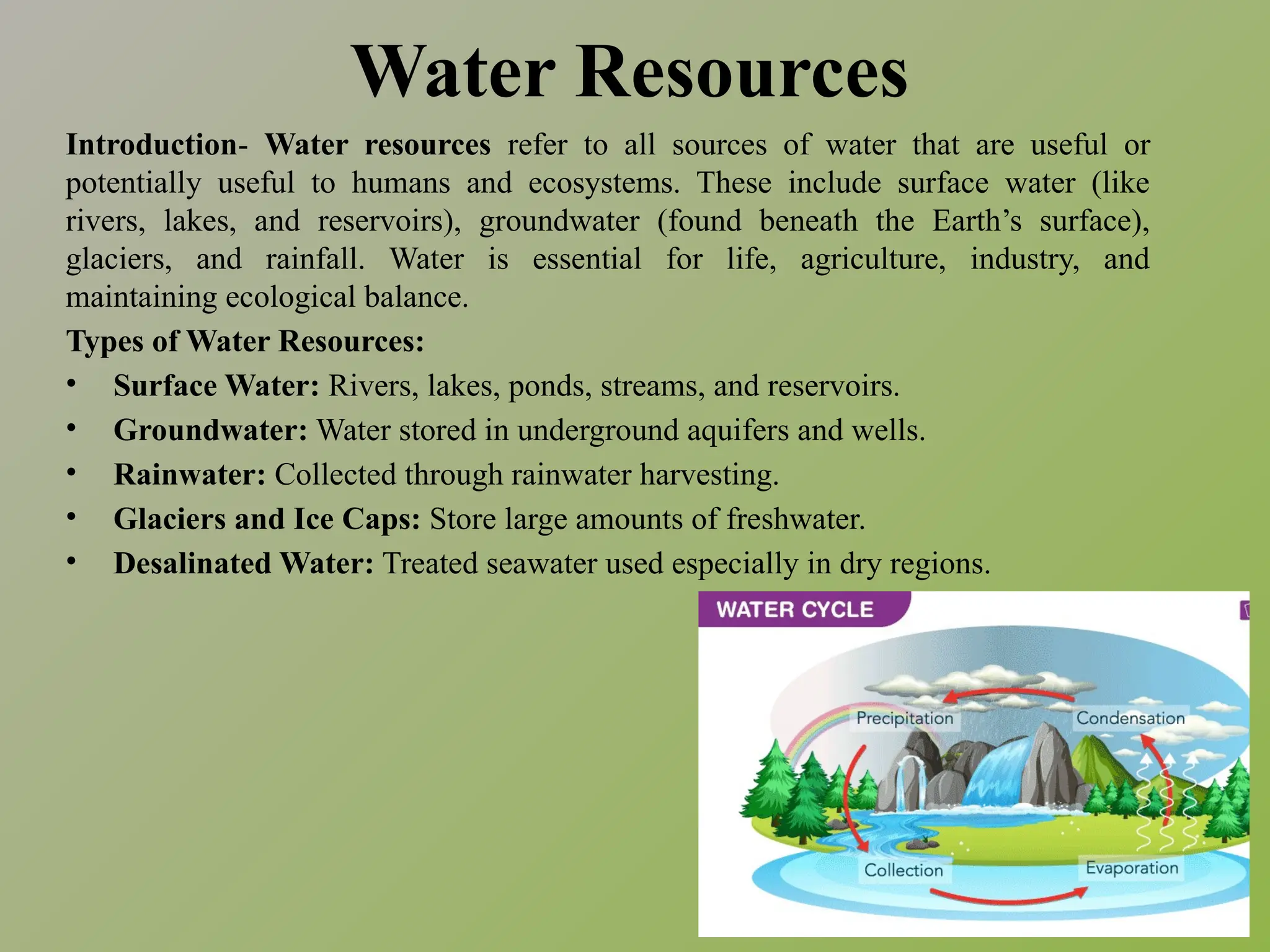
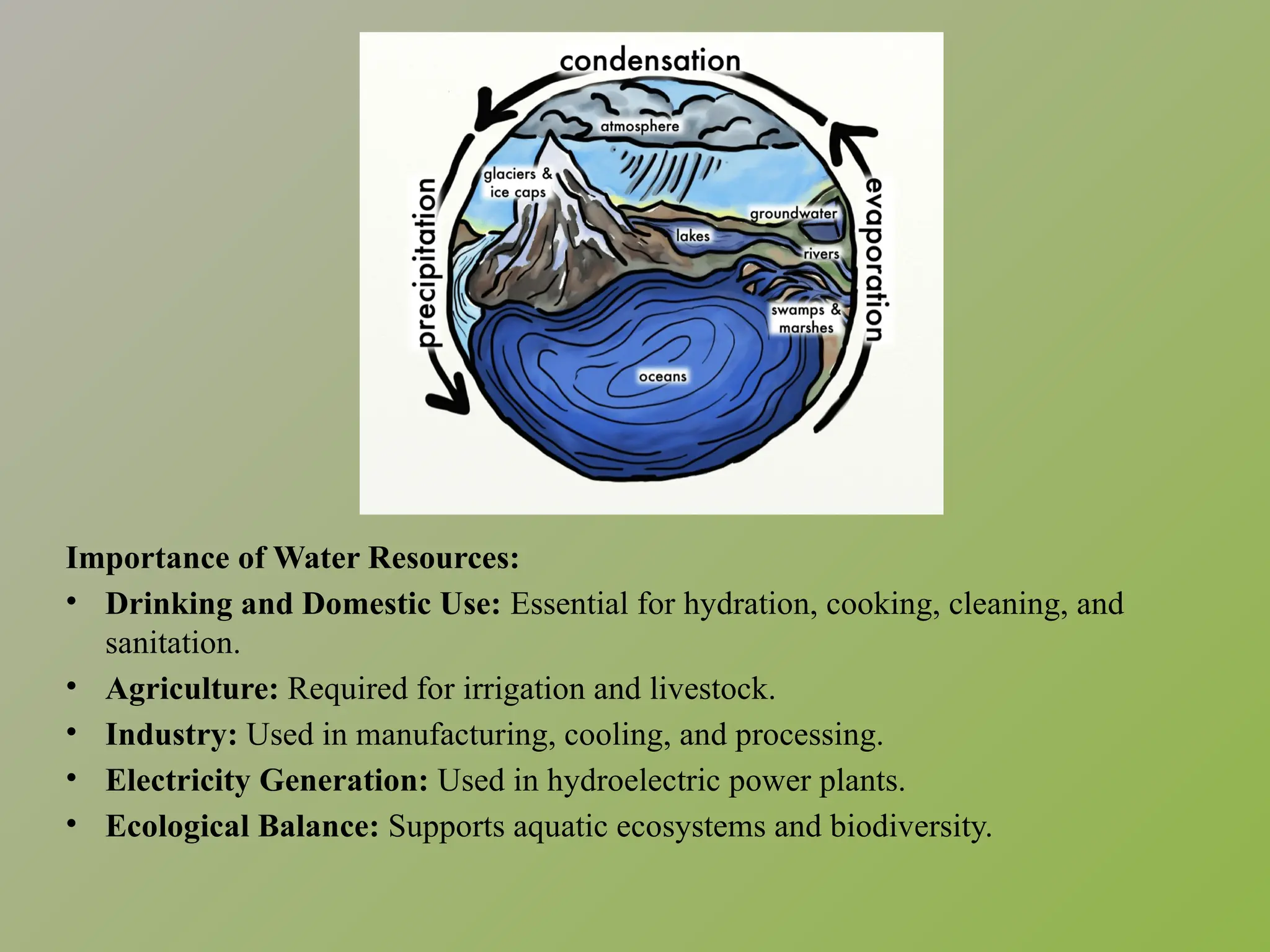
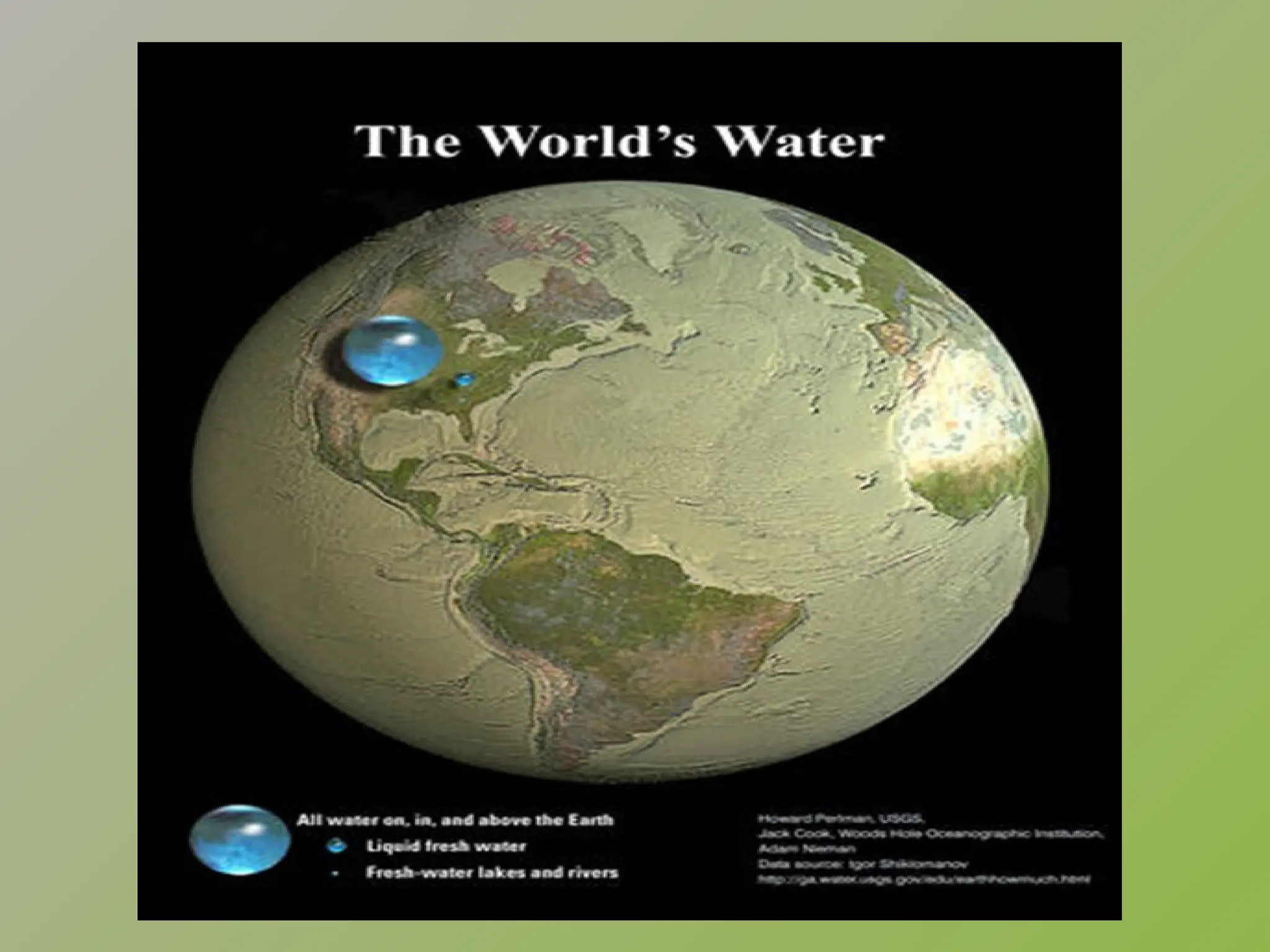
Introduction- Water resources refer to all sources of water that are useful or
potentially useful to humans and ecosystems. These include surface water (like
rivers, lakes, and reservoirs), groundwater (found beneath the Earth’s surface),
glaciers, and rainfall. Water is essential for life, agriculture, industry, and
maintaining ecological balance.
Types of Water Resources:
• Surface Water: Rivers, lakes, ponds, streams, and reservoirs.
• Groundwater: Water stored in underground aquifers and wells.
• Rainwater: Collected through rainwater harvesting.
• Glaciers and Ice Caps: Store large amounts of freshwater.
• Desalinated Water: Treated seawater used especially in dry regions.
Challenges to Water Resources:
• Water pollution from industries and
agriculture
• Overuse and wastage of water
• Depletion of groundwater
• Climate change affecting rainfall and
water availability
Conservation of Water Resources:
• Rainwater harvesting
• Reducing water pollution
• Reusing and recycling water
• Spreading awareness about water
conservation
• Implementing water-saving technologies
in agriculture and industry
Importance of Water Resources:
• Drinking and Domestic Use: Essential for hydration, cooking, cleaning, and
sanitation.
• Agriculture: Required for irrigation and livestock.
• Industry: Used in manufacturing, cooling, and processing.
• Electricity Generation: Used in hydroelectric power plants.
• Ecological Balance: Supports aquatic ecosystems and biodiversity.
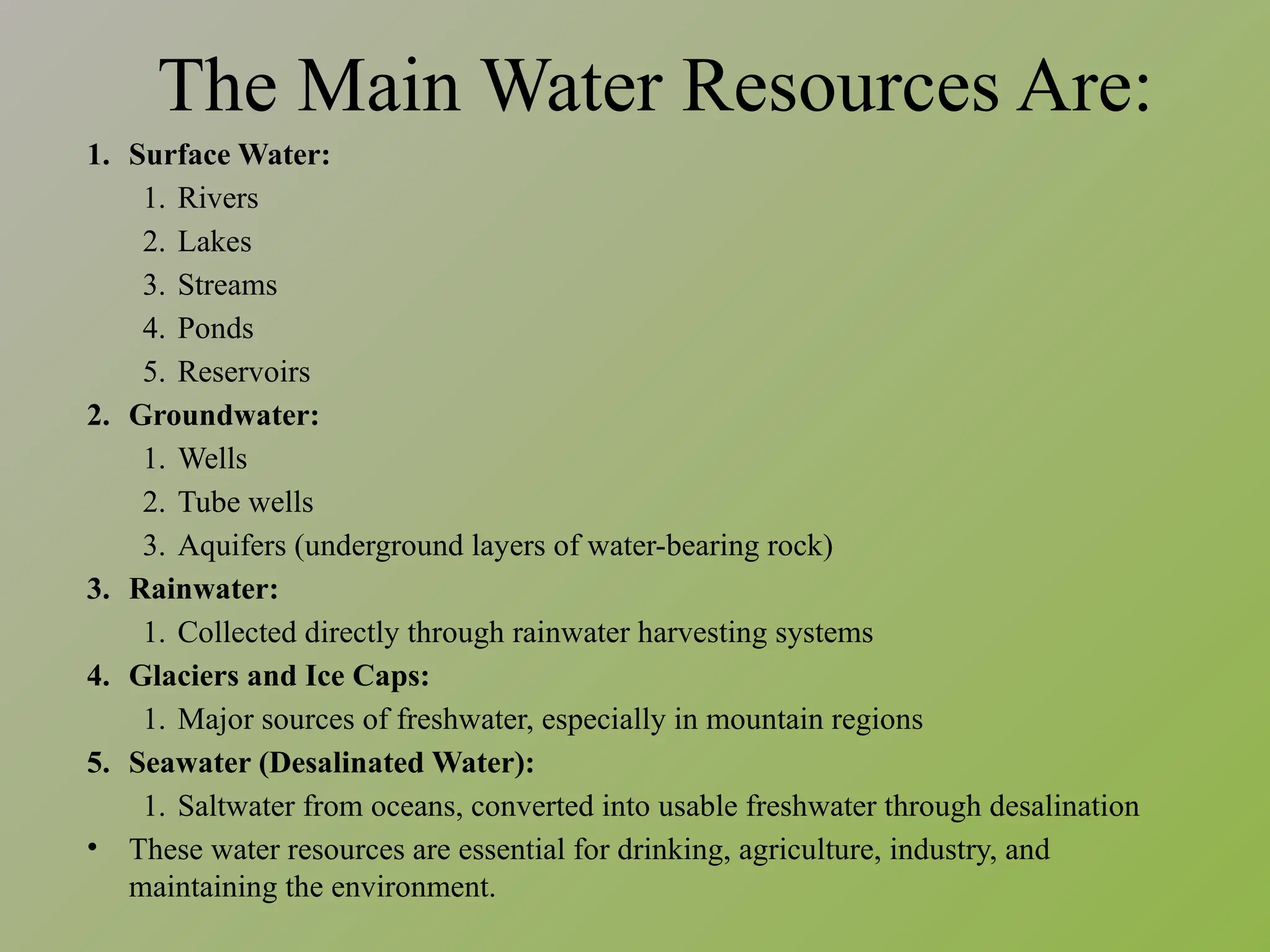
The Main Water Resources Are:
1. Surface Water:
1. Rivers
2. Lakes
3. Streams
4. Ponds
5. Reservoirs
2. Groundwater:
1. Wells
2. Tube wells
3. Aquifers (underground layers of water-bearing rock)
3. Rainwater:
1. Collected directly through rainwater harvesting systems
4. Glaciers and Ice Caps:
1. Major sources of freshwater, especially in mountain regions
5. Seawater (Desalinated Water):
1. Saltwater from oceans, converted into usable freshwater through desalination
• These water resources are essential for drinking, agriculture, industry, and
maintaining the environment.
Rain Water:
Rainwater – Introduction
Rainwater is the water that falls from clouds in the form of rain. It is a natural and pure source of
freshwater that plays a vital role in replenishing water bodies, recharging groundwater, and
supporting life on Earth.
Importance of Rainwater:
• Natural Source of Freshwater:
It helps fill rivers, lakes, and ponds.
• Supports Agriculture:
Provides water for crops and improves soil moisture.
• Recharges Groundwater:
Rain seeps into the ground and refills underground water reserves.
• Maintains Ecosystems:
Rainwater supports forests, plants, and wildlife.
• Reduces Dependence on Other Sources:
It can be collected and used for household, farming, and gardening needs.
Rainwater Harvesting:
• Rainwater can be collected and stored using rainwater harvesting systems. This involves
capturing rain from rooftops, paved areas, or land surfaces and storing it in tanks or letting it
soak into the ground to recharge wells.
Benefits of Rainwater:
• Fresh and Natural Water Source:
Rainwater is clean and free from many pollutants when it first falls, making it a good source of
water for various uses.
• Recharges Groundwater:
Helps refill wells, ponds, and underground aquifers, especially important in areas facing water
scarcity.
• Reduces Water Bills:
Collected rainwater can be used for domestic chores like washing, cleaning, and gardening,
reducing the use of tap water.
• Prevents Water Logging and Soil Erosion:
Proper rainwater harvesting controls excess surface runoff, reducing the risk of flooding and
erosion.
• Supports Agriculture:
Provides a natural source of irrigation, especially useful in rain-fed farming areas.
• Environmentally Friendly:
Promotes sustainable water use and reduces dependence on treated or pumped water sources.
• Reduces Pressure on Municipal Water Supply:
Helps in conserving public water resources and energy used in water treatment and distribution.
Sources of Water Pollution:
Water pollution occurs when harmful substances contaminate water bodies such as rivers, lakes,
oceans, and groundwater. These pollutants come from various sources, which can be broadly
classified into point sources and non-point sources.
Major Sources of Water Pollution:
• Industrial Waste:
– Factories discharge chemicals, heavy metals, and toxins into rivers and lakes.
– These pollutants are harmful to aquatic life and human health.
• Sewage and Domestic Waste:
– Untreated or poorly treated sewage from households contains harmful bacteria, viruses,
and nutrients that pollute water.
• Agricultural Runoff:
– Pesticides, fertilizers, and animal waste wash into water bodies during rainfall.
– This leads to nutrient pollution and causes algae blooms.
• Oil Spills:
– Leakage of oil from ships or pipelines pollutes oceans and coastal waters, harming
marine life.
• Plastic and Solid Waste:
– Garbage, especially plastic, thrown into water bodies can choke aquatic animals and
disrupt ecosystems.
• Thermal Pollution:
– Hot water released from industries or power plants raises the temperature of
water bodies, affecting aquatic life
• Mining Activities:
– Mining operations release heavy metals and toxic substances into nearby
water sources.
• Marine Dumping:
– Dumping of industrial, radioactive, and household waste into oceans pollutes
the water and sea life.
• Leakage from Landfills:
– Toxic substances from landfill sites seep into groundwater, contaminating it.
• Urban Runoff:
– Water from roads and cities picks up pollutants like oil, metals, and chemicals
and flows into nearby rivers or lakes.
• Water pollution is caused by both human activities and natural processes.
Preventing it requires proper waste treatment, sustainable practices, and public
awareness to protect water sources for current and future use.
Tidal energy
Introduction: is a form of renewable energy generated by harnessing the natural
rise and fall of ocean tides. It is produced by the movement of large volumes of
water caused by the gravitational pull of the moon and the sun. Tidal power plants
use underwater turbines or barrages (dams) to convert the kinetic and potential
energy of tides into electricity.
Disadvantages of Tidal Energy:
 High Initial Cost: Building tidal
power stations and underwater
turbines is expensive.
 Limited Suitable Locations: Only
areas with strong tidal ranges are
viable for energy generation.
 Environmental Impact: May affect
marine ecosystems and fish migration
patterns.
 Intermittent Energy Generation:
Energy can only be generated when
tides are moving, not continuously.
 Maintenance Challenges: Saltwater
can cause corrosion and damage to
underwater equipment.
Advantages of Tidal Energy:
 Renewable and Sustainable: Tidal
energy is limitless and naturally
replenished.
 Environmentally Friendly: It
produces no greenhouse gases or
harmful emissions.
 Efficient Energy Source: High
energy output compared to wind and
solar under suitable conditions.
 Long Operational Life: Tidal energy
systems have a long lifespan and
require low maintenance.
 Reduces Dependence on Fossil
Fuels: Helps in promoting clean and
green energy.
Mineral Resources
Introduction
Mineral resources are naturally occurring substances found in the Earth’s crust
that have economic value. These include metals, non-metals, and fuels which
are extracted through mining and used in various industries and day-to-day life.
They are essential for making tools, machines, construction materials, and even
electronic devices.
• Types of Mineral Resources:
1. Metallic Minerals:
1. Examples: Iron, copper, gold, silver, aluminum
2. Used in construction, machinery, transportation, and electronics.
2. Non-Metallic Minerals:
1. Examples: Limestone, gypsum, mica, quartz
2. Used in industries like cement, glass, and ceramics.
3. Energy Minerals (Fuel Minerals):
1. Examples: Coal, petroleum, natural gas, uranium
2. Used as fuel for electricity generation, transportation, and heating.
Importance of Mineral Resources:
• Industrial Development: Backbone of manufacturing and
infrastructure.
• Economic Growth: Boosts national income through mining and
exports.
• Employment: Creates job opportunities in mining and related sectors.
• Everyday Use: Used in buildings, vehicles, electronics, utensils, etc.
Conservation of Mineral Resources:
• Minerals are non-renewable, so we must use them wisely:
• Use alternative materials when possible.
• Recycle metals and minerals.
• Promote efficient mining and reduce wastage.
• Encourage research into sustainable practices.
Fuel Minerals
Introduction
• Fuel minerals, also known as energy minerals, are natural resources that are
used to produce energy. These minerals are burned or processed to generate
electricity, power vehicles, and support various industrial activities. They are
crucial for modern life and economic development.
• Types of Fuel Minerals:
1. Coal:
1. Most widely used fuel mineral.
2. Used in thermal power plants, steel production, and as a domestic fuel.
2. Petroleum (Crude Oil):
1. Used to produce petrol, diesel, kerosene, and lubricants.
2. Powers vehicles, airplanes, and industrial machinery.
3. Natural Gas:
1. A clean-burning fuel used for cooking, heating, and electricity generation.
2. Also used as a raw material in fertilizer and chemical industries.
4. Uranium and Thorium:
1. Nuclear fuel minerals used in atomic power plants.
2. Provide a powerful and efficient source of energy.
Importance of Fuel Minerals:
• Energy Production: Backbone of electricity generation.
• Transportation: Fuels vehicles, ships, and aircraft.
• Industrial Use: Powers machines, manufacturing, and
chemical industries.
• Economic Growth: Drives industrial development and trade.
• Challenges and Conservation:
• Non-renewable: These resources are limited and can run out.
• Environmental Impact: Burning fuel minerals leads to air
pollution and climate change.
• Need for Alternatives: Renewable energy sources like solar,
wind, and hydro should be promoted.
Metallic and Non-Metallic Minerals
Introduction and Differences
Minerals are naturally occurring substances found in the Earth. Based on their composition
and uses, they are mainly classified into metallic and non-metallic minerals.
1. Metallic Minerals:
Definition:
Metallic minerals are those that contain metal elements in their chemical composition.
They usually have a shiny surface and are good conductors of heat and electricity.
Examples:
• Iron ore (Hematite, Magnetite)
• Bauxite (Aluminum)
• Copper
• Gold
• Silver
• Manganese
• Zinc
Uses:
• Used in making tools, machinery, vehicles, buildings, and electrical wires.
• Important for industrial and economic development.
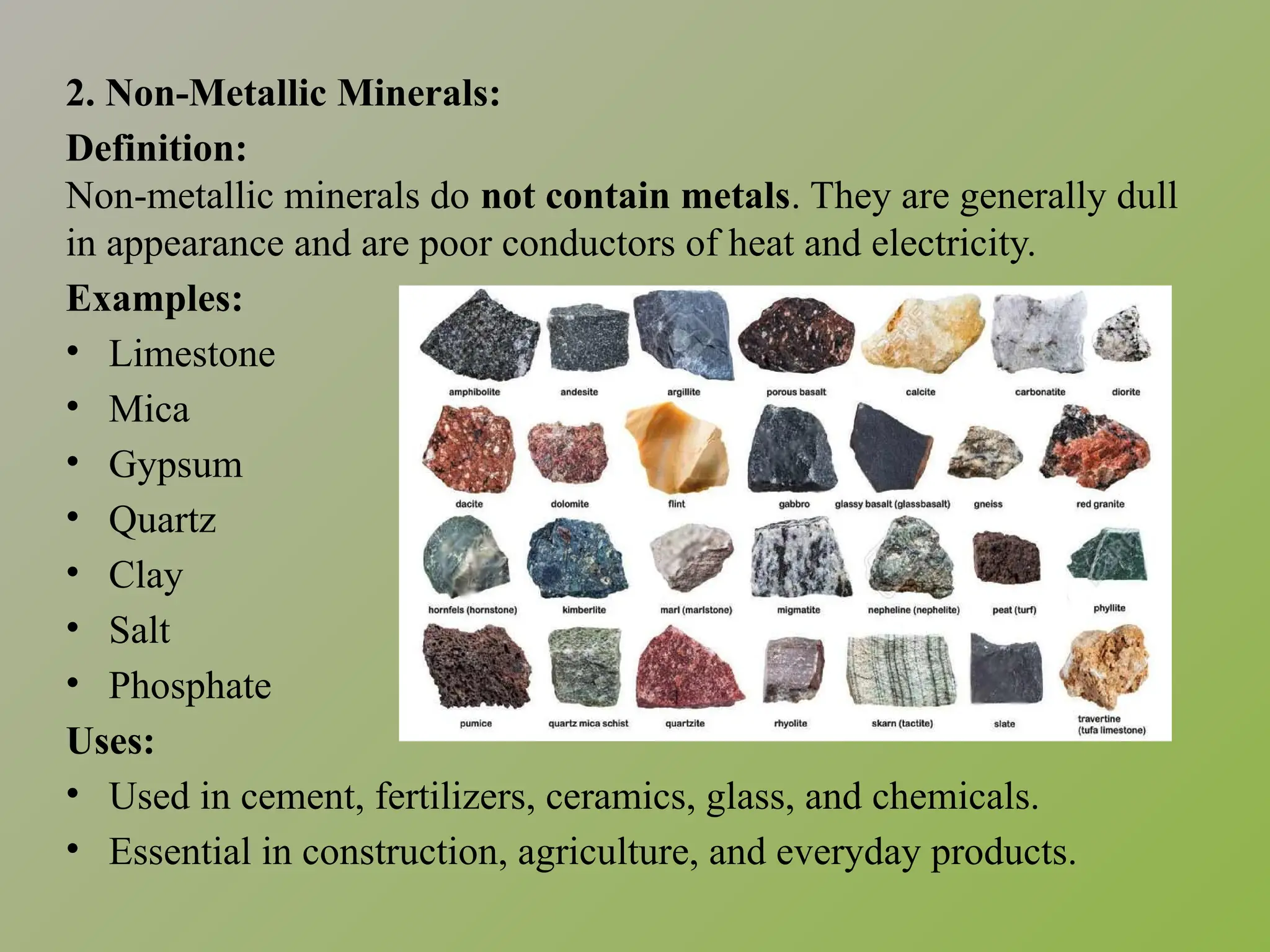
2. Non-Metallic Minerals:
Definition:
Non-metallic minerals do not contain metals. They are generally dull
in appearance and are poor conductors of heat and electricity.
Examples:
• Limestone
• Mica
• Gypsum
• Quartz
• Clay
• Salt
• Phosphate
Uses:
• Used in cement, fertilizers, ceramics, glass, and chemicals.
• Essential in construction, agriculture, and everyday products.
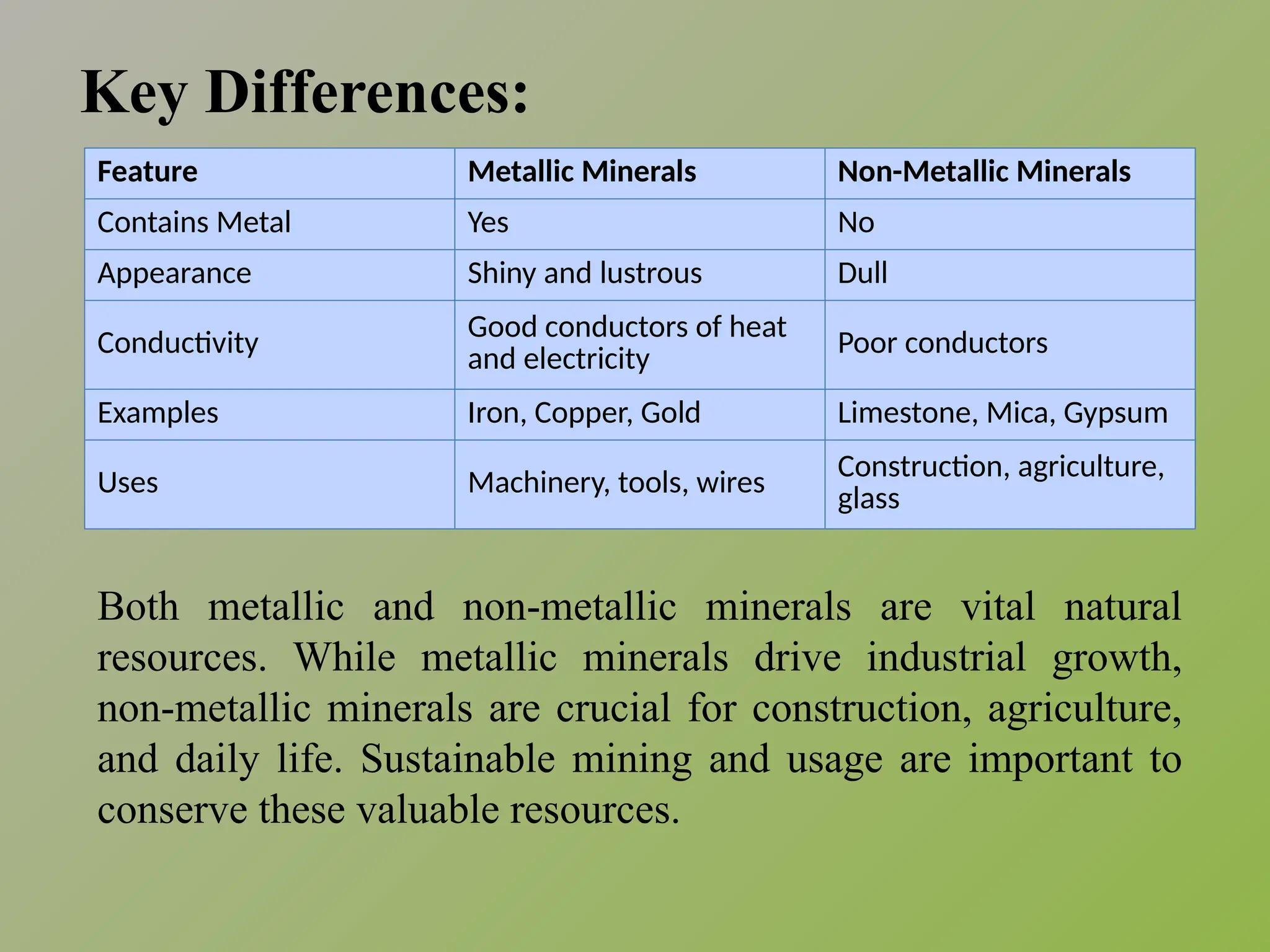
Feature Metallic Minerals Non-Metallic Minerals
Contains Metal Yes No
Appearance Shiny and lustrous Dull
Conductivity
Good conductors of heat
and electricity
Poor conductors
Examples Iron, Copper, Gold Limestone, Mica, Gypsum
Uses Machinery, tools, wires
Construction, agriculture,
glass
Key Differences:
Both metallic and non-metallic minerals are vital natural
resources. While metallic minerals drive industrial growth,
non-metallic minerals are crucial for construction, agriculture,
and daily life. Sustainable mining and usage are important to
conserve these valuable resources.
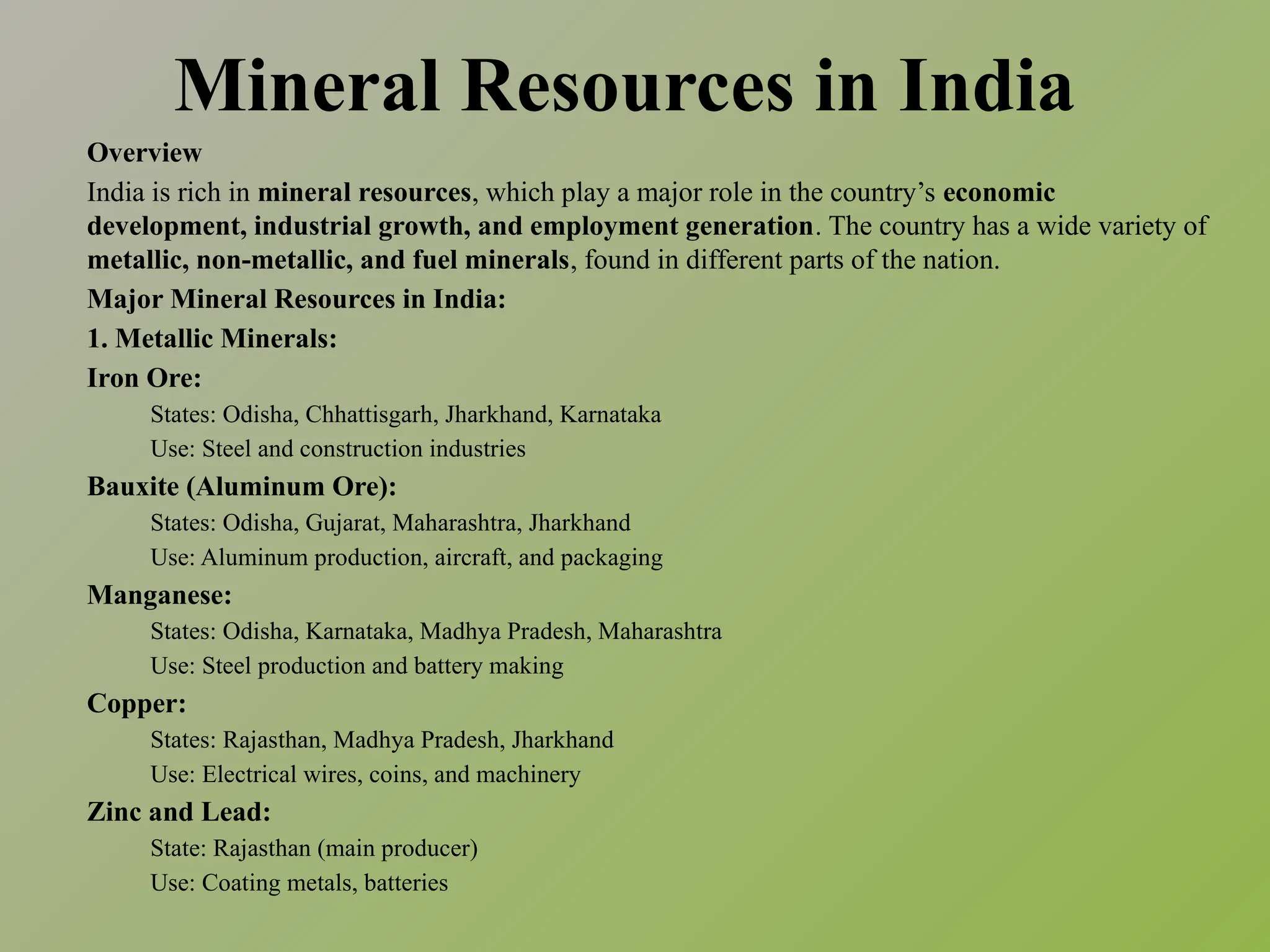
Mineral Resources in India
Overview
India is rich in mineral resources, which play a major role in the country’s economic
development, industrial growth, and employment generation. The country has a wide variety of
metallic, non-metallic, and fuel minerals, found in different parts of the nation.
Major Mineral Resources in India:
1. Metallic Minerals:
Iron Ore:
States: Odisha, Chhattisgarh, Jharkhand, Karnataka
Use: Steel and construction industries
Bauxite (Aluminum Ore):
States: Odisha, Gujarat, Maharashtra, Jharkhand
Use: Aluminum production, aircraft, and packaging
Manganese:
States: Odisha, Karnataka, Madhya Pradesh, Maharashtra
Use: Steel production and battery making
Copper:
States: Rajasthan, Madhya Pradesh, Jharkhand
Use: Electrical wires, coins, and machinery
Zinc and Lead:
State: Rajasthan (main producer)
Use: Coating metals, batteries
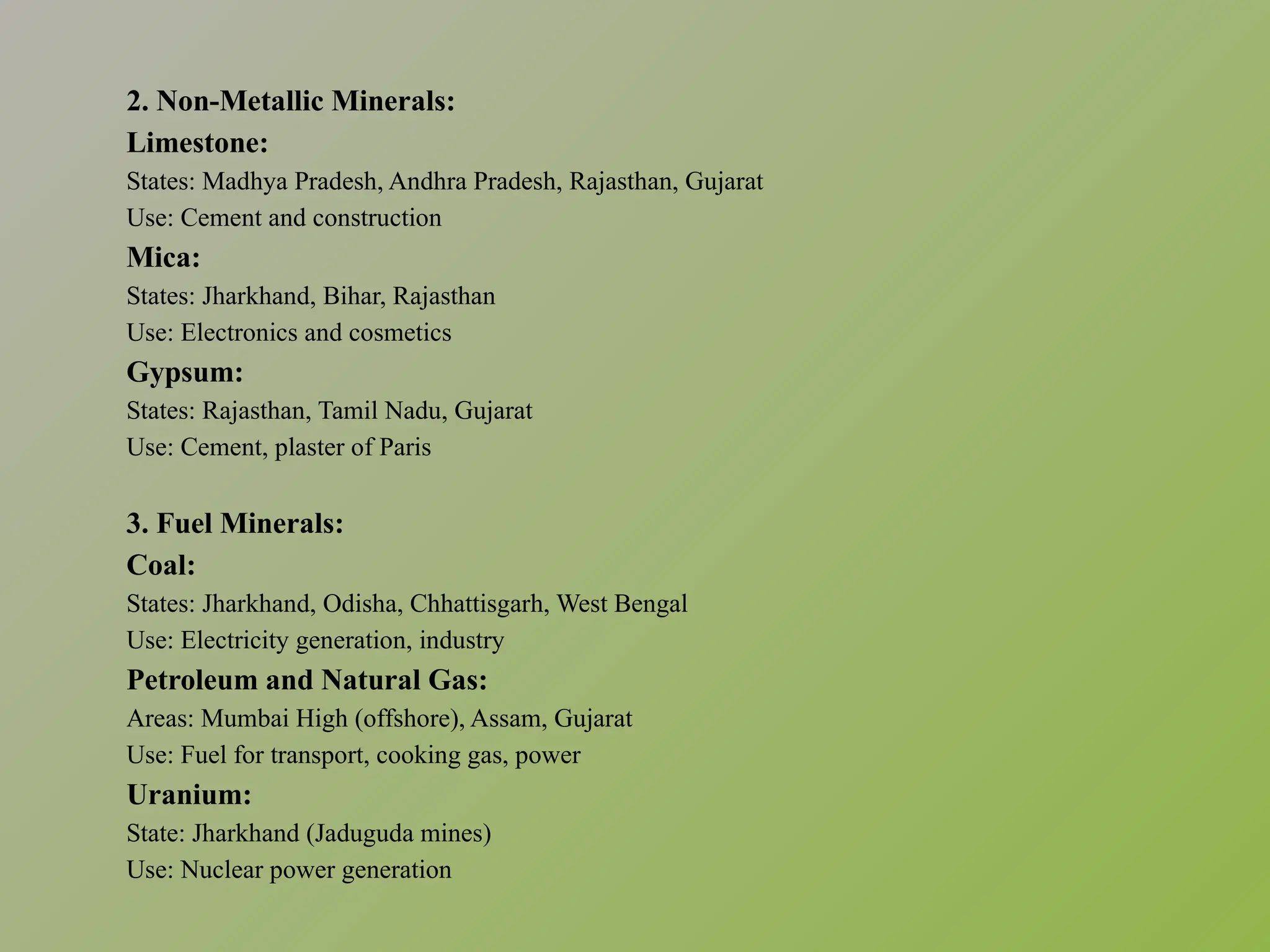
2. Non-Metallic Minerals:
Limestone:
States: Madhya Pradesh, Andhra Pradesh, Rajasthan, Gujarat
Use: Cement and construction
Mica:
States: Jharkhand, Bihar, Rajasthan
Use: Electronics and cosmetics
Gypsum:
States: Rajasthan, Tamil Nadu, Gujarat
Use: Cement, plaster of Paris
3. Fuel Minerals:
Coal:
States: Jharkhand, Odisha, Chhattisgarh, West Bengal
Use: Electricity generation, industry
Petroleum and Natural Gas:
Areas: Mumbai High (offshore), Assam, Gujarat
Use: Fuel for transport, cooking gas, power
Uranium:
State: Jharkhand (Jaduguda mines)
Use: Nuclear power generation
Mining and Extraction – Effects on the Environment
Mining is the process of extracting minerals and other geological materials from the earth. While it plays a
vital role in economic development, it also has several negative impacts on the environment if not managed
properly.
Environmental Effects of Mining and Extraction:
1. Deforestation and Habitat Loss:
Large areas of forests are cleared for mining operations.
It destroys natural habitats and threatens wildlife.
2. Soil Erosion and Land Degradation:
Mining loosens soil, making it prone to erosion.
Loss of fertile topsoil affects agriculture.
3. Water Pollution:
Chemicals like mercury, arsenic, and cyanide used in mining pollute rivers and groundwater.
Acid mine drainage turns water bodies toxic for aquatic life.
4. Air Pollution:
Dust and harmful gases (like sulfur dioxide) are released into the air during blasting and processing.
This affects human health and contributes to climate change.
5. Noise Pollution:
Blasting and heavy machinery create noise that disturbs both wildlife and nearby communities.
6. Loss of Biodiversity:
Mining disrupts ecosystems, causing the loss of plant and animal species.
7. Waste Generation:
Mining produces large amounts of solid waste and tailings, which require proper disposal.
Food Resources
Introduction
Food resources refer to all the natural sources that provide food necessary for the
survival and growth of living beings. These include plants, animals, and marine life that
supply carbohydrates, proteins, fats, vitamins, and minerals. Food resources are essential
for human health, economic development, and maintaining ecological balance.
Types of Food Resources:
1. Agricultural Crops:
1. Rice, wheat, maize, fruits, vegetables, pulses, and oilseeds.
2. Main sources of carbohydrates, proteins, and fibers.
2. Animal Resources:
1. Livestock like cattle, poultry (chicken, ducks), and fish.
2. Provide meat, milk, eggs, and other animal products.
3. Marine Resources:
1. Fish, crabs, prawns, and other seafood.
2. Major source of protein and essential nutrients.
4. Forest Produce:
1. Wild fruits, nuts, honey, and medicinal plants.
2. Supplements diet and provides economic value.
Importance of Food Resources:
• Basic Need:
Essential for survival, energy, and growth.
• Economic Development:
Agriculture and fisheries contribute to national income
and employment.
• Cultural Importance:
Food traditions and diets are a major part of cultural
identity.
• Health and Nutrition:
Provides the necessary nutrients for a healthy and
active life.
Challenges in Managing Food Resources:
• Food Scarcity: Due to population growth and poor
agricultural practices.
• Soil Degradation: Affects crop yields.
• Water Shortage: Impacts irrigation and food production.
• Climate Change: Alters crop patterns and reduces
productivity.
• Food Wastage: A major issue that needs better management.
• Food resources are critical for sustaining life and supporting
economic growth. Sustainable agricultural practices, better
food management, and conservation of natural resources are
necessary to ensure food security for present and future
generations.
Food Problem in India – Overview
India, despite being one of the largest food producers in the world, still faces significant food problems.
These issues affect millions of people, especially in rural and underdeveloped areas, and are related to both the
availability and accessibility of food.
Major Food Problems in India:
1. Hunger and Malnutrition:
A large section of the population suffers from undernourishment.
Children are highly affected, leading to stunted growth and health problems.
2. Food Wastage:
Significant amounts of food are wasted during harvesting, storage, transportation, and consumption.
Poor storage facilities cause grains and perishables to rot.
3. Inefficient Distribution:
The Public Distribution System (PDS) sometimes fails due to corruption, leakage, and poor management.
Food does not always reach the needy on time.
4. Population Growth:
Rapid population growth increases the demand for food.
Agriculture struggles to keep pace with the rising need.
5. Agricultural Challenges:
Small land holdings, outdated farming methods, poor irrigation, and dependence on monsoon rainfall reduce
food production.
6. Unemployment:
Many people cannot afford to buy enough nutritious food even when it is available.
7. Climate Change and Natural Disasters:
Droughts, floods, and unpredictable weather affect crop yields, worsening food security.
Solutions to Food Problems:
• Modernize agriculture with better technology and irrigation.
• Strengthen food storage, transportation, and distribution systems.
• Promote food security programs and direct aid to the poor.
• Encourage sustainable farming and crop diversification.
• Reduce food wastage at all levels.
• Increase awareness about nutrition and healthy diets.
India’s food problem is complex and deeply linked to poverty,
agriculture, and population dynamics. A combination of better
policies, modern agricultural practices, and strong food management
systems is essential to achieve food security and nutrition for all.
Energy Resources
Introduction
Energy resources are sources from which we obtain energy to perform work
and power our daily activities. These resources are essential for electricity
generation, transportation, industrial processes, and household needs. Energy
resources are classified into renewable and non-renewable types based on their
availability and sustainability.
Types of Energy Resources:
1. Renewable Energy Resources:
• These are naturally replenished and are considered sustainable.
• Solar Energy (Sunlight)
• Wind Energy (Moving air)
• Hydropower (Water flow)
• Biomass Energy (Organic matter)
• Tidal and Wave Energy (Ocean tides and waves)
• Geothermal Energy (Heat from the Earth's interior)
2. Non-Renewable Energy Resources:
These are limited and can be exhausted with excessive use.
• Coal
• Petroleum (Oil)
• Natural Gas
• Nuclear Fuels (Uranium and Thorium)
Importance of Energy Resources:
• Power Generation: Electricity for homes, industries, and offices.
• Transportation: Fuels for vehicles, ships, and airplanes.
• Industrial Development: Energy for manufacturing and processing.
• Economic Growth: Energy drives production, trade, and services.
• Daily Life: Cooking, heating, cooling, communication, and more.
Challenges:
• Overuse of non-renewable resources leads to pollution and climate change.
• Rising energy demand strains existing resources.
• Need for clean and sustainable energy to protect the environment.
Problems Associated with Energy Resources
While energy resources are vital for development and everyday life, their excessive and
careless use leads to several serious problems, especially when dependent on non-renewable
sources.
Major Problems Associated with Energy Resources:
1. Resource Depletion:
Non-renewable resources like coal, oil, and natural gas are being used faster than they are
formed.
Future generations may face severe shortages.
2. Environmental Pollution:
Burning fossil fuels releases harmful gases like carbon dioxide (CO ), sulfur dioxide (SO ),
₂ ₂
and nitrogen oxides (NO ).
ₓ
Causes air pollution, acid rain, and global warming.
3. Climate Change:
Emissions from energy use contribute to the greenhouse effect, leading to rising global
temperatures, melting glaciers, and extreme weather events.
4. Health Hazards:
Air pollution from energy production can cause respiratory diseases, heart problems, and
other health issues.
5. Economic Instability:
Fluctuations in the availability and price of fossil fuels can lead
to economic crises, especially for countries heavily dependent on
imported energy.
6. Habitat Destruction:
Extraction activities like mining, drilling, and dam construction
destroy forests, wildlife habitats, and marine ecosystems.
7. Waste Management Problems:
Nuclear energy produces radioactive waste that needs safe
storage for thousands of years, posing a long-term risk.
8. Energy Inequality:
In many parts of the world, especially rural and poor regions,
people still lack access to reliable and affordable energy.
Solutions:
1. Promote Renewable Energy:
Increase the use of solar, wind, hydro, biomass, and geothermal energy.
Support research and development of new clean energy technologies.
2. Energy Conservation:
Encourage people to use energy efficiently (e.g., energy-saving appliances, LED lights).
Promote habits like turning off unused devices and using public transport.
3. Improve Energy Efficiency:
Upgrade machinery, vehicles, and industrial processes to consume less energy.
Design energy-efficient buildings (green architecture).
4. Afforestation and Reforestation:
Plant more trees to absorb carbon dioxide and combat air pollution caused by fossil fuel use.
5. Adopt Clean Technologies:
Use cleaner fuels like natural gas instead of coal and oil where possible.
Develop and deploy carbon capture and storage (CCS) systems.
6. Waste Management:
Properly manage and recycle nuclear and industrial waste.
Promote recycling and reusing materials to reduce the need for new raw materials.
7. Public Awareness and Education:
Educate people about the importance of saving energy and using eco-friendly options.
Encourage responsible energy consumption from a young age.
8. Government Policies and Regulations:
Implement strong environmental laws to control pollution.
Provide subsidies for renewable energy projects and tax benefits for eco-friendly practices.
Land Resources
Introduction
Land resources refer to the natural surface of the Earth that provides
space and materials necessary for human survival and economic activities. It
includes soil, forests, minerals, water bodies, and biodiversity. Land is
essential for agriculture, housing, industries, transportation, and maintaining
natural ecosystems.
Importance of Land Resources:
• Agriculture: Land is used to grow crops and raise animals for food.
• Forests: Provide timber, fuel, and maintain ecological balance.
• Human Settlements: Space for building homes, cities, and infrastructure.
• Industrial Use: Land is needed for setting up factories and mines.
• Natural Habitats: Supports wildlife and maintains biodiversity.
• Recreation and Tourism: Parks, beaches, and scenic areas depend on
land resources.
Challenges to Land Resources:
 Deforestation: Clearing forests for agriculture and
construction leads to loss of land quality.
 Soil Erosion: Wind, water, and human activities remove the
fertile topsoil.
 Urbanization: Expansion of cities reduces agricultural and
natural lands.
 Overgrazing: Excessive grazing by livestock damages
grasslands and soil.
 Pollution: Industrial waste, chemicals, and plastics degrade
land quality.
 Desertification: Fertile land turning into desert due to poor
land management and climate change.
Conservation of Land Resources:
• Afforestation: Planting more trees to restore
degraded lands.
• Sustainable Agriculture: Using eco-friendly
farming methods to protect soil.
• Land-Use Planning: Organizing human activities
to minimize land degradation.
• Soil Conservation Techniques: Terracing, contour
plowing, and using organic fertilizers.
• Legal Protection: Implementing laws to prevent
illegal land use and deforestation.
Land Problems and Their Solutions
Land is a vital natural resource, but various human activities and natural processes have led to
serious problems that affect its quality and sustainability. Solving these problems is essential for
environmental health and human survival.
Major Land Problems:
1. Soil Erosion:
Removal of the fertile topsoil by wind, water, and human activities.
Leads to reduced agricultural productivity.
2. Desertification:
Degradation of fertile land into desert-like conditions due to overuse, drought, and deforestation.
3. Deforestation:
Large-scale clearing of forests for farming, construction, and industries harms the soil and ecosystems.
4. Urbanization and Industrialization:
Rapid growth of cities and industries leads to loss of agricultural and forest land.
5. Overgrazing:
Excessive grazing by livestock damages grasslands and causes soil erosion.
6. Land Pollution:
Dumping of waste, use of pesticides, chemicals, and mining activities contaminate and degrade land
quality.
7. Salinization:
Accumulation of salts in soil due to improper irrigation practices, making land unfit for farming.
Solutions to Land Problems:
1. Afforestation and Reforestation:
Planting trees to prevent soil erosion, restore ecosystems, and improve land quality.
2. Soil Conservation Techniques:
Methods like contour plowing, terracing, and building check dams to reduce soil erosion.
3. Sustainable Agricultural Practices:
Using organic farming, crop rotation, and minimum chemical use to maintain soil health.
4. Proper Land-Use Planning:
Careful planning of urban development and industrial projects to protect agricultural and forest
land.
5. Waste Management:
Proper disposal and recycling of waste to reduce land pollution.
6. Regulated Grazing:
Controlling livestock grazing to allow grasslands to recover.
7. Water Management:
Efficient irrigation methods like drip irrigation to prevent salinization.
8. Awareness and Education:
Educating farmers, industries, and communities about the importance of land conservation.
Role of Individuals in Conservation of Natural Resources
Every individual has an important role to play in conserving natural resources. Small
actions, when combined across society, can lead to big positive impacts on the
environment. Conservation helps ensure that resources like water, air, soil, minerals,
forests, and wildlife are available for future generations.
Ways Individuals Can Conserve Natural Resources:
1. Water Conservation:
Turn off taps when not in use.
Use water-saving devices and fix leaks.
Harvest rainwater and reuse water where possible.
2. Energy Conservation:
Use energy-efficient appliances and switch off lights and electronics when not needed.
Promote and use renewable energy sources like solar panels.
Prefer public transport, carpooling, cycling, or walking to save fuel.
3. Forest Conservation:
Plant trees and participate in tree plantation drives.
Avoid using products made from endangered trees or illegally sourced wood.
Support and volunteer for forest conservation programs.
4. Soil Conservation:
Grow plants and trees to prevent soil erosion.
Avoid excessive use of chemical fertilizers and pesticides.
Practice composting to enrich the soil naturally.
5. Waste Management:
Reduce, reuse, and recycle materials.
Avoid using single-use plastics and opt for eco-friendly products.
Properly segregate household waste.
6. Wildlife Protection:
Avoid buying products made from endangered animals.
Support wildlife conservation efforts and protected areas.
Respect wildlife and their natural habitats.
7. Spreading Awareness:
Educate others about the importance of natural resource conservation.
Participate in environmental campaigns and activities.
Use social media platforms to advocate for sustainable living.
Thank You…
Conclusion:
The conservation of natural resources is not only the
duty of governments and organizations but also of each
individual. By making responsible choices and
encouraging others to do the same, individuals can
greatly contribute to protecting the planet and ensuring
a healthier, greener future.

Multydisciplinary Nature of Environmental Studies

  • 1.
    Presented By Prof. Dr.Poonam Nilesh Chougule HOD & Associate Professor Pharmacognosy Department AMCP- Peth-Vadgaon. The Multidisciplinary Nature Of Environmental Studies
  • 2.
    Content • The Multidisciplinarynature of environmental studies: Natural Resources • Renewable and non-renewable resources • Natural resources and associated problems a) Forest resources; b) Water resources; c) Mineral resources; d) Food resources; e) Energy resources; f) Land resources. Role of an individual in conservation of natural resources.
  • 3.
    Introduction to EnvironmentalStudies (EVS): • Environmental Studies (EVS) is a multidisciplinary subject that explores the relationship between humans and their natural surroundings. It combines knowledge from science, social studies, and ethics to understand environmental issues and promote sustainable living. EVS helps us learn about the importance of air, water, soil, plants, animals, and ecosystems. It also encourages us to take care of the environment, conserve resources, and make responsible choices to protect our planet for future generations.
  • 4.
    Definition • EVS (EnvironmentalStudies) is the study of the environment and how living and non-living things interact with it. It helps us understand nature, protect natural resources, and solve environmental problems. • It is basically a versatile or we can say an associative approach that make us realize about our natural world and value on its truthfulness.
  • 5.
    Why is itimportant to study Environmental Studies (EVS)? Studying EVS is important for several reasons: 1. Awareness: It helps us understand the environment and the challenges it faces, such as pollution, climate change, deforestation, and loss of biodiversity. 2. Responsibility: EVS teaches us how human activities affect nature and encourages us to take responsibility for protecting the environment. 3. Sustainability: It promotes the sustainable use of natural resources so that future generations can also enjoy a healthy planet. 4. Problem Solving: EVS helps us develop solutions to environmental problems through knowledge, innovation, and action. 5. Healthy Living: Understanding the environment helps us live healthier lives by ensuring clean air, water, and food.
  • 6.
    Scope of EnvironmentalStudies (EVS): The scope of EVS is wide and includes everything related to the natural and human-made environment.  Understanding Ecosystems: Studying how living organisms interact with each other and with their surroundings (like forests, rivers, oceans, and deserts).  Natural Resources: Learning about the use and conservation of natural resources such as air, water, soil, minerals, and energy.  Environmental Issues: Exploring problems like pollution, climate change, global warming, deforestation, and loss of biodiversity.  Environmental Management: Learning how to manage waste, reduce pollution, and develop eco-friendly technologies.  Laws and Policies: Understanding environmental laws, acts, and international agreements that help protect nature.  Human and Environmental Interaction: Studying how human activities impact the environment and how we can live sustainably.  Environmental Education: Spreading awareness and encouraging positive actions to protect nature.
  • 7.
    Schematic representation ofMultidisciplinary Nature of EVS. Civil Engineering, Chemical Engineering, Nano Technology etc. Life Sciences, Biology, Biochemistry, Microbiology etc. Physical Sciences, Physics, Chemistry, Earth Sciences, Atmospheric temperature, Geography etc. Economics, Sociology, Law education, Management Mass Communication etc. Mathematics, Statistics, Computer sciences etc. EVS
  • 8.
    Significance of EnvironmentalStudies:  Environmental Studies plays a vital role in our lives. Here’s why it is significant:  Creates Environmental Awareness: EVS helps us understand the importance of nature and the need to protect it.  Promotes Sustainable Development: It teaches us how to use resources wisely, ensuring they are available for future generations.  Encourages Responsible Behavior: EVS inspires individuals and communities to adopt eco-friendly habits and reduce their environmental impact.  Solves Environmental Problems: It provides knowledge and tools to address issues like pollution, climate change, and waste management.  Improves Quality of Life: A clean and healthy environment contributes to better health and overall well-being.  Supports Policy Making: EVS knowledge helps in forming laws and policies for environmental protection and resource conservation.  Interdisciplinary Learning: It connects science, economics, ethics, and social studies, giving a complete understanding of environmental issues.  In summary, EVS is significant because it helps us live in harmony with nature, protect the planet, and ensure a better future for all.
  • 9.
    Renewable and non-renewableresources Introduction to Renewable and Non-Renewable Resources: • Natural resources are materials found in nature that are used by humans for various needs like food, energy, shelter, and transportation. These resources are broadly classified into renewable and non-renewable based on their availability and ability to regenerate. • Renewable Resources: These are resources that can be naturally replenished or regenerated over time. Examples include sunlight, wind, water, and biomass. They are generally considered sustainable because they are available continuously or can be regenerated quickly. • Non-Renewable Resources: These are resources that take millions of years to form and cannot be replaced once they are used up. Examples include coal, petroleum, natural gas, and minerals. These resources are limited and can eventually run out if not used wisely. • Let’s see one by one…..
  • 10.
    Forest Resources Introduction: Forest resourcesrefer to the various products and benefits that we obtain from forests. Forests are one of the most important natural resources on Earth, covering about 31% of the planet's land area. They are rich in biodiversity and play a key role in maintaining ecological balance. Types of Forest Resources: • Timber and Wood Products: Used for furniture, construction, paper, and fuel. • Non-Timber Forest Products (NTFPs): Includes fruits, nuts, honey, medicinal plants, gum, and resins. • Habitat for Wildlife: Forests provide shelter and food for a wide variety of animal and plant species. • Ecological Functions: – Absorb carbon dioxide and release oxygen – Prevent soil erosion – Maintain the water cycle – Control floods and droughts.
  • 11.
    Significances of forestresources: • Forests are one of the most valuable natural resources on Earth. They are often referred to as the "lungs of the planet" because of their crucial role in producing oxygen and maintaining the balance of gases in the atmosphere. The significance of forest resources is vast, covering ecological, economic, social, and cultural aspects of human life. • Firstly, forests play a vital role in maintaining ecological balance. They absorb carbon dioxide and release oxygen, helping to reduce the impact of global warming and climate change. Forests also regulate the water cycle by attracting rainfall and preventing water runoff, which is essential for maintaining groundwater levels. In addition, they protect against natural disasters such as floods, droughts, and soil erosion by holding the soil firmly with their roots and maintaining moisture levels in the air and ground.
  • 12.
    • Secondly, forestsare a rich source of biodiversity. They provide a habitat for countless species of plants, animals, birds, and microorganisms. Many of these species are found only in forest ecosystems and play an important role in the functioning of food chains and ecological processes. The protection of forests is essential to prevent the extinction of these species and to preserve biodiversity. • Economically, forests provide a wide range of forest products that are essential to our daily lives. These include timber for construction, fuelwood, paper, rubber, and various non-timber products such as medicinal plants, fruits, nuts, resins, and oils. Forests also contribute significantly to the economy through industries like wood processing, herbal medicine, and tourism.
  • 13.
    1. Raw MaterialSupply. 2. Fodders to cattle's 3. Balance in ecological system 4. Improvement in quality of environment 5. Protection against pollution 6. Rainfall attraction 7. Conservation of soil 8. Employment opportunities 9. Flood controlling 10. Maintain Global Warming. In Short:
  • 14.
    Importance of ForestResources: • Support biodiversity • Provide livelihood to millions of people • Help combat climate change • Maintain environmental balance Conservation of Forests: Due to deforestation and overuse, forest resources are under threat. Conservation methods include afforestation, reforestation, sustainable logging, wildlife protection laws, and awareness programs. In summary, forest resources are vital for life on Earth, and their protection is essential for a healthy and sustainable environment.
  • 15.
    Forest Coverage Statusin India: As per the India State of Forest Report (ISFR) 2023, India's total forest and tree cover has reached 827,357 square kilometers, which is about 25% of the country's geographical area. This marks an increase of approximately 1,445.8 sq km compared to the previous assessment in 2021 .​The Times of India+1Deccan Herald+1 Forest Cover Statistics (2023): • Total Forest Cover: Approximately 715,343 sq km, constituting 21.76% of India's geographical area .​Deccan Herald • Tree Cover: Around 112,014 sq km, accounting for 3.24% of the geographical area.​ Top States by Forest Area: • Madhya Pradesh: 77,073 sq km​Press Information Bureau • Arunachal Pradesh: 65,882 sq km ​ Press Information Bureau+1Drishti IAS+1 • Chhattisgarh: 55,812 sq km ​ Press Information Bureau
  • 16.
    States with HighestForest Cover Percentage (relative to their area): • Lakshadweep: 91.33%​Press Information Bureau • Mizoram: 85.34%​ • Andaman & Nicobar Islands: 81.62%​Press Information Bureau • States with Lowest Forest Cover Percentage: • Haryana: Approximately 3.6%​ • Punjab: Just over 3% .​ Statista Forest Cover Changes (2021–2023): • Increase in Forest Cover: The total forest cover increased by about 1,554 sq km from 2021 to 2023 .​Deccan Herald • States with Maximum Increase in Forest Cover: – Mizoram: 242 sq km​Drishti IAS+4Press Information Bureau+4Financial Services Institute+4 – Gujarat: 180 sq km​Press Information Bureau+5Wikipedia+5Wikipedia+5 – Odisha: 152 sq km .​
  • 17.
    States with MaximumIncrease in Forest and Tree Cover: – Chhattisgarh: 684 sq km​ – Uttar Pradesh: 559 sq km​ – Odisha: 559 sq km​ – Rajasthan: 394 sq km .​ Forest Types in India: India's forests are diverse, including: Tropical Wet Evergreen Forests, Tropical Deciduous Forests, Montane and Alpine Forests, Mangrove Forests, Subtropical Pine Forests • These forests support a wide range of biodiversity and play a crucial role in maintaining ecological balance.​
  • 18.
    Forest Over-Usage : •Forest over-usage refers to the excessive and unsustainable exploitation of forest resources such as wood, fuel, and non-timber products. This leads to deforestation, loss of biodiversity, and disruption of ecological balance. • Over-logging, illegal cutting, forest fires, and expansion of agriculture are major causes. It affects wildlife habitats, contributes to climate change, and results in soil erosion and reduced rainfall. • Continuous overuse weakens the forest’s ability to regenerate, threatening the environment and livelihoods dependent on it. Sustainable management and conservation practices are essential to protect forests for future generations and maintain the health of our planet.
  • 19.
    Deforestation: Causes andSolutions Deforestation: Causes and Solutions Deforestation is the large-scale removal of forests, leading to loss of trees and natural habitats. It is a major environmental concern affecting biodiversity, climate, and the livelihoods of millions. Causes of Deforestation: • Agricultural Expansion: Clearing forests for farming and livestock grazing. • Urbanization: Cutting trees for buildings, roads, and infrastructure. • Logging: Excessive cutting of trees for timber, paper, and fuelwood. • Mining Activities: Forests are cleared for mining minerals and fossil fuels. • Forest Fires: Both natural and man-made fires destroy vast forest areas. • Infrastructure Development: Dams, highways, and industrial projects often lead to deforestation.
  • 20.
    Solutions to Deforestation: •Afforestation and Reforestation: Planting new trees and restoring damaged forests. • Sustainable Forest Management: Using forest resources responsibly without harming ecosystems. • Legal Protection: Enforcing laws to prevent illegal logging and forest encroachment. • Alternative Resources: Promoting eco-friendly substitutes for wood and paper. • Awareness Campaigns: Educating people about the importance of forests. • Community Involvement: Encouraging local participation in forest conservation efforts.
  • 21.
    Water Resources Introduction- Waterresources refer to all sources of water that are useful or potentially useful to humans and ecosystems. These include surface water (like rivers, lakes, and reservoirs), groundwater (found beneath the Earth’s surface), glaciers, and rainfall. Water is essential for life, agriculture, industry, and maintaining ecological balance. Types of Water Resources: • Surface Water: Rivers, lakes, ponds, streams, and reservoirs. • Groundwater: Water stored in underground aquifers and wells. • Rainwater: Collected through rainwater harvesting. • Glaciers and Ice Caps: Store large amounts of freshwater. • Desalinated Water: Treated seawater used especially in dry regions.
  • 22.
    Challenges to WaterResources: • Water pollution from industries and agriculture • Overuse and wastage of water • Depletion of groundwater • Climate change affecting rainfall and water availability Conservation of Water Resources: • Rainwater harvesting • Reducing water pollution • Reusing and recycling water • Spreading awareness about water conservation • Implementing water-saving technologies in agriculture and industry
  • 23.
    Importance of WaterResources: • Drinking and Domestic Use: Essential for hydration, cooking, cleaning, and sanitation. • Agriculture: Required for irrigation and livestock. • Industry: Used in manufacturing, cooling, and processing. • Electricity Generation: Used in hydroelectric power plants. • Ecological Balance: Supports aquatic ecosystems and biodiversity.
  • 26.
    The Main WaterResources Are: 1. Surface Water: 1. Rivers 2. Lakes 3. Streams 4. Ponds 5. Reservoirs 2. Groundwater: 1. Wells 2. Tube wells 3. Aquifers (underground layers of water-bearing rock) 3. Rainwater: 1. Collected directly through rainwater harvesting systems 4. Glaciers and Ice Caps: 1. Major sources of freshwater, especially in mountain regions 5. Seawater (Desalinated Water): 1. Saltwater from oceans, converted into usable freshwater through desalination • These water resources are essential for drinking, agriculture, industry, and maintaining the environment.
  • 27.
    Rain Water: Rainwater –Introduction Rainwater is the water that falls from clouds in the form of rain. It is a natural and pure source of freshwater that plays a vital role in replenishing water bodies, recharging groundwater, and supporting life on Earth. Importance of Rainwater: • Natural Source of Freshwater: It helps fill rivers, lakes, and ponds. • Supports Agriculture: Provides water for crops and improves soil moisture. • Recharges Groundwater: Rain seeps into the ground and refills underground water reserves. • Maintains Ecosystems: Rainwater supports forests, plants, and wildlife. • Reduces Dependence on Other Sources: It can be collected and used for household, farming, and gardening needs. Rainwater Harvesting: • Rainwater can be collected and stored using rainwater harvesting systems. This involves capturing rain from rooftops, paved areas, or land surfaces and storing it in tanks or letting it soak into the ground to recharge wells.
  • 28.
    Benefits of Rainwater: •Fresh and Natural Water Source: Rainwater is clean and free from many pollutants when it first falls, making it a good source of water for various uses. • Recharges Groundwater: Helps refill wells, ponds, and underground aquifers, especially important in areas facing water scarcity. • Reduces Water Bills: Collected rainwater can be used for domestic chores like washing, cleaning, and gardening, reducing the use of tap water. • Prevents Water Logging and Soil Erosion: Proper rainwater harvesting controls excess surface runoff, reducing the risk of flooding and erosion. • Supports Agriculture: Provides a natural source of irrigation, especially useful in rain-fed farming areas. • Environmentally Friendly: Promotes sustainable water use and reduces dependence on treated or pumped water sources. • Reduces Pressure on Municipal Water Supply: Helps in conserving public water resources and energy used in water treatment and distribution.
  • 29.
    Sources of WaterPollution: Water pollution occurs when harmful substances contaminate water bodies such as rivers, lakes, oceans, and groundwater. These pollutants come from various sources, which can be broadly classified into point sources and non-point sources. Major Sources of Water Pollution: • Industrial Waste: – Factories discharge chemicals, heavy metals, and toxins into rivers and lakes. – These pollutants are harmful to aquatic life and human health. • Sewage and Domestic Waste: – Untreated or poorly treated sewage from households contains harmful bacteria, viruses, and nutrients that pollute water. • Agricultural Runoff: – Pesticides, fertilizers, and animal waste wash into water bodies during rainfall. – This leads to nutrient pollution and causes algae blooms. • Oil Spills: – Leakage of oil from ships or pipelines pollutes oceans and coastal waters, harming marine life. • Plastic and Solid Waste: – Garbage, especially plastic, thrown into water bodies can choke aquatic animals and disrupt ecosystems.
  • 30.
    • Thermal Pollution: –Hot water released from industries or power plants raises the temperature of water bodies, affecting aquatic life • Mining Activities: – Mining operations release heavy metals and toxic substances into nearby water sources. • Marine Dumping: – Dumping of industrial, radioactive, and household waste into oceans pollutes the water and sea life. • Leakage from Landfills: – Toxic substances from landfill sites seep into groundwater, contaminating it. • Urban Runoff: – Water from roads and cities picks up pollutants like oil, metals, and chemicals and flows into nearby rivers or lakes. • Water pollution is caused by both human activities and natural processes. Preventing it requires proper waste treatment, sustainable practices, and public awareness to protect water sources for current and future use.
  • 31.
    Tidal energy Introduction: isa form of renewable energy generated by harnessing the natural rise and fall of ocean tides. It is produced by the movement of large volumes of water caused by the gravitational pull of the moon and the sun. Tidal power plants use underwater turbines or barrages (dams) to convert the kinetic and potential energy of tides into electricity. Disadvantages of Tidal Energy:  High Initial Cost: Building tidal power stations and underwater turbines is expensive.  Limited Suitable Locations: Only areas with strong tidal ranges are viable for energy generation.  Environmental Impact: May affect marine ecosystems and fish migration patterns.  Intermittent Energy Generation: Energy can only be generated when tides are moving, not continuously.  Maintenance Challenges: Saltwater can cause corrosion and damage to underwater equipment. Advantages of Tidal Energy:  Renewable and Sustainable: Tidal energy is limitless and naturally replenished.  Environmentally Friendly: It produces no greenhouse gases or harmful emissions.  Efficient Energy Source: High energy output compared to wind and solar under suitable conditions.  Long Operational Life: Tidal energy systems have a long lifespan and require low maintenance.  Reduces Dependence on Fossil Fuels: Helps in promoting clean and green energy.
  • 32.
    Mineral Resources Introduction Mineral resourcesare naturally occurring substances found in the Earth’s crust that have economic value. These include metals, non-metals, and fuels which are extracted through mining and used in various industries and day-to-day life. They are essential for making tools, machines, construction materials, and even electronic devices. • Types of Mineral Resources: 1. Metallic Minerals: 1. Examples: Iron, copper, gold, silver, aluminum 2. Used in construction, machinery, transportation, and electronics. 2. Non-Metallic Minerals: 1. Examples: Limestone, gypsum, mica, quartz 2. Used in industries like cement, glass, and ceramics. 3. Energy Minerals (Fuel Minerals): 1. Examples: Coal, petroleum, natural gas, uranium 2. Used as fuel for electricity generation, transportation, and heating.
  • 33.
    Importance of MineralResources: • Industrial Development: Backbone of manufacturing and infrastructure. • Economic Growth: Boosts national income through mining and exports. • Employment: Creates job opportunities in mining and related sectors. • Everyday Use: Used in buildings, vehicles, electronics, utensils, etc. Conservation of Mineral Resources: • Minerals are non-renewable, so we must use them wisely: • Use alternative materials when possible. • Recycle metals and minerals. • Promote efficient mining and reduce wastage. • Encourage research into sustainable practices.
  • 34.
    Fuel Minerals Introduction • Fuelminerals, also known as energy minerals, are natural resources that are used to produce energy. These minerals are burned or processed to generate electricity, power vehicles, and support various industrial activities. They are crucial for modern life and economic development. • Types of Fuel Minerals: 1. Coal: 1. Most widely used fuel mineral. 2. Used in thermal power plants, steel production, and as a domestic fuel. 2. Petroleum (Crude Oil): 1. Used to produce petrol, diesel, kerosene, and lubricants. 2. Powers vehicles, airplanes, and industrial machinery. 3. Natural Gas: 1. A clean-burning fuel used for cooking, heating, and electricity generation. 2. Also used as a raw material in fertilizer and chemical industries. 4. Uranium and Thorium: 1. Nuclear fuel minerals used in atomic power plants. 2. Provide a powerful and efficient source of energy.
  • 35.
    Importance of FuelMinerals: • Energy Production: Backbone of electricity generation. • Transportation: Fuels vehicles, ships, and aircraft. • Industrial Use: Powers machines, manufacturing, and chemical industries. • Economic Growth: Drives industrial development and trade. • Challenges and Conservation: • Non-renewable: These resources are limited and can run out. • Environmental Impact: Burning fuel minerals leads to air pollution and climate change. • Need for Alternatives: Renewable energy sources like solar, wind, and hydro should be promoted.
  • 36.
    Metallic and Non-MetallicMinerals Introduction and Differences Minerals are naturally occurring substances found in the Earth. Based on their composition and uses, they are mainly classified into metallic and non-metallic minerals. 1. Metallic Minerals: Definition: Metallic minerals are those that contain metal elements in their chemical composition. They usually have a shiny surface and are good conductors of heat and electricity. Examples: • Iron ore (Hematite, Magnetite) • Bauxite (Aluminum) • Copper • Gold • Silver • Manganese • Zinc Uses: • Used in making tools, machinery, vehicles, buildings, and electrical wires. • Important for industrial and economic development.
  • 37.
    2. Non-Metallic Minerals: Definition: Non-metallicminerals do not contain metals. They are generally dull in appearance and are poor conductors of heat and electricity. Examples: • Limestone • Mica • Gypsum • Quartz • Clay • Salt • Phosphate Uses: • Used in cement, fertilizers, ceramics, glass, and chemicals. • Essential in construction, agriculture, and everyday products.
  • 38.
    Feature Metallic MineralsNon-Metallic Minerals Contains Metal Yes No Appearance Shiny and lustrous Dull Conductivity Good conductors of heat and electricity Poor conductors Examples Iron, Copper, Gold Limestone, Mica, Gypsum Uses Machinery, tools, wires Construction, agriculture, glass Key Differences: Both metallic and non-metallic minerals are vital natural resources. While metallic minerals drive industrial growth, non-metallic minerals are crucial for construction, agriculture, and daily life. Sustainable mining and usage are important to conserve these valuable resources.
  • 39.
    Mineral Resources inIndia Overview India is rich in mineral resources, which play a major role in the country’s economic development, industrial growth, and employment generation. The country has a wide variety of metallic, non-metallic, and fuel minerals, found in different parts of the nation. Major Mineral Resources in India: 1. Metallic Minerals: Iron Ore: States: Odisha, Chhattisgarh, Jharkhand, Karnataka Use: Steel and construction industries Bauxite (Aluminum Ore): States: Odisha, Gujarat, Maharashtra, Jharkhand Use: Aluminum production, aircraft, and packaging Manganese: States: Odisha, Karnataka, Madhya Pradesh, Maharashtra Use: Steel production and battery making Copper: States: Rajasthan, Madhya Pradesh, Jharkhand Use: Electrical wires, coins, and machinery Zinc and Lead: State: Rajasthan (main producer) Use: Coating metals, batteries
  • 40.
    2. Non-Metallic Minerals: Limestone: States:Madhya Pradesh, Andhra Pradesh, Rajasthan, Gujarat Use: Cement and construction Mica: States: Jharkhand, Bihar, Rajasthan Use: Electronics and cosmetics Gypsum: States: Rajasthan, Tamil Nadu, Gujarat Use: Cement, plaster of Paris 3. Fuel Minerals: Coal: States: Jharkhand, Odisha, Chhattisgarh, West Bengal Use: Electricity generation, industry Petroleum and Natural Gas: Areas: Mumbai High (offshore), Assam, Gujarat Use: Fuel for transport, cooking gas, power Uranium: State: Jharkhand (Jaduguda mines) Use: Nuclear power generation
  • 41.
    Mining and Extraction– Effects on the Environment Mining is the process of extracting minerals and other geological materials from the earth. While it plays a vital role in economic development, it also has several negative impacts on the environment if not managed properly. Environmental Effects of Mining and Extraction: 1. Deforestation and Habitat Loss: Large areas of forests are cleared for mining operations. It destroys natural habitats and threatens wildlife. 2. Soil Erosion and Land Degradation: Mining loosens soil, making it prone to erosion. Loss of fertile topsoil affects agriculture. 3. Water Pollution: Chemicals like mercury, arsenic, and cyanide used in mining pollute rivers and groundwater. Acid mine drainage turns water bodies toxic for aquatic life. 4. Air Pollution: Dust and harmful gases (like sulfur dioxide) are released into the air during blasting and processing. This affects human health and contributes to climate change. 5. Noise Pollution: Blasting and heavy machinery create noise that disturbs both wildlife and nearby communities. 6. Loss of Biodiversity: Mining disrupts ecosystems, causing the loss of plant and animal species. 7. Waste Generation: Mining produces large amounts of solid waste and tailings, which require proper disposal.
  • 42.
    Food Resources Introduction Food resourcesrefer to all the natural sources that provide food necessary for the survival and growth of living beings. These include plants, animals, and marine life that supply carbohydrates, proteins, fats, vitamins, and minerals. Food resources are essential for human health, economic development, and maintaining ecological balance. Types of Food Resources: 1. Agricultural Crops: 1. Rice, wheat, maize, fruits, vegetables, pulses, and oilseeds. 2. Main sources of carbohydrates, proteins, and fibers. 2. Animal Resources: 1. Livestock like cattle, poultry (chicken, ducks), and fish. 2. Provide meat, milk, eggs, and other animal products. 3. Marine Resources: 1. Fish, crabs, prawns, and other seafood. 2. Major source of protein and essential nutrients. 4. Forest Produce: 1. Wild fruits, nuts, honey, and medicinal plants. 2. Supplements diet and provides economic value.
  • 43.
    Importance of FoodResources: • Basic Need: Essential for survival, energy, and growth. • Economic Development: Agriculture and fisheries contribute to national income and employment. • Cultural Importance: Food traditions and diets are a major part of cultural identity. • Health and Nutrition: Provides the necessary nutrients for a healthy and active life.
  • 44.
    Challenges in ManagingFood Resources: • Food Scarcity: Due to population growth and poor agricultural practices. • Soil Degradation: Affects crop yields. • Water Shortage: Impacts irrigation and food production. • Climate Change: Alters crop patterns and reduces productivity. • Food Wastage: A major issue that needs better management. • Food resources are critical for sustaining life and supporting economic growth. Sustainable agricultural practices, better food management, and conservation of natural resources are necessary to ensure food security for present and future generations.
  • 45.
    Food Problem inIndia – Overview India, despite being one of the largest food producers in the world, still faces significant food problems. These issues affect millions of people, especially in rural and underdeveloped areas, and are related to both the availability and accessibility of food. Major Food Problems in India: 1. Hunger and Malnutrition: A large section of the population suffers from undernourishment. Children are highly affected, leading to stunted growth and health problems. 2. Food Wastage: Significant amounts of food are wasted during harvesting, storage, transportation, and consumption. Poor storage facilities cause grains and perishables to rot. 3. Inefficient Distribution: The Public Distribution System (PDS) sometimes fails due to corruption, leakage, and poor management. Food does not always reach the needy on time. 4. Population Growth: Rapid population growth increases the demand for food. Agriculture struggles to keep pace with the rising need. 5. Agricultural Challenges: Small land holdings, outdated farming methods, poor irrigation, and dependence on monsoon rainfall reduce food production. 6. Unemployment: Many people cannot afford to buy enough nutritious food even when it is available. 7. Climate Change and Natural Disasters: Droughts, floods, and unpredictable weather affect crop yields, worsening food security.
  • 46.
    Solutions to FoodProblems: • Modernize agriculture with better technology and irrigation. • Strengthen food storage, transportation, and distribution systems. • Promote food security programs and direct aid to the poor. • Encourage sustainable farming and crop diversification. • Reduce food wastage at all levels. • Increase awareness about nutrition and healthy diets. India’s food problem is complex and deeply linked to poverty, agriculture, and population dynamics. A combination of better policies, modern agricultural practices, and strong food management systems is essential to achieve food security and nutrition for all.
  • 47.
    Energy Resources Introduction Energy resourcesare sources from which we obtain energy to perform work and power our daily activities. These resources are essential for electricity generation, transportation, industrial processes, and household needs. Energy resources are classified into renewable and non-renewable types based on their availability and sustainability. Types of Energy Resources: 1. Renewable Energy Resources: • These are naturally replenished and are considered sustainable. • Solar Energy (Sunlight) • Wind Energy (Moving air) • Hydropower (Water flow) • Biomass Energy (Organic matter) • Tidal and Wave Energy (Ocean tides and waves) • Geothermal Energy (Heat from the Earth's interior)
  • 48.
    2. Non-Renewable EnergyResources: These are limited and can be exhausted with excessive use. • Coal • Petroleum (Oil) • Natural Gas • Nuclear Fuels (Uranium and Thorium) Importance of Energy Resources: • Power Generation: Electricity for homes, industries, and offices. • Transportation: Fuels for vehicles, ships, and airplanes. • Industrial Development: Energy for manufacturing and processing. • Economic Growth: Energy drives production, trade, and services. • Daily Life: Cooking, heating, cooling, communication, and more. Challenges: • Overuse of non-renewable resources leads to pollution and climate change. • Rising energy demand strains existing resources. • Need for clean and sustainable energy to protect the environment.
  • 49.
    Problems Associated withEnergy Resources While energy resources are vital for development and everyday life, their excessive and careless use leads to several serious problems, especially when dependent on non-renewable sources. Major Problems Associated with Energy Resources: 1. Resource Depletion: Non-renewable resources like coal, oil, and natural gas are being used faster than they are formed. Future generations may face severe shortages. 2. Environmental Pollution: Burning fossil fuels releases harmful gases like carbon dioxide (CO ), sulfur dioxide (SO ), ₂ ₂ and nitrogen oxides (NO ). ₓ Causes air pollution, acid rain, and global warming. 3. Climate Change: Emissions from energy use contribute to the greenhouse effect, leading to rising global temperatures, melting glaciers, and extreme weather events. 4. Health Hazards: Air pollution from energy production can cause respiratory diseases, heart problems, and other health issues.
  • 50.
    5. Economic Instability: Fluctuationsin the availability and price of fossil fuels can lead to economic crises, especially for countries heavily dependent on imported energy. 6. Habitat Destruction: Extraction activities like mining, drilling, and dam construction destroy forests, wildlife habitats, and marine ecosystems. 7. Waste Management Problems: Nuclear energy produces radioactive waste that needs safe storage for thousands of years, posing a long-term risk. 8. Energy Inequality: In many parts of the world, especially rural and poor regions, people still lack access to reliable and affordable energy.
  • 51.
    Solutions: 1. Promote RenewableEnergy: Increase the use of solar, wind, hydro, biomass, and geothermal energy. Support research and development of new clean energy technologies. 2. Energy Conservation: Encourage people to use energy efficiently (e.g., energy-saving appliances, LED lights). Promote habits like turning off unused devices and using public transport. 3. Improve Energy Efficiency: Upgrade machinery, vehicles, and industrial processes to consume less energy. Design energy-efficient buildings (green architecture). 4. Afforestation and Reforestation: Plant more trees to absorb carbon dioxide and combat air pollution caused by fossil fuel use. 5. Adopt Clean Technologies: Use cleaner fuels like natural gas instead of coal and oil where possible. Develop and deploy carbon capture and storage (CCS) systems. 6. Waste Management: Properly manage and recycle nuclear and industrial waste. Promote recycling and reusing materials to reduce the need for new raw materials. 7. Public Awareness and Education: Educate people about the importance of saving energy and using eco-friendly options. Encourage responsible energy consumption from a young age. 8. Government Policies and Regulations: Implement strong environmental laws to control pollution. Provide subsidies for renewable energy projects and tax benefits for eco-friendly practices.
  • 52.
    Land Resources Introduction Land resourcesrefer to the natural surface of the Earth that provides space and materials necessary for human survival and economic activities. It includes soil, forests, minerals, water bodies, and biodiversity. Land is essential for agriculture, housing, industries, transportation, and maintaining natural ecosystems. Importance of Land Resources: • Agriculture: Land is used to grow crops and raise animals for food. • Forests: Provide timber, fuel, and maintain ecological balance. • Human Settlements: Space for building homes, cities, and infrastructure. • Industrial Use: Land is needed for setting up factories and mines. • Natural Habitats: Supports wildlife and maintains biodiversity. • Recreation and Tourism: Parks, beaches, and scenic areas depend on land resources.
  • 53.
    Challenges to LandResources:  Deforestation: Clearing forests for agriculture and construction leads to loss of land quality.  Soil Erosion: Wind, water, and human activities remove the fertile topsoil.  Urbanization: Expansion of cities reduces agricultural and natural lands.  Overgrazing: Excessive grazing by livestock damages grasslands and soil.  Pollution: Industrial waste, chemicals, and plastics degrade land quality.  Desertification: Fertile land turning into desert due to poor land management and climate change.
  • 54.
    Conservation of LandResources: • Afforestation: Planting more trees to restore degraded lands. • Sustainable Agriculture: Using eco-friendly farming methods to protect soil. • Land-Use Planning: Organizing human activities to minimize land degradation. • Soil Conservation Techniques: Terracing, contour plowing, and using organic fertilizers. • Legal Protection: Implementing laws to prevent illegal land use and deforestation.
  • 55.
    Land Problems andTheir Solutions Land is a vital natural resource, but various human activities and natural processes have led to serious problems that affect its quality and sustainability. Solving these problems is essential for environmental health and human survival. Major Land Problems: 1. Soil Erosion: Removal of the fertile topsoil by wind, water, and human activities. Leads to reduced agricultural productivity. 2. Desertification: Degradation of fertile land into desert-like conditions due to overuse, drought, and deforestation. 3. Deforestation: Large-scale clearing of forests for farming, construction, and industries harms the soil and ecosystems. 4. Urbanization and Industrialization: Rapid growth of cities and industries leads to loss of agricultural and forest land. 5. Overgrazing: Excessive grazing by livestock damages grasslands and causes soil erosion. 6. Land Pollution: Dumping of waste, use of pesticides, chemicals, and mining activities contaminate and degrade land quality. 7. Salinization: Accumulation of salts in soil due to improper irrigation practices, making land unfit for farming.
  • 56.
    Solutions to LandProblems: 1. Afforestation and Reforestation: Planting trees to prevent soil erosion, restore ecosystems, and improve land quality. 2. Soil Conservation Techniques: Methods like contour plowing, terracing, and building check dams to reduce soil erosion. 3. Sustainable Agricultural Practices: Using organic farming, crop rotation, and minimum chemical use to maintain soil health. 4. Proper Land-Use Planning: Careful planning of urban development and industrial projects to protect agricultural and forest land. 5. Waste Management: Proper disposal and recycling of waste to reduce land pollution. 6. Regulated Grazing: Controlling livestock grazing to allow grasslands to recover. 7. Water Management: Efficient irrigation methods like drip irrigation to prevent salinization. 8. Awareness and Education: Educating farmers, industries, and communities about the importance of land conservation.
  • 57.
    Role of Individualsin Conservation of Natural Resources Every individual has an important role to play in conserving natural resources. Small actions, when combined across society, can lead to big positive impacts on the environment. Conservation helps ensure that resources like water, air, soil, minerals, forests, and wildlife are available for future generations. Ways Individuals Can Conserve Natural Resources: 1. Water Conservation: Turn off taps when not in use. Use water-saving devices and fix leaks. Harvest rainwater and reuse water where possible. 2. Energy Conservation: Use energy-efficient appliances and switch off lights and electronics when not needed. Promote and use renewable energy sources like solar panels. Prefer public transport, carpooling, cycling, or walking to save fuel. 3. Forest Conservation: Plant trees and participate in tree plantation drives. Avoid using products made from endangered trees or illegally sourced wood. Support and volunteer for forest conservation programs.
  • 58.
    4. Soil Conservation: Growplants and trees to prevent soil erosion. Avoid excessive use of chemical fertilizers and pesticides. Practice composting to enrich the soil naturally. 5. Waste Management: Reduce, reuse, and recycle materials. Avoid using single-use plastics and opt for eco-friendly products. Properly segregate household waste. 6. Wildlife Protection: Avoid buying products made from endangered animals. Support wildlife conservation efforts and protected areas. Respect wildlife and their natural habitats. 7. Spreading Awareness: Educate others about the importance of natural resource conservation. Participate in environmental campaigns and activities. Use social media platforms to advocate for sustainable living.
  • 59.
  • 60.
    Conclusion: The conservation ofnatural resources is not only the duty of governments and organizations but also of each individual. By making responsible choices and encouraging others to do the same, individuals can greatly contribute to protecting the planet and ensuring a healthier, greener future.