Industrial Production ,
Estimation and Utilization of the
following Phytoconstituents
Presented By-
Dr. Mrs. Poonam Nilesh Chougule
Professor
Dept. of Pharmacognosy DYP Kolhapur
 Forskolin,
 Sennoside,
 Artemisinin,
 Diosgenin,
 Digoxin,
 Atropine,
 Podophyllotoxin,
 Caffeine,
 Taxol,
 Vincristine and
 Vinblastine.
Forskolin
 Synonym- Forskohlii, Plectranthus
barbalus
 Biological Source- Forskolin is a
diterpenes is obtained from the dried
roots of Coleus forskohlii
 Family- Labiatae
 Method of cultivation-Vegetative method-
stem cutting.
 Harvesting – In the month of Autumn.
Chemical constituents-
 Forskolin is a diterpenes.
 It contains various diterpenoid
derivatives.
 The leaves give Coleon E
(Methylenequinine), barbatusin and
Coleon F.
 The root contains Coleonol B, Coleonol
C, Deoxycoleonol.
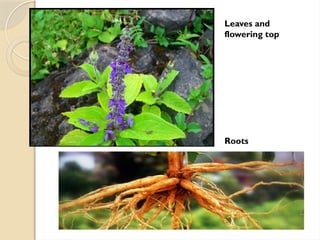
Leaves and
flowering top
Roots
Extraction and Isolation
 Dried roots of Coleus forskohlii
 Extract with Chloroform or Ethyl acetate (1 : 10)
using soxhlet apparatus
 Collect the organic extract
 Evaporate to dryness to yield crude extract of
forskolin.
 Saparation done by Column chromatography and by
using activated charcoal.
 The residue obtained from the eluate is purified and
crystalized by usnig organic solvent
 Pure form of Forskolin obtained.
Identification test-
 TLC Method-
 Stationary phase- Absorbent- pre-coated
Silica gel
 Mobile phase- Benzene: Ethyl Acetate
(85: 15)
 Sample – Root extract
 Detecting agent- Anisaldehyde sulphuric
acid.
 Observation-Violet to Purple color spot.
Estimation
 Forskolin is estimated by two methods,
 I . Method 1 - HPLC
 II. Method 2 – HPTLC
HPLC-
 Column- ODS (Octodecylsilane) C ₁₈, 5 micrometer 250*
4.6mm
 Mobile phase- Acetonitrile:Water (50: 50)
 Wavelength- 220 nm
 Flow rate- 1.6ml/ min
 Injection volume- 20 microlitre.
 Standard Preparation:
Dissolve 10mg of forskolin with 15ml of
acetonitrile in 25ml of volumetric flask and
makeup the volume up to 25ml with
acetonitrile.
 Sample Preparation:
Dissolve 250mg of sample with 25ml of
acetonitrile. Filter the solution & makeup the
volume up to 100ml with actonitrile.
 Procedure: Inject the standard and sample
preparation (10μl) & record the
chromatogram. Now calculate the percentage
of Forskolin content from the peak areas.
Utilization:
 Forskolin hasVasodilator and cardio
stimulant effects. Drug is used for
treatment of glaucoma, CHF and asthma.
 In Ayurvedic traditional medicine it
prefered for heart diseases and abdominal
colic.
 It also used in the treatment of
hypotension, spasmolytic and platelet
aggregation inhibitory activity.
Sennosides
 Are anthraquinone glycosides
obtained mainly from Cassia angustifolia
and Cassia acutifolia.
 Family: Leguminosae
 Part used: Dried leaflets and pods
 Nature: Natural stimulant laxatives
 Official in: Indian Pharmacopoeia, British
Pharmacopoeia, and USP
Chemical Constituents
 Major active principles: Sennosides A, B,
C, D
 Belong to anthraquinone glycosides
 Aglycone: Rhein anthrone
 Other compounds: Aloe-emodin,
chrysophanol, rhein
 Structure: Dianthrone glycosides (two
anthrone units linked together)
Extraction Process (Industrial Scale)
🔹 Stepwise Process:
 Raw Material Preparation:
Shade dry and pulverize Senna leaves/pods to 40–60 mesh.
 Defatting (Optional):
Extract with petroleum ether (60–80°C) to remove waxes and chlorophyll.
 Extraction:
Use 70% aqueous alcohol (ethanol/water) or hydroalcoholic percolation.
Maintain temperature around 50–60°C.
 Concentration:
Evaporate under reduced pressure to obtain soft extract.
 Precipitation of Impurities:
Add lead acetate or Ca(OH) to remove tannins.
₂
 Isolation:
Acidify filtrate and extract with ethyl acetate or n-butanol.
 Purification:
Concentrate and crystallize to obtain sennoside A & B.
 Drying & Standardization:
Vacuum dry and standardize (0.8–2.5% sennoside content by HPLC).
Identification & EstimationTests
1. ChemicalTests
 Bornträger’sTest:
Hydrolyze add ammonia
→ → pink/red color = anthraquinones
present.
 Modified Bornträger’sTest:
(For C-glycosides like sennosides) add ferric chloride heat extract
→ →
with organic solvent add ammonia red color.
→ →
2.TLC Identification
 Stationary phase: Silica gel
 Mobile phase: Ethyl acetate : methanol : water (100:13.5:10)
 Detection: Spray with methanolic KOH orange/yellow spots at
→
specific Rf values for sennoside A/B.
3. HPLC Method
 Column: C18
 Mobile phase:Acetonitrile : 0.1% phosphoric acid (30:70)
 λmax: 270 nm
 Used for quantitative estimation in industrial QC.
Pharmacological &Therapeutic Uses
 Primary Action: Stimulant laxative
 Mechanism:
◦ Acts on large intestine increases peristalsis
→
◦ Reduces water absorption softens stool
→
 Onset: 6–12 hours (overnight laxative)
 Uses:
◦ Treatment of constipation
◦ Bowel cleansing before surgery/colonoscopy
◦ Ingredient in herbal laxative preparations (Senokot®, Cremaffin® Plus, etc.)
Industrial & Commercial Applications
 Standardized extracts (8–10% sennoside) used in:
◦ Herbal tablets, granules, syrups, teas
 Pharmaceutical products:
◦ Senokot®, Pursennid®, Ex-Lax®
 Formulations:
◦ Single herb (Senna leaf powder)
◦ Polyherbal formulations for bowel regulation
Artemisinin
 is a sesquiterpene lactone with a unique
endoperoxide bridge responsible for potent
antimalarial activity.
 Isolated from Artemisia annua L. (Sweet
Wormwood).
 Family: Asteraceae
 Part used: Dried aerial parts (mainly leaves &
flowers).
 Discovered by Dr.TuYouyou (China) —
Nobel Prize in Physiology or Medicine (2015).
Industrial Extraction Process
🔹 Stepwise Industrial-Scale Extraction:
 Raw Material Preparation:
◦ Shade-dry aerial parts; pulverize to 20–40 mesh.
 Solvent Extraction:
◦ Extract using non-polar solvents – hexane, petroleum ether, or
supercritical CO₂.
◦ Soxhlet, percolation, or supercritical fluid extraction (SFE)
commonly used.
 Concentration:
◦ Evaporate solvent under reduced pressure crude extract.
→
 Purification:
◦ Re-extract with methanol or acetone crystallize artemisinin.
→
 Isolation:
◦ Purify by column chromatography (silica gel, elution with
petroleum ether : ethyl acetate).
 Drying & Standardization:
◦ Vacuum-dry; assay by HPLC (content ≥ 0.8–1.5% w/w).
Identification & EvaluationTests
1. ChemicalTest:
 Liebermann-Burchard test green-blue colour (triterpenes).
→
 TLC:
◦ Stationary phase: Silica gel G
◦ Mobile phase: Hexane : ethyl acetate (8:2)
◦ Detection:Vanillin–sulfuric acid spray purple spot at Rf ≈ 0.5.
→
2. HPLC Analysis:
 Column: C18
 Mobile phase:Acetonitrile :Water (70:30)
 Detection λmax: 210 nm
 Retention time: ~5 min for artemisinin.
3. Spectroscopic Identification:
 IR band ~ 880 cm ¹ (O–O stretch of endoperoxide bridge).
⁻
 Molecular mass 282 (M ).
⁺
Pharmacological &Therapeutic Uses
 Main use: Potent antimalarial (effective against Plasmodium
falciparum).
 Formulations: Artesunate,Artemether,Arteether (derivatives).
 Combination therapy (ACT):
◦ Artemether + Lumefantrine
◦ Artesunate + Mefloquine
◦ Artesunate + Amodiaquine
 Other potential uses:
◦ Antiviral, anticancer, and anti-inflammatory research areas.
Industrial Utilization
 WHO-recommended ACT therapy for malaria worldwide.
 Global market: > US $500 million per year.
 Semi-synthetic artemisinin production by Amyris/BASF (via
engineered yeast).
 Used in oral, injectable, and rectal dosage forms.
Diosgenin
 is a steroidal sapogenin obtained from species of
Dioscorea (Yam).
 It serves as a starting material for the semi-
synthesis of corticosteroids, sex hormones, and
oral contraceptives.
 Known as a phytosteroid because of its close
structural similarity to cholesterol.
 First isolated from Dioscorea deltoidea and Dioscorea
composita.
 Botanical Name: Dioscorea deltoidea Wall. ex Griseb.
Family: Dioscoreaceae
Common Names: Wild yam, Elephant foot yam
Part Used: Rhizomes and tubers
Industrial Extraction Process
🔹 Stepwise Industrial-Scale Extraction of Diosgenin:
 Raw Material Preparation:
◦ Rhizomes cleaned, sliced, and shade-dried powdered to 40 mesh.
→
 Defatting (Optional):
◦ Extract with petroleum ether to remove lipids & waxes.
 Saponin Extraction:
◦ Extract with alcohol (ethanol/methanol 70–90%) using percolation or
reflux.
 Acid Hydrolysis:
◦ Hydrolyze alcoholic extract with 2N HCl or H SO
₂ ₄ (boiling for 1–2 hrs) →
liberates diosgenin (aglycone) from dioscin.
 Separation & Purification:
◦ Cool, neutralize, filter, and extract with solvent (chloroform or ether).
◦ Wash with water concentrate.
→
 Crystallization:
◦ Crystallize from ethanol or methanol pure
→ diosgenin crystals.
 Drying & Standardization:
◦ Dry at low temperature (≤50°C).
◦ Assay using HPLC (content 1–3% in tubers).
Identification & EvaluationTests
 1. ChemicalTests
 Liebermann–BurchardTest:
Diosgenin + Acetic anhydride + H SO
₂ ₄ → Green to blue color →
confirms steroid nucleus.
 SalkowskiTest:
Diosgenin + Conc. H SO
₂ ₄ → Red coloration at interface
(steroidal confirmation).
 2.TLC Identification
 Stationary phase: Silica gel G
 Mobile phase: Toluene : Ethyl acetate (7:3)
 Detection: Anisaldehyde–sulfuric acid reagent violet spot (Rf ≈
→
0.45).
 3. HPLC Quantification
 Column: C18
 Mobile phase: Methanol :Water (90:10)
 Detection: 205 nm
 Retention time: ~6–8 min.
Pharmacological &Therapeutic Uses
 Not used directly as a drug, but as a starting material
in synthesis.
 However, pharmacological studies indicate:
◦ Anti-inflammatory, hypolipidemic, anticancer, antidiabetic
activities.
 Used in nutraceuticals and herbal supplements for
hormone balance and menopause relief.
Industrial Production & Market
 Global demand driven by steroid drug industries (Mexico,
China, India).
 Diosgenin content in Dioscorea deltoidea ranges from 1–3%.
 Processed in bulk for conversion to progesterone →
corticosteroids via Marker degradation process.
Digoxin
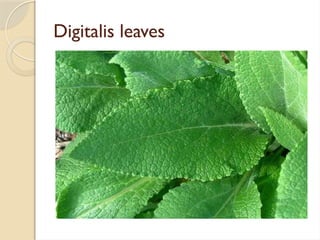
 Synonym- Foxglove leaves, digitalis.
 Biological source-
Digoxin is Cardiac glycoside obtained from
the dried leaves of plant Digitalis purpurea
and Digitalis lanata.
 Family- Scrophulariaceae
 Method of cultivation- Seed propagation
method.
 Harvesting- Hand picking method.
Digitalis leaves
Extraction and Isolation
 Coarsely powdered leaves extracted with 50% Ethanol
at low temp. and filter,
 To the filtrate add Lead acetate solution, impurities ppt
out
 Centrifuge to remove the ppt
 Cardiac glycosides present in the supernatant liquid
 Extract with chloroform and collect chloroform
extract.
 Evaporate under vacuum
 The residue of Cardiac glycoside obtained
 Purify it by chromatography.
 Get pure Digoxin.
Identification test-
 Chemical test- By Keller- Killani test, Legal test
and Baljet test.
 TLC method-
Stationary phase- Absorbent Pre-coated Silica
gel
Mobile phase- Benzene: Ethanol (7:3)
Sample- plant extract (leaves)
Detecting agent- p-Anisaldehyde, perchloric acid
Observation- UV 350nm, Blue spot.
Estimation-
 Colorimetric estimation-
Digoxin extract is treated with 3,5-
Dinitro benzoic acid and Benzyl trimethyl
ammonium hydroxide.
Bluish Red color is formed.
Calorimetrically measured at 550nm.
 Assay of Digoxin: IP 66
 Weigh about 40mg of digoxin, dissolve in 95%
ethanol and makeup volume to 50 ml.
 Pipette out 5ml from it and makeup volume to
100ml again with 95% ethanol.
 Again pipette out 5ml from above solution and
add 3ml alkaline picric acid.
 Allow to stand for 30 mins.
 Measure the absorbance at 495nm.
 Utilization- Mainly used in the treatment of
CHF.
Vinca alkaloids
 Synonym- Periwinkle leaf
 Biological source-Vincristine andVinblastine
are Dimeric indole alkaloid obtained from the
whole plants of Catharanthus roseus.
 Family- Apocynaceae
 Chemical constituents- about 90 alkaloids
isolated from catharanthus plant. Important
alkaloids are dimer indole alkaloidsVincristine
andVinblastine which posses Anti-cancer
activity.
Extraction and Isolation-
 Vinca leaves and herbs are extracted with aqueous
alcoholic acetic acid solution.
 After concentration of aqueous extract the residue
further extracted with 2% HCL.
 NaOH is used to adjust the pH of extract to 4.
 This is again extracted with benzene.
 The pH of solution again raised to 7.
 Again extracted with benzene.
 pH 7 benzene extract are concentrated, dried and
dissolved in benzene- methylene chloride (65:35)
solution.
 This is separated by chromatography on
neutral alumina column with benzene-
methylene chloride solution as eluent
technique.
 Evapouration of the vinblastine- rich
fractions gives vinblastine sulphate which is
recrystalised from alcohol.
 Further elution of the column gives
vincristine which is dried and crystallized
from alcohol.
Identification test
 ByTLC method-
Stationary phase- Absorbant pre coated
silica gel
Mobile phase- ACN : Benzene (30:70)
Sample- 1mg in 0.1ml of 25% H2o in
methanol.
Detecting agent- 1% solution of Cerric
ammonia sulfate in 85% phosphoric acid.
Rf value- 0.39
Estimation-
 HPLC method
 Utilisation-
 Vinblastine sulphate is used for the treatment of
Hodgkins disease.
 Vincristine sulphate is used for acute haemolytic
leukaemia. Highly active in childhood leukaemia.And
also used in breast cancer.
 Both vincristine and vinblastine are resulting in
tumour cell death during replication of DNA.
 They are used as intravenously.
Podophyllotoxin
 Synonym- Indian podophyllum, Himalayan
may-apple.
 Biological source- Podophyllotoxin is
resin obtained from the rhizomes and
roots of Podophyllum hexandrum or
podophyllum emodi.
 Family- Berberidaceae
 It grown in forest region of Himalyas from
kashmir to sikkim in Himachal pradesh.
Chemical Constituents-
 Podophyllum contains 3.5 to 6% of resin whose
active principles are Lignans, its
biosynthethically flavonoids.
 The most important ones present in the
podophyllumresin, podophyllitoxin, α-peltatin
and β-peltatin.
 Indian Podophyllum is derived of α and β-
peltatin.
 Also presence of dimethylpodophyllotoxin,
dehydropodophyllotoxin and quercetin-a-tetra-
hydroxy flavonol.
Extraction and Isolation
 Podophyllum resin extracted from dried
rhizomes and roots using an alcoholic
percolation method.
 It contains not less than 40% of
podophyllum resin.
 The powdered and dried rhizomes and roots of
podophyllum are extracted with 90% ethanol in
soxhlet extractor.
 Alcohol is removed by distillation and the
alcoholic extract as concentrated till it become
syrup-like consistancy.
 A mixture of water containing 2% HCL is poured
into this syrup at 5 C with continuous stirring.
ᵒ
 Mixture allow stand for 2hrs below 5 C and then
ᵒ
dissolved in sufficient quantity of 90% hot alcohol.
 This solution is filtered and alcohol distilled off.
 The residue is further dried at 80 C to constant
ᵒ
weight.
Utilization-
 It is used as a drastic but slow acting
purgative.
 Podophyllotoxin possesses Anti-tumour
properties and may be used in the treatment
of Cancer.
 It is invariable prescribed with other
purgatives, henbane or belladonna to prevent
gripping action in infants.
 It is used in the semi-solid synthetic
production of Etoposide.
TAXOL (PACLitaxel)
A Revolutionary Anticancer Drug from Taxus brevifolia
 Taxol (Paclitaxel) is a diterpenoid isolated from the bark of
Taxus brevifolia (Pacific yew).
 One of the most successful plant-derived anticancer drugs.
 First discovered by NCI-USA in 1967, approved by FDA in
1992.
 Active against breast cancer, ovarian cancer, lung cancer,
Kaposi sarcoma.
 Chemical Class: Diterpenoid (taxane diterpene)
 Molecular Formula: C H NO
₄₇ ₅₁ ₁₄
 Contains:
 Taxane ring system
 Benzoyl group
 Side chain at C13 (critical for activity)
Industrial Extraction Process
 🔹 Stepwise Extraction & Isolation ofTaxol
 Raw Material:
◦ Bark/leaves dried & powdered (40–60 mesh).
 Solvent Extraction:
◦ Exhaustive extraction with methanol or ethanol, or
dichloromethane (DCM).
 Liquid–Liquid Partitioning:
◦ Partition extract in water : chloroform / hexane to remove lipids.
 Purification ofTaxanes:
◦ Use column chromatography (silica/alumina).
◦ Elute with chloroform : methanol mixtures obtain crude
→
taxanes.
 Semi-purification:
◦ Preparative HPLC or reverse-phase column chromatography.
 Crystallization:
◦ Final purification → pure paclitaxel (Taxol).
IdentificationTests
 1.TLC Identification
 Stationary phase: Silica gel G
 Mobile phase: Chloroform : Methanol (9:1)
 Detect with:Vanillin–sulfuric acid blue or violet spot
→
 Rf: ~0.5–0.55
 2. HPLC
 Column: C18
 Mobile phase:Acetonitrile :Water (55:45)
 Detection: 227 nm
 Retention time: ~7–8 min
 3. Spectroscopic
 IR: Carbonyl groups (1730 cm ¹)
⁻
 Mass: 853 (M )
⁺
 NMR: Identifies taxane skeleton
Mechanism of Action
 Taxol binds to -
β tubulin in microtubules.
 Prevents depolymerization microtubules become
→
stable & nonfunctional.
 Results in:
◦ Mitotic arrest (G /M phase)
₂
◦ Apoptosis of cancer cells
 It is opposite to vinca alkaloids, which inhibit
polymerization.
Therapeutic Uses
 Breast cancer (1st line)
 Ovarian cancer
 Non-small cell lung carcinoma
 Kaposi sarcoma (HIV-positive)
 Used in angioplasty stents (drug-eluting stents)
Atropine
 is a tropane alkaloid.
 Obtained mainly from:
 Atropa belladonna (Deadly nightshade)
 Datura stramonium (Jimson weed)
 Hyoscyamus niger (Henbane)
 Family: Solanaceae
 Alkaloid content: 0.3–0.6% in leaves, 0.5–
1% in roots.
 Tropane ester alkaloid
 Chemically: DL-hyoscyamine
 Formula: C17H23NO3
 Optically inactive due to racemization.
 Soluble in organic solvents; forms salts
with acids (e.g., atropine sulfate).
Extraction & Isolation (Industry-Scale Method)
 Raw Material Preparation
 Shade-dried leaves/roots from Atropa, Datura, or Hyoscyamus.
 Powdered to 40–60 mesh.
 Industrial Extraction Steps
 Basification
◦ Powder moistened with lime (Ca(OH) )
₂ or ammonia to liberate free alkaloids.
 Solvent Extraction
◦ Extracted with organic solvents:
 Toluene / Benzene / Chloroform / Dichloromethane
◦ Continuous extraction (percolation or Soxhlet).
 Acid Extraction
◦ Organic layer shaken with dilute sulfuric acid to form water-soluble alkaloid salts.
 Purification
◦ Aqueous acidic layer treated with activated carbon to remove pigments.
 Re-Basification
◦ pH adjusted to ~10 using ammonia or sodium carbonate to regenerate free atropine.
 Final Extraction
◦ Re-extracted into organic solvent.
 Isolation & Crystallization
◦ Solvent evaporated under vacuum crude atropine.
→
◦ Purified by crystallization from ether or ethanol.
 Yield
 Typically 0.3–0.7% atropine depending on species & process.
IdentificationTests
Vitali–MorinTest (SpecificTest)
 Atropine treated with fuming nitric acid, evaporated
Add
→ methanolic KOH
 Produces violet color confirms tropane ester
→
structure.
TLC
 Stationary phase: Silica gel
 Mobile phase:Toluene :Acetone : Diethylamine (70:20:10)
 Detection: Dragendorff’s reagent orange spot.
→
HPLC (Industry standard)
 Reverse phase C18
 Mobile phase:Acetonitrile : Buffer (pH 3)
 Detection: 210 nm
Pharmacological Actions
 Parasympatholytic (Anticholinergic)
 Competitive antagonist of muscarinic receptors (M1–M5)
 Inhibits acetylcholine (ACh) at post-ganglionic parasympathetic
sites.
Therapeutic Uses
 Ophthalmology:
◦ Mydriatic & cycloplegic for eye examination
 Pre-anesthetic medication:
◦ Reduces salivation & bronchial secretions
 Antispasmodic:
◦ Reduces GI spasms, biliary/renal colic
 Treatment of Bradycardia
 Antidote for organophosphate poisoning
 Antidote for mushroom (Amanita muscaria) poisoning
ThankYou