
LAND RESOURCES AND SOIL.
IN THIS
PRESANTATION
WE WILL COVER
IMPORTANT
TOPICS ABOUT
LAND RESOURCES
AND SOIL.
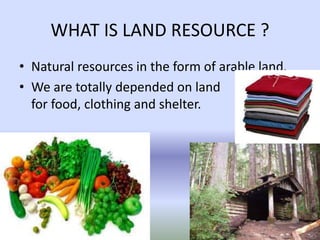
WHAT IS LAND RESOURCE ?
• Natural resources in the form of arable land.
• We are totally depended on land
for food, clothing and shelter.
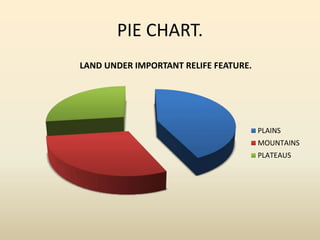
PIE CHART.
LAND UNDER IMPORTANT RELIFE FEATURE.
PLAINS
MOUNTAINS
PLATEAUS
LAND UTILISATION
• Land resources used by following purpose are:
• Agriculture & Forest.
• Barren and Wasteland (Building, factories &
etc.)
• Fallow land.
• Net sown area.
Land use pattern in India.
• In India use of land is determined by both
physical factor such as topography , climate,
soil type as well as human factor such as
population density, technological capability
and culture and traditions.
Land Degradation and Conservation
Measures.
• Land degradation is a process in which the
value of the biophysical environment is
affected by a combination of human-induced
processes acting upon the land.
• Conservation measures to taken up :-
• Afforestation and proper management of
grazing.
• Proper management of wasteland.
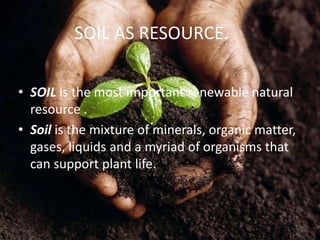
SOIL AS RESOURCE.
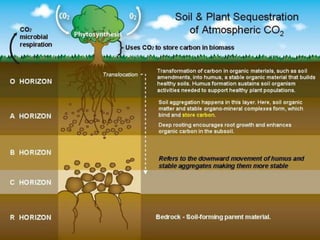
• SOIL is the most important renewable natural
resource .
• Soil is the mixture of minerals, organic matter,
gases, liquids and a myriad of organisms that
can support plant life.
Soil Profile.
Classification of Soil.
• Alluvial soil
• Black soil
• Red and yellow soil
• Laterite soil
• Arid soil
• Forest soil
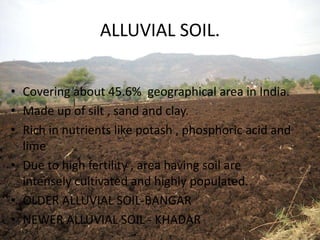
ALLUVIAL SOIL.
• Covering about 45.6% geographical area in India.
• Made up of silt , sand and clay.
• Rich in nutrients like potash , phosphoric acid and
lime
• Due to high fertility , area having soil are
intensely cultivated and highly populated.
• OLDER ALLUVIAL SOIL-BANGAR
• NEWER ALLUVIAL SOIL - KHADAR
Black soil( regur soil )
• Made up of extremely fine clayey material.
• It develops the deep cracks during summer
season which helps in aeration of soil became
sticky ( due to high moisture ) when wet
became difficult to be tilled.
• Covers near by 16 % geographical area India’s .
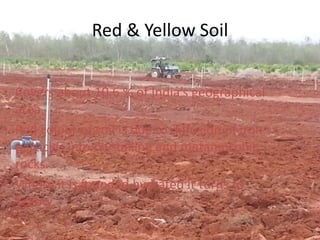
Red & Yellow Soil
• Covers about 10.6 % of India’s geographical
area.
• Red colour of soil is due to diffusion of iron
particles into crystalline and metamorphic
rocks.
• Where it is founded hydrated it turns to
Yellow.
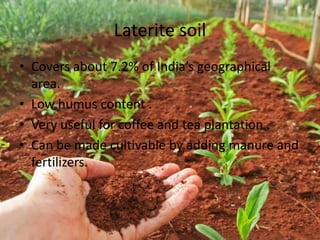
Laterite soil
• Covers about 7.2% of India’s geographical
area.
• Low humus content .
• Very useful for coffee and tea plantation .
• Can be made cultivable by adding manure and
fertilizers.
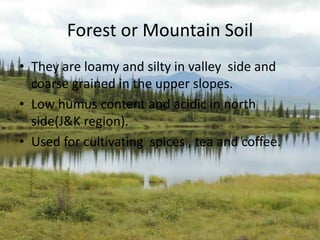
Forest or Mountain Soil
• They are loamy and silty in valley side and
coarse grained in the upper slopes.
• Low humus content and acidic in north
side(J&K region).
• Used for cultivating spices , tea and coffee.
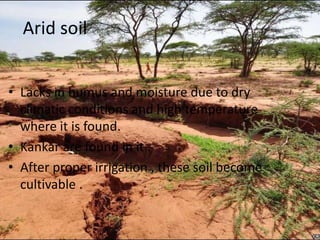
Arid soil
• Lacks in humus and moisture due to dry
climatic conditions and high temperature
where it is found.
• Kankar are found in it .
• After proper irrigation , these soil become
cultivable .
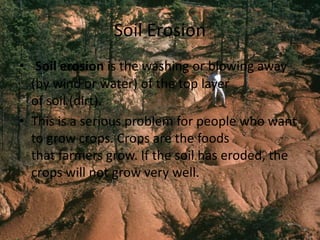
Soil Erosion
• Soil erosion is the washing or blowing away
(by wind or water) of the top layer
of soil (dirt).
• This is a serious problem for people who want
to grow crops. Crops are the foods
that farmers grow. If the soil has eroded, the
crops will not grow very well.
Soil Conservation
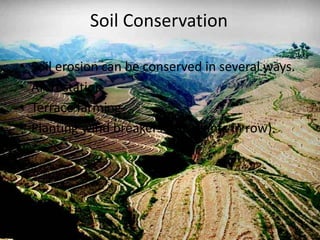
• Soil erosion can be conserved in several ways.
• Aforestation
• Terrace farming
• Planting wind breakers (the plants in row).
Land resources and soil

Land resources and soil

  • 1.
    LAND RESOURCES ANDSOIL. IN THIS PRESANTATION WE WILL COVER IMPORTANT TOPICS ABOUT LAND RESOURCES AND SOIL.
  • 2.
    WHAT IS LANDRESOURCE ? • Natural resources in the form of arable land. • We are totally depended on land for food, clothing and shelter.
  • 3.
    PIE CHART. LAND UNDERIMPORTANT RELIFE FEATURE. PLAINS MOUNTAINS PLATEAUS
  • 4.
    LAND UTILISATION • Landresources used by following purpose are: • Agriculture & Forest. • Barren and Wasteland (Building, factories & etc.) • Fallow land. • Net sown area.
  • 5.
    Land use patternin India. • In India use of land is determined by both physical factor such as topography , climate, soil type as well as human factor such as population density, technological capability and culture and traditions.
  • 6.
    Land Degradation andConservation Measures. • Land degradation is a process in which the value of the biophysical environment is affected by a combination of human-induced processes acting upon the land. • Conservation measures to taken up :- • Afforestation and proper management of grazing. • Proper management of wasteland.
  • 7.
    SOIL AS RESOURCE. •SOIL is the most important renewable natural resource . • Soil is the mixture of minerals, organic matter, gases, liquids and a myriad of organisms that can support plant life.
  • 8.
  • 9.
    Classification of Soil. •Alluvial soil • Black soil • Red and yellow soil • Laterite soil • Arid soil • Forest soil
  • 10.
    ALLUVIAL SOIL. • Coveringabout 45.6% geographical area in India. • Made up of silt , sand and clay. • Rich in nutrients like potash , phosphoric acid and lime • Due to high fertility , area having soil are intensely cultivated and highly populated. • OLDER ALLUVIAL SOIL-BANGAR • NEWER ALLUVIAL SOIL - KHADAR
  • 11.
    Black soil( regursoil ) • Made up of extremely fine clayey material. • It develops the deep cracks during summer season which helps in aeration of soil became sticky ( due to high moisture ) when wet became difficult to be tilled. • Covers near by 16 % geographical area India’s .
  • 12.
    Red & YellowSoil • Covers about 10.6 % of India’s geographical area. • Red colour of soil is due to diffusion of iron particles into crystalline and metamorphic rocks. • Where it is founded hydrated it turns to Yellow.
  • 13.
    Laterite soil • Coversabout 7.2% of India’s geographical area. • Low humus content . • Very useful for coffee and tea plantation . • Can be made cultivable by adding manure and fertilizers.
  • 14.
    Forest or MountainSoil • They are loamy and silty in valley side and coarse grained in the upper slopes. • Low humus content and acidic in north side(J&K region). • Used for cultivating spices , tea and coffee.
  • 15.
    Arid soil • Lacksin humus and moisture due to dry climatic conditions and high temperature where it is found. • Kankar are found in it . • After proper irrigation , these soil become cultivable .
  • 16.
    Soil Erosion • Soilerosion is the washing or blowing away (by wind or water) of the top layer of soil (dirt). • This is a serious problem for people who want to grow crops. Crops are the foods that farmers grow. If the soil has eroded, the crops will not grow very well.
  • 17.
    Soil Conservation • Soilerosion can be conserved in several ways. • Aforestation • Terrace farming • Planting wind breakers (the plants in row).