
NATURAL
RESOURCES
KEMBERLY N. LEE
2
Any material which can be transformed in a way that it becomesmore valuableand
useful can be termed as a resource.
Natural
Resources
These are substances and energy resources needed for
survival.
Renewable Resources are resources that can be replaced
through natural process at a rate equal to or greater than the
rate at which they are consumed.
Non-Renewable Resources are resources that cannot be
replenish once they are used.
Classification of Natural Resources
3
Resources can be classified as Biotic and
Abiotic.
Biotic Resources are living resources like forest,
agriculture, fish and wildlife that can reproduce and to
increase.
Non-Renewable Resources are resources that cannot be
replenish once they are used.
FOREST RESOURCES
SIGNIFICANCE OF FOREST
1. COMMERCIAL VALUE
• Forest are the main source of many commercial
products such as wood, timber, pulpwood etc.
Timber is a raw material use for preparation of
paper, rayon and film.
• Forest provide food, fiber, edible oils and herbal
plants.
• Forest is an important source for the development
of dams, recreation and mining.
2. LIFE AND ECONOMY OF TRIBAL PEOPLE
• Forest provide food, medicine and other products
needed for tribal people and play a vital role in life
and economy of tribes living in the forests.
4
Forest vary in composition and diversity and can contribute substantially to the economic development of any country.
3. ECOLOGICAL USES
• Forest are habitat to all wild animals, plants
and support millions of species. They help in
reducing global warming caused by
greenhouse gases and produce oxygen.
• Forest not only help the soil conservation
but also help to regulate the hydrological
cycle.
4. AESTHETIC VALUE
• All over the world people appreciate the
beauty and tranquility of the forest because
forests provide opportunity for recreation
and ecosystem research.
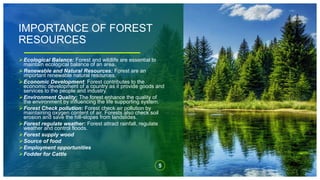
IMPORTANCE OF FOREST
RESOURCES
5
Ecological Balance: Forest and wildlife are essential to
maintain ecological balance of an area.
Renewable and Natural Resources: Forest are an
important renewable natural resources.
Economic Development: Forest contributes to the
economic development of a country as it provide goods and
services to the people and industry.
Environment Quality: The forest enhance the quality of
the environment by influencing the life supporting system.
Forest Check pollution: Forest check air pollution by
maintaining oxygen content of air. Forests also check soil
erosion and save the hill-slopes from landslides.
Forest regulate weather: Forest attract rainfall, regulate
weather and control floods.
Forest supply wood
Source of food
Employment opportunities
Fodder for Cattle
6
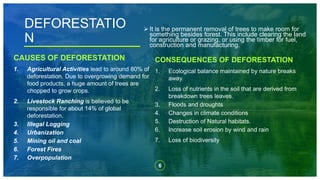
 It is the permanent removal of trees to make room for
something besides forest. This include clearing the land
for agriculture or grazing, or using the timber for fuel,
construction and manufacturing.
DEFORESTATIO
N
CAUSES OF DEFORESTATION
1. Agricultural Activities lead to around 80% of
deforestation. Due to overgrowing demand for
food products, a huge amount of trees are
chopped to grow crops.
2. Livestock Ranching is believed to be
responsible for about 14% of global
deforestation.
3. Illegal Logging
4. Urbanization
5. Mining oil and coal
6. Forest Fires
7. Overpopulation
CONSEQUENCES OF DEFORESTATION
1. Ecological balance maintained by nature breaks
away.
2. Loss of nutrients in the soil that are derived from
breakdown trees leaves.
3. Floods and droughts
4. Changes in climate conditions
5. Destruction of Natural habitats.
6. Increase soil erosion by wind and rain
7. Loss of biodiversity
TYPES OF
FOREST
7
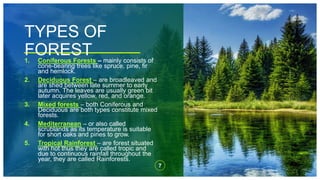
1. Coniferous Forests – mainly consists of
cone-bearing trees like spruce, pine, fir
and hemlock.
2. Deciduous Forest – are broadleaved and
are shed between late summer to early
autumn. The leaves are usually green bit
later acquires yellow, red, and orange.
3. Mixed forests – both Coniferous and
Deciduous are both types constitute mixed
forests.
4. Mediterranean – or also called
scrublands as its temperature is suitable
for short oaks and pines to grow.
5. Tropical Rainforest – are forest situated
with hot thus they are called tropic and
due to continuous rainfall throughout the
year, they are called Rainforests.
WATER RESOURCES
USE OF WATER RESOURCES
Water resources are used for agricultural, industrial,
domestic, recreational and environmental activities.
Some major and important sectors of use of water
are:
1. Agricultural use: Agriculture accounts for 69% of
all water consumption. It is therefore the largest
consumer of the Earth’s available freshwater.
2. Industrial use: Water is used as a raw material
coolant, a solvent, a transport agent, and as a
source of energy. Worldwide, the industry
accounts for 19 percent of total consumption.
3. Domestic use: we need water for drinking,
cleaning, personal hygiene, garden care,
cooking, washing clothes, dishes, etc, Domestic
use accounts for about 12 %.
8
Water is the source of life.
4. Hydropower generation: Hydropower is the
leading renewable source of electricity in the
world. It accounts for about 16% of total
electricity generation globally.
5. Use for Navigation and Recreation: Navigable
waterways are defined as water courses that
have been or may be used for transport of
interstate or foreign commerce. Water is also
used for recreational purposes such as boating,
swimming and sporting activities. These uses
affect the quality of the water and pollute it.
9
OVERUTILIZATION OF SURFACE
AND GROUND WATER
CONSEQUENCES OF
OVERUTILIZATION
• Water scarcity has become a burning global
issue. Continuous overutilization of surface
and ground water has led to virtual water
scarcity in the world today.
• There has been continuous overutilization of
the existing water sources due to mammoth
growth in world population.
• Continuous depletion of this source due too
its overexploitation by rising human
population and the rapid rise in
industrialization and urbanization in modern
times.
• Climate change – temperature increase affects the
hydrological cycle by directly increasing the
evaporation of available surface water and vegetation
transpiration. As a result, precipitation amount, timing
and intensity rates are largely affected.
• Floods and draughts – The former is due to excess in
water flow and the latter is due to scarcity of water.
WATER RESOURCES
MINERAL RESOURCES
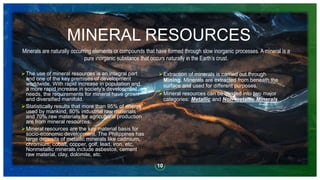
The use of mineral resources is an integral part
and one of the key premises of development
worldwide. With rapid increase in population and
a more rapid increase in society’s development
needs, the requirements for mineral have grown
and diversified manifold.
Statistically results that more than 95% of energy
used by mankind, 80% industrial raw materials
and 70% raw materials for agricultural production
are from mineral resources.
Mineral resources are the key material basis for
socio-economic development. The Philippines has
large deposits of metallic minerals like cadmium,
chromium, cobalt, copper, golf, lead, iron, etc,
Nonmetallic minerals include asbestos, cement
raw material, clay, dolomite, etc.
10
Minerals are naturally occurring elements or compounds that have formed through slow inorganic processes. A mineral is a
pure inorganic substance that occurs naturally in the Earth’s crust.
Extraction of minerals is carried out through
Mining. Minerals are extracted from beneath the
surface and used for different purposes.
Mineral resources can be divided into two major
categories: Metallic and Non-metallic Minerals.
11
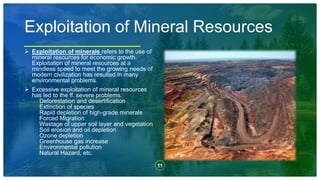
Exploitation of Mineral Resources
 Exploitation of minerals refers to the use of
mineral resources for economic growth.
Exploitation of mineral resources at a
mindless speed to meet the growing needs of
modern civilization has resulted in many
environmental problems.
 Excessive exploitation of mineral resources
has led to the ff. severe problems.
Deforestation and desertification
Extinction of species
Rapid depletion of high-grade minerals
Forced Migration
Wastage of upper soil layer and vegetation
Soil erosion and oil depletion
Ozone depletion
Greenhouse gas increase
Environmental pollution
Natural Hazard, etc.
FOOD RESOURCES
Food is a source of energy for human. It is used
for maintaining all body processes and activities.
For physical and mental development
For protection and regulation of body needs.
12
Food refers to anything eaten by man which gives energy, and which can meet physiological needs for growth of human
body.
Wheat and rice
Domesticated animals (cattle, sheep, goat, etc.)
Aquaculture (fish and sea food)
IMPORTANCE OF FOOD
SOURCES OF FOOD
 Modern societies obtain food through cultivation
through agriculture, domestication of animals, fishing.
 World food supply through gathering and hunting.
 Agricultural revolution: with the application of science
and technology world food supply increased
remarkably.
OUR MAIN FOOD RESOURCE
TYPES OF FOOD PRODUCTION
Industrialized Agriculture – uses large amounts of
fossil fuels, energy, water, commercial fertilizers and
pesticides to produce huge quantities of single crops or
livestock animals for sale.
Traditional Agriculture -can be defined as a primitive
style of farming that involves the intensive use of
indigenous knowledge, traditional tools, natural
resources, organic fertilizer and cultural beliefs of the
farmers.
13
ADD A FOOTER
WORLD FOOD PROBLEMS
UNDERNUTRITION – consuming
insufficient food to meet one’s
minimum daily energy requirement
for a long enough time to cause
harmful effects.
MALNUTRITION – caused by a diet
that does not supply a person with
enough protein, essential fats,
vitamins, minerals and other
nutrients.
OVERNUTRITION –an excessive
intake of food, especially fats.
 Large population – despite of green
revolution it could not meet the needs
of growing population. Agricultural
land got loot due urbanization.
 Energy: Farmers cannot afford
fertilizers and pesticides.
 Land, weather and climate:
Agriculture is gamble on climate
conditions.
 Absence of food security which
depends on food availability and
purchasing power.
14
ADD A FOOTER
ENVIRONMENTAL EFFECTS OF
FOOD PRODUCTION
• Biodiversity Loss or the variety of all
living things on our planet, has been
declining at an alarming rate in recent years,
mainly due to human activities, such as land
use changes, pollution and climate change.
• Soil degradation is the decline
in soil condition caused by its improper use
or poor management, usually for
agricultural, industrial or urban purposes
• Air pollution greenhouse gas emissions
from fossil fuels.
• Water pollution – contamination of drinking
and swimming water with disease
organisms from livestock waste.
• Human Health
• Traditional Agriculture –
deforestation due to slash or burn
technique. Clearing of forests for
new land area. Depletion of
Nutrients.
• Modern Agriculture – Impacts
related to high yield variety,
Fertilizer related impacts,
pesticides related impacts, water
logging, salinity problems.
15
IMPORTANCE OF ENERGY
RESOURCES
SOURCES OF
ENERGY
• Energy consumption of a nation is usually
considered as an index of its development,
because almost all the development activities
are directly or indirectly dependent upon energy.
• Power generation and energy consumption are
crucial to economic development as economy of
any nation depends upon availability of energy
resources.
• Industrialization, urbanization and unbelievable
rise in human settlements have multiplied the
energy requirement by several times.
-due to Modern lifestyle and man’s growing
dependence on the machines and equipment for
his/her necessity.
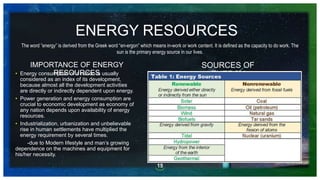
ENERGY RESOURCES
The word ”energy” is derived from the Greek word “en-ergon” which means in-work or work content. It is defined as the capacity to do work. The
sun is the primary energy source in our lives.
16
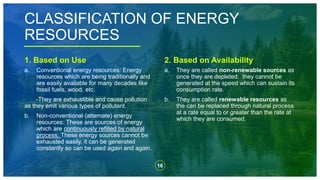
CLASSIFICATION OF ENERGY
RESOURCES
1. Based on Use
a. Conventional energy resources: Energy
resources which are being traditionally and
are easily available for many decades like
fossil fuels, wood, etc.
-They are exhaustible and cause pollution
as they emit various types of pollutant.
b. Non-conventional (alternate) energy
resources: These are sources of energy
which are continuously refilled by natural
process. These energy sources cannot be
exhausted easily, it can be generated
constantly so can be used again and again.
2. Based on Availability
a. They are called non-renewable sources as
once they are depleted; they cannot be
generated at the speed which can sustain its
consumption rate.
b. They are called renewable resources as
the can be replaced through natural process
at a rate equal to or greater than the rate at
which they are consumed.
17
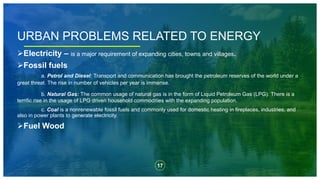
Electricity – is a major requirement of expanding cities, towns and villages.
Fossil fuels
a. Petrol and Diesel: Transport and communication has brought the petroleum reserves of the world under a
great threat. The rise in number of vehicles per year is immense.
b. Natural Gas: The common usage of natural gas is in the form of Liquid Petroleum Gas (LPG). There is a
terrific rise in the usage of LPG driven household commodities with the expanding population.
c. Coal is a nonrenewable fossil fuels and commonly used for domestic heating in fireplaces, industries, and
also in power plants to generate electricity.
Fuel Wood
URBAN PROBLEMS RELATED TO ENERGY
18
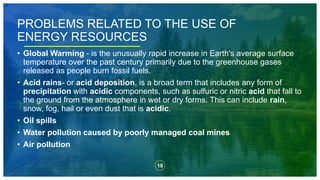
• Global Warming - is the unusually rapid increase in Earth's average surface
temperature over the past century primarily due to the greenhouse gases
released as people burn fossil fuels.
• Acid rains- or acid deposition, is a broad term that includes any form of
precipitation with acidic components, such as sulfuric or nitric acid that fall to
the ground from the atmosphere in wet or dry forms. This can include rain,
snow, fog, hail or even dust that is acidic.
• Oil spills
• Water pollution caused by poorly managed coal mines
• Air pollution
PROBLEMS RELATED TO THE USE OF
ENERGY RESOURCES
19
• Due to increasing population, the demands
for arable land for producing food, fiber and
fuel wood is also increasing. Hence there is
more and more pressure on the limited land
resources which are getting degraded due
to over-exploitation.
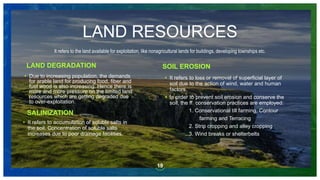
LAND RESOURCES
It refers to the land available for exploitation, like nonagricultural lands for buildings, developing townships etc.
LAND DEGRADATION SOIL EROSION
• It refers to loss or removal of superficial layer of
soil due to the action of wind, water and human
factors.
• In order to prevent soil erosion and conserve the
soil, the ff. conservation practices are employed:
1. Conservational till farming, Contour
farming and Terracing
2. Strip cropping and alley cropping
3. Wind breaks or shelterbelts
SALINIZATION
• It refers to accumulation of soluble salts in
the soil. Concentration of soluble salts
increases due to poor drainage facilities.
20
• Excessive utilization of irrigation may disturb the
water balance which can lead to waterlogging
due to rise of water table.
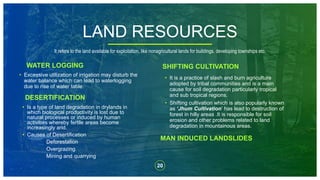
LAND RESOURCES
It refers to the land available for exploitation, like nonagricultural lands for buildings, developing townships etc.
WATER LOGGING SHIFTING CULTIVATION
• It is a practice of slash and burn agriculture
adopted by tribal communities and is a main
cause for soil degradation particularly tropical
and sub tropical regions.
• Shifting cultivation which is also popularly known
as ‘Jhum Cultivation’ has lead to destruction of
forest in hilly areas .It is responsible for soil
erosion and other problems related to land
degradation in mountainous areas.
DESERTIFICATION
• Is a type of land degradation in drylands in
which biological productivity is lost due to
natural processes or induced by human
activities whereby fertile areas become
increasingly arid.
• Causes of Desertification
Deforestation
Overgrazing
Mining and quarrying
MAN INDUCED LANDSLIDES
THANK YOU!

Natural resources

  • 1.
  • 2.
    2 Any material whichcan be transformed in a way that it becomesmore valuableand useful can be termed as a resource.
  • 3.
    Natural Resources These are substancesand energy resources needed for survival. Renewable Resources are resources that can be replaced through natural process at a rate equal to or greater than the rate at which they are consumed. Non-Renewable Resources are resources that cannot be replenish once they are used. Classification of Natural Resources 3 Resources can be classified as Biotic and Abiotic. Biotic Resources are living resources like forest, agriculture, fish and wildlife that can reproduce and to increase. Non-Renewable Resources are resources that cannot be replenish once they are used.
  • 4.
    FOREST RESOURCES SIGNIFICANCE OFFOREST 1. COMMERCIAL VALUE • Forest are the main source of many commercial products such as wood, timber, pulpwood etc. Timber is a raw material use for preparation of paper, rayon and film. • Forest provide food, fiber, edible oils and herbal plants. • Forest is an important source for the development of dams, recreation and mining. 2. LIFE AND ECONOMY OF TRIBAL PEOPLE • Forest provide food, medicine and other products needed for tribal people and play a vital role in life and economy of tribes living in the forests. 4 Forest vary in composition and diversity and can contribute substantially to the economic development of any country. 3. ECOLOGICAL USES • Forest are habitat to all wild animals, plants and support millions of species. They help in reducing global warming caused by greenhouse gases and produce oxygen. • Forest not only help the soil conservation but also help to regulate the hydrological cycle. 4. AESTHETIC VALUE • All over the world people appreciate the beauty and tranquility of the forest because forests provide opportunity for recreation and ecosystem research.
  • 5.
    IMPORTANCE OF FOREST RESOURCES 5 EcologicalBalance: Forest and wildlife are essential to maintain ecological balance of an area. Renewable and Natural Resources: Forest are an important renewable natural resources. Economic Development: Forest contributes to the economic development of a country as it provide goods and services to the people and industry. Environment Quality: The forest enhance the quality of the environment by influencing the life supporting system. Forest Check pollution: Forest check air pollution by maintaining oxygen content of air. Forests also check soil erosion and save the hill-slopes from landslides. Forest regulate weather: Forest attract rainfall, regulate weather and control floods. Forest supply wood Source of food Employment opportunities Fodder for Cattle
  • 6.
    6  It isthe permanent removal of trees to make room for something besides forest. This include clearing the land for agriculture or grazing, or using the timber for fuel, construction and manufacturing. DEFORESTATIO N CAUSES OF DEFORESTATION 1. Agricultural Activities lead to around 80% of deforestation. Due to overgrowing demand for food products, a huge amount of trees are chopped to grow crops. 2. Livestock Ranching is believed to be responsible for about 14% of global deforestation. 3. Illegal Logging 4. Urbanization 5. Mining oil and coal 6. Forest Fires 7. Overpopulation CONSEQUENCES OF DEFORESTATION 1. Ecological balance maintained by nature breaks away. 2. Loss of nutrients in the soil that are derived from breakdown trees leaves. 3. Floods and droughts 4. Changes in climate conditions 5. Destruction of Natural habitats. 6. Increase soil erosion by wind and rain 7. Loss of biodiversity
  • 7.
    TYPES OF FOREST 7 1. ConiferousForests – mainly consists of cone-bearing trees like spruce, pine, fir and hemlock. 2. Deciduous Forest – are broadleaved and are shed between late summer to early autumn. The leaves are usually green bit later acquires yellow, red, and orange. 3. Mixed forests – both Coniferous and Deciduous are both types constitute mixed forests. 4. Mediterranean – or also called scrublands as its temperature is suitable for short oaks and pines to grow. 5. Tropical Rainforest – are forest situated with hot thus they are called tropic and due to continuous rainfall throughout the year, they are called Rainforests.
  • 8.
    WATER RESOURCES USE OFWATER RESOURCES Water resources are used for agricultural, industrial, domestic, recreational and environmental activities. Some major and important sectors of use of water are: 1. Agricultural use: Agriculture accounts for 69% of all water consumption. It is therefore the largest consumer of the Earth’s available freshwater. 2. Industrial use: Water is used as a raw material coolant, a solvent, a transport agent, and as a source of energy. Worldwide, the industry accounts for 19 percent of total consumption. 3. Domestic use: we need water for drinking, cleaning, personal hygiene, garden care, cooking, washing clothes, dishes, etc, Domestic use accounts for about 12 %. 8 Water is the source of life. 4. Hydropower generation: Hydropower is the leading renewable source of electricity in the world. It accounts for about 16% of total electricity generation globally. 5. Use for Navigation and Recreation: Navigable waterways are defined as water courses that have been or may be used for transport of interstate or foreign commerce. Water is also used for recreational purposes such as boating, swimming and sporting activities. These uses affect the quality of the water and pollute it.
  • 9.
    9 OVERUTILIZATION OF SURFACE ANDGROUND WATER CONSEQUENCES OF OVERUTILIZATION • Water scarcity has become a burning global issue. Continuous overutilization of surface and ground water has led to virtual water scarcity in the world today. • There has been continuous overutilization of the existing water sources due to mammoth growth in world population. • Continuous depletion of this source due too its overexploitation by rising human population and the rapid rise in industrialization and urbanization in modern times. • Climate change – temperature increase affects the hydrological cycle by directly increasing the evaporation of available surface water and vegetation transpiration. As a result, precipitation amount, timing and intensity rates are largely affected. • Floods and draughts – The former is due to excess in water flow and the latter is due to scarcity of water. WATER RESOURCES
  • 10.
    MINERAL RESOURCES The useof mineral resources is an integral part and one of the key premises of development worldwide. With rapid increase in population and a more rapid increase in society’s development needs, the requirements for mineral have grown and diversified manifold. Statistically results that more than 95% of energy used by mankind, 80% industrial raw materials and 70% raw materials for agricultural production are from mineral resources. Mineral resources are the key material basis for socio-economic development. The Philippines has large deposits of metallic minerals like cadmium, chromium, cobalt, copper, golf, lead, iron, etc, Nonmetallic minerals include asbestos, cement raw material, clay, dolomite, etc. 10 Minerals are naturally occurring elements or compounds that have formed through slow inorganic processes. A mineral is a pure inorganic substance that occurs naturally in the Earth’s crust. Extraction of minerals is carried out through Mining. Minerals are extracted from beneath the surface and used for different purposes. Mineral resources can be divided into two major categories: Metallic and Non-metallic Minerals.
  • 11.
    11 Exploitation of MineralResources  Exploitation of minerals refers to the use of mineral resources for economic growth. Exploitation of mineral resources at a mindless speed to meet the growing needs of modern civilization has resulted in many environmental problems.  Excessive exploitation of mineral resources has led to the ff. severe problems. Deforestation and desertification Extinction of species Rapid depletion of high-grade minerals Forced Migration Wastage of upper soil layer and vegetation Soil erosion and oil depletion Ozone depletion Greenhouse gas increase Environmental pollution Natural Hazard, etc.
  • 12.
    FOOD RESOURCES Food isa source of energy for human. It is used for maintaining all body processes and activities. For physical and mental development For protection and regulation of body needs. 12 Food refers to anything eaten by man which gives energy, and which can meet physiological needs for growth of human body. Wheat and rice Domesticated animals (cattle, sheep, goat, etc.) Aquaculture (fish and sea food) IMPORTANCE OF FOOD SOURCES OF FOOD  Modern societies obtain food through cultivation through agriculture, domestication of animals, fishing.  World food supply through gathering and hunting.  Agricultural revolution: with the application of science and technology world food supply increased remarkably. OUR MAIN FOOD RESOURCE TYPES OF FOOD PRODUCTION Industrialized Agriculture – uses large amounts of fossil fuels, energy, water, commercial fertilizers and pesticides to produce huge quantities of single crops or livestock animals for sale. Traditional Agriculture -can be defined as a primitive style of farming that involves the intensive use of indigenous knowledge, traditional tools, natural resources, organic fertilizer and cultural beliefs of the farmers.
  • 13.
    13 ADD A FOOTER WORLDFOOD PROBLEMS UNDERNUTRITION – consuming insufficient food to meet one’s minimum daily energy requirement for a long enough time to cause harmful effects. MALNUTRITION – caused by a diet that does not supply a person with enough protein, essential fats, vitamins, minerals and other nutrients. OVERNUTRITION –an excessive intake of food, especially fats.  Large population – despite of green revolution it could not meet the needs of growing population. Agricultural land got loot due urbanization.  Energy: Farmers cannot afford fertilizers and pesticides.  Land, weather and climate: Agriculture is gamble on climate conditions.  Absence of food security which depends on food availability and purchasing power.
  • 14.
    14 ADD A FOOTER ENVIRONMENTALEFFECTS OF FOOD PRODUCTION • Biodiversity Loss or the variety of all living things on our planet, has been declining at an alarming rate in recent years, mainly due to human activities, such as land use changes, pollution and climate change. • Soil degradation is the decline in soil condition caused by its improper use or poor management, usually for agricultural, industrial or urban purposes • Air pollution greenhouse gas emissions from fossil fuels. • Water pollution – contamination of drinking and swimming water with disease organisms from livestock waste. • Human Health • Traditional Agriculture – deforestation due to slash or burn technique. Clearing of forests for new land area. Depletion of Nutrients. • Modern Agriculture – Impacts related to high yield variety, Fertilizer related impacts, pesticides related impacts, water logging, salinity problems.
  • 15.
    15 IMPORTANCE OF ENERGY RESOURCES SOURCESOF ENERGY • Energy consumption of a nation is usually considered as an index of its development, because almost all the development activities are directly or indirectly dependent upon energy. • Power generation and energy consumption are crucial to economic development as economy of any nation depends upon availability of energy resources. • Industrialization, urbanization and unbelievable rise in human settlements have multiplied the energy requirement by several times. -due to Modern lifestyle and man’s growing dependence on the machines and equipment for his/her necessity. ENERGY RESOURCES The word ”energy” is derived from the Greek word “en-ergon” which means in-work or work content. It is defined as the capacity to do work. The sun is the primary energy source in our lives.
  • 16.
    16 CLASSIFICATION OF ENERGY RESOURCES 1.Based on Use a. Conventional energy resources: Energy resources which are being traditionally and are easily available for many decades like fossil fuels, wood, etc. -They are exhaustible and cause pollution as they emit various types of pollutant. b. Non-conventional (alternate) energy resources: These are sources of energy which are continuously refilled by natural process. These energy sources cannot be exhausted easily, it can be generated constantly so can be used again and again. 2. Based on Availability a. They are called non-renewable sources as once they are depleted; they cannot be generated at the speed which can sustain its consumption rate. b. They are called renewable resources as the can be replaced through natural process at a rate equal to or greater than the rate at which they are consumed.
  • 17.
    17 Electricity – isa major requirement of expanding cities, towns and villages. Fossil fuels a. Petrol and Diesel: Transport and communication has brought the petroleum reserves of the world under a great threat. The rise in number of vehicles per year is immense. b. Natural Gas: The common usage of natural gas is in the form of Liquid Petroleum Gas (LPG). There is a terrific rise in the usage of LPG driven household commodities with the expanding population. c. Coal is a nonrenewable fossil fuels and commonly used for domestic heating in fireplaces, industries, and also in power plants to generate electricity. Fuel Wood URBAN PROBLEMS RELATED TO ENERGY
  • 18.
    18 • Global Warming- is the unusually rapid increase in Earth's average surface temperature over the past century primarily due to the greenhouse gases released as people burn fossil fuels. • Acid rains- or acid deposition, is a broad term that includes any form of precipitation with acidic components, such as sulfuric or nitric acid that fall to the ground from the atmosphere in wet or dry forms. This can include rain, snow, fog, hail or even dust that is acidic. • Oil spills • Water pollution caused by poorly managed coal mines • Air pollution PROBLEMS RELATED TO THE USE OF ENERGY RESOURCES
  • 19.
    19 • Due toincreasing population, the demands for arable land for producing food, fiber and fuel wood is also increasing. Hence there is more and more pressure on the limited land resources which are getting degraded due to over-exploitation. LAND RESOURCES It refers to the land available for exploitation, like nonagricultural lands for buildings, developing townships etc. LAND DEGRADATION SOIL EROSION • It refers to loss or removal of superficial layer of soil due to the action of wind, water and human factors. • In order to prevent soil erosion and conserve the soil, the ff. conservation practices are employed: 1. Conservational till farming, Contour farming and Terracing 2. Strip cropping and alley cropping 3. Wind breaks or shelterbelts SALINIZATION • It refers to accumulation of soluble salts in the soil. Concentration of soluble salts increases due to poor drainage facilities.
  • 20.
    20 • Excessive utilizationof irrigation may disturb the water balance which can lead to waterlogging due to rise of water table. LAND RESOURCES It refers to the land available for exploitation, like nonagricultural lands for buildings, developing townships etc. WATER LOGGING SHIFTING CULTIVATION • It is a practice of slash and burn agriculture adopted by tribal communities and is a main cause for soil degradation particularly tropical and sub tropical regions. • Shifting cultivation which is also popularly known as ‘Jhum Cultivation’ has lead to destruction of forest in hilly areas .It is responsible for soil erosion and other problems related to land degradation in mountainous areas. DESERTIFICATION • Is a type of land degradation in drylands in which biological productivity is lost due to natural processes or induced by human activities whereby fertile areas become increasingly arid. • Causes of Desertification Deforestation Overgrazing Mining and quarrying MAN INDUCED LANDSLIDES
  • 21.