
PHARMACOGNOSY & Phytochemistry-I
(BP405T)
Unit-IV
Part-1
Pharmacognosy in various systems of medicine:
Name: Mrs. Pooja Deepak Bhandare
Assistant Professor
Dadasaheb Balpande College of Pharmacy Besa Nagpur
Content:
• Role of Pharmacognosy in allopathy and traditional systems of medicine
1. Ayurveda systems of medicine
2. Siddha systems of medicine
3. Homeopathy systems of medicine
4. Unani systems of medicine
5. Chinese systems of medicine
Ayurveda
AYUR + VEDA= LIFE+ KNOWLEDGE OR SCIENCE . It is described as science of life
Ayurveda-Ancient Science of Life dated back to 5000 years in India
Ayurveda deals with the plant products, anatomy and physiology of human body, principles of treatment
of diseases.
Oldest Treatise of Ayurveda : Charak Samhita 1900 BC – 341 plants
Shushruta samhita: 600BC: Surgery in Ayurveda, 395 plants, 57 of animal origin , 4 of mineral origin
1. Panchmahabhuta: Everything in universe is composed of 5 basic elements : Vayu, Akash, Agni,
Jal and Prithvi. All these are in perfect balance in the body when the balance disturbed- unhealthy
condition developed.
2. Tridosha theory : Panchamahabhutas represent- doshas- means impurities or imbalance
vata (Vayu + Akash), pitta (Agni + Jal) and kapha (Prithvi + Jal).
1. Vata (Vayu + Akash) : Respiration, sensation, mobility, psychochemical function.
2. Pitta (Agni + Jal): Digestion, metabolism & Energy production (heat)
3. Kapha (Prithvi + Jal) : Formation of various preservative fluid (mucus, synovial
fluid, stability, lubrication. Heat regulation. Health- ‘Balance of tridosha’
• Saptadhatu theory: Tridosha exist in human body as basic body tissue Rasa (lymph),
Rakta (blood), meda (adipose tissue), mamsa (flesh), majja (nervine tissue), Shukra
(reproductive tissue) and asthi (bones).
Malas : By product dhatus 1. Mutra (urine) 2. Sweda(Sweat) 3. Shakrit(faces)
When tridosha, saptadhatu and mala are in balance with each other, it is called as healthy
condition while imbalance causes a pathological condition.
• Panchshil theory:It is hypothesised that the five characters of the medicinal herbs viz.
rasa, guna, virya,vipak and prabhava can be applied to treat various pathological
conditions.
Rasa- Based on taste. Each taste has own effect of tridoshas
Guna- Basic nature of drug
Virya- Drug potency
Vipak- Metabolite of drug
Prabhav – Actual therapeutic activity
• Diognosis: Observation & study of patient for tridosha & it imbalance of clinical examination in Ayurveda
is called as ashta sthana pariksha (Eight point dignosis: 1. Nadi pariksha-(Pulse) 2. Mutra pariksha (urine)
3. Sparsh (touch) 4. Shabdha (speech ) 5. Malas (Stool) 6. Jiva (Tounge) 7. Netra (eye) , 8. Akrti (shape)
Treatment:A number of other dosage forms like churna, avaleha, ghrita, sandhana kalpa, bhasma are there.
Most of them are polyherbal formulations.
Based on patient body type, what disease or disturbance of doshas they are suffering form
1. Shodhana (Panchkarma) – Cleanising /purification treatment of body & mind Snehan (massage),
Vaman(Vomit) Swedan (steaming) virechan (Purgation), Basti (Enema)
2. Shaman Therapy- Elimination of Vitiated doshas
3. Suitable diet activity
4. Rasayana- (Rejuvenation tbherapy.)
• Role of Pharmacognosy in Ayurvedic system of medicine
• Pharmacognosy: Systematic study of crude drug (All types of drug from natural origin).
• Ayurvedic system of medicine- Consist of drug diet and certain practices for treatment of disease. Medicinal
preparation of polyherbal formulation available in market contain number of medicinal plant (crude Dug)
• Pharmacognostic study of crude drug help in
1. Development of Pharmacopoeial standard for herbal drug-
Example: Ashwagandha standard limit-
2. Correct identification of crud drug through
Morphological and organoleptic evaluation
Microscopic evaluation
Physical and chemical evaluation
1. Foreign organic matter- NMT- 2%
2. Total Ash- NMT 7%
3. Aci insoluble ash- NLT 1.2%
4. Alcohol soluble matters- NLT-16%
3. Followed by characterization- Example- Microscopic evaluation- diagnostic
character
• In case of leaves – Special type of stomata (Peppermint- Diacytic stomata).
• Presence or absence of cluster crystal of calcium oxalate (Powder clove-stone
cell and calcium oxalate crystal absent & in clove stalk powder both present).
Trichomes (Glandular in peppermint)
• Authenticated drugs → Used in Ayurvedic formulation → gives proper
therapeutic action with less side effect
• Detection and Isolation of Phytochemicals.
 SIDDHA
• Term 'Siddha' means achievement and 'Siddhars' were saintly personalities, who
obtained expertise in medicine by practicing Bhakti and Yoga.
• It is a belief that Lord Shiva unfolded the knowledge of medicine to his wife
Parvati which was then passed to Siddhars.
• System of pre-vedic period identified with Dravidian culture and it is largely
therapeutic in nature.
• Agastya- Father of siddha medicine guru of 18 Siddhar who developed this system
deals with the thousand of herb, animal, mineral and metal.
• The literature of Siddha system is mostly in Tamil.
• It is also based on three humors i.e. vatta, pitta and kapha & believes everything in
universe is made up of 5 basic elements1.Munn( earth/solid), 2. Neer (water/fluid),
3.Aakasham (sky),4. Thee (Radiance/ fire) and 5. Vayu(gas/air). Present in
different proportion. Three (Dravya) humors made of 5 elements known as Triguna
• Diagnosis: A Siddha physician studies eight important things of body i.e.
nadi (pulse), kan (eyes), swara (voice), sparisam (touch), varna (colour),
na (tongue), mala (faeces) and neer (urine).
• The literature of Siddha system is mostly in Tamil.
• Treatment: Holistic in approach ( Study of the person as “whole” as well
as disease) For identification of causative factor. Treatment of imbalance
Dosha. Commonly medicine are prepared freshly for specific disease. The
formulation are prepared using plants, animals, mineral and metal like
gold, silver, sulphur, Cu, Al in small quantities
• Examples of some natural drugs used: Abini (Papaver somniferum), Alari
(Nerium indicum), Ethi (Strychnos Nux-vomica), Gomathai (Datura
stramonium), Haikalli (Euphoribia nerifolia), Ratha polam (Aloe-
barbadensis).
 HOMEOPATHY
• Homeo means ‘similar’ and Pathos means ‘suffering’ so homeopathy is the “system of similar
suffering”. German physician Samuel Hahnemann first stated the basic principle of homeopathy
in 1796, known as the “law of similars” (let like be cured by like”).Cinchona produced the
symptoms of malaria.
• Theory and principle: Homeopathy emphasises the root cause of the disease and the nature’s law
of its cure that is ‘like cures like’. Thus, homeopathy deals with the following seven principles
1. Individualisation: No two individuals in the world are alike, i.e., the disease affecting two
individuals cannot be similar though they may share common symptoms. Therefore, the medicines
used to cure the same disease in different individuals are different.
2. Principle of similar: Use of the medicine will produce similar symptoms of disease in a healthy
individual. For example, an onion is a substance, which makes your eyes water and your nose burn. If
you are having an attack of hay fever with watering eyes and a burning nose, a homeopathic remedy
made from onion can relieve it.
3. Principle of simplex: Only one single simple medicine at one time and no combination is allowed.
4. Minimum dose: Minimum medicine at a time.
5. Law of proving: Medicine should have the capacity to produce disease state in a healthy individual.
6. Law of dynamisation: Medicine should preserve the normal state of healthy body.
7. Vital force: Medicine should have the capacity to arouse sufficient energy to maintain a healthy body.
• Diagnosis: It involves knowing of complete hereditary history as well as observation of moods,
habits, skin, eyes, tongue, blood, urine etc., of patients.
• Treatment: When the symptoms picture matches with the drug picture, the physician always
attempts to identify a single medicine. In producing remedies for diseases, homeopaths use a
process called “dynamisation” or “potentiation”, whereby a substance is diluted with alcohol or
distilled water and then vigorously shaken in a process called “succussion”. Three logarithmic
potency scales are in regular use in homeopathy for dilution. Hahnemann created the
“centesimal” or “C scale”, diluting a substance by a factor of 100 at each stage. Homeopathic
pills are made from an inert substance (often sugars, typically lactose), upon which a drop of
liquid homeopathic preparation is placed. Hahnemann began to test what effects substances
produced in humans, a procedure that would later become known as “homeopathic proving”.
 UNANI
• History of Unani system credited to Greek philosopher Hippocrates Aristotle Galen (384 - 322 BC) Greek -
Philosopher "Father of natural history" made valuable contributions
• From Greek it was carried to Persia (Iran), where it was improved by Arabian physicians.
• In India unani system is introduced by Arab (10 century AD) muslim brought eith them Hakkem and the arebian
system of medicine
• System slowly spread all over India During Muslim rule
Principle:
• Based on two theories → the Hippocratic theory of four humours (blood, phelgm, yellow bile and black bile )
Pythagorian theory of four proximate qualities (states of living human body like hot, cold, moist and dry,
represented as earth, water, fire and air)
• Arabian physicians added seven working principles (Umur-e-Tabia) and included
elements, temperaments, humours, organs, life, spirit, energy and actions.
• These principles are responsible for the body constitution and its health, as well as,
the diseased conditions.
Diagnosis: The human body is considered to be made up of seven components, which
have direct bearing on the health status of a person. They are 1. Elements (Arkan) 2.
Temperament (Mijaz). 3. Humors (Aklat) 4. Organs (Aaza) 5. Faculties (Quwa) 6.
Spirits (Arwah)7. Functions (Afaal). These components are taken in to consideration
by the physician for diagnosis and also for deciding the line of treatment.
In diagnosis Unani Physican (Hakim) ask a patient a lot questions to know history and decides
treatment.
It aims at treating the root cause of disease and not its symptoms.
Thorough history of patient is recorded in addition to his pulse, urine and stool examinations.
Treatment:
• The diseased condition may be due to the imbalance between humours
• The drugs used : polyherbal formulations
• Known as Arab medicine, Greco-Arab medicine, Loniah medicine, Islamic medicine and also
Oriental medicine.
• Unani-medicines: Madar, fufal, Gilo, Kabab chini, Karanj, Kulthi, Lodh, Qust, Sana, Tagar,
Zeera, Siyah.
 CHINESE
• It is also ancient dated back to Yellow Emperor's classic of Internal Medicine
(Huang Di Nei Jing)-200 BC & 100 AD.
• based on the idea “all life is subject to natural laws”
• Principle:
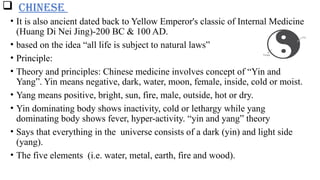
• Theory and principles: Chinese medicine involves concept of “Yin and
Yang”. Yin means negative, dark, water, moon, female, inside, cold or moist.
• Yang means positive, bright, sun, fire, male, outside, hot or dry.
• Yin dominating body shows inactivity, cold or lethargy while yang
dominating body shows fever, hyper-activity. “yin and yang” theory
• Says that everything in the universe consists of a dark (yin) and light side
(yang).
• The five elements (i.e. water, metal, earth, fire and wood).
• Diagnosis:
Diagnosis is based on “pattern of discrimination” i..e valuation of the present signs and
symptoms on the basis of the “Eight Principles” or causes like internal, external, heat,
cold, vacuity (deficiency), Repletion (excess), yin and yang. TCM diagnosis consists in
tracing symptoms to an underlying disharmony pattern, mainly by palpating the pulse
and inspecting the tongue.
• Treatment: Treatment includes:
1. Acupuncture: The acupuncture points located in skin are opened and closed by a
stainless steel needle for 20-40 minutes to adjust proper blood circulation.
2. Herbal Medicine: Specific herbs and their combinations are used to cure diseases.
3. Diet: Herbal supplements are given as a part of diet to fortify the body constituents.
Ex. Ephedra sinica, Rheum palmatum, Carthamus tinctorius, Clerodendron
trichotomum, Panax ginseng etc
4. Exercise: For healthy individuals as well as for patients, exercise is properly planned
in the Chinese system.
5. Massage: It is an important part of the Chinese system to harmonize body climate.
Thank you!