Natural Resources
and
Associated problems
(Environmental Studies)
Advait Vijay Mane
Branch: Computer engineering
Natural Resources:
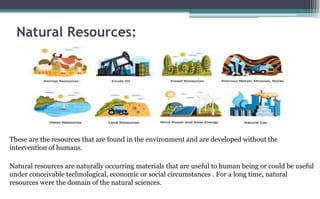
These are the resources that are found in the environment and are developed without the
intervention of humans.
Natural resources are naturally occurring materials that are useful to human being or could be useful
under conceivable technological, economic or social circumstances . For a long time, natural
resources were the domain of the natural sciences.
Need for management of natural resources :-
All the things we use and consume are obtained from natural resources. Due to increase in
population, industrialization and urbanization the demand for natural resources is increasing and
their availability is limited . So there is a need for proper management of natural resources. The
proper management of natural resources consists of :-
 Judicious use of natural resources and avoiding wastage of natural resources.
 Long term planning for the use of natural resources so that it last not only for the present but also
for future generations.
 The exploitation of natural resources should not be for the benefit of a few people but should be
distributed equally for all.
 While extracting and using natural resources we should also plan for the safe disposal of wastes so
that no damage is caused to the environment.
Natural Resources :
 Forest Resources
 Water Resources
 Mineral Resources
 Food Resources
 Land Resources
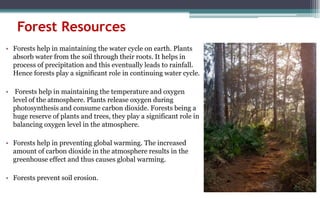
Forest Resources
• Forests help in maintaining the water cycle on earth. Plants
absorb water from the soil through their roots. It helps in
process of precipitation and this eventually leads to rainfall.
Hence forests play a significant role in continuing water cycle.
• Forests help in maintaining the temperature and oxygen
level of the atmosphere. Plants release oxygen during
photosynthesis and consume carbon dioxide. Forests being a
huge reserve of plants and trees, they play a significant role in
balancing oxygen level in the atmosphere.
• Forests help in preventing global warming. The increased
amount of carbon dioxide in the atmosphere results in the
greenhouse effect and thus causes global warming.
• Forests prevent soil erosion.
 Deforestation Effects
• Atmospheric Effects of Deforestation — Forests are carbon sinks that sequester carbon
dioxide from the atmosphere and release oxygen in its place. As trees are cut down, the carbon
dioxide they have sequestered is subsequently released back into the atmosphere, increasing the
quantity of greenhouse gasses in our atmosphere.
• Atmospheric Water — Trees help control the level of water found in the atmosphere. As trees
are cut down, there is less water in the air to return to the soil. The result of deforestation is
dryer soil that eventually will no longer support agriculture or cattle ranching.
• Loss of Habitat — Forest trees provide shelter, while the canopy helps regulate light and
temperatures. As these trees are removed, temperature variations, increased sunlight, loss of
habitat can result in the endangerment or extinction of known species, and more tragically, the
loss of unknown species.
• Flooding and Soil Erosion — Underground, tree, shrub, brush, and grassroots all work
together to prevent soil erosion. Without trees, precious topsoil erodes and washes away, leaving
the land sterile and more prone to flooding.
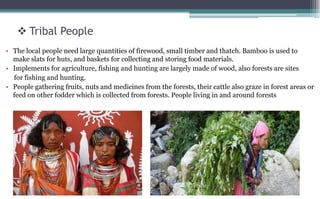
 Tribal People
• The local people need large quantities of firewood, small timber and thatch. Bamboo is used to
make slats for huts, and baskets for collecting and storing food materials.
• Implements for agriculture, fishing and hunting are largely made of wood, also forests are sites
for fishing and hunting.
• People gathering fruits, nuts and medicines from the forests, their cattle also graze in forest areas or
feed on other fodder which is collected from forests. People living in and around forests
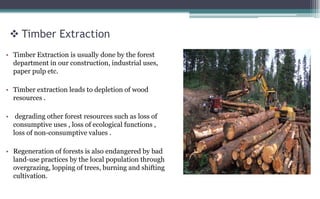
 Timber Extraction
• Timber Extraction is usually done by the forest
department in our construction, industrial uses,
paper pulp etc.
• Timber extraction leads to depletion of wood
resources .
• degrading other forest resources such as loss of
consumptive uses , loss of ecological functions ,
loss of non-consumptive values .
• Regeneration of forests is also endangered by bad
land-use practices by the local population through
overgrazing, lopping of trees, burning and shifting
cultivation.
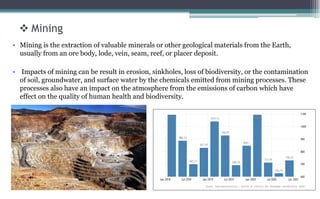
 Mining
• Mining is the extraction of valuable minerals or other geological materials from the Earth,
usually from an ore body, lode, vein, seam, reef, or placer deposit.
• Impacts of mining can be result in erosion, sinkholes, loss of biodiversity, or the contamination
of soil, groundwater, and surface water by the chemicals emitted from mining processes. These
processes also have an impact on the atmosphere from the emissions of carbon which have
effect on the quality of human health and biodiversity.
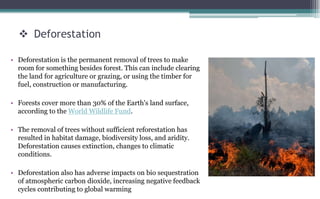
 Deforestation
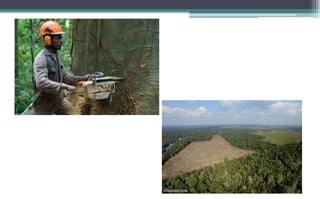
• Deforestation is the permanent removal of trees to make
room for something besides forest. This can include clearing
the land for agriculture or grazing, or using the timber for
fuel, construction or manufacturing.
• Forests cover more than 30% of the Earth's land surface,
according to the World Wildlife Fund.
• The removal of trees without sufficient reforestation has
resulted in habitat damage, biodiversity loss, and aridity.
Deforestation causes extinction, changes to climatic
conditions.
• Deforestation also has adverse impacts on bio sequestration
of atmospheric carbon dioxide, increasing negative feedback
cycles contributing to global warming
 Dams and their effects on forest
• Dam is a structure built across the river or stream to hold back water They have also
resulted in deforestation elsewhere, as farmers displaced by the dams have to clear
forests in other areas in order to grow their crops and build their homes.
• Additionally, dams imply road building, thus allowing access to previously remote areas
by loggers and “developers”, resulting in further deforestation processes.
• Not only are the best agricultural soils flooded by the reservoir, but major changes occur
in the environment, where the river’s flora and fauna begins to disappear, with strong
impacts on people dependent on those resources.
• Downstream Impacts Reduced biodiversity, poor water quality, lower crop production,
decreased fish production.
• Blocked fish migration , disrupted flow of sediments and water
• Contributes to global warming , increases water bone illness and triggers earthquakes.
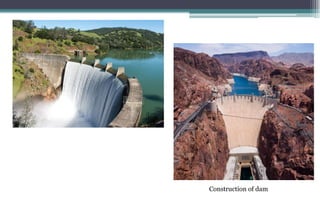
Construction of dam
Water Resource
• Earth is known as the "Blue Planet" because 71 percent of the
Earth's surface is covered with water. , but only a small
proportion of it accounts for freshwater that can be put to
use. If three-fourth of the world is covered with water .
• So it is important to conserve water resources. Water
conservation includes all the policies, strategies and activities
to sustainably manage the natural resource of fresh water, to
protect the hydrosphere.
• Water is a vital elixir for all living beings. Although it is a
renewable resource, scarcity of quality water is felt in many
parts of the world. We need water to grow food, keep clean,
generate electricity, control fire, and last but not the least, we
need it to stay alive.
Contaminated water resource effects
• Human health
Polluted water resource is the world’s largest health risk and continues to threaten both quality
of life and public health. Associated with this are health service costs, loss life expectancy, and
emergency health costs associated with major pollution events
• Ecosystem Health
Damage to freshwater and marine Ecosystem and loss of ecosystem service, which may require
investment in additional or different grey infrastructure alternatives to replicate these services
• Agriculture Productivity
Exclusion of contaminated water and irrigation results in increasing water scarcity, irrigation
with contaminated water caused damage to and reduce productivity of crops, pasture, etc. It
has bad impacts to human health and production,etc.
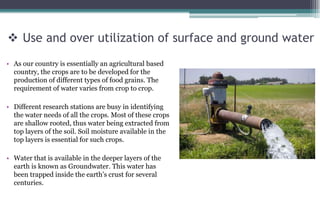
 Use and over utilization of surface and ground water
• As our country is essentially an agricultural based
country, the crops are to be developed for the
production of different types of food grains. The
requirement of water varies from crop to crop.
• Different research stations are busy in identifying
the water needs of all the crops. Most of these crops
are shallow rooted, thus water being extracted from
top layers of the soil. Soil moisture available in the
top layers is essential for such crops.
• Water that is available in the deeper layers of the
earth is known as Groundwater. This water has
been trapped inside the earth’s crust for several
centuries.
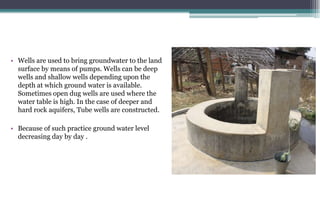
• Wells are used to bring groundwater to the land
surface by means of pumps. Wells can be deep
wells and shallow wells depending upon the
depth at which ground water is available.
Sometimes open dug wells are used where the
water table is high. In the case of deeper and
hard rock aquifers, Tube wells are constructed.
• Because of such practice ground water level
decreasing day by day .
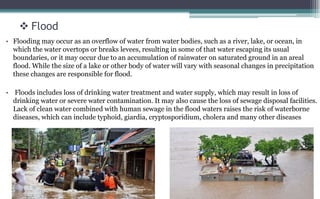
 Flood
• Flooding may occur as an overflow of water from water bodies, such as a river, lake, or ocean, in
which the water overtops or breaks levees, resulting in some of that water escaping its usual
boundaries, or it may occur due to an accumulation of rainwater on saturated ground in an areal
flood. While the size of a lake or other body of water will vary with seasonal changes in precipitation
these changes are responsible for flood.
• Floods includes loss of drinking water treatment and water supply, which may result in loss of
drinking water or severe water contamination. It may also cause the loss of sewage disposal facilities.
Lack of clean water combined with human sewage in the flood waters raises the risk of waterborne
diseases, which can include typhoid, giardia, cryptosporidium, cholera and many other diseases
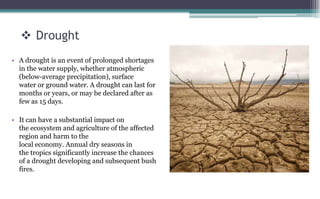
 Drought
• A drought is an event of prolonged shortages
in the water supply, whether atmospheric
(below-average precipitation), surface
water or ground water. A drought can last for
months or years, or may be declared after as
few as 15 days.
• It can have a substantial impact on
the ecosystem and agriculture of the affected
region and harm to the
local economy. Annual dry seasons in
the tropics significantly increase the chances
of a drought developing and subsequent bush
fires.
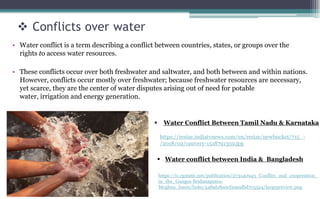
 Conflicts over water
• Water conflict is a term describing a conflict between countries, states, or groups over the
rights to access water resources.
• These conflicts occur over both freshwater and saltwater, and both between and within nations.
However, conflicts occur mostly over freshwater; because freshwater resources are necessary,
yet scarce, they are the center of water disputes arising out of need for potable
water, irrigation and energy generation.
 Water conflict between India & Bangladesh
 Water Conflict Between Tamil Nadu & Karnataka
https://i1.rgstatic.net/publication/273140943_Conflict_and_cooperation_
in_the_Ganges-Brahmaputra-
Meghna_basin/links/54f9d18a0cf29a9fbd7c5524/largepreview.png
https://resize.indiatvnews.com/en/resize/newbucket/715_-
/2018/02/cauvery-1518791359.jpg
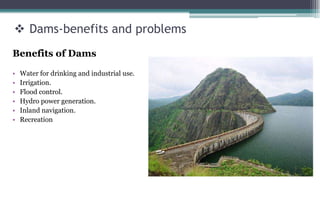
 Dams-benefits and problems
Benefits of Dams
• Water for drinking and industrial use.
• Irrigation.
• Flood control.
• Hydro power generation.
• Inland navigation.
• Recreation
Problems of Dams
• Soil Erosion
• Species Extinction
• Spread of Disease
• Changes to Earth's Rotation
• Sedimentation
• Siltation
• Water logging
Mineral resources
• Mineral resources are the key material basis for
socio-economic development. Statistical results
show that more than 95% of energy used by
mankind, 80% industrial raw materials and 70%
raw materials for agricultural production are from
mineral resources.
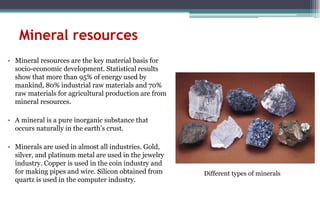
• A mineral is a pure inorganic substance that
occurs naturally in the earth’s crust.
• Minerals are used in almost all industries. Gold,
silver, and platinum metal are used in the jewelry
industry. Copper is used in the coin industry and
for making pipes and wire. Silicon obtained from
quartz is used in the computer industry.
Different types of minerals
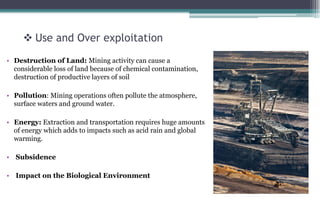
 Use and Over exploitation
• Destruction of Land: Mining activity can cause a
considerable loss of land because of chemical contamination,
destruction of productive layers of soil
• Pollution: Mining operations often pollute the atmosphere,
surface waters and ground water.
• Energy: Extraction and transportation requires huge amounts
of energy which adds to impacts such as acid rain and global
warming.
• Subsidence
• Impact on the Biological Environment
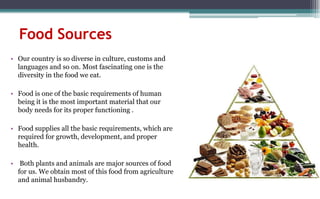
Food Sources
• Our country is so diverse in culture, customs and
languages and so on. Most fascinating one is the
diversity in the food we eat.
• Food is one of the basic requirements of human
being it is the most important material that our
body needs for its proper functioning .
• Food supplies all the basic requirements, which are
required for growth, development, and proper
health.
• Both plants and animals are major sources of food
for us. We obtain most of this food from agriculture
and animal husbandry.
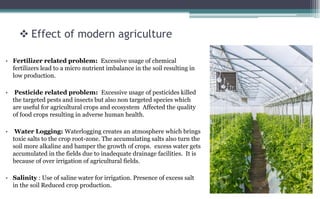
 Effect of modern agriculture
• Fertilizer related problem: Excessive usage of chemical
fertilizers lead to a micro nutrient imbalance in the soil resulting in
low production.
• Pesticide related problem: Excessive usage of pesticides killed
the targeted pests and insects but also non targeted species which
are useful for agricultural crops and ecosystem Affected the quality
of food crops resulting in adverse human health.
• Water Logging: Waterlogging creates an atmosphere which brings
toxic salts to the crop root-zone. The accumulating salts also turn the
soil more alkaline and hamper the growth of crops. excess water gets
accumulated in the fields due to inadequate drainage facilities. It is
because of over irrigation of agricultural fields.
• Salinity : Use of saline water for irrigation. Presence of excess salt
in the soil Reduced crop production.
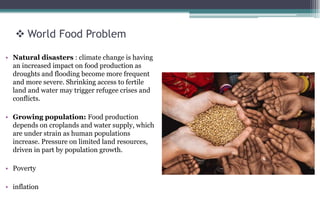
 World Food Problem
• Natural disasters : climate change is having
an increased impact on food production as
droughts and flooding become more frequent
and more severe. Shrinking access to fertile
land and water may trigger refugee crises and
conflicts.
• Growing population: Food production
depends on croplands and water supply, which
are under strain as human populations
increase. Pressure on limited land resources,
driven in part by population growth.
• Poverty
• inflation
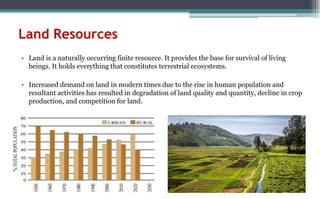
Land Resources
• Land is a naturally occurring finite resource. It provides the base for survival of living
beings. It holds everything that constitutes terrestrial ecosystems.
• Increased demand on land in modern times due to the rise in human population and
resultant activities has resulted in degradation of land quality and quantity, decline in crop
production, and competition for land.
 Land degradation
• Land degradation is a process in which the value of the biophysical environment is affected by a
combination of human-induced processes acting upon the land.
• Its impacts can be far-reaching, including loss of soil fertility, destruction of species habitat and
biodiversity, soil erosion, and excessive nutrient runoff into lakes.
• Land degradation also has serious knock-on effects for humans, such as malnutrition, disease,
forced migration, etc.
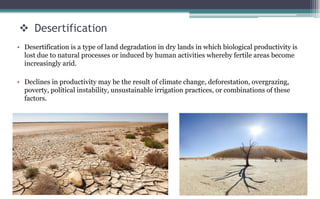
 Desertification
• Desertification is a type of land degradation in dry lands in which biological productivity is
lost due to natural processes or induced by human activities whereby fertile areas become
increasingly arid.
• Declines in productivity may be the result of climate change, deforestation, overgrazing,
poverty, political instability, unsustainable irrigation practices, or combinations of these
factors.
The End………….

Natural resources and problems

  • 1.
    Natural Resources and Associated problems (EnvironmentalStudies) Advait Vijay Mane Branch: Computer engineering
  • 2.
    Natural Resources: These arethe resources that are found in the environment and are developed without the intervention of humans. Natural resources are naturally occurring materials that are useful to human being or could be useful under conceivable technological, economic or social circumstances . For a long time, natural resources were the domain of the natural sciences.
  • 3.
    Need for managementof natural resources :- All the things we use and consume are obtained from natural resources. Due to increase in population, industrialization and urbanization the demand for natural resources is increasing and their availability is limited . So there is a need for proper management of natural resources. The proper management of natural resources consists of :-  Judicious use of natural resources and avoiding wastage of natural resources.  Long term planning for the use of natural resources so that it last not only for the present but also for future generations.  The exploitation of natural resources should not be for the benefit of a few people but should be distributed equally for all.  While extracting and using natural resources we should also plan for the safe disposal of wastes so that no damage is caused to the environment.
  • 4.
    Natural Resources : Forest Resources  Water Resources  Mineral Resources  Food Resources  Land Resources
  • 5.
    Forest Resources • Forestshelp in maintaining the water cycle on earth. Plants absorb water from the soil through their roots. It helps in process of precipitation and this eventually leads to rainfall. Hence forests play a significant role in continuing water cycle. • Forests help in maintaining the temperature and oxygen level of the atmosphere. Plants release oxygen during photosynthesis and consume carbon dioxide. Forests being a huge reserve of plants and trees, they play a significant role in balancing oxygen level in the atmosphere. • Forests help in preventing global warming. The increased amount of carbon dioxide in the atmosphere results in the greenhouse effect and thus causes global warming. • Forests prevent soil erosion.
  • 6.
     Deforestation Effects •Atmospheric Effects of Deforestation — Forests are carbon sinks that sequester carbon dioxide from the atmosphere and release oxygen in its place. As trees are cut down, the carbon dioxide they have sequestered is subsequently released back into the atmosphere, increasing the quantity of greenhouse gasses in our atmosphere. • Atmospheric Water — Trees help control the level of water found in the atmosphere. As trees are cut down, there is less water in the air to return to the soil. The result of deforestation is dryer soil that eventually will no longer support agriculture or cattle ranching. • Loss of Habitat — Forest trees provide shelter, while the canopy helps regulate light and temperatures. As these trees are removed, temperature variations, increased sunlight, loss of habitat can result in the endangerment or extinction of known species, and more tragically, the loss of unknown species. • Flooding and Soil Erosion — Underground, tree, shrub, brush, and grassroots all work together to prevent soil erosion. Without trees, precious topsoil erodes and washes away, leaving the land sterile and more prone to flooding.
  • 7.
     Tribal People •The local people need large quantities of firewood, small timber and thatch. Bamboo is used to make slats for huts, and baskets for collecting and storing food materials. • Implements for agriculture, fishing and hunting are largely made of wood, also forests are sites for fishing and hunting. • People gathering fruits, nuts and medicines from the forests, their cattle also graze in forest areas or feed on other fodder which is collected from forests. People living in and around forests
  • 8.
     Timber Extraction •Timber Extraction is usually done by the forest department in our construction, industrial uses, paper pulp etc. • Timber extraction leads to depletion of wood resources . • degrading other forest resources such as loss of consumptive uses , loss of ecological functions , loss of non-consumptive values . • Regeneration of forests is also endangered by bad land-use practices by the local population through overgrazing, lopping of trees, burning and shifting cultivation.
  • 9.
     Mining • Miningis the extraction of valuable minerals or other geological materials from the Earth, usually from an ore body, lode, vein, seam, reef, or placer deposit. • Impacts of mining can be result in erosion, sinkholes, loss of biodiversity, or the contamination of soil, groundwater, and surface water by the chemicals emitted from mining processes. These processes also have an impact on the atmosphere from the emissions of carbon which have effect on the quality of human health and biodiversity.
  • 10.
     Deforestation • Deforestationis the permanent removal of trees to make room for something besides forest. This can include clearing the land for agriculture or grazing, or using the timber for fuel, construction or manufacturing. • Forests cover more than 30% of the Earth's land surface, according to the World Wildlife Fund. • The removal of trees without sufficient reforestation has resulted in habitat damage, biodiversity loss, and aridity. Deforestation causes extinction, changes to climatic conditions. • Deforestation also has adverse impacts on bio sequestration of atmospheric carbon dioxide, increasing negative feedback cycles contributing to global warming
  • 12.
     Dams andtheir effects on forest • Dam is a structure built across the river or stream to hold back water They have also resulted in deforestation elsewhere, as farmers displaced by the dams have to clear forests in other areas in order to grow their crops and build their homes. • Additionally, dams imply road building, thus allowing access to previously remote areas by loggers and “developers”, resulting in further deforestation processes. • Not only are the best agricultural soils flooded by the reservoir, but major changes occur in the environment, where the river’s flora and fauna begins to disappear, with strong impacts on people dependent on those resources. • Downstream Impacts Reduced biodiversity, poor water quality, lower crop production, decreased fish production. • Blocked fish migration , disrupted flow of sediments and water • Contributes to global warming , increases water bone illness and triggers earthquakes.
  • 13.
  • 14.
    Water Resource • Earthis known as the "Blue Planet" because 71 percent of the Earth's surface is covered with water. , but only a small proportion of it accounts for freshwater that can be put to use. If three-fourth of the world is covered with water . • So it is important to conserve water resources. Water conservation includes all the policies, strategies and activities to sustainably manage the natural resource of fresh water, to protect the hydrosphere. • Water is a vital elixir for all living beings. Although it is a renewable resource, scarcity of quality water is felt in many parts of the world. We need water to grow food, keep clean, generate electricity, control fire, and last but not the least, we need it to stay alive.
  • 15.
    Contaminated water resourceeffects • Human health Polluted water resource is the world’s largest health risk and continues to threaten both quality of life and public health. Associated with this are health service costs, loss life expectancy, and emergency health costs associated with major pollution events • Ecosystem Health Damage to freshwater and marine Ecosystem and loss of ecosystem service, which may require investment in additional or different grey infrastructure alternatives to replicate these services • Agriculture Productivity Exclusion of contaminated water and irrigation results in increasing water scarcity, irrigation with contaminated water caused damage to and reduce productivity of crops, pasture, etc. It has bad impacts to human health and production,etc.
  • 16.
     Use andover utilization of surface and ground water • As our country is essentially an agricultural based country, the crops are to be developed for the production of different types of food grains. The requirement of water varies from crop to crop. • Different research stations are busy in identifying the water needs of all the crops. Most of these crops are shallow rooted, thus water being extracted from top layers of the soil. Soil moisture available in the top layers is essential for such crops. • Water that is available in the deeper layers of the earth is known as Groundwater. This water has been trapped inside the earth’s crust for several centuries.
  • 17.
    • Wells areused to bring groundwater to the land surface by means of pumps. Wells can be deep wells and shallow wells depending upon the depth at which ground water is available. Sometimes open dug wells are used where the water table is high. In the case of deeper and hard rock aquifers, Tube wells are constructed. • Because of such practice ground water level decreasing day by day .
  • 18.
     Flood • Floodingmay occur as an overflow of water from water bodies, such as a river, lake, or ocean, in which the water overtops or breaks levees, resulting in some of that water escaping its usual boundaries, or it may occur due to an accumulation of rainwater on saturated ground in an areal flood. While the size of a lake or other body of water will vary with seasonal changes in precipitation these changes are responsible for flood. • Floods includes loss of drinking water treatment and water supply, which may result in loss of drinking water or severe water contamination. It may also cause the loss of sewage disposal facilities. Lack of clean water combined with human sewage in the flood waters raises the risk of waterborne diseases, which can include typhoid, giardia, cryptosporidium, cholera and many other diseases
  • 19.
     Drought • Adrought is an event of prolonged shortages in the water supply, whether atmospheric (below-average precipitation), surface water or ground water. A drought can last for months or years, or may be declared after as few as 15 days. • It can have a substantial impact on the ecosystem and agriculture of the affected region and harm to the local economy. Annual dry seasons in the tropics significantly increase the chances of a drought developing and subsequent bush fires.
  • 20.
     Conflicts overwater • Water conflict is a term describing a conflict between countries, states, or groups over the rights to access water resources. • These conflicts occur over both freshwater and saltwater, and both between and within nations. However, conflicts occur mostly over freshwater; because freshwater resources are necessary, yet scarce, they are the center of water disputes arising out of need for potable water, irrigation and energy generation.  Water conflict between India & Bangladesh  Water Conflict Between Tamil Nadu & Karnataka https://i1.rgstatic.net/publication/273140943_Conflict_and_cooperation_ in_the_Ganges-Brahmaputra- Meghna_basin/links/54f9d18a0cf29a9fbd7c5524/largepreview.png https://resize.indiatvnews.com/en/resize/newbucket/715_- /2018/02/cauvery-1518791359.jpg
  • 21.
     Dams-benefits andproblems Benefits of Dams • Water for drinking and industrial use. • Irrigation. • Flood control. • Hydro power generation. • Inland navigation. • Recreation
  • 22.
    Problems of Dams •Soil Erosion • Species Extinction • Spread of Disease • Changes to Earth's Rotation • Sedimentation • Siltation • Water logging
  • 23.
    Mineral resources • Mineralresources are the key material basis for socio-economic development. Statistical results show that more than 95% of energy used by mankind, 80% industrial raw materials and 70% raw materials for agricultural production are from mineral resources. • A mineral is a pure inorganic substance that occurs naturally in the earth’s crust. • Minerals are used in almost all industries. Gold, silver, and platinum metal are used in the jewelry industry. Copper is used in the coin industry and for making pipes and wire. Silicon obtained from quartz is used in the computer industry. Different types of minerals
  • 24.
     Use andOver exploitation • Destruction of Land: Mining activity can cause a considerable loss of land because of chemical contamination, destruction of productive layers of soil • Pollution: Mining operations often pollute the atmosphere, surface waters and ground water. • Energy: Extraction and transportation requires huge amounts of energy which adds to impacts such as acid rain and global warming. • Subsidence • Impact on the Biological Environment
  • 25.
    Food Sources • Ourcountry is so diverse in culture, customs and languages and so on. Most fascinating one is the diversity in the food we eat. • Food is one of the basic requirements of human being it is the most important material that our body needs for its proper functioning . • Food supplies all the basic requirements, which are required for growth, development, and proper health. • Both plants and animals are major sources of food for us. We obtain most of this food from agriculture and animal husbandry.
  • 26.
     Effect ofmodern agriculture • Fertilizer related problem: Excessive usage of chemical fertilizers lead to a micro nutrient imbalance in the soil resulting in low production. • Pesticide related problem: Excessive usage of pesticides killed the targeted pests and insects but also non targeted species which are useful for agricultural crops and ecosystem Affected the quality of food crops resulting in adverse human health. • Water Logging: Waterlogging creates an atmosphere which brings toxic salts to the crop root-zone. The accumulating salts also turn the soil more alkaline and hamper the growth of crops. excess water gets accumulated in the fields due to inadequate drainage facilities. It is because of over irrigation of agricultural fields. • Salinity : Use of saline water for irrigation. Presence of excess salt in the soil Reduced crop production.
  • 27.
     World FoodProblem • Natural disasters : climate change is having an increased impact on food production as droughts and flooding become more frequent and more severe. Shrinking access to fertile land and water may trigger refugee crises and conflicts. • Growing population: Food production depends on croplands and water supply, which are under strain as human populations increase. Pressure on limited land resources, driven in part by population growth. • Poverty • inflation
  • 28.
    Land Resources • Landis a naturally occurring finite resource. It provides the base for survival of living beings. It holds everything that constitutes terrestrial ecosystems. • Increased demand on land in modern times due to the rise in human population and resultant activities has resulted in degradation of land quality and quantity, decline in crop production, and competition for land.
  • 29.
     Land degradation •Land degradation is a process in which the value of the biophysical environment is affected by a combination of human-induced processes acting upon the land. • Its impacts can be far-reaching, including loss of soil fertility, destruction of species habitat and biodiversity, soil erosion, and excessive nutrient runoff into lakes. • Land degradation also has serious knock-on effects for humans, such as malnutrition, disease, forced migration, etc.
  • 30.
     Desertification • Desertificationis a type of land degradation in dry lands in which biological productivity is lost due to natural processes or induced by human activities whereby fertile areas become increasingly arid. • Declines in productivity may be the result of climate change, deforestation, overgrazing, poverty, political instability, unsustainable irrigation practices, or combinations of these factors.
  • 31.