Changing The SamplingRate
Using Discrete-Time
Processing
Sampling Rate Reduction by an Integer Factor
Increasing the Sampling Rate by an Integer
Factor
Changing the Sampling Rate by a
Noninteger Factor
Sampling Rate Reduction Increase
period
Decrease
frequency
4.
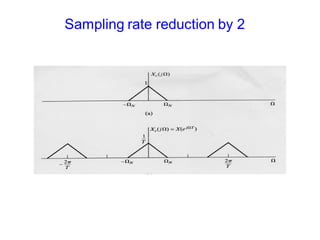
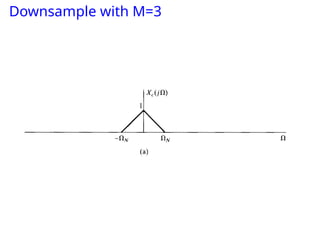
Sampling RateReduction by an Integer Factor
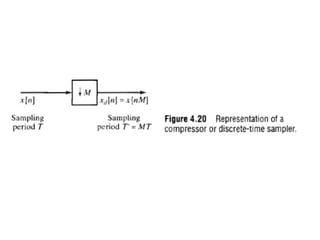
xd[n] = x[nM] = xc(nMT)
system called Sampling Rate Compressor or Compressor
operation called Downsampling
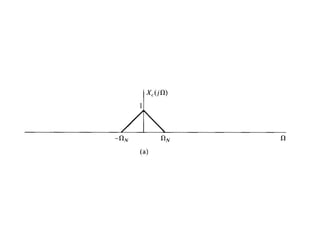
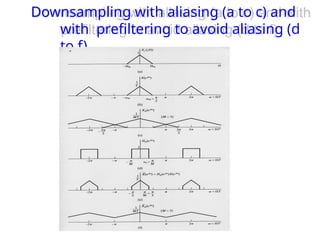
xd[n] is an exact representation of xc(t) if /(MT) > N
sampling rate can be reduced by a factor of M without aliasing
if the original sampling rate was at least M times the Nyquist
rate or if the bandwidth of the sequence is first reduced by a
factor of M by discrete-time filtering
Fourier transform of discrete-time sampled sequence xd[n] is
where r = i+kM, -infinity < k < infinity and 0 < and = i < and = M-
1
Lowpass filter+Compressor = Decimator
Sampling Rate Reduction by an Integer
Factor
MT MT
MT
X ( j j
)
j
Xd (e )
r
c
1
2r
M
X(e
)
j
Xd (e )
j(/ M2i/
M)
i
0
1 M1
6.
General system forsampling rate reduction
by integer factor M
Lowpass filter
Gain = 1
Cutoff = /M
M
x[n] x~[n] xd
~[n] = x~[nM]
Sampling
period T
Sampling
period T
Sampling
period T’ = MT
Increasing the SamplingRate by an
Integer Factor
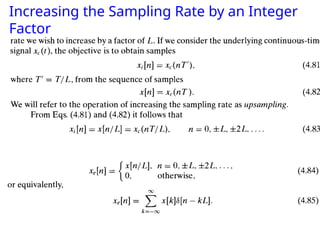
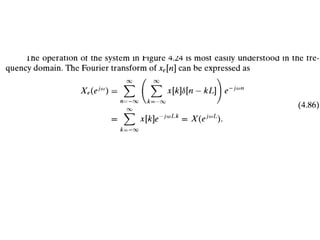
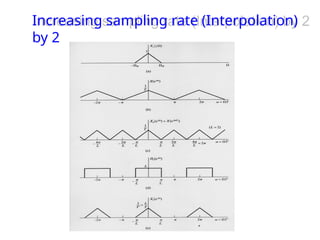
Increasing the Sampling Rate by an Integer Factor
xi[n] = x[n/L] = xc(nT/L), n = 0, ±L, ± 2L, ...
and
Xi(ej) can be obtained from Xe(ej) by correcting the amplitude
scale from 1/T to L/T and by removing all the frequency-scaled
images of Xc(j) except at integer multiples of 2
k
system called Sampling Rate Expander or
Expander
operation called Upsampling or Interpolation
xe [n] x[k][n
kL]
j
j
L
X (e )
(4.85)
j
n
j
Lk
k
x[k]e
n k
Xe (e ) x[k]
[n kL]e
xi [n]
x[k]
k
sin[(n kL) / L]
(n kL) / L
General system forsampling rate increase by
integer factor L
L
Lowpass filter
Gain = L
Cutoff = /L
x[n] xe[n] xi[n]
Sampling
period
T
Sampling
period T’ = T/L
Sampling
period T’ = T/L
![ Sampling Rate Reduction by an Integer Factor
xd[n] = x[nM] = xc(nMT)
system called Sampling Rate Compressor or Compressor
operation called Downsampling
xd[n] is an exact representation of xc(t) if /(MT) > N
sampling rate can be reduced by a factor of M without aliasing
if the original sampling rate was at least M times the Nyquist
rate or if the bandwidth of the sequence is first reduced by a
factor of M by discrete-time filtering
Fourier transform of discrete-time sampled sequence xd[n] is
where r = i+kM, -infinity < k < infinity and 0 < and = i < and = M-
1
Lowpass filter+Compressor = Decimator
Sampling Rate Reduction by an Integer
Factor
MT MT
MT
X ( j j
)
j
Xd (e )
r
c
1
2r
M
X(e
)
j
Xd (e )
j(/ M2i/
M)
i
0
1 M1](https://image.slidesharecdn.com/week71a-251203133900-ffbc1fe9/85/week-7_1a-pptx-di9gital-signal-processing-4-320.jpg)

![General system for sampling rate reduction
by integer factor M
Lowpass filter
Gain = 1
Cutoff = /M
M
x[n] x~[n] xd
~[n] = x~[nM]
Sampling
period T
Sampling
period T
Sampling
period T’ = MT](https://image.slidesharecdn.com/week71a-251203133900-ffbc1fe9/85/week-7_1a-pptx-di9gital-signal-processing-6-320.jpg)

![Increasing the Sampling Rate by an
Integer Factor
Increasing the Sampling Rate by an Integer Factor
xi[n] = x[n/L] = xc(nT/L), n = 0, ±L, ± 2L, ...
and
Xi(ej) can be obtained from Xe(ej) by correcting the amplitude
scale from 1/T to L/T and by removing all the frequency-scaled
images of Xc(j) except at integer multiples of 2
k
system called Sampling Rate Expander or
Expander
operation called Upsampling or Interpolation
xe [n] x[k][n
kL]
j
j
L
X (e )
(4.85)
j
n
j
Lk
k
x[k]e
n k
Xe (e ) x[k]
[n kL]e
xi [n]
x[k]
k
sin[(n kL) / L]
(n kL) / L](https://image.slidesharecdn.com/week71a-251203133900-ffbc1fe9/85/week-7_1a-pptx-di9gital-signal-processing-12-320.jpg)
![General system for sampling rate increase by
integer factor L
L
Lowpass filter
Gain = L
Cutoff = /L
x[n] xe[n] xi[n]
Sampling
period
T
Sampling
period T’ = T/L
Sampling
period T’ = T/L](https://image.slidesharecdn.com/week71a-251203133900-ffbc1fe9/85/week-7_1a-pptx-di9gital-signal-processing-15-320.jpg)
![Digital Signal Processing[ECEG-3171]-Ch1_L06](https://cdn.slidesharecdn.com/ss_thumbnails/dspl6ch2-180427094424-thumbnail.jpg?width=640&height=640&fit=bounds)


![Digital Signal Processing[ECEG-3171]-Ch1_L05](https://cdn.slidesharecdn.com/ss_thumbnails/dspl5ch2-180427094424-thumbnail.jpg?width=640&height=640&fit=bounds)


