Prepared by: Kishan Panara
Roll no. 24











Vector Processing Principles
Multivector Design
Multiprocessor
Multitasking
Multiprogramming
Instruction and datastream
Advantages
Disadvantages
Conclusion








A vector is a set of scalar data items, all of the
same type, stored in memory.
A vector processor is an ensemble of hardware
resources, including vector registers, functional
pipelines, processing elements, and register
counters, for performing vector operations.
Vector processing occurs when arithmetic or logical
operations are applied to vectors.
Vector processing speedup 10..20 compared with
scalar processing.






A process that allows the CPU to execute a single
instruction simultaneously on multiple pieces of
data, rather than by repetitive looping.
superscalar designs can take advantage of
parallelism in scalar operations, it is possible to
take advantage of similar parallelism in vector
codes , Thus, it makes sense to provide multiple
vector processors in a system.
Here the main issue is memory access.






Multiprocessing is the use of two or more central
processing units (CPUs) within a single computer
system.
Ability of a system to support more than one
processor and/or the ability to allocate tasks
between them.
The terms multitasking or multiprogramming are
more appropriate to describe this concept.


A single CPU can only go so fast, use more
than one CPU to improve performance



Multiple users



Multiple applications



Multi-tasking within an application



Responsiveness and/or throughput
◦ The ability to execute more than one task at the
same time, a task being a program.
◦ In multitasking, only one CPU is involved, but it
switches from one program to another so quickly
that it gives the appearance of executing all of
the programs at the same time.
◦ There are two basic types of multitasking:
 preemptive
 the operating system parcels out CPU time slices to each
program.

 cooperative.
 each program can control the CPU for as long as it needs
it.
◦ A single program it self has more than one line of
executions (Thread). Every thread shares common
memory.
◦ Multiprogramming is a rudimentary form of
parallel processing in which several programs are
run at the same time on a uniprocessor.
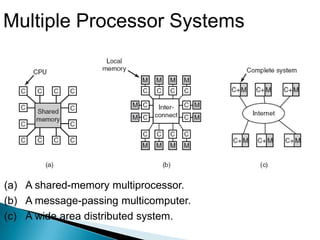
Multiple Processor Systems

(a) A shared-memory multiprocessor.
(b) A message-passing multicomputer.
(c) A wide area distributed system.
Multiprocessors can be used in different ways:
 Uniprossesors (single-instruction, single-data or
SISD)
 Within a single system to execute multiple,
independent sequences of instructions in multiple
contexts (multiple-instruction, multiple-data or
MIMD);
 A single sequence of instructions in multiple
contexts (single-instruction, multiple-data or SIMD,
often used in vector processing);
 Multiple sequences of instructions in a single
context (multiple-instruction, single-data or MISD,
used for redundancy in fail-safe systems and
sometimes applied to describe pipelined
processors).


Reduced Cost



Increased Reliability



Increased Throughput


If one processor fails then it will affect in the speed



complex OS is required



large main memory required.




Parallel processing is a future technique for higher
performance and effectiveness for
multiprogrammed workloads.
Using multiprocessor we can do multiple task at a
time and save time.


www.wikipedia.org



http://solutionhomebd.blogspot.in/





http://whatis.techtarget.com/definition/multi
programming
http://wiki.answers.com/
Thank you

Multivector and multiprocessor

  • 1.
    Prepared by: KishanPanara Roll no. 24
  • 2.
             Vector Processing Principles MultivectorDesign Multiprocessor Multitasking Multiprogramming Instruction and datastream Advantages Disadvantages Conclusion
  • 3.
        A vector isa set of scalar data items, all of the same type, stored in memory. A vector processor is an ensemble of hardware resources, including vector registers, functional pipelines, processing elements, and register counters, for performing vector operations. Vector processing occurs when arithmetic or logical operations are applied to vectors. Vector processing speedup 10..20 compared with scalar processing.
  • 4.
       A process thatallows the CPU to execute a single instruction simultaneously on multiple pieces of data, rather than by repetitive looping. superscalar designs can take advantage of parallelism in scalar operations, it is possible to take advantage of similar parallelism in vector codes , Thus, it makes sense to provide multiple vector processors in a system. Here the main issue is memory access.
  • 5.
       Multiprocessing is theuse of two or more central processing units (CPUs) within a single computer system. Ability of a system to support more than one processor and/or the ability to allocate tasks between them. The terms multitasking or multiprogramming are more appropriate to describe this concept.
  • 6.
     A single CPUcan only go so fast, use more than one CPU to improve performance  Multiple users  Multiple applications  Multi-tasking within an application  Responsiveness and/or throughput
  • 7.
    ◦ The abilityto execute more than one task at the same time, a task being a program. ◦ In multitasking, only one CPU is involved, but it switches from one program to another so quickly that it gives the appearance of executing all of the programs at the same time. ◦ There are two basic types of multitasking:  preemptive  the operating system parcels out CPU time slices to each program.  cooperative.  each program can control the CPU for as long as it needs it.
  • 8.
    ◦ A singleprogram it self has more than one line of executions (Thread). Every thread shares common memory. ◦ Multiprogramming is a rudimentary form of parallel processing in which several programs are run at the same time on a uniprocessor.
  • 9.
    Multiple Processor Systems (a)A shared-memory multiprocessor. (b) A message-passing multicomputer. (c) A wide area distributed system.
  • 10.
    Multiprocessors can beused in different ways:  Uniprossesors (single-instruction, single-data or SISD)  Within a single system to execute multiple, independent sequences of instructions in multiple contexts (multiple-instruction, multiple-data or MIMD);  A single sequence of instructions in multiple contexts (single-instruction, multiple-data or SIMD, often used in vector processing);  Multiple sequences of instructions in a single context (multiple-instruction, single-data or MISD, used for redundancy in fail-safe systems and sometimes applied to describe pipelined processors).
  • 11.
  • 12.
     If one processorfails then it will affect in the speed  complex OS is required  large main memory required.
  • 13.
      Parallel processing isa future technique for higher performance and effectiveness for multiprogrammed workloads. Using multiprocessor we can do multiple task at a time and save time.
  • 14.
  • 15.