•Multiplexing
Multiplexing
• It is a technique which allows to a send
multiples signals over a single data link.
• In simple words sharing of medium between
multiple signals.
• Multiplexer: it is a device that combine
multiple signals into one signal.
• Demultiplexer: it is a device that separate
the multiplexer signal
Multiplexer and Demultiplexer:
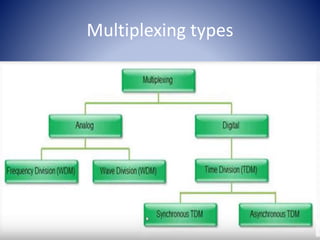
Multiplexing types
ANALOG AND DIGITAL
• Data can be analog or digital.
Analog data are continuous and take
continuous values.
• Digital data have discrete states and take
discrete values.
• Signals can be analog or digital.
Analog signals can have an infinite
number of values in a range; digital signals
can have only a limited number of values.
Comparison of analog and digital
signals
Frequency Division Multiplexing
• FDM an analog multiplexing techniqe.Every
input signal is modulated with carries
frequency to change its characteristics
(frequency).
Frequency
• Two signals with the same amplitude and
phase but different frequencies
Wave Division multiplexing (WDM)
• It is an analog technique. It combines multiple
wavelength of optical signal to transmit in
single optical fiber.
wavelength
• A wavelength is a measure of distance
between two identical peaks (high points) or
troughs (low points) in a wave -- a repeating
pattern of traveling energy like light or sound.
Time Division Multiplex (TDM)
• TDM is a digital multiplexing technique. Every
transmitter is assigned a time slot to transmit
its signal.
1. Synchronous TDM
2. Asynchronous TDM
Time Division Multiplex (TDM)
Synchronous TDM
• Time slots are fixed. Each source is given it's
time slot at every turn due to it. This turn may
be once per cycle, or several turns per cycle ,if
it has a high data transfer rate, or may be once
in a no. of cycles if it is slow. This slot is given
even if the source is not ready with data. So
this slot is transmitted empty.
Asynchronous TDM:
Asynchronous TDM: In this method, slots are
not fixed. They are allotted dynamically
depending on speed of sources, and whether
they are ready for transmission.
Multiplexing
Multiplexing

Multiplexing

  • 1.
  • 2.
    Multiplexing • It isa technique which allows to a send multiples signals over a single data link. • In simple words sharing of medium between multiple signals. • Multiplexer: it is a device that combine multiple signals into one signal. • Demultiplexer: it is a device that separate the multiplexer signal
  • 3.
  • 4.
  • 5.
    ANALOG AND DIGITAL •Data can be analog or digital. Analog data are continuous and take continuous values. • Digital data have discrete states and take discrete values. • Signals can be analog or digital. Analog signals can have an infinite number of values in a range; digital signals can have only a limited number of values.
  • 6.
    Comparison of analogand digital signals
  • 7.
    Frequency Division Multiplexing •FDM an analog multiplexing techniqe.Every input signal is modulated with carries frequency to change its characteristics (frequency).
  • 8.
    Frequency • Two signalswith the same amplitude and phase but different frequencies
  • 9.
    Wave Division multiplexing(WDM) • It is an analog technique. It combines multiple wavelength of optical signal to transmit in single optical fiber.
  • 10.
    wavelength • A wavelengthis a measure of distance between two identical peaks (high points) or troughs (low points) in a wave -- a repeating pattern of traveling energy like light or sound.
  • 11.
    Time Division Multiplex(TDM) • TDM is a digital multiplexing technique. Every transmitter is assigned a time slot to transmit its signal. 1. Synchronous TDM 2. Asynchronous TDM
  • 12.
  • 13.
    Synchronous TDM • Timeslots are fixed. Each source is given it's time slot at every turn due to it. This turn may be once per cycle, or several turns per cycle ,if it has a high data transfer rate, or may be once in a no. of cycles if it is slow. This slot is given even if the source is not ready with data. So this slot is transmitted empty.
  • 15.
    Asynchronous TDM: Asynchronous TDM:In this method, slots are not fixed. They are allotted dynamically depending on speed of sources, and whether they are ready for transmission.