Risk	
  factors	
  in	
  Mul0ple	
  Sclerosis:	
  
Detec0on	
  and	
  Treatment	
  in	
  Daily	
  Life	
  
Caroline	
  Pot	
  
Patrice	
  Lalive	


Unit	
  of	
  Neuroimmunology	
  and	
  Mul0ple	
  Sclerosis	
  
Geneva	
  University	
  Hospital	


16th	
  State	
  of	
  the	
  Art	
  
Lucerne,	
  January	
  11th,	
  2014	
  	
  
Workshop	
  C	
  	
  
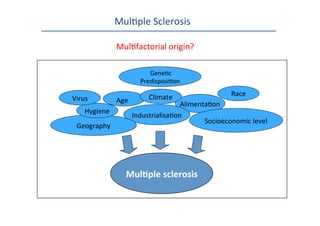
Alimenta0on	
  
Socioeconomic	
  level	
  
Age	
  
Industrialisa0on	
  
Climate	
  
	
  Gene0c	
  
Predisposi0on	
  
Race	
  
Geography	
  
Hygiene	
  
Virus	
  
Mul$ple	
  sclerosis	
  
Mul0ple	
  Sclerosis	
  
Mul0factorial	
  origin?	
  
Mul0ple	
  Sclerosis	
  
Mul0ple	
  Sclerosis	
  
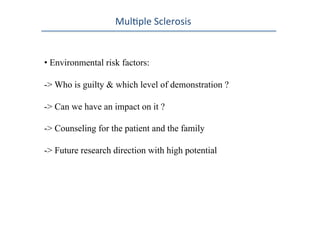
• Environmental risk factors:
-> Who is guilty & which level of demonstration ?
-> Can we have an impact on it ?
-> Counseling for the patient and the family
-> Future research direction with high potential
Mul0ple	
  Sclerosis	
  
-> How do you manage “Environmental risk factors” with patients ?
- Give advices (only if asked) ?
- Blood test ?
- Vit. D ?
- Diet ?
- Smoking ?
- Follow specific protocol?
- > Do you believe this can have an impact on the disease course or the
risk of MS?
Mul0ple	
  Sclerosis	
  :	
  Risk	
  factors
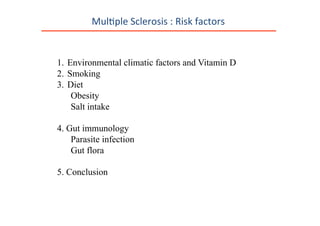
1.  Environmental climatic factors and Vitamin D
2.  Smoking
3.  Diet
Obesity
Salt intake
4. Gut immunology
Parasite infection
Gut flora
5. Conclusion
Mul0ple	
  Sclerosis	
  :	
  mul0factorial	
  disease
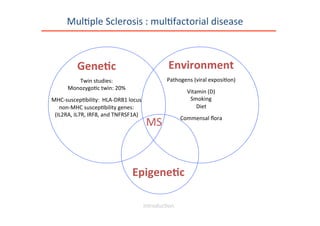
Gene$c	


Twin	
  studies:	
  
Monozygo0c	
  twin:	
  20%	


MHC-­‐suscep0bility:	
  	
  HLA-­‐DRB1	
  locus	
  
non-­‐MHC	
  suscep0bility	
  genes:	
  
(IL2RA,	
  IL7R,	
  IRF8,	
  and	
  TNFRSF1A)
Environment	


Pathogens	
  (viral	
  exposi0on)	


Vitamin	
  (D)	
  	
  
Smoking	
  
Diet	


Commensal	
  flora	
  
Epigene$c	
  
MS
Introduc0on	
  
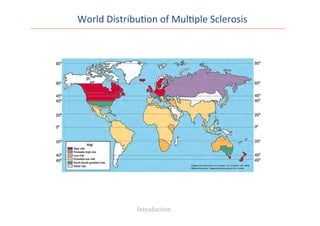
World	
  Distribu0on	
  of	
  Mul0ple	
  Sclerosis	
  
Introduction
hence limiting ascertainment bias. Treatment costs for
values” heading. The d
daily sums for UVB ra
latitude and longitude
MSA regions in France
by the service were use
tion. The “all sky” UV
the latter provides the
vides an average value.
used for analysis as the
tion. Verification of th
have been previously p
A map of France ill
irradiation was produc
vices.18
The quantitie
(kWh/m2
) calculated f
puted from satellite ob
ergy that reaches the
Oldenburg, MINES P
Data analyses. Pears
relationship of overall
MSA region. This was
Both annual and wint
rately in males and fem
assess the association o
mean UVB.
Sex ratio was calcu
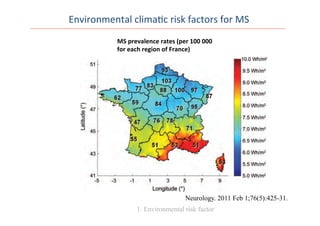
Figure 1 Annual mean ultraviolet B (Wh/m2
) radiation in France
Multiple sclerosis prevalence rates (per 100,000) for each Mutualite´ Sociale Agricole re-
gion are shown.
Neurology. 2011 Feb 1;76(5):425-31.
1. Environmental risk factor
MS	
  prevalence	
  rates	
  (per	
  100	
  000	
  
for	
  each	
  region	
  of	
  France)	
  
Environmental	
  clima0c	
  risk	
  factors	
  for	
  MS	
  
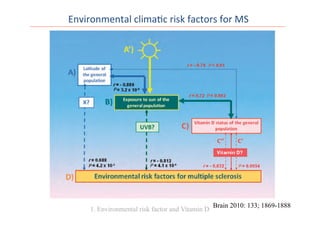
Figure 3 Environmental climatic risk factors for multiple sclerosis and links between them. The r- and P-values illustrate the example of
France and correspond to the Pearson correlation tests reviewed in this article or performed by the authors, based on data for French
regions concerning (A) mean latitude, (B) mean global annual sunshine (Suri et al., 2007), (C) mean serum level of vitamin D in normal
Hypovitaminosis D in multiple sclerosis Brain 2010: 133; 1869–1888 | 1875
Brain 2010: 133; 1869-1888
Environmental	
  clima0c	
  risk	
  factors	
  for	
  MS	
  
1. Environmental risk factor and Vitamin D
Mul0ple	
  Sclerosis	
  
Vitamin D ?
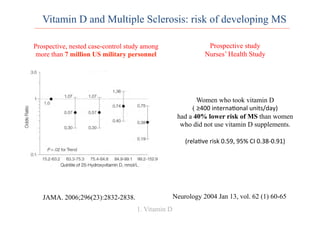
Vitamin D and Multiple Sclerosis: risk of developing MS
Neurology 2004 Jan 13, vol. 62 (1) 60-65
Prospective study
Nurses’ Health Study
Women who took vitamin D
( ≥400	
  interna0onal	
  units/day)	
  	
  
had a 40% lower risk of MS than women
who did not use vitamin D supplements.
(rela0ve	
  risk	
  0.59,	
  95%	
  CI	
  0.38-­‐0.91)
JAMA. 2006;296(23):2832-2838.
Prospective, nested case-control study among
more than 7 million US military personnel
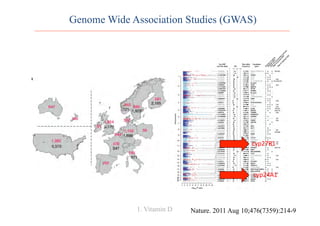
1. Vitamin D
Genome Wide Association Studies (GWAS)
Nature. 2011 Aug 10;476(7359):214-9
cyp27B1	
  
cyp24A1	
  
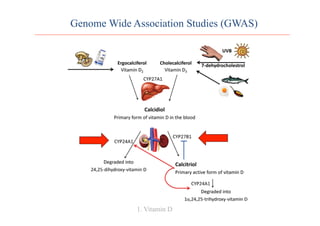
1. Vitamin D
Genome Wide Association Studies (GWAS)
1. Vitamin D
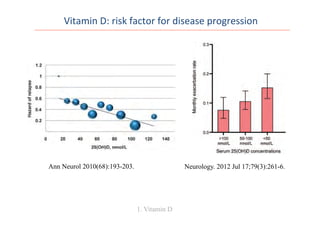
Ann Neurol 2010(68):193-203. Neurology. 2012 Jul 17;79(3):261-6.
August and nadirs in mid February. The
soidal curve resulted in a geometric mean
concentration of 69 nmol/L. There was
able variation in mean levels between pa
ficient of variation 41%).
Association between serum 25-OH-D co
Figure 2 Monthly exacerbation rates for the different groups
(A) Monthly exacerbation rates for the different groups of serum 25-hydro
(25-OH-D) concentrations, and (B) for at-risk period for infections. Error
95% confidence intervals. Serum 25-OH-D concentrations: p (trend) ϭ
tions p Ͻ 0.001.
Vitamin	
  D:	
  risk	
  factor	
  for	
  disease	
  progression	
  	
  
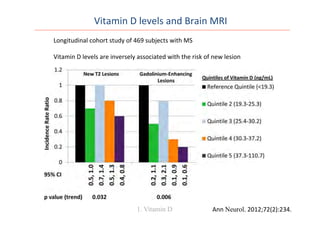
1. Vitamin D
Vitamin	
  D	
  levels	
  and	
  Brain	
  MRI	
  
Longitudinal	
  cohort	
  study	
  of	
  469	
  subjects	
  with	
  MS	


Vitamin	
  D	
  levels	
  are	
  inversely	
  associated	
  with	
  the	
  risk	
  of	
  new	
  lesion	
  
Ann	
  Neurol.	
  2012;72(2):234.	
  1. Vitamin D
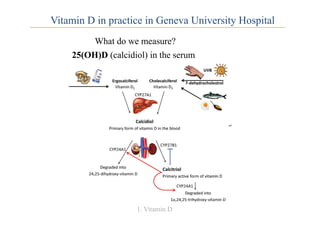
What do we measure?
Vitamin D in practice in Geneva University Hospital
25(OH)D (calcidiol) in the serum
	
  
Optimal ≥ 75 nmol/L
Sub-optimal: ≥50 nmol/L et < 75 nmol/L
Moderate deficit: >25 nmol/L et <50nmol/L
Severe deficit : < 25 nmol/l
	
  
1. Vitamin D
Vitamin D in practice in Geneva University Hospital
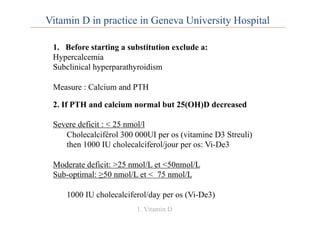
1.  Before starting a substitution exclude a:
Hypercalcemia
Subclinical hyperparathyroidism
Measure : Calcium and PTH
2. If PTH and calcium normal but 25(OH)D decreased
Severe deficit : < 25 nmol/l
Cholecalciférol 300 000UI per os (vitamine D3 Streuli)
then 1000 IU cholecalciferol/jour per os: Vi-De3
Moderate deficit: >25 nmol/L et <50nmol/L
Sub-optimal: ≥50 nmol/L et < 75 nmol/L
1000 IU cholecalciferol/day per os (Vi-De3)
	
  
1. Vitamin D
Mul0ple	
  Sclerosis	
  
Smoking?
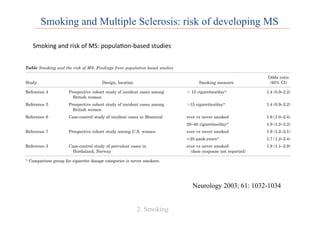
Smoking and Multiple Sclerosis: risk of developing MS
2. Smoking
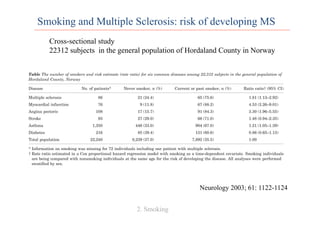
Cross-sectional study
22312 subjects in the general population of Hordaland County in Norway
years. Exclusion of these cases from the analyses did not
change the results.
The RR estimated by the Cox model comparing ever-
smokers with never-smokers was 1.81 (p ϭ 0.014) (table).
The RR was 2.75 for men and 1.61 for women. An analysis
excluding the patients who started to smoke less than 4
years prior to the onset of disease gave an RR of 1.74 (p ϭ
0.024). Further, an analysis including educational level
per 100,000 people 40 to 49 years old.8
This is
slightly lower than the rate found in the current
study, assuming the same frequency of nonresponse
among patients with MS as the rest of the popula-
tion (390 per 100,000). This could reflect a small
increase in the prevalence rate during these 4 years
or that the patients with MS in the current study
had a slightly higher response rate than did the total
Table The number of smokers and risk estimate (rate ratio) for six common diseases among 22,312 subjects in the general population of
Hordaland County, Norway
Disease No. of patients* Never smoker, n (%) Current or past smoker, n (%) Ratio ratio† (95% CI)
Multiple sclerosis 86 21 (24.4) 65 (75.6) 1.81 (1.13–2.92)
Myocardial infarction 76 9 (11.8) 67 (88.2) 4.53 (2.26–9.01)
Angina pectoris 108 17 (15.7) 91 (84.3) 3.30 (1.96–5.55)
Stroke 93 27 (29.0) 66 (71.0) 1.48 (0.94–2.35)
Asthma 1,350 446 (33.0) 904 (67.0) 1.21 (1.05–1.39)
Diabetes 216 85 (39.4) 131 (60.6) 0.86 (0.65–1.13)
Total population 22,240 8,239 (37.0) 7,892 (35.5) 1.00
* Information on smoking was missing for 72 individuals including one patient with multiple sclerosis.
† Rate ratio estimated in a Cox proportional hazard regression model with smoking as a time-dependent covariate. Smoking individuals
are being compared with nonsmoking individuals at the same age for the risk of developing the disease. All analyses were performed
stratified by sex.
Neurology 2003; 61: 1122-1124
Smoking	
  and	
  risk	
  of	
  MS:	
  popula0on-­‐based	
  studies	
  
anese17
but not in Canadian18
patients. Ongoing
work associating vitamin D exposure, ultraviolet ir-
radiation, and MS is under way in Australia, as is
research examining dietary vitamin D supplementa-
tion as a possible preventive treatment strategy for
the disease.
unsaturated fatty acids and vitamin D foods may be
encouraged.
Acknowledgment
The authors thank Dr. Stephen Reingold, National MS Society,
and Dr. Annette-Langer-Gould, Stanford University, for their
input.
Table Smoking and the risk of MS: Findings from population-based studies
Study Design, location Smoking measure
Odds ratio
(95% CI)
Reference 4 Prospective cohort study of incident cases among
British women
Ͼ 15 cigarettes/day* 1.4 (0.9–2.2)
Reference 5 Prospective cohort study of incident cases among
British women
Ͼ15 cigarettes/day* 1.4 (0.9–2.2)
Reference 6 Case-control study of incident cases in Montreal ever vs never smoked 1.6 (1.0–2.4)
20–40 cigarettes/day* 1.9 (1.2–3.2)
Reference 7 Prospective cohort study among U.S. women ever vs never smoked 1.6 (1.2–2.1)
Ն25 pack-years* 1.7 (1.2–2.4)
Reference 3 Case-control study of prevalent cases in
Hordaland, Norway
ever vs never smoked
(dose response not reported)
1.8 (1.1–2.9)
* Comparison group for cigarette dosage categories is never smokers.
Smoking and Multiple Sclerosis: risk of developing MS
2. Smoking
Neurology 2003; 61: 1032-1034
7 for current smokers
rd ratio, 0.95; 95% CI,
ver-smokers). In con-
etween smoking status
of 2 years; the percent-
was 23.3% in smokers,
never-smokers(P=.57,
ase duration, and treat-
ed progression also was
the groups (adjusted
nd for progression at 5
alyses restricted to pa-
nd T2-weighted lesion
e 2). Current smokers
d a significantly greater
volume (P=.02, ad-
ase duration, and dis-
greater decrease in the
ex-smokers and never-
ant difference on either
ion; EDSS, Expanded Disability Status Scale score; ellipses, no data available; IQR, interquartile range; MS, multiple
core.
ups.
ups adjusting for age, sex, and disease duration as appropriate. Twenty-five patients had missing number of
patients stopped smoking before the study but were missing age at smoking initiation; data for these patients are
.70
.75
.80
.85
.90
.95
.99
Study Time, y
SurvivalProbability
0 2 4 6 8
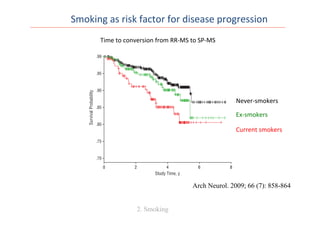
Figure 1. Kaplan-Meier curve for time to conversion from relapsing-remitting
to secondary progressive multiple sclerosis. Smoking status was defined at
study entry. Disease in current smokers progressed significantly faster than
in never-smokers (P=.002). Red line indicates current smokers; green line,
ex-smokers; and black line, never-smokers.
Smoking	
  as	
  risk	
  factor	
  for	
  disease	
  progression	
  	
  
2. Smoking
Arch Neurol. 2009; 66 (7): 858-864
Current	
  smokers	
  
Ex-­‐smokers	
  
Never-­‐smokers	
  
Time	
  to	
  conversion	
  from	
  RR-­‐MS	
  to	
  SP-­‐MS	
  
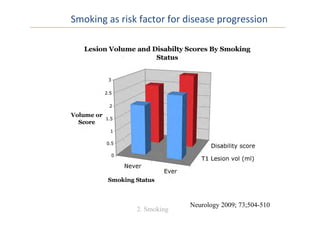
Neurology 2009; 73;504-510
Smoking	
  as	
  risk	
  factor	
  for	
  disease	
  progression	
  	
  
2. Smoking
Smoking in practice in Geneva University Hospital
Question about smoking
It is never too late to quit smoking
2. Smoking
Counseling for the family :
Avoid exposure to smoke
Mul0ple	
  Sclerosis	
  
Specific Diet?
Diet and MS
?	
  
3. Diet
Diet	
  and	
  MS	
  
3. Diet
No	
  Diet	
  has	
  been	
  proven	
  to	
  alter	
  the	
  evolu0on	
  of	
  the	
  disease	
  	
  
HOWEVER	
  
Obesity	
  and	
  risk	
  of	
  developing	
  Mul0ple	
  sclerosis	
  
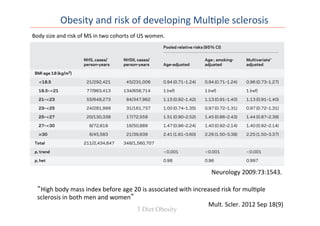
Body	
  size	
  and	
  risk	
  of	
  MS	
  in	
  two	
  cohorts	
  of	
  US	
  women.	
  	
  
Table 2 Pooled relative risks and 95% confidence intervals (CIs) for body mass index (BMI) at age 18 and
baseline and risk of multiple sclerosis, Nurses’ Health Study (NHS) (1976–2002), and Nurses’
Health Study II (NHSII) (1989–2003)
NHS, cases/
person-years
NHSII, cases/
person-years
Pooled relative risks (95% CI)
Age-adjusted
Age-, smoking-
adjusted
Multivariate*
adjusted
BMI age 18 (kg/m2
)
<18.5 21/292,421 45/231,006 0.94 (0.71–1.24) 0.94 (0.71–1.24) 0.96 (0.73–1.27)
18.5–<21 77/963,413 134/656,714 1 (ref) 1 (ref) 1 (ref)
21–<23 55/648,273 84/347,962 1.15 (0.92–1.42) 1.13 (0.91–1.40) 1.13 (0.91–1.40)
23–<25 24/281,999 31/161,737 1.00 (0.74–1.35) 0.97 (0.72–1.31) 0.97 (0.72–1.31)
25–<27 20/130,338 17/72,559 1.51 (0.90–2.52) 1.45 (0.86–2.43) 1.44 (0.87–2.39)
27–<30 8/72,619 16/50,889 1.47 (0.96–2.24) 1.40 (0.92–2.14) 1.40 (0.92–2.14)
>30 6/45,583 21/39,839 2.41 (1.61–3.60) 2.26 (1.50–3.38) 2.25 (1.50–3.37)
Total 211/2,434,647 348/1,560,707
p, trend Ͻ0.001 Ͻ0.001 Ͻ0.001
p, het 0.98 0.96 0.997
Baseline BMI (kg/m2
)
<18.5 7/74,199 14/53,541 1.11 (0.70–1.75) 1.10 (0.69–1.74) 1.13 (0.71–1.78)
18.5–<21 68/656,533 81/396,203 1 (ref) 1 (ref) 1 (ref)
21–<23 66/816,791 68/377,321 0.87 (0.69–1.10) 0.87 (0.69–1.10) 0.87 (0.69–1.10)
23–<25 45/574,546 59/266,505 1.00 (0.78–1.28) 1.00 (0.78–1.28) 1.00 (0.78–1.29)
25–<27 32/344,643 42/157,999 1.22 (0.92–1.62) 1.22 (0.92–1.61) 1.23 (0.93–1.62)
27–<30 9/263,744 36/134,424 0.78 (0.28–2.19) 0.78 (0.29–2.11) 0.79 (0.30–2.12)
“High	
  body	
  mass	
  index	
  before	
  age	
  20	
  is	
  associated	
  with	
  increased	
  risk	
  for	
  mul0ple	
  
sclerosis	
  in	
  both	
  men	
  and	
  women”	
  
Neurology	
  2009:73:1543.	
  
3 Diet Obesity
Mult.	
  Scler.	
  2012	
  Sep	
  18(9)	
  
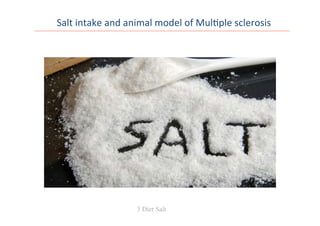
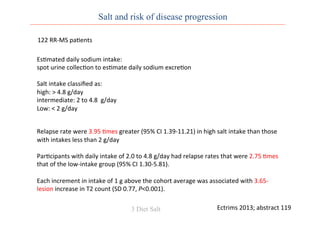
Salt	
  intake	
  and	
  animal	
  model	
  of	
  Mul0ple	
  sclerosis	
  
3 Diet Salt
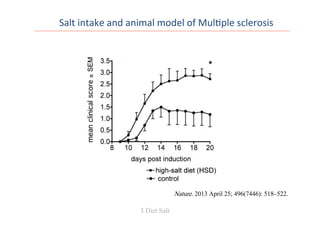
Salt	
  intake	
  and	
  animal	
  model	
  of	
  Mul0ple	
  sclerosis	
  
Sodium Chloride Drives Autoimmun
NIH Public Access
Author Manuscript
Nature. Author manuscript; available in PMC 2013 A
Published in final edited form as:
Nature. 2013 April 25; 496(7446): 518–522. doi:10.1038
NIH-PAAu
3 Diet Salt
Ectrims	
  2013;	
  abstract	
  119	
  
Salt and risk of disease progression
Es0mated	
  daily	
  sodium	
  intake:	
  	
  
spot	
  urine	
  collec0on	
  to	
  es0mate	
  daily	
  sodium	
  excre0on	


Salt	
  intake	
  classified	
  as:	
  
high:	
  >	
  4.8	
  g/day	
  
intermediate:	
  2	
  to	
  4.8	
  	
  g/day	
  
Low:	
  <	
  2	
  g/day	


Relapse	
  rate	
  were	
  3.95	
  0mes	
  greater	
  (95%	
  CI	
  1.39-­‐11.21)	
  in	
  high	
  salt	
  intake	
  than	
  those	
  
with	
  intakes	
  less	
  than	
  2	
  g/day	


Par0cipants	
  with	
  daily	
  intake	
  of	
  2.0	
  to	
  4.8	
  g/day	
  had	
  relapse	
  rates	
  that	
  were	
  2.75	
  0mes	
  
that	
  of	
  the	
  low-­‐intake	
  group	
  (95%	
  CI	
  1.30-­‐5.81).	


Each	
  increment	
  in	
  intake	
  of	
  1	
  g	
  above	
  the	
  cohort	
  average	
  was	
  associated	
  with	
  3.65-­‐
lesion	
  increase	
  in	
  T2	
  count	
  (SD	
  0.77,	
  P<0.001).	


122	
  RR-­‐MS	
  pa0ents	


3 Diet Salt
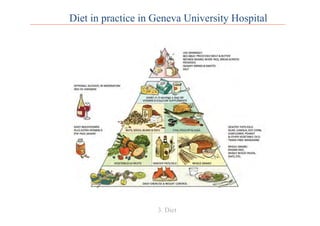
Diet in practice in Geneva University Hospital
3. Diet
Mul0ple	
  Sclerosis	
  
Future promising research direction?
The	
  gut-­‐brain	
  axis	
  
4 Gut immunology
Nat	
  reviews	
  Neuroscience	
  October	
  2012,	
  vol	
  13.	
  701-­‐712	
  
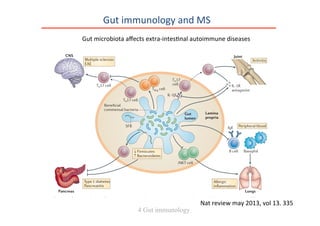
Gut	
  immunology	
  and	
  MS	
  
Nature Reviews | Immunology
BasophilB cell
iNKT cell
Gut
lumen
Lamina
propria
IgE
Pancreas Lungs
↓ Firmicutes
↑ Bacteroidetes
TReg cell
IL-1β
CNS Joint
TH17
cell IL-1R
antagonist
TH17 cell
TH17 cell
Peripheral blood
Multiple sclerosis
EAE
Type 1 diabetes
Pancreatitis
Allergic
Arthritis
commensal bacteria
SFB
mice with KRN T cell receptor-
transgenic mice on the C57BL/6
background. As the KRN
receptor on T cells recognizes a
peptide from the autoantigen
glucose-6-phosphate
isomerase, these mice develop
an arthritis that is mediated,
and transferable, by circulating
antibodies against glucose-6-
phosphate isomerase.
erbation. However, it is unclear whether the disease is
caused by the migration of SFB-specific TH
17 cells into
the CNS or by the expansion of pathogenic autoantigen-
specific T cells that are promoted by intestinal TH
17
cell responses (FIG. 4). By contrast, certain populations
of commensal bacteria are capable of attenuating CNS
inflammation. For example, PSA+
B. fragilis, which
are reduced in a germ-free environment136,153
. As in EAE,
TH
17 cell responses are implicated in promoting disease,
and SFB-mediated enhancement of TH
17 cell immunity
stimulates autoantibody production by B cells, which
leads to arthritic symptoms153
(FIG. 4). TH
17 cell immunity
is also a key factor in spontaneous rheumatoid arthri-
tis in IL-1R antagonist (Il1rn)−/−
mice, which exhibit
Figure 4 | Gut microbiota affects extra-intestinal autoimmune diseases. Segmented filamentous bacteria (SFB)
colonization induces T helper 17 (TH
17) cell development in the intestine. These TH
17 cells might migrate to the periphery
toaffectsystemicandcentralnervoussystem(CNS)immunity;increasedintestinalTH
17cellsenhancetheexpansion
commensalbacteriacanattenuateCNSinflammationthroughtheinductionofforkheadboxP3(FOXP3)+
regulatoryT(TReg
)
cells. Induced T
Nat	
  review	
  may	
  2013,	
  vol	
  13.	
  335	
  	
  
Gut	
  microbiota	
  affects	
  extra-­‐intes0nal	
  autoimmune	
  diseases	
  
4 Gut immunology
The	
  gut-­‐brain	
  axis	
  
Gut immunology : a new risk factor for MS?
4 Gut immunology
to autoimmunity include (i) a primary
which normally promote immunological
tral tolerance and peripheral tolerance) (
2011), (ii) infections or other exogenou
inflammation and thereby override toler
2009; Sener and Afsar, 2012), (iii) an abn
tissues themselves (e.g., inappropriate re
nals or aberrant antigen presentation
2010), or (iv) a combination of processes
In this regard, Dobzhansy observed
makes sense except in the light of evoluti
giene or microbial deprivation hypothe
based explanation (Pollard, 2008) for the
autoimmunity which has been observed
during the last century (Bach, 2002) an
be occurring in the developing world (C
et al., 2011; Etemadifar and Maghzi, 2
2011). Rook (2012) has summarised how
hygienic environment in the developed w
lutionarily ancient microbes, including p
he coined the term ‘‘Old Friends’’ (Rook e
as recently as 1947, it was estimated that
ulation was colonised by intestinal hel
these infections are virtually absent in
1947; Gale, 2002). It may sound paradox
as friends or beneficial, given the major
constitute, especially in tropical regions
less, from an evolutionary perspective, t
most parasitic diseases is relatively low
worm (Brooker et al., 2004)); the relatio
flict and morbidity, but over millions
0 20 40 60 80
0
20
40
60
80
100
120
TT Prevalence (%)
MSPrevalence(per100,000)
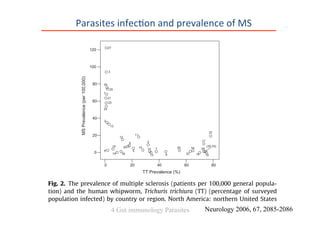
Fig. 2. The prevalence of multiple sclerosis (patients per 100,000 general popula-
tion) and the human whipworm, Trichuris trichiura (TT) (percentage of surveyed
population infected) by country or region. North America: northern United States
(1), southern United States (2), Canada (3). Latin America: Brazil (4), Mexico (5),
Paraguay (6), Honduras (7), Cuba (8), Jamaica (9), Panama (10), Argentina (11), Chile
(12). Oceania: Australia (13). Africa: Ethiopia (14), Kenya (15), Cameroon (16),
Nigeria/Ghana (17), Ivory Coast/Senegal (18). Middle East: Iran/Iraq (19), Lebanon/
Jordan (20), Jerusalem–Jewish (21), Jerusalem–Arab (22). Europe: Italy (23), Poland
(24), Belgium (25), East Germany (26), United Kingdom (27). Asia: Indonesia (28),
J.O. Fleming / International Journal for Parasitology 43 (2013) 259–274
Neurology 2006, 67, 2085-2086
inflamm
2009; Se
tissues t
nals or
2010), o
In th
makes s
giene or
based ex
autoimm
during t
be occu
et al., 2
2011). R
hygienic
lutionar
he coine
as recen
ulation
these in
1947; G
as friend
constitu
less, fro
0 20 40 60 80
0
20
40
60
80
100
TT Prevalence (%)
MSPrevalence(per100,000)
Fig. 2. The prevalence of multiple sclerosis (patients per 100,000 general popula-
tion) and the human whipworm, Trichuris trichiura (TT) (percentage of surveyed
population infected) by country or region. North America: northern United States
(1), southern United States (2), Canada (3). Latin America: Brazil (4), Mexico (5),
Paraguay (6), Honduras (7), Cuba (8), Jamaica (9), Panama (10), Argentina (11), Chile
(12). Oceania: Australia (13). Africa: Ethiopia (14), Kenya (15), Cameroon (16),
Parasites	
  infec0on	
  and	
  prevalence	
  of	
  MS	
  
4 Gut immunology Parasites
Observa0onal	
  study,	
  no	
  immunomodulatory	
  or	
  immunosuppressive	
  treatment	
  
Annals of Neurology Vol 61 No 2 February 2007
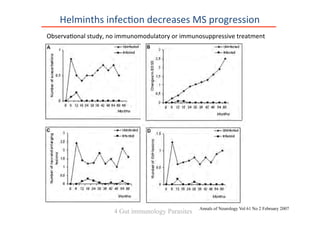
Fig 1. Number of exacerbations (A) and changes in extended disability status scale (EDSS; B) and magnetic resonance imaging (C
and D) parameters observed over time in parasite infected (squares) and uninfected (diamonds) multiple sclerosis (MS) patients.
. Number of exacerbations (A) and changes in extended disability status scale (EDSS; B) and magnetic resonance imaging (C
D) parameters observed over time in parasite infected (squares) and uninfected (diamonds) multiple sclerosis (MS) patients.
Helminths	
  infec0on	
  decreases	
  MS	
  progression	
  
4 Gut immunology Parasites
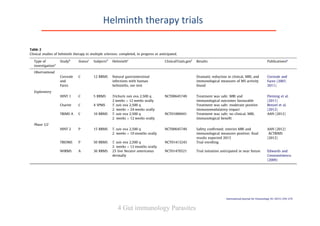
Table 2
Clinical studies of helminth therapy in multiple sclerosis: completed, in progress or anticipated.
Type of
investigationa
Studyb
Statusc
Subjectsd
Helminthe
ClinicalTrials.govf
Results Publicationsg
Observational
Correale
and
Farez
C 12 RRMS Natural gastrointestinal
infections with human
helminths, see text
Dramatic reduction in clinical, MRI, and
immunological measures of MS activity
found
Correale and
Farez (2007,
2011)
Exploratory
HINT 1 C 5 RRMS Trichuris suis ova 2,500 q
2 weeks  12 weeks orally
NCT00645749 Treatment was safe; MRI and
immunological outcomes favourable
Fleming et al.
(2011)
Charite C 4 SPMS T. suis ova 2,500 q
2 weeks  24 weeks orally
Treatment was safe; moderate positive
immunomodulatory impact
Benzel et al.
(2012)
TRIMS A C 10 RRMS T. suis ova 2,500 q
2 weeks  12 weeks orally
NCT01006941 Treatment was safe; no clinical, MRI,
immunological benefit
AAN (2012)
Phase 1/2
HINT 2 P 15 RRMS T. suis ova 2,500 q
2 weeks  10 months orally
NCT00645749 Safety confirmed; interim MRI and
immunological measures positive; final
results expected 2013
AAN (2012)
ACTRIMS
(2012)
TRIOMS P 50 RRMS T. suis ova 2,500 q
2 weeks  12 months orally
NCT01413243 Trial enrolling
WIRMS A 36 RRMS 25 live Necator americanus
dermally
NCT01470521 Trial initiation anticipated in near future Edwards and
Constantinescu
(2009)
MRI, magnetic resonance imaging.
a
Studies are classified as observational (field study, naturally-acquired infections), exploratory (preliminary pilot first-use safety clinical trials), or early phase 1/2 (follow
up clinical trials).
b
Each study is designated by location, investigators or acronym.
c
Study status is indicated by C (completed), P (in progress or enroling), or A (initiation anticipated in near future).
d
The number and type of subjects are noted (RRMS = relapsing-remitting MS; SPMS = secondary progressive MS); only the number of subjects with MS are shown,
exclusive of subjects in placebo or observational arms.
e
The heminth infection or treatment indicated by agent, dose, duration and route.
f
Clinical trial listings are provided by study number on the clinicaltrials.gov website; these listings provide details of study design and periodic updates on study progress.
g
Publications or meeting presentations (AAN, American Academy of Neurology, 2012; ACTRIMS, Americas Committee for Treatment and Research in Multiple Sclerosis,
2012) are indicated.
266 J.O. Fleming / International Journal for Parasitology 43 (2013) 259–274
International Journal for Parasitology 43 (2013) 259–274
Contents lists available at SciVerse ScienceDirect
International Journal for Parasitology
Helminth	
  therapy	
  trials	
  
4 Gut immunology Parasites
Gut	
  immunology	
  and	
  Mul0ple	
  sclerosis	
  
uto-
how
cing
vail-
yco-
ions
une
.
SJL/J
ans-
–106
elop
ssive
NS)
hich
cells
pon-
ther
90%
also
cific
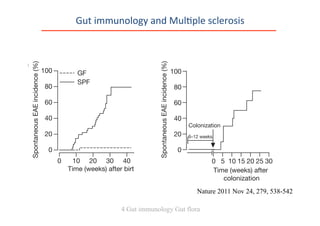
SPF mice (Supplementary Table 1). Moreover, germ-free and SPF SJL/J
mice immunized with rMOG produced comparable levels of anti-
MOG antibodies in their serum (Fig. 1d).
Recent studies established that components of the commensal micro-
biota profoundly shape the gut-associated lymphatic tissue (GALT),
a b
c d
4
5 GF WT
SPF WT
lscore
0 10 20 30 40 50
0
20
40
60
80
100 GF
SPF
Time (weeks) after birth
SpontaneousEAEincidence(%)
0
20
40
60
80
100
0 5 10 15 20 25 30
Colonization
6–12 weeks
Time (weeks) after
colonization
2.0
2.5 GF WT
SPF WT
m
Nature 2011 Nov 24, 279, 538-542
auto-
show
ducing
avail-
glyco-
ations
mune
ets.
c SJL/J
trans-
2–106
evelop
cessive
(CNS)
which
B cells
spon-
other
5–90%
at also
pecific
SPF mice (Supplementary Table 1). Moreover, germ-free and SPF SJL/J
mice immunized with rMOG produced comparable levels of anti-
MOG antibodies in their serum (Fig. 1d).
Recent studies established that components of the commensal micro-
biota profoundly shape the gut-associated lymphatic tissue (GALT),
a b
c d
4
5 GF WT
SPF WT
lscore
0 10 20 30 40 50
0
20
40
60
80
100 GF
SPF
Time (weeks) after birth
SpontaneousEAEincidence(%)
0
20
40
60
80
100
0 5 10 15 20 25 30
Colonization
6–12 weeks
Time (weeks) after
colonization
2.0
2.5 GF WT
SPF WT
m
4 Gut immunology Gut flora
From Mouse to Man (MS >RR)
0 2 4 6 8 10 12 14 16
0
20
40
60
80
100 MS Patient feces (n = 5)
Healthy Control feces (n = 5)
Time (wk) after colonization
SpontaneousEAE[%]
State	
  of	
  the	
  art	
  Luzern	
  26.01.2013	
  
Presenta0on	
  from	
  Prof	
  Wekerle	
  
Fecal	
  Microbiota	
  Transplanta0on	
  and	
  Mul0ple	
  sclerosis	
  
4 Gut immunology Gut flora
The new england
journal of medicine
established in 1812 january 31, 2013 vol. 368 no. 5
Duodenal Infusion of Donor Feces for Recurrent
Clostridium difficile
Els van Nood, M.D., Anne Vrieze, M.D., Max Nieuwdorp, M.D., Ph.D., Susana Fuentes, Ph.D.,
Erwin G. Zoetendal, Ph.D., Willem M. de Vos, Ph.D., Caroline E. Visser, M.D., Ph.D., Ed J. Kuijper, M.D., Ph.D.,
Joep F.W.M. Bartelsman, M.D., Jan G.P. Tijssen, Ph.D., Peter Speelman, M.D., Ph.D.,
Marcel G.W. Dijkgraaf, Ph.D., and Josbert J. Keller, M.D., Ph.D.
Abstr act
From the Departments of Internal Medi-
cine (E.N., A.V., M.N., P.S.), Microbiology
(C.E.V.), Gastroenterology (J.F.W.M.B.,
J.J.K.), and Cardiology (J.G.P.T.) and the
Clinical Research Unit (M.G.W.D.), Aca-
demic Medical Center, University of Am-
sterdam, Amsterdam; the Laboratory of
Microbiology, Wageningen University,
Background
Recurrent Clostridium difficile infection is difficult to treat, and failure rates for anti-
biotic therapy are high. We studied the effect of duodenal infusion of donor feces
in patients with recurrent C. difficile infection.
Methods
We randomly assigned patients to receive one of three therapies: an initial vanco-
Fecal	
  Microbiota	
  Transplanta0on	
  	
  
4 Gut immunology Gut flora
Risk factors and multiple sclerosis
Summary in one slide!
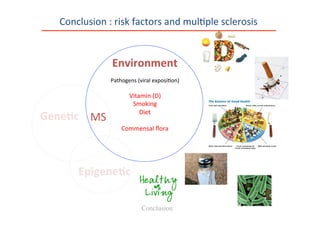
Conclusion	
  :	
  risk	
  factors	
  and	
  mul0ple	
  sclerosis	
  
Gene$c	


Environment	


Pathogens	
  (viral	
  exposi0on)	


Vitamin	
  (D)	
  	
  
Smoking	
  
Diet	


Commensal	
  flora	
  
Epigene$c	
  
MS
Earn Free CME Credits by reading the latest medical news
in your specialty.
Register Today
Sign Up
Dietary Salt Associated With MS
Activity
Published: Oct 4, 2013 | Updated: Oct 4, 2013
By John Gever, Deputy Managing Editor, MedPage
Today
Reviewed by Zalman S. Agus, MD; Emeritus Professor,
Perelman School of Medicine at the University of
Pennsylvania and Dorothy Caputo, MA, BSN, RN, Nurse Planner
save | A A
Action Points
Note that this study was published as
an abstract and presented at a
conference. These data and
conclusions should be considered to be
preliminary until published in a peer-
reviewed journal.
This study suggests that higher sodium
intake is associated with increased
clinical activity and MRI lesions in
patients with multiple sclerosis.
COPENHAGEN -- Sodium intake was
positively correlated with risk of increased
disease activity in patients with multiple
sclerosis, according to a small study
reported here.
Each gram of estimated daily sodium
intake above the average in a 52-patient
sample was associated with an increase of
3.65 in MRI lesion counts, said Mauricio
Farez, MD, PhD, of Fundación para la
Lucha contra las Enfermedades
Neurológicas de la Infancia in Buenos
Aires.
Also, patients with estimated salt intake
classified as high -- more than 4.8 g daily --
showed relapse rates that were 3.95 times
greater (95% CI 1.39-11.21) than those
with intakes less than 2 g/day, he told
attendees at the European Committee for
Treatment and Research in Multiple
Sclerosis annual meeting.
Farez emphasized repeatedly that the
findings did not prove that high salt intake
caused the increased disease activity. He
ADVERTISEMENT
Conclusion
Ques0ons?	
  
Thank	
  you	
  for	
  your	
  alen0on	
  

Risk factors in Multiple Sclerosis: Detection and Treatment in Daily Life

  • 1.
    Risk  factors  in  Mul0ple  Sclerosis:   Detec0on  and  Treatment  in  Daily  Life   Caroline  Pot   Patrice  Lalive     Unit  of  Neuroimmunology  and  Mul0ple  Sclerosis   Geneva  University  Hospital     16th  State  of  the  Art   Lucerne,  January  11th,  2014     Workshop  C    
  • 2.
    Alimenta0on   Socioeconomic  level   Age   Industrialisa0on   Climate    Gene0c   Predisposi0on   Race   Geography   Hygiene   Virus   Mul$ple  sclerosis   Mul0ple  Sclerosis   Mul0factorial  origin?  
  • 3.
  • 4.
    Mul0ple  Sclerosis   • Environmentalrisk factors: -> Who is guilty & which level of demonstration ? -> Can we have an impact on it ? -> Counseling for the patient and the family -> Future research direction with high potential
  • 5.
    Mul0ple  Sclerosis   ->How do you manage “Environmental risk factors” with patients ? - Give advices (only if asked) ? - Blood test ? - Vit. D ? - Diet ? - Smoking ? - Follow specific protocol? - > Do you believe this can have an impact on the disease course or the risk of MS?
  • 6.
    Mul0ple  Sclerosis  :  Risk  factors 1.  Environmental climatic factors and Vitamin D 2.  Smoking 3.  Diet Obesity Salt intake 4. Gut immunology Parasite infection Gut flora 5. Conclusion
  • 7.
    Mul0ple  Sclerosis  :  mul0factorial  disease Gene$c       Twin  studies:   Monozygo0c  twin:  20%     MHC-­‐suscep0bility:    HLA-­‐DRB1  locus   non-­‐MHC  suscep0bility  genes:   (IL2RA,  IL7R,  IRF8,  and  TNFRSF1A) Environment     Pathogens  (viral  exposi0on)     Vitamin  (D)     Smoking   Diet     Commensal  flora   Epigene$c   MS Introduc0on  
  • 8.
    World  Distribu0on  of  Mul0ple  Sclerosis   Introduction
  • 9.
    hence limiting ascertainmentbias. Treatment costs for values” heading. The d daily sums for UVB ra latitude and longitude MSA regions in France by the service were use tion. The “all sky” UV the latter provides the vides an average value. used for analysis as the tion. Verification of th have been previously p A map of France ill irradiation was produc vices.18 The quantitie (kWh/m2 ) calculated f puted from satellite ob ergy that reaches the Oldenburg, MINES P Data analyses. Pears relationship of overall MSA region. This was Both annual and wint rately in males and fem assess the association o mean UVB. Sex ratio was calcu Figure 1 Annual mean ultraviolet B (Wh/m2 ) radiation in France Multiple sclerosis prevalence rates (per 100,000) for each Mutualite´ Sociale Agricole re- gion are shown. Neurology. 2011 Feb 1;76(5):425-31. 1. Environmental risk factor MS  prevalence  rates  (per  100  000   for  each  region  of  France)   Environmental  clima0c  risk  factors  for  MS  
  • 10.
    Figure 3 Environmentalclimatic risk factors for multiple sclerosis and links between them. The r- and P-values illustrate the example of France and correspond to the Pearson correlation tests reviewed in this article or performed by the authors, based on data for French regions concerning (A) mean latitude, (B) mean global annual sunshine (Suri et al., 2007), (C) mean serum level of vitamin D in normal Hypovitaminosis D in multiple sclerosis Brain 2010: 133; 1869–1888 | 1875 Brain 2010: 133; 1869-1888 Environmental  clima0c  risk  factors  for  MS   1. Environmental risk factor and Vitamin D
  • 11.
  • 12.
    Vitamin D andMultiple Sclerosis: risk of developing MS Neurology 2004 Jan 13, vol. 62 (1) 60-65 Prospective study Nurses’ Health Study Women who took vitamin D ( ≥400  interna0onal  units/day)     had a 40% lower risk of MS than women who did not use vitamin D supplements. (rela0ve  risk  0.59,  95%  CI  0.38-­‐0.91) JAMA. 2006;296(23):2832-2838. Prospective, nested case-control study among more than 7 million US military personnel 1. Vitamin D
  • 13.
    Genome Wide AssociationStudies (GWAS) Nature. 2011 Aug 10;476(7359):214-9 cyp27B1   cyp24A1   1. Vitamin D
  • 14.
    Genome Wide AssociationStudies (GWAS) 1. Vitamin D
  • 15.
    Ann Neurol 2010(68):193-203.Neurology. 2012 Jul 17;79(3):261-6. August and nadirs in mid February. The soidal curve resulted in a geometric mean concentration of 69 nmol/L. There was able variation in mean levels between pa ficient of variation 41%). Association between serum 25-OH-D co Figure 2 Monthly exacerbation rates for the different groups (A) Monthly exacerbation rates for the different groups of serum 25-hydro (25-OH-D) concentrations, and (B) for at-risk period for infections. Error 95% confidence intervals. Serum 25-OH-D concentrations: p (trend) ϭ tions p Ͻ 0.001. Vitamin  D:  risk  factor  for  disease  progression     1. Vitamin D
  • 16.
    Vitamin  D  levels  and  Brain  MRI   Longitudinal  cohort  study  of  469  subjects  with  MS       Vitamin  D  levels  are  inversely  associated  with  the  risk  of  new  lesion   Ann  Neurol.  2012;72(2):234.  1. Vitamin D
  • 17.
    What do wemeasure? Vitamin D in practice in Geneva University Hospital 25(OH)D (calcidiol) in the serum   Optimal ≥ 75 nmol/L Sub-optimal: ≥50 nmol/L et < 75 nmol/L Moderate deficit: >25 nmol/L et <50nmol/L Severe deficit : < 25 nmol/l   1. Vitamin D
  • 18.
    Vitamin D inpractice in Geneva University Hospital 1.  Before starting a substitution exclude a: Hypercalcemia Subclinical hyperparathyroidism Measure : Calcium and PTH 2. If PTH and calcium normal but 25(OH)D decreased Severe deficit : < 25 nmol/l Cholecalciférol 300 000UI per os (vitamine D3 Streuli) then 1000 IU cholecalciferol/jour per os: Vi-De3 Moderate deficit: >25 nmol/L et <50nmol/L Sub-optimal: ≥50 nmol/L et < 75 nmol/L 1000 IU cholecalciferol/day per os (Vi-De3)   1. Vitamin D
  • 19.
  • 20.
    Smoking and MultipleSclerosis: risk of developing MS 2. Smoking Cross-sectional study 22312 subjects in the general population of Hordaland County in Norway years. Exclusion of these cases from the analyses did not change the results. The RR estimated by the Cox model comparing ever- smokers with never-smokers was 1.81 (p ϭ 0.014) (table). The RR was 2.75 for men and 1.61 for women. An analysis excluding the patients who started to smoke less than 4 years prior to the onset of disease gave an RR of 1.74 (p ϭ 0.024). Further, an analysis including educational level per 100,000 people 40 to 49 years old.8 This is slightly lower than the rate found in the current study, assuming the same frequency of nonresponse among patients with MS as the rest of the popula- tion (390 per 100,000). This could reflect a small increase in the prevalence rate during these 4 years or that the patients with MS in the current study had a slightly higher response rate than did the total Table The number of smokers and risk estimate (rate ratio) for six common diseases among 22,312 subjects in the general population of Hordaland County, Norway Disease No. of patients* Never smoker, n (%) Current or past smoker, n (%) Ratio ratio† (95% CI) Multiple sclerosis 86 21 (24.4) 65 (75.6) 1.81 (1.13–2.92) Myocardial infarction 76 9 (11.8) 67 (88.2) 4.53 (2.26–9.01) Angina pectoris 108 17 (15.7) 91 (84.3) 3.30 (1.96–5.55) Stroke 93 27 (29.0) 66 (71.0) 1.48 (0.94–2.35) Asthma 1,350 446 (33.0) 904 (67.0) 1.21 (1.05–1.39) Diabetes 216 85 (39.4) 131 (60.6) 0.86 (0.65–1.13) Total population 22,240 8,239 (37.0) 7,892 (35.5) 1.00 * Information on smoking was missing for 72 individuals including one patient with multiple sclerosis. † Rate ratio estimated in a Cox proportional hazard regression model with smoking as a time-dependent covariate. Smoking individuals are being compared with nonsmoking individuals at the same age for the risk of developing the disease. All analyses were performed stratified by sex. Neurology 2003; 61: 1122-1124
  • 21.
    Smoking  and  risk  of  MS:  popula0on-­‐based  studies   anese17 but not in Canadian18 patients. Ongoing work associating vitamin D exposure, ultraviolet ir- radiation, and MS is under way in Australia, as is research examining dietary vitamin D supplementa- tion as a possible preventive treatment strategy for the disease. unsaturated fatty acids and vitamin D foods may be encouraged. Acknowledgment The authors thank Dr. Stephen Reingold, National MS Society, and Dr. Annette-Langer-Gould, Stanford University, for their input. Table Smoking and the risk of MS: Findings from population-based studies Study Design, location Smoking measure Odds ratio (95% CI) Reference 4 Prospective cohort study of incident cases among British women Ͼ 15 cigarettes/day* 1.4 (0.9–2.2) Reference 5 Prospective cohort study of incident cases among British women Ͼ15 cigarettes/day* 1.4 (0.9–2.2) Reference 6 Case-control study of incident cases in Montreal ever vs never smoked 1.6 (1.0–2.4) 20–40 cigarettes/day* 1.9 (1.2–3.2) Reference 7 Prospective cohort study among U.S. women ever vs never smoked 1.6 (1.2–2.1) Ն25 pack-years* 1.7 (1.2–2.4) Reference 3 Case-control study of prevalent cases in Hordaland, Norway ever vs never smoked (dose response not reported) 1.8 (1.1–2.9) * Comparison group for cigarette dosage categories is never smokers. Smoking and Multiple Sclerosis: risk of developing MS 2. Smoking Neurology 2003; 61: 1032-1034
  • 22.
    7 for currentsmokers rd ratio, 0.95; 95% CI, ver-smokers). In con- etween smoking status of 2 years; the percent- was 23.3% in smokers, never-smokers(P=.57, ase duration, and treat- ed progression also was the groups (adjusted nd for progression at 5 alyses restricted to pa- nd T2-weighted lesion e 2). Current smokers d a significantly greater volume (P=.02, ad- ase duration, and dis- greater decrease in the ex-smokers and never- ant difference on either ion; EDSS, Expanded Disability Status Scale score; ellipses, no data available; IQR, interquartile range; MS, multiple core. ups. ups adjusting for age, sex, and disease duration as appropriate. Twenty-five patients had missing number of patients stopped smoking before the study but were missing age at smoking initiation; data for these patients are .70 .75 .80 .85 .90 .95 .99 Study Time, y SurvivalProbability 0 2 4 6 8 Figure 1. Kaplan-Meier curve for time to conversion from relapsing-remitting to secondary progressive multiple sclerosis. Smoking status was defined at study entry. Disease in current smokers progressed significantly faster than in never-smokers (P=.002). Red line indicates current smokers; green line, ex-smokers; and black line, never-smokers. Smoking  as  risk  factor  for  disease  progression     2. Smoking Arch Neurol. 2009; 66 (7): 858-864 Current  smokers   Ex-­‐smokers   Never-­‐smokers   Time  to  conversion  from  RR-­‐MS  to  SP-­‐MS  
  • 23.
    Neurology 2009; 73;504-510 Smoking  as  risk  factor  for  disease  progression     2. Smoking
  • 24.
    Smoking in practicein Geneva University Hospital Question about smoking It is never too late to quit smoking 2. Smoking Counseling for the family : Avoid exposure to smoke
  • 25.
  • 26.
    Diet and MS ?   3. Diet
  • 27.
    Diet  and  MS   3. Diet No  Diet  has  been  proven  to  alter  the  evolu0on  of  the  disease     HOWEVER  
  • 28.
    Obesity  and  risk  of  developing  Mul0ple  sclerosis   Body  size  and  risk  of  MS  in  two  cohorts  of  US  women.     Table 2 Pooled relative risks and 95% confidence intervals (CIs) for body mass index (BMI) at age 18 and baseline and risk of multiple sclerosis, Nurses’ Health Study (NHS) (1976–2002), and Nurses’ Health Study II (NHSII) (1989–2003) NHS, cases/ person-years NHSII, cases/ person-years Pooled relative risks (95% CI) Age-adjusted Age-, smoking- adjusted Multivariate* adjusted BMI age 18 (kg/m2 ) <18.5 21/292,421 45/231,006 0.94 (0.71–1.24) 0.94 (0.71–1.24) 0.96 (0.73–1.27) 18.5–<21 77/963,413 134/656,714 1 (ref) 1 (ref) 1 (ref) 21–<23 55/648,273 84/347,962 1.15 (0.92–1.42) 1.13 (0.91–1.40) 1.13 (0.91–1.40) 23–<25 24/281,999 31/161,737 1.00 (0.74–1.35) 0.97 (0.72–1.31) 0.97 (0.72–1.31) 25–<27 20/130,338 17/72,559 1.51 (0.90–2.52) 1.45 (0.86–2.43) 1.44 (0.87–2.39) 27–<30 8/72,619 16/50,889 1.47 (0.96–2.24) 1.40 (0.92–2.14) 1.40 (0.92–2.14) >30 6/45,583 21/39,839 2.41 (1.61–3.60) 2.26 (1.50–3.38) 2.25 (1.50–3.37) Total 211/2,434,647 348/1,560,707 p, trend Ͻ0.001 Ͻ0.001 Ͻ0.001 p, het 0.98 0.96 0.997 Baseline BMI (kg/m2 ) <18.5 7/74,199 14/53,541 1.11 (0.70–1.75) 1.10 (0.69–1.74) 1.13 (0.71–1.78) 18.5–<21 68/656,533 81/396,203 1 (ref) 1 (ref) 1 (ref) 21–<23 66/816,791 68/377,321 0.87 (0.69–1.10) 0.87 (0.69–1.10) 0.87 (0.69–1.10) 23–<25 45/574,546 59/266,505 1.00 (0.78–1.28) 1.00 (0.78–1.28) 1.00 (0.78–1.29) 25–<27 32/344,643 42/157,999 1.22 (0.92–1.62) 1.22 (0.92–1.61) 1.23 (0.93–1.62) 27–<30 9/263,744 36/134,424 0.78 (0.28–2.19) 0.78 (0.29–2.11) 0.79 (0.30–2.12) “High  body  mass  index  before  age  20  is  associated  with  increased  risk  for  mul0ple   sclerosis  in  both  men  and  women”   Neurology  2009:73:1543.   3 Diet Obesity Mult.  Scler.  2012  Sep  18(9)  
  • 29.
    Salt  intake  and  animal  model  of  Mul0ple  sclerosis   3 Diet Salt
  • 30.
    Salt  intake  and  animal  model  of  Mul0ple  sclerosis   Sodium Chloride Drives Autoimmun NIH Public Access Author Manuscript Nature. Author manuscript; available in PMC 2013 A Published in final edited form as: Nature. 2013 April 25; 496(7446): 518–522. doi:10.1038 NIH-PAAu 3 Diet Salt
  • 31.
    Ectrims  2013;  abstract  119   Salt and risk of disease progression Es0mated  daily  sodium  intake:     spot  urine  collec0on  to  es0mate  daily  sodium  excre0on     Salt  intake  classified  as:   high:  >  4.8  g/day   intermediate:  2  to  4.8    g/day   Low:  <  2  g/day     Relapse  rate  were  3.95  0mes  greater  (95%  CI  1.39-­‐11.21)  in  high  salt  intake  than  those   with  intakes  less  than  2  g/day     Par0cipants  with  daily  intake  of  2.0  to  4.8  g/day  had  relapse  rates  that  were  2.75  0mes   that  of  the  low-­‐intake  group  (95%  CI  1.30-­‐5.81).       Each  increment  in  intake  of  1  g  above  the  cohort  average  was  associated  with  3.65-­‐ lesion  increase  in  T2  count  (SD  0.77,  P<0.001).     122  RR-­‐MS  pa0ents     3 Diet Salt
  • 32.
    Diet in practicein Geneva University Hospital 3. Diet
  • 33.
    Mul0ple  Sclerosis   Futurepromising research direction?
  • 34.
    The  gut-­‐brain  axis   4 Gut immunology Nat  reviews  Neuroscience  October  2012,  vol  13.  701-­‐712  
  • 35.
    Gut  immunology  and  MS   Nature Reviews | Immunology BasophilB cell iNKT cell Gut lumen Lamina propria IgE Pancreas Lungs ↓ Firmicutes ↑ Bacteroidetes TReg cell IL-1β CNS Joint TH17 cell IL-1R antagonist TH17 cell TH17 cell Peripheral blood Multiple sclerosis EAE Type 1 diabetes Pancreatitis Allergic Arthritis commensal bacteria SFB mice with KRN T cell receptor- transgenic mice on the C57BL/6 background. As the KRN receptor on T cells recognizes a peptide from the autoantigen glucose-6-phosphate isomerase, these mice develop an arthritis that is mediated, and transferable, by circulating antibodies against glucose-6- phosphate isomerase. erbation. However, it is unclear whether the disease is caused by the migration of SFB-specific TH 17 cells into the CNS or by the expansion of pathogenic autoantigen- specific T cells that are promoted by intestinal TH 17 cell responses (FIG. 4). By contrast, certain populations of commensal bacteria are capable of attenuating CNS inflammation. For example, PSA+ B. fragilis, which are reduced in a germ-free environment136,153 . As in EAE, TH 17 cell responses are implicated in promoting disease, and SFB-mediated enhancement of TH 17 cell immunity stimulates autoantibody production by B cells, which leads to arthritic symptoms153 (FIG. 4). TH 17 cell immunity is also a key factor in spontaneous rheumatoid arthri- tis in IL-1R antagonist (Il1rn)−/− mice, which exhibit Figure 4 | Gut microbiota affects extra-intestinal autoimmune diseases. Segmented filamentous bacteria (SFB) colonization induces T helper 17 (TH 17) cell development in the intestine. These TH 17 cells might migrate to the periphery toaffectsystemicandcentralnervoussystem(CNS)immunity;increasedintestinalTH 17cellsenhancetheexpansion commensalbacteriacanattenuateCNSinflammationthroughtheinductionofforkheadboxP3(FOXP3)+ regulatoryT(TReg ) cells. Induced T Nat  review  may  2013,  vol  13.  335     Gut  microbiota  affects  extra-­‐intes0nal  autoimmune  diseases   4 Gut immunology
  • 36.
    The  gut-­‐brain  axis   Gut immunology : a new risk factor for MS? 4 Gut immunology
  • 37.
    to autoimmunity include(i) a primary which normally promote immunological tral tolerance and peripheral tolerance) ( 2011), (ii) infections or other exogenou inflammation and thereby override toler 2009; Sener and Afsar, 2012), (iii) an abn tissues themselves (e.g., inappropriate re nals or aberrant antigen presentation 2010), or (iv) a combination of processes In this regard, Dobzhansy observed makes sense except in the light of evoluti giene or microbial deprivation hypothe based explanation (Pollard, 2008) for the autoimmunity which has been observed during the last century (Bach, 2002) an be occurring in the developing world (C et al., 2011; Etemadifar and Maghzi, 2 2011). Rook (2012) has summarised how hygienic environment in the developed w lutionarily ancient microbes, including p he coined the term ‘‘Old Friends’’ (Rook e as recently as 1947, it was estimated that ulation was colonised by intestinal hel these infections are virtually absent in 1947; Gale, 2002). It may sound paradox as friends or beneficial, given the major constitute, especially in tropical regions less, from an evolutionary perspective, t most parasitic diseases is relatively low worm (Brooker et al., 2004)); the relatio flict and morbidity, but over millions 0 20 40 60 80 0 20 40 60 80 100 120 TT Prevalence (%) MSPrevalence(per100,000) Fig. 2. The prevalence of multiple sclerosis (patients per 100,000 general popula- tion) and the human whipworm, Trichuris trichiura (TT) (percentage of surveyed population infected) by country or region. North America: northern United States (1), southern United States (2), Canada (3). Latin America: Brazil (4), Mexico (5), Paraguay (6), Honduras (7), Cuba (8), Jamaica (9), Panama (10), Argentina (11), Chile (12). Oceania: Australia (13). Africa: Ethiopia (14), Kenya (15), Cameroon (16), Nigeria/Ghana (17), Ivory Coast/Senegal (18). Middle East: Iran/Iraq (19), Lebanon/ Jordan (20), Jerusalem–Jewish (21), Jerusalem–Arab (22). Europe: Italy (23), Poland (24), Belgium (25), East Germany (26), United Kingdom (27). Asia: Indonesia (28), J.O. Fleming / International Journal for Parasitology 43 (2013) 259–274 Neurology 2006, 67, 2085-2086 inflamm 2009; Se tissues t nals or 2010), o In th makes s giene or based ex autoimm during t be occu et al., 2 2011). R hygienic lutionar he coine as recen ulation these in 1947; G as friend constitu less, fro 0 20 40 60 80 0 20 40 60 80 100 TT Prevalence (%) MSPrevalence(per100,000) Fig. 2. The prevalence of multiple sclerosis (patients per 100,000 general popula- tion) and the human whipworm, Trichuris trichiura (TT) (percentage of surveyed population infected) by country or region. North America: northern United States (1), southern United States (2), Canada (3). Latin America: Brazil (4), Mexico (5), Paraguay (6), Honduras (7), Cuba (8), Jamaica (9), Panama (10), Argentina (11), Chile (12). Oceania: Australia (13). Africa: Ethiopia (14), Kenya (15), Cameroon (16), Parasites  infec0on  and  prevalence  of  MS   4 Gut immunology Parasites
  • 38.
    Observa0onal  study,  no  immunomodulatory  or  immunosuppressive  treatment   Annals of Neurology Vol 61 No 2 February 2007 Fig 1. Number of exacerbations (A) and changes in extended disability status scale (EDSS; B) and magnetic resonance imaging (C Fig 1. Number of exacerbations (A) and changes in extended disability status scale (EDSS; B) and magnetic resonance imaging (C and D) parameters observed over time in parasite infected (squares) and uninfected (diamonds) multiple sclerosis (MS) patients. . Number of exacerbations (A) and changes in extended disability status scale (EDSS; B) and magnetic resonance imaging (C D) parameters observed over time in parasite infected (squares) and uninfected (diamonds) multiple sclerosis (MS) patients. Helminths  infec0on  decreases  MS  progression   4 Gut immunology Parasites
  • 39.
    Table 2 Clinical studiesof helminth therapy in multiple sclerosis: completed, in progress or anticipated. Type of investigationa Studyb Statusc Subjectsd Helminthe ClinicalTrials.govf Results Publicationsg Observational Correale and Farez C 12 RRMS Natural gastrointestinal infections with human helminths, see text Dramatic reduction in clinical, MRI, and immunological measures of MS activity found Correale and Farez (2007, 2011) Exploratory HINT 1 C 5 RRMS Trichuris suis ova 2,500 q 2 weeks  12 weeks orally NCT00645749 Treatment was safe; MRI and immunological outcomes favourable Fleming et al. (2011) Charite C 4 SPMS T. suis ova 2,500 q 2 weeks  24 weeks orally Treatment was safe; moderate positive immunomodulatory impact Benzel et al. (2012) TRIMS A C 10 RRMS T. suis ova 2,500 q 2 weeks  12 weeks orally NCT01006941 Treatment was safe; no clinical, MRI, immunological benefit AAN (2012) Phase 1/2 HINT 2 P 15 RRMS T. suis ova 2,500 q 2 weeks  10 months orally NCT00645749 Safety confirmed; interim MRI and immunological measures positive; final results expected 2013 AAN (2012) ACTRIMS (2012) TRIOMS P 50 RRMS T. suis ova 2,500 q 2 weeks  12 months orally NCT01413243 Trial enrolling WIRMS A 36 RRMS 25 live Necator americanus dermally NCT01470521 Trial initiation anticipated in near future Edwards and Constantinescu (2009) MRI, magnetic resonance imaging. a Studies are classified as observational (field study, naturally-acquired infections), exploratory (preliminary pilot first-use safety clinical trials), or early phase 1/2 (follow up clinical trials). b Each study is designated by location, investigators or acronym. c Study status is indicated by C (completed), P (in progress or enroling), or A (initiation anticipated in near future). d The number and type of subjects are noted (RRMS = relapsing-remitting MS; SPMS = secondary progressive MS); only the number of subjects with MS are shown, exclusive of subjects in placebo or observational arms. e The heminth infection or treatment indicated by agent, dose, duration and route. f Clinical trial listings are provided by study number on the clinicaltrials.gov website; these listings provide details of study design and periodic updates on study progress. g Publications or meeting presentations (AAN, American Academy of Neurology, 2012; ACTRIMS, Americas Committee for Treatment and Research in Multiple Sclerosis, 2012) are indicated. 266 J.O. Fleming / International Journal for Parasitology 43 (2013) 259–274 International Journal for Parasitology 43 (2013) 259–274 Contents lists available at SciVerse ScienceDirect International Journal for Parasitology Helminth  therapy  trials   4 Gut immunology Parasites
  • 40.
    Gut  immunology  and  Mul0ple  sclerosis   uto- how cing vail- yco- ions une . SJL/J ans- –106 elop ssive NS) hich cells pon- ther 90% also cific SPF mice (Supplementary Table 1). Moreover, germ-free and SPF SJL/J mice immunized with rMOG produced comparable levels of anti- MOG antibodies in their serum (Fig. 1d). Recent studies established that components of the commensal micro- biota profoundly shape the gut-associated lymphatic tissue (GALT), a b c d 4 5 GF WT SPF WT lscore 0 10 20 30 40 50 0 20 40 60 80 100 GF SPF Time (weeks) after birth SpontaneousEAEincidence(%) SpontaneousEAEincidence(%) 0 20 40 60 80 100 0 5 10 15 20 25 30 Colonization 6–12 weeks Time (weeks) after colonization 2.0 2.5 GF WT SPF WT m Nature 2011 Nov 24, 279, 538-542 auto- show ducing avail- glyco- ations mune ets. c SJL/J trans- 2–106 evelop cessive (CNS) which B cells spon- other 5–90% at also pecific SPF mice (Supplementary Table 1). Moreover, germ-free and SPF SJL/J mice immunized with rMOG produced comparable levels of anti- MOG antibodies in their serum (Fig. 1d). Recent studies established that components of the commensal micro- biota profoundly shape the gut-associated lymphatic tissue (GALT), a b c d 4 5 GF WT SPF WT lscore 0 10 20 30 40 50 0 20 40 60 80 100 GF SPF Time (weeks) after birth SpontaneousEAEincidence(%) SpontaneousEAEincidence(%) 0 20 40 60 80 100 0 5 10 15 20 25 30 Colonization 6–12 weeks Time (weeks) after colonization 2.0 2.5 GF WT SPF WT m 4 Gut immunology Gut flora
  • 41.
    From Mouse toMan (MS >RR) 0 2 4 6 8 10 12 14 16 0 20 40 60 80 100 MS Patient feces (n = 5) Healthy Control feces (n = 5) Time (wk) after colonization SpontaneousEAE[%] State  of  the  art  Luzern  26.01.2013   Presenta0on  from  Prof  Wekerle   Fecal  Microbiota  Transplanta0on  and  Mul0ple  sclerosis   4 Gut immunology Gut flora
  • 42.
    The new england journalof medicine established in 1812 january 31, 2013 vol. 368 no. 5 Duodenal Infusion of Donor Feces for Recurrent Clostridium difficile Els van Nood, M.D., Anne Vrieze, M.D., Max Nieuwdorp, M.D., Ph.D., Susana Fuentes, Ph.D., Erwin G. Zoetendal, Ph.D., Willem M. de Vos, Ph.D., Caroline E. Visser, M.D., Ph.D., Ed J. Kuijper, M.D., Ph.D., Joep F.W.M. Bartelsman, M.D., Jan G.P. Tijssen, Ph.D., Peter Speelman, M.D., Ph.D., Marcel G.W. Dijkgraaf, Ph.D., and Josbert J. Keller, M.D., Ph.D. Abstr act From the Departments of Internal Medi- cine (E.N., A.V., M.N., P.S.), Microbiology (C.E.V.), Gastroenterology (J.F.W.M.B., J.J.K.), and Cardiology (J.G.P.T.) and the Clinical Research Unit (M.G.W.D.), Aca- demic Medical Center, University of Am- sterdam, Amsterdam; the Laboratory of Microbiology, Wageningen University, Background Recurrent Clostridium difficile infection is difficult to treat, and failure rates for anti- biotic therapy are high. We studied the effect of duodenal infusion of donor feces in patients with recurrent C. difficile infection. Methods We randomly assigned patients to receive one of three therapies: an initial vanco- Fecal  Microbiota  Transplanta0on     4 Gut immunology Gut flora
  • 43.
    Risk factors andmultiple sclerosis Summary in one slide!
  • 44.
    Conclusion  :  risk  factors  and  mul0ple  sclerosis   Gene$c       Environment     Pathogens  (viral  exposi0on)     Vitamin  (D)     Smoking   Diet     Commensal  flora   Epigene$c   MS Earn Free CME Credits by reading the latest medical news in your specialty. Register Today Sign Up Dietary Salt Associated With MS Activity Published: Oct 4, 2013 | Updated: Oct 4, 2013 By John Gever, Deputy Managing Editor, MedPage Today Reviewed by Zalman S. Agus, MD; Emeritus Professor, Perelman School of Medicine at the University of Pennsylvania and Dorothy Caputo, MA, BSN, RN, Nurse Planner save | A A Action Points Note that this study was published as an abstract and presented at a conference. These data and conclusions should be considered to be preliminary until published in a peer- reviewed journal. This study suggests that higher sodium intake is associated with increased clinical activity and MRI lesions in patients with multiple sclerosis. COPENHAGEN -- Sodium intake was positively correlated with risk of increased disease activity in patients with multiple sclerosis, according to a small study reported here. Each gram of estimated daily sodium intake above the average in a 52-patient sample was associated with an increase of 3.65 in MRI lesion counts, said Mauricio Farez, MD, PhD, of Fundación para la Lucha contra las Enfermedades Neurológicas de la Infancia in Buenos Aires. Also, patients with estimated salt intake classified as high -- more than 4.8 g daily -- showed relapse rates that were 3.95 times greater (95% CI 1.39-11.21) than those with intakes less than 2 g/day, he told attendees at the European Committee for Treatment and Research in Multiple Sclerosis annual meeting. Farez emphasized repeatedly that the findings did not prove that high salt intake caused the increased disease activity. He ADVERTISEMENT Conclusion

  • 45.
    Ques0ons?   Thank  you  for  your  alen0on