Fitango Education
          Health Topics

                   Multiple Sclerosis


http://www.fitango.com/categories.php?id=302
Overview
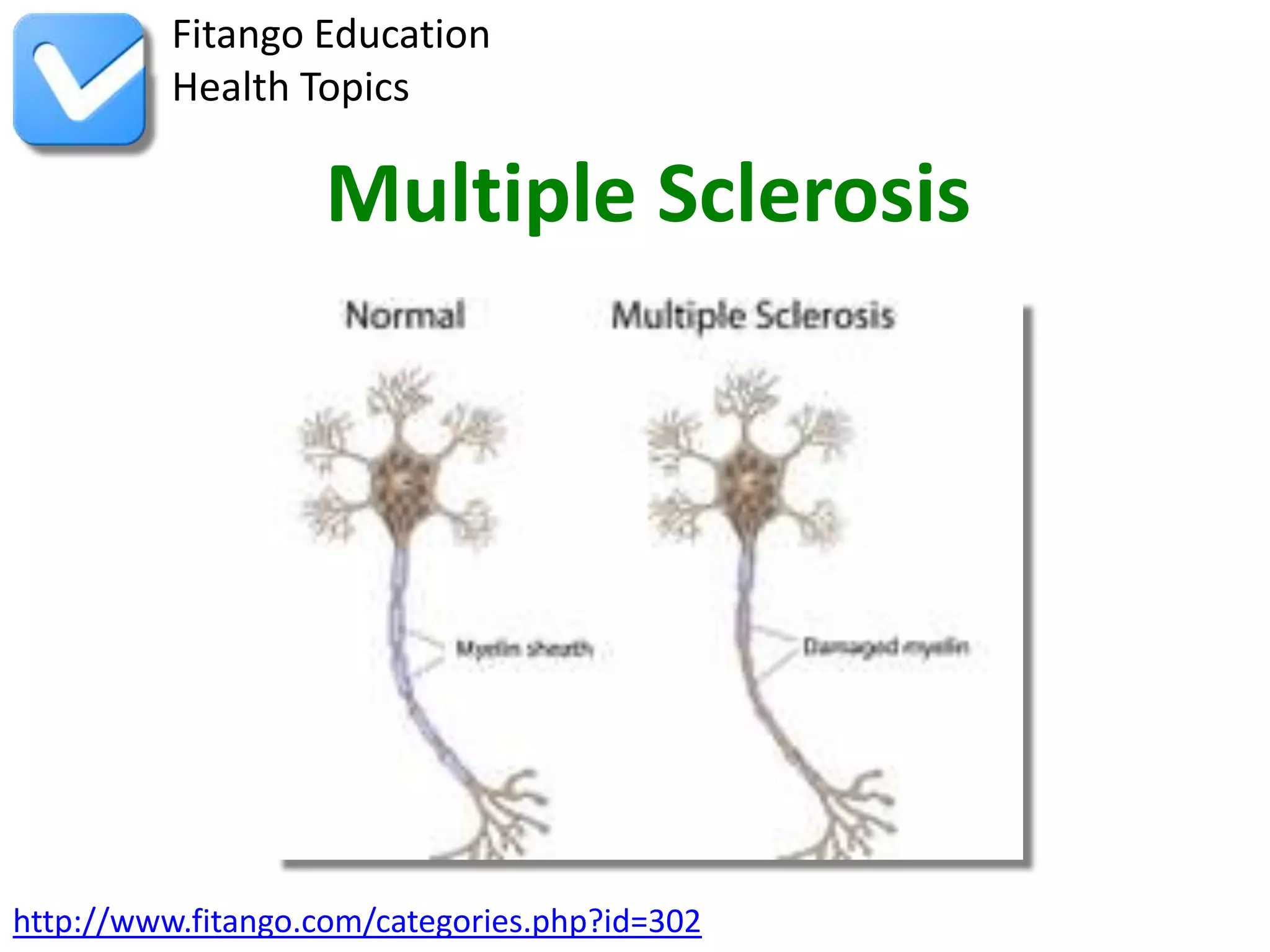
Multiple sclerosis (MS) is a nervous system disease
that affects your brain and spinal cord. It damages
the myelin sheath, the material that surrounds and
protects your nerve cells. This damage slows down
or blocks messages between your brain and your
body.


                                                      1
Overview
No one knows what causes MS. It may be an
autoimmune disease, which happens when your
body attacks itself. Multiple sclerosis affects
women more than men. It often begins between
the ages of 20 and 40. Usually, the disease is mild,
but some people lose the ability to write, speak or
walk. There is no cure for MS, but medicines may
slow it down and help control symptoms. Physical
and occupational therapy may also help.


                                                       2
Symptoms
-- Visual disturbances
-- Muscle weakness
-- Trouble with coordination and balance
-- Sensations such as numbness, prickling, or "pins
and needles"


                                                      3
Symptoms
-- Thinking and memory problems


                                  4
Diagnosis
Physical examination and medical history are very
important in diagnosing MS. Physical exams
include a variety of tests to check the health of the
nerves and muscles. A diagnosis of MS relies
primarily on seeing patches of destroyed myelin on
a magnetic resonance imaging (MRI) scan. As the
doctor tracks the progress of the disease, multiple
MRIs may need to be done.


                                                        5
Diagnosis
MRIs also help make sure that the patient is not
suffering from other diseases that have symptoms
similar to MS, such as brain tumors and disk
herniations in the neck or lower back.


                                                   6
Diagnosis
If a diagnosis is still questionable, spinal fluid may
be taken from the back to test for abnormalities.
Other tests aim at measuring the speed of the
brain connections. For example, the Visual Evoked
Response test measures the speed of the visual
pathway. The Brain Stem Evoked Response test
measures the speed of the auditory, or hearing,
pathways.


                                                         7
Diagnosis
Your doctor may ask for blood tests to determine if
diseases other than MS are causing symptoms
similar to those of MS. For example, some vitamin
deficiencies have early symptoms that resemble
those of MS.


                                                      8
Treatment
Scientists have not discovered a cure for MS yet.
However, several medications are available to help
control the disease.


                                                     9
Treatment
Doctors and scientists are constantly finding out
new things about MS and about how to treat and
manage it. The specific treatment
recommendations for each patient with MS
depend on the patient’s condition, his or her type
of MS, how debilitating it is and how progressive it
is.


                                                       10
Treatment
For patients who find out that they have MS
unexpectedly after an MRI, when they’ve had no
recent symptoms or active disease, treatment may
not be necessary. However, these patients should
be watched closely just in case the MS flares up.


                                                    11
Treatment
Patients with ongoing flare ups and symptoms,
may be prescribed a variety of medications to
control the progress of MS. Such medications may
reduce the severity of the symptoms or decrease
how often they occur.


                                                   12
Treatment
Special chemicals that help regulate the immune
system can be used to treat MS. These are known
as Beta interferons. Beta interferon has been
shown to reduce the number of exacerbations and
may slow the progression of physical disability.
When attacks do occur, they tend to be shorter
and less severe.
Three types and or formulations have been
approved by the FDA. These are:

                                                   13
Treatment
-- Betaseron® Betaseron is given as an injection
under the skin or subcutaneous injection every
other day.
-- Avonex® Avonex is given once a week as an
injection in the muscles.


                                                   14
Treatment
-- Rebif® Rebif, is the same compound found in
Avonex, and can be given in subcutaneous
injections three days a week. The injections should
be taken on the same three days a week. Injections
should be at least 48 hours apart. Many people
choose to take their injections on
Monday, Wednesday, and Friday so that they have
injection free weekends.


                                                      15
Treatment
The side effects of these interferons include:
symptoms of cold, depression, increase in
spasticity, and possible abnormalities in liver
function tests or blood counts.


                                                  16
Treatment
The FDA has recently approved fingolimod (Gilenya
®),an immunosuppressive medication taken by
mouth. It was shown to reduce MS attacks and
decrease disability. It, however, has some
potentially dangerous side effects, such as a slow
heart rate, vision and liver problems among others.
Strict follow up and supervision by a healthcare
provider is a must. The FDA also has approved a
synthetic form of myelin basic protein, called
copolymer I (Copaxone®), for the treatment of
relapsing-remitting MS.
                                                      17
Treatment
Novantrone® (mitoxantrone) is an anticancer drug
that weakens the immune system. By weakening
the immune system it decreases the symptoms of
MS. It is given intravenously once every three
months. It is very well tolerated except for some
nausea and vomiting that can be treated at the
time of the injection. One of its side effects is
possible damage to the heart. This occurs after a
certain dosage of the medication has been given.
Most patients can take it safely for up to two years.
                                                        18
Treatment
Other anticancer medications have been tried.
These include cyclosporine (Sandimmune®),
cyclophosphamide (Cytoxan®), methotrexate and
azathioprine (Imuran®). Bone marrow transplant is
also being studied as a treatment for MS.


                                                    19
Treatment
The FDA has also approved dalfampridine
(Ampyra®) to improve walking in individuals with
MS. One monoclonal antibody, natalizumab
(Tysabri®), was shown in clinical trials to
significantly reduce the frequency of attacks in
people with relapsing forms of MS and was
approved for marketing by the U.S. Food and Drug
Administration (FDA) in 2004. However, in 2005
the drug’s manufacturer voluntarily suspended
marketing of the drug after several reports of
significant adverse events. In 2006, the F
                                                   20
Treatment
Steroids, given either orally or intravenously, can
help decrease the severity of an attack. It is not
known whether they can help a patient have fewer
attacks or not. Steroids sometimes used include
methylprenisolone, prednisone and ACTH.


                                                      21
Treatment
There are a lot of ways to treat MS and the
treatment methods change all the time as we keep
learning more. This is why it is very important to
check with your physicians frequently about any
new developments in this ever evolving and
thankfully improving field. Many clinical trials are
under way to help patients who need better
control of their MS.


                                                       22
Causes
Scientists do not know what causes the
destruction of myelin in multiple sclerosis. Some
scientists believe that cells of the immune system
attack the myelin in the central nervous system.


                                                     23
Causes
The immune system usually attacks germs and
foreign bodies. Cells of the immune system may be
attacking myelin in MS because they mistake it for
a foreign, harmful material. This type of disease is
called an autoimmune disease. Some researchers
think that after certain types of viral infections, the
immune system starts attacking the myelin of the
central nervous system as if it were the virus.


                                                          24
Causes
There may also be genetic causes of MS because
certain populations are more or less susceptible to
it. For example, Eskimos never get MS and Native
Americans have a very low incidence of it. This
leads to the idea that MS may be partially
hereditary.


                                                      25
Causes
Family members of patients with MS have about a
4% chance of developing MS, while people who
don’t have anyone with MS in their family only
have about a 0.3% chance of developing it.
In studies of identical twins, only about 30% of
twins of patients with MS developed MS. This
shows that even though there is a genetic
component, this component is not the only reason
for developing MS.

                                                   26
Multiple Sclerosis

Multiple Sclerosis

  • 1.
    Fitango Education Health Topics Multiple Sclerosis http://www.fitango.com/categories.php?id=302
  • 2.
    Overview Multiple sclerosis (MS)is a nervous system disease that affects your brain and spinal cord. It damages the myelin sheath, the material that surrounds and protects your nerve cells. This damage slows down or blocks messages between your brain and your body. 1
  • 3.
    Overview No one knowswhat causes MS. It may be an autoimmune disease, which happens when your body attacks itself. Multiple sclerosis affects women more than men. It often begins between the ages of 20 and 40. Usually, the disease is mild, but some people lose the ability to write, speak or walk. There is no cure for MS, but medicines may slow it down and help control symptoms. Physical and occupational therapy may also help. 2
  • 4.
    Symptoms -- Visual disturbances --Muscle weakness -- Trouble with coordination and balance -- Sensations such as numbness, prickling, or "pins and needles" 3
  • 5.
    Symptoms -- Thinking andmemory problems 4
  • 6.
    Diagnosis Physical examination andmedical history are very important in diagnosing MS. Physical exams include a variety of tests to check the health of the nerves and muscles. A diagnosis of MS relies primarily on seeing patches of destroyed myelin on a magnetic resonance imaging (MRI) scan. As the doctor tracks the progress of the disease, multiple MRIs may need to be done. 5
  • 7.
    Diagnosis MRIs also helpmake sure that the patient is not suffering from other diseases that have symptoms similar to MS, such as brain tumors and disk herniations in the neck or lower back. 6
  • 8.
    Diagnosis If a diagnosisis still questionable, spinal fluid may be taken from the back to test for abnormalities. Other tests aim at measuring the speed of the brain connections. For example, the Visual Evoked Response test measures the speed of the visual pathway. The Brain Stem Evoked Response test measures the speed of the auditory, or hearing, pathways. 7
  • 9.
    Diagnosis Your doctor mayask for blood tests to determine if diseases other than MS are causing symptoms similar to those of MS. For example, some vitamin deficiencies have early symptoms that resemble those of MS. 8
  • 10.
    Treatment Scientists have notdiscovered a cure for MS yet. However, several medications are available to help control the disease. 9
  • 11.
    Treatment Doctors and scientistsare constantly finding out new things about MS and about how to treat and manage it. The specific treatment recommendations for each patient with MS depend on the patient’s condition, his or her type of MS, how debilitating it is and how progressive it is. 10
  • 12.
    Treatment For patients whofind out that they have MS unexpectedly after an MRI, when they’ve had no recent symptoms or active disease, treatment may not be necessary. However, these patients should be watched closely just in case the MS flares up. 11
  • 13.
    Treatment Patients with ongoingflare ups and symptoms, may be prescribed a variety of medications to control the progress of MS. Such medications may reduce the severity of the symptoms or decrease how often they occur. 12
  • 14.
    Treatment Special chemicals thathelp regulate the immune system can be used to treat MS. These are known as Beta interferons. Beta interferon has been shown to reduce the number of exacerbations and may slow the progression of physical disability. When attacks do occur, they tend to be shorter and less severe. Three types and or formulations have been approved by the FDA. These are: 13
  • 15.
    Treatment -- Betaseron® Betaseronis given as an injection under the skin or subcutaneous injection every other day. -- Avonex® Avonex is given once a week as an injection in the muscles. 14
  • 16.
    Treatment -- Rebif® Rebif,is the same compound found in Avonex, and can be given in subcutaneous injections three days a week. The injections should be taken on the same three days a week. Injections should be at least 48 hours apart. Many people choose to take their injections on Monday, Wednesday, and Friday so that they have injection free weekends. 15
  • 17.
    Treatment The side effectsof these interferons include: symptoms of cold, depression, increase in spasticity, and possible abnormalities in liver function tests or blood counts. 16
  • 18.
    Treatment The FDA hasrecently approved fingolimod (Gilenya ®),an immunosuppressive medication taken by mouth. It was shown to reduce MS attacks and decrease disability. It, however, has some potentially dangerous side effects, such as a slow heart rate, vision and liver problems among others. Strict follow up and supervision by a healthcare provider is a must. The FDA also has approved a synthetic form of myelin basic protein, called copolymer I (Copaxone®), for the treatment of relapsing-remitting MS. 17
  • 19.
    Treatment Novantrone® (mitoxantrone) isan anticancer drug that weakens the immune system. By weakening the immune system it decreases the symptoms of MS. It is given intravenously once every three months. It is very well tolerated except for some nausea and vomiting that can be treated at the time of the injection. One of its side effects is possible damage to the heart. This occurs after a certain dosage of the medication has been given. Most patients can take it safely for up to two years. 18
  • 20.
    Treatment Other anticancer medicationshave been tried. These include cyclosporine (Sandimmune®), cyclophosphamide (Cytoxan®), methotrexate and azathioprine (Imuran®). Bone marrow transplant is also being studied as a treatment for MS. 19
  • 21.
    Treatment The FDA hasalso approved dalfampridine (Ampyra®) to improve walking in individuals with MS. One monoclonal antibody, natalizumab (Tysabri®), was shown in clinical trials to significantly reduce the frequency of attacks in people with relapsing forms of MS and was approved for marketing by the U.S. Food and Drug Administration (FDA) in 2004. However, in 2005 the drug’s manufacturer voluntarily suspended marketing of the drug after several reports of significant adverse events. In 2006, the F 20
  • 22.
    Treatment Steroids, given eitherorally or intravenously, can help decrease the severity of an attack. It is not known whether they can help a patient have fewer attacks or not. Steroids sometimes used include methylprenisolone, prednisone and ACTH. 21
  • 23.
    Treatment There are alot of ways to treat MS and the treatment methods change all the time as we keep learning more. This is why it is very important to check with your physicians frequently about any new developments in this ever evolving and thankfully improving field. Many clinical trials are under way to help patients who need better control of their MS. 22
  • 24.
    Causes Scientists do notknow what causes the destruction of myelin in multiple sclerosis. Some scientists believe that cells of the immune system attack the myelin in the central nervous system. 23
  • 25.
    Causes The immune systemusually attacks germs and foreign bodies. Cells of the immune system may be attacking myelin in MS because they mistake it for a foreign, harmful material. This type of disease is called an autoimmune disease. Some researchers think that after certain types of viral infections, the immune system starts attacking the myelin of the central nervous system as if it were the virus. 24
  • 26.
    Causes There may alsobe genetic causes of MS because certain populations are more or less susceptible to it. For example, Eskimos never get MS and Native Americans have a very low incidence of it. This leads to the idea that MS may be partially hereditary. 25
  • 27.
    Causes Family members ofpatients with MS have about a 4% chance of developing MS, while people who don’t have anyone with MS in their family only have about a 0.3% chance of developing it. In studies of identical twins, only about 30% of twins of patients with MS developed MS. This shows that even though there is a genetic component, this component is not the only reason for developing MS. 26