WASTE MANAGEMENT IN DENTISTRY Dr. Rajeev Kashyap B.Sc,B.D.S., M.Sc(DPH)UK
 
WASTE MANAGEMENT DEFINITION Waste Management is collection, transport,processing,recycling of disposal of waste material.This term usually relates to materials produced by human activity and is generally undertaken to reduce effect on health, the environment and aesthetics. Practice of waste management may differ in developing nation to under developing nation, urban to rural area and residential to industrial setup.
CATEGORIES OF WASTE Discarded sharps Laboratory and associated waste Human tissue including solutions containing blood Cytotoxic waste Pharmaceutical waste Chemical waste Radiation waste General waste
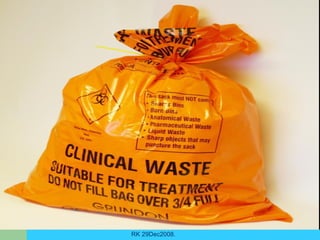
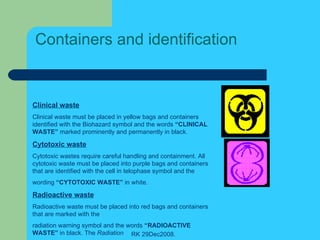
Containers and identification Clinical waste Clinical waste must be placed in yellow bags and containers identified with the Biohazard symbol and the words  “CLINICAL WASTE”  marked prominently and permanently in black. Cytotoxic waste Cytotoxic wastes require careful handling and containment. All cytotoxic waste must be placed into purple bags and containers that are identified with the cell in telophase symbol and the wording  “CYTOTOXIC WASTE”  in white. Radioactive waste Radioactive waste must be placed into red bags and containers that are marked with the radiation warning symbol and the words  “RADIOACTIVE WASTE”  in black. The  Radiation
 
Waste Management in Dental Office Regulated by Different  Governing Bodies Federal  Provincial  Local for infection control, hazardous materials handling, safety and waste disposal issues.
Understanding Waste Management in Dental Clinic Clinical Personal must be trained  to handle  waste. Trainings provided by Different organizations under guidelines of OSHA, CDC, ADA and Environment Protection agencies
Occupational Health and safety Administration Regulations concerning  Blood borne pathogens Hazardous materials Safe use of chemicals
Environmental Protection Agency. Regulates Workplace exposure level of chemicals. Heat Radiation Discharge of waste materials Requirements concerning sterilization, disinfections and waste management
Center For Disease Control In Dental Practice provides Program for waste management need to be developed Personals dealing with waste in practice are appropriately trained
American Dental Association  Indicate that staff are knowledgeable about the rules about waste management
Types of Waste Regulated Medical Waste ( Hospital waste and  Infectious medical waste – this require special care and is nearly 3% of the total waste  ) Non regulated medical waste
Types of regulated waste Contaminated Waste: items came in contact with blood or blood products Hazardous waste:posing a risk to human being or environment Infectious waste:capable of causing an infectious disease  Medical waste:any solid waste that is generated in the diagnosis treatment or immunization Regulated waste :needs special handling and disposal Toxic waste:having a poisonous effect
INFECTIOUS WASTE  Bulk blood or blood products  Pathology waste Sharps Saliva(CDC consider it to be infectious because it is often tainted with blood during treatment.)
BLOOD Blood mixed with saliva and other fluids evacuated in the dental office as waste water system. Rinse sink traps and evacuation lines daily with disinfected solution Carefully pour blood, suction fluids into the drain connected to the sewer system(meeting local regulatory guidelines)in an acceptable method
PATHOGENIC WASTE Teeth and other tissues Potentially infectious there disposal should be in a color labeled container (many areas allow in house  neutralization of such items) Disposal of treated tooth and other tissue are as to the local guidelines Pathologic waste is hidden from public and its disposal is in a secured and receptable.
ANATOMICAL WASTE (HUMAN TISSUE) Human tissue waste generation is normally limited to oral surgeons and periodontists for example in the course of harvesting of human tissue for treatment. C ollect human tissue in red liners that are marked with a universal biohazard symbol. Store anatomical waste in an enclosed storage area that is locked and separated from other supply areas. Anatomical waste should be stored at a temperature at or below 4 degrees centigrade. The storage area must be marked as Biomedical Waste Storage Area and must display the universal symbol. Once accumulated contact an approved biomedical waste carrier for disposal.
Dental Amalgam  Amalgam restored teeth can be disinfected before disposal with sterilizing chemical for 30 minutes and should rinse treated teeth well. Teeth with amalgam restoration must not be heat sterilized to avoid the possibility of mercury vapor release during the sterilization procedure. Extracted teeth should not ordinarily be returned to patients, however, the new CDC guideline allows extracted teeth to be returned to the patient. It should be soaked first in sodium hypochlorite for 10 minutes before returning to the patient.
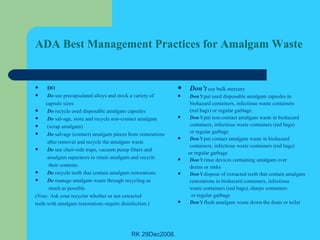
ADA Best Management Practices for Amalgam Waste DO Do  use precapsulated alloys and stock a variety of capsule sizes Do  recycle used disposable amalgam capsules Do  salvage, store and recycle non-contact amalgam (scrap amalgam) Do  salvage (contact) amalgam pieces from restorations after removal and recycle the amalgam waste Do  use chair-side traps, vacuum pump filters and amalgam separators to retain amalgam and recycle their contents. Do  recycle teeth that contain amalgam restorations. Do  manage amalgam waste through recycling as much as possible ( Note:  Ask your recycler whether or not extracted teeth with amalgam restorations require disinfection.) Don’t   use bulk mercury Don’t  put used disposable amalgam capsules in biohazard containers, infectious waste containers (red bags) or regular garbage. Don’t  put non-contact amalgam waste in biohazard containers, infectious waste containers (red bags) or regular garbage Don’t  put contact amalgam waste in biohazard containers, infectious waste containers (red bags) or regular garbage Don’t  rinse devices containing amalgam over drains or sinks Don’t  dispose of extracted teeth that contain amalgam restorations in biohazard containers, infectious waste containers (red bags), sharps containers or regular garbage Don’t  flush amalgam waste down the drain or toilet
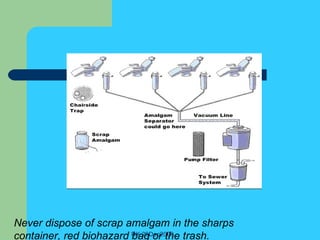
Never dispose of scrap amalgam in the sharps container, red biohazard bag or the trash.  5
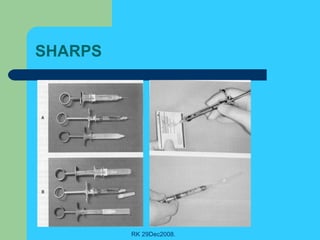
SHARPS Sharps waste is in the form of medical waste in the form of devices or objects used to puncture or lacerate the skin. Sharps waste is designated as biohazard and is to be carefully handled.
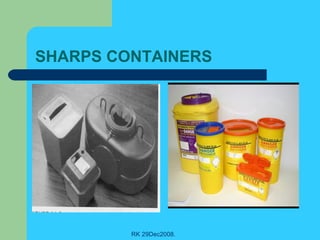
SHARPS Contaminated sharps are capable of transmitting the disease from injection needles, orthodontic bands,burs, scalpel blades, sutures, instruments and broken glass. Sterilization of sharp containers Use labeled and specified container Spore test the sterilizer. Label the disposable containers as to local regulations. Keep containers in upright position. Process containers for 40- 60 minutes. Leave containers vent open.
SHARPS
SHARPS CONTAINERS
Handling of Sharps Needles should not be bend, break, or manipulated for the avoidance of accidents in clinic Protective cap holdings devices capping sheath by scoop technique Size of sharp container also influence overall efficacy of sterilization
X-RAY FIXER AND DEVELOPER Separate fixer and developer solutions in the container provided by the approved waste carrier and supplier. Label the container. Once the container is full contact appropriate waste carrier for disposal.
CONTAMINATED LAUNDRY   Contaminated laundry is to be placed and transported in bags containers that are color coded or labeled with a biohazard symbol.. If the contaminated laundry is sent off site for cleaning, it must be placed in bags or containers that are color coded or labeled with a biohazard symbol, unless the laundry uses universal precautions in handling all soiled laundry.
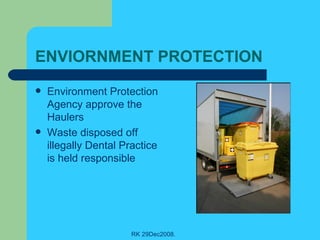
ENVIORNMENT PROTECTION  Environment Protection Agency approve the Haulers Waste disposed off illegally Dental Practice is held responsible
Reference “ Infection Control & Management of Hazardous Materials for Dental Team” Chris H.Miller,Charles John Palenik. “ National Guidelines for  waste management in health care industry” Govt. of Australia Guide lines. American Dental Council Guidelines. Handling Dental Waste
Any Questions

Waste Management

  • 1.
    WASTE MANAGEMENT INDENTISTRY Dr. Rajeev Kashyap B.Sc,B.D.S., M.Sc(DPH)UK
  • 2.
  • 3.
    WASTE MANAGEMENT DEFINITIONWaste Management is collection, transport,processing,recycling of disposal of waste material.This term usually relates to materials produced by human activity and is generally undertaken to reduce effect on health, the environment and aesthetics. Practice of waste management may differ in developing nation to under developing nation, urban to rural area and residential to industrial setup.
  • 4.
    CATEGORIES OF WASTEDiscarded sharps Laboratory and associated waste Human tissue including solutions containing blood Cytotoxic waste Pharmaceutical waste Chemical waste Radiation waste General waste
  • 5.
    Containers and identificationClinical waste Clinical waste must be placed in yellow bags and containers identified with the Biohazard symbol and the words “CLINICAL WASTE” marked prominently and permanently in black. Cytotoxic waste Cytotoxic wastes require careful handling and containment. All cytotoxic waste must be placed into purple bags and containers that are identified with the cell in telophase symbol and the wording “CYTOTOXIC WASTE” in white. Radioactive waste Radioactive waste must be placed into red bags and containers that are marked with the radiation warning symbol and the words “RADIOACTIVE WASTE” in black. The Radiation
  • 6.
  • 7.
    Waste Management inDental Office Regulated by Different Governing Bodies Federal Provincial Local for infection control, hazardous materials handling, safety and waste disposal issues.
  • 8.
    Understanding Waste Managementin Dental Clinic Clinical Personal must be trained to handle waste. Trainings provided by Different organizations under guidelines of OSHA, CDC, ADA and Environment Protection agencies
  • 9.
    Occupational Health andsafety Administration Regulations concerning Blood borne pathogens Hazardous materials Safe use of chemicals
  • 10.
    Environmental Protection Agency.Regulates Workplace exposure level of chemicals. Heat Radiation Discharge of waste materials Requirements concerning sterilization, disinfections and waste management
  • 11.
    Center For DiseaseControl In Dental Practice provides Program for waste management need to be developed Personals dealing with waste in practice are appropriately trained
  • 12.
    American Dental Association Indicate that staff are knowledgeable about the rules about waste management
  • 13.
    Types of WasteRegulated Medical Waste ( Hospital waste and Infectious medical waste – this require special care and is nearly 3% of the total waste ) Non regulated medical waste
  • 14.
    Types of regulatedwaste Contaminated Waste: items came in contact with blood or blood products Hazardous waste:posing a risk to human being or environment Infectious waste:capable of causing an infectious disease Medical waste:any solid waste that is generated in the diagnosis treatment or immunization Regulated waste :needs special handling and disposal Toxic waste:having a poisonous effect
  • 15.
    INFECTIOUS WASTE Bulk blood or blood products Pathology waste Sharps Saliva(CDC consider it to be infectious because it is often tainted with blood during treatment.)
  • 16.
    BLOOD Blood mixedwith saliva and other fluids evacuated in the dental office as waste water system. Rinse sink traps and evacuation lines daily with disinfected solution Carefully pour blood, suction fluids into the drain connected to the sewer system(meeting local regulatory guidelines)in an acceptable method
  • 17.
    PATHOGENIC WASTE Teethand other tissues Potentially infectious there disposal should be in a color labeled container (many areas allow in house neutralization of such items) Disposal of treated tooth and other tissue are as to the local guidelines Pathologic waste is hidden from public and its disposal is in a secured and receptable.
  • 18.
    ANATOMICAL WASTE (HUMANTISSUE) Human tissue waste generation is normally limited to oral surgeons and periodontists for example in the course of harvesting of human tissue for treatment. C ollect human tissue in red liners that are marked with a universal biohazard symbol. Store anatomical waste in an enclosed storage area that is locked and separated from other supply areas. Anatomical waste should be stored at a temperature at or below 4 degrees centigrade. The storage area must be marked as Biomedical Waste Storage Area and must display the universal symbol. Once accumulated contact an approved biomedical waste carrier for disposal.
  • 19.
    Dental Amalgam Amalgam restored teeth can be disinfected before disposal with sterilizing chemical for 30 minutes and should rinse treated teeth well. Teeth with amalgam restoration must not be heat sterilized to avoid the possibility of mercury vapor release during the sterilization procedure. Extracted teeth should not ordinarily be returned to patients, however, the new CDC guideline allows extracted teeth to be returned to the patient. It should be soaked first in sodium hypochlorite for 10 minutes before returning to the patient.
  • 20.
    ADA Best ManagementPractices for Amalgam Waste DO Do use precapsulated alloys and stock a variety of capsule sizes Do recycle used disposable amalgam capsules Do salvage, store and recycle non-contact amalgam (scrap amalgam) Do salvage (contact) amalgam pieces from restorations after removal and recycle the amalgam waste Do use chair-side traps, vacuum pump filters and amalgam separators to retain amalgam and recycle their contents. Do recycle teeth that contain amalgam restorations. Do manage amalgam waste through recycling as much as possible ( Note: Ask your recycler whether or not extracted teeth with amalgam restorations require disinfection.) Don’t use bulk mercury Don’t put used disposable amalgam capsules in biohazard containers, infectious waste containers (red bags) or regular garbage. Don’t put non-contact amalgam waste in biohazard containers, infectious waste containers (red bags) or regular garbage Don’t put contact amalgam waste in biohazard containers, infectious waste containers (red bags) or regular garbage Don’t rinse devices containing amalgam over drains or sinks Don’t dispose of extracted teeth that contain amalgam restorations in biohazard containers, infectious waste containers (red bags), sharps containers or regular garbage Don’t flush amalgam waste down the drain or toilet
  • 21.
    Never dispose ofscrap amalgam in the sharps container, red biohazard bag or the trash. 5
  • 22.
    SHARPS Sharps wasteis in the form of medical waste in the form of devices or objects used to puncture or lacerate the skin. Sharps waste is designated as biohazard and is to be carefully handled.
  • 23.
    SHARPS Contaminated sharpsare capable of transmitting the disease from injection needles, orthodontic bands,burs, scalpel blades, sutures, instruments and broken glass. Sterilization of sharp containers Use labeled and specified container Spore test the sterilizer. Label the disposable containers as to local regulations. Keep containers in upright position. Process containers for 40- 60 minutes. Leave containers vent open.
  • 24.
  • 25.
  • 26.
    Handling of SharpsNeedles should not be bend, break, or manipulated for the avoidance of accidents in clinic Protective cap holdings devices capping sheath by scoop technique Size of sharp container also influence overall efficacy of sterilization
  • 27.
    X-RAY FIXER ANDDEVELOPER Separate fixer and developer solutions in the container provided by the approved waste carrier and supplier. Label the container. Once the container is full contact appropriate waste carrier for disposal.
  • 28.
    CONTAMINATED LAUNDRY Contaminated laundry is to be placed and transported in bags containers that are color coded or labeled with a biohazard symbol.. If the contaminated laundry is sent off site for cleaning, it must be placed in bags or containers that are color coded or labeled with a biohazard symbol, unless the laundry uses universal precautions in handling all soiled laundry.
  • 29.
    ENVIORNMENT PROTECTION Environment Protection Agency approve the Haulers Waste disposed off illegally Dental Practice is held responsible
  • 30.
    Reference “ InfectionControl & Management of Hazardous Materials for Dental Team” Chris H.Miller,Charles John Palenik. “ National Guidelines for waste management in health care industry” Govt. of Australia Guide lines. American Dental Council Guidelines. Handling Dental Waste
  • 31.