Peutz Jeghers Syndrome
Peutz-Jeghers syndrome (PJS)
Autosomal dominant syndrome characterized by
1. multiple hamartomatous polyps in the
gastrointestinal tract
2. mucocutaneous pigmentation
3. an increased risk of gastrointestinal and
nongastrointestinal cancer
Epidemiology and genetics
• Prevalence - 1:8000 to 1:200,000 births
• Males and females are equally affected.
• Autosomal dominant.
• Mutation of STK 11 gene . Chromosome
19p13
• Mostly hereditary. Can also be sporadic in 10-
20% cases
Clinical manifestations
• Mucocutaneous pigmentation
– Seen in 95% patients
– 1mm to 5mm in size.
– Appears by 1 or 2 years of age. Fades after puberty
except buccal mucosa.
• Hamartomatous polyps.
– Most common in small bowel 60-90% esp jejunum. Stomach
15-30%, Colon 50%
– 50% asymptomatic at diagnosis.
– Can present with bleeding , obstruction, intussusception(in
upto 70%).
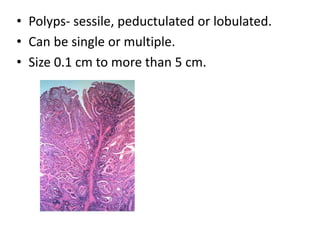
• Polyps- sessile, peductulated or lobulated.
• Can be single or multiple.
• Size 0.1 cm to more than 5 cm.
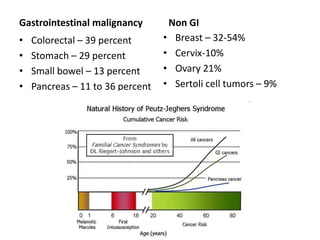
Gastrointestinal malignancy
• Colorectal – 39 percent
• Stomach – 29 percent
• Small bowel – 13 percent
• Pancreas – 11 to 36 percent
Non GI
• Breast – 32-54%
• Cervix-10%
• Ovary 21%
• Sertoli cell tumors – 9%
Diagnosis
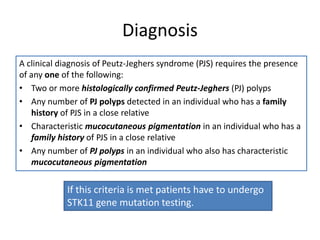
A clinical diagnosis of Peutz-Jeghers syndrome (PJS) requires the presence
of any one of the following:
• Two or more histologically confirmed Peutz-Jeghers (PJ) polyps
• Any number of PJ polyps detected in an individual who has a family
history of PJS in a close relative
• Characteristic mucocutaneous pigmentation in an individual who has a
family history of PJS in a close relative
• Any number of PJ polyps in an individual who also has characteristic
mucocutaneous pigmentation
If this criteria is met patients have to undergo
STK11 gene mutation testing.
Management
• Endoscopic polypectomy.
• Double balloon enteroscopy
• Laparotomy and resection of bowel with on
table enteroscopy and polypectomy.

Peutz jeghers syndrome

  • 1.
  • 2.
    Peutz-Jeghers syndrome (PJS) Autosomaldominant syndrome characterized by 1. multiple hamartomatous polyps in the gastrointestinal tract 2. mucocutaneous pigmentation 3. an increased risk of gastrointestinal and nongastrointestinal cancer
  • 3.
    Epidemiology and genetics •Prevalence - 1:8000 to 1:200,000 births • Males and females are equally affected. • Autosomal dominant. • Mutation of STK 11 gene . Chromosome 19p13 • Mostly hereditary. Can also be sporadic in 10- 20% cases
  • 4.
    Clinical manifestations • Mucocutaneouspigmentation – Seen in 95% patients – 1mm to 5mm in size. – Appears by 1 or 2 years of age. Fades after puberty except buccal mucosa. • Hamartomatous polyps. – Most common in small bowel 60-90% esp jejunum. Stomach 15-30%, Colon 50% – 50% asymptomatic at diagnosis. – Can present with bleeding , obstruction, intussusception(in upto 70%).
  • 5.
    • Polyps- sessile,peductulated or lobulated. • Can be single or multiple. • Size 0.1 cm to more than 5 cm.
  • 6.
    Gastrointestinal malignancy • Colorectal– 39 percent • Stomach – 29 percent • Small bowel – 13 percent • Pancreas – 11 to 36 percent Non GI • Breast – 32-54% • Cervix-10% • Ovary 21% • Sertoli cell tumors – 9%
  • 7.
    Diagnosis A clinical diagnosisof Peutz-Jeghers syndrome (PJS) requires the presence of any one of the following: • Two or more histologically confirmed Peutz-Jeghers (PJ) polyps • Any number of PJ polyps detected in an individual who has a family history of PJS in a close relative • Characteristic mucocutaneous pigmentation in an individual who has a family history of PJS in a close relative • Any number of PJ polyps in an individual who also has characteristic mucocutaneous pigmentation If this criteria is met patients have to undergo STK11 gene mutation testing.
  • 9.
    Management • Endoscopic polypectomy. •Double balloon enteroscopy • Laparotomy and resection of bowel with on table enteroscopy and polypectomy.