NISO/DCMI Webinar:
Implementing Linked Data in Developing
Countries and Low-Resource Conditions
September 25, 2013
Speakers:
Johannes Keizer - Information Systems Officer, Food and Agriculture
Organization of the United Nations
Caterina Caracciolo - Senior Information Specialist at the Food and
Agriculture Organization of the United Nations
http://www.niso.org/news/events/2013/dcmi/developing
Implementing Linked Data in
Developing Countries and Low
Resource Conditions
NISO/DCMI Webminar
25 September, 2013
Caterina Caracciolo, Johannes Keizer
{caterina.caracciolo},{johannes.keizer}@fao.org
Goal of this Webinar
• Overview of Linked data stack and
components
• LOD in low resource conditions
– Possible? Why to do it?
• What to think of when doing LOD in low
resources
• Explain some initiatives to enable LOD in low
resources
• Exemplify a real world LOD Szenario
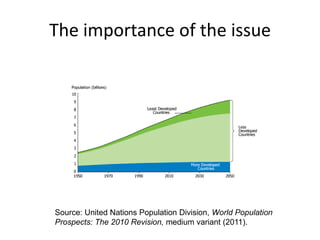
The importance of the issue
Source: United Nations Population Division, World Population
Prospects: The 2010 Revision, medium variant (2011).
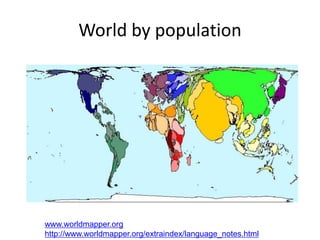
World by population
www.worldmapper.org
http://www.worldmapper.org/extraindex/language_notes.html
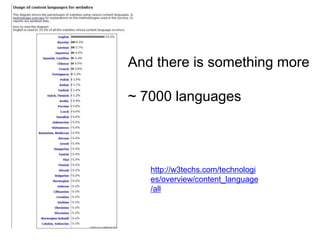
• ~ 7000 languages
http://w3techs.com/technologi
es/overview/content_language
/all
And there is something more
~ 7000 languages
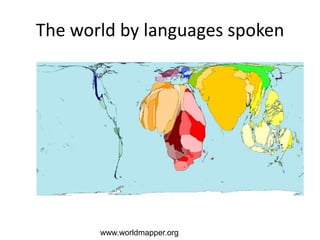
The world by languages spoken
www.worldmapper.org
Let’s get into the nitty gritty
Implementing Linked Data in
Developing Countries and Low
Resource Conditions
Part 2
NISO/DCMI Webminar
25 September, 2013
Caterina Caracciolo
caterina.caracciolo@fao.org
Today
• A bird’s eye view on Linked Data lifecycle, from
data consumption to data generation
• Discussion on major difficulties, especially in
the data generation phase
• Some considerations on possible solutions,
especially from a strategic and organizational
point of view
• No ambition to have a comprehensive survey
of tools!
What are low resource conditions
really?
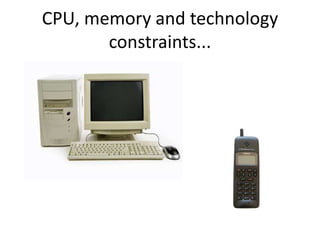
CPU, memory and technology
constraints...
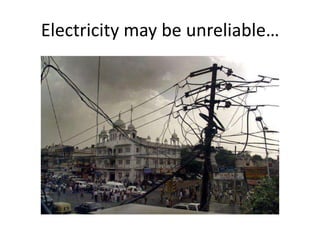
Electricity may be unreliable…
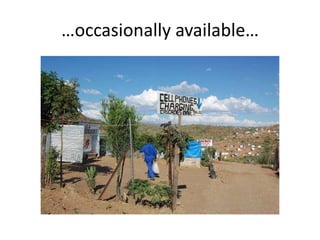
…occasionally available…
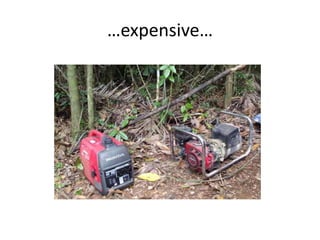
…expensive…
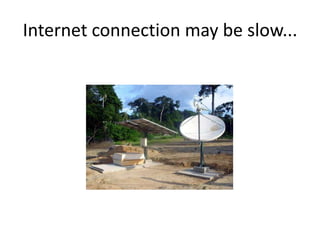
Internet connection may be slow...
… and dependent on the weather…
Funding...
is always a problem 
IT competencies…
Few IT people, over-busy, trained on different
technologies, with little or no incentives to
learn/adopt new ones
IT and domain-specific
competencies
• Usually, complete separation between those
working on IT and those working on
collecting/analysing/maintaining data
(domain specialists)
• Domain specialists do not want to spend time
changing formats, validating conversions,
explaining intended meaning of data etc.
– Tendency to consider data as “my” data
Linked Data
Scenario
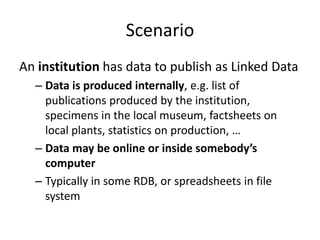
An institution has data to publish as Linked Data
– Data is produced internally, e.g. list of
publications produced by the institution,
specimens in the local museum, factsheets on
local plants, statistics on production, …
– Data may be online or inside somebody’s
computer
– Typically in some RDB, or spreadsheets in file
system
Remark
• Although not necessary, strictly speaking, here
we consider RDF as the format for Linked Data
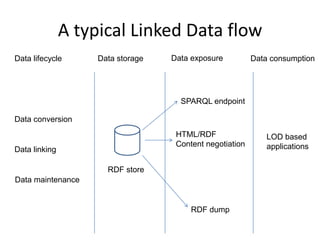
A typical Linked Data flow
SPARQL endpoint
HTML/RDF
Content negotiation
RDF store
RDF dump
LOD based
applications
Data consumptionData exposureData storageData lifecycle
Data conversion
Data linking
Data maintenance
Data consumption
Building LOD based applications
is easy…
(relatively)
Relatively easy…
• It is about making mash up applications…
• But interfacing with the data may be an issue
– Developers need to know SPARQL
– And how to use it within his/her framework of
choice
A pointer
• Research to Impact Hackathon, Kenya, Jan
2013
– @iHub Research, Kenya
• local agricultural and nutritional sector
– Comments on that in Tim Davies’ blog
• http://www.timdavies.org.uk/
• Other blogs around … (search for them!)
Data exposure can be done in
various ways
Exposing de-referenceable URIs
• Need to set up content negotiation mechanism
– Serving content for URIs
• In our experience, not a big problem
– Simple back-ends are available, e.g. Pubby
• Still, need server 24/7… properly configured
Provide an RDF dump
• Always a good choice
– Data is downloaded for inclusion in applications
– Efficiency of access to data is under control
– Perhaps not always clear how to produce the
dump, what to include in it…
• Only the data? Also the links?
Expose SPARQL endpoint
• Endpoint typically provided by triple store
• Heavy on server side
• Query processing is left to the SPARQL engine
– Implementation of reasoning
– Implementation of order in clause processing –
filters, unions, select
• Require 24/7 server availability
Expose Web Services
• Known technology
• May be built on top RDF stores
• Good performances
• Control on what data may be accessed
• API formats to simplify use of linked data by
web developers https://code.google.com/p/linked-data-api/
Data storage is tricky
Triple stores are well known
resource-guzzlers
• Intense use of CPU, memory
• Server configuration needs to be appropriate
• Internet connection may be a bottleneck
• Again, some tech know-how needed to
choose the best solution
– Also considering other technologies, e.g. NoSQL
The Semantic Web is resource
guzzler!
Downscale the Semantic Web!
http://worldwidesemanticweb.org/events/downscale2012/
http://worldwidesemanticweb.org/events/downscale2013/
Data generation
Producing RDF may be a daunting
task
Getting to RDF… from what?
• In many cases, RDF means an abrupt jump
from formats that we consider long
abandoned
• From a recent survey, we learn that some
AGROVOC users (libraries, institutions) use the
paper version
– Last published in 1992
RDF generation
• It is a simple format, simply triples
• But requires some familiarity with the
technology, and especially acquaintance with
the mentality around, especially on standards
and reuse
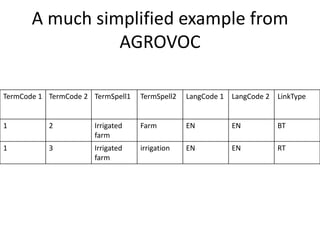
A much simplified example from
AGROVOC
TermCode 1 TermCode 2 TermSpell1 TermSpell2 LangCode 1 LangCode 2 LinkType
1 2 Irrigated
farm
Farm EN EN BT
1 3 Irrigated
farm
irrigation EN EN RT
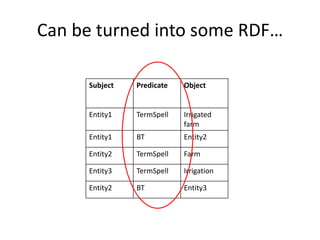
Can be turned into some RDF…
Subject Predicate Object
Entity1 TermSpell Irrigated
farm
Entity1 BT Entity2
Entity2 TermSpell Farm
Entity3 TermSpell Irrigation
Entity2 BT Entity3
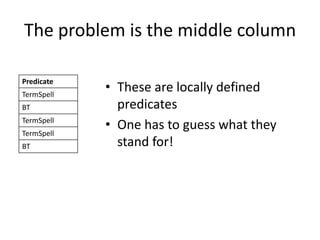
The problem is the middle column
• These are locally defined
predicates
• One has to guess what they
stand for!
Predicate
TermSpell
BT
TermSpell
TermSpell
BT
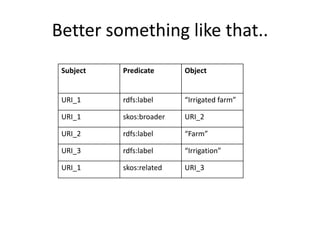
Better something like that..
Subject Predicate Object
URI_1 rdfs:label “Irrigated farm”
URI_1 skos:broader URI_2
URI_2 rdfs:label “Farm”
URI_3 rdfs:label “Irrigation”
URI_1 skos:related URI_3
Using standard vocabularies is the
key
• Standard, or de facto standard
• Only a few of them:
– Dublin Core, BIBO, FOAF, SKOS, ..
• Ensure possibility of reuse of data
Standard vocabularies as Step 0 of
Linked Data
• Reusing existing vocabularies is the first step
to have some indications of what data may be
linked and what not
– E.g. dct:subject in a bibliographic record indicates
the “topic” of the record
How to know what vocabulary to
use?
• And how to know if the right vocabulary
exists?
– We very often receive questions about this from
local institutions (who expect to use AGROVOC for
that…)
• This is probably the very first conceptual
blocker!
Need to support data managers
• Initiatives such as Linked Open Vocabularies
(LOV) are useful:
– http://lov.okfn.org/dataset/lov/index.html
• But also need usable and stable tools to
support data managers
Drupal’s way to support small users
• Allows one to import data from other sources,
create RDF, and expose RDF dumps
• At conversion time, one can chose the
vocabulary to use
• Then, it becomes the tool for data
maintenance
• No programming skill required, still some
competency on Drupal! And you need to
understand RDF and your data!
Other attempts along the same
line
• AgriDrupal
– Drupal especially customized for small institutions
– And bibliographic data, data on people,
organizations
• ScratchPad
– Customized for biodiversity data
URIs
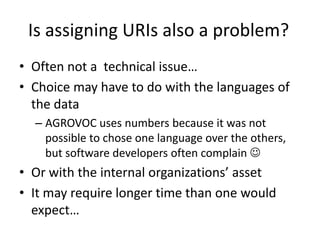
Is assigning URIs also a problem?
• Often not a technical issue…
• Choice may have to do with the languages of
the data
– AGROVOC uses numbers because it was not
possible to chose one language over the others,
but software developers often complain 
• Or with the internal organizations’ asset
• It may require longer time than one would
expect…
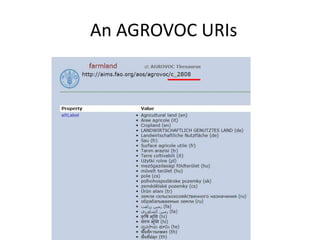
An AGROVOC URIs
Linking data is a bottleneck
Example of linking from AGROVOC
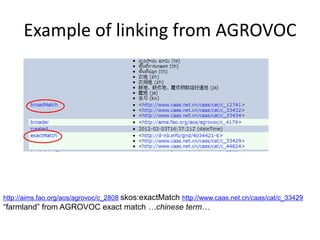
http://aims.fao.org/aos/agrovoc/c_2808 skos:exactMatch http://www.caas.net.cn/caas/cat/c_33429
“farmland” from AGROVOC exact match …chinese term…
Linking entities
• Still active research area
• Maintenance still an issue
– see example of AGROVOC linked to Chinese
thesaurus…
• Data validation usually outside the rest of the
data lifecycle
Data maintenance
• Choice: keep everything in your db and
continue periodic generation of rdf
• Move maintenance in different tools
In what language is your data?
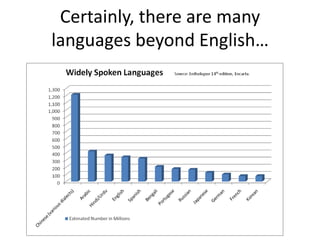
Certainly, there are many
languages beyond English…
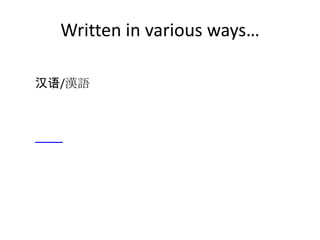
Written in various ways…
汉语/漢語
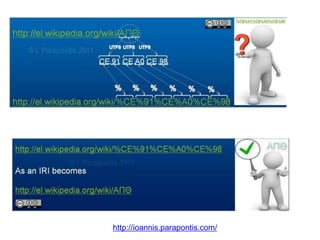
http://ioannis.parapontis.com/
Some considerations from a
managerial perspective…
Assuming an institution with
constrained resources has already
planned to go Linked Data, what
to do?
Options
• Go ahead on your own
• Organize a collaboration
– A network creation effort
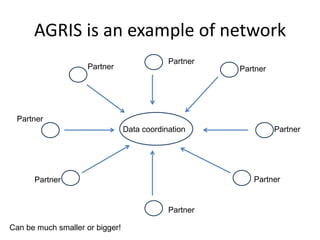
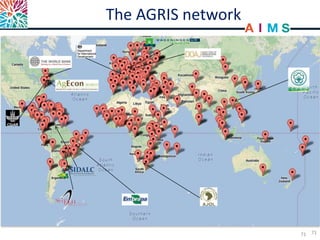
AGRIS is an example of network
Data coordination
Partner
Partner
Partner
Partner
Partner
Partner
Can be much smaller or bigger!
Partner
Partner
Our conclusions
1) Semantic Web is energy
intensive
• Because of infrastructure requirements
• The biggest bottleneck is often on the side of
IT competencies, and at the interface between
IT and domain knowledge, especially for data
modeling
• Linked Data-related technologies must
become lighter in order to be adoptable in low
resource conditions
2) In low resource conditions…
• Do a careful assessment of your data and in-
house skills
• It is a good idea to organize your effort in
collaboration
• Start mobilizing IT specialists, data curators
3) Start with Step 0: identify and
use standards to describe your
data
• Mobilize IT specialists, data curators
The AGRIS network
7171
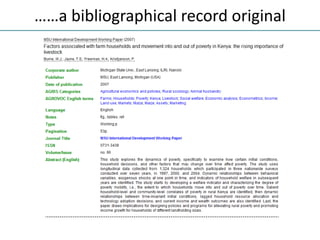
……a bibliographical record original
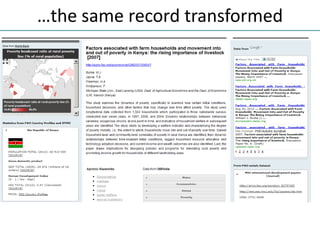
…the same record transformed
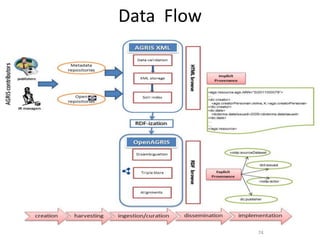
Data Flow
74
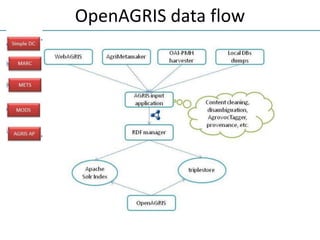
OpenAGRIS data flow
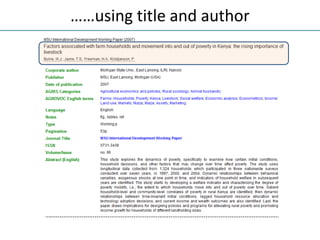
How is linked data produced
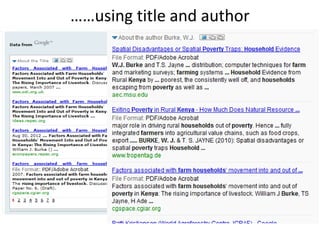
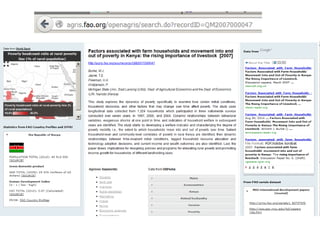
……using title and author
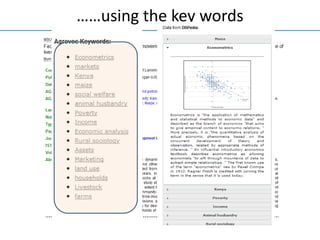
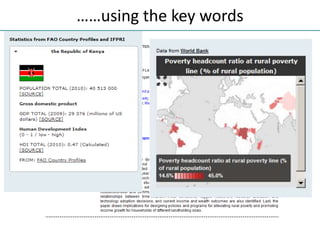
……using the key words
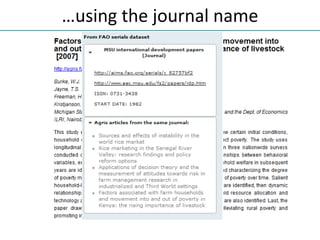
…using the journal name
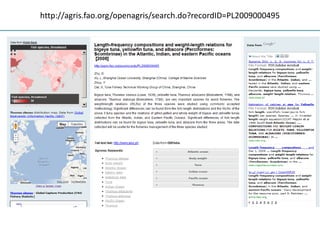
http://agris.fao.org/openagris/search.do?recordID=PL2009000495
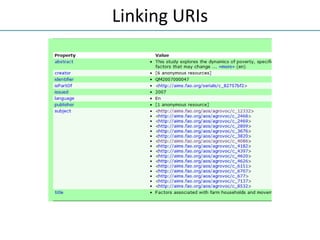
Linking URIs
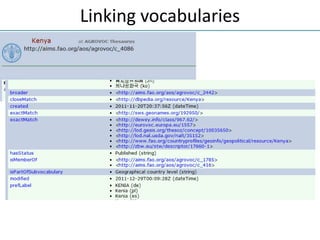
Linking vocabularies
Questions?
NISO/DCMI Webinar
Implementing Linked Data in Developing Countries and
Low-Resource Conditions
NISO/DCMI Webinar • September 25, 2013
Questions?
All questions will be posted with presenter answers on
the NISO website following the webinar:
http://www.niso.org/news/events/2013/dcmi/developing
Thank you for joining us today.
Please take a moment to fill out the brief online survey.
We look forward to hearing from you!
THANK YOU

NISO/DCMI September 25 Webinar: Implementing Linked Data in Developing Countries and Low-Resource Conditions

  • 1.
    NISO/DCMI Webinar: Implementing LinkedData in Developing Countries and Low-Resource Conditions September 25, 2013 Speakers: Johannes Keizer - Information Systems Officer, Food and Agriculture Organization of the United Nations Caterina Caracciolo - Senior Information Specialist at the Food and Agriculture Organization of the United Nations http://www.niso.org/news/events/2013/dcmi/developing
  • 2.
    Implementing Linked Datain Developing Countries and Low Resource Conditions NISO/DCMI Webminar 25 September, 2013 Caterina Caracciolo, Johannes Keizer {caterina.caracciolo},{johannes.keizer}@fao.org
  • 3.
    Goal of thisWebinar • Overview of Linked data stack and components • LOD in low resource conditions – Possible? Why to do it? • What to think of when doing LOD in low resources • Explain some initiatives to enable LOD in low resources • Exemplify a real world LOD Szenario
  • 4.
    The importance ofthe issue Source: United Nations Population Division, World Population Prospects: The 2010 Revision, medium variant (2011).
  • 5.
  • 6.
    • ~ 7000languages http://w3techs.com/technologi es/overview/content_language /all And there is something more ~ 7000 languages
  • 7.
    The world bylanguages spoken www.worldmapper.org
  • 8.
    Let’s get intothe nitty gritty
  • 9.
    Implementing Linked Datain Developing Countries and Low Resource Conditions Part 2 NISO/DCMI Webminar 25 September, 2013 Caterina Caracciolo caterina.caracciolo@fao.org
  • 10.
    Today • A bird’seye view on Linked Data lifecycle, from data consumption to data generation • Discussion on major difficulties, especially in the data generation phase • Some considerations on possible solutions, especially from a strategic and organizational point of view • No ambition to have a comprehensive survey of tools!
  • 11.
    What are lowresource conditions really?
  • 12.
    CPU, memory andtechnology constraints...
  • 13.
    Electricity may beunreliable…
  • 14.
  • 15.
  • 16.
  • 17.
    … and dependenton the weather…
  • 18.
  • 19.
    IT competencies… Few ITpeople, over-busy, trained on different technologies, with little or no incentives to learn/adopt new ones
  • 20.
    IT and domain-specific competencies •Usually, complete separation between those working on IT and those working on collecting/analysing/maintaining data (domain specialists) • Domain specialists do not want to spend time changing formats, validating conversions, explaining intended meaning of data etc. – Tendency to consider data as “my” data
  • 21.
  • 23.
    Scenario An institution hasdata to publish as Linked Data – Data is produced internally, e.g. list of publications produced by the institution, specimens in the local museum, factsheets on local plants, statistics on production, … – Data may be online or inside somebody’s computer – Typically in some RDB, or spreadsheets in file system
  • 24.
    Remark • Although notnecessary, strictly speaking, here we consider RDF as the format for Linked Data
  • 25.
    A typical LinkedData flow SPARQL endpoint HTML/RDF Content negotiation RDF store RDF dump LOD based applications Data consumptionData exposureData storageData lifecycle Data conversion Data linking Data maintenance
  • 26.
  • 27.
    Building LOD basedapplications is easy… (relatively)
  • 28.
    Relatively easy… • Itis about making mash up applications… • But interfacing with the data may be an issue – Developers need to know SPARQL – And how to use it within his/her framework of choice
  • 29.
    A pointer • Researchto Impact Hackathon, Kenya, Jan 2013 – @iHub Research, Kenya • local agricultural and nutritional sector – Comments on that in Tim Davies’ blog • http://www.timdavies.org.uk/ • Other blogs around … (search for them!)
  • 30.
    Data exposure canbe done in various ways
  • 31.
    Exposing de-referenceable URIs •Need to set up content negotiation mechanism – Serving content for URIs • In our experience, not a big problem – Simple back-ends are available, e.g. Pubby • Still, need server 24/7… properly configured
  • 32.
    Provide an RDFdump • Always a good choice – Data is downloaded for inclusion in applications – Efficiency of access to data is under control – Perhaps not always clear how to produce the dump, what to include in it… • Only the data? Also the links?
  • 33.
    Expose SPARQL endpoint •Endpoint typically provided by triple store • Heavy on server side • Query processing is left to the SPARQL engine – Implementation of reasoning – Implementation of order in clause processing – filters, unions, select • Require 24/7 server availability
  • 34.
    Expose Web Services •Known technology • May be built on top RDF stores • Good performances • Control on what data may be accessed • API formats to simplify use of linked data by web developers https://code.google.com/p/linked-data-api/
  • 35.
  • 36.
    Triple stores arewell known resource-guzzlers • Intense use of CPU, memory • Server configuration needs to be appropriate • Internet connection may be a bottleneck • Again, some tech know-how needed to choose the best solution – Also considering other technologies, e.g. NoSQL
  • 37.
    The Semantic Webis resource guzzler! Downscale the Semantic Web! http://worldwidesemanticweb.org/events/downscale2012/ http://worldwidesemanticweb.org/events/downscale2013/
  • 38.
  • 39.
    Producing RDF maybe a daunting task
  • 40.
    Getting to RDF…from what? • In many cases, RDF means an abrupt jump from formats that we consider long abandoned • From a recent survey, we learn that some AGROVOC users (libraries, institutions) use the paper version – Last published in 1992
  • 41.
    RDF generation • Itis a simple format, simply triples • But requires some familiarity with the technology, and especially acquaintance with the mentality around, especially on standards and reuse
  • 42.
    A much simplifiedexample from AGROVOC TermCode 1 TermCode 2 TermSpell1 TermSpell2 LangCode 1 LangCode 2 LinkType 1 2 Irrigated farm Farm EN EN BT 1 3 Irrigated farm irrigation EN EN RT
  • 43.
    Can be turnedinto some RDF… Subject Predicate Object Entity1 TermSpell Irrigated farm Entity1 BT Entity2 Entity2 TermSpell Farm Entity3 TermSpell Irrigation Entity2 BT Entity3
  • 44.
    The problem isthe middle column • These are locally defined predicates • One has to guess what they stand for! Predicate TermSpell BT TermSpell TermSpell BT
  • 45.
    Better something likethat.. Subject Predicate Object URI_1 rdfs:label “Irrigated farm” URI_1 skos:broader URI_2 URI_2 rdfs:label “Farm” URI_3 rdfs:label “Irrigation” URI_1 skos:related URI_3
  • 46.
    Using standard vocabulariesis the key • Standard, or de facto standard • Only a few of them: – Dublin Core, BIBO, FOAF, SKOS, .. • Ensure possibility of reuse of data
  • 47.
    Standard vocabularies asStep 0 of Linked Data • Reusing existing vocabularies is the first step to have some indications of what data may be linked and what not – E.g. dct:subject in a bibliographic record indicates the “topic” of the record
  • 48.
    How to knowwhat vocabulary to use? • And how to know if the right vocabulary exists? – We very often receive questions about this from local institutions (who expect to use AGROVOC for that…) • This is probably the very first conceptual blocker!
  • 49.
    Need to supportdata managers • Initiatives such as Linked Open Vocabularies (LOV) are useful: – http://lov.okfn.org/dataset/lov/index.html • But also need usable and stable tools to support data managers
  • 50.
    Drupal’s way tosupport small users • Allows one to import data from other sources, create RDF, and expose RDF dumps • At conversion time, one can chose the vocabulary to use • Then, it becomes the tool for data maintenance • No programming skill required, still some competency on Drupal! And you need to understand RDF and your data!
  • 51.
    Other attempts alongthe same line • AgriDrupal – Drupal especially customized for small institutions – And bibliographic data, data on people, organizations • ScratchPad – Customized for biodiversity data
  • 52.
  • 53.
    Is assigning URIsalso a problem? • Often not a technical issue… • Choice may have to do with the languages of the data – AGROVOC uses numbers because it was not possible to chose one language over the others, but software developers often complain  • Or with the internal organizations’ asset • It may require longer time than one would expect…
  • 54.
  • 55.
    Linking data isa bottleneck
  • 56.
    Example of linkingfrom AGROVOC http://aims.fao.org/aos/agrovoc/c_2808 skos:exactMatch http://www.caas.net.cn/caas/cat/c_33429 “farmland” from AGROVOC exact match …chinese term…
  • 57.
    Linking entities • Stillactive research area • Maintenance still an issue – see example of AGROVOC linked to Chinese thesaurus… • Data validation usually outside the rest of the data lifecycle
  • 58.
    Data maintenance • Choice:keep everything in your db and continue periodic generation of rdf • Move maintenance in different tools
  • 59.
    In what languageis your data?
  • 60.
    Certainly, there aremany languages beyond English…
  • 61.
    Written in variousways… 汉语/漢語
  • 62.
  • 63.
    Some considerations froma managerial perspective…
  • 64.
    Assuming an institutionwith constrained resources has already planned to go Linked Data, what to do?
  • 65.
    Options • Go aheadon your own • Organize a collaboration – A network creation effort
  • 66.
    AGRIS is anexample of network Data coordination Partner Partner Partner Partner Partner Partner Can be much smaller or bigger! Partner Partner
  • 67.
  • 68.
    1) Semantic Webis energy intensive • Because of infrastructure requirements • The biggest bottleneck is often on the side of IT competencies, and at the interface between IT and domain knowledge, especially for data modeling • Linked Data-related technologies must become lighter in order to be adoptable in low resource conditions
  • 69.
    2) In lowresource conditions… • Do a careful assessment of your data and in- house skills • It is a good idea to organize your effort in collaboration • Start mobilizing IT specialists, data curators
  • 70.
    3) Start withStep 0: identify and use standards to describe your data • Mobilize IT specialists, data curators
  • 71.
  • 72.
  • 73.
    …the same recordtransformed
  • 74.
  • 75.
  • 76.
    How is linkeddata produced
  • 77.
  • 78.
  • 79.
  • 80.
  • 81.
  • 83.
  • 84.
  • 85.
  • 86.
  • 87.
    NISO/DCMI Webinar Implementing LinkedData in Developing Countries and Low-Resource Conditions NISO/DCMI Webinar • September 25, 2013 Questions? All questions will be posted with presenter answers on the NISO website following the webinar: http://www.niso.org/news/events/2013/dcmi/developing
  • 88.
    Thank you forjoining us today. Please take a moment to fill out the brief online survey. We look forward to hearing from you! THANK YOU

Editor's Notes

  • #5 Definition varyUsually based on socio-economic parametersGDP, …In any case, they are the majority of the world193 members of UNBut more countries and territories in the world…Not only the majority of countries, also the majority of people….In 2009: "Out of every 100 persons added to the population in the coming decade, 97 will live in developing countries.“Hania Zlotnik, UN Population Division
  • #72 AGRIS is a central repository aggregating and centralizing data from more than 200 bibliographic collections worldwide, some of them of a huge relevance in the agricultural domain.AGRIS ingests data from collections varying from National Research Centres, open access repositories of full-text scholarly literature, publishers of scientific electronic journals in agriculture, and so on.Open Access repositories in 2012.. 29, 355 records from the Wageningen UR, Library (Netherlands)28,582 from the Open Knowledge Repository of the World Bank, which recently opened up to OA to ensure that their research projects and publications are widely available13,000 from R4D: Research for Development - Department for International Development in UK11,600 from AgEcon open access repository15,000 resources from EMBRAPA’s Open Repository
  • #75 - AGRIS consumes metadata provided by the community and publishes it as open data The metadata is captured either via a client harvester collecting the data from OAI-PMH client services and open repositories or by delivery (via email or ftp) of database dumps from other information systems and cross reference tools.The data is thus ingested, validated, processed and indexed/stored in two different repositories (the XML and the RDF store). In the next few months, data will be stored only in the RDF repositoryThe data is disseminated via the OpenAGRIS application