Multidimensional Indexes

        Chapter 5
Outline
•   Applications
•   Hash-like structures
•   Tree-like structures
•   Bit-map indexes
Search Key
• Search key is (F1, F2, ..Fk)
  – Separated by special markers.
  – Example
     • If F1=abcd and F2=123, the search key is
       “abcd#123”
Applications: GIS
• Geographic Information Systems
   – Objects are in two dimensional space
   – The objects may be points or shapes
   – Objects may be houses, roads, bridges, pipelines and many
     other physical objects.
• Query types
   – Partial match queries
      • Specify the values for one or more dimensions and look for all
        points matching those values in those dimensions.
   – Range queries
      • Set of shapes within the range
   – Nearest neighbor queries
      • Closest point to a given point
   – Where-am-I queries
      • When you click a mouse, the system determines which of the
        displayed elements you were clicking.
Data Cubes
• Data exists in high dimensional space
• A chain store may record each sale made, including
   –   The day and time
   –   The store in which the sale was made
   –   The item purchased
   –   The color of the item
   –   The size of the item
• Attributes are seen as dimensions multidimensional
  space, data cube.
• Typical query
   – Give a class of pink shirts for each store and each month of
     1998.
Multidimensional queries in SQL
• Represent points as a relation Points(x,y)
• Query
  – Find the nearest point to (10, 20)
  – Compute the distance between (10,20) to
    every other point.
Rectangles
• Rectangles(id, x11, y11, xur, yur)
• If the query is
  – Find the rectangles enclosing the point
    (10,20)
• SELECT id
  FROM Rectangles
  WHERE x11 <= 10.0 AND y11 <= 20.0
  AND xur >=10.0 AND yur >=20.0;
Data Cube
• Fact table
  – Sales(day,store, item. color, size)
• Query
  – Summarize the sale of pink shirts by day and store
• SELECT day, store, COUNT(*) AS totalSales
  FROM Sales
  WHERE item=‘shirt’ AND color=‘pink’
  GROUP BY day, store;
Executing range queries in
        Conventional Indexes
• Motivation: Find records where
               DEPT = “Toy” AND SAL > 50k
• Strategy 1: Use “Toy” index and check salary
• Strategy II: Use “Toy” index and SAL index and
  intersect.
   – Complexity
      • Toy index: number of disk accesses = number of disk blocks
      • SAL index: number of disk accesses= number of records
• So conventional indexes of little help.
Executing nearest-neighbor queries using
              conventional indexes
• There might be no point in the selected
  range
  – Repeat the search by increasing the range
• The closest point within the range might
  not be the closest point overall.
  – There is one point closer from outside range.
Other Limitations of Conventional
                Indexes
• We can only keep the file sorted on only
  attribute.
• If the query is on multiple dimensions
  – We will end-up having one disk access for
    each record
• It becomes too expensive
Overview of Multidimensional Index
            Structures
• Hash-table-like approaches
• Tree-like approaches
• In both cases, we give-up some properties of
  single dimensional indexes
• Hash
  – We have to access multiple buckets
• Tree
  – Tree may not be balanced
  – There may not exist a correspondence between tree
    nodes and disk blocks
  – Information in the disk block is much smaller.
Hash like structures: GRID Files
• Each dimension, grid lines partition the
  space into stripes,
  – Points that fall on a grid line will be
    considered to belong to the stripe for which
    that grid line is lower boundary
  – The number of grid lines in each dimension
    may vary.
  – Space between grid lines in the same
    dimension may also vary
Grid Index
                           Key 2
                  X1 X2      ……            Xn
         V1
         V2
Key 1

             Vn

                    To records with key1=V3, key2=X2


                                                 14
CLAIM

• Can quickly find records with
  – key 1 = Vi ∧ Key 2 = Xj
  – key 1 = Vi
  – key 2 = Xj


                                  15
CLAIM

• Can quickly find records with
  – key 1 = Vi ∧ Key 2 = Xj
  – key 1 = Vi
  – key 2 = Xj

• And also ranges….
  – E.g., key 1 ≥ Vi ∧ key 2 < Xj


                                    16
But there is a catch with Grid Indexes!

  • How is Grid Index stored on disk?

           V1        V2        V3
Like
Array...
           X1
           X2
           X3
           X4

                   X1
                   X2
                   X3
                   X4

                            X1
                            X2
                            X3
                            X4
                                            17
But there is a catch with Grid Indexes!

  • How is Grid Index stored on disk?

           V1        V2        V3
Like
Array...
           X1
           X2
           X3
           X4

                   X1
                   X2
                   X3
                   X4

                            X1
                            X2
                            X3
                            X4
Problem:
• Need regularity so we can compute
     position of Vi,Xj entry
                                            18
Solution: Use Indirection

      X1 X2 X3              Buckets
                       --
 V1                    --
                       --
 V2                    --
                       --
                       --
 V3                             *Grid only
                       --
 V4                    --
                       --       contains
                                pointers to
                                buckets
             --
             --   --
                  --
 Buckets     --   --


                                              19
With indirection:

• Grid can be regular without wasting space
• We do have price of indirection


                                         20
Can also index grid on value ranges

Salary                    Grid

     0-20K         1
    20K-50K        2
      50K-         3
               8


                        1    2       3
Linear Scale           Toy Sales Personnel


                                         21
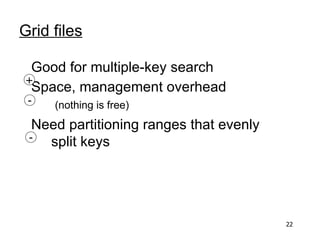
Grid files

 Good for multiple-key search
+
 Space, management overhead
 -   (nothing is free)
  Need partitioning ranges that evenly
 -  split keys


                                         22
Partitioned Hash Functions
Partitioned hash function

Idea:
         010110 1110010

Key1                         Key2
            h1     h2


                                    24
EX:
h1(toy)     =0        000
h1(sales)   =1        001
h1(art)     =1        010
  .                   011
  .
h2(10k)     =01       100
h2(20k)     =11       101
h2(30k)     =01       110
h2(40k)     =00       111
  .
  .

            Fred,toy,10k,Joe,sales,10k
 Insert     Sally,art,30k
                                             25
EX:
h1(toy)     =0        000
h1(sales)   =1        001       Fred
h1(art)     =1        010
  .                   011
  .
h2(10k)     =01       100
h2(20k)     =11       101    JoeSally
h2(30k)     =01       110
h2(40k)     =00       111
  .
  .

            Fred,toy,10k,Joe,sales,10k
 Insert     Sally,art,30k
                                             26
h1(toy)   =0          000      Fred
h1(sales) =1          001    JoeJan
h1(art)   =1          010      Mary
  .                   011
  .
h2(10k)   =01         100      Sally
h2(20k)   =11         101
h2(30k)   =01         110 TomBill
h2(40k)   =00         111      Andy
  .
  .
• Find Emp. with Dept. = Sales ∧ Sal=40k

                                           27
h1(toy)   =0          000      Fred
h1(sales) =1          001    JoeJan
h1(art)   =1          010      Mary
  .                   011
  .
h2(10k)   =01         100      Sally
h2(20k)   =11         101
h2(30k)   =01         110 TomBill
h2(40k)   =00         111      Andy
  .
  .
• Find Emp. with Dept. = Sales ∧ Sal=40k

                                           28
h1(toy)   =0          000     Fred
h1(sales) =1          001   JoeJan
h1(art)   =1          010     Mary
  .                   011
  .
h2(10k)   =01         100     Sally
h2(20k)   =11         101
h2(30k)   =01         110   TomBill
h2(40k)   =00         111     Andy
  .
  .
• Find Emp. with Sal=30k

                                          29
h1(toy)   =0          000     Fred
h1(sales) =1          001   JoeJan
h1(art)   =1          010     Mary
  .                   011
  .
h2(10k)   =01         100     Sally
h2(20k)   =11         101
h2(30k)   =01         110   TomBill
h2(40k)   =00         111     Andy
  .
  .
• Find Emp. with Sal=30k            look here

                                            30
h1(toy)   =0          000      Fred
h1(sales) =1          001    JoeJan
h1(art)   =1          010      Mary
  .                   011
  .
h2(10k)   =01         100      Sally
h2(20k)   =11         101
h2(30k)   =01         110 TomBill
h2(40k)   =00         111      Andy
  .
  .
• Find Emp. with Dept. = Sales

                                          31
h1(toy)   =0          000      Fred
h1(sales) =1          001    JoeJan
h1(art)   =1          010      Mary
  .                   011
  .
h2(10k)   =01         100      Sally
h2(20k)   =11         101
h2(30k)   =01         110 TomBill
h2(40k)   =00         111      Andy
  .
  .
• Find Emp. with Dept. = Sales    look here


                                              32
Tree-like Structures
•   Multiple-key indexes
•   Kd-trees
•   Quad trees
•   R-trees
Multiple-key indexes
• Several attributes representing
  dimensions of data points
• Multiple key index is an index of indexes in
  which the nodes at each level are indexes
  for one attribute.
Strategy:

• Multiple Key Index
One idea:
                       I2


               I1      I3


                            35
Example
            10k
            15k    Example
  Art       17k    Record
 Sales      21k
  Toy

Dept        12k      Name=Joe
Index       15k      DEPT=Sales
            15k      SAL=15k
            19k
          Salary
          Index

                              36
For which queries is this index good?


  Find RECs Dept = “Sales”   SAL=20k
  Find RECs Dept = “Sales”   SAL  20k
  Find RECs Dept = “Sales”
  Find RECs SAL = 20k


                                        37
KD-trees
• K dimensional tree is generalizing binary
  search tree into multi-dimensional data.
• A KD tree is a binary tree in which interior
  nodes have an associated attribute “a”
  and a value “v” that splits data into two
  parts.
• The attributes at different levels of a tree
  are different, and levels rotating among
  the attributes of all dimensions.
Interesting application:


 • Geographic Data
     y
                           DATA:
                           X1,Y1, Attributes
                 x         X2,Y2, Attributes


                             ...
                                            39
Queries:

• What city is at Xi,Yi?
• What is within 5 miles from Xi,Yi?
• Which is closest point to Xi,Yi?


                                         40
Example           i
                                      a
                          e   d
              h
                                  b
                  n       f
          l           o           c
          j               g
          k       m


                                      41
Example                     i
                                                  a
                                     e   d
                        h
                                              b
          10   20           n        f
                    l           o             c
                    j                g
                    k       m

                                10       20


                                                  42
Example                                                        a
                            40           i        e   d
                                     h
                            30                             b
          10      20                     n        f
                            20   l           o             c
                            10   j                g
    25    15 35        20                m
                                 k

                                             10       20


                                                               43
Example                                                                  a
                                      40           i        e   d
                                               h
                                      30                             b
                    10      20                     n        f
                                      20   l           o             c
                                      10   j                g
          25        15 35        20                m
                                           k

                                                       10       20
 5


     15        15


                                                                         44
Example                                                                         a
                                            40            i        e   d
                                                      h
                                            30                              b
                         10      20                       n        f
                                            20    l           o             c
                                            10    j                g
          25             15 35         20                 m
                                                  k

                                                              10       20
 5        h i        g    f      d e    c   a b


     15         15


j k       l      m        n o
                                                                                45
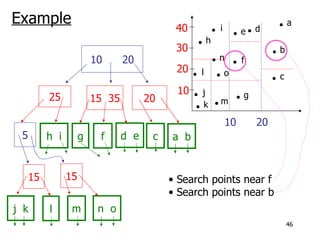
Example                                                                         a
                                             40           i        e   d
                                                      h
                                             30                             b
                         10      20                       n        f
                                             20   l           o             c
                                             10    j               g
          25             15 35         20                 m
                                                   k

                                                              10       20
 5        h i        g    f      d e    c   a b


     15         15                          • Search points near f
                                            • Search points near b
j k       l      m        n o
                                                                                46
Queries

•   Find points with Yi  20
•   Find points with Xi  5
•   Find points “close” to i = 12,38
•   Find points “close” to b = 7,24


                                         47
Quad trees
• Divides multidimensional space into
  quadrants and divides the quadrants
  same way if they have too many points.
• If the number of points in a square
  – fits in a block, it is a leaf node
  – no longer fits in a block, it becomes an interior
    node, four quadrants are its children.
Quad tree pictures
R-tree
• Captures the spirit of B-tree for multidimensional
  data.
• Represents a collection of regions by grouping
  them into a hierarchy of larger regions.
• Data is divided into regions.
• Interior node is corresponds to interior region
  – region can be of any shape
     • Rectangular is popular
  – Children corresponds to sub-regions.
R-tree
Bitmap indexes
• Assume that records have permanent numbers
• A bit-map index is a collection of bit vectors of length n,
  one for each value may appear in the field F.
• The vector for value v has 1 in position i if the i’th record
  has v in field F, and it has 0 there if not.
• Example for F and G fields:
   – (30, foo), (30,bar), (40, baz), (50, foo), (40, bar), (30, baz)
   – Bit index for F, each of 6 bits. For 30, it is 110001, for 40, it is
     001010, and for 50, it is 000100.
   – Bit index for G also have three vectors. For foo it is, 100100, for
     bar it is 010010, and for baz it is 001001.
Bit map indexes: Partial match
• Bit maps allow answering of partial match
  queries quickly and efficiently.
• Example:
   –   Movie(title, year, length, studioName)
   –   SELECT title
   –   FROM Movie
   –   WHERE studioName= ‘Disney’ and Year=1965;
• If we have bitmap for studioName and year, then
  intersection or AND operation will give the result.
• Bit vectors do not occupy much space.
Bitmap indexes: range queries
•   Example: consider the gold jewelry data of twelve points
    – 1 (25,60), 2(45,60), 3(50,75), 4(50,100), 5(50,120), 6(70, 110),
      7(85,140), 8(30,260), 9(25,400), 10(45,350), 11(50,275),
      12(60,260)
• Age has seven different values
    – 25(100000001000), 30(000000010000), 45(010000000100),
      50(001110000010), 60(000000000001), 70(000001000000)
    – 85(000000100000)
• Salary has 10 different values
    –   60(000000000000), 75(001000000000), 100(000100000000)
    –   110(000001000000), 120(000010000000), 140(000000100000)
    –   260(000000010001), 275(000000000010), 350(000000000100)
    –   400(000000001000),
Example continued
• Find the jewelry buyers with an age range 45-55 and
  salary in the range 100-200
• Find the bit vectors of for the age values in the range
  and take OR
   – 010000000100 (for 45) and 001110000010 (for 50)
   – Result: 011110000110
• Find the bit vectors of salaries between 100 and 200
  thousand.
   – There are four: 100,110,120, and 140, their bitwaise OR is
     000111100000
• Take AND of both bit vectors
   – 000110000000
   – Find two records (50,100) and (50,120) are in the range.
Compressed bitmaps
• If number of different values is large, then
  number of 1 is rare.
• Run-length coding is used
   – Sequence of 0’s followed by 1.
   – Example: 000101 is two runs, 3 and 1. the binary
     representation is 11 and 1. So it is decoded as 111.
• To save space, the bitmap indexes tend to
  consist of vectors with very few 1’s are
  compressed using run-length coding.
Finding bit vectors
• Use any index technique to find the
  values.
• From the values to bit vectors.
• B-tree is a good choice.

Multidimensional Indexing

  • 1.
  • 2.
    Outline • Applications • Hash-like structures • Tree-like structures • Bit-map indexes
  • 3.
    Search Key • Searchkey is (F1, F2, ..Fk) – Separated by special markers. – Example • If F1=abcd and F2=123, the search key is “abcd#123”
  • 4.
    Applications: GIS • GeographicInformation Systems – Objects are in two dimensional space – The objects may be points or shapes – Objects may be houses, roads, bridges, pipelines and many other physical objects. • Query types – Partial match queries • Specify the values for one or more dimensions and look for all points matching those values in those dimensions. – Range queries • Set of shapes within the range – Nearest neighbor queries • Closest point to a given point – Where-am-I queries • When you click a mouse, the system determines which of the displayed elements you were clicking.
  • 5.
    Data Cubes • Dataexists in high dimensional space • A chain store may record each sale made, including – The day and time – The store in which the sale was made – The item purchased – The color of the item – The size of the item • Attributes are seen as dimensions multidimensional space, data cube. • Typical query – Give a class of pink shirts for each store and each month of 1998.
  • 6.
    Multidimensional queries inSQL • Represent points as a relation Points(x,y) • Query – Find the nearest point to (10, 20) – Compute the distance between (10,20) to every other point.
  • 7.
    Rectangles • Rectangles(id, x11,y11, xur, yur) • If the query is – Find the rectangles enclosing the point (10,20) • SELECT id FROM Rectangles WHERE x11 <= 10.0 AND y11 <= 20.0 AND xur >=10.0 AND yur >=20.0;
  • 8.
    Data Cube • Facttable – Sales(day,store, item. color, size) • Query – Summarize the sale of pink shirts by day and store • SELECT day, store, COUNT(*) AS totalSales FROM Sales WHERE item=‘shirt’ AND color=‘pink’ GROUP BY day, store;
  • 9.
    Executing range queriesin Conventional Indexes • Motivation: Find records where DEPT = “Toy” AND SAL > 50k • Strategy 1: Use “Toy” index and check salary • Strategy II: Use “Toy” index and SAL index and intersect. – Complexity • Toy index: number of disk accesses = number of disk blocks • SAL index: number of disk accesses= number of records • So conventional indexes of little help.
  • 10.
    Executing nearest-neighbor queriesusing conventional indexes • There might be no point in the selected range – Repeat the search by increasing the range • The closest point within the range might not be the closest point overall. – There is one point closer from outside range.
  • 11.
    Other Limitations ofConventional Indexes • We can only keep the file sorted on only attribute. • If the query is on multiple dimensions – We will end-up having one disk access for each record • It becomes too expensive
  • 12.
    Overview of MultidimensionalIndex Structures • Hash-table-like approaches • Tree-like approaches • In both cases, we give-up some properties of single dimensional indexes • Hash – We have to access multiple buckets • Tree – Tree may not be balanced – There may not exist a correspondence between tree nodes and disk blocks – Information in the disk block is much smaller.
  • 13.
    Hash like structures:GRID Files • Each dimension, grid lines partition the space into stripes, – Points that fall on a grid line will be considered to belong to the stripe for which that grid line is lower boundary – The number of grid lines in each dimension may vary. – Space between grid lines in the same dimension may also vary
  • 14.
    Grid Index Key 2 X1 X2 …… Xn V1 V2 Key 1 Vn To records with key1=V3, key2=X2 14
  • 15.
    CLAIM • Can quicklyfind records with – key 1 = Vi ∧ Key 2 = Xj – key 1 = Vi – key 2 = Xj 15
  • 16.
    CLAIM • Can quicklyfind records with – key 1 = Vi ∧ Key 2 = Xj – key 1 = Vi – key 2 = Xj • And also ranges…. – E.g., key 1 ≥ Vi ∧ key 2 < Xj 16
  • 17.
    But there isa catch with Grid Indexes! • How is Grid Index stored on disk? V1 V2 V3 Like Array... X1 X2 X3 X4 X1 X2 X3 X4 X1 X2 X3 X4 17
  • 18.
    But there isa catch with Grid Indexes! • How is Grid Index stored on disk? V1 V2 V3 Like Array... X1 X2 X3 X4 X1 X2 X3 X4 X1 X2 X3 X4 Problem: • Need regularity so we can compute position of Vi,Xj entry 18
  • 19.
    Solution: Use Indirection X1 X2 X3 Buckets -- V1 -- -- V2 -- -- -- V3 *Grid only -- V4 -- -- contains pointers to buckets -- -- -- -- Buckets -- -- 19
  • 20.
    With indirection: • Gridcan be regular without wasting space • We do have price of indirection 20
  • 21.
    Can also indexgrid on value ranges Salary Grid 0-20K 1 20K-50K 2 50K- 3 8 1 2 3 Linear Scale Toy Sales Personnel 21
  • 22.
    Grid files Goodfor multiple-key search + Space, management overhead - (nothing is free) Need partitioning ranges that evenly - split keys 22
  • 23.
  • 24.
    Partitioned hash function Idea: 010110 1110010 Key1 Key2 h1 h2 24
  • 25.
    EX: h1(toy) =0 000 h1(sales) =1 001 h1(art) =1 010 . 011 . h2(10k) =01 100 h2(20k) =11 101 h2(30k) =01 110 h2(40k) =00 111 . . Fred,toy,10k,Joe,sales,10k Insert Sally,art,30k 25
  • 26.
    EX: h1(toy) =0 000 h1(sales) =1 001 Fred h1(art) =1 010 . 011 . h2(10k) =01 100 h2(20k) =11 101 JoeSally h2(30k) =01 110 h2(40k) =00 111 . . Fred,toy,10k,Joe,sales,10k Insert Sally,art,30k 26
  • 27.
    h1(toy) =0 000 Fred h1(sales) =1 001 JoeJan h1(art) =1 010 Mary . 011 . h2(10k) =01 100 Sally h2(20k) =11 101 h2(30k) =01 110 TomBill h2(40k) =00 111 Andy . . • Find Emp. with Dept. = Sales ∧ Sal=40k 27
  • 28.
    h1(toy) =0 000 Fred h1(sales) =1 001 JoeJan h1(art) =1 010 Mary . 011 . h2(10k) =01 100 Sally h2(20k) =11 101 h2(30k) =01 110 TomBill h2(40k) =00 111 Andy . . • Find Emp. with Dept. = Sales ∧ Sal=40k 28
  • 29.
    h1(toy) =0 000 Fred h1(sales) =1 001 JoeJan h1(art) =1 010 Mary . 011 . h2(10k) =01 100 Sally h2(20k) =11 101 h2(30k) =01 110 TomBill h2(40k) =00 111 Andy . . • Find Emp. with Sal=30k 29
  • 30.
    h1(toy) =0 000 Fred h1(sales) =1 001 JoeJan h1(art) =1 010 Mary . 011 . h2(10k) =01 100 Sally h2(20k) =11 101 h2(30k) =01 110 TomBill h2(40k) =00 111 Andy . . • Find Emp. with Sal=30k look here 30
  • 31.
    h1(toy) =0 000 Fred h1(sales) =1 001 JoeJan h1(art) =1 010 Mary . 011 . h2(10k) =01 100 Sally h2(20k) =11 101 h2(30k) =01 110 TomBill h2(40k) =00 111 Andy . . • Find Emp. with Dept. = Sales 31
  • 32.
    h1(toy) =0 000 Fred h1(sales) =1 001 JoeJan h1(art) =1 010 Mary . 011 . h2(10k) =01 100 Sally h2(20k) =11 101 h2(30k) =01 110 TomBill h2(40k) =00 111 Andy . . • Find Emp. with Dept. = Sales look here 32
  • 33.
    Tree-like Structures • Multiple-key indexes • Kd-trees • Quad trees • R-trees
  • 34.
    Multiple-key indexes • Severalattributes representing dimensions of data points • Multiple key index is an index of indexes in which the nodes at each level are indexes for one attribute.
  • 35.
    Strategy: • Multiple KeyIndex One idea: I2 I1 I3 35
  • 36.
    Example 10k 15k Example Art 17k Record Sales 21k Toy Dept 12k Name=Joe Index 15k DEPT=Sales 15k SAL=15k 19k Salary Index 36
  • 37.
    For which queriesis this index good? Find RECs Dept = “Sales” SAL=20k Find RECs Dept = “Sales” SAL 20k Find RECs Dept = “Sales” Find RECs SAL = 20k 37
  • 38.
    KD-trees • K dimensionaltree is generalizing binary search tree into multi-dimensional data. • A KD tree is a binary tree in which interior nodes have an associated attribute “a” and a value “v” that splits data into two parts. • The attributes at different levels of a tree are different, and levels rotating among the attributes of all dimensions.
  • 39.
    Interesting application: •Geographic Data y DATA: X1,Y1, Attributes x X2,Y2, Attributes ... 39
  • 40.
    Queries: • What cityis at Xi,Yi? • What is within 5 miles from Xi,Yi? • Which is closest point to Xi,Yi? 40
  • 41.
    Example i a e d h b n f l o c j g k m 41
  • 42.
    Example i a e d h b 10 20 n f l o c j g k m 10 20 42
  • 43.
    Example a 40 i e d h 30 b 10 20 n f 20 l o c 10 j g 25 15 35 20 m k 10 20 43
  • 44.
    Example a 40 i e d h 30 b 10 20 n f 20 l o c 10 j g 25 15 35 20 m k 10 20 5 15 15 44
  • 45.
    Example a 40 i e d h 30 b 10 20 n f 20 l o c 10 j g 25 15 35 20 m k 10 20 5 h i g f d e c a b 15 15 j k l m n o 45
  • 46.
    Example a 40 i e d h 30 b 10 20 n f 20 l o c 10 j g 25 15 35 20 m k 10 20 5 h i g f d e c a b 15 15 • Search points near f • Search points near b j k l m n o 46
  • 47.
    Queries • Find points with Yi 20 • Find points with Xi 5 • Find points “close” to i = 12,38 • Find points “close” to b = 7,24 47
  • 48.
    Quad trees • Dividesmultidimensional space into quadrants and divides the quadrants same way if they have too many points. • If the number of points in a square – fits in a block, it is a leaf node – no longer fits in a block, it becomes an interior node, four quadrants are its children.
  • 49.
  • 50.
    R-tree • Captures thespirit of B-tree for multidimensional data. • Represents a collection of regions by grouping them into a hierarchy of larger regions. • Data is divided into regions. • Interior node is corresponds to interior region – region can be of any shape • Rectangular is popular – Children corresponds to sub-regions.
  • 51.
  • 52.
    Bitmap indexes • Assumethat records have permanent numbers • A bit-map index is a collection of bit vectors of length n, one for each value may appear in the field F. • The vector for value v has 1 in position i if the i’th record has v in field F, and it has 0 there if not. • Example for F and G fields: – (30, foo), (30,bar), (40, baz), (50, foo), (40, bar), (30, baz) – Bit index for F, each of 6 bits. For 30, it is 110001, for 40, it is 001010, and for 50, it is 000100. – Bit index for G also have three vectors. For foo it is, 100100, for bar it is 010010, and for baz it is 001001.
  • 53.
    Bit map indexes:Partial match • Bit maps allow answering of partial match queries quickly and efficiently. • Example: – Movie(title, year, length, studioName) – SELECT title – FROM Movie – WHERE studioName= ‘Disney’ and Year=1965; • If we have bitmap for studioName and year, then intersection or AND operation will give the result. • Bit vectors do not occupy much space.
  • 54.
    Bitmap indexes: rangequeries • Example: consider the gold jewelry data of twelve points – 1 (25,60), 2(45,60), 3(50,75), 4(50,100), 5(50,120), 6(70, 110), 7(85,140), 8(30,260), 9(25,400), 10(45,350), 11(50,275), 12(60,260) • Age has seven different values – 25(100000001000), 30(000000010000), 45(010000000100), 50(001110000010), 60(000000000001), 70(000001000000) – 85(000000100000) • Salary has 10 different values – 60(000000000000), 75(001000000000), 100(000100000000) – 110(000001000000), 120(000010000000), 140(000000100000) – 260(000000010001), 275(000000000010), 350(000000000100) – 400(000000001000),
  • 55.
    Example continued • Findthe jewelry buyers with an age range 45-55 and salary in the range 100-200 • Find the bit vectors of for the age values in the range and take OR – 010000000100 (for 45) and 001110000010 (for 50) – Result: 011110000110 • Find the bit vectors of salaries between 100 and 200 thousand. – There are four: 100,110,120, and 140, their bitwaise OR is 000111100000 • Take AND of both bit vectors – 000110000000 – Find two records (50,100) and (50,120) are in the range.
  • 56.
    Compressed bitmaps • Ifnumber of different values is large, then number of 1 is rare. • Run-length coding is used – Sequence of 0’s followed by 1. – Example: 000101 is two runs, 3 and 1. the binary representation is 11 and 1. So it is decoded as 111. • To save space, the bitmap indexes tend to consist of vectors with very few 1’s are compressed using run-length coding.
  • 57.
    Finding bit vectors •Use any index technique to find the values. • From the values to bit vectors. • B-tree is a good choice.