Data Types
Ng Eu Jinn      1071112650
Tan Chin Tong   1081106274
Ng Cong Jie     1071117296
Mostafa Abedi   1091108989
Tan Joanne      1071115484
6.2 Primitive Data Types
 6.2.1 Numeric Types
   Integer
      Common integral data types
       Bit        Name          Decimal Digits
           8       byte               3
        16        short               5
        32     int and long          10

     Store negative integers
          Twos complement
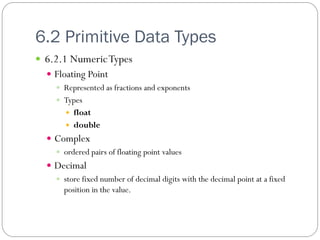
6.2 Primitive Data Types
 6.2.1 Numeric Types
   Floating Point
     Represented as fractions and exponents
     Types
        float
        double
   Complex
     ordered pairs of floating point values
   Decimal
     store fixed number of decimal digits with the decimal point at a fixed
      position in the value.
6.2 Primitive Data Types
 6.2.2 Boolean Types
   true or false
   represented by a single bit(can’t access efficiently)
   stored in the smallest efficiently addressable cell of memory
    (1 byte)
 6.2.3 Character Types
   stored as numeric codings (computer)
   ASCII > UCSS-2 >UCS-4
6.3 Character String Types
 String operations
   Assignment &Comparison
     complicated(string operands of different lengths)
   Catenation
   Substring reference(slices)
     reference to a substring of a given string
   Pattern matching
     supported directly in the language or provided library
6.3 Character String Types
 String Length Options
   Static length strings
   Limited dynamic length strings
     varying length up to a declared and fixed maximum set by the variable’s
      definition
     store any number of character between 0 and maximum
   Dynamic length strings
     varying length with no maximum
     overhead of dynamic storage allocation and deallocation (maximum
      flexibility)
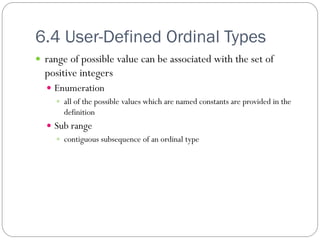
6.4 User-Defined Ordinal Types
 range of possible value can be associated with the set of
  positive integers
   Enumeration
     all of the possible values which are named constants are provided in the
      definition
   Sub range
     contiguous subsequence of an ordinal type
Array Types
 Homogeneous
 Reference – aggregate name & subscript


              e.g. arrayName [10]
 Element type & Subscript type
 Subscript range checking
 Subscript lower binding
Arrays and Indices
 Ada :
   e.g. name (10) : Array? Element?
   Ordinal Type subscript : e.g. day(Monday)


 Perl
   Sign @ for array : e.g. @list
   Sign $ for scalars : e.g.$list[1]
   Negative subscript
   +ve subscript     0     1      2     3    4
   Array’s Element   0     1      2     3    4
   -ve subscript     -5    -4    -3     -2   -1
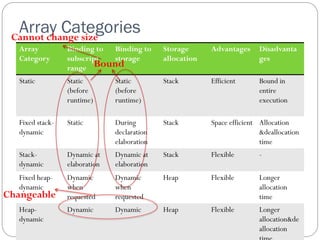
Array Categories
 Cannot change size
   Array          Binding to Binding to       Storage      Advantages     Disadvanta
   Category       subscript  storage          allocation                  ges
                  range   Bound
   Static         Static        Static        Stack        Efficient      Bound in
                  (before       (before                                   entire
                  runtime)      runtime)                                  execution

   Fixed stack-   Static        During        Stack        Space efficient Allocation
   dynamic                      declaration                                &deallocation
                                elaboration                                time
   Stack-         Dynamic at    Dynamic at    Stack        Flexible       -
   dynamic        elaboration   elaboration
   Fixed heap-    Dynamic       Dynamic       Heap         Flexible       Longer
   dynamic        when          when                                      allocation
Changeable        requested     requested                                 time
   Heap-          Dynamic       Dynamic       Heap         Flexible       Longer
   dynamic                                                                allocation&de
                                                                          allocation
Array Initialization
      Language       Example
      Fortran 95     Integer, Dimension(3) :: List = (/0, 5, 5/)
      C              int list [ ] = {4, 5, 6, 83};
      C, C++         char name [ ] = “freddie”;
                     char *name [ ] = (“Bob”, “Jake”, “Darcie”); //pointer
      Java           String[ ] names = [“Bob”, “Jake”, Darcie”];
      Ada            List : array (1..5) of Integer := (1, 3, 4, 7, 8);
                     Bunch : array (1..5) of Integer := (1 => 17, 3 => 34, others => 0);


List Comprehensions of Python
Syntax   : [expression     for iterate_var               in array                if condition ]
Example : [ x * x          for x                         in range (12)           if x % 3 == 0 ]

[0, 1, 2, 3, 4, 5, 6, 7, 8, 9, 10, 11, 12]
                                                               [0, 9, 36, 81, 144]
                        [0, 3, 6, 9, 12]
Array Operations
 C -> through Java, C++ and C#
 Perl -> Array assignments, comparisons
 Ada -> Array assignments, catenation, equality and inequality
  operators
 Python -> Array catenation, membership, comparisons
   Tuples : immutable and use parentheses
 Fortran 95 -> Elemental operations
 Array-Processing Language (APL)
Rectangular & Jagged Array
Rectangular Array   Jagged Array


Fortran, Ada, C#    C, C++, Java, C#
myArray [3, 7]      myArray [3] [7]
6.5.7 Slices

Python:                mat           0           1              2
                       0                 1               2           3
                       1                 4               5           6
                       2                 7               8           9

mat [1]                                                      -> [4, 5, 6]
mat [0] [0 : 2]                                              -> [1 ,2]

vector 0       1             2           3           4          5        6        7        8
0          2       4             6           8           10         12       14       16       17

vector [0 : 8 : 2]                                            -> [2 ,6, 10, 14]
6.5.9 Implementation of Array Types
 Array : 3 4 7                  Row Major Order                   Column Major Order
                                           3 4 7                                 34 7
            6 2 5                          6 2 5                                 6 2 5
            1 3 8                          1 3 8                                 1 3 8
                                   3, 4, 7, 6, 2, 5, 1, 3, 8           3, 6, 1, 4, 2, 3, 7, 5, 8

 location(a [i, j]) =                             a   1       2   3    4    5    6    7   8       9
adress of a[1, 1] + ((                             1
                                                   2
  ((# of rows above ith row)
                                                   3
  * (size of row)) +                               4
  (# of columns left jth column))                  5                              X
  * element size)                                  6

    location (a [5, 6]) = Adress of a[1, 1] + ( ( 4 x 9 + 5 ) x element size)
Associative Arrays
 An unordered collection of data elements that are indexed
  by an equal number of values called keys.
 Each element is a pair of entities (key , value)


    Key      Value
    Eujinn   70         =>      Dataset[“Eujinn”] = 70;
    Marry    99         =>      Dataset[“Marry”] = 99;
    Joanne   55         =>      Dataset[“Joanne”] = 55;
                        =>      Dataset[“Johnny”] = 41;
    Johnny   41
Associative Array : Structure
 Elements are stored and retrieved with hash functions


      Key                                 Hashed Key
      John              HASH              61409aa1fd47d4a
                      FUNCTION

                                                Hashed Key     Value
   Perl => Key must be string
                                                61409aa1f…     70
   PHP => Key either integer or string
                                                8a31409aa..    99
   Ruby => Key can be any object               af115391a..    55
   PHP => Both array and associative array     cc2d4fe946..   41
Associative Array : Operation
 Assignments
   $salaries{“Perry”} = 58850;        //In Perl
   salaries[“Perry”] = 58850;         //In C++
 Delete
   delete $salaries{“Gary”};          //In Perl
   salaries.erase(“Gary”);            //In C++
 Exists
   If(exists $salaries{“Shelly”}) …   //In Perl
   If( salaries.find(“Shelly”))       //In C++
Record Type
 Is used to group collection of data with different
  (heterogeneous) data-type.
 Eg: Struct in C, C++ and C#
  struct Employee
  {
       string name;
       int age;
       float salary;
  };
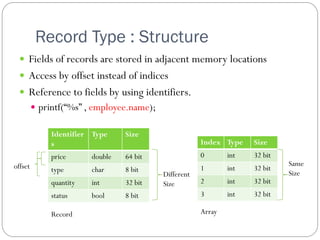
Record Type : Structure
   Fields of records are stored in adjacent memory locations
   Access by offset instead of indices
   Reference to fields by using identifiers.
          printf(“%s” , employee.name);

              Identifier Type     Size
              s                                        Index Type    Size
              price      double   64 bit               0       int   32 bit
offset                                                                        Same
              type       char     8 bit                1       int   32 bit
                                           Different                          Size
              quantity   int      32 bit   Size        2       int   32 bit
              status     bool     8 bit                3       int   32 bit

              Record                                   Array
Record Type: Operations
 Initialization
    Aggregate literals
    Employee e = {“John”, 28, 3000.0f};
 Assignments
 Comparison
 MOVE CORRESPONDING
   In COBOL, copies all the field from source record to the destination
    field record with the same name.
   MOVE CORRESPONDING INPUT-RECORD TO OUTPUT-
    RECORD
Union Type
 A type whose variable may store different type values at
  different times during program execution
 Specifying Union
   In C / C++ => union
   In Fortran => Equivalence
Union Type : Design Issue
 Type Checking one of the major design issue
 2 ways of implementations
   Free Union
     Programmers are allowed complete freedom from type checking in their
      use
     Use in C, C++, Fortran
   Discriminated Union
     Type indicator(tag) is used for type checking
     Use in ALGOL 68 , ADA
Union Type : Implementation
 Implemented by using the same address for every variant
 Storage is allocated to largest variant


                             11101000    00000011     00000000      00000000


                           C[0] => 232    C[1] = 3
                                                     a => 100010 (11111010002)
                                                     *32 bits is allocated because
                                                     int has larger size
Pointer Problems: Dangling Pointer
 Dangling pointer or Dangling reference
 occurs when a pointer stores the address of an already
  deallocated heap-dynamic variable.
 Explicit deallocation is the major reason causing this.
 Problem:
   Location can be reallocated to a new heap-dynamic variable.
   the location now could be temporarily used by storage
    management system.

               74569                   46314
               46314
Solution: Tombstone
 Tombstones:
   Every heap-dynamic variable includes an extra cell called
    tombstone
   The Tombstone is a pointer to the heap dynamic variable.
   When the heap-dynamic variable is deallocated, the tombstone
    is set to NULL.
 Disadvantages :
   Costly in memory and time.

   74569                  65742                    46314
   65742                  NULL
                          46314
   Pointer               Tombstone          Heap-dynamic Variable
Solution: Lock-and-Keys
 Pointers instead of only being an address, also have a key and are made
    into a pair. (key, address)
   Heap-dynamic variables also have a header containing a lock.
   When allocated, the keya and the lock are set the same. (key=lock)
   Access is granted only if the lock and key match. Otherwise it’s an error.
   In deallocating, the lock is cleared to an illegal lock value. When other
    pointers try to access it, the key doesn’t match the lock hence it is not
    allowed.

         Pointer
        12                               54
                                         12
       KEY   address                   LOCK Heap-dynamic variable
Lost Heap-Dynamic Variables
 An allocated heap-dynamic variable that is not accessible
  anymore.
 This happens regardless of deallocation happening implicitly
  or explicitly.
        int* p;
       p= new int;
       p= new int;

                  74569                  46314

             P     23171
                   46314

                                         23171
Reference Type
 A pointer refers to an address, a reference refers to an
  object.
 In C++, reference is a constant pointer. Since it is constant,
  should be initialized and cannot be changed later.
 A reference is always dereferenced implicitly.
      int a=1;
      int& b=a; //reference type
      // “a” and “b” are aliases.         46314

                                     a      1


                     74569

               b     46314
                     46314
Heap Management: Single-Sized
 All cells are linked together (linked-list).
 It make a list of available space.
 Allocating is taking a fixed number of cells.
 Deallocating is more complex.
   The reason: hard to know when a variable is no longer useful.


 Two methods:
   Reference counters ( eager approach )
   Mark-sweep ( lazy approach )
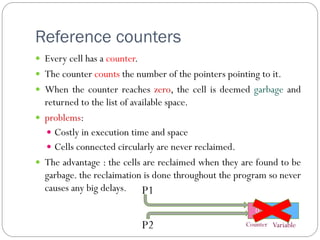
Reference counters
 Every cell has a counter.
 The counter counts the number of the pointers pointing to it.
 When the counter reaches zero, the cell is deemed garbage and
  returned to the list of available space.
 problems:
   Costly in execution time and space
   Cells connected circularly are never reclaimed.
 The advantage : the cells are reclaimed when they are found to be
  garbage. the reclaimation is done throughout the program so never
  causes any big delays. P1

                                                        0
                                                        2
                                                        1
                              P2                     Counter Variable
Mark-Sweep
 Allocates cell and disconnect them, without reclaiming. (lets the
  garbage to build up)
 After all the available space is allocated, mark-sweep process
  reclaims all the garbage floating around.
 The problem is that it isn’t frequent enough and costly in time.
 Mark-sweep 3 phases:
                                      1
   Set phase          0
                       1                           0
                                                   1
                                      G Variable
   Mark phase         G Variable                  G Variable
                                   1                           1
   Sweep phase 1                                 1
                                                  0            G Variable
                                        G   Variable
                     G   Variable                             G   Variable
                         0
                         1
                                                1                  0
                                                                   1
                         G   Variable
                                                G      Variable     G   Variable
Heap Management: Variable-sized
 Additional problems arise. In case of mark-sweep:
   Setting all the bits to indicate garbage is difficult. Scanning of all
    the different sized cells is a problem.
      Solution: each cell have a field to indicate its size.
   cells with no pointers. How can you follow a chain?
     Solution: adding internal pointers to every cell.
   maintaining a list of available space.
     Solution: sorting the list according to block size.
Type Checking
 Process to verify that the operands of an operator are
  compatible types.
 A compatible type is
   legal for the operator OR
   allowed under language rules to be automatically converted by
    the compiler-generated code to a legal type (also known as
    coercion).
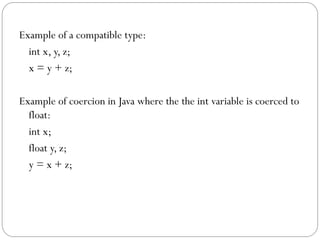
Example of a compatible type:
  int x, y, z;
  x = y + z;

Example of coercion in Java where the the int variable is coerced to
  float:
  int x;
  float y, z;
  y = x + z;
Type Error
 Happens when an operator is applied to an operand with
  inappropriate type.

Types of type checking:
 Static type checking
 Dynamic type checking
Static type checking
 occurs at compile-time
 allows type errors to be found early
 languages include Ada, C, C++, C#


Dynamic type checking
 occurs at run-time
 more flexibility
 languages include JavaScript, PHP, Lisp, Perl
Strong Typing
 A strongly typed programming language has severe
    restrictions that prevents the compilation of code with data
    that is used in an invalid way.
   Type errors are always detected.
   Requires that the types of all operands determined either
    at compile-time or run-time.
   Example:
    Integer addition operation may not be used on strings.
   Importance of strong typing
    - Detect all misuses of variables that result in type errors.
 The value of strong typing is however weakened by coercion as it
  results in the loss of error detection.
 Reliability of a language
  - Coercion↑ Reliability↓
  - Coercion↓ Reliability↑
Strong Typing in Different Languages
Fortran 95, C, C++
 Not strongly typed.
 The use of Equivalence in Fortran allows a variable of one type to
  refer to a value of a different type, without the system being able
  to check the type of the value when one of the Equivalenced
  variables is referenced or assigned.
 C and C++ both include union types which are not type
  checked.
Ada, Java, C#
 Nearly strongly typed.
 Ada allows programmers to breach type-checking rules which
  can only be done when Unchecked_Conversion is called.
Type Equivalence
 Strict form of type compatibility.
 No coercion.
 2 ways to define type equivalence
   Name type equivalence
   Structure type equivalence
Name Type Equivalence
 2 variables have equivalent types if they are defined in the same declaration or
    in declarations that use the same type name.
   Easy to implement.
   Compare only 2 type names.
   All types must have names.
   Restrictive.
   For example, a variable’s type with subrange of integers is not equivalent to an
    integer type variable.
   Sample code from Ada
    type Indextype is 1..100;
    count : Integer;
    index : Indextype;
    Count and Index are not equivalent.
Structure Type Equivalence
 2 variables have equivalent types if their types have identical
  structures.
 More flexible compared to name type equivalence.
 Difficult to implement.
 Entire structures of 2 types have to be compared.
Derived Type                     Subtype


 A new type based on             Type equivalent with parent
  previously defined type.         type.
 Has identical structure with
  parent type, but not
  equivalent.
 Inherits all properties of
  parent type.
Type Theory
 2 branches in computer science
   Practical
   Abstract
 Practical branch
   Concerned with data types in commercial programming
    languages.
 Abstract branch
   Concerned with typed lambda calculus, an area of extensive
    research by theoretical computer scientists.
Data Type
 Defines a set of values.
 Defines a collection of operations on those values.
 Elements are often ordered.
 Set operations can be used on data types to define new data
  types.
 Structured data types are defined by type operators or
  constructors
Thank You!
Q&A

Plc (1)

  • 1.
    Data Types Ng EuJinn 1071112650 Tan Chin Tong 1081106274 Ng Cong Jie 1071117296 Mostafa Abedi 1091108989 Tan Joanne 1071115484
  • 2.
    6.2 Primitive DataTypes  6.2.1 Numeric Types  Integer  Common integral data types Bit Name Decimal Digits 8 byte 3 16 short 5 32 int and long 10  Store negative integers  Twos complement
  • 3.
    6.2 Primitive DataTypes  6.2.1 Numeric Types  Floating Point  Represented as fractions and exponents  Types  float  double  Complex  ordered pairs of floating point values  Decimal  store fixed number of decimal digits with the decimal point at a fixed position in the value.
  • 4.
    6.2 Primitive DataTypes  6.2.2 Boolean Types  true or false  represented by a single bit(can’t access efficiently)  stored in the smallest efficiently addressable cell of memory (1 byte)  6.2.3 Character Types  stored as numeric codings (computer)  ASCII > UCSS-2 >UCS-4
  • 5.
    6.3 Character StringTypes  String operations  Assignment &Comparison  complicated(string operands of different lengths)  Catenation  Substring reference(slices)  reference to a substring of a given string  Pattern matching  supported directly in the language or provided library
  • 6.
    6.3 Character StringTypes  String Length Options  Static length strings  Limited dynamic length strings  varying length up to a declared and fixed maximum set by the variable’s definition  store any number of character between 0 and maximum  Dynamic length strings  varying length with no maximum  overhead of dynamic storage allocation and deallocation (maximum flexibility)
  • 7.
    6.4 User-Defined OrdinalTypes  range of possible value can be associated with the set of positive integers  Enumeration  all of the possible values which are named constants are provided in the definition  Sub range  contiguous subsequence of an ordinal type
  • 8.
    Array Types  Homogeneous Reference – aggregate name & subscript e.g. arrayName [10]  Element type & Subscript type  Subscript range checking  Subscript lower binding
  • 9.
    Arrays and Indices Ada :  e.g. name (10) : Array? Element?  Ordinal Type subscript : e.g. day(Monday)  Perl  Sign @ for array : e.g. @list  Sign $ for scalars : e.g.$list[1]  Negative subscript +ve subscript 0 1 2 3 4 Array’s Element 0 1 2 3 4 -ve subscript -5 -4 -3 -2 -1
  • 10.
    Array Categories Cannotchange size Array Binding to Binding to Storage Advantages Disadvanta Category subscript storage allocation ges range Bound Static Static Static Stack Efficient Bound in (before (before entire runtime) runtime) execution Fixed stack- Static During Stack Space efficient Allocation dynamic declaration &deallocation elaboration time Stack- Dynamic at Dynamic at Stack Flexible - dynamic elaboration elaboration Fixed heap- Dynamic Dynamic Heap Flexible Longer dynamic when when allocation Changeable requested requested time Heap- Dynamic Dynamic Heap Flexible Longer dynamic allocation&de allocation
  • 11.
    Array Initialization Language Example Fortran 95 Integer, Dimension(3) :: List = (/0, 5, 5/) C int list [ ] = {4, 5, 6, 83}; C, C++ char name [ ] = “freddie”; char *name [ ] = (“Bob”, “Jake”, “Darcie”); //pointer Java String[ ] names = [“Bob”, “Jake”, Darcie”]; Ada List : array (1..5) of Integer := (1, 3, 4, 7, 8); Bunch : array (1..5) of Integer := (1 => 17, 3 => 34, others => 0); List Comprehensions of Python Syntax : [expression for iterate_var in array if condition ] Example : [ x * x for x in range (12) if x % 3 == 0 ] [0, 1, 2, 3, 4, 5, 6, 7, 8, 9, 10, 11, 12] [0, 9, 36, 81, 144] [0, 3, 6, 9, 12]
  • 12.
    Array Operations  C-> through Java, C++ and C#  Perl -> Array assignments, comparisons  Ada -> Array assignments, catenation, equality and inequality operators  Python -> Array catenation, membership, comparisons  Tuples : immutable and use parentheses  Fortran 95 -> Elemental operations  Array-Processing Language (APL)
  • 13.
    Rectangular & JaggedArray Rectangular Array Jagged Array Fortran, Ada, C# C, C++, Java, C# myArray [3, 7] myArray [3] [7]
  • 14.
    6.5.7 Slices Python: mat 0 1 2 0 1 2 3 1 4 5 6 2 7 8 9 mat [1] -> [4, 5, 6] mat [0] [0 : 2] -> [1 ,2] vector 0 1 2 3 4 5 6 7 8 0 2 4 6 8 10 12 14 16 17 vector [0 : 8 : 2] -> [2 ,6, 10, 14]
  • 15.
    6.5.9 Implementation ofArray Types  Array : 3 4 7 Row Major Order Column Major Order 3 4 7 34 7 6 2 5 6 2 5 6 2 5 1 3 8 1 3 8 1 3 8 3, 4, 7, 6, 2, 5, 1, 3, 8 3, 6, 1, 4, 2, 3, 7, 5, 8  location(a [i, j]) = a 1 2 3 4 5 6 7 8 9 adress of a[1, 1] + (( 1 2 ((# of rows above ith row) 3 * (size of row)) + 4 (# of columns left jth column)) 5 X * element size) 6 location (a [5, 6]) = Adress of a[1, 1] + ( ( 4 x 9 + 5 ) x element size)
  • 16.
    Associative Arrays  Anunordered collection of data elements that are indexed by an equal number of values called keys.  Each element is a pair of entities (key , value) Key Value Eujinn 70 => Dataset[“Eujinn”] = 70; Marry 99 => Dataset[“Marry”] = 99; Joanne 55 => Dataset[“Joanne”] = 55; => Dataset[“Johnny”] = 41; Johnny 41
  • 17.
    Associative Array :Structure  Elements are stored and retrieved with hash functions Key Hashed Key John HASH 61409aa1fd47d4a FUNCTION Hashed Key Value  Perl => Key must be string 61409aa1f… 70  PHP => Key either integer or string 8a31409aa.. 99  Ruby => Key can be any object af115391a.. 55  PHP => Both array and associative array cc2d4fe946.. 41
  • 18.
    Associative Array :Operation  Assignments  $salaries{“Perry”} = 58850; //In Perl  salaries[“Perry”] = 58850; //In C++  Delete  delete $salaries{“Gary”}; //In Perl  salaries.erase(“Gary”); //In C++  Exists  If(exists $salaries{“Shelly”}) … //In Perl  If( salaries.find(“Shelly”)) //In C++
  • 19.
    Record Type  Isused to group collection of data with different (heterogeneous) data-type.  Eg: Struct in C, C++ and C# struct Employee { string name; int age; float salary; };
  • 20.
    Record Type :Structure  Fields of records are stored in adjacent memory locations  Access by offset instead of indices  Reference to fields by using identifiers.  printf(“%s” , employee.name); Identifier Type Size s Index Type Size price double 64 bit 0 int 32 bit offset Same type char 8 bit 1 int 32 bit Different Size quantity int 32 bit Size 2 int 32 bit status bool 8 bit 3 int 32 bit Record Array
  • 21.
    Record Type: Operations Initialization  Aggregate literals  Employee e = {“John”, 28, 3000.0f};  Assignments  Comparison  MOVE CORRESPONDING  In COBOL, copies all the field from source record to the destination field record with the same name.  MOVE CORRESPONDING INPUT-RECORD TO OUTPUT- RECORD
  • 22.
    Union Type  Atype whose variable may store different type values at different times during program execution  Specifying Union  In C / C++ => union  In Fortran => Equivalence
  • 23.
    Union Type :Design Issue  Type Checking one of the major design issue  2 ways of implementations  Free Union  Programmers are allowed complete freedom from type checking in their use  Use in C, C++, Fortran  Discriminated Union  Type indicator(tag) is used for type checking  Use in ALGOL 68 , ADA
  • 24.
    Union Type :Implementation  Implemented by using the same address for every variant  Storage is allocated to largest variant 11101000 00000011 00000000 00000000 C[0] => 232 C[1] = 3 a => 100010 (11111010002) *32 bits is allocated because int has larger size
  • 25.
    Pointer Problems: DanglingPointer  Dangling pointer or Dangling reference  occurs when a pointer stores the address of an already deallocated heap-dynamic variable.  Explicit deallocation is the major reason causing this.  Problem:  Location can be reallocated to a new heap-dynamic variable.  the location now could be temporarily used by storage management system. 74569 46314 46314
  • 26.
    Solution: Tombstone  Tombstones:  Every heap-dynamic variable includes an extra cell called tombstone  The Tombstone is a pointer to the heap dynamic variable.  When the heap-dynamic variable is deallocated, the tombstone is set to NULL.  Disadvantages :  Costly in memory and time. 74569 65742 46314 65742 NULL 46314 Pointer Tombstone Heap-dynamic Variable
  • 27.
    Solution: Lock-and-Keys  Pointersinstead of only being an address, also have a key and are made into a pair. (key, address)  Heap-dynamic variables also have a header containing a lock.  When allocated, the keya and the lock are set the same. (key=lock)  Access is granted only if the lock and key match. Otherwise it’s an error.  In deallocating, the lock is cleared to an illegal lock value. When other pointers try to access it, the key doesn’t match the lock hence it is not allowed. Pointer 12 54 12 KEY address LOCK Heap-dynamic variable
  • 28.
    Lost Heap-Dynamic Variables An allocated heap-dynamic variable that is not accessible anymore.  This happens regardless of deallocation happening implicitly or explicitly. int* p; p= new int; p= new int; 74569 46314 P 23171 46314 23171
  • 29.
    Reference Type  Apointer refers to an address, a reference refers to an object.  In C++, reference is a constant pointer. Since it is constant, should be initialized and cannot be changed later.  A reference is always dereferenced implicitly. int a=1; int& b=a; //reference type // “a” and “b” are aliases. 46314 a 1 74569 b 46314 46314
  • 30.
    Heap Management: Single-Sized All cells are linked together (linked-list).  It make a list of available space.  Allocating is taking a fixed number of cells.  Deallocating is more complex.  The reason: hard to know when a variable is no longer useful.  Two methods:  Reference counters ( eager approach )  Mark-sweep ( lazy approach )
  • 31.
    Reference counters  Everycell has a counter.  The counter counts the number of the pointers pointing to it.  When the counter reaches zero, the cell is deemed garbage and returned to the list of available space.  problems:  Costly in execution time and space  Cells connected circularly are never reclaimed.  The advantage : the cells are reclaimed when they are found to be garbage. the reclaimation is done throughout the program so never causes any big delays. P1 0 2 1 P2 Counter Variable
  • 32.
    Mark-Sweep  Allocates celland disconnect them, without reclaiming. (lets the garbage to build up)  After all the available space is allocated, mark-sweep process reclaims all the garbage floating around.  The problem is that it isn’t frequent enough and costly in time.  Mark-sweep 3 phases: 1  Set phase 0 1 0 1 G Variable  Mark phase G Variable G Variable 1 1  Sweep phase 1 1 0 G Variable G Variable G Variable G Variable 0 1 1 0 1 G Variable G Variable G Variable
  • 33.
    Heap Management: Variable-sized Additional problems arise. In case of mark-sweep:  Setting all the bits to indicate garbage is difficult. Scanning of all the different sized cells is a problem.  Solution: each cell have a field to indicate its size.  cells with no pointers. How can you follow a chain?  Solution: adding internal pointers to every cell.  maintaining a list of available space.  Solution: sorting the list according to block size.
  • 34.
    Type Checking  Processto verify that the operands of an operator are compatible types.  A compatible type is  legal for the operator OR  allowed under language rules to be automatically converted by the compiler-generated code to a legal type (also known as coercion).
  • 35.
    Example of acompatible type: int x, y, z; x = y + z; Example of coercion in Java where the the int variable is coerced to float: int x; float y, z; y = x + z;
  • 36.
    Type Error  Happenswhen an operator is applied to an operand with inappropriate type. Types of type checking:  Static type checking  Dynamic type checking
  • 37.
    Static type checking occurs at compile-time  allows type errors to be found early  languages include Ada, C, C++, C# Dynamic type checking  occurs at run-time  more flexibility  languages include JavaScript, PHP, Lisp, Perl
  • 38.
    Strong Typing  Astrongly typed programming language has severe restrictions that prevents the compilation of code with data that is used in an invalid way.  Type errors are always detected.  Requires that the types of all operands determined either at compile-time or run-time.  Example: Integer addition operation may not be used on strings.  Importance of strong typing - Detect all misuses of variables that result in type errors.
  • 39.
     The valueof strong typing is however weakened by coercion as it results in the loss of error detection.  Reliability of a language - Coercion↑ Reliability↓ - Coercion↓ Reliability↑
  • 40.
    Strong Typing inDifferent Languages Fortran 95, C, C++  Not strongly typed.  The use of Equivalence in Fortran allows a variable of one type to refer to a value of a different type, without the system being able to check the type of the value when one of the Equivalenced variables is referenced or assigned.  C and C++ both include union types which are not type checked.
  • 41.
    Ada, Java, C# Nearly strongly typed.  Ada allows programmers to breach type-checking rules which can only be done when Unchecked_Conversion is called.
  • 42.
    Type Equivalence  Strictform of type compatibility.  No coercion.  2 ways to define type equivalence  Name type equivalence  Structure type equivalence
  • 43.
    Name Type Equivalence 2 variables have equivalent types if they are defined in the same declaration or in declarations that use the same type name.  Easy to implement.  Compare only 2 type names.  All types must have names.  Restrictive.  For example, a variable’s type with subrange of integers is not equivalent to an integer type variable.  Sample code from Ada type Indextype is 1..100; count : Integer; index : Indextype; Count and Index are not equivalent.
  • 44.
    Structure Type Equivalence 2 variables have equivalent types if their types have identical structures.  More flexible compared to name type equivalence.  Difficult to implement.  Entire structures of 2 types have to be compared.
  • 45.
    Derived Type Subtype  A new type based on  Type equivalent with parent previously defined type. type.  Has identical structure with parent type, but not equivalent.  Inherits all properties of parent type.
  • 46.
    Type Theory  2branches in computer science  Practical  Abstract  Practical branch  Concerned with data types in commercial programming languages.  Abstract branch  Concerned with typed lambda calculus, an area of extensive research by theoretical computer scientists.
  • 47.
    Data Type  Definesa set of values.  Defines a collection of operations on those values.  Elements are often ordered.  Set operations can be used on data types to define new data types.  Structured data types are defined by type operators or constructors
  • 48.
  • 49.