N-grams and Smoothing


    CSC 371: Spring 2012
Last lecture
• Uncertainty
   – How to represent uncertainty
• Probability and its axioms
   – As degree of agent’s belief
• Joint distribution
   – P(A,B,C,D … Z)
• Bayes rule
   – P(X,Y) = P(X|Y) P(Y) = P(Y/X) P(X)
• Independence
   – 2 random variables A and B are independent iff
          P(a, b) = P(a) P(b) for all values a, b

• Conditional independence
   – 2 random variables A and B are conditionally independent given C iff
          P(a, b | c) = P(a | c) P(b | c) for all values a, b, c
Today’s Lecture
• Use probability axioms to model word prediction
• N-grams
• Smoothing

• Reading:
  – Sections 4.1, 4.2, 4.3, 4.5.1 in Speech and Language
    Processing [Jurafsky & Martin]
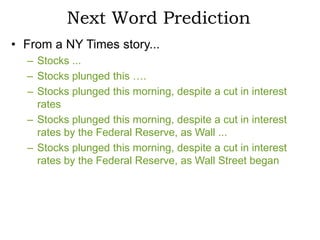
Next Word Prediction
• From a NY Times story...
  – Stocks ...
  – Stocks plunged this ….
  – Stocks plunged this morning, despite a cut in interest
    rates
  – Stocks plunged this morning, despite a cut in interest
    rates by the Federal Reserve, as Wall ...
  – Stocks plunged this morning, despite a cut in interest
    rates by the Federal Reserve, as Wall Street began
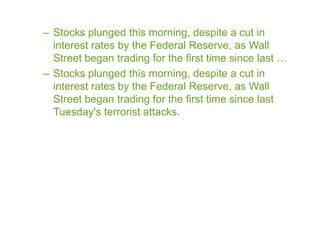
– Stocks plunged this morning, despite a cut in
  interest rates by the Federal Reserve, as Wall
  Street began trading for the first time since last …
– Stocks plunged this morning, despite a cut in
  interest rates by the Federal Reserve, as Wall
  Street began trading for the first time since last
  Tuesday's terrorist attacks.
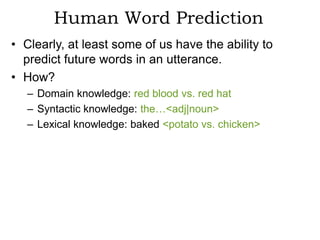
Human Word Prediction
• Clearly, at least some of us have the ability to
  predict future words in an utterance.
• How?
   – Domain knowledge: red blood vs. red hat
   – Syntactic knowledge: the…<adj|noun>
   – Lexical knowledge: baked <potato vs. chicken>
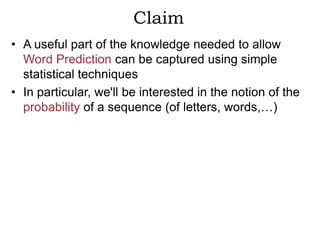
Claim
• A useful part of the knowledge needed to allow
  Word Prediction can be captured using simple
  statistical techniques
• In particular, we'll be interested in the notion of the
  probability of a sequence (of letters, words,…)
Useful Applications
• Why do we want to predict a word, given some
  preceding words?
  – Rank the likelihood of sequences containing various
    alternative hypotheses, e.g. for ASR
  Theatre owners say popcorn/unicorn sales have doubled...
  – Assess the likelihood/goodness of a sentence, e.g. for
    text generation or machine translation
Applications of word prediction
• Spelling checkers
   – They are leaving in about fifteen minuets to go to her house
   – The study was conducted mainly be John Black.
   – I need to notified the bank of this problem.

• Mobile phone texting
   – He is trying to fine out.
   – Hopefully, all with continue smoothly in my absence.

• Speech recognition
   – Theatre owners say popcorn/unicorn sales have doubled...

• Handwriting recognition
• Disabled users
• Machine Translation
 September 2003                                                     9
N-Gram Models of Language
• Use the previous N-1 words in a sequence to
  predict the next word
• Language Model (LM)
  – unigrams, bigrams, trigrams,…
• How do we train these models?
  – Very large corpora
Corpora
• Corpora are online collections of text and speech
  – Brown Corpus
  – Wall Street Journal
  – AP newswire
  – Hansards
  – Timit
  – DARPA/NIST text/speech corpora (Call Home, Call
    Friend, ATIS, Switchboard, Broadcast News, Broadcast
    Conversation, TDT, Communicator)
  – TRAINS, Boston Radio News Corpus
Terminology

• Sentence: unit of written language
• Utterance: unit of spoken language
• Word Form: the inflected form as it actually
  appears in the corpus
• Lemma: an abstract form, shared by word forms
  having the same stem, part of speech, word
  sense – stands for the class of words with same
  stem
   – chairs [chair] , reflected [reflect], ate [eat],
• Types: number of distinct words in a corpus
  (vocabulary size)
• Tokens: total number of words
Simple N-Grams
• Assume a language has T word types in its lexicon,
  how likely is word x to follow word y?
  – Simplest model of word probability: 1/T
  – Alternative 1: estimate likelihood of x occurring in new text
    based on its general frequency of occurrence estimated
    from a corpus (unigram probability)
     popcorn is more likely to occur than unicorn
  – Alternative 2: condition the likelihood of x occurring in the
    context of previous words (bigrams, trigrams,…)
     mythical unicorn is more likely than mythical popcorn
Computing the Probability of a
        Word Sequence
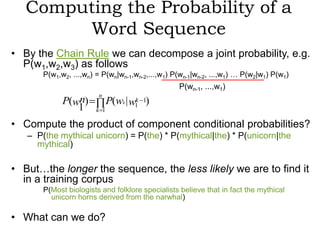
• By the Chain Rule we can decompose a joint probability, e.g.
  P(w1,w2,w3) as follows
       P(w1,w2, ...,wn) = P(wn|wn-1,wn-2,...,w1) P(wn-1|wn-2, ...,w1) … P(w2|w1) P(w1)
                                                  P(wn-1, ...,w1)
                        n
             P(wn)            P(wk | w1 1)
                                      k
                1       k 1

• Compute the product of component conditional probabilities?
   – P(the mythical unicorn) = P(the) * P(mythical|the) * P(unicorn|the
     mythical)

• But…the longer the sequence, the less likely we are to find it
  in a training corpus
       P(Most biologists and folklore specialists believe that in fact the mythical
         unicorn horns derived from the narwhal)

• What can we do?
Bigram Model
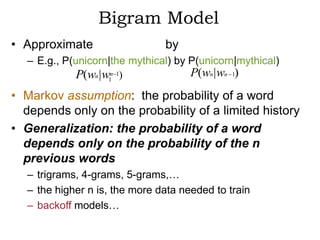
• Approximate                  by
  – E.g., P(unicorn|the mythical) by P(unicorn|mythical)
             P(wn |w1n 1)            P(wn | wn 1)
• Markov assumption: the probability of a word
  depends only on the probability of a limited history
• Generalization: the probability of a word
  depends only on the probability of the n
  previous words
  – trigrams, 4-grams, 5-grams,…
  – the higher n is, the more data needed to train
  – backoff models…
Using N-Grams

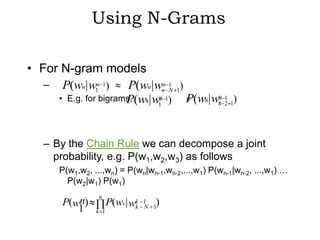
• For N-gram models
   – P(wn | w1n 1)     P(wn |wn 1 1)
                                 n
                                   N
     • E.g. for bigrams, (w8| w8 1)
                      P              P(w8| w88 2 1)
                                               1
                               1


   – By the Chain Rule we can decompose a joint
     probability, e.g. P(w1,w2,w3) as follows
       P(w1,w2, ...,wn) = P(wn|wn-1,wn-2,...,w1) P(wn-1|wn-2, ...,w1) …
         P(w2|w1) P(w1)
                  n
        P(wn)          P(wk | wk   1 )
           1     k 1
                               k   N 1
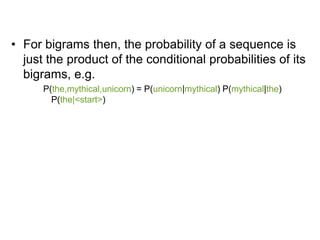
• For bigrams then, the probability of a sequence is
  just the product of the conditional probabilities of its
  bigrams, e.g.
      P(the,mythical,unicorn) = P(unicorn|mythical) P(mythical|the)
        P(the|<start>)
Training and Testing
• N-Gram probabilities come from a training corpus
  – overly narrow corpus: probabilities don't generalize
  – overly general corpus: probabilities don't reflect task or
    domain
• A separate test corpus is used to evaluate the
  model
  – held out test set; development (dev) test set
  – Simple baseline
  – results tested for statistical significance – how do they
    differ from a baseline? Other results?
A Simple Bigram Example
• Estimate the likelihood of the sentence I want to eat
  Chinese food.
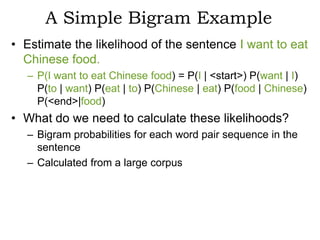
  – P(I want to eat Chinese food) = P(I | <start>) P(want | I)
    P(to | want) P(eat | to) P(Chinese | eat) P(food | Chinese)
    P(<end>|food)
• What do we need to calculate these likelihoods?
  – Bigram probabilities for each word pair sequence in the
    sentence
  – Calculated from a large corpus
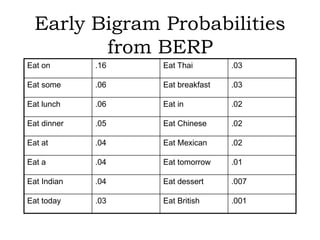
Early Bigram Probabilities
         from BERP
Eat on       .16   Eat Thai        .03

Eat some     .06   Eat breakfast   .03

Eat lunch    .06   Eat in          .02

Eat dinner   .05   Eat Chinese     .02

Eat at       .04   Eat Mexican     .02

Eat a        .04   Eat tomorrow    .01

Eat Indian   .04   Eat dessert     .007

Eat today    .03   Eat British     .001
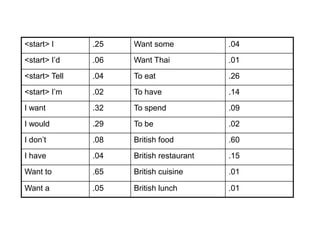
<start> I      .25   Want some            .04
<start> I’d    .06   Want Thai            .01
<start> Tell   .04   To eat               .26
<start> I’m    .02   To have              .14
I want         .32   To spend             .09
I would        .29   To be                .02
I don’t        .08   British food         .60
I have         .04   British restaurant   .15
Want to        .65   British cuisine      .01

Want a         .05   British lunch        .01
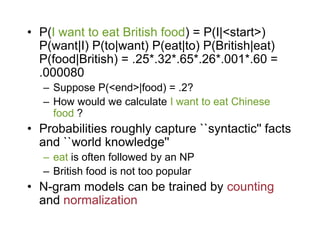
• P(I want to eat British food) = P(I|<start>)
  P(want|I) P(to|want) P(eat|to) P(British|eat)
  P(food|British) = .25*.32*.65*.26*.001*.60 =
  .000080
   – Suppose P(<end>|food) = .2?
   – How would we calculate I want to eat Chinese
     food ?
• Probabilities roughly capture ``syntactic'' facts
  and ``world knowledge''
   – eat is often followed by an NP
   – British food is not too popular
• N-gram models can be trained by counting
  and normalization
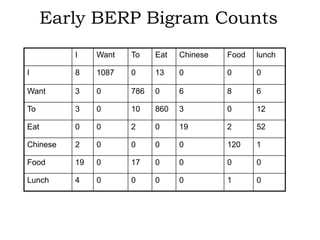
Early BERP Bigram Counts
          I    Want   To    Eat   Chinese   Food   lunch

I         8    1087   0     13    0         0      0

Want      3    0      786   0     6         8      6

To        3    0      10    860   3         0      12

Eat       0    0      2     0     19        2      52

Chinese   2    0      0     0     0         120    1

Food      19   0      17    0     0         0      0

Lunch     4    0      0     0     0         1      0
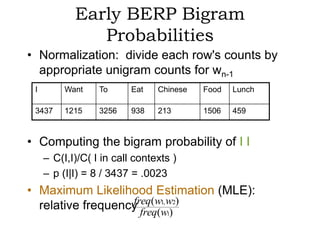
Early BERP Bigram
               Probabilities
• Normalization: divide each row's counts by
  appropriate unigram counts for wn-1
 I        Want    To      Eat   Chinese   Food   Lunch

 3437     1215    3256    938   213       1506   459


• Computing the bigram probability of I I
     – C(I,I)/C( I in call contexts )
     – p (I|I) = 8 / 3437 = .0023
• Maximum Likelihood Estimation (MLE):
  relative frequency freqwww2)
                   freq( 1,
                         ( 1)
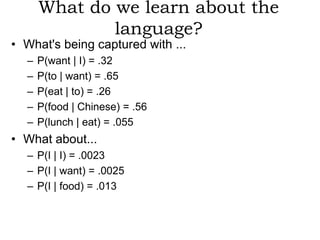
What do we learn about the
              language?
• What's being captured with ...
  –   P(want | I) = .32
  –   P(to | want) = .65
  –   P(eat | to) = .26
  –   P(food | Chinese) = .56
  –   P(lunch | eat) = .055
• What about...
  – P(I | I) = .0023
  – P(I | want) = .0025
  – P(I | food) = .013
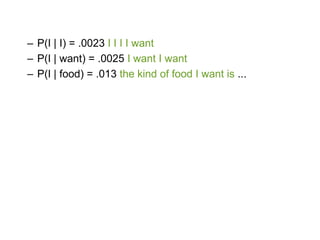
– P(I | I) = .0023 I I I I want
– P(I | want) = .0025 I want I want
– P(I | food) = .013 the kind of food I want is ...
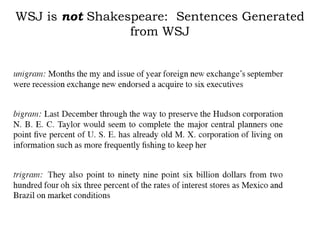
Approximating Shakespeare

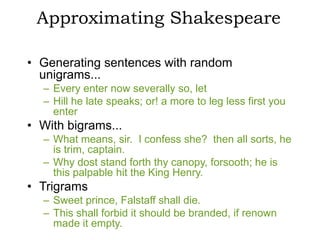
• Generating sentences with random
  unigrams...
  – Every enter now severally so, let
  – Hill he late speaks; or! a more to leg less first you
    enter
• With bigrams...
  – What means, sir. I confess she? then all sorts, he
    is trim, captain.
  – Why dost stand forth thy canopy, forsooth; he is
    this palpable hit the King Henry.
• Trigrams
  – Sweet prince, Falstaff shall die.
  – This shall forbid it should be branded, if renown
    made it empty.
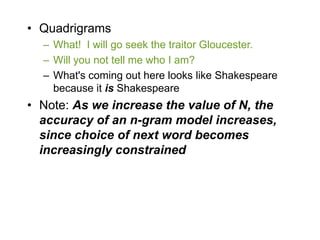
• Quadrigrams
  – What! I will go seek the traitor Gloucester.
  – Will you not tell me who I am?
  – What's coming out here looks like Shakespeare
    because it is Shakespeare
• Note: As we increase the value of N, the
  accuracy of an n-gram model increases,
  since choice of next word becomes
  increasingly constrained
N-Gram Training Sensitivity
• If we repeated the Shakespeare experiment but
  trained our n-grams on a Wall Street Journal
  corpus, what would we get?
• Note: This question has major implications for
  corpus selection or design
WSJ is not Shakespeare: Sentences Generated
                 from WSJ
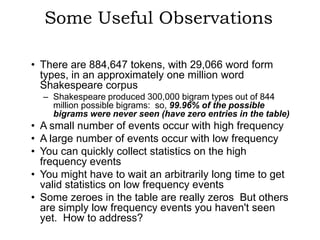
Some Useful Observations

• There are 884,647 tokens, with 29,066 word form
  types, in an approximately one million word
  Shakespeare corpus
  – Shakespeare produced 300,000 bigram types out of 844
    million possible bigrams: so, 99.96% of the possible
    bigrams were never seen (have zero entries in the table)
• A small number of events occur with high frequency
• A large number of events occur with low frequency
• You can quickly collect statistics on the high
  frequency events
• You might have to wait an arbitrarily long time to get
  valid statistics on low frequency events
• Some zeroes in the table are really zeros But others
  are simply low frequency events you haven't seen
  yet. How to address?
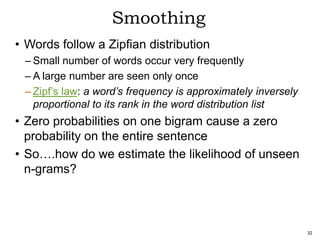
Smoothing
• Words follow a Zipfian distribution
 – Small number of words occur very frequently
 – A large number are seen only once
 – Zipf’s law: a word’s frequency is approximately inversely
   proportional to its rank in the word distribution list
• Zero probabilities on one bigram cause a zero
  probability on the entire sentence
• So….how do we estimate the likelihood of unseen
  n-grams?


                                                               32
Slide from Dan Klein
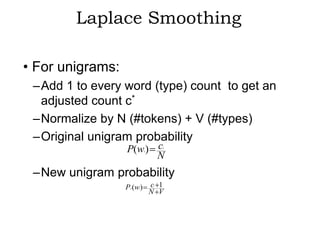
Laplace Smoothing

• For unigrams:
 –Add 1 to every word (type) count to get an
  adjusted count c*
 –Normalize by N (#tokens) + V (#types)
 –Original unigram probability
                  P(w ) c   i
                                     i


                        N
 –New unigram probability
                  P (w )
                   LP   i
                                c 1
                                 i


                                N V
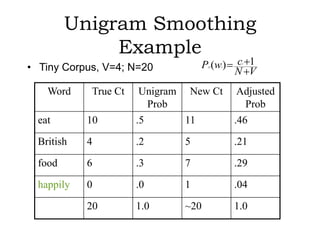
Unigram Smoothing
              Example
                                  P (w )     c 1
• Tiny Corpus, V=4; N=20
                                              i
                                    LP   i

                                             N V
    Word    True Ct    Unigram New Ct         Adjusted
                         Prob                   Prob
  eat       10        .5       11            .46

  British   4         .2      5              .21

  food      6         .3      7              .29

  happily   0         .0      1              .04

            20        1.0     ~20            1.0
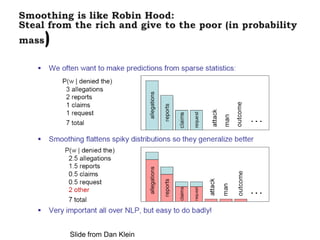
• So, we lower some (larger) observed
  counts in order to include
  unobserved vocabulary
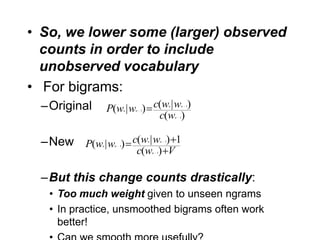
• For bigrams:
 –Original       P(w | w ) c(w | w )
                          n   n   1
                                                          n       n   1


                            c(w )                             n   1


 –New P(w | w ) c(w | w ) 1
             n    n   1
                                      n           n   1


                              c(w ) V     n   1


 –But this change counts drastically:
   • Too much weight given to unseen ngrams
   • In practice, unsmoothed bigrams often work
     better!
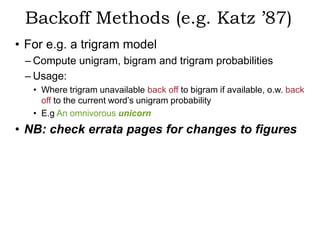
Backoff Methods (e.g. Katz ’87)
• For e.g. a trigram model
 – Compute unigram, bigram and trigram probabilities
 – Usage:
   • Where trigram unavailable back off to bigram if available, o.w. back
     off to the current word’s unigram probability
   • E.g An omnivorous unicorn
• NB: check errata pages for changes to figures
Smoothing Summed Up

• Add-one smoothing (easy, but inaccurate)
 – Add 1 to every word count (Note: this is type)
 – Increment normalization factor by Vocabulary size: N (tokens)
   + V (types)
• Backoff models
 – When a count for an n-gram is 0, back off to the count for the
   (n-1)-gram
 – These can be weighted – trigrams count more
Summary
• N-gram probabilities can be used to estimate the
  likelihood
  – Of a word occurring in a context (N-1)
  – Of a sentence occurring at all
• Smoothing techniques and backoff models deal with
  problems of unseen words in corpus

Ngrams smoothing

  • 1.
    N-grams and Smoothing CSC 371: Spring 2012
  • 2.
    Last lecture • Uncertainty – How to represent uncertainty • Probability and its axioms – As degree of agent’s belief • Joint distribution – P(A,B,C,D … Z) • Bayes rule – P(X,Y) = P(X|Y) P(Y) = P(Y/X) P(X) • Independence – 2 random variables A and B are independent iff P(a, b) = P(a) P(b) for all values a, b • Conditional independence – 2 random variables A and B are conditionally independent given C iff P(a, b | c) = P(a | c) P(b | c) for all values a, b, c
  • 3.
    Today’s Lecture • Useprobability axioms to model word prediction • N-grams • Smoothing • Reading: – Sections 4.1, 4.2, 4.3, 4.5.1 in Speech and Language Processing [Jurafsky & Martin]
  • 4.
    Next Word Prediction •From a NY Times story... – Stocks ... – Stocks plunged this …. – Stocks plunged this morning, despite a cut in interest rates – Stocks plunged this morning, despite a cut in interest rates by the Federal Reserve, as Wall ... – Stocks plunged this morning, despite a cut in interest rates by the Federal Reserve, as Wall Street began
  • 5.
    – Stocks plungedthis morning, despite a cut in interest rates by the Federal Reserve, as Wall Street began trading for the first time since last … – Stocks plunged this morning, despite a cut in interest rates by the Federal Reserve, as Wall Street began trading for the first time since last Tuesday's terrorist attacks.
  • 6.
    Human Word Prediction •Clearly, at least some of us have the ability to predict future words in an utterance. • How? – Domain knowledge: red blood vs. red hat – Syntactic knowledge: the…<adj|noun> – Lexical knowledge: baked <potato vs. chicken>
  • 7.
    Claim • A usefulpart of the knowledge needed to allow Word Prediction can be captured using simple statistical techniques • In particular, we'll be interested in the notion of the probability of a sequence (of letters, words,…)
  • 8.
    Useful Applications • Whydo we want to predict a word, given some preceding words? – Rank the likelihood of sequences containing various alternative hypotheses, e.g. for ASR Theatre owners say popcorn/unicorn sales have doubled... – Assess the likelihood/goodness of a sentence, e.g. for text generation or machine translation
  • 9.
    Applications of wordprediction • Spelling checkers – They are leaving in about fifteen minuets to go to her house – The study was conducted mainly be John Black. – I need to notified the bank of this problem. • Mobile phone texting – He is trying to fine out. – Hopefully, all with continue smoothly in my absence. • Speech recognition – Theatre owners say popcorn/unicorn sales have doubled... • Handwriting recognition • Disabled users • Machine Translation September 2003 9
  • 10.
    N-Gram Models ofLanguage • Use the previous N-1 words in a sequence to predict the next word • Language Model (LM) – unigrams, bigrams, trigrams,… • How do we train these models? – Very large corpora
  • 11.
    Corpora • Corpora areonline collections of text and speech – Brown Corpus – Wall Street Journal – AP newswire – Hansards – Timit – DARPA/NIST text/speech corpora (Call Home, Call Friend, ATIS, Switchboard, Broadcast News, Broadcast Conversation, TDT, Communicator) – TRAINS, Boston Radio News Corpus
  • 12.
    Terminology • Sentence: unitof written language • Utterance: unit of spoken language • Word Form: the inflected form as it actually appears in the corpus • Lemma: an abstract form, shared by word forms having the same stem, part of speech, word sense – stands for the class of words with same stem – chairs [chair] , reflected [reflect], ate [eat], • Types: number of distinct words in a corpus (vocabulary size) • Tokens: total number of words
  • 13.
    Simple N-Grams • Assumea language has T word types in its lexicon, how likely is word x to follow word y? – Simplest model of word probability: 1/T – Alternative 1: estimate likelihood of x occurring in new text based on its general frequency of occurrence estimated from a corpus (unigram probability) popcorn is more likely to occur than unicorn – Alternative 2: condition the likelihood of x occurring in the context of previous words (bigrams, trigrams,…) mythical unicorn is more likely than mythical popcorn
  • 14.
    Computing the Probabilityof a Word Sequence • By the Chain Rule we can decompose a joint probability, e.g. P(w1,w2,w3) as follows P(w1,w2, ...,wn) = P(wn|wn-1,wn-2,...,w1) P(wn-1|wn-2, ...,w1) … P(w2|w1) P(w1) P(wn-1, ...,w1) n P(wn) P(wk | w1 1) k 1 k 1 • Compute the product of component conditional probabilities? – P(the mythical unicorn) = P(the) * P(mythical|the) * P(unicorn|the mythical) • But…the longer the sequence, the less likely we are to find it in a training corpus P(Most biologists and folklore specialists believe that in fact the mythical unicorn horns derived from the narwhal) • What can we do?
  • 15.
    Bigram Model • Approximate by – E.g., P(unicorn|the mythical) by P(unicorn|mythical) P(wn |w1n 1) P(wn | wn 1) • Markov assumption: the probability of a word depends only on the probability of a limited history • Generalization: the probability of a word depends only on the probability of the n previous words – trigrams, 4-grams, 5-grams,… – the higher n is, the more data needed to train – backoff models…
  • 16.
    Using N-Grams • ForN-gram models – P(wn | w1n 1) P(wn |wn 1 1) n N • E.g. for bigrams, (w8| w8 1) P P(w8| w88 2 1) 1 1 – By the Chain Rule we can decompose a joint probability, e.g. P(w1,w2,w3) as follows P(w1,w2, ...,wn) = P(wn|wn-1,wn-2,...,w1) P(wn-1|wn-2, ...,w1) … P(w2|w1) P(w1) n P(wn) P(wk | wk 1 ) 1 k 1 k N 1
  • 17.
    • For bigramsthen, the probability of a sequence is just the product of the conditional probabilities of its bigrams, e.g. P(the,mythical,unicorn) = P(unicorn|mythical) P(mythical|the) P(the|<start>)
  • 18.
    Training and Testing •N-Gram probabilities come from a training corpus – overly narrow corpus: probabilities don't generalize – overly general corpus: probabilities don't reflect task or domain • A separate test corpus is used to evaluate the model – held out test set; development (dev) test set – Simple baseline – results tested for statistical significance – how do they differ from a baseline? Other results?
  • 19.
    A Simple BigramExample • Estimate the likelihood of the sentence I want to eat Chinese food. – P(I want to eat Chinese food) = P(I | <start>) P(want | I) P(to | want) P(eat | to) P(Chinese | eat) P(food | Chinese) P(<end>|food) • What do we need to calculate these likelihoods? – Bigram probabilities for each word pair sequence in the sentence – Calculated from a large corpus
  • 20.
    Early Bigram Probabilities from BERP Eat on .16 Eat Thai .03 Eat some .06 Eat breakfast .03 Eat lunch .06 Eat in .02 Eat dinner .05 Eat Chinese .02 Eat at .04 Eat Mexican .02 Eat a .04 Eat tomorrow .01 Eat Indian .04 Eat dessert .007 Eat today .03 Eat British .001
  • 21.
    <start> I .25 Want some .04 <start> I’d .06 Want Thai .01 <start> Tell .04 To eat .26 <start> I’m .02 To have .14 I want .32 To spend .09 I would .29 To be .02 I don’t .08 British food .60 I have .04 British restaurant .15 Want to .65 British cuisine .01 Want a .05 British lunch .01
  • 22.
    • P(I wantto eat British food) = P(I|<start>) P(want|I) P(to|want) P(eat|to) P(British|eat) P(food|British) = .25*.32*.65*.26*.001*.60 = .000080 – Suppose P(<end>|food) = .2? – How would we calculate I want to eat Chinese food ? • Probabilities roughly capture ``syntactic'' facts and ``world knowledge'' – eat is often followed by an NP – British food is not too popular • N-gram models can be trained by counting and normalization
  • 23.
    Early BERP BigramCounts I Want To Eat Chinese Food lunch I 8 1087 0 13 0 0 0 Want 3 0 786 0 6 8 6 To 3 0 10 860 3 0 12 Eat 0 0 2 0 19 2 52 Chinese 2 0 0 0 0 120 1 Food 19 0 17 0 0 0 0 Lunch 4 0 0 0 0 1 0
  • 24.
    Early BERP Bigram Probabilities • Normalization: divide each row's counts by appropriate unigram counts for wn-1 I Want To Eat Chinese Food Lunch 3437 1215 3256 938 213 1506 459 • Computing the bigram probability of I I – C(I,I)/C( I in call contexts ) – p (I|I) = 8 / 3437 = .0023 • Maximum Likelihood Estimation (MLE): relative frequency freqwww2) freq( 1, ( 1)
  • 25.
    What do welearn about the language? • What's being captured with ... – P(want | I) = .32 – P(to | want) = .65 – P(eat | to) = .26 – P(food | Chinese) = .56 – P(lunch | eat) = .055 • What about... – P(I | I) = .0023 – P(I | want) = .0025 – P(I | food) = .013
  • 26.
    – P(I |I) = .0023 I I I I want – P(I | want) = .0025 I want I want – P(I | food) = .013 the kind of food I want is ...
  • 27.
    Approximating Shakespeare • Generatingsentences with random unigrams... – Every enter now severally so, let – Hill he late speaks; or! a more to leg less first you enter • With bigrams... – What means, sir. I confess she? then all sorts, he is trim, captain. – Why dost stand forth thy canopy, forsooth; he is this palpable hit the King Henry. • Trigrams – Sweet prince, Falstaff shall die. – This shall forbid it should be branded, if renown made it empty.
  • 28.
    • Quadrigrams – What! I will go seek the traitor Gloucester. – Will you not tell me who I am? – What's coming out here looks like Shakespeare because it is Shakespeare • Note: As we increase the value of N, the accuracy of an n-gram model increases, since choice of next word becomes increasingly constrained
  • 29.
    N-Gram Training Sensitivity •If we repeated the Shakespeare experiment but trained our n-grams on a Wall Street Journal corpus, what would we get? • Note: This question has major implications for corpus selection or design
  • 30.
    WSJ is notShakespeare: Sentences Generated from WSJ
  • 31.
    Some Useful Observations •There are 884,647 tokens, with 29,066 word form types, in an approximately one million word Shakespeare corpus – Shakespeare produced 300,000 bigram types out of 844 million possible bigrams: so, 99.96% of the possible bigrams were never seen (have zero entries in the table) • A small number of events occur with high frequency • A large number of events occur with low frequency • You can quickly collect statistics on the high frequency events • You might have to wait an arbitrarily long time to get valid statistics on low frequency events • Some zeroes in the table are really zeros But others are simply low frequency events you haven't seen yet. How to address?
  • 32.
    Smoothing • Words followa Zipfian distribution – Small number of words occur very frequently – A large number are seen only once – Zipf’s law: a word’s frequency is approximately inversely proportional to its rank in the word distribution list • Zero probabilities on one bigram cause a zero probability on the entire sentence • So….how do we estimate the likelihood of unseen n-grams? 32
  • 33.
  • 34.
    Laplace Smoothing • Forunigrams: –Add 1 to every word (type) count to get an adjusted count c* –Normalize by N (#tokens) + V (#types) –Original unigram probability P(w ) c i i N –New unigram probability P (w ) LP i c 1 i N V
  • 35.
    Unigram Smoothing Example P (w ) c 1 • Tiny Corpus, V=4; N=20 i LP i N V Word True Ct Unigram New Ct Adjusted Prob Prob eat 10 .5 11 .46 British 4 .2 5 .21 food 6 .3 7 .29 happily 0 .0 1 .04 20 1.0 ~20 1.0
  • 36.
    • So, welower some (larger) observed counts in order to include unobserved vocabulary • For bigrams: –Original P(w | w ) c(w | w ) n n 1 n n 1 c(w ) n 1 –New P(w | w ) c(w | w ) 1 n n 1 n n 1 c(w ) V n 1 –But this change counts drastically: • Too much weight given to unseen ngrams • In practice, unsmoothed bigrams often work better!
  • 37.
    Backoff Methods (e.g.Katz ’87) • For e.g. a trigram model – Compute unigram, bigram and trigram probabilities – Usage: • Where trigram unavailable back off to bigram if available, o.w. back off to the current word’s unigram probability • E.g An omnivorous unicorn • NB: check errata pages for changes to figures
  • 38.
    Smoothing Summed Up •Add-one smoothing (easy, but inaccurate) – Add 1 to every word count (Note: this is type) – Increment normalization factor by Vocabulary size: N (tokens) + V (types) • Backoff models – When a count for an n-gram is 0, back off to the count for the (n-1)-gram – These can be weighted – trigrams count more
  • 39.
    Summary • N-gram probabilitiescan be used to estimate the likelihood – Of a word occurring in a context (N-1) – Of a sentence occurring at all • Smoothing techniques and backoff models deal with problems of unseen words in corpus