Data Types
Ng Eu Jinn              1071112650
Tan Chin Tong    1081106274
Ng Cong Jie      1071117296
 Mostafa Abedi   1091108989
Tan Joanne              1071115484
6.2 Primitive Data Types
 6.2.1 Numeric Types
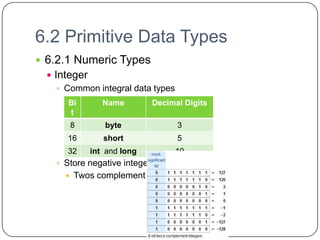
   Integer
      Common integral data types
       Bi        Name        Decimal Digits
       t
          8      byte               3
       16        short              5
       32     int and long          10
     Store negative integers
         Twos complement
6.2 Primitive Data Types
 6.2.1 Numeric Types
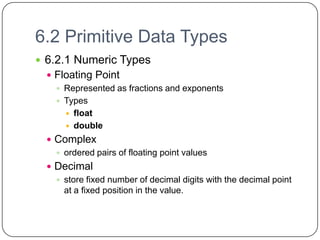
   Floating Point
     Represented as fractions and exponents
     Types
       float
       double

   Complex
     ordered pairs of floating point values
   Decimal
     store fixed number of decimal digits with the decimal point
      at a fixed position in the value.
6.2 Primitive Data Types
 6.2.2 Boolean Types
   true or false
   represented by a single bit(can’t access efficiently)
   stored in the smallest efficiently addressable cell of
   memory      (1 byte)
 6.2.3 Character Types
   stored as numeric codings (computer)
   ASCII > UCSS-2 >UCS-4
6.3 Character String Types
 String operations
   Assignment &Comparison
     complicated(string operands of different lengths)
   Catenation
   Substring reference(slices)
     reference to a substring of a given string
   Pattern matching
     supported directly in the language or provided library
6.3 Character String Types
 String Length Options
   Static length strings
   Limited dynamic length strings
     varying length up to a declared and fixed maximum set by
      the variable’s definition
     store any number of character between 0 and maximum
   Dynamic length strings
     varying length with no maximum
     overhead of dynamic storage allocation and deallocation
      (maximum flexibility)
6.4 User-Defined Ordinal Types
 range of possible value can be associated with
 the set of positive integers
   Enumeration
     all of the possible values which are named constants are
      provided in the definition
   Sub range
     contiguous subsequence of an ordinal type
Array Types
 Homogeneous
 Reference – aggregate name & subscript


           e.g. arrayName [10]
 Element type & Subscript type
 Subscript range checking
 Subscript lower binding
Arrays and Indices
 Ada :
   e.g. name (10) : Array? Element?
   Ordinal Type subscript : e.g. day(Monday)


 Perl
   Sign @ for array : e.g. @list
   Sign $ for scalars : e.g.$list[1]
   Negative subscript
  +ve subscript   0    1    2    3      4
  Array’s         0    1    2    3      4
  Element
  -ve subscript   -5   -4   -3   -2     -1
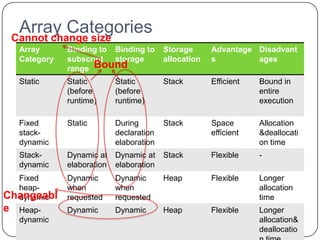
Array Categories
    Cannot change size
     Array      Binding to Binding to       Storage      Advantage Disadvant
     Category   subscript  storage          allocation   s         ages
                range Bound
     Static     Static        Static        Stack        Efficient   Bound in
                (before       (before                                entire
                runtime)      runtime)                               execution

     Fixed      Static        During        Stack        Space       Allocation
     stack-                   declaration                efficient   &deallocati
     dynamic                  elaboration                            on time
     Stack-     Dynamic at    Dynamic at    Stack        Flexible    -
     dynamic    elaboration   elaboration
  Fixed         Dynamic       Dynamic       Heap         Flexible    Longer
  heap-         when          when                                   allocation
Changeabl
  dynamic       requested     requested                              time
e    Heap-      Dynamic       Dynamic       Heap         Flexible    Longer
     dynamic                                                         allocation&
                                                                     deallocatio
Array Initialization
     Languag Example
     e
     Fortran     Integer, Dimension(3) :: List = (/0, 5, 5/)
     95
     C           int list [ ] = {4, 5, 6, 83};
     C, C++      char name [ ] = “freddie”;
                 char *name [ ] = (“Bob”, “Jake”, “Darcie”); //pointer
     Java        String[ ] names = [“Bob”, “Jake”, Darcie”];
     Ada           List : array (1..5) of Integer := (1, 3, 4, 7, 8);
                   Bunch : array (1..5) of Integer := (1 => 17, 3 => 34, others =>
List Comprehensions of Python
                   0);
Syntax : [expression            for iterate_var     in array            if condition ]
Example               :[x*x               for x                in range (12)      if x %
3 == 0 ]
[0, 1, 2, 3, 4, 5, 6, 7, 8, 9, 10, 11,
12]                                                      [0, 9, 36, 81,
                     [0, 3, 6, 9,                        144]
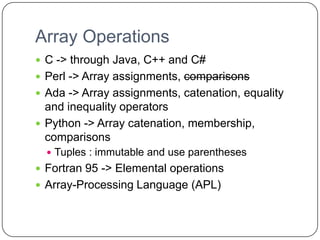
Array Operations
 C -> through Java, C++ and C#
 Perl -> Array assignments, comparisons
 Ada -> Array assignments, catenation, equality
  and inequality operators
 Python -> Array catenation, membership,
  comparisons
   Tuples : immutable and use parentheses
 Fortran 95 -> Elemental operations
 Array-Processing Language (APL)
Rectangular & Jagged Array
Rectangular Array   Jagged Array


Fortran, Ada, C#    C, C++, Java, C#
myArray [3, 7]      myArray [3] [7]
6.5.7 Slices

Python:               mat         0           1         2
                      0               1           2          3
                      1               4           5          6
                      2               7           8          9

mat [1]                                               -> [4, 5, 6]
mat [0] [0 : 2]                                       -> [1 ,2]

vecto 0       1           2           3       4         5         6        7        8
r
0         2       4           6           8       10        12        14       16       17
vector [0 : 8 : 2]                                               -> [2 ,6, 10,
14]
6.5.9 Implementation of Array Types
 Array : 3 4              7 Row Major Order             Column Major Order
                                  3 4 7                           34 7
           6 2             5      6 2 5                          6 2 5
           1 3             8      1 3 8                          1 3 8
                             3, 4, 7, 6, 2, 5, 1, 3, 8   3, 6, 1, 4, 2, 3, 7, 5, 8

 location(a [i, j]) =                      a 1 2 3 4 5 6 7 8 9
adress of a[1, 1] + ((        1

 ((# of rows above ith row) 2
                              3
 * (size of row)) +           4
 (# of columns left jth column))
                              5                                     X
 * element size)              6

    location (a [5, 6]) Adress of a[1, 1] + 4   9 + 5 ) x element
    =                   ((                  x           size)
Associative Arrays
 An unordered collection of data elements that
  are indexed by an equal number of values called
  keys.
 Each element is a pair of entities (key , value)
   Key      Value
   Eujinn   70
   Marry    99      =>   Dataset[“Eujinn”] = 70;
   Joanne   55      =>   Dataset[“Marry”] = 99;
   Johnny   41      =>   Dataset[“Joanne”] = 55;
                    =>   Dataset[“Johnny”] = 41;
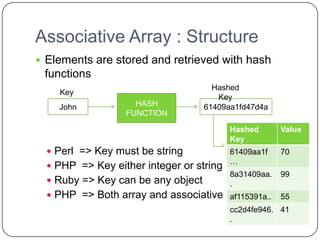
Associative Array : Structure
 Elements are stored and retrieved with hash
 functions
                                      Hashed
    Key
                                       Key
    John            HASH            61409aa1fd47d4a
                  FUNCTION

                                          Hashed       Value
                                          Key
   Perl => Key must be string            61409aa1f    70
                                          …
   PHP => Key either integer or string
                                          8a31409aa.   99
   Ruby => Key can be any object         .
   PHP => Both array and associative array
                                       af115391a..     55
                                          cc2d4fe946. 41
                                          .
Associative Array : Operation
 Assignments
   $salaries{“Perry”} = 58850;    //In Perl
   salaries[“Perry”] = 58850;            //In C++
 Delete
   delete $salaries{“Gary”};             //In Perl
   salaries.erase(“Gary”);        //In C++
 Exists
   If(exists $salaries{“Shelly”}) …      //In Perl
   If( salaries.find(“Shelly”))          //In C++
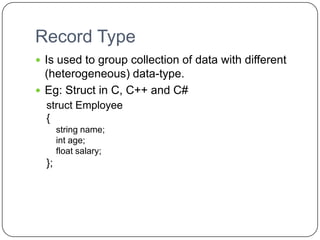
Record Type
 Is used to group collection of data with different
  (heterogeneous) data-type.
 Eg: Struct in C, C++ and C#
  struct Employee
  {
       string name;
       int age;
       float salary;
  };
Record Type : Structure
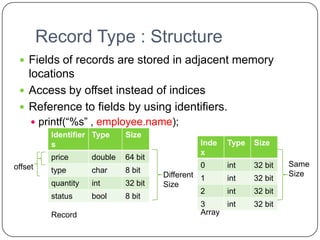
  Fields of records are stored in adjacent memory
   locations
  Access by offset instead of indices
  Reference to fields by using identifiers.
      printf(“%s” , employee.name);
          Identifier Type     Size
          s                                     Inde   Type   Size
                                                x
          price      double   64 bit
offset                                          0      int    32 bit   Same
          type       char     8 bit                                    Size
                                       Different 1     int    32 bit
          quantity   int      32 bit   Size
                                                 2     int    32 bit
          status     bool     8 bit
                                                3     int     32 bit
          Record                                Array
Record Type: Operations
 Initialization
   Aggregate literals
   Employee e = {“John”, 28, 3000.0f};
 Assignments
 Comparison
 MOVE CORRESPONDING
   In COBOL, copies all the field from source record to the
    destination field record with the same name.
   MOVE CORRESPONDING INPUT-RECORD TO
    OUTPUT-RECORD
Union Type
 A type whose variable may store different type
  values at different times during program
  execution
 Specifying Union
   In C / C++ => union
   In Fortran => Equivalence
Union Type : Design Issue
 Type Checking one of the major design issue
 2 ways of implementations
   Free Union
     Programmers are allowed complete freedom from type
      checking in their use
     Use in C, C++, Fortran
   Discriminated Union
     Type indicator(tag) is used for type checking
     Use in ALGOL 68 , ADA
Union Type : Implementation
 Implemented by using the same address for
  every variant
 Storage is allocated to largest variant


                       1110100   0000001      0000000    0000000
                       0         1            0          0


                      C[0] => 232 C[1] = 3

                                             a => 100010 (11111010002)
                                             *32 bits is allocated becaus
                                             int has larger size
Pointer Problems: Dangling
Pointer
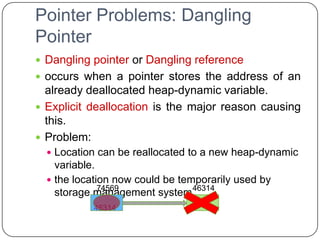
 Dangling pointer or Dangling reference
 occurs when a pointer stores the address of an
  already deallocated heap-dynamic variable.
 Explicit deallocation is the major reason causing
  this.
 Problem:
   Location can be reallocated to a new heap-dynamic
    variable.
   the location now could be temporarily used by
              74569              46314
    storage management system.
           46314
Solution: Tombstone
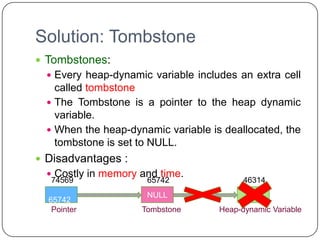
 Tombstones:
   Every heap-dynamic variable includes an extra cell
    called tombstone
   The Tombstone is a pointer to the heap dynamic
    variable.
   When the heap-dynamic variable is deallocated, the
    tombstone is set to NULL.
 Disadvantages :
   Costly in memory and time.
  74569               65742                46314
                      46314
                      NULL
  65742
   Pointer           Tombstone       Heap-dynamic Variable
Solution: Lock-and-Keys
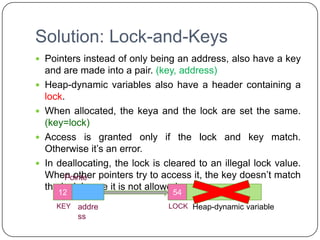
 Pointers instead of only being an address, also have a key
    and are made into a pair. (key, address)
   Heap-dynamic variables also have a header containing a
    lock.
   When allocated, the keya and the lock are set the same.
    (key=lock)
   Access is granted only if the lock and key match.
    Otherwise it’s an error.
   In deallocating, the lock is cleared to an illegal lock value.
    When other pointers try to access it, the key doesn’t match
         Pointe
    the lock hence it is not allowed.
         r
       12                          54
                                   12
      KEY   addre                LOCK Heap-dynamic variable
            ss
Lost Heap-Dynamic Variables
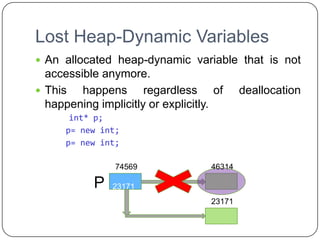
 An allocated heap-dynamic variable that is not
  accessible anymore.
 This   happens regardless of            deallocation
  happening implicitly or explicitly.
       int* p;
      p= new int;
      p= new int;

                74569             46314

           P   23171
               46314
                                  23171
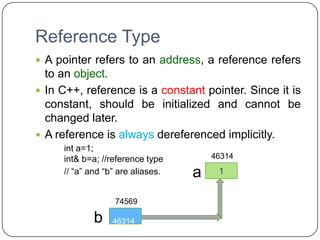
Reference Type
 A pointer refers to an address, a reference refers
  to an object.
 In C++, reference is a constant pointer. Since it is
  constant, should be initialized and cannot be
  changed later.
 A reference is always dereferenced implicitly.
     int a=1;
     int& b=a; //reference type        46314
     // “a” and “b” are aliases.   a    1


                  74569

             b    46314
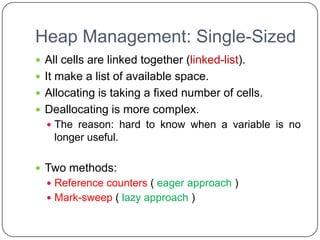
Heap Management: Single-Sized
 All cells are linked together (linked-list).
 It make a list of available space.
 Allocating is taking a fixed number of cells.
 Deallocating is more complex.
   The reason: hard to know when a variable is no
    longer useful.

 Two methods:
   Reference counters ( eager approach )
   Mark-sweep ( lazy approach )
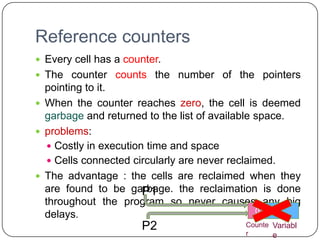
Reference counters
 Every cell has a counter.
 The counter counts the number of the pointers
  pointing to it.
 When the counter reaches zero, the cell is deemed
  garbage and returned to the list of available space.
 problems:
    Costly in execution time and space
    Cells connected circularly are never reclaimed.
 The advantage : the cells are reclaimed when they
  are found to be garbage. the reclaimation is done
                        P1
  throughout the program so never causes any big
                                                0
                                                2
                                                1
  delays.
                      P2                  Counte Variabl
                                          r      e
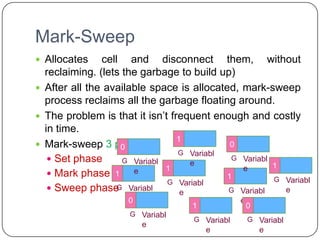
Mark-Sweep
 Allocates    cell and disconnect them, without
  reclaiming. (lets the garbage to build up)
 After all the available space is allocated, mark-sweep
  process reclaims all the garbage floating around.
 The problem is that it isn’t frequent enough and costly
  in time.
                                 1
 Mark-sweep 3 phases:
                    0
                    1                       0
                                            1
                                 G Variabl
    Set phase      G Variabl       e
                                            G Variabl
                              1               e       1
    Mark phase 1     e
                                           1
                                           0          G Variabl
                              G Variabl
    Sweep phase Variabl
                   G
                                  e        G Variabl    e
                     e
                     0
                     1                          e
                                    1               0
                                                    1
                     G Variabl
                                    G Variabl       G Variabl
                         e
                                        e               e
Heap Management: Variable-
sized
 Additional problems arise. In case of mark-sweep:
   Setting all the bits to indicate garbage is difficult.
    Scanning of all the different sized cells is a problem.
     Solution: each cell have a field to indicate its size.
   cells with no pointers. How can you follow a chain?
     Solution: adding internal pointers to every cell.
   maintaining a list of available space.
     Solution: sorting the list according to block size.
Type Checking
 Process to verify that the operands of an operator
  are compatible types.
 A compatible type is
   legal for the operator OR
   allowed under language rules to be automatically
   converted by the compiler-generated code to a legal
   type (also known as coercion).
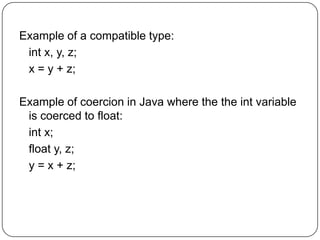
Example of a compatible type:
 int x, y, z;
 x = y + z;

Example of coercion in Java where the the int variable
 is coerced to float:
 int x;
 float y, z;
 y = x + z;
Type Error
 Happens when an operator is applied to an operand
  with inappropriate type.

Types of type checking:
 Static type checking
 Dynamic type checking
Static type checking
 occurs at compile-time
 allows type errors to be found early
 languages include Ada, C, C++, C#


Dynamic type checking
 occurs at run-time
 more flexibility
 languages include JavaScript, PHP, Lisp, Perl
Strong Typing
 A strongly typed programming language has
    severe restrictions that prevents the compilation
    of code with data that is used in an invalid way.
   Type errors are always detected.
   Requires that the types of all operands
    determined either at compile-time or run-time.
   Example:
    Integer addition operation may not be used on
    strings.
   Importance of strong typing
    - Detect all misuses of variables that result in type
     errors.
 The value of strong typing is however weakened by
  coercion as it results in the loss of error detection.
 Reliability of a language
  - Coercion↑ Reliability↓
  - Coercion↓ Reliability↑
Strong Typing in Different Languages
Fortran 95, C, C++
 Not strongly typed.
 The use of Equivalence in Fortran allows a variable
  of one type to refer to a value of a different type,
  without the system being able to check the type of
  the value when one of the Equivalenced variables is
  referenced or assigned.
 C and C++ both include union types which are not
  type checked.
Ada, Java, C#
 Nearly strongly typed.
 Ada allows programmers to breach type-checking
  rules which can only be done when
  Unchecked_Conversion is called.
Type Equivalence
 Strict form of type compatibility.
 No coercion.
 2 ways to define type equivalence
   Name type equivalence
   Structure type equivalence
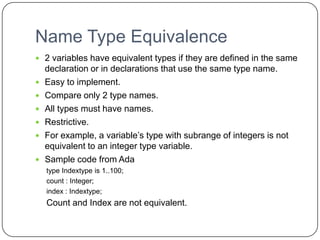
Name Type Equivalence
 2 variables have equivalent types if they are defined in the same
    declaration or in declarations that use the same type name.
   Easy to implement.
   Compare only 2 type names.
   All types must have names.
   Restrictive.
   For example, a variable’s type with subrange of integers is not
    equivalent to an integer type variable.
   Sample code from Ada
    type Indextype is 1..100;
    count : Integer;
    index : Indextype;
    Count and Index are not equivalent.
Structure Type Equivalence
 2 variables have equivalent types if their types
  have identical structures.
 More flexible compared to name type
  equivalence.
 Difficult to implement.
 Entire structures of 2 types have to be compared.
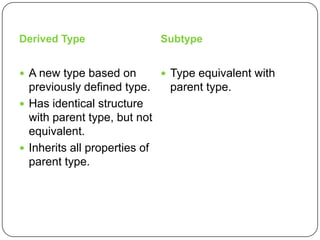
Derived Type                   Subtype


 A new type based on           Type equivalent with
  previously defined type.      parent type.
 Has identical structure
  with parent type, but not
  equivalent.
 Inherits all properties of
  parent type.
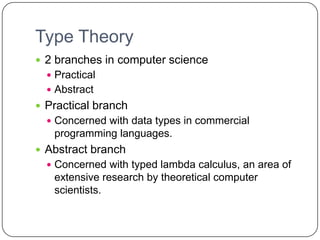
Type Theory
 2 branches in computer science
   Practical
   Abstract
 Practical branch
   Concerned with data types in commercial
   programming languages.
 Abstract branch
   Concerned with typed lambda calculus, an area of
   extensive research by theoretical computer
   scientists.
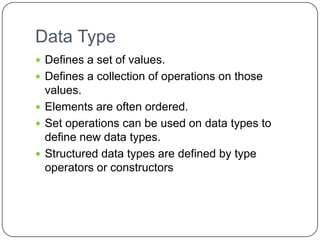
Data Type
 Defines a set of values.
 Defines a collection of operations on those
  values.
 Elements are often ordered.
 Set operations can be used on data types to
  define new data types.
 Structured data types are defined by type
  operators or constructors
Thank You!
Q&A

Plc (1)

  • 1.
    Data Types Ng EuJinn 1071112650 Tan Chin Tong 1081106274 Ng Cong Jie 1071117296 Mostafa Abedi 1091108989 Tan Joanne 1071115484
  • 2.
    6.2 Primitive DataTypes  6.2.1 Numeric Types  Integer  Common integral data types Bi Name Decimal Digits t 8 byte 3 16 short 5 32 int and long 10  Store negative integers  Twos complement
  • 3.
    6.2 Primitive DataTypes  6.2.1 Numeric Types  Floating Point  Represented as fractions and exponents  Types  float  double  Complex  ordered pairs of floating point values  Decimal  store fixed number of decimal digits with the decimal point at a fixed position in the value.
  • 4.
    6.2 Primitive DataTypes  6.2.2 Boolean Types  true or false  represented by a single bit(can’t access efficiently)  stored in the smallest efficiently addressable cell of memory (1 byte)  6.2.3 Character Types  stored as numeric codings (computer)  ASCII > UCSS-2 >UCS-4
  • 5.
    6.3 Character StringTypes  String operations  Assignment &Comparison  complicated(string operands of different lengths)  Catenation  Substring reference(slices)  reference to a substring of a given string  Pattern matching  supported directly in the language or provided library
  • 6.
    6.3 Character StringTypes  String Length Options  Static length strings  Limited dynamic length strings  varying length up to a declared and fixed maximum set by the variable’s definition  store any number of character between 0 and maximum  Dynamic length strings  varying length with no maximum  overhead of dynamic storage allocation and deallocation (maximum flexibility)
  • 7.
    6.4 User-Defined OrdinalTypes  range of possible value can be associated with the set of positive integers  Enumeration  all of the possible values which are named constants are provided in the definition  Sub range  contiguous subsequence of an ordinal type
  • 8.
    Array Types  Homogeneous Reference – aggregate name & subscript e.g. arrayName [10]  Element type & Subscript type  Subscript range checking  Subscript lower binding
  • 9.
    Arrays and Indices Ada :  e.g. name (10) : Array? Element?  Ordinal Type subscript : e.g. day(Monday)  Perl  Sign @ for array : e.g. @list  Sign $ for scalars : e.g.$list[1]  Negative subscript +ve subscript 0 1 2 3 4 Array’s 0 1 2 3 4 Element -ve subscript -5 -4 -3 -2 -1
  • 10.
    Array Categories Cannot change size Array Binding to Binding to Storage Advantage Disadvant Category subscript storage allocation s ages range Bound Static Static Static Stack Efficient Bound in (before (before entire runtime) runtime) execution Fixed Static During Stack Space Allocation stack- declaration efficient &deallocati dynamic elaboration on time Stack- Dynamic at Dynamic at Stack Flexible - dynamic elaboration elaboration Fixed Dynamic Dynamic Heap Flexible Longer heap- when when allocation Changeabl dynamic requested requested time e Heap- Dynamic Dynamic Heap Flexible Longer dynamic allocation& deallocatio
  • 11.
    Array Initialization Languag Example e Fortran Integer, Dimension(3) :: List = (/0, 5, 5/) 95 C int list [ ] = {4, 5, 6, 83}; C, C++ char name [ ] = “freddie”; char *name [ ] = (“Bob”, “Jake”, “Darcie”); //pointer Java String[ ] names = [“Bob”, “Jake”, Darcie”]; Ada List : array (1..5) of Integer := (1, 3, 4, 7, 8); Bunch : array (1..5) of Integer := (1 => 17, 3 => 34, others => List Comprehensions of Python 0); Syntax : [expression for iterate_var in array if condition ] Example :[x*x for x in range (12) if x % 3 == 0 ] [0, 1, 2, 3, 4, 5, 6, 7, 8, 9, 10, 11, 12] [0, 9, 36, 81, [0, 3, 6, 9, 144]
  • 12.
    Array Operations  C-> through Java, C++ and C#  Perl -> Array assignments, comparisons  Ada -> Array assignments, catenation, equality and inequality operators  Python -> Array catenation, membership, comparisons  Tuples : immutable and use parentheses  Fortran 95 -> Elemental operations  Array-Processing Language (APL)
  • 13.
    Rectangular & JaggedArray Rectangular Array Jagged Array Fortran, Ada, C# C, C++, Java, C# myArray [3, 7] myArray [3] [7]
  • 14.
    6.5.7 Slices Python: mat 0 1 2 0 1 2 3 1 4 5 6 2 7 8 9 mat [1] -> [4, 5, 6] mat [0] [0 : 2] -> [1 ,2] vecto 0 1 2 3 4 5 6 7 8 r 0 2 4 6 8 10 12 14 16 17 vector [0 : 8 : 2] -> [2 ,6, 10, 14]
  • 15.
    6.5.9 Implementation ofArray Types  Array : 3 4 7 Row Major Order Column Major Order 3 4 7 34 7 6 2 5 6 2 5 6 2 5 1 3 8 1 3 8 1 3 8 3, 4, 7, 6, 2, 5, 1, 3, 8 3, 6, 1, 4, 2, 3, 7, 5, 8  location(a [i, j]) = a 1 2 3 4 5 6 7 8 9 adress of a[1, 1] + (( 1 ((# of rows above ith row) 2 3 * (size of row)) + 4 (# of columns left jth column)) 5 X * element size) 6 location (a [5, 6]) Adress of a[1, 1] + 4 9 + 5 ) x element = (( x size)
  • 16.
    Associative Arrays  Anunordered collection of data elements that are indexed by an equal number of values called keys.  Each element is a pair of entities (key , value) Key Value Eujinn 70 Marry 99 => Dataset[“Eujinn”] = 70; Joanne 55 => Dataset[“Marry”] = 99; Johnny 41 => Dataset[“Joanne”] = 55; => Dataset[“Johnny”] = 41;
  • 17.
    Associative Array :Structure  Elements are stored and retrieved with hash functions Hashed Key Key John HASH 61409aa1fd47d4a FUNCTION Hashed Value Key  Perl => Key must be string 61409aa1f 70 …  PHP => Key either integer or string 8a31409aa. 99  Ruby => Key can be any object .  PHP => Both array and associative array af115391a.. 55 cc2d4fe946. 41 .
  • 18.
    Associative Array :Operation  Assignments  $salaries{“Perry”} = 58850; //In Perl  salaries[“Perry”] = 58850; //In C++  Delete  delete $salaries{“Gary”}; //In Perl  salaries.erase(“Gary”); //In C++  Exists  If(exists $salaries{“Shelly”}) … //In Perl  If( salaries.find(“Shelly”)) //In C++
  • 19.
    Record Type  Isused to group collection of data with different (heterogeneous) data-type.  Eg: Struct in C, C++ and C# struct Employee { string name; int age; float salary; };
  • 20.
    Record Type :Structure  Fields of records are stored in adjacent memory locations  Access by offset instead of indices  Reference to fields by using identifiers.  printf(“%s” , employee.name); Identifier Type Size s Inde Type Size x price double 64 bit offset 0 int 32 bit Same type char 8 bit Size Different 1 int 32 bit quantity int 32 bit Size 2 int 32 bit status bool 8 bit 3 int 32 bit Record Array
  • 21.
    Record Type: Operations Initialization  Aggregate literals  Employee e = {“John”, 28, 3000.0f};  Assignments  Comparison  MOVE CORRESPONDING  In COBOL, copies all the field from source record to the destination field record with the same name.  MOVE CORRESPONDING INPUT-RECORD TO OUTPUT-RECORD
  • 22.
    Union Type  Atype whose variable may store different type values at different times during program execution  Specifying Union  In C / C++ => union  In Fortran => Equivalence
  • 23.
    Union Type :Design Issue  Type Checking one of the major design issue  2 ways of implementations  Free Union  Programmers are allowed complete freedom from type checking in their use  Use in C, C++, Fortran  Discriminated Union  Type indicator(tag) is used for type checking  Use in ALGOL 68 , ADA
  • 24.
    Union Type :Implementation  Implemented by using the same address for every variant  Storage is allocated to largest variant 1110100 0000001 0000000 0000000 0 1 0 0 C[0] => 232 C[1] = 3 a => 100010 (11111010002) *32 bits is allocated becaus int has larger size
  • 25.
    Pointer Problems: Dangling Pointer Dangling pointer or Dangling reference  occurs when a pointer stores the address of an already deallocated heap-dynamic variable.  Explicit deallocation is the major reason causing this.  Problem:  Location can be reallocated to a new heap-dynamic variable.  the location now could be temporarily used by 74569 46314 storage management system. 46314
  • 26.
    Solution: Tombstone  Tombstones:  Every heap-dynamic variable includes an extra cell called tombstone  The Tombstone is a pointer to the heap dynamic variable.  When the heap-dynamic variable is deallocated, the tombstone is set to NULL.  Disadvantages :  Costly in memory and time. 74569 65742 46314 46314 NULL 65742 Pointer Tombstone Heap-dynamic Variable
  • 27.
    Solution: Lock-and-Keys  Pointersinstead of only being an address, also have a key and are made into a pair. (key, address)  Heap-dynamic variables also have a header containing a lock.  When allocated, the keya and the lock are set the same. (key=lock)  Access is granted only if the lock and key match. Otherwise it’s an error.  In deallocating, the lock is cleared to an illegal lock value. When other pointers try to access it, the key doesn’t match Pointe the lock hence it is not allowed. r 12 54 12 KEY addre LOCK Heap-dynamic variable ss
  • 28.
    Lost Heap-Dynamic Variables An allocated heap-dynamic variable that is not accessible anymore.  This happens regardless of deallocation happening implicitly or explicitly. int* p; p= new int; p= new int; 74569 46314 P 23171 46314 23171
  • 29.
    Reference Type  Apointer refers to an address, a reference refers to an object.  In C++, reference is a constant pointer. Since it is constant, should be initialized and cannot be changed later.  A reference is always dereferenced implicitly. int a=1; int& b=a; //reference type 46314 // “a” and “b” are aliases. a 1 74569 b 46314
  • 30.
    Heap Management: Single-Sized All cells are linked together (linked-list).  It make a list of available space.  Allocating is taking a fixed number of cells.  Deallocating is more complex.  The reason: hard to know when a variable is no longer useful.  Two methods:  Reference counters ( eager approach )  Mark-sweep ( lazy approach )
  • 31.
    Reference counters  Everycell has a counter.  The counter counts the number of the pointers pointing to it.  When the counter reaches zero, the cell is deemed garbage and returned to the list of available space.  problems:  Costly in execution time and space  Cells connected circularly are never reclaimed.  The advantage : the cells are reclaimed when they are found to be garbage. the reclaimation is done P1 throughout the program so never causes any big 0 2 1 delays. P2 Counte Variabl r e
  • 32.
    Mark-Sweep  Allocates cell and disconnect them, without reclaiming. (lets the garbage to build up)  After all the available space is allocated, mark-sweep process reclaims all the garbage floating around.  The problem is that it isn’t frequent enough and costly in time. 1  Mark-sweep 3 phases: 0 1 0 1 G Variabl  Set phase G Variabl e G Variabl 1 e 1  Mark phase 1 e 1 0 G Variabl G Variabl  Sweep phase Variabl G e G Variabl e e 0 1 e 1 0 1 G Variabl G Variabl G Variabl e e e
  • 33.
    Heap Management: Variable- sized Additional problems arise. In case of mark-sweep:  Setting all the bits to indicate garbage is difficult. Scanning of all the different sized cells is a problem.  Solution: each cell have a field to indicate its size.  cells with no pointers. How can you follow a chain?  Solution: adding internal pointers to every cell.  maintaining a list of available space.  Solution: sorting the list according to block size.
  • 34.
    Type Checking  Processto verify that the operands of an operator are compatible types.  A compatible type is  legal for the operator OR  allowed under language rules to be automatically converted by the compiler-generated code to a legal type (also known as coercion).
  • 35.
    Example of acompatible type: int x, y, z; x = y + z; Example of coercion in Java where the the int variable is coerced to float: int x; float y, z; y = x + z;
  • 36.
    Type Error  Happenswhen an operator is applied to an operand with inappropriate type. Types of type checking:  Static type checking  Dynamic type checking
  • 37.
    Static type checking occurs at compile-time  allows type errors to be found early  languages include Ada, C, C++, C# Dynamic type checking  occurs at run-time  more flexibility  languages include JavaScript, PHP, Lisp, Perl
  • 38.
    Strong Typing  Astrongly typed programming language has severe restrictions that prevents the compilation of code with data that is used in an invalid way.  Type errors are always detected.  Requires that the types of all operands determined either at compile-time or run-time.  Example: Integer addition operation may not be used on strings.  Importance of strong typing - Detect all misuses of variables that result in type errors.
  • 39.
     The valueof strong typing is however weakened by coercion as it results in the loss of error detection.  Reliability of a language - Coercion↑ Reliability↓ - Coercion↓ Reliability↑
  • 40.
    Strong Typing inDifferent Languages Fortran 95, C, C++  Not strongly typed.  The use of Equivalence in Fortran allows a variable of one type to refer to a value of a different type, without the system being able to check the type of the value when one of the Equivalenced variables is referenced or assigned.  C and C++ both include union types which are not type checked.
  • 41.
    Ada, Java, C# Nearly strongly typed.  Ada allows programmers to breach type-checking rules which can only be done when Unchecked_Conversion is called.
  • 42.
    Type Equivalence  Strictform of type compatibility.  No coercion.  2 ways to define type equivalence  Name type equivalence  Structure type equivalence
  • 43.
    Name Type Equivalence 2 variables have equivalent types if they are defined in the same declaration or in declarations that use the same type name.  Easy to implement.  Compare only 2 type names.  All types must have names.  Restrictive.  For example, a variable’s type with subrange of integers is not equivalent to an integer type variable.  Sample code from Ada type Indextype is 1..100; count : Integer; index : Indextype; Count and Index are not equivalent.
  • 44.
    Structure Type Equivalence 2 variables have equivalent types if their types have identical structures.  More flexible compared to name type equivalence.  Difficult to implement.  Entire structures of 2 types have to be compared.
  • 45.
    Derived Type Subtype  A new type based on  Type equivalent with previously defined type. parent type.  Has identical structure with parent type, but not equivalent.  Inherits all properties of parent type.
  • 46.
    Type Theory  2branches in computer science  Practical  Abstract  Practical branch  Concerned with data types in commercial programming languages.  Abstract branch  Concerned with typed lambda calculus, an area of extensive research by theoretical computer scientists.
  • 47.
    Data Type  Definesa set of values.  Defines a collection of operations on those values.  Elements are often ordered.  Set operations can be used on data types to define new data types.  Structured data types are defined by type operators or constructors
  • 48.
  • 49.