







Why we need Data Structures?
•Efficient and Intuitive representation of data
    •Tree using arrays vs tree using pointers
•To solve real life problems efficiently
    •Insertion
    •Deletion
    •Search
    •Sort
•Applications
    •Social networks
    •Employee hierarchy
    •Recommended items
Basic Operations
1.traverse
2.insert

3.delete

4.find
Data Structures (Basic)
•Arrays
•Linked Lists
•Stacks
•Queues
•Recursion
•Trees – Basic
•Practice Problems
Arrays
•Contiguous and fixed memory allocation (independent of
language)

•Random access and modification

•List of (index, value); index is non-negative integer; all values in
a given array are of the same data type

•To hold various types of values or have non-numerical indices,
use associative arrays/dictionaries – The Dictionary Problem?
•Arrays may also be:
    •2-D : array of 1-D arrays (a 1-D array is a data type in itself)
    •3-D : array of 2-D arrays (a 2-D array is a data type in itself)

•Memory placement of multi-dimensional arrays
   1.row-major
   2.column-major

•Useful Operation
   a.Modify

   b.Access

   c.Swap

   d.In-place reverse
Structure of an Array
template<class T> class Array{
int size;
T *arr;
void put();
void get();
…….
};
Useful Libraries
#include <vector>
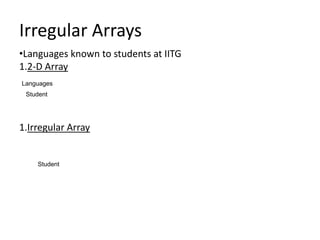
Irregular Arrays
•Languages known to students at IITG
1.2-D Array
Languages
 Student


1.Irregular Array


    Student
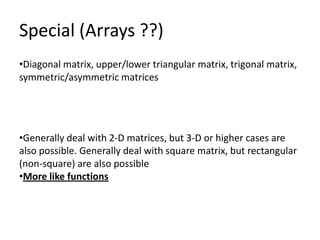
Special (Arrays ??)
•Diagonal matrix, upper/lower triangular matrix, trigonal matrix,
symmetric/asymmetric matrices


•Generally deal with 2-D matrices, but 3-D or higher cases are
also possible. Generally deal with square matrix, but rectangular
(non-square) are also possible
•More like functions
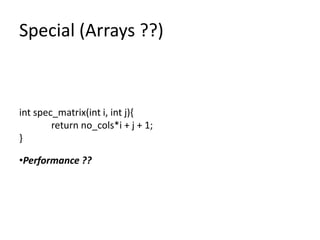
Special (Arrays ??)


int spec_matrix(int i, int j){
        return no_cols*i + j + 1;
}

•Performance ??
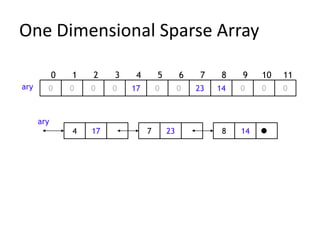
One Dimensional Sparse Array

            0   1   2    3    4       5        6    7    8   9    10   11
ary     0       0   0    0   17       0        0   23   14   0    0    0


      ary
                4   17            7       23             8   14
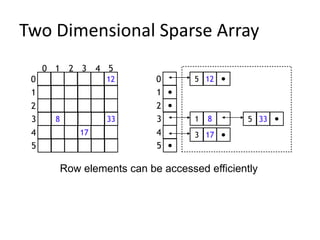
Two Dimensional Sparse Array
     0 1    2 3     4 5
 0                   12       0       5 12
 1                            1
 2                            2
 3     8             33       3       1   8      5 33
 4             17             4       3 17
 5                            5

           Row elements can be accessed efficiently
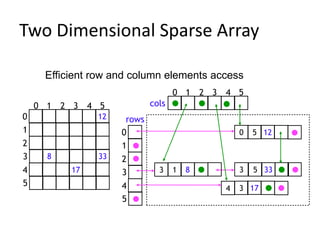
Two Dimensional Sparse Array

     Efficient row and column elements access
                                     0 1     2 3   4 5
    0 1   2 3   4 5           cols
0                12    rows
1                     0                                0   5 12
2                     1
3     8          33   2
4          17         3         3    1   8             3   5 33
5                     4                            4   3 17
                      5
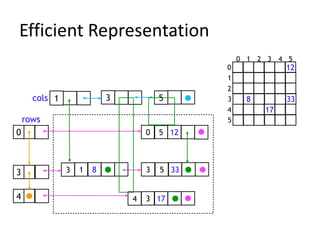
Efficient Representation
                                                  0 1 2 3 4 5
                                              0             12
                                              1
                                              2
      cols 1               3           5      3    8        33
                                              4        17
    rows                                      5
0                                  0   5 12


3              3   1   8           3   5 33


4                              4   3 17
Linked Lists
Why?
•To store heterogeneous data
•To store sparse data
•Flexibility of increase/decrease in size; easy insertion and
deletion of elements

•Useful Operations
   •insertion
   •deletion
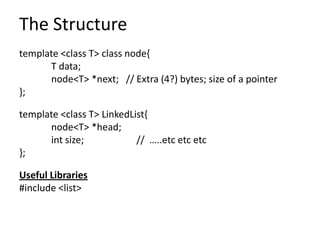
The Structure
template <class T> class node{
      T data;
      node<T> *next; // Extra (4?) bytes; size of a pointer
};

template <class T> LinkedList{
      node<T> *head;
      int size;            // …..etc etc etc
};

Useful Libraries
#include <list>
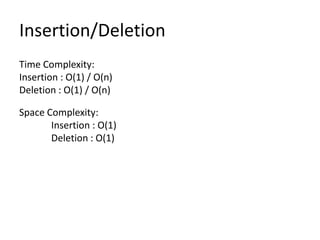
Insertion/Deletion
Time Complexity:
Insertion : O(1) / O(n)
Deletion : O(1) / O(n)

Space Complexity:
       Insertion : O(1)
       Deletion : O(1)
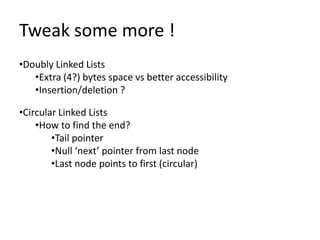
Tweak some more !
•Doubly Linked Lists
   •Extra (4?) bytes space vs better accessibility
   •Insertion/deletion ?

•Circular Linked Lists
    •How to find the end?
        •Tail pointer
        •Null ‘next’ pointer from last node
        •Last node points to first (circular)
Practice (Linked List)
   Linked List 1)
   Linked List 2)
Recursion
•To solve a task using that task itself
   •; a task should have recursive nature
   •; generally can be transformed by tweaking some parts of the
   task

•Example: task of piling up n coins vs picking up a
suitcase.
•Let the task be a C function. What are the parts of the
task:
   1.Input it takes
   2.What it does
   3.Output it gives
•A task is performed recursively when generally a large input
can’t be handled directly.

•So, recursion is all about simplifying the input at every step till it
becomes trivial (base case)
Implementation – run time stack
•Activation Records (AR)
   •Store the state of a method
        1.input parameters
        2.return values
        3.local variables
        4.return addresses
Advantages/Disadvantages
1.more readable/understandable/consistent with the the
definition

1.memory requirements increase due to runtime stack
2.difficult to open and debug
Types of Recursion
•Tail (vs loop?)
int factn;
While (n > 0) factn *= n--;


•Indirect
     •A() -> B() -> C() -> A()

•Nested:
     •h(n) = h(2 + h(n-1))
Hashes
Why?
•Want to store dictionaries?, associative arrays?
    •arrays with non-numerical indices
•String operations made easy
    •Ex: Finding anagrams
    •Ex: Counting frequency of words in a string
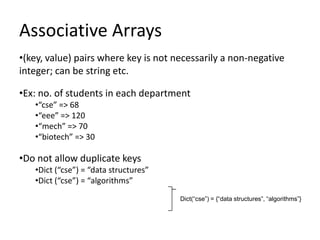
Associative Arrays
•(key, value) pairs where key is not necessarily a non-negative
integer; can be string etc.

•Ex: no. of students in each department
   •“cse” => 68
   •“eee” => 120
   •“mech” => 70
   •“biotech” => 30

•Do not allow duplicate keys
   •Dict (“cse”) = “data structures”
   •Dict (“cse”) = “algorithms”
                                       Dict(“cse”) = {“data structures”, “algorithms”}
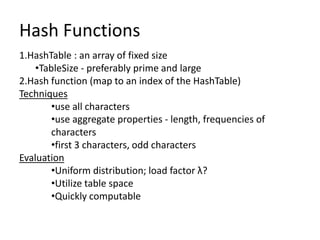
Hash Functions
1.HashTable : an array of fixed size
    •TableSize - preferably prime and large
2.Hash function (map to an index of the HashTable)
Techniques
        •use all characters
        •use aggregate properties - length, frequencies of
        characters
        •first 3 characters, odd characters
Evaluation
        •Uniform distribution; load factor λ?
        •Utilize table space
        •Quickly computable
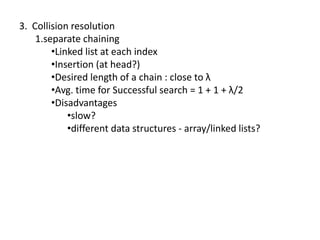
3. Collision resolution
    1.separate chaining
        •Linked list at each index
        •Insertion (at head?)
        •Desired length of a chain : close to λ
        •Avg. time for Successful search = 1 + 1 + λ/2
        •Disadvantages
            •slow?
            •different data structures - array/linked lists?
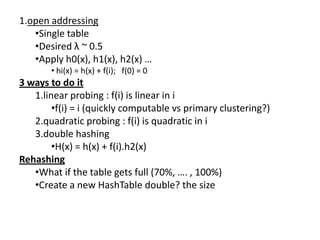
1.open addressing
   •Single table
   •Desired λ ~ 0.5
   •Apply h0(x), h1(x), h2(x) …
       • hi(x) = h(x) + f(i); f(0) = 0
3 ways to do it
   1.linear probing : f(i) is linear in i
        •f(i) = i (quickly computable vs primary clustering?)
   2.quadratic probing : f(i) is quadratic in i
   3.double hashing
        •H(x) = h(x) + f(i).h2(x)
Rehashing
   •What if the table gets full (70%, …. , 100%)
   •Create a new HashTable double? the size
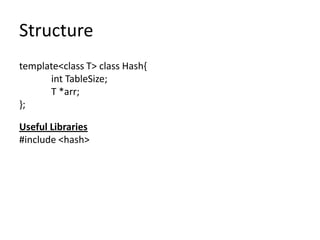
Structure
template<class T> class Hash{
      int TableSize;
      T *arr;
};

Useful Libraries
#include <hash>
Practice (Hashes)
      Trie 7)
Graphs
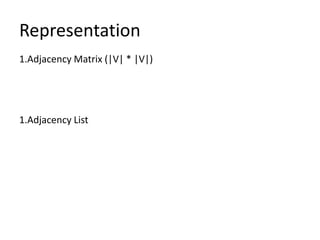
Representation
1.Adjacency Matrix (|V| * |V|)


1.Adjacency List
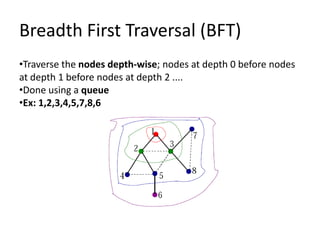
Breadth First Traversal (BFT)
•Traverse the nodes depth-wise; nodes at depth 0 before nodes
at depth 1 before nodes at depth 2 ....
•Done using a queue
•Ex: 1,2,3,4,5,7,8,6
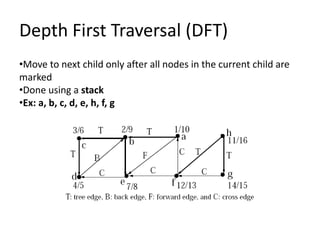
Depth First Traversal (DFT)
•Move to next child only after all nodes in the current child are
marked
•Done using a stack
•Ex: a, b, c, d, e, h, f, g
Trees (Advanced)
Retrieval
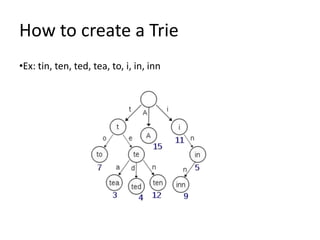
•Stores the prefixes of a set of strings in an efficient manner
•Used to store associative arrays/dictionaries
How to create a Trie
•Ex: tin, ten, ted, tea, to, i, in, inn
Pairs of anagrams
•Sort all the strings
   •acute -> acetu
   •obtuse -> beostu       … etc

•Insert them into the trie
•Keep storing collisions i.e. multiple values for each key
•Each set of values gives groups of anagrams
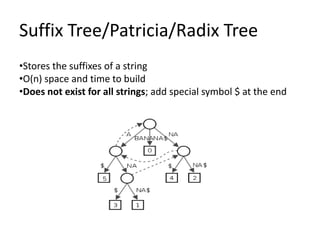
Suffix Tree/Patricia/Radix Tree
•Stores the suffixes of a string
•O(n) space and time to build
•Does not exist for all strings; add special symbol $ at the end
Advantages of Suffix Trees
•Store n suffixes in O(n) space.
•Improved string operations. Eg. substring lookup, Longest
common substring operation (generalized suffix trees?)

Generalized Suffix Trees
•Each string terminated by a different special symbol
•More space efficient
•Have different set of algorithms
Longest Common Substring
1.Make a “generalized suffix tree” for the (2?) strings
2.Traverse the tree to mark all internal nodes as 1, 2 or (1,2)
depending on whether it is parent to a leaf node terminating
with the special symbol of string 1 and string 2.
3.Find the deepest internal node marked 1,2

Pattern Matching ?

Data structures

  • 2.
    Why we needData Structures? •Efficient and Intuitive representation of data •Tree using arrays vs tree using pointers •To solve real life problems efficiently •Insertion •Deletion •Search •Sort •Applications •Social networks •Employee hierarchy •Recommended items
  • 3.
  • 4.
    Data Structures (Basic) •Arrays •LinkedLists •Stacks •Queues •Recursion •Trees – Basic •Practice Problems
  • 5.
  • 6.
    •Contiguous and fixedmemory allocation (independent of language) •Random access and modification •List of (index, value); index is non-negative integer; all values in a given array are of the same data type •To hold various types of values or have non-numerical indices, use associative arrays/dictionaries – The Dictionary Problem?
  • 7.
    •Arrays may alsobe: •2-D : array of 1-D arrays (a 1-D array is a data type in itself) •3-D : array of 2-D arrays (a 2-D array is a data type in itself) •Memory placement of multi-dimensional arrays 1.row-major 2.column-major •Useful Operation a.Modify b.Access c.Swap d.In-place reverse
  • 8.
    Structure of anArray template<class T> class Array{ int size; T *arr; void put(); void get(); ……. }; Useful Libraries #include <vector>
  • 9.
    Irregular Arrays •Languages knownto students at IITG 1.2-D Array Languages Student 1.Irregular Array Student
  • 10.
    Special (Arrays ??) •Diagonalmatrix, upper/lower triangular matrix, trigonal matrix, symmetric/asymmetric matrices •Generally deal with 2-D matrices, but 3-D or higher cases are also possible. Generally deal with square matrix, but rectangular (non-square) are also possible •More like functions
  • 11.
    Special (Arrays ??) intspec_matrix(int i, int j){ return no_cols*i + j + 1; } •Performance ??
  • 12.
    One Dimensional SparseArray 0 1 2 3 4 5 6 7 8 9 10 11 ary 0 0 0 0 17 0 0 23 14 0 0 0 ary 4 17 7 23 8 14
  • 13.
    Two Dimensional SparseArray 0 1 2 3 4 5 0 12 0 5 12 1 1 2 2 3 8 33 3 1 8 5 33 4 17 4 3 17 5 5 Row elements can be accessed efficiently
  • 14.
    Two Dimensional SparseArray Efficient row and column elements access 0 1 2 3 4 5 0 1 2 3 4 5 cols 0 12 rows 1 0 0 5 12 2 1 3 8 33 2 4 17 3 3 1 8 3 5 33 5 4 4 3 17 5
  • 15.
    Efficient Representation 0 1 2 3 4 5 0 12 1 2 cols 1 3 5 3 8 33 4 17 rows 5 0 0 5 12 3 3 1 8 3 5 33 4 4 3 17
  • 16.
  • 17.
    Why? •To store heterogeneousdata •To store sparse data •Flexibility of increase/decrease in size; easy insertion and deletion of elements •Useful Operations •insertion •deletion
  • 19.
    The Structure template <classT> class node{ T data; node<T> *next; // Extra (4?) bytes; size of a pointer }; template <class T> LinkedList{ node<T> *head; int size; // …..etc etc etc }; Useful Libraries #include <list>
  • 21.
    Insertion/Deletion Time Complexity: Insertion :O(1) / O(n) Deletion : O(1) / O(n) Space Complexity: Insertion : O(1) Deletion : O(1)
  • 22.
    Tweak some more! •Doubly Linked Lists •Extra (4?) bytes space vs better accessibility •Insertion/deletion ? •Circular Linked Lists •How to find the end? •Tail pointer •Null ‘next’ pointer from last node •Last node points to first (circular)
  • 23.
    Practice (Linked List) Linked List 1) Linked List 2)
  • 24.
  • 25.
    •To solve atask using that task itself •; a task should have recursive nature •; generally can be transformed by tweaking some parts of the task •Example: task of piling up n coins vs picking up a suitcase. •Let the task be a C function. What are the parts of the task: 1.Input it takes 2.What it does 3.Output it gives
  • 26.
    •A task isperformed recursively when generally a large input can’t be handled directly. •So, recursion is all about simplifying the input at every step till it becomes trivial (base case)
  • 27.
    Implementation – runtime stack •Activation Records (AR) •Store the state of a method 1.input parameters 2.return values 3.local variables 4.return addresses
  • 30.
    Advantages/Disadvantages 1.more readable/understandable/consistent withthe the definition 1.memory requirements increase due to runtime stack 2.difficult to open and debug
  • 31.
    Types of Recursion •Tail(vs loop?) int factn; While (n > 0) factn *= n--; •Indirect •A() -> B() -> C() -> A() •Nested: •h(n) = h(2 + h(n-1))
  • 33.
  • 34.
    Why? •Want to storedictionaries?, associative arrays? •arrays with non-numerical indices •String operations made easy •Ex: Finding anagrams •Ex: Counting frequency of words in a string
  • 35.
    Associative Arrays •(key, value)pairs where key is not necessarily a non-negative integer; can be string etc. •Ex: no. of students in each department •“cse” => 68 •“eee” => 120 •“mech” => 70 •“biotech” => 30 •Do not allow duplicate keys •Dict (“cse”) = “data structures” •Dict (“cse”) = “algorithms” Dict(“cse”) = {“data structures”, “algorithms”}
  • 36.
    Hash Functions 1.HashTable :an array of fixed size •TableSize - preferably prime and large 2.Hash function (map to an index of the HashTable) Techniques •use all characters •use aggregate properties - length, frequencies of characters •first 3 characters, odd characters Evaluation •Uniform distribution; load factor λ? •Utilize table space •Quickly computable
  • 37.
    3. Collision resolution 1.separate chaining •Linked list at each index •Insertion (at head?) •Desired length of a chain : close to λ •Avg. time for Successful search = 1 + 1 + λ/2 •Disadvantages •slow? •different data structures - array/linked lists?
  • 38.
    1.open addressing •Single table •Desired λ ~ 0.5 •Apply h0(x), h1(x), h2(x) … • hi(x) = h(x) + f(i); f(0) = 0 3 ways to do it 1.linear probing : f(i) is linear in i •f(i) = i (quickly computable vs primary clustering?) 2.quadratic probing : f(i) is quadratic in i 3.double hashing •H(x) = h(x) + f(i).h2(x) Rehashing •What if the table gets full (70%, …. , 100%) •Create a new HashTable double? the size
  • 39.
    Structure template<class T> classHash{ int TableSize; T *arr; }; Useful Libraries #include <hash>
  • 40.
  • 41.
  • 43.
  • 44.
    Breadth First Traversal(BFT) •Traverse the nodes depth-wise; nodes at depth 0 before nodes at depth 1 before nodes at depth 2 .... •Done using a queue •Ex: 1,2,3,4,5,7,8,6
  • 45.
    Depth First Traversal(DFT) •Move to next child only after all nodes in the current child are marked •Done using a stack •Ex: a, b, c, d, e, h, f, g
  • 46.
  • 47.
    Retrieval •Stores the prefixesof a set of strings in an efficient manner •Used to store associative arrays/dictionaries
  • 48.
    How to createa Trie •Ex: tin, ten, ted, tea, to, i, in, inn
  • 49.
    Pairs of anagrams •Sortall the strings •acute -> acetu •obtuse -> beostu … etc •Insert them into the trie •Keep storing collisions i.e. multiple values for each key •Each set of values gives groups of anagrams
  • 50.
    Suffix Tree/Patricia/Radix Tree •Storesthe suffixes of a string •O(n) space and time to build •Does not exist for all strings; add special symbol $ at the end
  • 51.
    Advantages of SuffixTrees •Store n suffixes in O(n) space. •Improved string operations. Eg. substring lookup, Longest common substring operation (generalized suffix trees?) Generalized Suffix Trees •Each string terminated by a different special symbol •More space efficient •Have different set of algorithms
  • 52.
    Longest Common Substring LongestCommon Substring 1.Make a “generalized suffix tree” for the (2?) strings 2.Traverse the tree to mark all internal nodes as 1, 2 or (1,2) depending on whether it is parent to a leaf node terminating with the special symbol of string 1 and string 2. 3.Find the deepest internal node marked 1,2 Pattern Matching ?