SURFACE COMPUTING
&
MULTI-TOUCH DISPLAY
DEVICES
Introduction
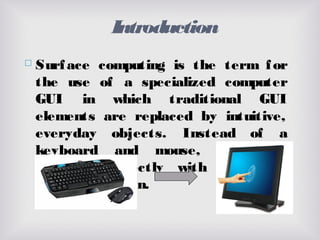
 Surface computing is the term for
the use of a specialized computer
GUI in which traditional GUI
elements are replaced by intuitive,
everyday objects. Instead of a
keyboard and mouse, the user
interacts directly with a touch-
sensitive screen.

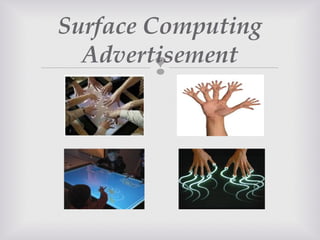
Surface Computing
Advertisement

Description
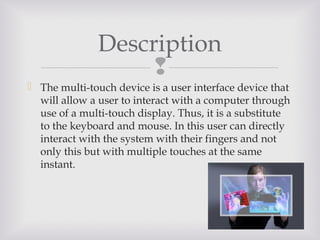
 The multi-touch device is a user interface device that
will allow a user to interact with a computer through
use of a multi-touch display. Thus, it is a substitute
to the keyboard and mouse. In this user can directly
interact with the system with their fingers and not
only this but with multiple touches at the same
instant.

 A basic touch-screen has three main components:
 1. Touch sensor;
 2. Controller;
 3. Software driver.
 The touch-screen is an input device, so it needs to be
combined with a display and a PC or other device to
make a complete touch input system.
How Does a Touchscreen Work? 
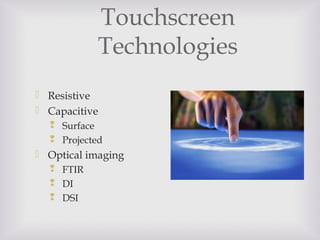
Touchscreen
Technologies
 Resistive
 Capacitive
 Surface
 Projected
 Optical imaging
 FTIR
 DI
 DSI
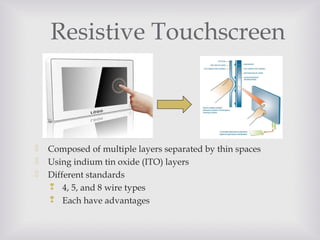
Resistive Touchscreen
 Composed of multiple layers separated by thin spaces
 Using indium tin oxide (ITO) layers
 Different standards
 4, 5, and 8 wire types
 Each have advantages
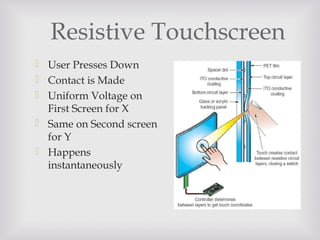
Resistive Touchscreen
 User Presses Down
 Contact is Made
 Uniform Voltage on
First Screen for X
 Same on Second screen
for Y
 Happens
instantaneously
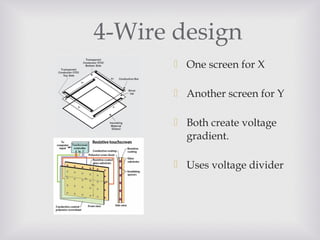
4-Wire design
 One screen for X
 Another screen for Y
 Both create voltage
gradient.
 Uses voltage divider
Advantages & Disadvantages
 Works well with
fingertip or stylus input
 Generally most
affordable touchscreen
technology
 Rugged/Durable
 Has multi-touch input
capabilities
 Not as accurate
 Multi-touch much more
complex
 Usually no discretion
between stylus and
hand
 More pressure needed
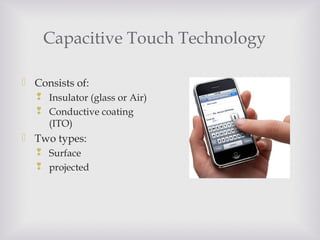
Capacitive Touch Technology
 Consists of:
 Insulator (glass or Air)
 Conductive coating
(ITO)
 Two types:
 Surface
 projected
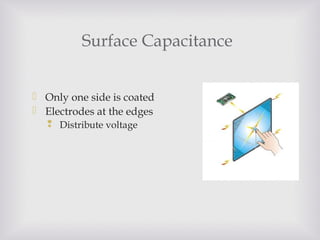
Surface Capacitance
 Only one side is coated
 Electrodes at the edges
 Distribute voltage
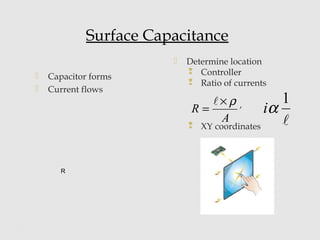
 Capacitor forms
 Current flows
 Determine location
 Controller
 Ratio of currents
,
 XY coordinates
A
R
ρ×
=


1
αi
R
Surface Capacitance
Projected Capacitance
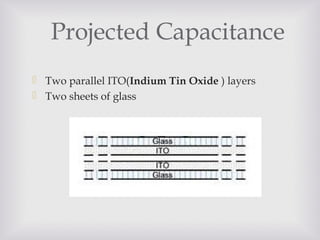
 Two parallel ITO(Indium Tin Oxide ) layers
 Two sheets of glass
Projected Capacitance
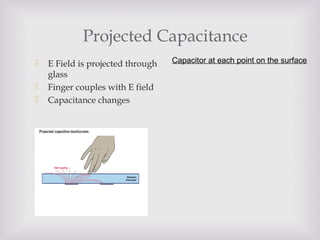
 E Field is projected through
glass
 Finger couples with E field
 Capacitance changes
Capacitor at each point on the surface
Surface vs. Projected
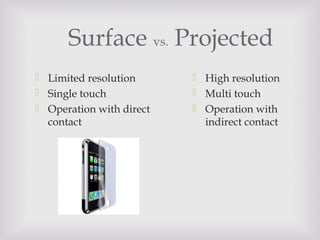
 Limited resolution
 Single touch
 Operation with direct
contact
 High resolution
 Multi touch
 Operation with
indirect contact

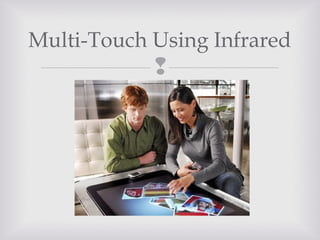
Multi-Touch Using Infrared
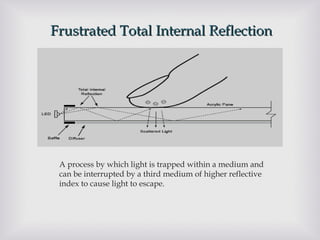
Frustrated Total Internal ReflectionFrustrated Total Internal Reflection
A process by which light is trapped within a medium and
can be interrupted by a third medium of higher reflective
index to cause light to escape.
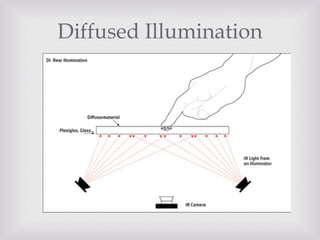
Diffused Illumination

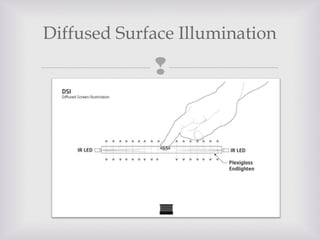
Diffused Surface Illumination
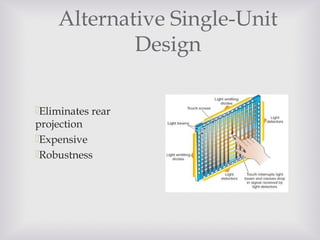
Alternative Single-Unit
Design
Eliminates rear
projection
Expensive
Robustness

Software
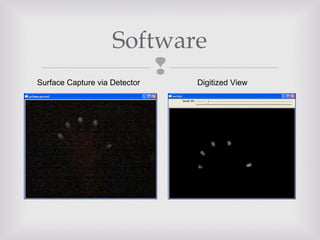
Surface Capture via Detector Digitized View
Software Cont.
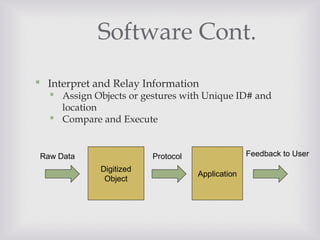
 Interpret and Relay Information
 Assign Objects or gestures with Unique ID# and
location
 Compare and Execute
Digitized
Object
Application
ProtocolRaw Data Feedback to User

 Universal Design Principles
 Utility for all users
 Simple and intuitive
 Touchscreens depend on visual feedback in order to
use
Improving Accessibility?

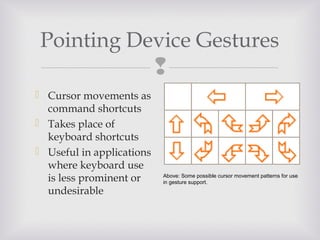
 Cursor movements as
command shortcuts
 Takes place of
keyboard shortcuts
 Useful in applications
where keyboard use
is less prominent or
undesirable
Pointing Device Gestures
Above: Some possible cursor movement patterns for use
in gesture support.
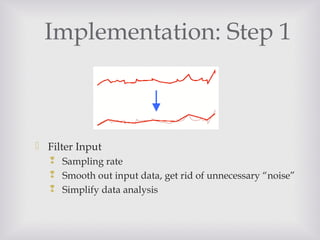
Implementation: Step 1
 Filter Input
 Sampling rate
 Smooth out input data, get rid of unnecessary “noise”
 Simplify data analysis
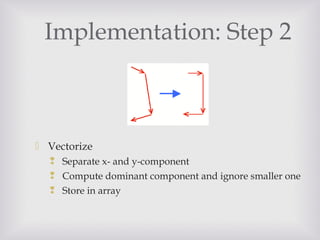
Implementation: Step 2
 Vectorize
 Separate x- and y-component
 Compute dominant component and ignore smaller one
 Store in array
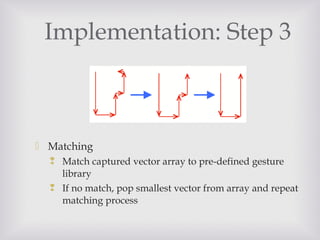
Implementation: Step 3
 Matching
 Match captured vector array to pre-defined gesture
library
 If no match, pop smallest vector from array and repeat
matching process
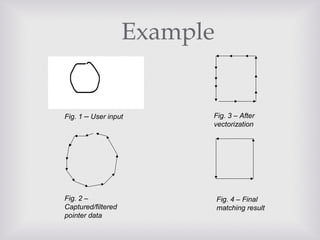
Example
Fig. 1 – User input
Fig. 2 –
Captured/filtered
pointer data
Fig. 3 – After
vectorization
Fig. 4 – Final
matching result

 Allows for a quicker and more efficient UI
 Universal Design
 Enhances usability for visually-impaired as well as
non-impaired
 Easily added to existing touchscreen devices, no
additional hardware required
Goal

 A personal computerwith 20 GBfree hard disk
space, 1GBRAMand PIV + processorcan be
efficient enough.
 The Windows Vista operating systemwas chosen
because the CCV package is highly supported in
Windows.
Computer Subsystem

 Many different platforms can be used to
develop multi-touch applications utilizing
TUIO events. Such platforms include:
 Adobe Flash
 Java
 C++
 Python
Application Development

 Personal Computing
 Graphics
 Audio Mixing
 Video Playing
 ComputerGaming
 Slide Presentations
……and many more!
APPLICATIONS
Touchscreen%20 implementation%20for%20multi touch-new[1] (1)

Touchscreen%20 implementation%20for%20multi touch-new[1] (1)

  • 1.
  • 4.
    Introduction  Surface computingis the term for the use of a specialized computer GUI in which traditional GUI elements are replaced by intuitive, everyday objects. Instead of a keyboard and mouse, the user interacts directly with a touch- sensitive screen.
  • 5.
  • 6.
     Description  The multi-touchdevice is a user interface device that will allow a user to interact with a computer through use of a multi-touch display. Thus, it is a substitute to the keyboard and mouse. In this user can directly interact with the system with their fingers and not only this but with multiple touches at the same instant.
  • 7.
      A basictouch-screen has three main components:  1. Touch sensor;  2. Controller;  3. Software driver.  The touch-screen is an input device, so it needs to be combined with a display and a PC or other device to make a complete touch input system. How Does a Touchscreen Work? 
  • 8.
    Touchscreen Technologies  Resistive  Capacitive Surface  Projected  Optical imaging  FTIR  DI  DSI
  • 9.
    Resistive Touchscreen  Composedof multiple layers separated by thin spaces  Using indium tin oxide (ITO) layers  Different standards  4, 5, and 8 wire types  Each have advantages
  • 10.
    Resistive Touchscreen  UserPresses Down  Contact is Made  Uniform Voltage on First Screen for X  Same on Second screen for Y  Happens instantaneously
  • 11.
    4-Wire design  Onescreen for X  Another screen for Y  Both create voltage gradient.  Uses voltage divider
  • 12.
    Advantages & Disadvantages Works well with fingertip or stylus input  Generally most affordable touchscreen technology  Rugged/Durable  Has multi-touch input capabilities  Not as accurate  Multi-touch much more complex  Usually no discretion between stylus and hand  More pressure needed
  • 13.
    Capacitive Touch Technology Consists of:  Insulator (glass or Air)  Conductive coating (ITO)  Two types:  Surface  projected
  • 14.
    Surface Capacitance  Onlyone side is coated  Electrodes at the edges  Distribute voltage
  • 15.
     Capacitor forms Current flows  Determine location  Controller  Ratio of currents ,  XY coordinates A R ρ× =   1 αi R Surface Capacitance
  • 16.
    Projected Capacitance  Twoparallel ITO(Indium Tin Oxide ) layers  Two sheets of glass
  • 17.
    Projected Capacitance  EField is projected through glass  Finger couples with E field  Capacitance changes Capacitor at each point on the surface
  • 18.
    Surface vs. Projected Limited resolution  Single touch  Operation with direct contact  High resolution  Multi touch  Operation with indirect contact
  • 19.
  • 20.
    Frustrated Total InternalReflectionFrustrated Total Internal Reflection A process by which light is trapped within a medium and can be interrupted by a third medium of higher reflective index to cause light to escape.
  • 21.
  • 22.
  • 23.
  • 24.
     Software Surface Capture viaDetector Digitized View
  • 25.
    Software Cont.  Interpretand Relay Information  Assign Objects or gestures with Unique ID# and location  Compare and Execute Digitized Object Application ProtocolRaw Data Feedback to User
  • 26.
      Universal DesignPrinciples  Utility for all users  Simple and intuitive  Touchscreens depend on visual feedback in order to use Improving Accessibility?
  • 27.
      Cursor movementsas command shortcuts  Takes place of keyboard shortcuts  Useful in applications where keyboard use is less prominent or undesirable Pointing Device Gestures Above: Some possible cursor movement patterns for use in gesture support.
  • 28.
    Implementation: Step 1 Filter Input  Sampling rate  Smooth out input data, get rid of unnecessary “noise”  Simplify data analysis
  • 29.
    Implementation: Step 2 Vectorize  Separate x- and y-component  Compute dominant component and ignore smaller one  Store in array
  • 30.
    Implementation: Step 3 Matching  Match captured vector array to pre-defined gesture library  If no match, pop smallest vector from array and repeat matching process
  • 31.
    Example Fig. 1 –User input Fig. 2 – Captured/filtered pointer data Fig. 3 – After vectorization Fig. 4 – Final matching result
  • 32.
      Allows fora quicker and more efficient UI  Universal Design  Enhances usability for visually-impaired as well as non-impaired  Easily added to existing touchscreen devices, no additional hardware required Goal
  • 33.
      A personalcomputerwith 20 GBfree hard disk space, 1GBRAMand PIV + processorcan be efficient enough.  The Windows Vista operating systemwas chosen because the CCV package is highly supported in Windows. Computer Subsystem
  • 34.
      Many differentplatforms can be used to develop multi-touch applications utilizing TUIO events. Such platforms include:  Adobe Flash  Java  C++  Python Application Development
  • 35.
      Personal Computing Graphics  Audio Mixing  Video Playing  ComputerGaming  Slide Presentations ……and many more! APPLICATIONS

Editor's Notes