A Case Study On Statistical process control (SPC)
Submitted By –SHANKHA SHUBHRA GOSWAMI
M.Tech. 2nd semester
ROLL NO – 17101203011
DEPARTMENT –MECHANICAL ENGINEERING
Introduction
• Statistical process control (SPC) is a method of quality control which
employs statistical methods to monitor and control a process. ... An
example of aprocess where SPC is applied is manufacturing lines.
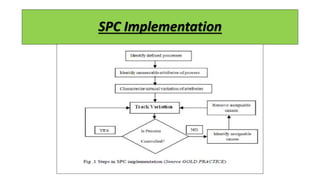
SPC Implementation
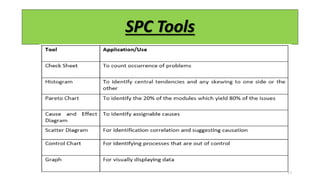
SPC Tools
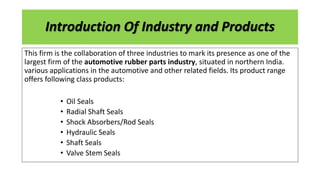
Introduction Of Industry and Products
This firm is the collaboration of three industries to mark its presence as one of the
largest firm of the automotive rubber parts industry, situated in northern India.
various applications in the automotive and other related fields. Its product range
offers following class products:
• Oil Seals
• Radial Shaft Seals
• Shock Absorbers/Rod Seals
• Hydraulic Seals
• Shaft Seals
• Valve Stem Seals
Continued..
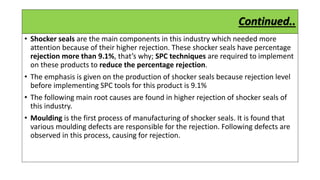
• Shocker seals are the main components in this industry which needed more
attention because of their higher rejection. These shocker seals have percentage
rejection more than 9.1%, that’s why; SPC techniques are required to implement
on these products to reduce the percentage rejection.
• The emphasis is given on the production of shocker seals because rejection level
before implementing SPC tools for this product is 9.1%
• The following main root causes are found in higher rejection of shocker seals of
this industry.
• Moulding is the first process of manufacturing of shocker seals. It is found that
various moulding defects are responsible for the rejection. Following defects are
observed in this process, causing for rejection.
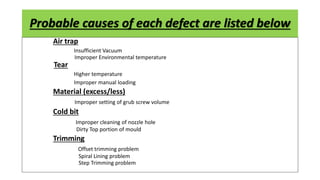
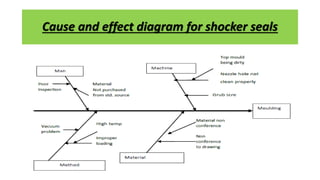
Probable causes of each defect are listed below
Air trap
Insufficient Vacuum
Improper Environmental temperature
Tear
Higher temperature
Improper manual loading
Material (excess/less)
Improper setting of grub screw volume
Cold bit
Improper cleaning of nozzle hole
Dirty Top portion of mould
Trimming
Offset trimming problem
Spiral Lining problem
Step Trimming problem
Cause and effect diagram for shocker seals
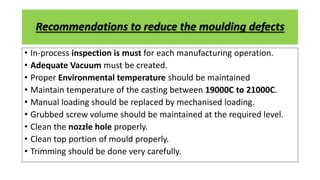
Recommendations to reduce the moulding defects
• In-process inspection is must for each manufacturing operation.
• Adequate Vacuum must be created.
• Proper Environmental temperature should be maintained
• Maintain temperature of the casting between 19000C to 21000C.
• Manual loading should be replaced by mechanised loading.
• Grubbed screw volume should be maintained at the required level.
• Clean the nozzle hole properly.
• Clean top portion of mould properly.
• Trimming should be done very carefully.
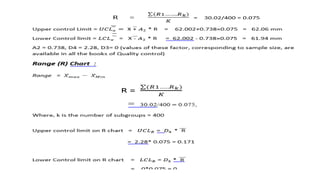
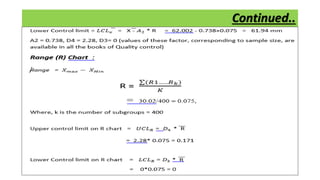
IMPLEMENTATION OF (X) AND RANGE (R)
CHARTS TO DIAMETERS OF SHOCKER SEALS :
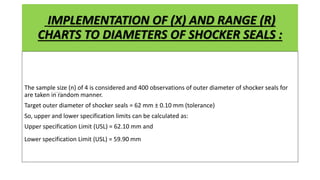
The sample size (n) of 4 is considered and 400 observations of outer diameter of shocker seals for
are taken in random manner.
Target outer diameter of shocker seals = 62 mm ± 0.10 mm (tolerance)
So, upper and lower specification limits can be calculated as:
Upper specification Limit (USL) = 62.10 mm and
Lower specification Limit (USL) = 59.90 mm
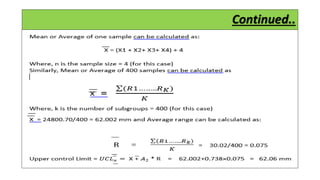
Continued..
Continued..
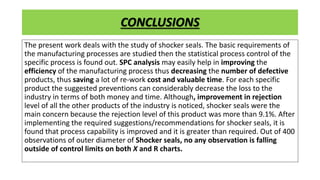
CONCLUSIONS
The present work deals with the study of shocker seals. The basic requirements of
the manufacturing processes are studied then the statistical process control of the
specific process is found out. SPC analysis may easily help in improving the
efficiency of the manufacturing process thus decreasing the number of defective
products, thus saving a lot of re-work cost and valuable time. For each specific
product the suggested preventions can considerably decrease the loss to the
industry in terms of both money and time. Although, improvement in rejection
level of all the other products of the industry is noticed, shocker seals were the
main concern because the rejection level of this product was more than 9.1%. After
implementing the required suggestions/recommendations for shocker seals, it is
found that process capability is improved and it is greater than required. Out of 400
observations of outer diameter of Shocker seals, no any observation is falling
outside of control limits on both X and R charts.
Reference
• Application of Statistical Process Control (SPC) in Manufacturing
Industry in a Developing Country.
By [Ignatio Madanhire,*, Charles Mbohwa]
• Implementation of SPC Techniques in Automotive Industry
By Dr. D. R. Prajapati
(Website: www.ijetae.com (ISSN 2250-2459, Volume 2, Issue 3,
March 2012)
• Wikipedia

Statistical process control

  • 1.
    A Case StudyOn Statistical process control (SPC) Submitted By –SHANKHA SHUBHRA GOSWAMI M.Tech. 2nd semester ROLL NO – 17101203011 DEPARTMENT –MECHANICAL ENGINEERING
  • 2.
    Introduction • Statistical processcontrol (SPC) is a method of quality control which employs statistical methods to monitor and control a process. ... An example of aprocess where SPC is applied is manufacturing lines.
  • 3.
  • 4.
  • 5.
    Introduction Of Industryand Products This firm is the collaboration of three industries to mark its presence as one of the largest firm of the automotive rubber parts industry, situated in northern India. various applications in the automotive and other related fields. Its product range offers following class products: • Oil Seals • Radial Shaft Seals • Shock Absorbers/Rod Seals • Hydraulic Seals • Shaft Seals • Valve Stem Seals
  • 6.
    Continued.. • Shocker sealsare the main components in this industry which needed more attention because of their higher rejection. These shocker seals have percentage rejection more than 9.1%, that’s why; SPC techniques are required to implement on these products to reduce the percentage rejection. • The emphasis is given on the production of shocker seals because rejection level before implementing SPC tools for this product is 9.1% • The following main root causes are found in higher rejection of shocker seals of this industry. • Moulding is the first process of manufacturing of shocker seals. It is found that various moulding defects are responsible for the rejection. Following defects are observed in this process, causing for rejection.
  • 7.
    Probable causes ofeach defect are listed below Air trap Insufficient Vacuum Improper Environmental temperature Tear Higher temperature Improper manual loading Material (excess/less) Improper setting of grub screw volume Cold bit Improper cleaning of nozzle hole Dirty Top portion of mould Trimming Offset trimming problem Spiral Lining problem Step Trimming problem
  • 8.
    Cause and effectdiagram for shocker seals
  • 9.
    Recommendations to reducethe moulding defects • In-process inspection is must for each manufacturing operation. • Adequate Vacuum must be created. • Proper Environmental temperature should be maintained • Maintain temperature of the casting between 19000C to 21000C. • Manual loading should be replaced by mechanised loading. • Grubbed screw volume should be maintained at the required level. • Clean the nozzle hole properly. • Clean top portion of mould properly. • Trimming should be done very carefully.
  • 10.
    IMPLEMENTATION OF (X)AND RANGE (R) CHARTS TO DIAMETERS OF SHOCKER SEALS : The sample size (n) of 4 is considered and 400 observations of outer diameter of shocker seals for are taken in random manner. Target outer diameter of shocker seals = 62 mm ± 0.10 mm (tolerance) So, upper and lower specification limits can be calculated as: Upper specification Limit (USL) = 62.10 mm and Lower specification Limit (USL) = 59.90 mm
  • 11.
  • 13.
  • 14.
    CONCLUSIONS The present workdeals with the study of shocker seals. The basic requirements of the manufacturing processes are studied then the statistical process control of the specific process is found out. SPC analysis may easily help in improving the efficiency of the manufacturing process thus decreasing the number of defective products, thus saving a lot of re-work cost and valuable time. For each specific product the suggested preventions can considerably decrease the loss to the industry in terms of both money and time. Although, improvement in rejection level of all the other products of the industry is noticed, shocker seals were the main concern because the rejection level of this product was more than 9.1%. After implementing the required suggestions/recommendations for shocker seals, it is found that process capability is improved and it is greater than required. Out of 400 observations of outer diameter of Shocker seals, no any observation is falling outside of control limits on both X and R charts.
  • 15.
    Reference • Application ofStatistical Process Control (SPC) in Manufacturing Industry in a Developing Country. By [Ignatio Madanhire,*, Charles Mbohwa] • Implementation of SPC Techniques in Automotive Industry By Dr. D. R. Prajapati (Website: www.ijetae.com (ISSN 2250-2459, Volume 2, Issue 3, March 2012) • Wikipedia