TOTAL PRODUCTIVE
MAINTENANCE
BY- SHANKHA SHUBHRA GOSWAMI
M. TECH
ROLL NO-17101203011
CASE STUDY
WHAT IS TPM???
TPM is a unique Japanese philosophy which has been developed
based on the productive maintenance concepts and
methodologies. Total Productive Maintenance is an innovative
approach to maintenance that optimizes equipment effectiveness,
eliminates breakdowns and promotes autonomous maintenance
by operators through day-to-day activities involving total
workforce. TPM is a production driven improvement methodology
that enhance the equipment reliability and ensure effectual
management of plant assets using employee involvement and
empowerment, by linking maintenance, manufacturing and
engineering functions. The key objective of an effective TPM
initiative is to bring critical maintenance skilled trades and
production workers together with its three ultimate goals: Zero
breakdowns, Zero defects and Zero accidents.
TPM PILLARS
The eight pillars of TPM are mostly focused on proactive and preventive
techniques for improving equipment reliability:
1) Autonomous Maintenance
2) Focused Improvement
3) Planned Maintenance
4) Quality management
5) Early/equipment management
6) Education and Training
7) Safety Health Environment
8) Administrative & office TPM
TPM starts with 5S. It is a systematic process of housekeeping to achieve a
serene environment in the work place involving the employees with a
commitment to sincerely implement and practice housekeeping. Problems
cannot be clearly seen when the work place is unorganized. Cleaning and
organizing the workplace helps the team to uncover problems. Making problems
visible is the first step of improvement. 5S is a foundation program before the
implementation of TPM.
5’S OF TPM
5S is the name of a workplace organization method that uses a list
of five Japanese words : seiri, seiton, seiso, seiketsu and shitsuke.
There are five primary 5S phases: sorting, set in order, systematic
cleaning, standardizing and sustaining.
STEPS IN TPM IMPLEMENTATION
Following are the steps involved in the
implementation of TPM in an organization:
 Step 1: Announcement of TPM .
 Step 2: Launch a formal education program.
 Step 3: Create an organizational support structure.
 Step 4: Establish basic TPM policies and quantifiable goals.
 Step 5: Outline a detailed master deployment plan.
 Step 6: TPM kick-off. Implementation will begin at this stage.
 Step 7: Improve effectiveness of each piece of equipment.
 Step 8: Develop an autonomous maintenance program for
operators.
 Step 9: Develop a planned or preventive maintenance program.
 Step 10: Conduct training to improve operation and maintenance
skills.
 Step 11: Develop an early equipment management program.
 Step 12: Continuous Improvement.
CASE STUDY OF AN AUTOMOBILE
MANUFACTURING ORGANIZATION
The case study reported in this paper has been
conducted at an automobile manufacturing two
wheeler plant in SIDCUL, Haridwar. The management
of the company observed that maintenance costs
increased for 30-40 percent of the production costs
and emergency repairs were three times more
expensive then the same job done in pre-planned
manner. Since the plant facilities and manufacturing
processes were extremely equipment intensive and
the data collection and analysis process revealed that
the total idle time for the critical process equipment
was observed to be extremely high which was not at
all acceptable under the prevailing circumstances.
Thus, the need for fostering an efficient TPM
implementation program was felt fundamentally
necessary.
TPM IMPLEMENTATION IN AUTOMOBILE
MANUFACTURING
TPM implementation started with the selection of key model
machines and measurement of TPM effectiveness with initiation
of four activities – 5S Implementation, Autonomous Maintenance,
focused improvement, planned maintenance and OEE have been
implemented. A maintenance plan has also been prepared.
The main implementation was done by,
1) Selection of machines and replacing old machineries with new and
modified technological equipments.
2) The processes are carried out in a pre planned manner an thus the
sequence of operation is well maintained.
3) Employing educated workers who can handle the equipments more
effectively and get maximum output from the machine.
4) Training employees on working on particular specified machineries
and creating awareness among them.
5) Allotting disciplined and punctual workers so that the machine idle
time can be reduced, therefore running the machine for a longer time
and obtaining more output.
TPM IMPLEMENTATION IN AUTOMOBILE
MANUFACTURING
The first step of this work is selection of machines on which the
study is carried out. To start with TPM, a few machines have been
selected for implementation of TPM, which is known as TPM
model machine. In that Organization, there are seven shops. Four
machines have been selected from Light Machine Shop (LMS)
i.e. 2 Broaching machines, 1 Cylindrical Grinder and 1 Surface
Grinder for TPM implementation. This section was named as
TPM model section in Light Machine Shop. These machines are
used in production of components like bull gear, shafts for power
transmission etc. A code is assigned to each machine for ease of
identification. Each machine is studied thoroughly to identify each
part and to understand the working of every component. OEE is
calculated for all the machines before and after implementation
as shown in next 3 Tables.
OVERALL EQUIPMENT EFFECTIVENESS
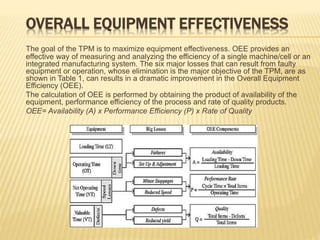
The goal of the TPM is to maximize equipment effectiveness. OEE provides an
effective way of measuring and analyzing the efficiency of a single machine/cell or an
integrated manufacturing system. The six major losses that can result from faulty
equipment or operation, whose elimination is the major objective of the TPM, are as
shown in Table 1, can results in a dramatic improvement in the Overall Equipment
Efficiency (OEE).
The calculation of OEE is performed by obtaining the product of availability of the
equipment, performance efficiency of the process and rate of quality products.
OEE= Availability (A) x Performance Efficiency (P) x Rate of Quality
AVAILABILITY
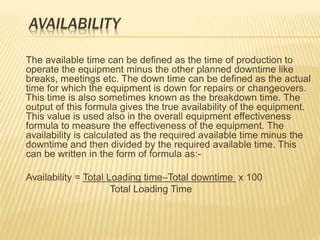
The available time can be defined as the time of production to
operate the equipment minus the other planned downtime like
breaks, meetings etc. The down time can be defined as the actual
time for which the equipment is down for repairs or changeovers.
This time is also sometimes known as the breakdown time. The
output of this formula gives the true availability of the equipment.
This value is used also in the overall equipment effectiveness
formula to measure the effectiveness of the equipment. The
availability is calculated as the required available time minus the
downtime and then divided by the required available time. This
can be written in the form of formula as:-
Availability = Total Loading time–Total downtime x 100
Total Loading Time
PERFORMANCE EFFICIENCY
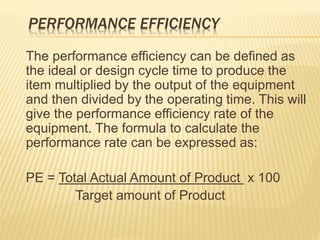
The performance efficiency can be defined as
the ideal or design cycle time to produce the
item multiplied by the output of the equipment
and then divided by the operating time. This will
give the performance efficiency rate of the
equipment. The formula to calculate the
performance rate can be expressed as:
PE = Total Actual Amount of Product x 100
Target amount of Product
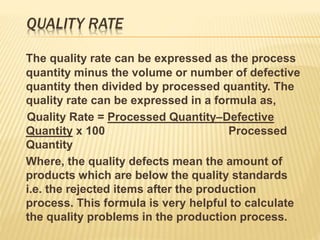
QUALITY RATE
The quality rate can be expressed as the process
quantity minus the volume or number of defective
quantity then divided by processed quantity. The
quality rate can be expressed in a formula as,
Quality Rate = Processed Quantity–Defective
Quantity x 100 Processed
Quantity
Where, the quality defects mean the amount of
products which are below the quality standards
i.e. the rejected items after the production
process. This formula is very helpful to calculate
the quality problems in the production process.
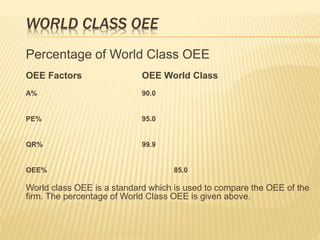
WORLD CLASS OEE
Percentage of World Class OEE
OEE Factors OEE World Class
A% 90.0
PE% 95.0
QR% 99.9
OEE% 85.0
World class OEE is a standard which is used to compare the OEE of the
firm. The percentage of World Class OEE is given above.
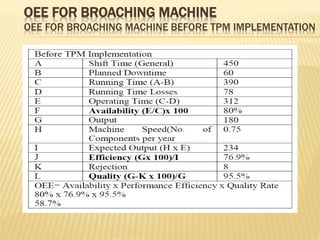
OEE FOR BROACHING MACHINE
OEE FOR BROACHING MACHINE BEFORE TPM IMPLEMENTATION
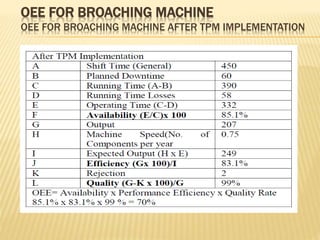
OEE FOR BROACHING MACHINE
OEE FOR BROACHING MACHINE AFTER TPM IMPLEMENTATION
IMPROVEMENT DONE BY THE IMPLEMENTATION
1) Running time losses is reduced, thereby reducing the Idle
time of the machine.
2) The production or expected output is increases as the idle
time decreases and the availability increases.
3) The efficiency also increases as the output increases
instead of the input remaining the same.
4) The accuracy is highly increased and thus the rejection of
products becomes much less.
5) There is high increase in the quality of products produced
and therefore the rejection becomes less.
As a result of these, the Overall Equipment Efficiency (OEE)
increases and hence this implementation is successful.
OEE IMPROVEMENT BEFORE AND AFTER TPM
IMPLEMENTATION
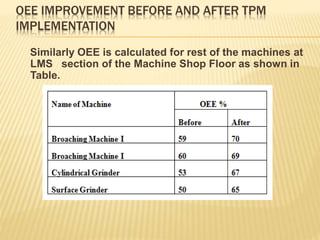
Similarly OEE is calculated for rest of the machines at
LMS section of the Machine Shop Floor as shown in
Table.
CONCLUSION
It can be seen that OEE has shown a progressive growth as
shown in last table, which is an indication of increase in
equipment availability, decrease in rework, rejection and increase
in rate of performance. Today, with competition in industry at an
all time high, TPM may be the only thing that stands between
success and total failure for some companies TPM can be
adapted to work not only in industrial plants, but also in
construction, building maintenance, transportation, and in variety
of other situations. Employees must be educated and convinced
that TPM is not just another program of the month and that
management is totally committed to the program and the
extended time frame is necessary for full implementation. If
everyone involved in a TPM program does his or her part, a
usually high rate of return compared to resources invested may
be expected. TPM success requires strong and active support
from management, clear organizational goals and objectives for
TPM implementation.

total productive maintenance

  • 1.
    TOTAL PRODUCTIVE MAINTENANCE BY- SHANKHASHUBHRA GOSWAMI M. TECH ROLL NO-17101203011 CASE STUDY
  • 2.
    WHAT IS TPM??? TPMis a unique Japanese philosophy which has been developed based on the productive maintenance concepts and methodologies. Total Productive Maintenance is an innovative approach to maintenance that optimizes equipment effectiveness, eliminates breakdowns and promotes autonomous maintenance by operators through day-to-day activities involving total workforce. TPM is a production driven improvement methodology that enhance the equipment reliability and ensure effectual management of plant assets using employee involvement and empowerment, by linking maintenance, manufacturing and engineering functions. The key objective of an effective TPM initiative is to bring critical maintenance skilled trades and production workers together with its three ultimate goals: Zero breakdowns, Zero defects and Zero accidents.
  • 3.
    TPM PILLARS The eightpillars of TPM are mostly focused on proactive and preventive techniques for improving equipment reliability: 1) Autonomous Maintenance 2) Focused Improvement 3) Planned Maintenance 4) Quality management 5) Early/equipment management 6) Education and Training 7) Safety Health Environment 8) Administrative & office TPM TPM starts with 5S. It is a systematic process of housekeeping to achieve a serene environment in the work place involving the employees with a commitment to sincerely implement and practice housekeeping. Problems cannot be clearly seen when the work place is unorganized. Cleaning and organizing the workplace helps the team to uncover problems. Making problems visible is the first step of improvement. 5S is a foundation program before the implementation of TPM.
  • 4.
    5’S OF TPM 5Sis the name of a workplace organization method that uses a list of five Japanese words : seiri, seiton, seiso, seiketsu and shitsuke. There are five primary 5S phases: sorting, set in order, systematic cleaning, standardizing and sustaining.
  • 5.
    STEPS IN TPMIMPLEMENTATION Following are the steps involved in the implementation of TPM in an organization:  Step 1: Announcement of TPM .  Step 2: Launch a formal education program.  Step 3: Create an organizational support structure.  Step 4: Establish basic TPM policies and quantifiable goals.  Step 5: Outline a detailed master deployment plan.  Step 6: TPM kick-off. Implementation will begin at this stage.  Step 7: Improve effectiveness of each piece of equipment.  Step 8: Develop an autonomous maintenance program for operators.  Step 9: Develop a planned or preventive maintenance program.  Step 10: Conduct training to improve operation and maintenance skills.  Step 11: Develop an early equipment management program.  Step 12: Continuous Improvement.
  • 6.
    CASE STUDY OFAN AUTOMOBILE MANUFACTURING ORGANIZATION The case study reported in this paper has been conducted at an automobile manufacturing two wheeler plant in SIDCUL, Haridwar. The management of the company observed that maintenance costs increased for 30-40 percent of the production costs and emergency repairs were three times more expensive then the same job done in pre-planned manner. Since the plant facilities and manufacturing processes were extremely equipment intensive and the data collection and analysis process revealed that the total idle time for the critical process equipment was observed to be extremely high which was not at all acceptable under the prevailing circumstances. Thus, the need for fostering an efficient TPM implementation program was felt fundamentally necessary.
  • 7.
    TPM IMPLEMENTATION INAUTOMOBILE MANUFACTURING TPM implementation started with the selection of key model machines and measurement of TPM effectiveness with initiation of four activities – 5S Implementation, Autonomous Maintenance, focused improvement, planned maintenance and OEE have been implemented. A maintenance plan has also been prepared. The main implementation was done by, 1) Selection of machines and replacing old machineries with new and modified technological equipments. 2) The processes are carried out in a pre planned manner an thus the sequence of operation is well maintained. 3) Employing educated workers who can handle the equipments more effectively and get maximum output from the machine. 4) Training employees on working on particular specified machineries and creating awareness among them. 5) Allotting disciplined and punctual workers so that the machine idle time can be reduced, therefore running the machine for a longer time and obtaining more output.
  • 8.
    TPM IMPLEMENTATION INAUTOMOBILE MANUFACTURING The first step of this work is selection of machines on which the study is carried out. To start with TPM, a few machines have been selected for implementation of TPM, which is known as TPM model machine. In that Organization, there are seven shops. Four machines have been selected from Light Machine Shop (LMS) i.e. 2 Broaching machines, 1 Cylindrical Grinder and 1 Surface Grinder for TPM implementation. This section was named as TPM model section in Light Machine Shop. These machines are used in production of components like bull gear, shafts for power transmission etc. A code is assigned to each machine for ease of identification. Each machine is studied thoroughly to identify each part and to understand the working of every component. OEE is calculated for all the machines before and after implementation as shown in next 3 Tables.
  • 9.
    OVERALL EQUIPMENT EFFECTIVENESS Thegoal of the TPM is to maximize equipment effectiveness. OEE provides an effective way of measuring and analyzing the efficiency of a single machine/cell or an integrated manufacturing system. The six major losses that can result from faulty equipment or operation, whose elimination is the major objective of the TPM, are as shown in Table 1, can results in a dramatic improvement in the Overall Equipment Efficiency (OEE). The calculation of OEE is performed by obtaining the product of availability of the equipment, performance efficiency of the process and rate of quality products. OEE= Availability (A) x Performance Efficiency (P) x Rate of Quality
  • 10.
    AVAILABILITY The available timecan be defined as the time of production to operate the equipment minus the other planned downtime like breaks, meetings etc. The down time can be defined as the actual time for which the equipment is down for repairs or changeovers. This time is also sometimes known as the breakdown time. The output of this formula gives the true availability of the equipment. This value is used also in the overall equipment effectiveness formula to measure the effectiveness of the equipment. The availability is calculated as the required available time minus the downtime and then divided by the required available time. This can be written in the form of formula as:- Availability = Total Loading time–Total downtime x 100 Total Loading Time
  • 11.
    PERFORMANCE EFFICIENCY The performanceefficiency can be defined as the ideal or design cycle time to produce the item multiplied by the output of the equipment and then divided by the operating time. This will give the performance efficiency rate of the equipment. The formula to calculate the performance rate can be expressed as: PE = Total Actual Amount of Product x 100 Target amount of Product
  • 12.
    QUALITY RATE The qualityrate can be expressed as the process quantity minus the volume or number of defective quantity then divided by processed quantity. The quality rate can be expressed in a formula as, Quality Rate = Processed Quantity–Defective Quantity x 100 Processed Quantity Where, the quality defects mean the amount of products which are below the quality standards i.e. the rejected items after the production process. This formula is very helpful to calculate the quality problems in the production process.
  • 13.
    WORLD CLASS OEE Percentageof World Class OEE OEE Factors OEE World Class A% 90.0 PE% 95.0 QR% 99.9 OEE% 85.0 World class OEE is a standard which is used to compare the OEE of the firm. The percentage of World Class OEE is given above.
  • 14.
    OEE FOR BROACHINGMACHINE OEE FOR BROACHING MACHINE BEFORE TPM IMPLEMENTATION
  • 15.
    OEE FOR BROACHINGMACHINE OEE FOR BROACHING MACHINE AFTER TPM IMPLEMENTATION
  • 16.
    IMPROVEMENT DONE BYTHE IMPLEMENTATION 1) Running time losses is reduced, thereby reducing the Idle time of the machine. 2) The production or expected output is increases as the idle time decreases and the availability increases. 3) The efficiency also increases as the output increases instead of the input remaining the same. 4) The accuracy is highly increased and thus the rejection of products becomes much less. 5) There is high increase in the quality of products produced and therefore the rejection becomes less. As a result of these, the Overall Equipment Efficiency (OEE) increases and hence this implementation is successful.
  • 17.
    OEE IMPROVEMENT BEFOREAND AFTER TPM IMPLEMENTATION Similarly OEE is calculated for rest of the machines at LMS section of the Machine Shop Floor as shown in Table.
  • 18.
    CONCLUSION It can beseen that OEE has shown a progressive growth as shown in last table, which is an indication of increase in equipment availability, decrease in rework, rejection and increase in rate of performance. Today, with competition in industry at an all time high, TPM may be the only thing that stands between success and total failure for some companies TPM can be adapted to work not only in industrial plants, but also in construction, building maintenance, transportation, and in variety of other situations. Employees must be educated and convinced that TPM is not just another program of the month and that management is totally committed to the program and the extended time frame is necessary for full implementation. If everyone involved in a TPM program does his or her part, a usually high rate of return compared to resources invested may be expected. TPM success requires strong and active support from management, clear organizational goals and objectives for TPM implementation.