1
INTRODUCTION TO MPI
MPI is a non-destructive testing method used for the inspection of ferromagnetic materials.
Magnetic Particle inspection detects surface flaws and slightly subsurface discontinuities present in the material
It uses magnetic fields and magnetic particles for detecting flaws.
It is popular ,fast , accurate, easy to apply and low cost method.
MPI inspect a variety of products including forging , casting, wire, rod, sheet, bar stock, blooms, slabs, billets, gears,
cylinder, discs and weldment parts.
Industries that uses MPI are automotive , aerospace, petrochemical , and structural steel.
2
Magnetism and ferromagnetic materials
 Magnetism is a force of attraction
or repulsion and this is due to
electric currents and magnetic
moments which gives rise to
magnetic field
 Ferromagnetic materials show
a long-range of
ordering phenomenon at the
atomic level which causes the
unpaired electron spins to line up
parallel with each other in a region
called a domain.
3
Example of ferromagnetic materials
 Elements
1. Iron
2. Nickel
3. Cobalt
 Alloys
1. Carbon Steel
2. Cast Iron
4
working principle
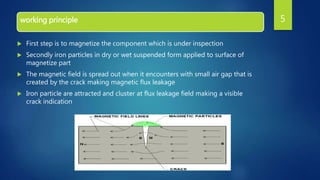
 First step is to magnetize the component which is under inspection
 Secondly iron particles in dry or wet suspended form applied to surface of
magnetize part
 The magnetic field is spread out when it encounters with small air gap that is
created by the crack making magnetic flux leakage
 Iron particle are attracted and cluster at flux leakage field making a visible
crack indication
5
PROCEDURE
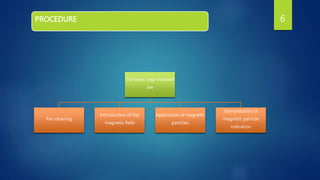
The basic step involved
are
Pre-cleaning
Introduction of the
magnetic field
Application of magnetic
particles
Interpretation of
magnetic particle
indication
6
PRE-CLEANING
 The component must be
cleaned and dry before starting
the inspection
 Oil or grease presence disturb
the process and prevent the
attraction of magnetic particle
to leakage field
 Contaminants also interfere
with interpretation of
indications
7
Introduction of magnetic field
Magnetic field can be introduced by different ways:
1. Flowing an electric current through specimen(Direct Magnetization)
2. By using permanent magnet or electromagnet(Indirect Magnetization)
3. Using a coil for production of magnetic field(Indirect Magnetization)
8
Direction of magnetic field
 Since flaws can occur in various directions
,two type of magnetic fields are there
 Detection of crack is determined when
magnetic lines of force are at right angle to
the longest dimension of the defect
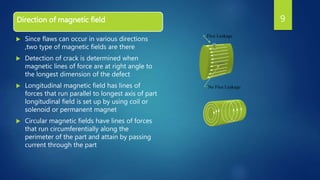
 Longitudinal magnetic field has lines of
forces that run parallel to longest axis of part
longitudinal field is set up by using coil or
solenoid or permanent magnet
 Circular magnetic fields have lines of forces
that run circumferentially along the
perimeter of the part and attain by passing
current through the part
9
Flux Leakage
No Flux Leakage
Types of current used in MPI
 Both types of current can be used in the process (i.e. A.C and D.C)
 Dc current is more desirable when detecting surface defects because DC
generate a magnetic field that penetrate deeper into the material
 Change in magnetic field produces eddy currents in the test object
 The eddy current produces a magnetic field that opposes the primary field ,
reducing the net flux below the surface
10
Portable equipment
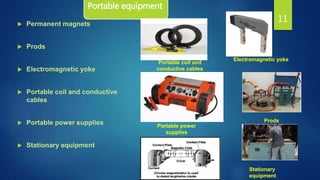
 Permanent magnets
 Prods
 Electromagnetic yoke
 Portable coil and conductive
cables
 Portable power supplies
 Stationary equipment
11
Electromagnetic yoke
Prods
Portable coil and
conductive cables
Portable power
supplies
Stationary
equipment
Application of magnetic particles
 There are two methods for the application of magnetic media
1. Dry method - it is a more portable
2. Wet method - sensitive as liquid carrier particles give extra mobility
 Dry magnetic particles usually have number of colours so that a high degree of
contrast must be obtained between dry particles and part which is required to be
inspected
 Wet particle are provided in a wet suspension of water or oil
 Wet particles are supplied as fluorescent particles
12
ADVANTAGES OF MPI:
 Can detect both surface and sub-surface flaws.
 Can inspect parts having intricate, irregular shapes easily.
 Pre cleaning of components is not much critical as it is for some other
inspection techniques. Most of the contaminants present in a flaw will
not hinder flaw detectability.
 Fast method of inspection and indications are quite visible on the
specimen surface.
 Equipments costs are relatively low.
 High sensitive (can detect small flaws).
13
LIMITATIONS OF MPI:
Cannot inspect non-ferrous materials such as aluminum,
magnesium, copper, lead, zinc, tin etc.
Large currents are needed for large parts.
Paints and other coverings adversely affects sensitivity of process.
Requires relatively smooth surface.
Post cleaning is often necessary.
Only ferromagnetic materials can be inspected.
14
Research Article
AUTOMATED SYSTEM FOR MAGNETIC PARTICLE INSPECTION OF RAILWAY WHEELS 15
• It is an advanced technique used for flaw
detection. The main goal was to develop
the highly reliable system that gives a
warning of surface flaws to prevent
possible future accidents. By this
technique, cracks are visible by using high
resolution digital camera.
• Desired wheel diameter is between 500-
1300 mm. The minimal size of detected
flaw was determined to 1 mm in length
and 0.3 mm in thickness.
• Then the coil is used for the
magnetization of the inspected wheel.
The whole volume of railway wheel must
have to be magnetized.
• So, in order to ensure complete
magnetization, instead of one, two coils
are used.
• For proper configuration of coils and
location of railway wheel, the first
measurements were performed.
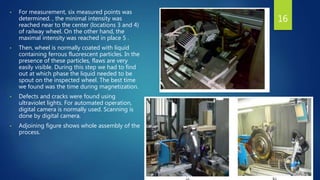
• For measurement, six measured points was
determined. , the minimal intensity was
reached near to the center (locations 3 and 4)
of railway wheel. On the other hand, the
maximal intensity was reached in place 5 .
• Then, wheel is normally coated with liquid
containing ferrous fluorescent particles. In the
presence of these particles, flaws are very
easily visible. During this step we had to find
out at which phase the liquid needed to be
spout on the inspected wheel. The best time
we found was the time during magnetization.
• Defects and cracks were found using
ultraviolet lights. For automated operation,
digital camera is normally used. Scanning is
done by digital camera.
• Adjoining figure shows whole assembly of the
process.
16
Defect Detection and Classification:
 Noise Reduction:
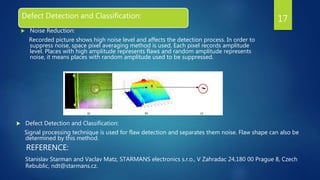
Recorded picture shows high noise level and affects the detection process. In order to
suppress noise, space pixel averaging method is used. Each pixel records amplitude
level. Places with high amplitude represents flaws and random amplitude represents
noise, it means places with random amplitude used to be suppressed.
17
 Defect Detection and Classification:
Signal processing technique is used for flaw detection and separates them noise. Flaw shape can also be
determined by this method.
REFERENCE:
Stanislav Starman and Vaclav Matz, STARMANS electronics s.r.o., V Zahradac 24,180 00 Prague 8, Czech
Rebublic, ndt@starmans.cz.
Conclusion
IT IS AN INNOVATIVE METHOD HAVING THE ADVANTAGES OF VERY HIGH-
EFFICIENCY, HIGH-ACCURACY AND CONVENIENCE. THIS TECHNIQUE CAN FULFIL
THE SPECIAL INSPECTION TASKS OF TESTING PIPELINES, RAILWAY WHEELS AND
OTHER STRUCTURAL COMPONENTS ETC WHICH ARE NECESSARY AND RELIABLE
SOURCES OF OPERATIONS IN DAILY LIFE.
18
19
20

Magnetic particle-inspection-modified-1

  • 1.
  • 2.
    INTRODUCTION TO MPI MPIis a non-destructive testing method used for the inspection of ferromagnetic materials. Magnetic Particle inspection detects surface flaws and slightly subsurface discontinuities present in the material It uses magnetic fields and magnetic particles for detecting flaws. It is popular ,fast , accurate, easy to apply and low cost method. MPI inspect a variety of products including forging , casting, wire, rod, sheet, bar stock, blooms, slabs, billets, gears, cylinder, discs and weldment parts. Industries that uses MPI are automotive , aerospace, petrochemical , and structural steel. 2
  • 3.
    Magnetism and ferromagneticmaterials  Magnetism is a force of attraction or repulsion and this is due to electric currents and magnetic moments which gives rise to magnetic field  Ferromagnetic materials show a long-range of ordering phenomenon at the atomic level which causes the unpaired electron spins to line up parallel with each other in a region called a domain. 3
  • 4.
    Example of ferromagneticmaterials  Elements 1. Iron 2. Nickel 3. Cobalt  Alloys 1. Carbon Steel 2. Cast Iron 4
  • 5.
    working principle  Firststep is to magnetize the component which is under inspection  Secondly iron particles in dry or wet suspended form applied to surface of magnetize part  The magnetic field is spread out when it encounters with small air gap that is created by the crack making magnetic flux leakage  Iron particle are attracted and cluster at flux leakage field making a visible crack indication 5
  • 6.
    PROCEDURE The basic stepinvolved are Pre-cleaning Introduction of the magnetic field Application of magnetic particles Interpretation of magnetic particle indication 6
  • 7.
    PRE-CLEANING  The componentmust be cleaned and dry before starting the inspection  Oil or grease presence disturb the process and prevent the attraction of magnetic particle to leakage field  Contaminants also interfere with interpretation of indications 7
  • 8.
    Introduction of magneticfield Magnetic field can be introduced by different ways: 1. Flowing an electric current through specimen(Direct Magnetization) 2. By using permanent magnet or electromagnet(Indirect Magnetization) 3. Using a coil for production of magnetic field(Indirect Magnetization) 8
  • 9.
    Direction of magneticfield  Since flaws can occur in various directions ,two type of magnetic fields are there  Detection of crack is determined when magnetic lines of force are at right angle to the longest dimension of the defect  Longitudinal magnetic field has lines of forces that run parallel to longest axis of part longitudinal field is set up by using coil or solenoid or permanent magnet  Circular magnetic fields have lines of forces that run circumferentially along the perimeter of the part and attain by passing current through the part 9 Flux Leakage No Flux Leakage
  • 10.
    Types of currentused in MPI  Both types of current can be used in the process (i.e. A.C and D.C)  Dc current is more desirable when detecting surface defects because DC generate a magnetic field that penetrate deeper into the material  Change in magnetic field produces eddy currents in the test object  The eddy current produces a magnetic field that opposes the primary field , reducing the net flux below the surface 10
  • 11.
    Portable equipment  Permanentmagnets  Prods  Electromagnetic yoke  Portable coil and conductive cables  Portable power supplies  Stationary equipment 11 Electromagnetic yoke Prods Portable coil and conductive cables Portable power supplies Stationary equipment
  • 12.
    Application of magneticparticles  There are two methods for the application of magnetic media 1. Dry method - it is a more portable 2. Wet method - sensitive as liquid carrier particles give extra mobility  Dry magnetic particles usually have number of colours so that a high degree of contrast must be obtained between dry particles and part which is required to be inspected  Wet particle are provided in a wet suspension of water or oil  Wet particles are supplied as fluorescent particles 12
  • 13.
    ADVANTAGES OF MPI: Can detect both surface and sub-surface flaws.  Can inspect parts having intricate, irregular shapes easily.  Pre cleaning of components is not much critical as it is for some other inspection techniques. Most of the contaminants present in a flaw will not hinder flaw detectability.  Fast method of inspection and indications are quite visible on the specimen surface.  Equipments costs are relatively low.  High sensitive (can detect small flaws). 13
  • 14.
    LIMITATIONS OF MPI: Cannotinspect non-ferrous materials such as aluminum, magnesium, copper, lead, zinc, tin etc. Large currents are needed for large parts. Paints and other coverings adversely affects sensitivity of process. Requires relatively smooth surface. Post cleaning is often necessary. Only ferromagnetic materials can be inspected. 14
  • 15.
    Research Article AUTOMATED SYSTEMFOR MAGNETIC PARTICLE INSPECTION OF RAILWAY WHEELS 15 • It is an advanced technique used for flaw detection. The main goal was to develop the highly reliable system that gives a warning of surface flaws to prevent possible future accidents. By this technique, cracks are visible by using high resolution digital camera. • Desired wheel diameter is between 500- 1300 mm. The minimal size of detected flaw was determined to 1 mm in length and 0.3 mm in thickness. • Then the coil is used for the magnetization of the inspected wheel. The whole volume of railway wheel must have to be magnetized. • So, in order to ensure complete magnetization, instead of one, two coils are used. • For proper configuration of coils and location of railway wheel, the first measurements were performed.
  • 16.
    • For measurement,six measured points was determined. , the minimal intensity was reached near to the center (locations 3 and 4) of railway wheel. On the other hand, the maximal intensity was reached in place 5 . • Then, wheel is normally coated with liquid containing ferrous fluorescent particles. In the presence of these particles, flaws are very easily visible. During this step we had to find out at which phase the liquid needed to be spout on the inspected wheel. The best time we found was the time during magnetization. • Defects and cracks were found using ultraviolet lights. For automated operation, digital camera is normally used. Scanning is done by digital camera. • Adjoining figure shows whole assembly of the process. 16
  • 17.
    Defect Detection andClassification:  Noise Reduction: Recorded picture shows high noise level and affects the detection process. In order to suppress noise, space pixel averaging method is used. Each pixel records amplitude level. Places with high amplitude represents flaws and random amplitude represents noise, it means places with random amplitude used to be suppressed. 17  Defect Detection and Classification: Signal processing technique is used for flaw detection and separates them noise. Flaw shape can also be determined by this method. REFERENCE: Stanislav Starman and Vaclav Matz, STARMANS electronics s.r.o., V Zahradac 24,180 00 Prague 8, Czech Rebublic, ndt@starmans.cz.
  • 18.
    Conclusion IT IS ANINNOVATIVE METHOD HAVING THE ADVANTAGES OF VERY HIGH- EFFICIENCY, HIGH-ACCURACY AND CONVENIENCE. THIS TECHNIQUE CAN FULFIL THE SPECIAL INSPECTION TASKS OF TESTING PIPELINES, RAILWAY WHEELS AND OTHER STRUCTURAL COMPONENTS ETC WHICH ARE NECESSARY AND RELIABLE SOURCES OF OPERATIONS IN DAILY LIFE. 18
  • 19.
  • 20.