Right-to-Know / Hazard Communication
  Bloodborne Pathogens/ Exposure Control
                     Annual Safety
                   Refresher Training


Presented by: Debra B. Eichholtz, Safety Coordinator
            Safety and Risk Management
Hazard
Communication
      OSHA Standard
     29 CFR 1910.1200
 And NYS Right to Know Law
Introduction
• The federal Hazard Communication
  Standard says that you have a
  “Right-To-Know” what hazards you
  face on the job and how to protect
  yourself against those hazards.

 That’s your Right-To-Know!
Purpose
• The standard was developed to make sure
  that everyone who works with any
  hazardous chemical is aware of the hazards
  and the necessary precautions.
District Right to Know Officer is
David Crisafulli for Oswego and
    Alicia Koster for Mexico
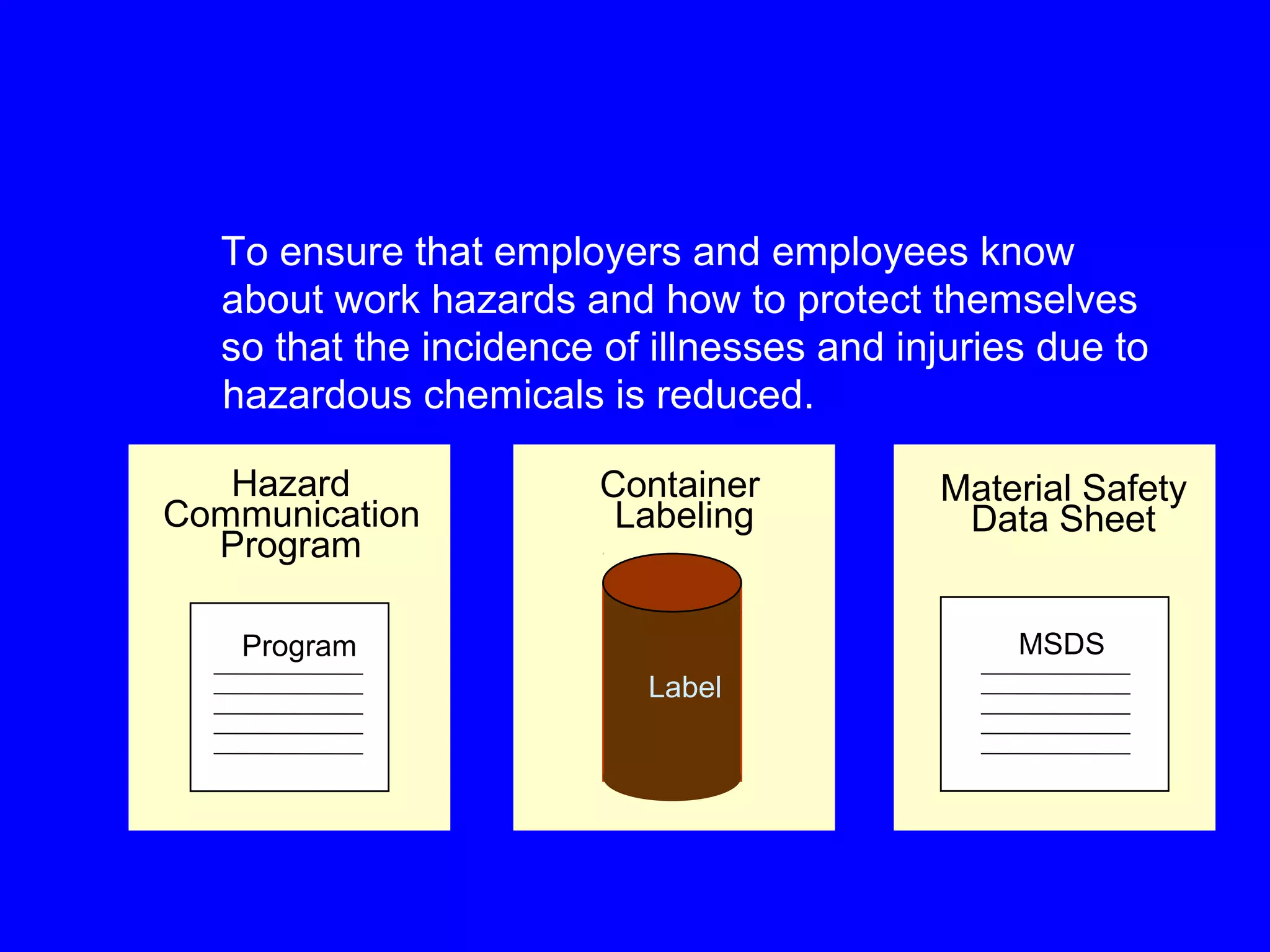
To ensure that employers and employees know
  about work hazards and how to protect themselves
  so that the incidence of illnesses and injuries due to
  hazardous chemicals is reduced.

   Hazard               Container          Material Safety
Communication            Labeling           Data Sheet
  Program

   Program                                      MSDS
                          Label
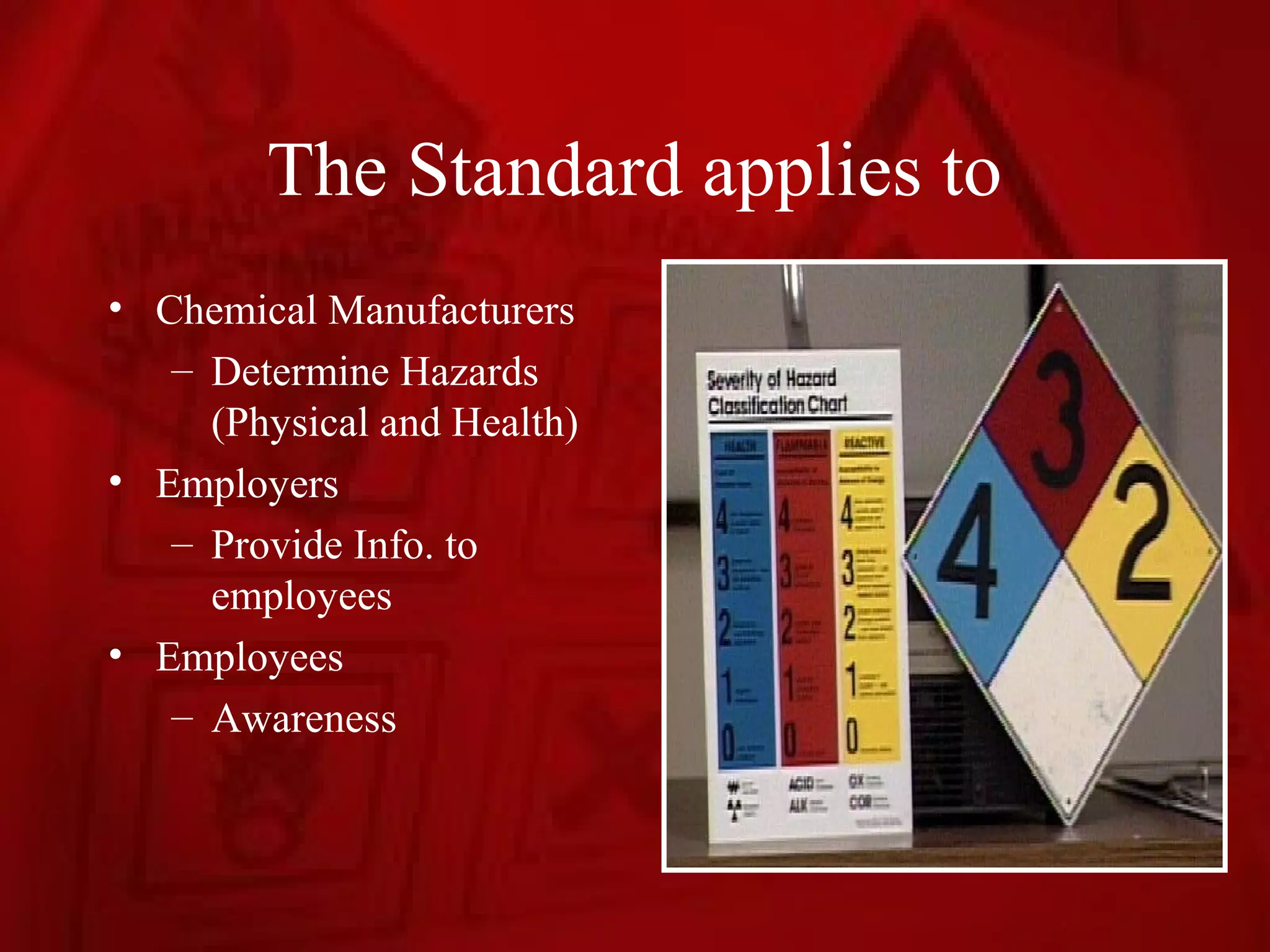
The Standard applies to
• Chemical Manufacturers
   – Determine Hazards
     (Physical and Health)
• Employers
   – Provide Info. to
     employees
• Employees
   – Awareness
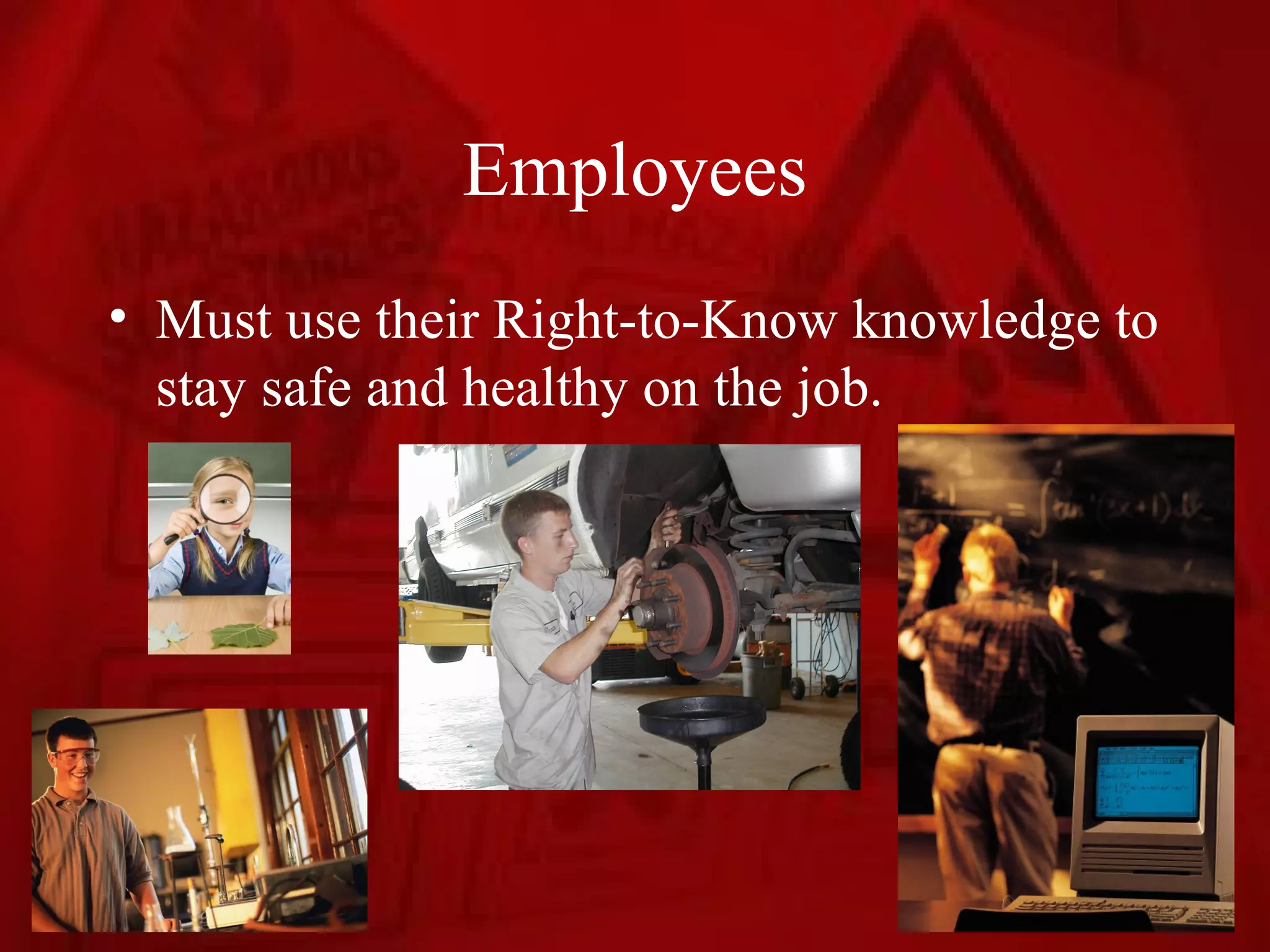
Employees
• Must use their Right-to-Know knowledge to
  stay safe and healthy on the job.
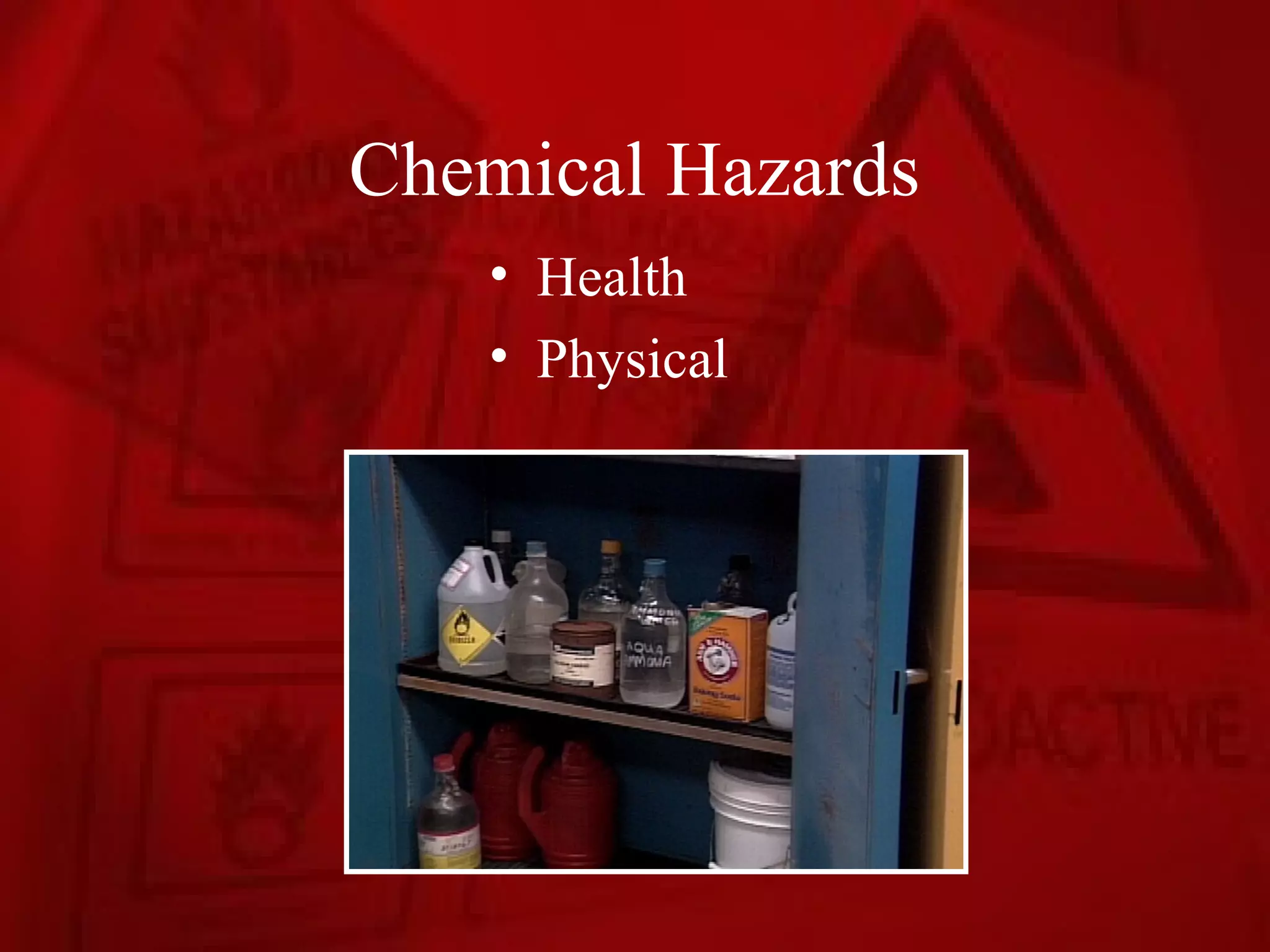
Chemical Hazards
   • Health
   • Physical
Health Hazards
• Acute Health Problems
  – symptoms show up immediately after exposure
• Chronic Health Problems
  – problems develop gradually from prolonged or
    repeated exposure
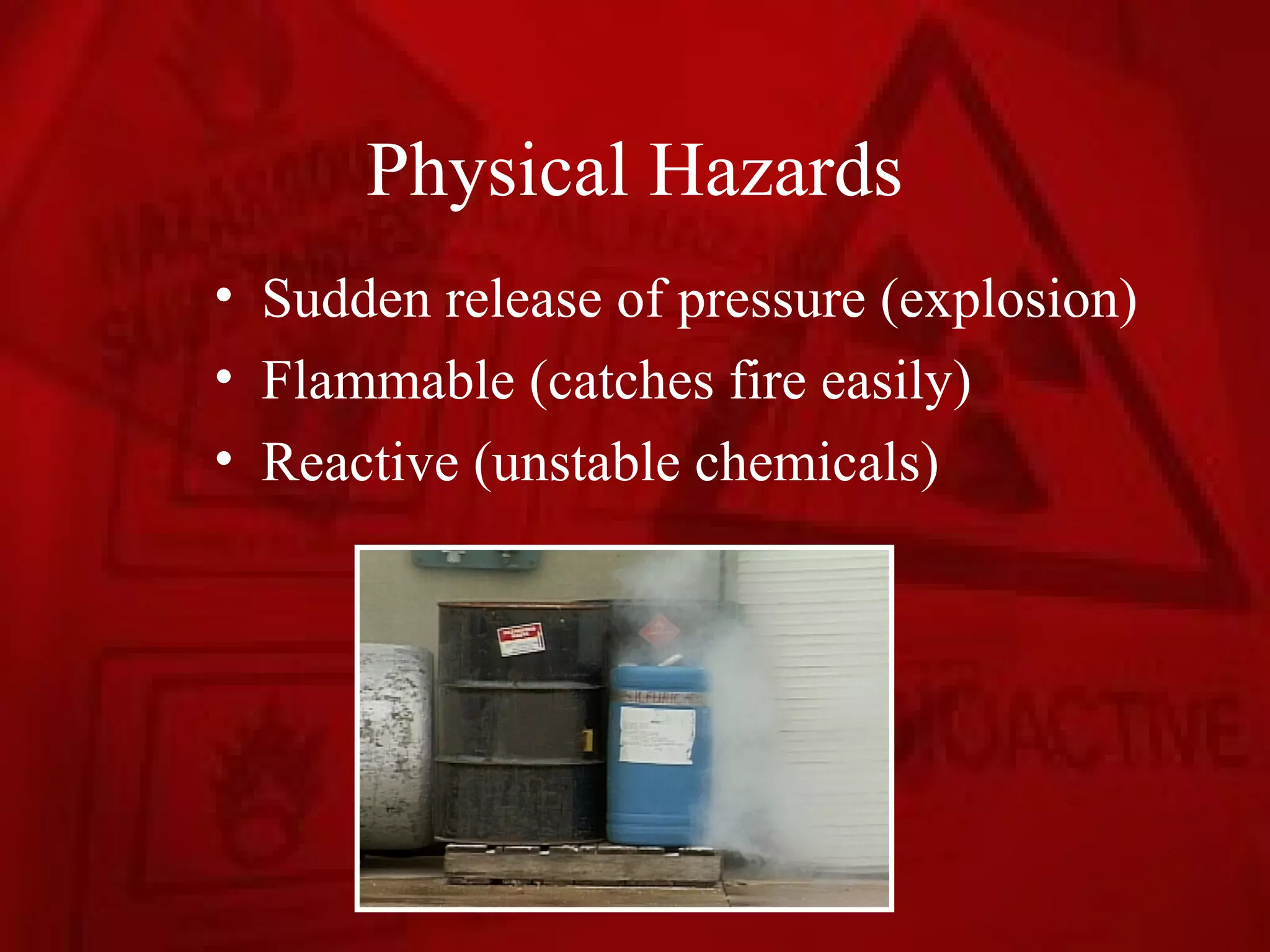
Physical Hazards
• Sudden release of pressure (explosion)
• Flammable (catches fire easily)
• Reactive (unstable chemicals)
Routes of Entry
•   Inhalation
•   Ingestion
•   Injection
•   Skin Contact or Absorption
4 Main Areas of Haz Com

 •   Labeling
 •   Material Safety Data Sheets
 •   Written Program
 •   Education and Training
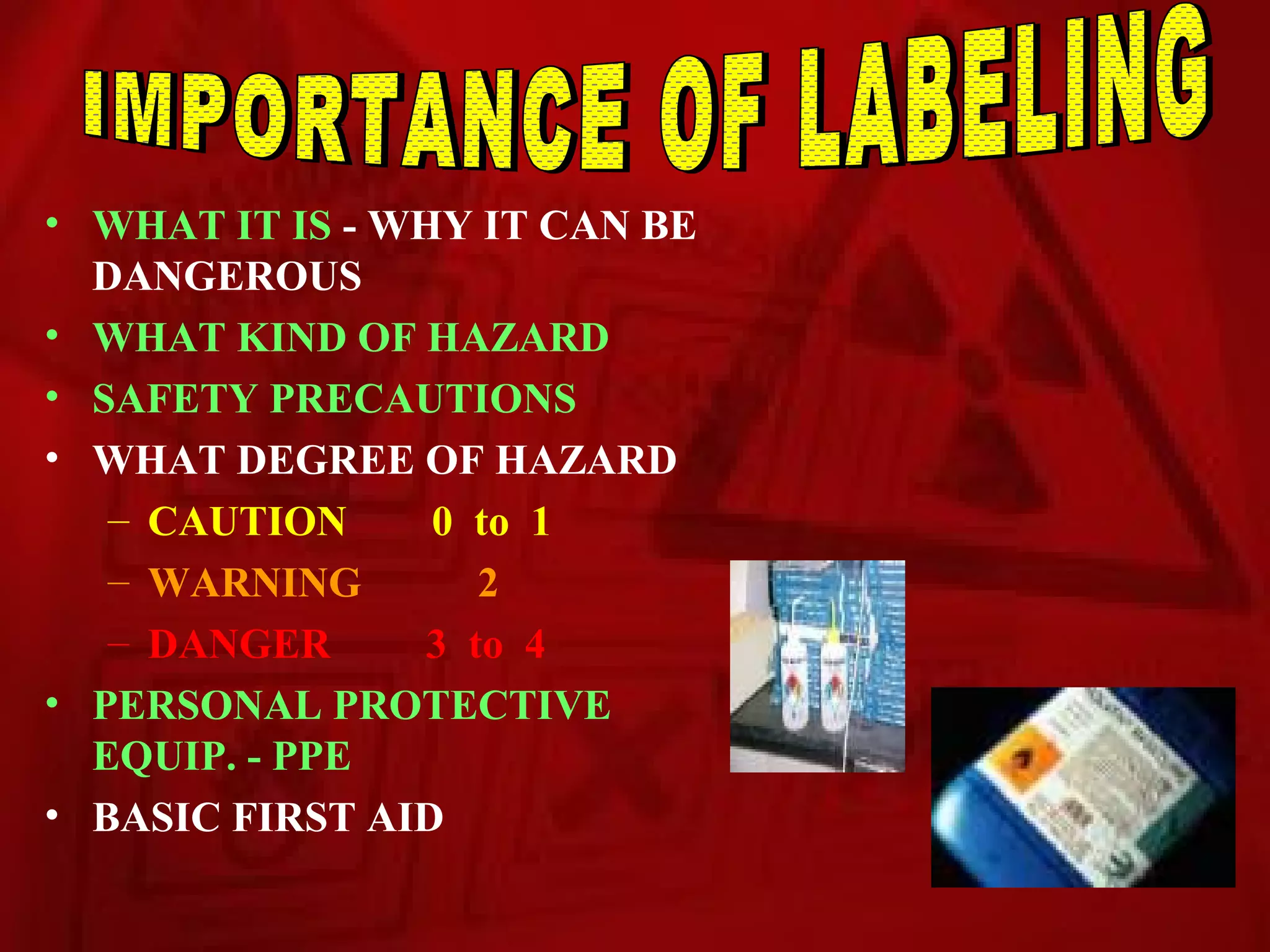
• WHAT IT IS - WHY IT CAN BE
  DANGEROUS
• WHAT KIND OF HAZARD
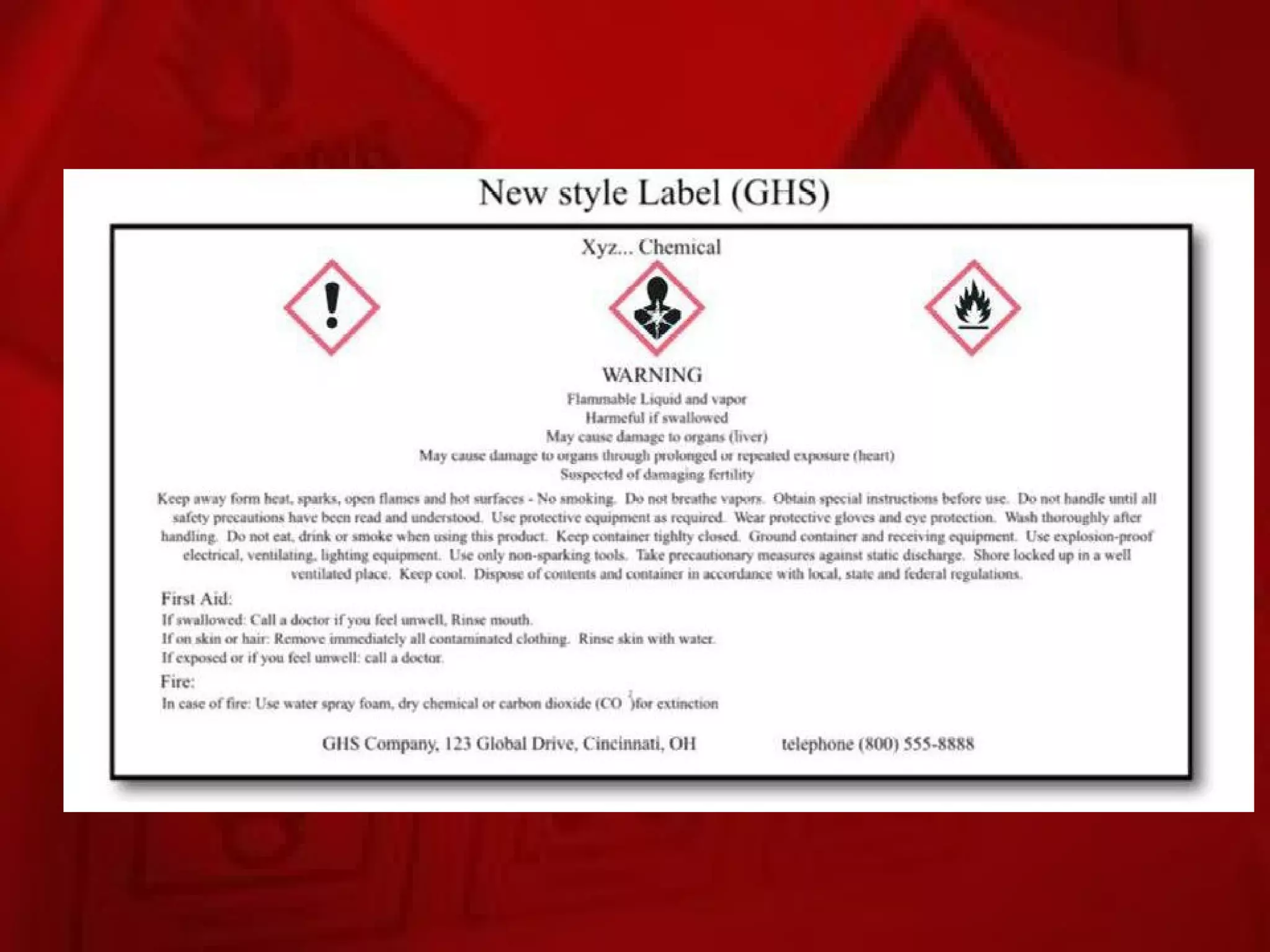
• SAFETY PRECAUTIONS
• WHAT DEGREE OF HAZARD
   – CAUTION     0 to 1
   – WARNING       2
   – DANGER     3 to 4
• PERSONAL PROTECTIVE
  EQUIP. - PPE
• BASIC FIRST AID
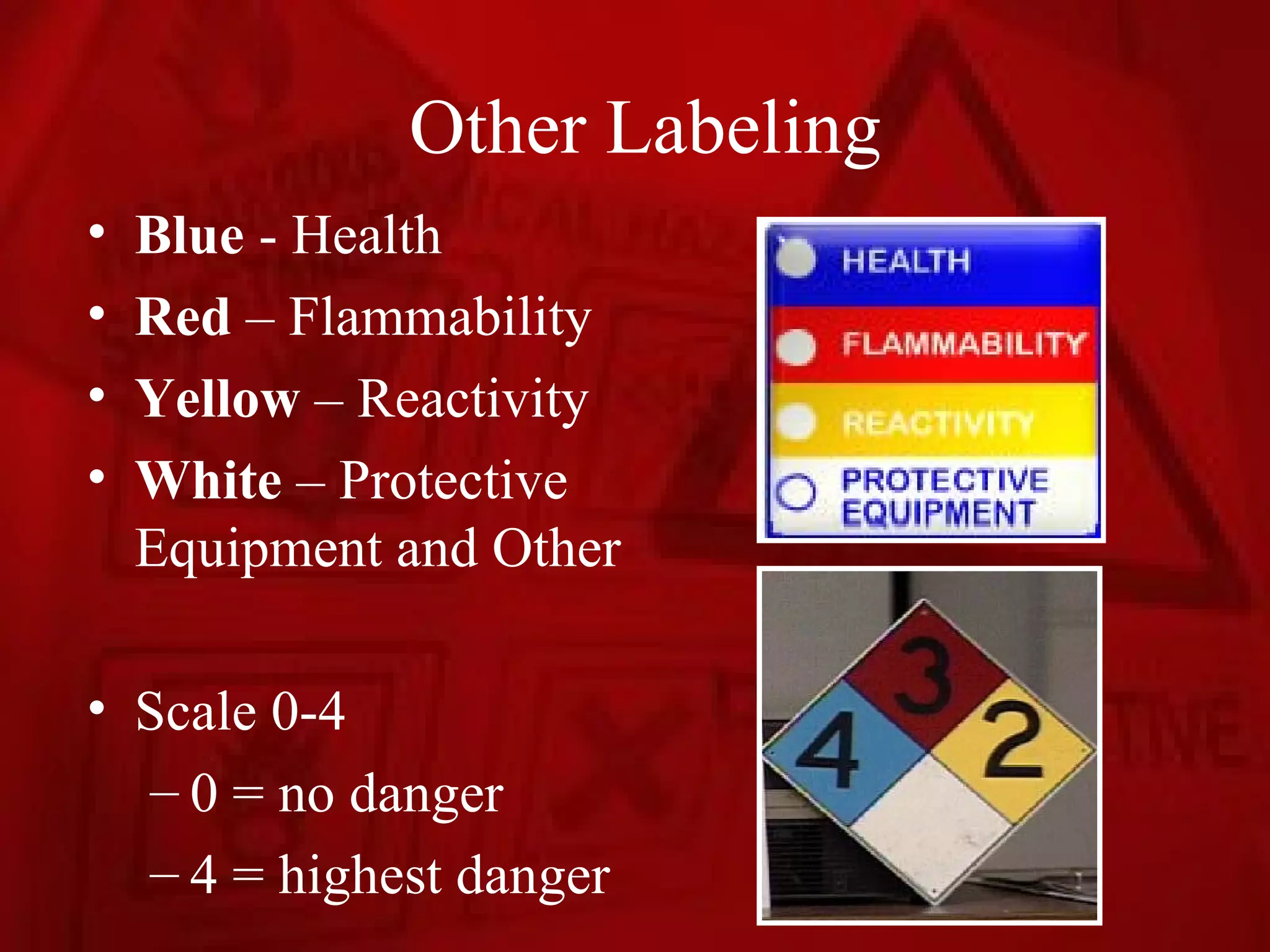
Other Labeling
•   Blue - Health
•   Red – Flammability
•   Yellow – Reactivity
•   White – Protective
    Equipment and Other

• Scale 0-4
   – 0 = no danger
   – 4 = highest danger
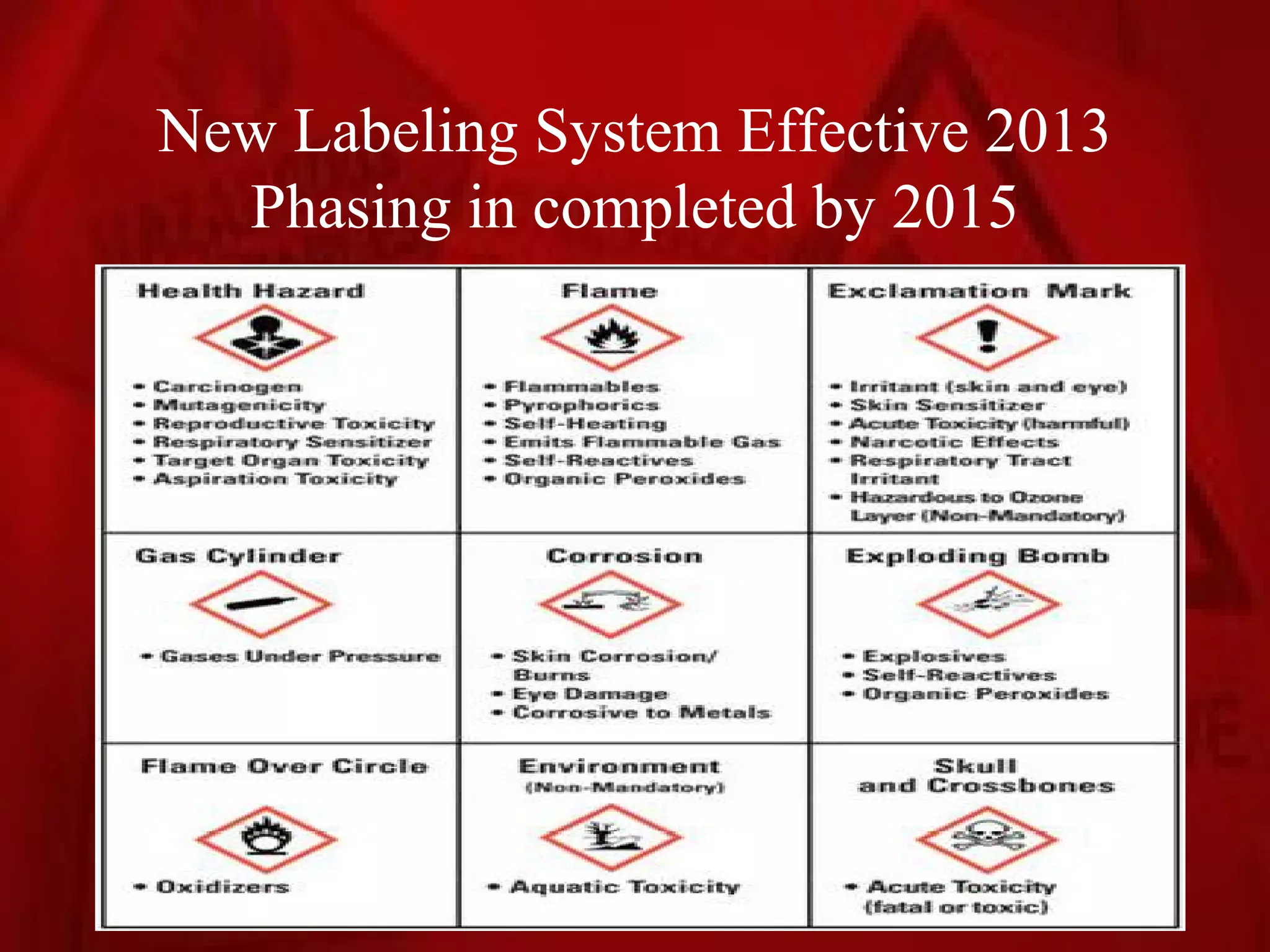
New Labeling System Effective 2013
  Phasing in completed by 2015
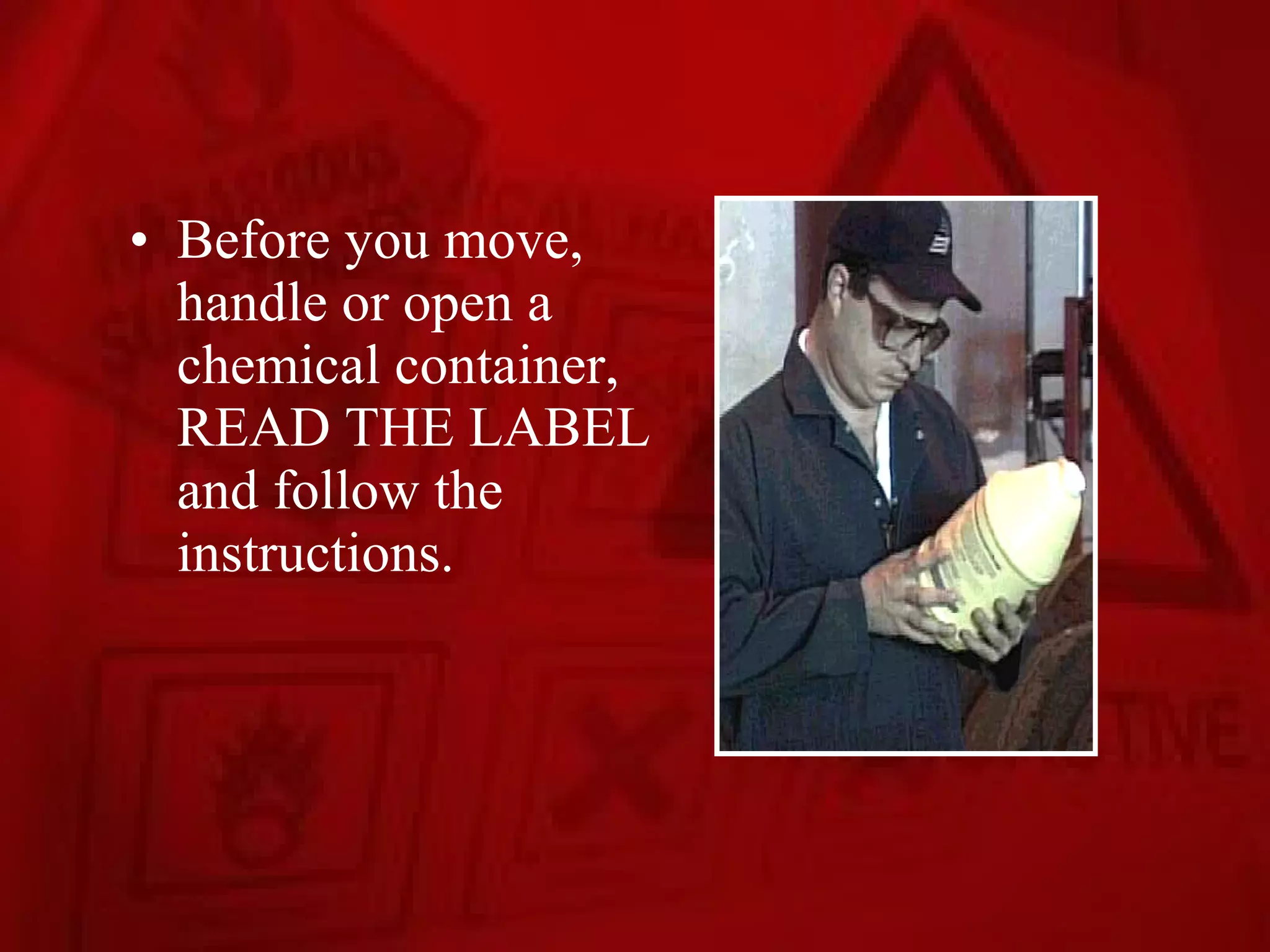
• Before you move,
  handle or open a
  chemical container,
  READ THE LABEL
  and follow the
  instructions.
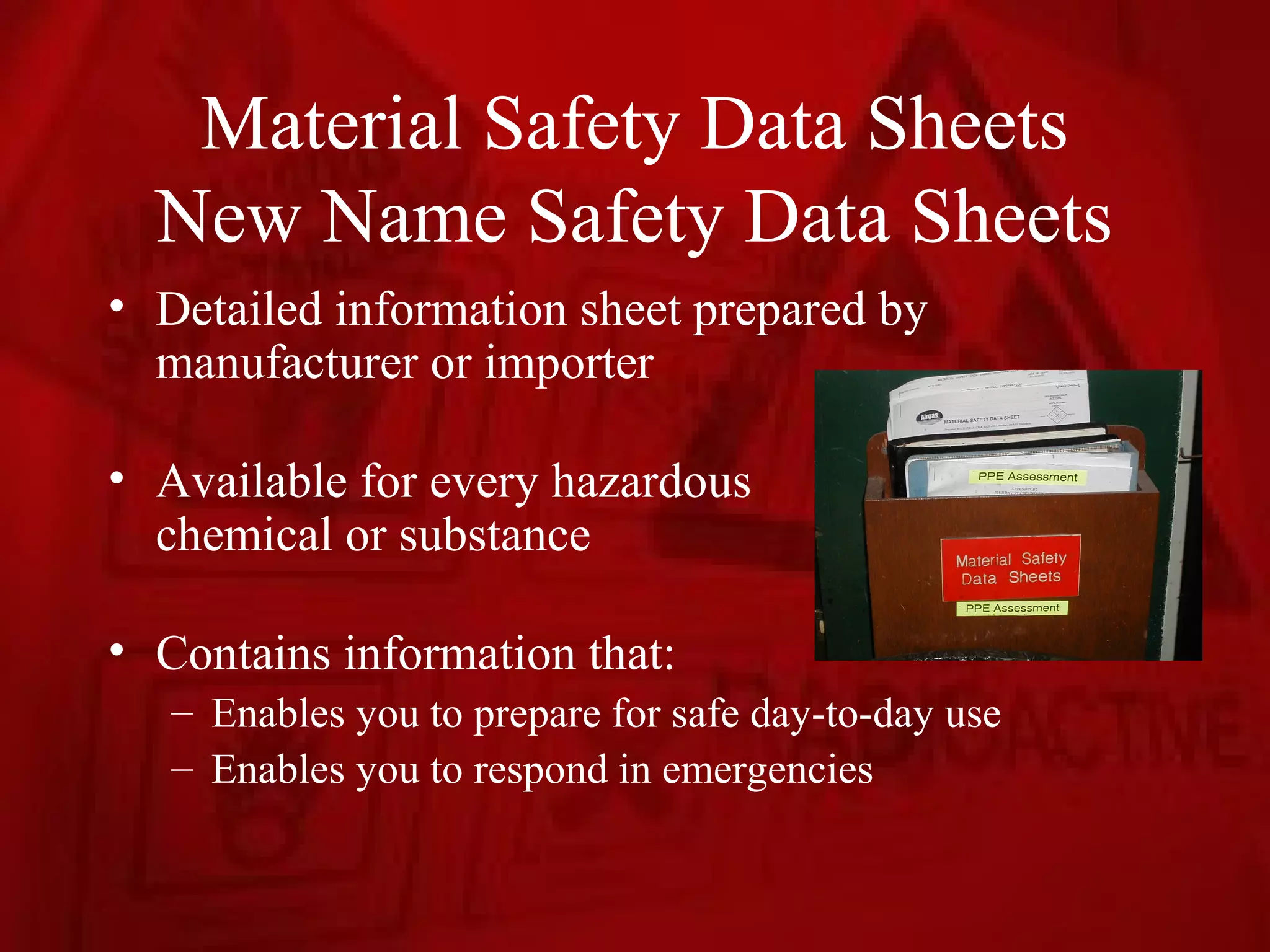
Material Safety Data Sheets
  New Name Safety Data Sheets
• Detailed information sheet prepared by
  manufacturer or importer

• Available for every hazardous
  chemical or substance

• Contains information that:
   – Enables you to prepare for safe day-to-day use
   – Enables you to respond in emergencies
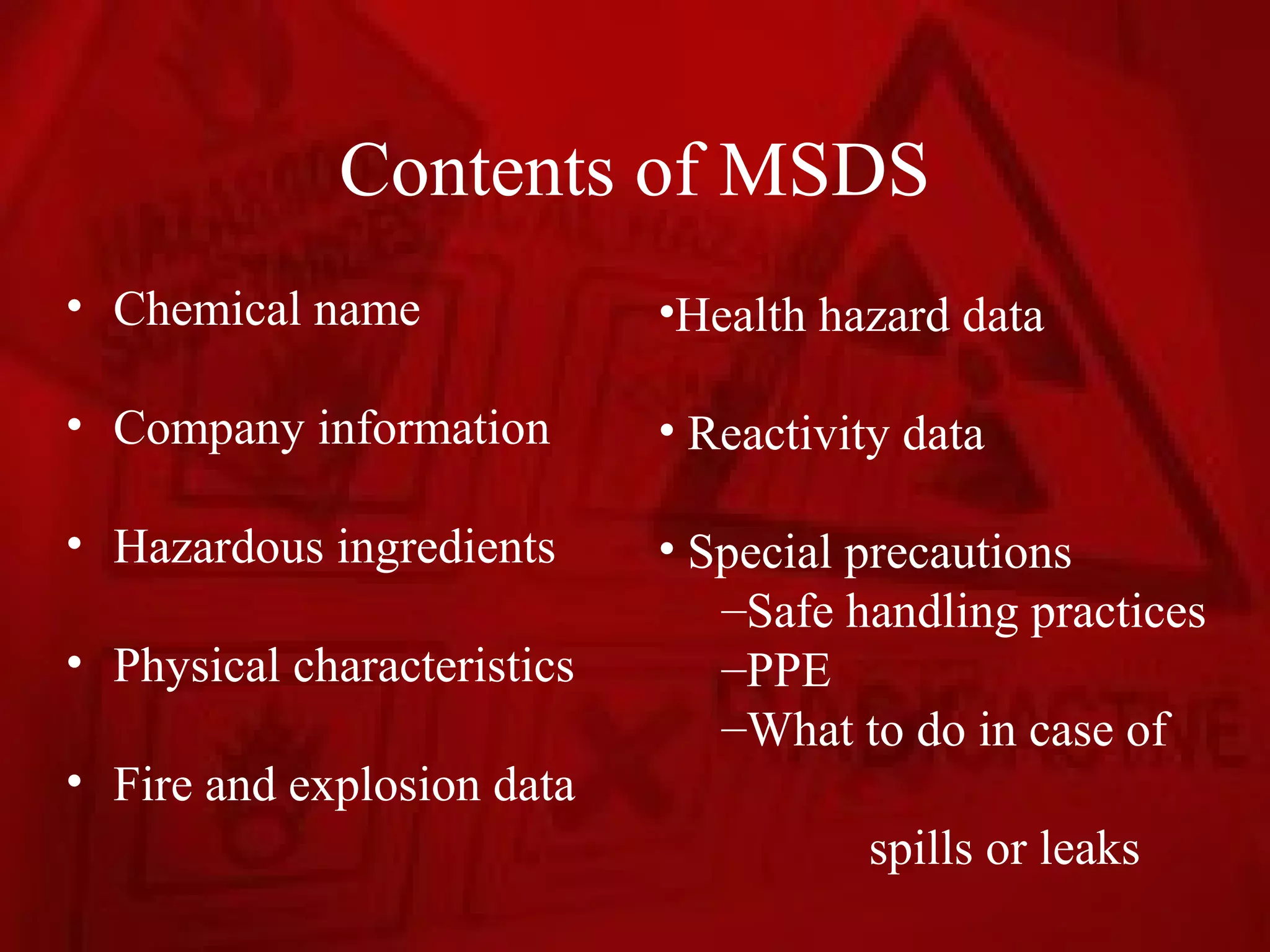
Contents of MSDS
• Chemical name              •Health hazard data

• Company information        • Reactivity data

• Hazardous ingredients      • Special precautions
                                –Safe handling practices
• Physical characteristics      –PPE
                                –What to do in case of
• Fire and explosion data
                                       spills or leaks
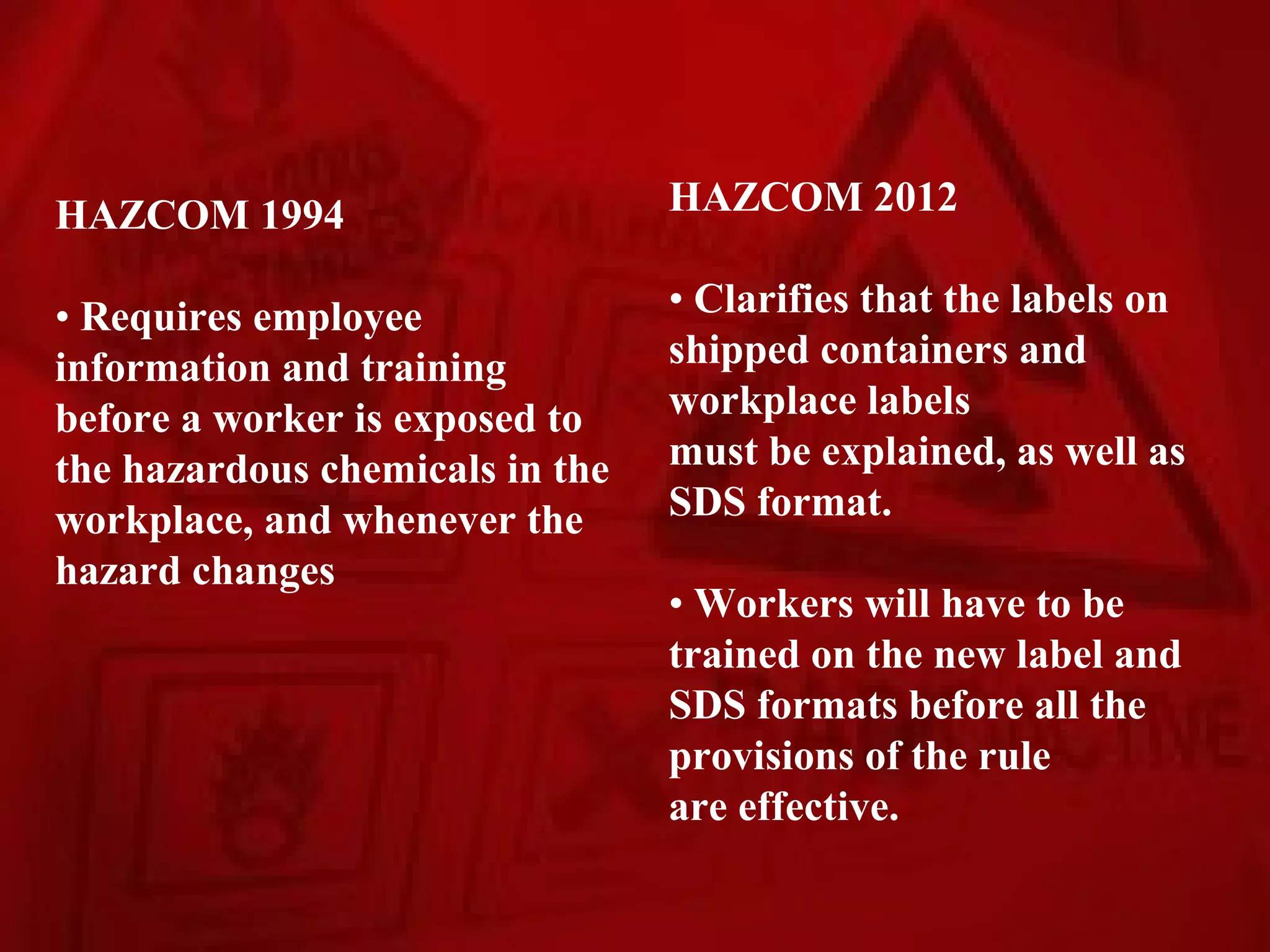
HAZCOM 1994                      HAZCOM 2012

• Requires employee              • Clarifies that the labels on
information and training         shipped containers and
before a worker is exposed to    workplace labels
the hazardous chemicals in the   must be explained, as well as
workplace, and whenever the      SDS format.
hazard changes
                                 • Workers will have to be
                                 trained on the new label and
                                 SDS formats before all the
                                 provisions of the rule
                                 are effective.
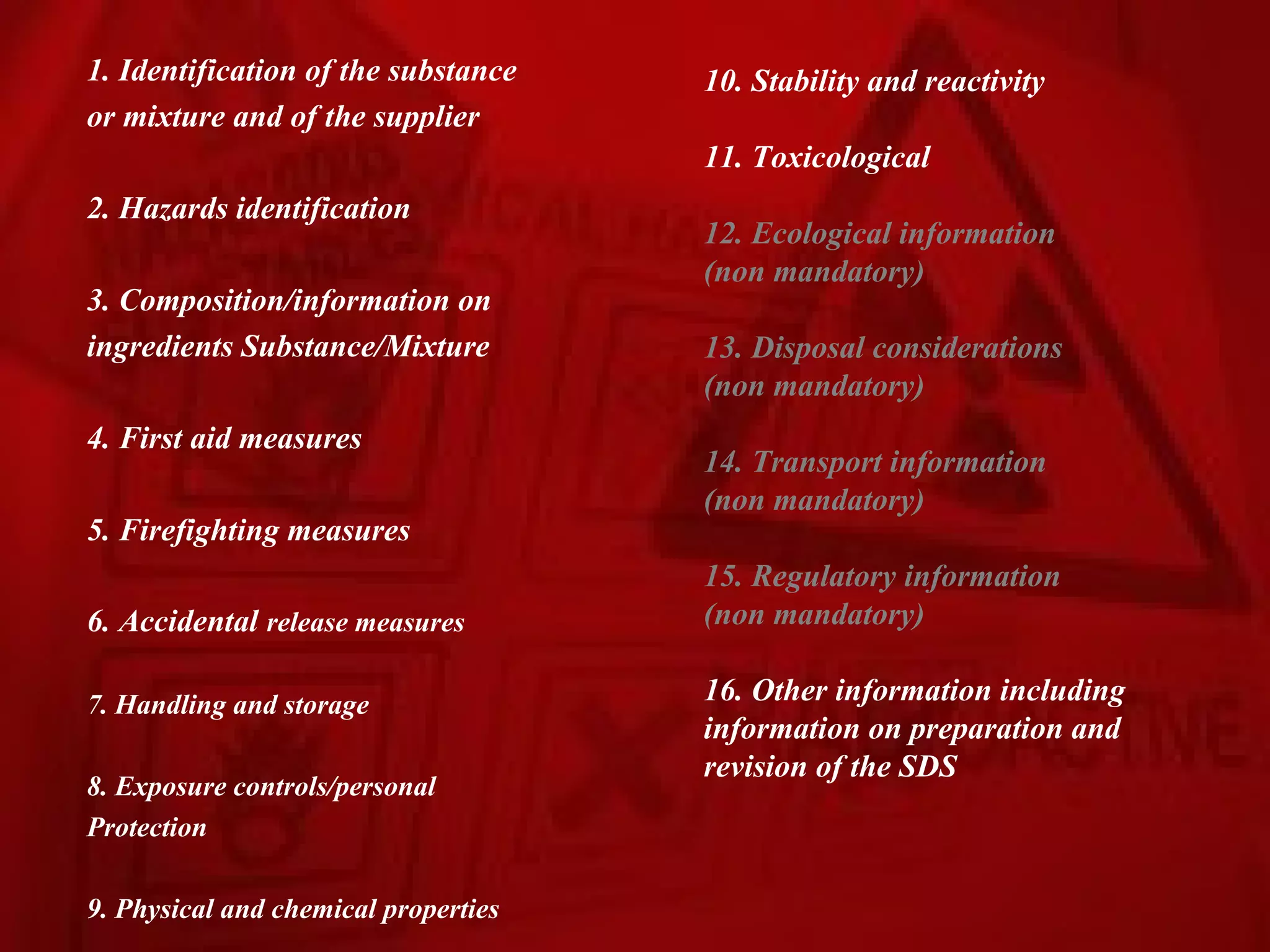
1. Identification of the substance    10. Stability and reactivity
or mixture and of the supplier
                                      11. Toxicological
2. Hazards identification
                                      12. Ecological information
                                      (non mandatory)
3. Composition/information on
ingredients Substance/Mixture         13. Disposal considerations
                                      (non mandatory)
4. First aid measures
                                      14. Transport information
                                      (non mandatory)
5. Firefighting measures
                                      15. Regulatory information
6. Accidental release measures        (non mandatory)

7. Handling and storage               16. Other information including
                                      information on preparation and
                                      revision of the SDS
8. Exposure controls/personal
Protection

9. Physical and chemical properties
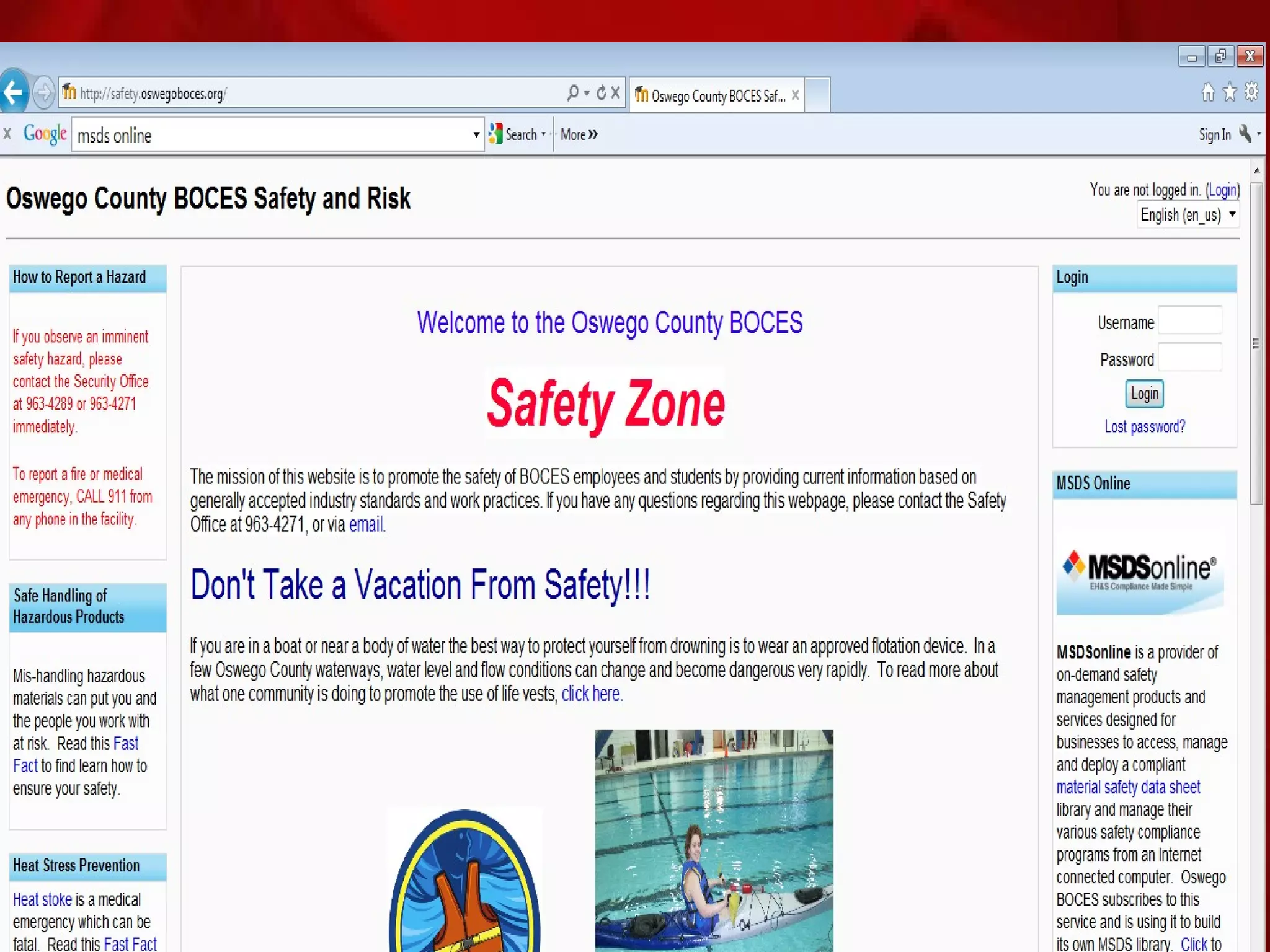
Location of MSDS
• In your work area
  – Your supervisor will inform you of the specific
    location
  – District Office
• Online with MSDSonline.com
Written Program
• The School District must have a written
  Hazard Communication Program
  – Inform employees about standard
  – Information and training on the Hazard
    Communication program
  – Must be available to all employees
Education & Training
• The regulation requires that the employer
  provide employees with education and
  training on hazardous chemicals in their
  work area at the time of initial assignment,
  and whenever a new chemical hazard is
  introduced into the work area.
Summary
• You have a right to know about the
  chemical hazards in your workplace.

• And you have a duty to use that right to
  learn about and protect yourself from those
  hazards.
Why are we here?
• OSHA Blood Borne Pathogen Standard

• The more you know, the better you will perform in
  real situations!
Who is covered by the standard?
• All employees who could be “reasonably
  anticipated”, as the result of performing
  their job duties, to face contact with blood
  and other potentially infectious materials
• “Good Samaritan” acts such as assisting a
  co-worker with a nosebleed would not be
  considered occupational exposure
At Risk Staff:
•   Nursing Staff
•   Athletic Trainer
•   Cleaners
•   Custodial Workers,
•   Maintenance Worker I
•   Bus Drivers, Bus Attendants, Bus Aides
•   Special Education Teacher, Assistant and Aide as
    dependent on tasks or procedures performed
How does exposure occur?
• Most common: needlesticks
• Cuts from other contaminated sharps
  (scalpels, broken glass, etc.)
• Contact of mucous membranes (for
  example; the eyes, nose, mouth) or broken
  (cut or abraded) skin with contaminated
  blood
Exposure Control Plan
• Identifies jobs and tasks where occupational
  exposure to blood or other potentially infectious
  material occurs
• Describes how the employer will:
   –   Use engineering and work practice controls
   –   Ensure use of Personal Protective Equipment
   –   Provide training
   –   Provide medical surveillance
   –   Provide Hepatitis B (HBV) vaccinations
   –   Use signs and labels
Exposure Control Plan
• Written plan required
• Plan must be reviewed at least annually to reflect changes in:
   – Tasks, procedures, or assignments which affect exposure
   – Technology that will eliminate or reduce exposure
• Annual review must document employer’s consideration and
  implementation of safer medical devices
• Must solicit input from potentially exposed employees in the
  identification, evaluation, and selection of engineering and
  work practice controls
• Plan must be accessible to employees
What is a
Blood Borne
 Pathogen?
 Microorganisms that are present
   in the blood that can cause
        disease in humans
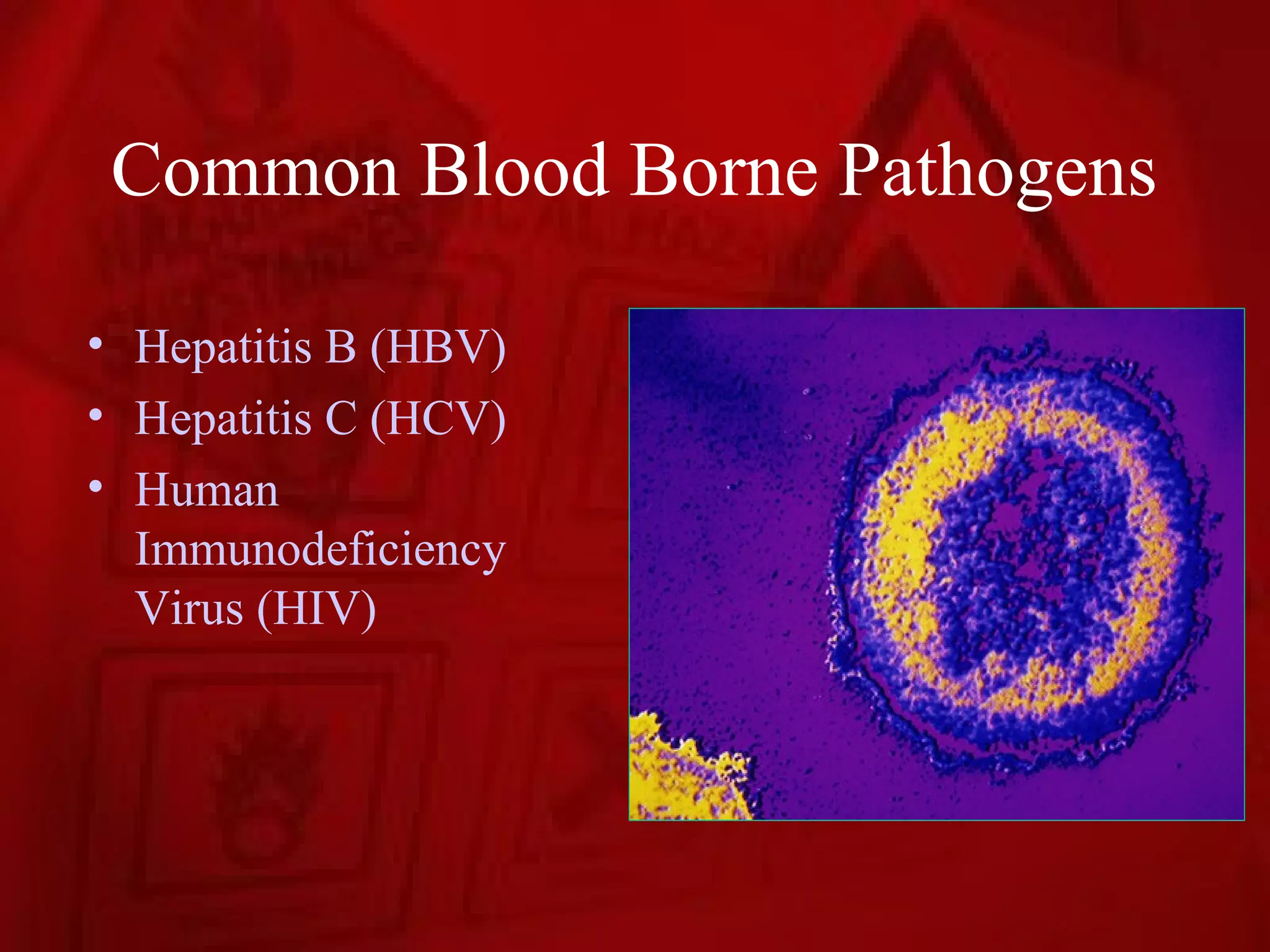
Common Blood Borne Pathogens

• Hepatitis B (HBV)
• Hepatitis C (HCV)
• Human
  Immunodeficiency
  Virus (HIV)
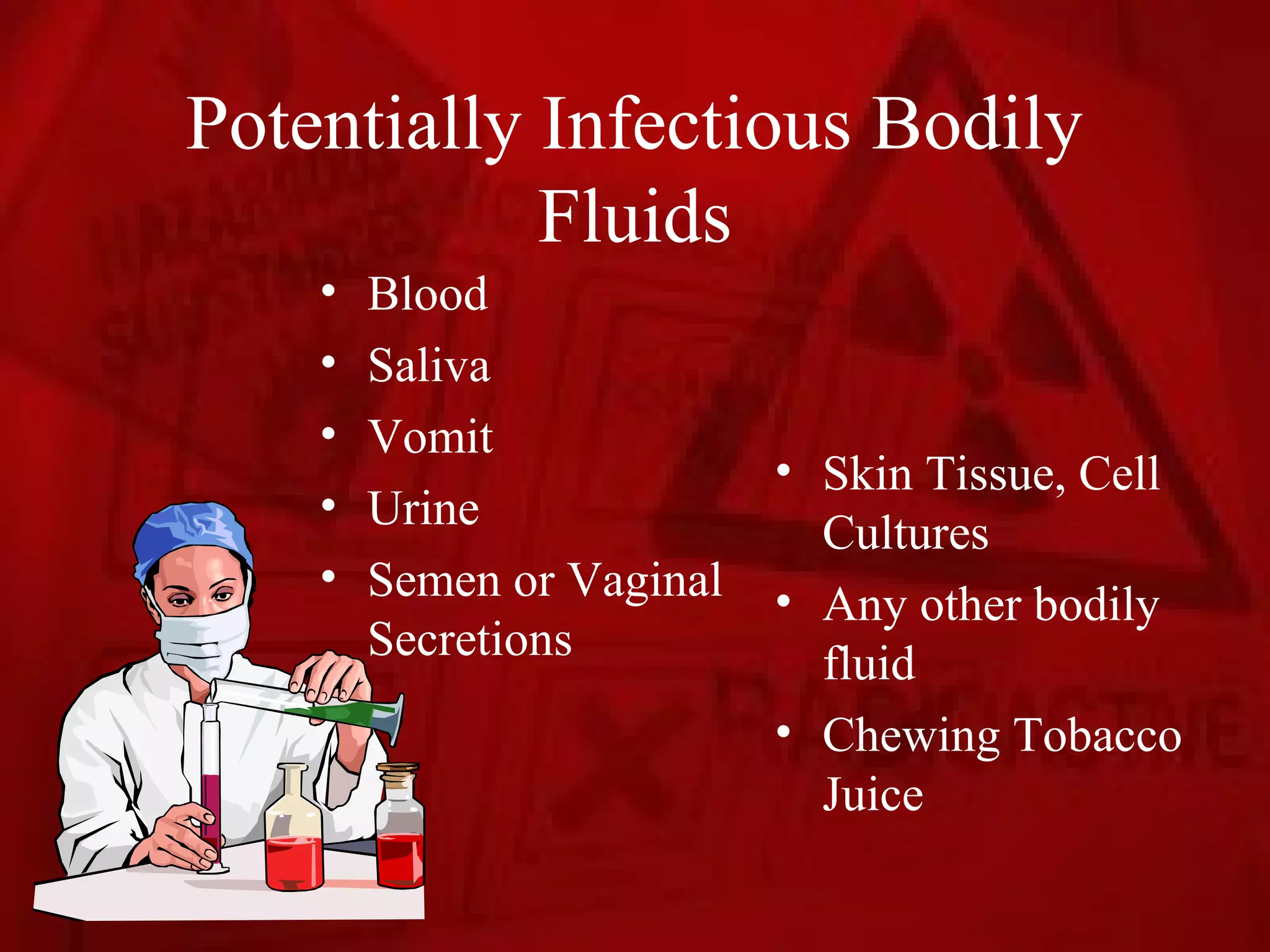
Potentially Infectious Bodily
            Fluids
    •   Blood
    •   Saliva
    •   Vomit
                           • Skin Tissue, Cell
    •   Urine                Cultures
    •   Semen or Vaginal   • Any other bodily
        Secretions           fluid
                           • Chewing Tobacco
                             Juice
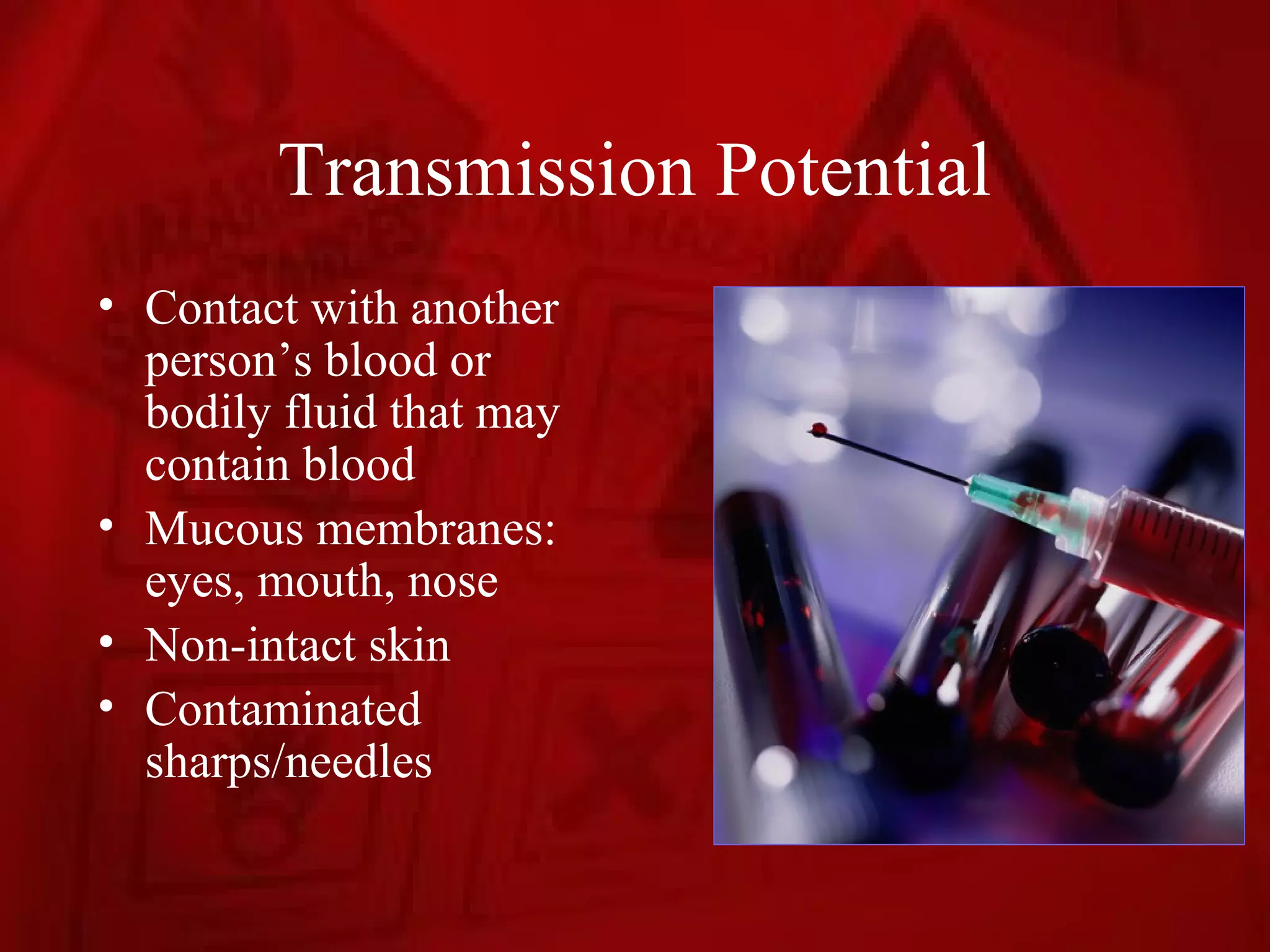
Transmission Potential
• Contact with another
  person’s blood or
  bodily fluid that may
  contain blood
• Mucous membranes:
  eyes, mouth, nose
• Non-intact skin
• Contaminated
  sharps/needles
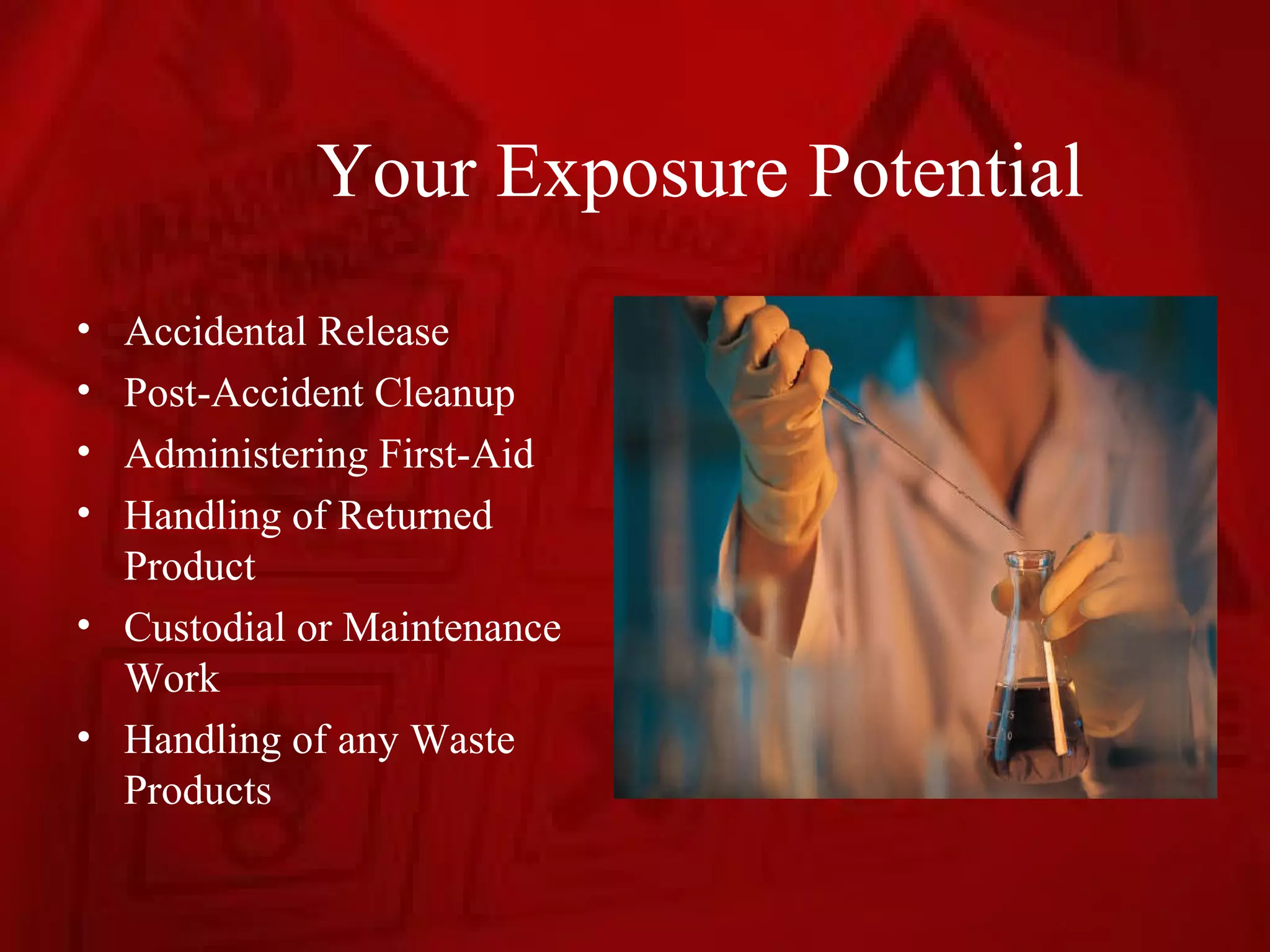
Your Exposure Potential
• Accidental Release
• Post-Accident Cleanup
• Administering First-Aid
• Handling of Returned
  Product
• Custodial or Maintenance
  Work
• Handling of any Waste
  Products
Universal Precautions
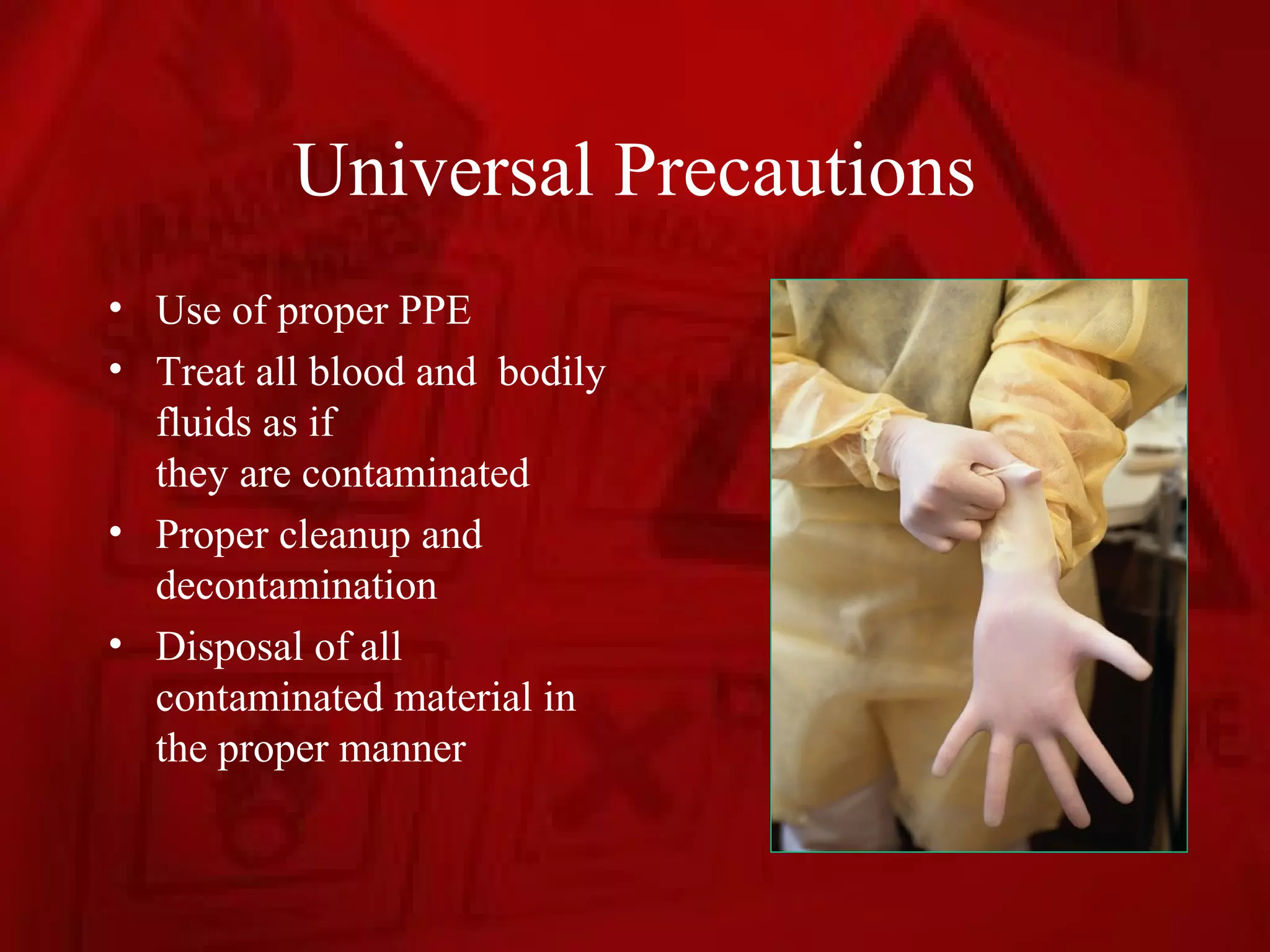
• Use of proper PPE
• Treat all blood and bodily
  fluids as if
  they are contaminated
• Proper cleanup and
  decontamination
• Disposal of all
  contaminated material in
  the proper manner
Personal Protective Equipment (PPE)

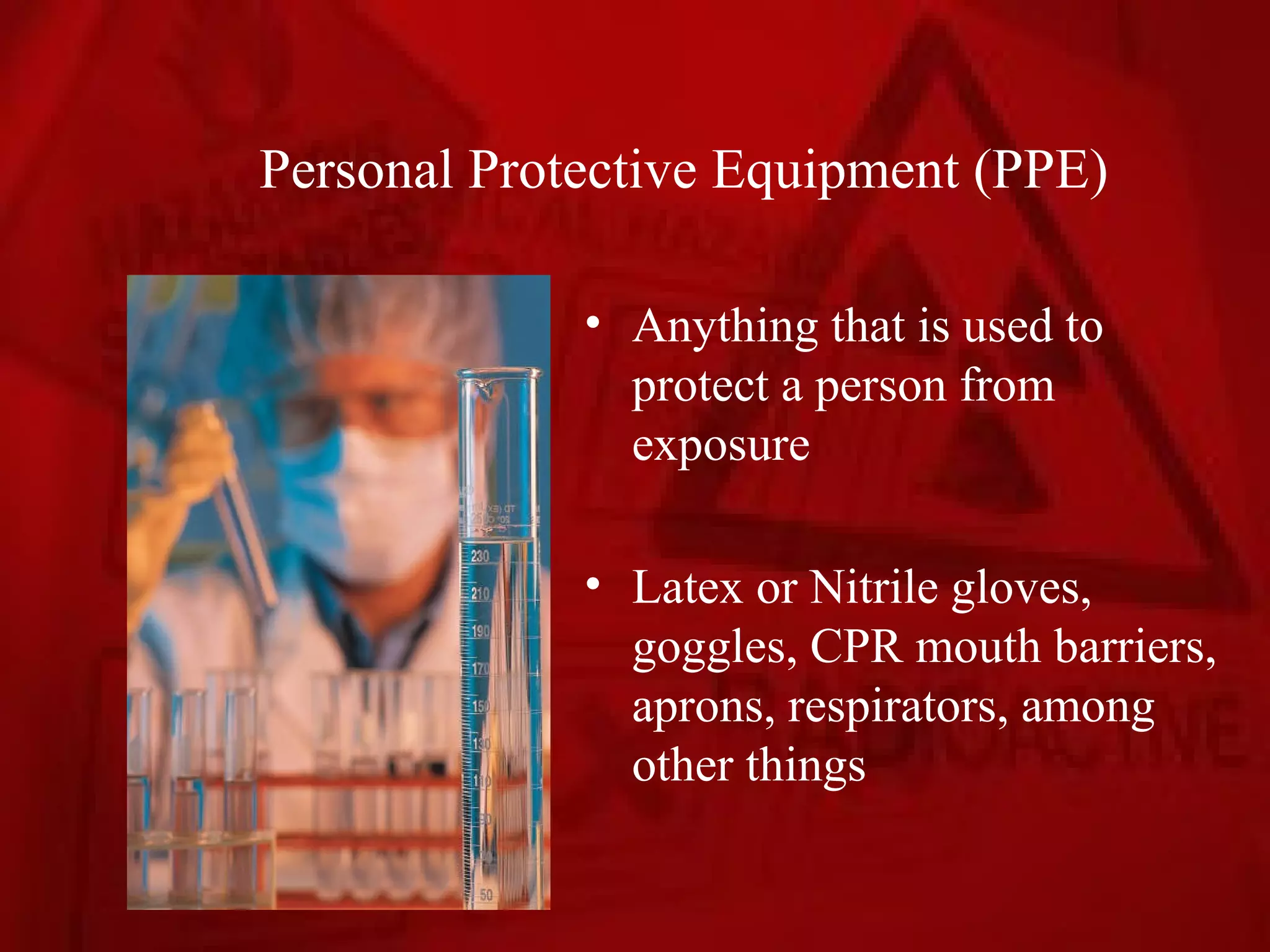
             • Anything that is used to
               protect a person from
               exposure

             • Latex or Nitrile gloves,
               goggles, CPR mouth barriers,
               aprons, respirators, among
               other things
PPE Rules to Remember
• Always check PPE for defects or tears
  before using
• If PPE becomes torn or defective remove
  and get new
• Remove PPE before leaving a contaminated
  area
• Do not reuse disposable equipment
Decontamination
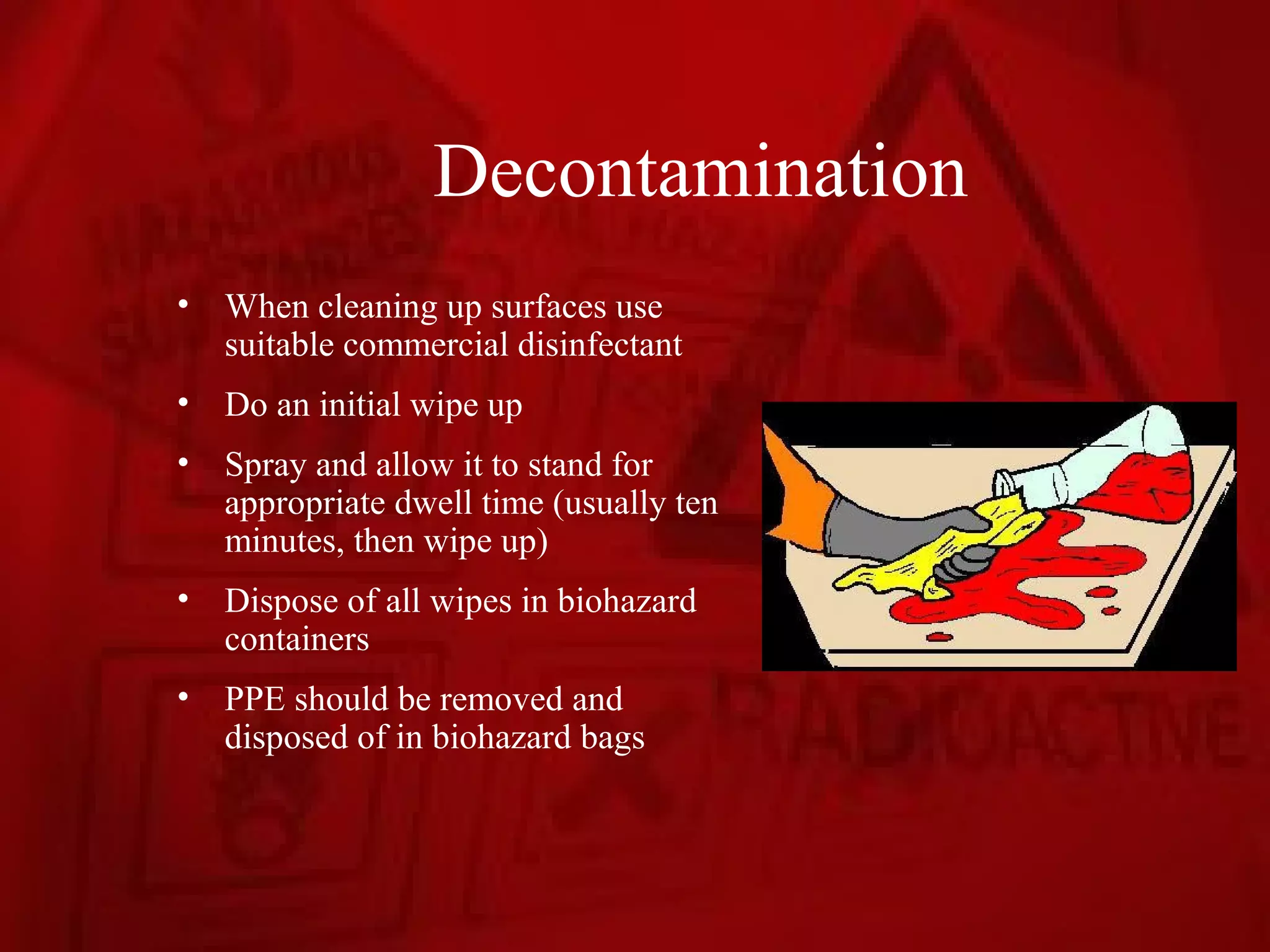
•   When cleaning up surfaces use
    suitable commercial disinfectant
•   Do an initial wipe up
•   Spray and allow it to stand for
    appropriate dwell time (usually ten
    minutes, then wipe up)
•   Dispose of all wipes in biohazard
    containers
•   PPE should be removed and
    disposed of in biohazard bags
Hand Washing
• Wash hands
  immediately after
  removing PPE
• Use a soft antibacterial
  soap
• A hand sanitizer can
  be used, but wash with
  soap and water as soon
  as possible afterward
Regulated Medical Waste
• Liquid or semi-liquid
  blood or other potentially
  infectious material
  (OPIM)
• Contaminated items that
  would release blood or
  OPIM when compressed
• Contaminated sharps
• Pathological and
  microbiological waste
  containing blood or OPIM
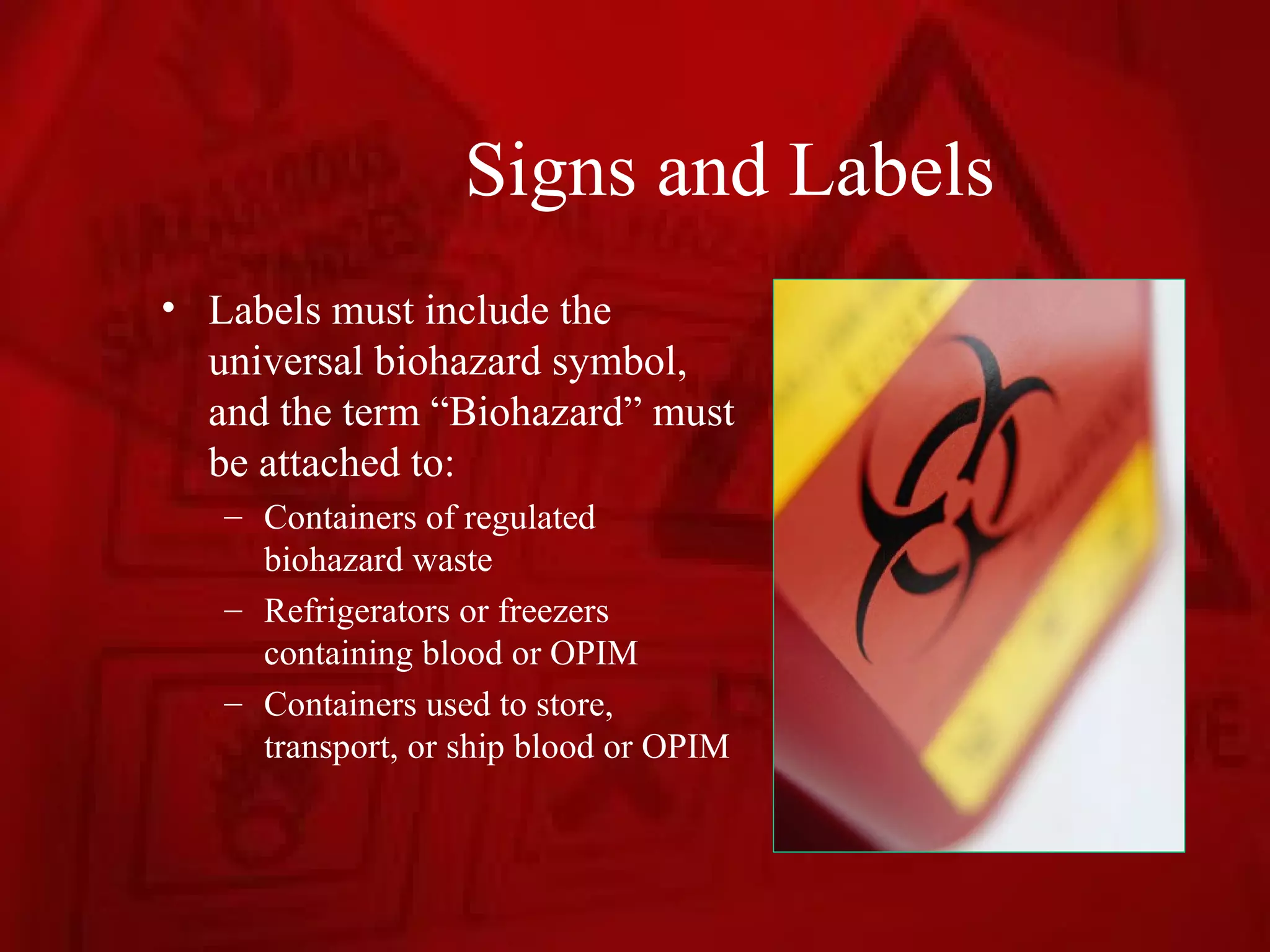
Signs and Labels
• Labels must include the
  universal biohazard symbol,
  and the term “Biohazard” must
  be attached to:
   – Containers of regulated
     biohazard waste
   – Refrigerators or freezers
     containing blood or OPIM
   – Containers used to store,
     transport, or ship blood or OPIM
Exposure Incident
• A specific incident of contact with potentially
  infectious bodily fluid
• If there are no infiltrations of mucous
  membranes or open skin surfaces, it is not
  considered an occupational exposure
• Report all accidents involving blood or
  bodily fluids
• Post-exposure medical evaluations are
  offered
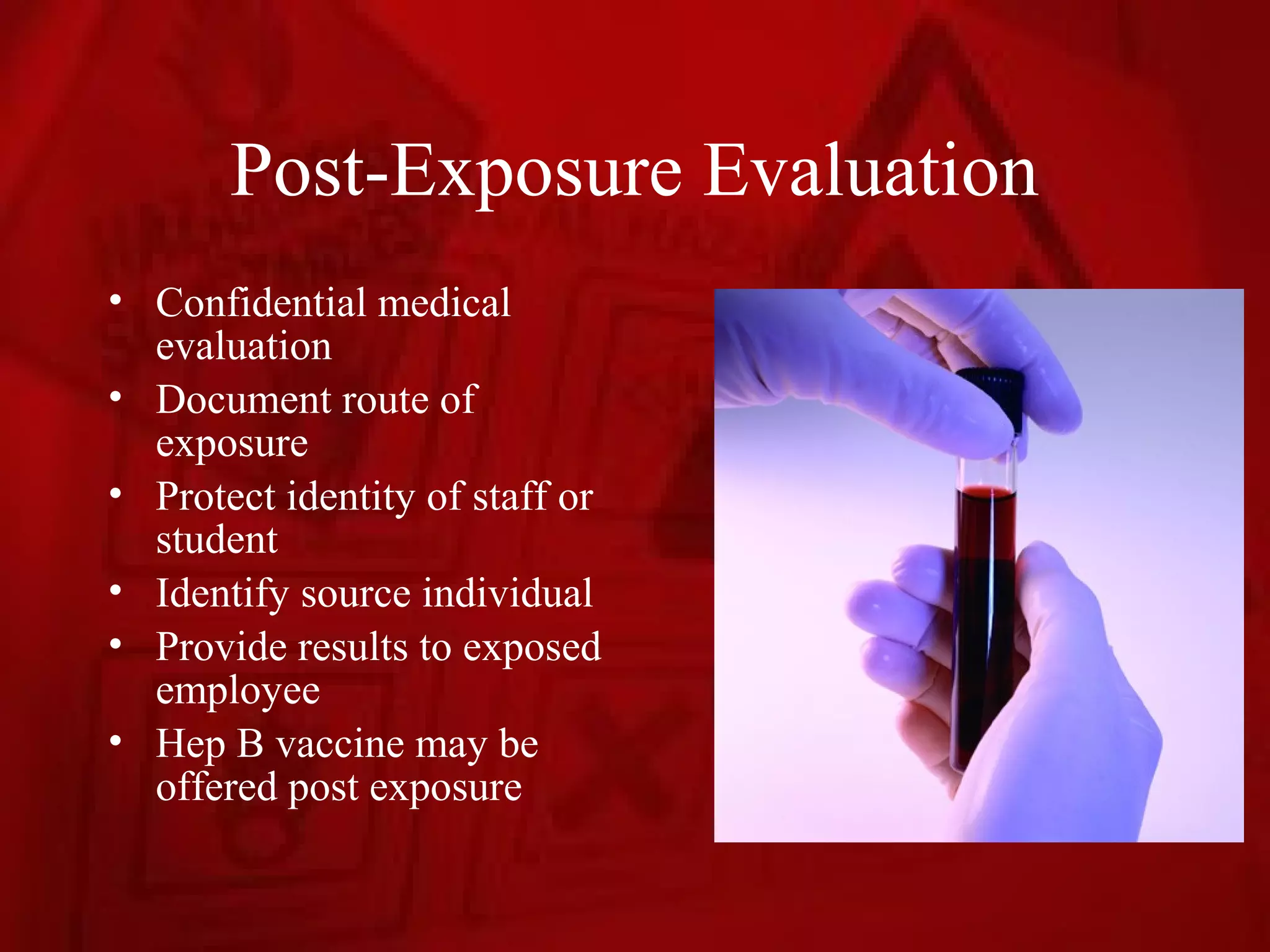
Post-Exposure Evaluation
• Confidential medical
  evaluation
• Document route of
  exposure
• Protect identity of staff or
  student
• Identify source individual
• Provide results to exposed
  employee
• Hep B vaccine may be
  offered post exposure
Hepatitis B Vaccination
          • Offered to all potentially
            exposed employees
            preexposure
          • Provided at no cost to
            employees
          • Must give written consent
            or declination
Recordkeeping
Medical records include:
• Hepatitis B vaccination status
• Post-exposure evaluation and follow-up results
Training records include:
• Training dates
• Contents of the training
• Signature of trainer and trainee
In Conclusion:
The previous Safety Practices are
 in place for your protection, use
these tools to protect yourself and
         your classroom.

2012 2013 rtk bbp

  • 1.
    Right-to-Know / HazardCommunication Bloodborne Pathogens/ Exposure Control Annual Safety Refresher Training Presented by: Debra B. Eichholtz, Safety Coordinator Safety and Risk Management
  • 2.
    Hazard Communication OSHA Standard 29 CFR 1910.1200 And NYS Right to Know Law
  • 3.
    Introduction • The federalHazard Communication Standard says that you have a “Right-To-Know” what hazards you face on the job and how to protect yourself against those hazards. That’s your Right-To-Know!
  • 4.
    Purpose • The standardwas developed to make sure that everyone who works with any hazardous chemical is aware of the hazards and the necessary precautions.
  • 5.
    District Right toKnow Officer is David Crisafulli for Oswego and Alicia Koster for Mexico
  • 6.
    To ensure thatemployers and employees know about work hazards and how to protect themselves so that the incidence of illnesses and injuries due to hazardous chemicals is reduced. Hazard Container Material Safety Communication Labeling Data Sheet Program Program MSDS Label
  • 7.
    The Standard appliesto • Chemical Manufacturers – Determine Hazards (Physical and Health) • Employers – Provide Info. to employees • Employees – Awareness
  • 8.
    Employees • Must usetheir Right-to-Know knowledge to stay safe and healthy on the job.
  • 9.
    Chemical Hazards • Health • Physical
  • 10.
    Health Hazards • AcuteHealth Problems – symptoms show up immediately after exposure • Chronic Health Problems – problems develop gradually from prolonged or repeated exposure
  • 11.
    Physical Hazards • Suddenrelease of pressure (explosion) • Flammable (catches fire easily) • Reactive (unstable chemicals)
  • 12.
    Routes of Entry • Inhalation • Ingestion • Injection • Skin Contact or Absorption
  • 13.
    4 Main Areasof Haz Com • Labeling • Material Safety Data Sheets • Written Program • Education and Training
  • 14.
    • WHAT ITIS - WHY IT CAN BE DANGEROUS • WHAT KIND OF HAZARD • SAFETY PRECAUTIONS • WHAT DEGREE OF HAZARD – CAUTION 0 to 1 – WARNING 2 – DANGER 3 to 4 • PERSONAL PROTECTIVE EQUIP. - PPE • BASIC FIRST AID
  • 15.
    Other Labeling • Blue - Health • Red – Flammability • Yellow – Reactivity • White – Protective Equipment and Other • Scale 0-4 – 0 = no danger – 4 = highest danger
  • 16.
    New Labeling SystemEffective 2013 Phasing in completed by 2015
  • 17.
    • Before youmove, handle or open a chemical container, READ THE LABEL and follow the instructions.
  • 19.
    Material Safety DataSheets New Name Safety Data Sheets • Detailed information sheet prepared by manufacturer or importer • Available for every hazardous chemical or substance • Contains information that: – Enables you to prepare for safe day-to-day use – Enables you to respond in emergencies
  • 20.
    Contents of MSDS •Chemical name •Health hazard data • Company information • Reactivity data • Hazardous ingredients • Special precautions –Safe handling practices • Physical characteristics –PPE –What to do in case of • Fire and explosion data spills or leaks
  • 21.
    HAZCOM 1994 HAZCOM 2012 • Requires employee • Clarifies that the labels on information and training shipped containers and before a worker is exposed to workplace labels the hazardous chemicals in the must be explained, as well as workplace, and whenever the SDS format. hazard changes • Workers will have to be trained on the new label and SDS formats before all the provisions of the rule are effective.
  • 22.
    1. Identification ofthe substance 10. Stability and reactivity or mixture and of the supplier 11. Toxicological 2. Hazards identification 12. Ecological information (non mandatory) 3. Composition/information on ingredients Substance/Mixture 13. Disposal considerations (non mandatory) 4. First aid measures 14. Transport information (non mandatory) 5. Firefighting measures 15. Regulatory information 6. Accidental release measures (non mandatory) 7. Handling and storage 16. Other information including information on preparation and revision of the SDS 8. Exposure controls/personal Protection 9. Physical and chemical properties
  • 23.
    Location of MSDS •In your work area – Your supervisor will inform you of the specific location – District Office • Online with MSDSonline.com
  • 25.
    Written Program • TheSchool District must have a written Hazard Communication Program – Inform employees about standard – Information and training on the Hazard Communication program – Must be available to all employees
  • 26.
    Education & Training •The regulation requires that the employer provide employees with education and training on hazardous chemicals in their work area at the time of initial assignment, and whenever a new chemical hazard is introduced into the work area.
  • 27.
    Summary • You havea right to know about the chemical hazards in your workplace. • And you have a duty to use that right to learn about and protect yourself from those hazards.
  • 29.
    Why are wehere? • OSHA Blood Borne Pathogen Standard • The more you know, the better you will perform in real situations!
  • 30.
    Who is coveredby the standard? • All employees who could be “reasonably anticipated”, as the result of performing their job duties, to face contact with blood and other potentially infectious materials • “Good Samaritan” acts such as assisting a co-worker with a nosebleed would not be considered occupational exposure
  • 31.
    At Risk Staff: • Nursing Staff • Athletic Trainer • Cleaners • Custodial Workers, • Maintenance Worker I • Bus Drivers, Bus Attendants, Bus Aides • Special Education Teacher, Assistant and Aide as dependent on tasks or procedures performed
  • 32.
    How does exposureoccur? • Most common: needlesticks • Cuts from other contaminated sharps (scalpels, broken glass, etc.) • Contact of mucous membranes (for example; the eyes, nose, mouth) or broken (cut or abraded) skin with contaminated blood
  • 33.
    Exposure Control Plan •Identifies jobs and tasks where occupational exposure to blood or other potentially infectious material occurs • Describes how the employer will: – Use engineering and work practice controls – Ensure use of Personal Protective Equipment – Provide training – Provide medical surveillance – Provide Hepatitis B (HBV) vaccinations – Use signs and labels
  • 34.
    Exposure Control Plan •Written plan required • Plan must be reviewed at least annually to reflect changes in: – Tasks, procedures, or assignments which affect exposure – Technology that will eliminate or reduce exposure • Annual review must document employer’s consideration and implementation of safer medical devices • Must solicit input from potentially exposed employees in the identification, evaluation, and selection of engineering and work practice controls • Plan must be accessible to employees
  • 35.
    What is a BloodBorne Pathogen? Microorganisms that are present in the blood that can cause disease in humans
  • 36.
    Common Blood BornePathogens • Hepatitis B (HBV) • Hepatitis C (HCV) • Human Immunodeficiency Virus (HIV)
  • 37.
    Potentially Infectious Bodily Fluids • Blood • Saliva • Vomit • Skin Tissue, Cell • Urine Cultures • Semen or Vaginal • Any other bodily Secretions fluid • Chewing Tobacco Juice
  • 38.
    Transmission Potential • Contactwith another person’s blood or bodily fluid that may contain blood • Mucous membranes: eyes, mouth, nose • Non-intact skin • Contaminated sharps/needles
  • 39.
    Your Exposure Potential •Accidental Release • Post-Accident Cleanup • Administering First-Aid • Handling of Returned Product • Custodial or Maintenance Work • Handling of any Waste Products
  • 40.
    Universal Precautions • Useof proper PPE • Treat all blood and bodily fluids as if they are contaminated • Proper cleanup and decontamination • Disposal of all contaminated material in the proper manner
  • 41.
    Personal Protective Equipment(PPE) • Anything that is used to protect a person from exposure • Latex or Nitrile gloves, goggles, CPR mouth barriers, aprons, respirators, among other things
  • 42.
    PPE Rules toRemember • Always check PPE for defects or tears before using • If PPE becomes torn or defective remove and get new • Remove PPE before leaving a contaminated area • Do not reuse disposable equipment
  • 43.
    Decontamination • When cleaning up surfaces use suitable commercial disinfectant • Do an initial wipe up • Spray and allow it to stand for appropriate dwell time (usually ten minutes, then wipe up) • Dispose of all wipes in biohazard containers • PPE should be removed and disposed of in biohazard bags
  • 44.
    Hand Washing • Washhands immediately after removing PPE • Use a soft antibacterial soap • A hand sanitizer can be used, but wash with soap and water as soon as possible afterward
  • 45.
    Regulated Medical Waste •Liquid or semi-liquid blood or other potentially infectious material (OPIM) • Contaminated items that would release blood or OPIM when compressed • Contaminated sharps • Pathological and microbiological waste containing blood or OPIM
  • 46.
    Signs and Labels •Labels must include the universal biohazard symbol, and the term “Biohazard” must be attached to: – Containers of regulated biohazard waste – Refrigerators or freezers containing blood or OPIM – Containers used to store, transport, or ship blood or OPIM
  • 47.
    Exposure Incident • Aspecific incident of contact with potentially infectious bodily fluid • If there are no infiltrations of mucous membranes or open skin surfaces, it is not considered an occupational exposure • Report all accidents involving blood or bodily fluids • Post-exposure medical evaluations are offered
  • 48.
    Post-Exposure Evaluation • Confidentialmedical evaluation • Document route of exposure • Protect identity of staff or student • Identify source individual • Provide results to exposed employee • Hep B vaccine may be offered post exposure
  • 49.
    Hepatitis B Vaccination • Offered to all potentially exposed employees preexposure • Provided at no cost to employees • Must give written consent or declination
  • 50.
    Recordkeeping Medical records include: •Hepatitis B vaccination status • Post-exposure evaluation and follow-up results Training records include: • Training dates • Contents of the training • Signature of trainer and trainee
  • 51.
    In Conclusion: The previousSafety Practices are in place for your protection, use these tools to protect yourself and your classroom.