1
MS Excel 2010
2
Group No: 1
RANA IMRAN IQBAL 04
RIDA FATIMA 06
MUHAMMAD AMIR 07
ASFAND HAYAT 10
AIMAN ASHRAF 36
ZEESHAN SADDIQUE 59 3
Introduction to Excel
Identify the components of a spreadsheet.
Enter data into a spreadsheet.
Perform basic mathematical tasks in a
spreadsheet.
Insert charts in a spreadsheet.
Printing a spreadsheet.
4
Open Excel 2010
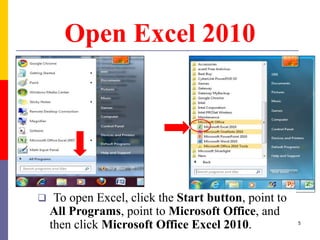
 To open Excel, click the Start button, point to
All Programs, point to Microsoft Office, and
then click Microsoft Office Excel 2010. 5
A New Workbook
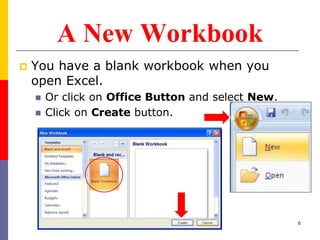
 You have a blank workbook when you
open Excel.
 Or click on Office Button and select New.
 Click on Create button.
6
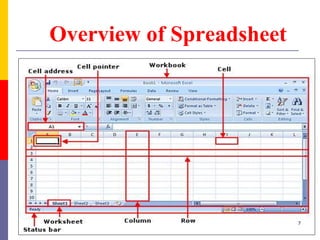
Overview of Spreadsheet
7
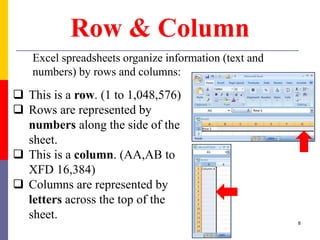
Row & Column
Excel spreadsheets organize information (text and
numbers) by rows and columns:
 This is a row. (1 to 1,048,576)
 Rows are represented by
numbers along the side of the
sheet.
 This is a column. (AA,AB to
XFD 16,384)
 Columns are represented by
letters across the top of the
sheet.
8
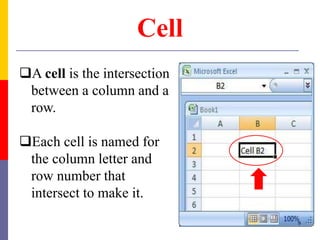
Cell
A cell is the intersection
between a column and a
row.
Each cell is named for
the column letter and
row number that
intersect to make it.
9
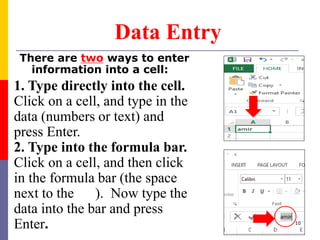
There are two ways to enter
information into a cell:
Data Entry
1. Type directly into the cell.
Click on a cell, and type in the
data (numbers or text) and
press Enter.
2. Type into the formula bar.
Click on a cell, and then click
in the formula bar (the space
next to the ). Now type the
data into the bar and press
Enter. 10
Home
Tab 11
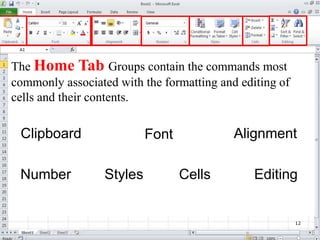
The Home Tab Groups contain the commands most
commonly associated with the formatting and editing of
cells and their contents.
Clipboard Font Alignment
Number Styles Cells Editing
12
Work on Spreadsheet
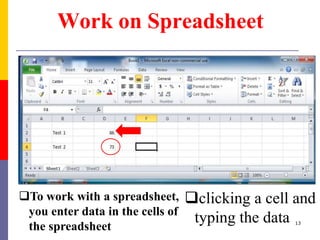
To work with a spreadsheet,
you enter data in the cells of
the spreadsheet
clicking a cell and
typing the data 13
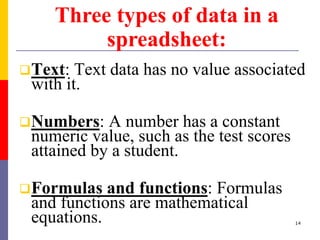
Text: Text data has no value associated
with it.
Numbers: A number has a constant
numeric value, such as the test scores
attained by a student.
Formulas and functions: Formulas
and functions are mathematical
equations.
Three types of data in a
spreadsheet:
14
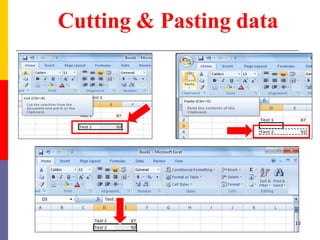
Cutting & Pasting data
15
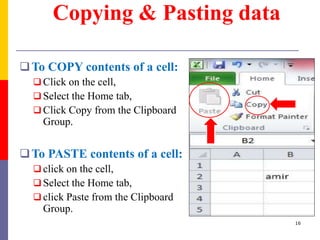
Copying & Pasting data
To COPY contents of a cell:
 Click on the cell,
 Select the Home tab,
 Click Copy from the Clipboard
Group.
To PASTE contents of a cell:
 click on the cell,
 Select the Home tab,
 click Paste from the Clipboard
Group.
16
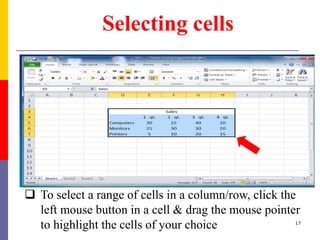
Selecting cells
 To select a range of cells in a column/row, click the
left mouse button in a cell & drag the mouse pointer
to highlight the cells of your choice 17
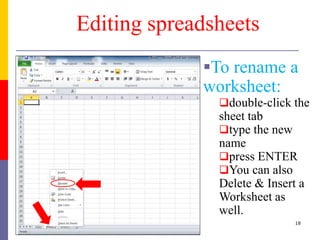
Editing spreadsheets
To rename a
worksheet:
double-click the
sheet tab
type the new
name
press ENTER
You can also
Delete & Insert a
Worksheet as
well.
18
Alignment Option
19
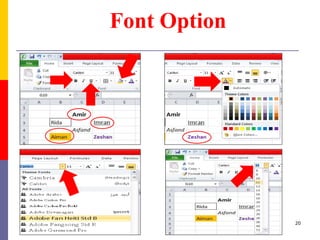
Font Option
20
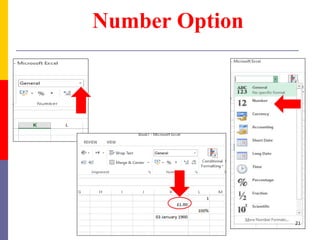
Number Option
21
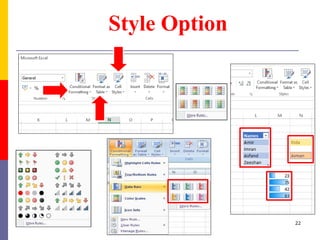
Style Option
22
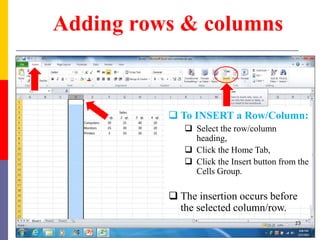
Adding rows & columns
 To INSERT a Row/Column:
 Select the row/column
heading,
 Click the Home Tab,
 Click the Insert button from the
Cells Group.
 The insertion occurs before
the selected column/row.
23
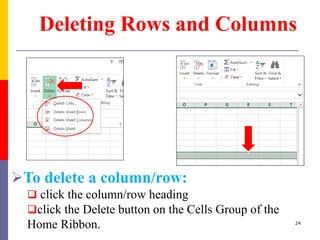
Deleting Rows and Columns
To delete a column/row:
 click the column/row heading
click the Delete button on the Cells Group of the
Home Ribbon. 24
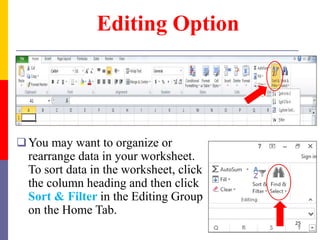
Editing Option
You may want to organize or
rearrange data in your worksheet.
To sort data in the worksheet, click
the column heading and then click
Sort & Filter in the Editing Group
on the Home Tab.
25
Insert
Tab 26
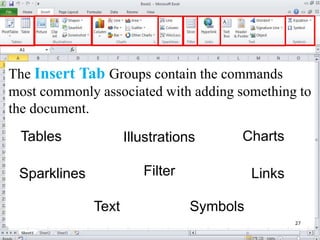
The Insert Tab Groups contain the commands
most commonly associated with adding something to
the document.
Tables Illustrations Charts
Sparklines Filter Links
Text Symbols
27
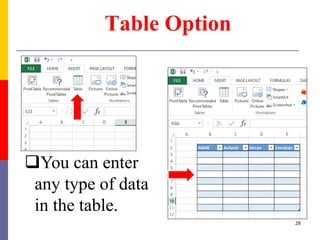
Table Option
You can enter
any type of data
in the table.
28
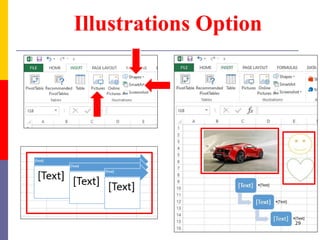
Illustrations Option
29
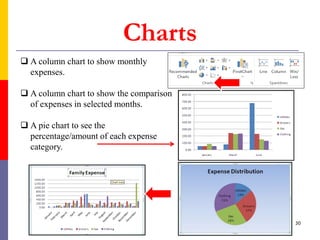
Charts
 A column chart to show monthly
expenses.
 A column chart to show the comparison
of expenses in selected months.
 A pie chart to see the
percentage/amount of each expense
category.
30
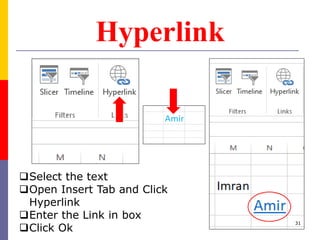
Hyperlink
Select the text
Open Insert Tab and Click
Hyperlink
Enter the Link in box
Click Ok
31
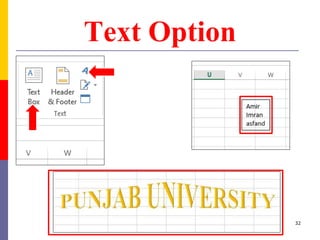
Text Option
32
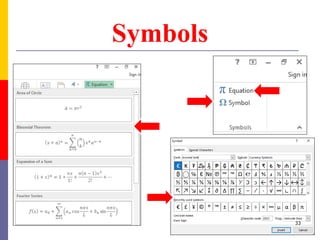
Symbols
33
Page Layout
Tab
34
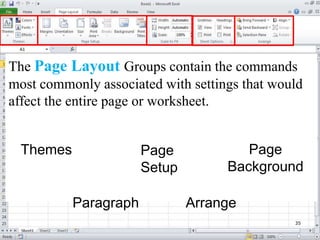
The Page Layout Groups contain the commands
most commonly associated with settings that would
affect the entire page or worksheet.
Themes Page
Setup
Page
Background
Paragraph Arrange
35
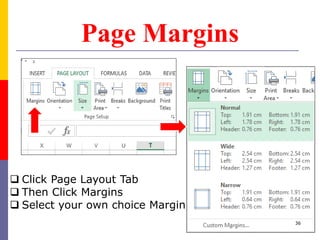
Page Margins
 Click Page Layout Tab
 Then Click Margins
 Select your own choice Margin
36
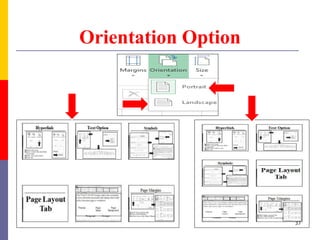
Orientation Option
37
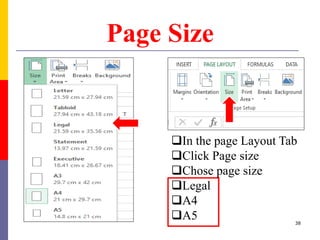
Page Size
In the page Layout Tab
Click Page size
Chose page size
Legal
A4
A5 38
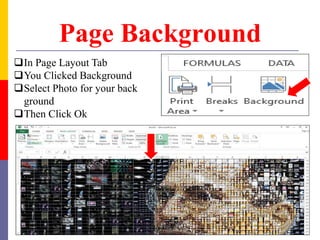
Page Background
In Page Layout Tab
You Clicked Background
Select Photo for your back
ground
Then Click Ok
39
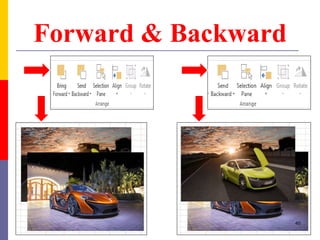
Forward & Backward
40
Formulas
Tab
41
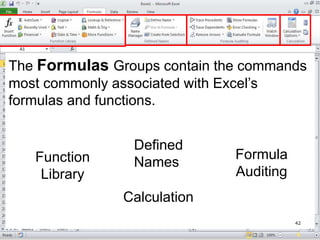
The Formulas Groups contain the commands
most commonly associated with Excel’s
formulas and functions.
Function
Library
Defined
Names
Formula
Auditing
Calculation
42
What is Formula
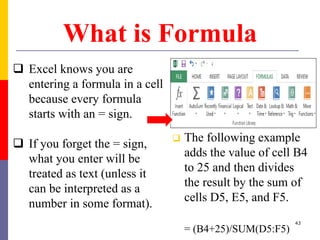
 Excel knows you are
entering a formula in a cell
because every formula
starts with an = sign.
 If you forget the = sign,
what you enter will be
treated as text (unless it
can be interpreted as a
number in some format).
 The following example
adds the value of cell B4
to 25 and then divides
the result by the sum of
cells D5, E5, and F5.
= (B4+25)/SUM(D5:F5)
43
Formula Workings
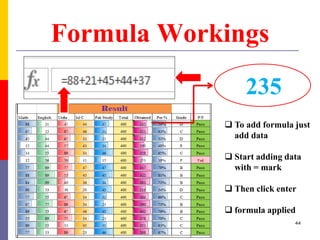
235
 To add formula just
add data
 Start adding data
with = mark
 Then click enter
 formula applied
44
Formula Data
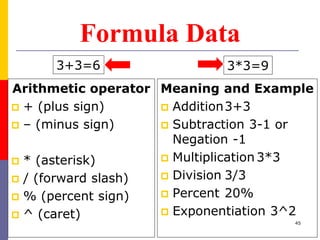
Arithmetic operator
 + (plus sign)
 – (minus sign)
 * (asterisk)
 / (forward slash)
 % (percent sign)
 ^ (caret)
Meaning and Example
 Addition3+3
 Subtraction 3-1 or
Negation -1
 Multiplication 3*3
 Division 3/3
 Percent 20%
 Exponentiation 3^2
3+3=6 3*3=9
45
Functions
 Microsoft Excel contains many predefined
functions that can be used in formulas.
 Functions can be used to perform simple or
complex calculations.
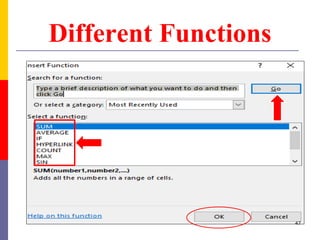
 To enter a function, you can either type it in
directly, or select it from the dialog box that
appears when you click the Paste Function
button on the standard toolbar:
46
Different Functions
47
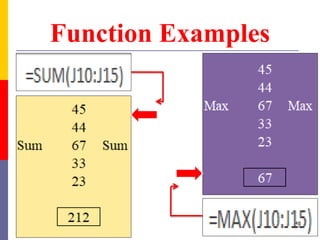
Function Examples
48
How to Save
& Print
49
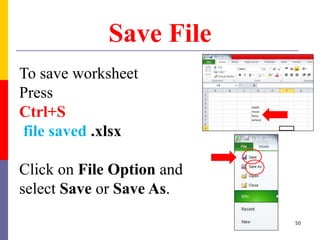
Save File
To save worksheet
Press
Ctrl+S
file saved .xlsx
Click on File Option and
select Save or Save As.
50
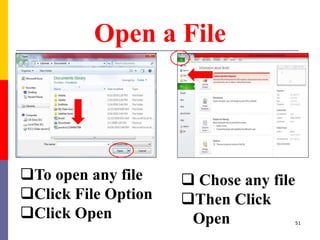
Open a File
To open any file
Click File Option
Click Open
 Chose any file
Then Click
Open 51
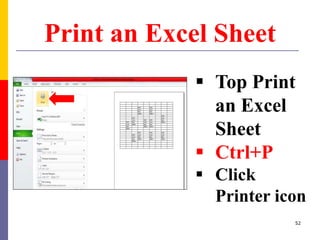
Print an Excel Sheet
 Top Print
an Excel
Sheet
 Ctrl+P
 Click
Printer icon
52
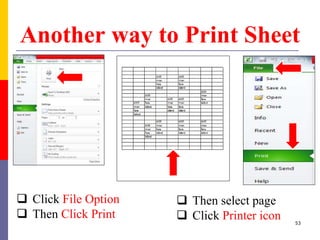
Another way to Print Sheet
 Click File Option
 Then Click Print
 Then select page
 Click Printer icon 53
54
55

MS Excel new version 2013

  • 1.
  • 2.
  • 3.
    Group No: 1 RANAIMRAN IQBAL 04 RIDA FATIMA 06 MUHAMMAD AMIR 07 ASFAND HAYAT 10 AIMAN ASHRAF 36 ZEESHAN SADDIQUE 59 3
  • 4.
    Introduction to Excel Identifythe components of a spreadsheet. Enter data into a spreadsheet. Perform basic mathematical tasks in a spreadsheet. Insert charts in a spreadsheet. Printing a spreadsheet. 4
  • 5.
    Open Excel 2010 To open Excel, click the Start button, point to All Programs, point to Microsoft Office, and then click Microsoft Office Excel 2010. 5
  • 6.
    A New Workbook You have a blank workbook when you open Excel.  Or click on Office Button and select New.  Click on Create button. 6
  • 7.
  • 8.
    Row & Column Excelspreadsheets organize information (text and numbers) by rows and columns:  This is a row. (1 to 1,048,576)  Rows are represented by numbers along the side of the sheet.  This is a column. (AA,AB to XFD 16,384)  Columns are represented by letters across the top of the sheet. 8
  • 9.
    Cell A cell isthe intersection between a column and a row. Each cell is named for the column letter and row number that intersect to make it. 9
  • 10.
    There are twoways to enter information into a cell: Data Entry 1. Type directly into the cell. Click on a cell, and type in the data (numbers or text) and press Enter. 2. Type into the formula bar. Click on a cell, and then click in the formula bar (the space next to the ). Now type the data into the bar and press Enter. 10
  • 11.
  • 12.
    The Home TabGroups contain the commands most commonly associated with the formatting and editing of cells and their contents. Clipboard Font Alignment Number Styles Cells Editing 12
  • 13.
    Work on Spreadsheet Towork with a spreadsheet, you enter data in the cells of the spreadsheet clicking a cell and typing the data 13
  • 14.
    Text: Text datahas no value associated with it. Numbers: A number has a constant numeric value, such as the test scores attained by a student. Formulas and functions: Formulas and functions are mathematical equations. Three types of data in a spreadsheet: 14
  • 15.
  • 16.
    Copying & Pastingdata To COPY contents of a cell:  Click on the cell,  Select the Home tab,  Click Copy from the Clipboard Group. To PASTE contents of a cell:  click on the cell,  Select the Home tab,  click Paste from the Clipboard Group. 16
  • 17.
    Selecting cells  Toselect a range of cells in a column/row, click the left mouse button in a cell & drag the mouse pointer to highlight the cells of your choice 17
  • 18.
    Editing spreadsheets To renamea worksheet: double-click the sheet tab type the new name press ENTER You can also Delete & Insert a Worksheet as well. 18
  • 19.
  • 20.
  • 21.
  • 22.
  • 23.
    Adding rows &columns  To INSERT a Row/Column:  Select the row/column heading,  Click the Home Tab,  Click the Insert button from the Cells Group.  The insertion occurs before the selected column/row. 23
  • 24.
    Deleting Rows andColumns To delete a column/row:  click the column/row heading click the Delete button on the Cells Group of the Home Ribbon. 24
  • 25.
    Editing Option You maywant to organize or rearrange data in your worksheet. To sort data in the worksheet, click the column heading and then click Sort & Filter in the Editing Group on the Home Tab. 25
  • 26.
  • 27.
    The Insert TabGroups contain the commands most commonly associated with adding something to the document. Tables Illustrations Charts Sparklines Filter Links Text Symbols 27
  • 28.
    Table Option You canenter any type of data in the table. 28
  • 29.
  • 30.
    Charts  A columnchart to show monthly expenses.  A column chart to show the comparison of expenses in selected months.  A pie chart to see the percentage/amount of each expense category. 30
  • 31.
    Hyperlink Select the text OpenInsert Tab and Click Hyperlink Enter the Link in box Click Ok 31
  • 32.
  • 33.
  • 34.
  • 35.
    The Page LayoutGroups contain the commands most commonly associated with settings that would affect the entire page or worksheet. Themes Page Setup Page Background Paragraph Arrange 35
  • 36.
    Page Margins  ClickPage Layout Tab  Then Click Margins  Select your own choice Margin 36
  • 37.
  • 38.
    Page Size In thepage Layout Tab Click Page size Chose page size Legal A4 A5 38
  • 39.
    Page Background In PageLayout Tab You Clicked Background Select Photo for your back ground Then Click Ok 39
  • 40.
  • 41.
  • 42.
    The Formulas Groupscontain the commands most commonly associated with Excel’s formulas and functions. Function Library Defined Names Formula Auditing Calculation 42
  • 43.
    What is Formula Excel knows you are entering a formula in a cell because every formula starts with an = sign.  If you forget the = sign, what you enter will be treated as text (unless it can be interpreted as a number in some format).  The following example adds the value of cell B4 to 25 and then divides the result by the sum of cells D5, E5, and F5. = (B4+25)/SUM(D5:F5) 43
  • 44.
    Formula Workings 235  Toadd formula just add data  Start adding data with = mark  Then click enter  formula applied 44
  • 45.
    Formula Data Arithmetic operator + (plus sign)  – (minus sign)  * (asterisk)  / (forward slash)  % (percent sign)  ^ (caret) Meaning and Example  Addition3+3  Subtraction 3-1 or Negation -1  Multiplication 3*3  Division 3/3  Percent 20%  Exponentiation 3^2 3+3=6 3*3=9 45
  • 46.
    Functions  Microsoft Excelcontains many predefined functions that can be used in formulas.  Functions can be used to perform simple or complex calculations.  To enter a function, you can either type it in directly, or select it from the dialog box that appears when you click the Paste Function button on the standard toolbar: 46
  • 47.
  • 48.
  • 49.
    How to Save &Print 49
  • 50.
    Save File To saveworksheet Press Ctrl+S file saved .xlsx Click on File Option and select Save or Save As. 50
  • 51.
    Open a File Toopen any file Click File Option Click Open  Chose any file Then Click Open 51
  • 52.
    Print an ExcelSheet  Top Print an Excel Sheet  Ctrl+P  Click Printer icon 52
  • 53.
    Another way toPrint Sheet  Click File Option  Then Click Print  Then select page  Click Printer icon 53
  • 54.
  • 55.