LEARNİNG OBJECTİVES
Understand andapply the following skills:
• Explore and identify MS Excel user interface elements.
• Moving around worksheets.
• Selecting cells, rows, and columns.
• Editing & formatting worksheets.
• Inserting & deleting rows and columns.
• Deleting rows & columns.
• Changing row heights & column widths.
• Hiding and unhiding rows and columns.
• Selecting worksheets.
• Navigating between worksheets.
• Renaming worksheets.
• Inserting & deleting worksheets.
• Moving & copying worksheets.
• Switching between MS Excel views.
• Freezing & unfreezing panes.
• Using templates.
3.
OUTLİNES
• Introduction
• MSPowerPoint 2010 Interface
• Moving Around Worksheets
• Selecting Cells, Rows, and Columns
• Editing & Formatting Worksheets
• Formatting Numbers
• Inserting Rows and Columns
• Deleting Rows and Columns
• Changing Row Heights
• Changing Column Widths
• Hiding and Unhiding Rows and
Columns
• Selecting Worksheets
• Navigating Between Worksheets
• Renaming Worksheets
• Inserting Worksheets
• Deleting Worksheets
• Moving Worksheets
• Copying Worksheets
• MS Excel Views
o The Normal View
o Page Layout View
o Page Break Preview View
o Custom Views
o Full Screen View
• Freezing Panes
• Using Templates
4.
INTRODUCTİON
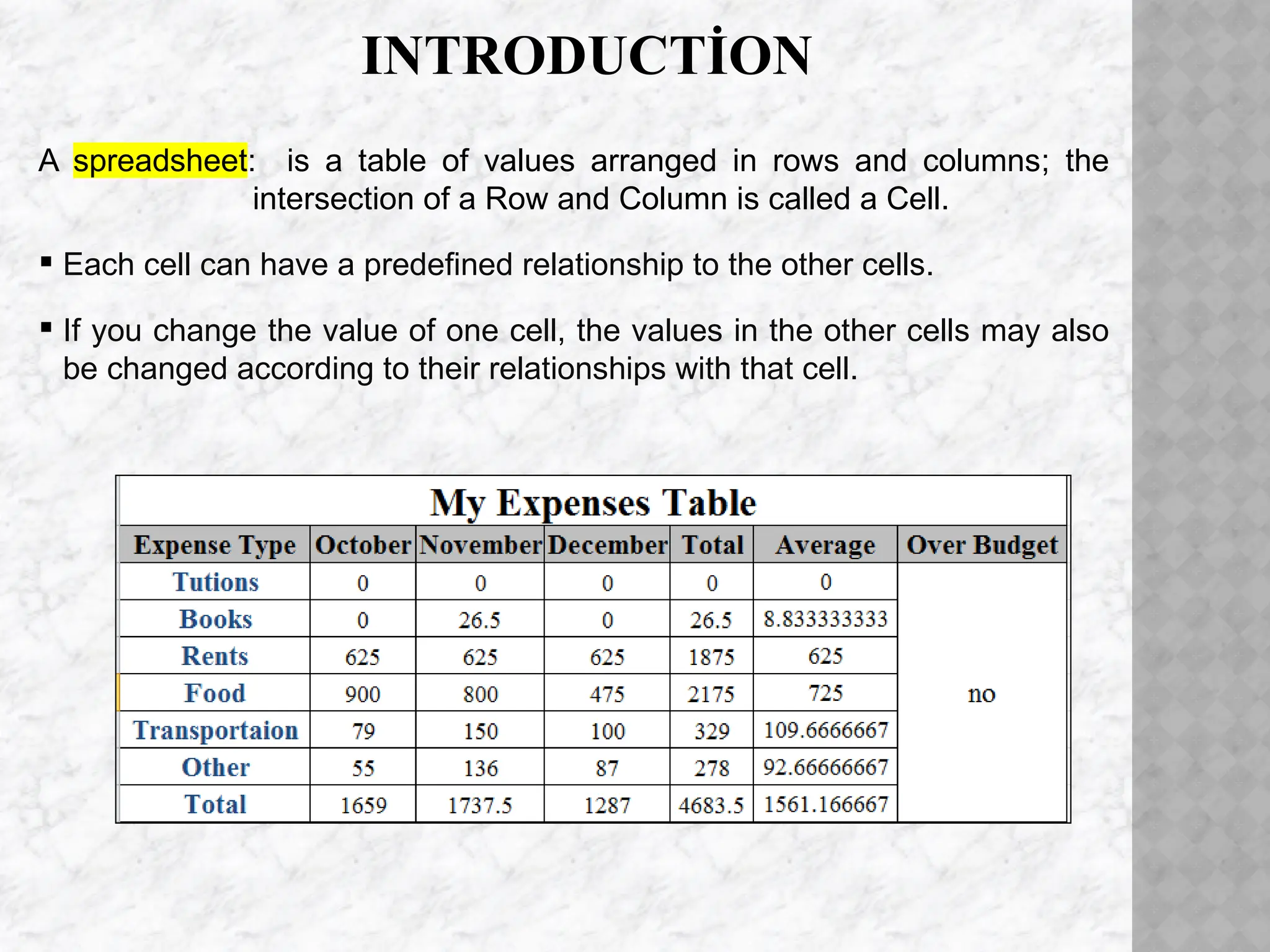
A spreadsheet: isa table of values arranged in rows and columns; the
intersection of a Row and Column is called a Cell.
Each cell can have a predefined relationship to the other cells.
If you change the value of one cell, the values in the other cells may also
be changed according to their relationships with that cell.
5.
INTRODUCTİON
• Excel isthe MS-Office Application program used for creating
spreadsheets.
• You can use Excel to enter all sorts of data and perform
financial, mathematical, or statistical calculations.
• Excel operates like other MS Office programs and has many
of the same functions and shortcuts as MS Word & MS
PowerPoint.
• Excel can do most (not all) of the common (i.e. useful &
popular) tasks done in MATLAB or similar software.
• MATLAB is more powerful, but it’s also SPECIALIZED and
EXPENSIVE.
• Excel is more widespread, quick, and easy.
6.
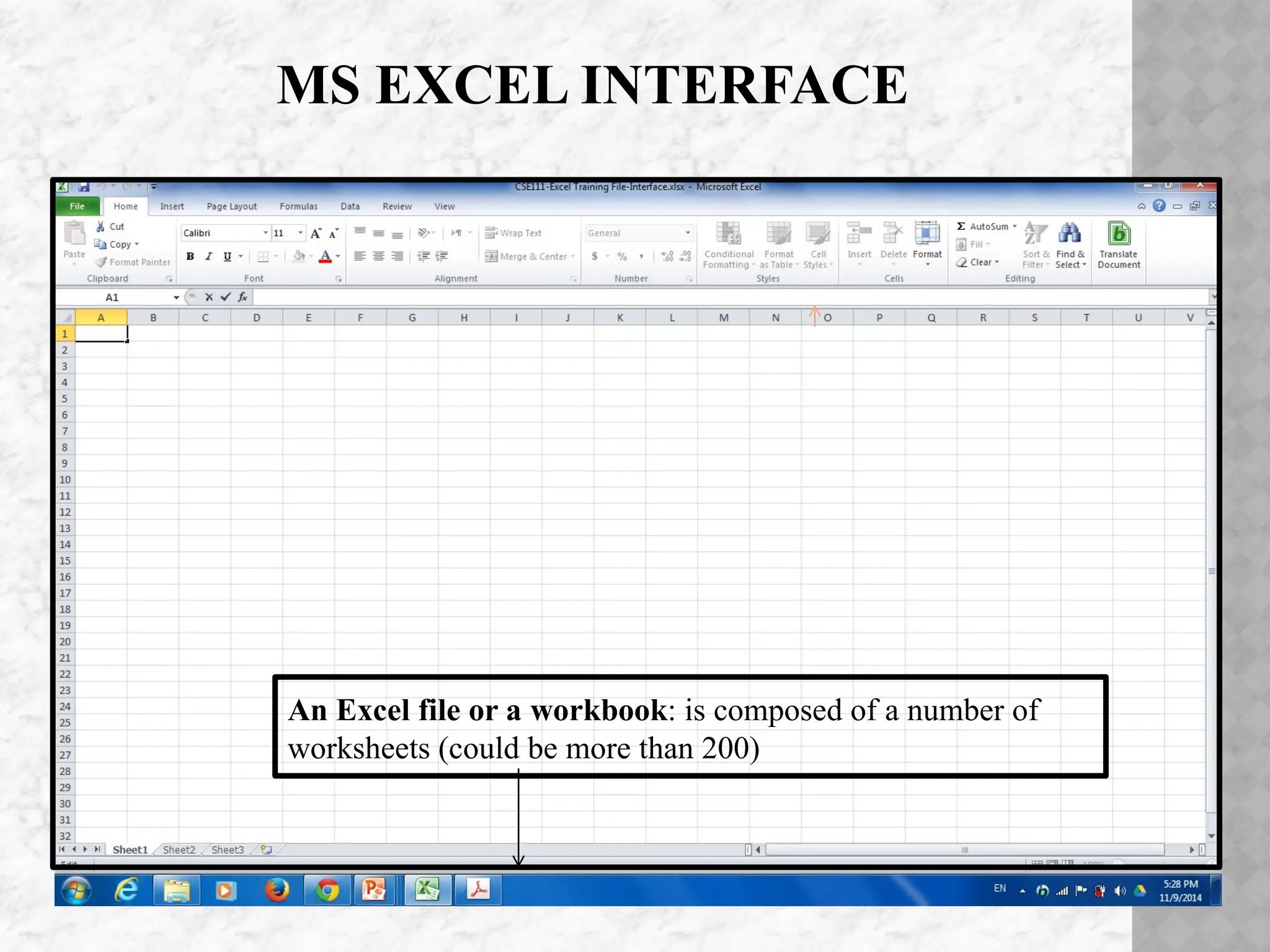
MS EXCEL INTERFACE
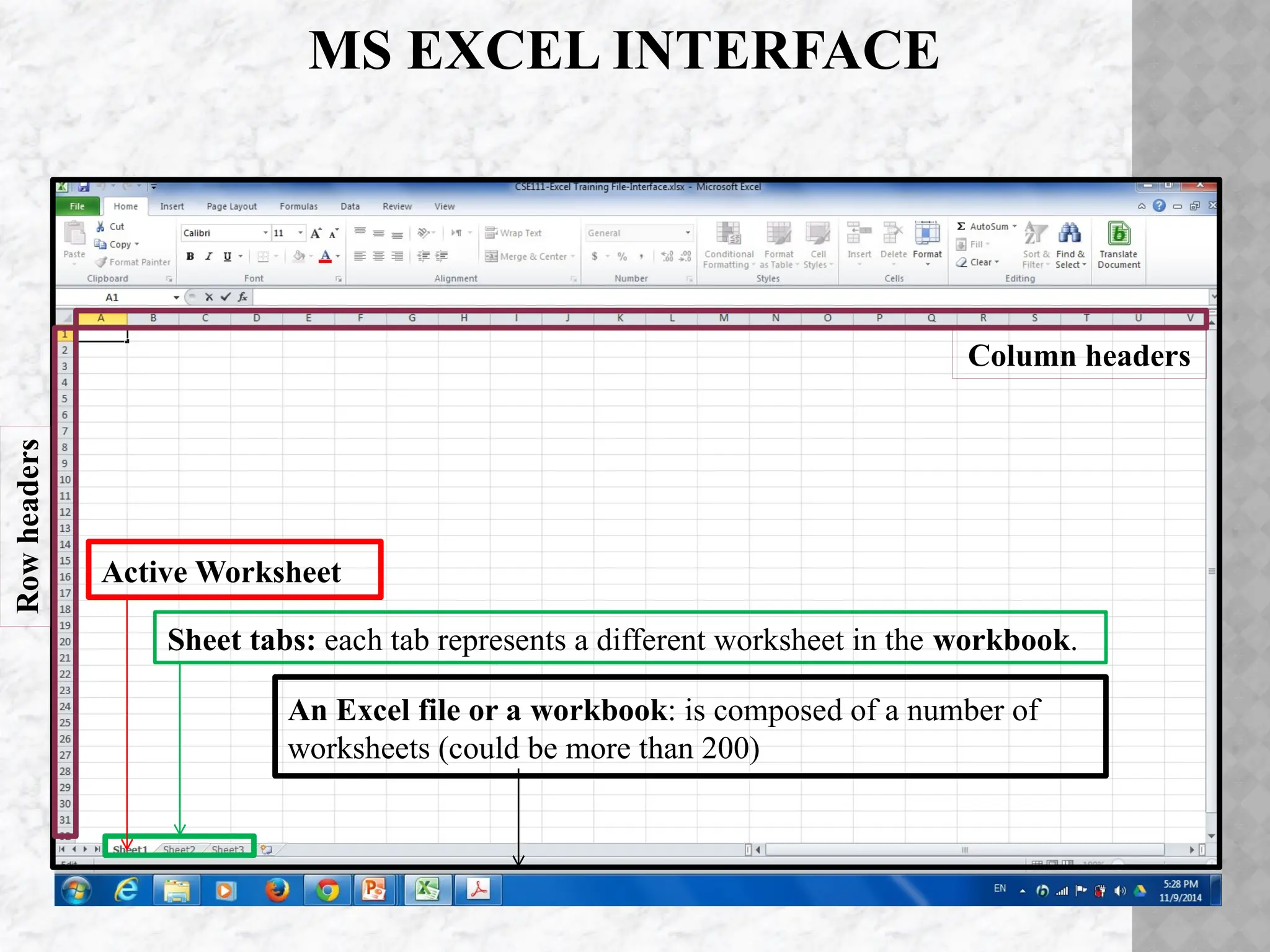
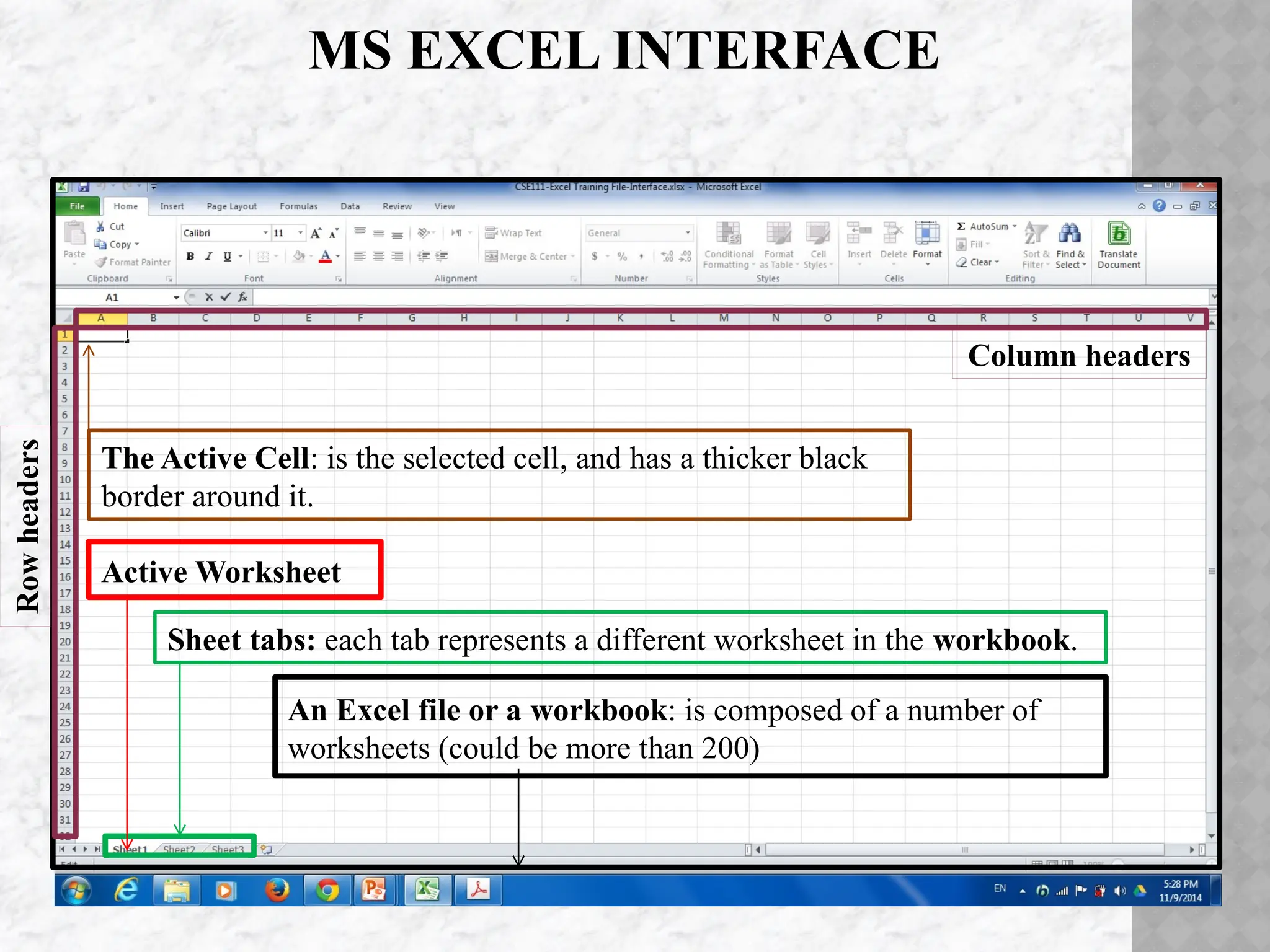
AnExcel file or a workbook: is composed of a number of
worksheets (could be more than 200)
7.
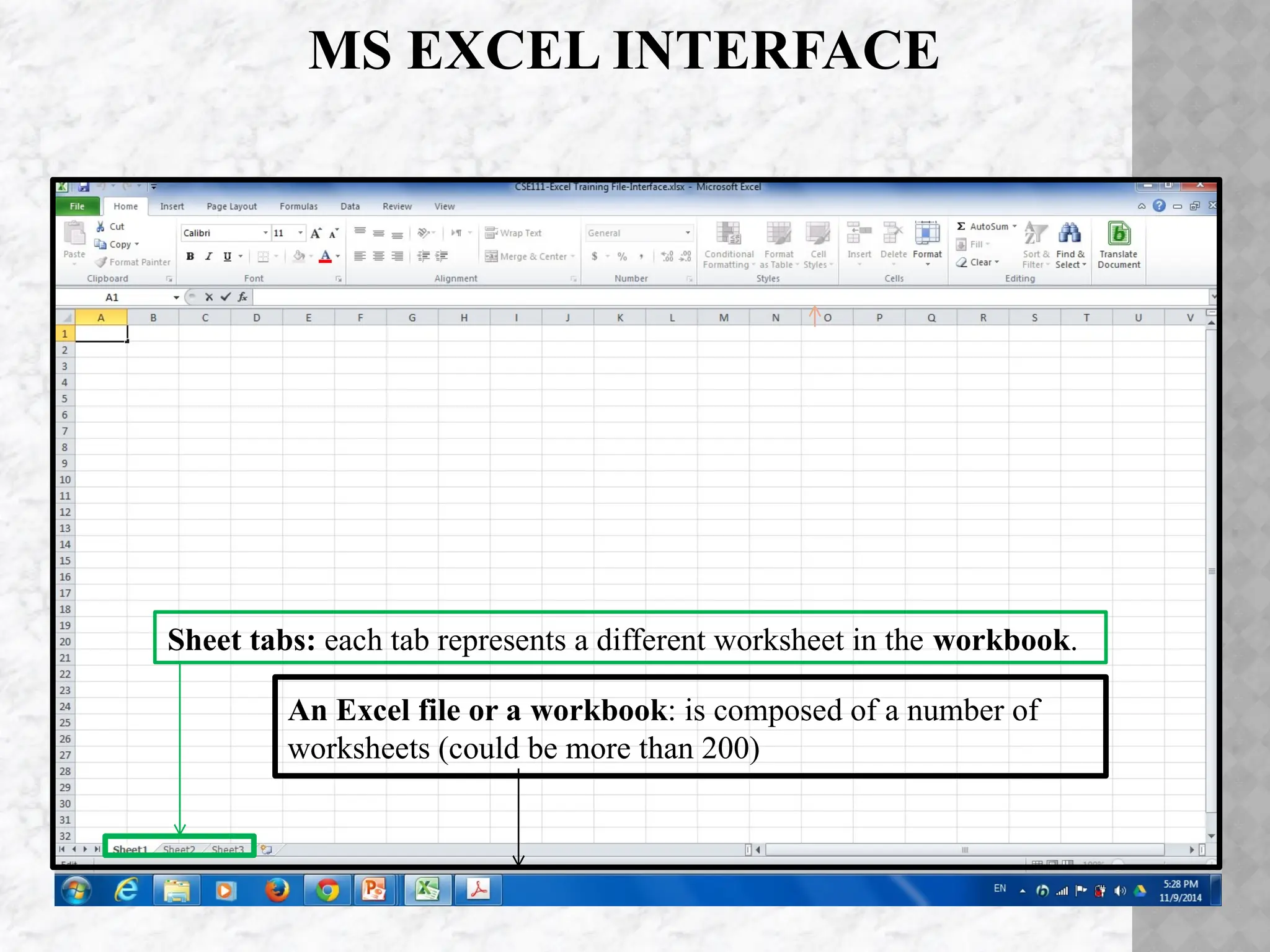
MS EXCEL INTERFACE
AnExcel file or a workbook: is composed of a number of
worksheets (could be more than 200)
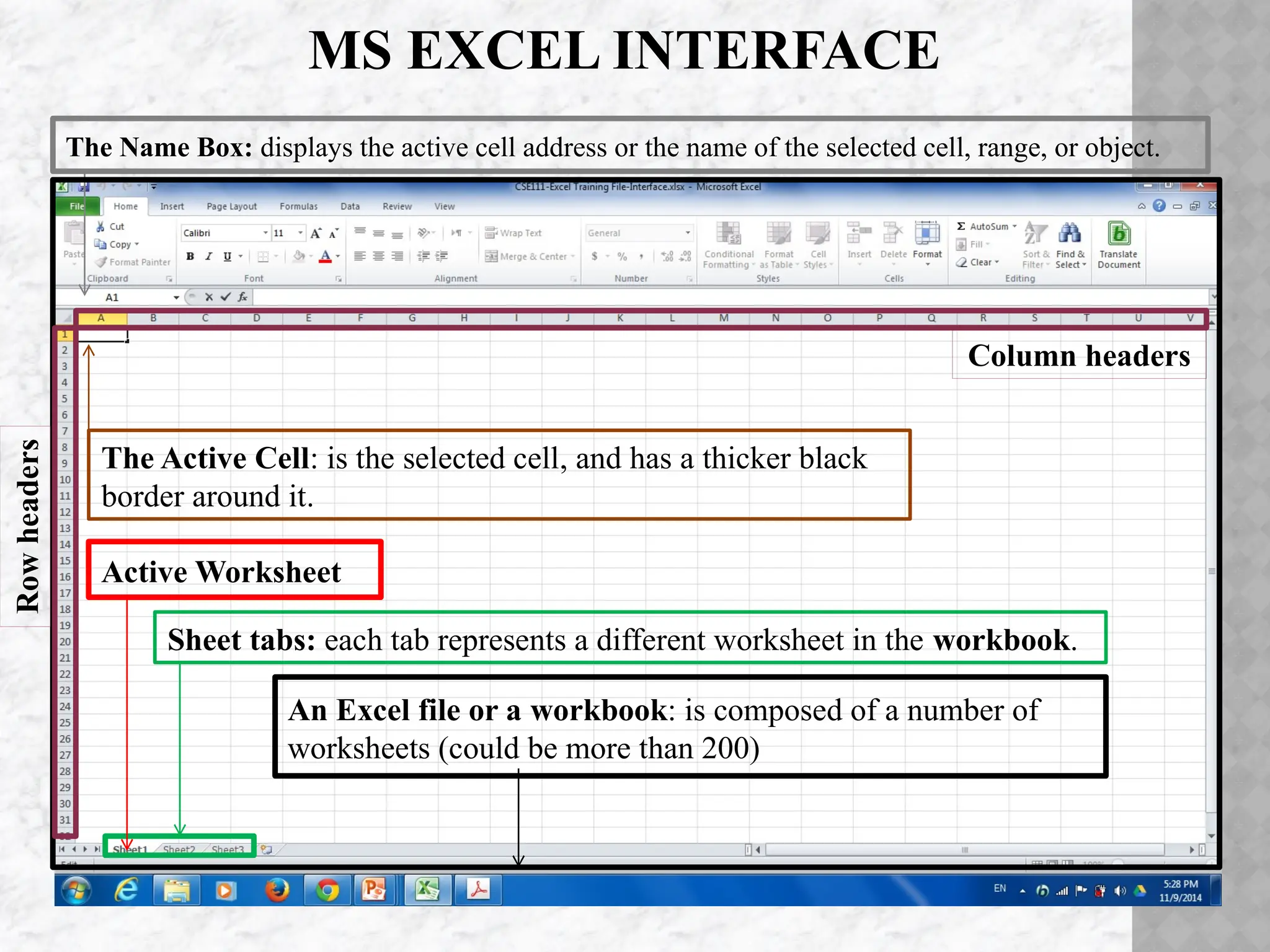
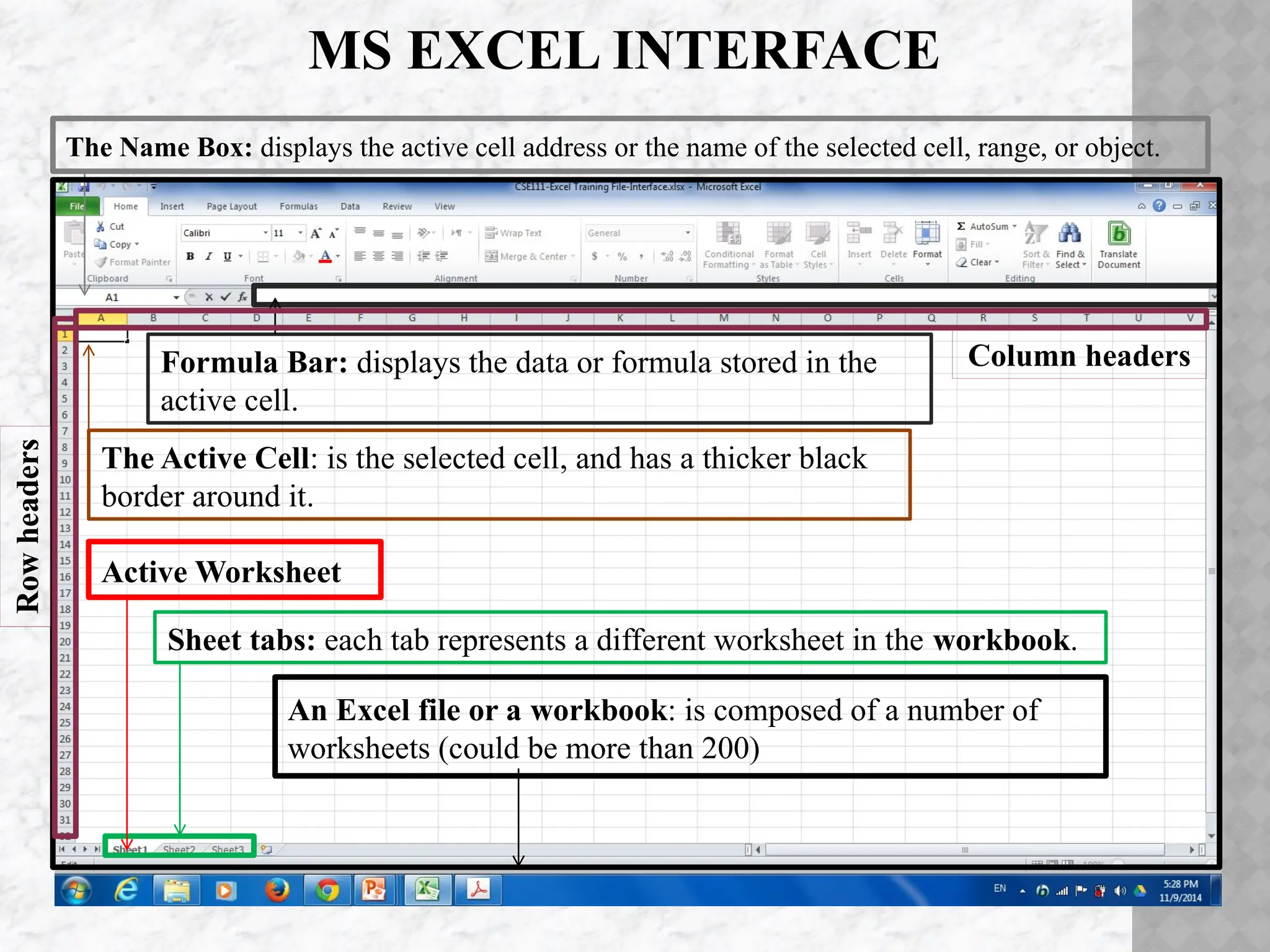
Sheet tabs: each tab represents a different worksheet in the workbook.
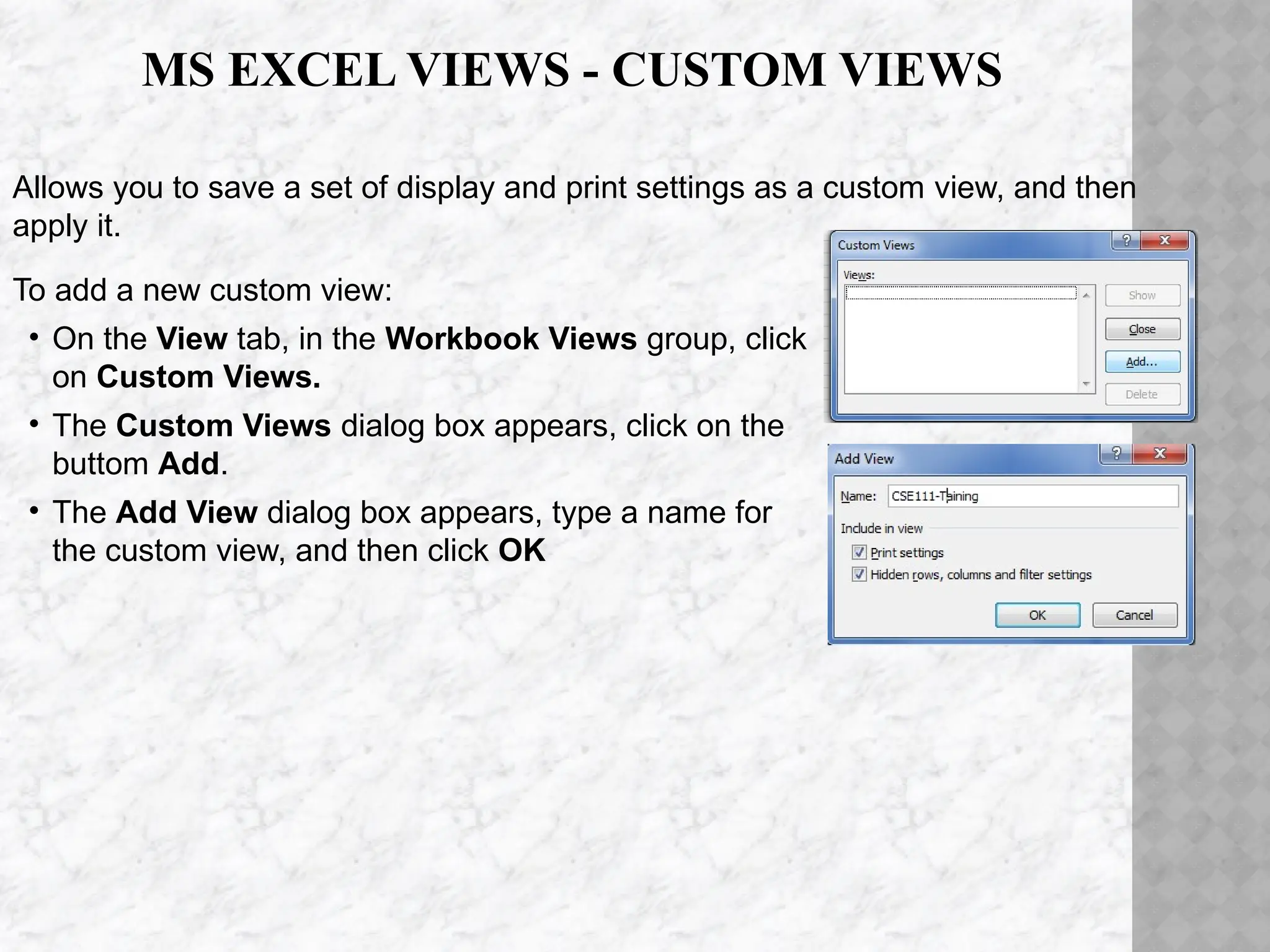
8.
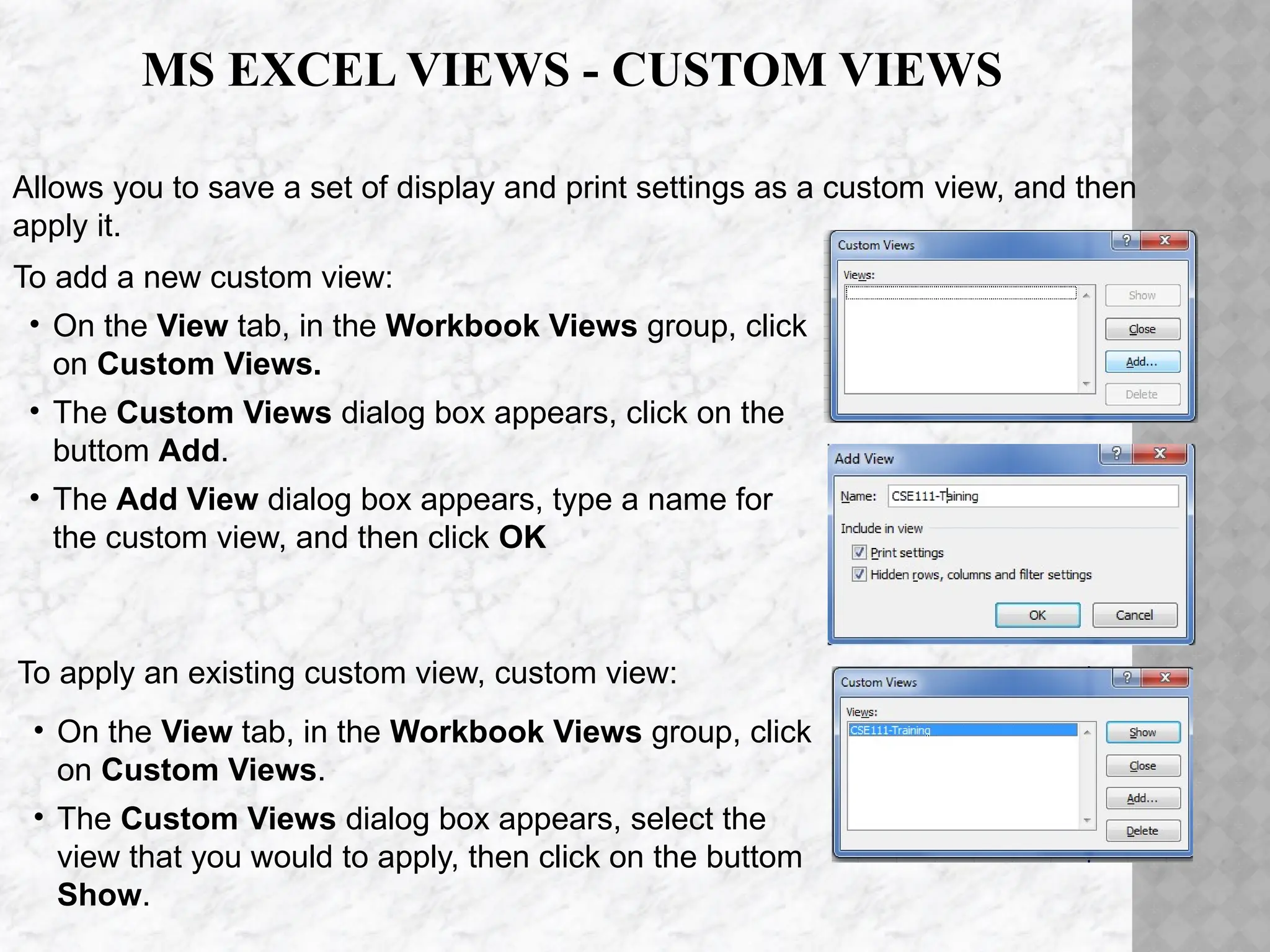
MS EXCEL INTERFACE
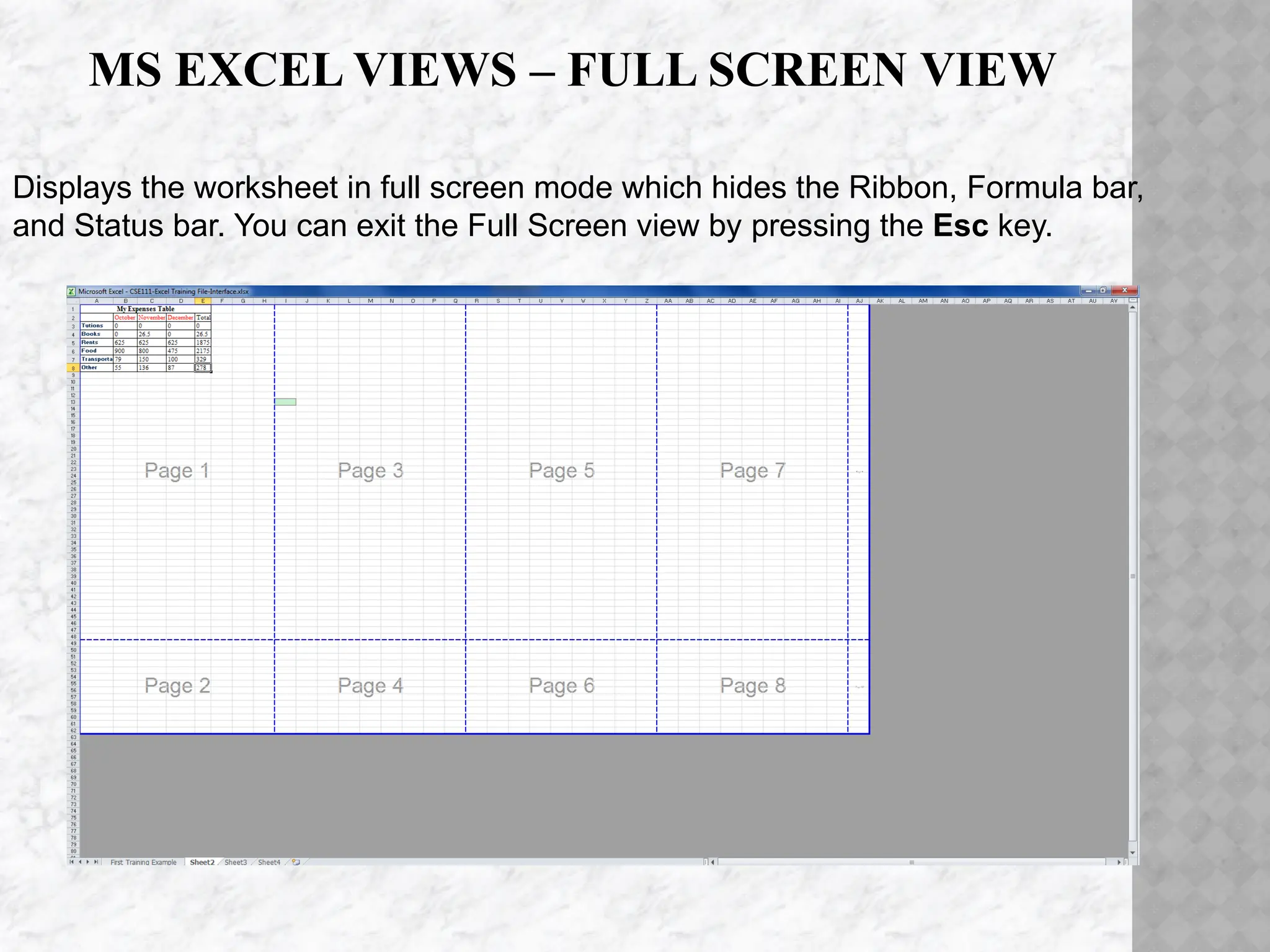
AnExcel file or a workbook: is composed of a number of
worksheets (could be more than 200)
Sheet tabs: each tab represents a different worksheet in the workbook.
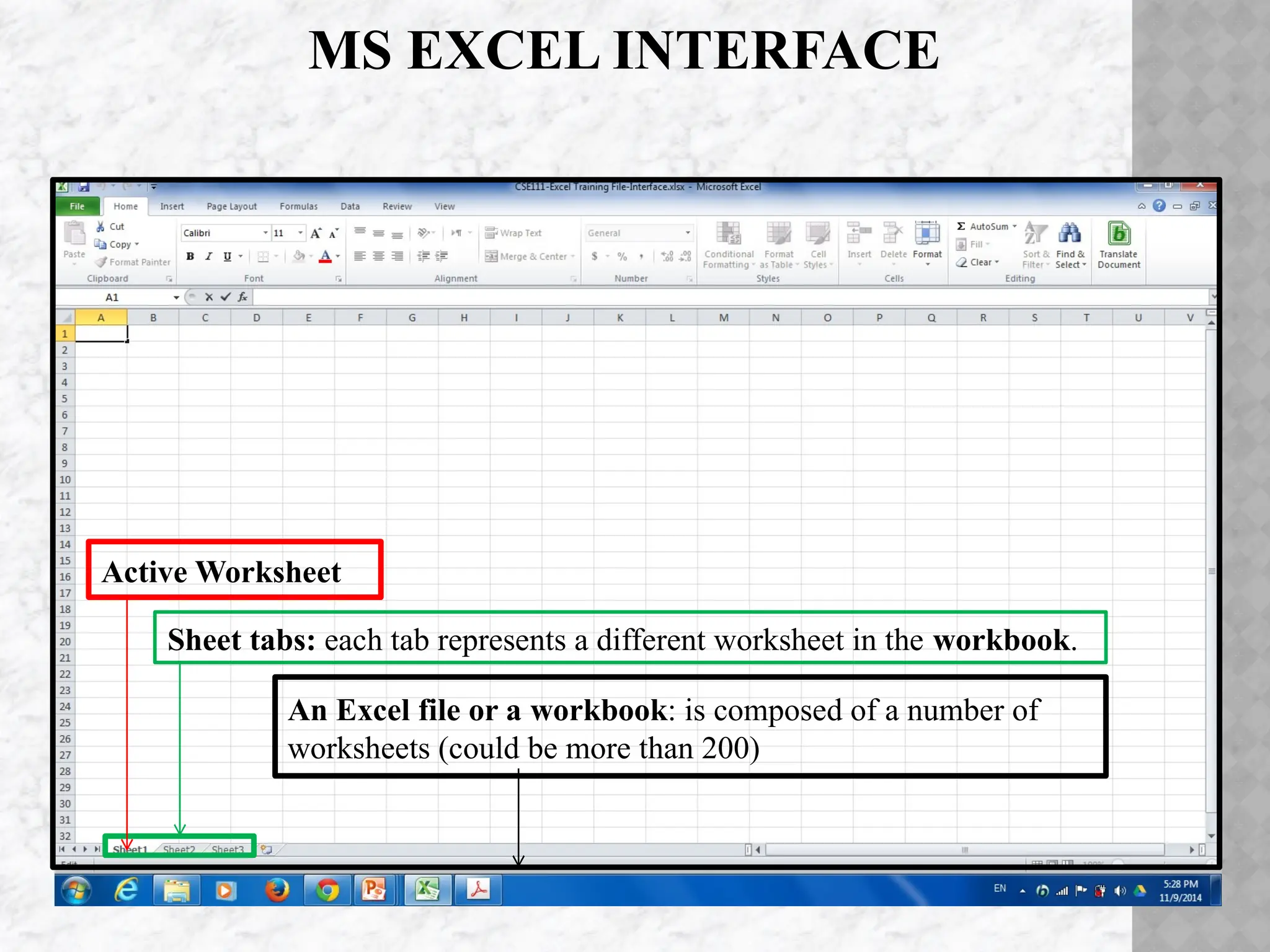
Active Worksheet
9.
MS EXCEL INTERFACE
AnExcel file or a workbook: is composed of a number of
worksheets (could be more than 200)
Sheet tabs: each tab represents a different worksheet in the workbook.
Active Worksheet
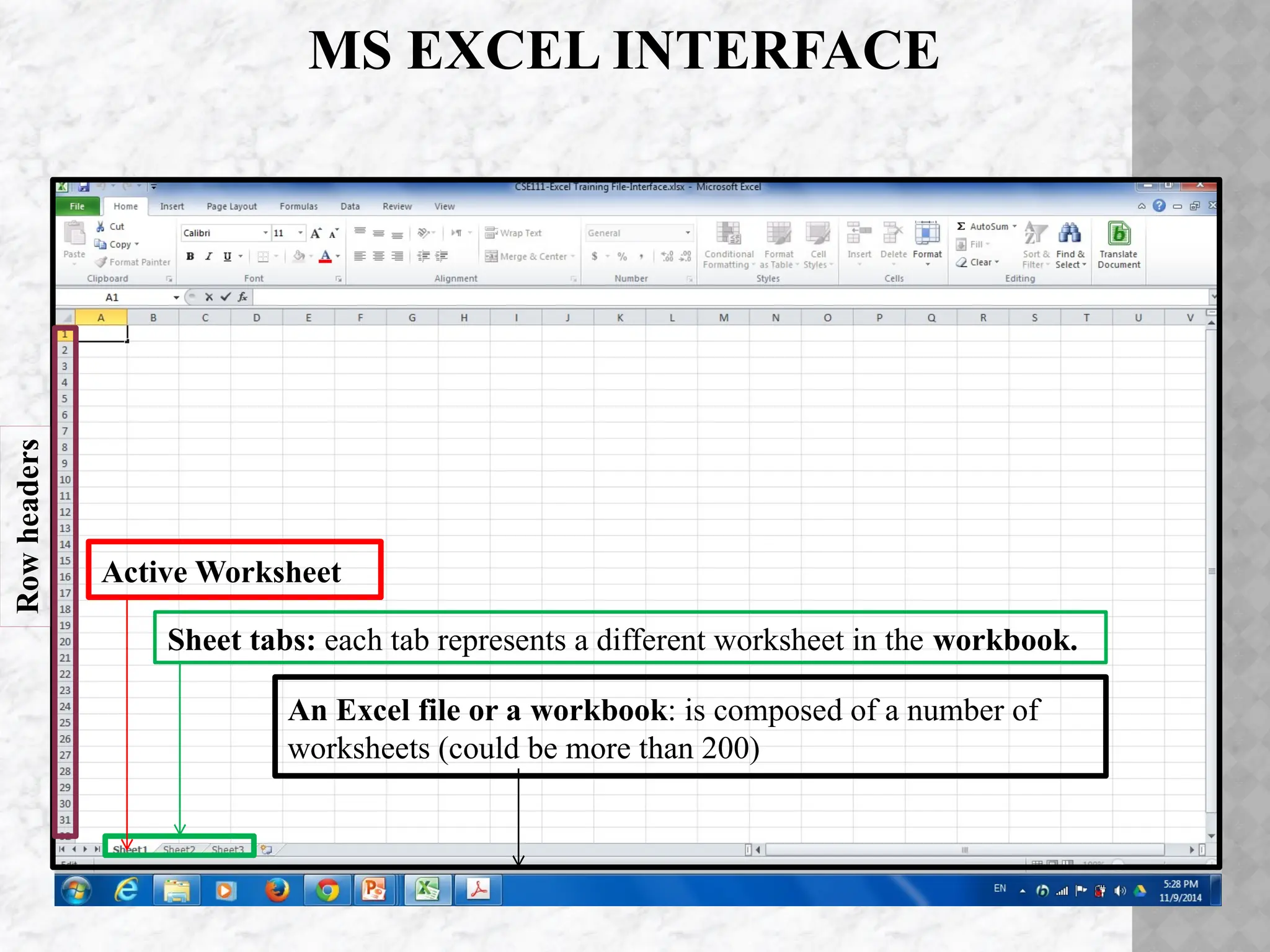
Row
headers
10.
MS EXCEL INTERFACE
AnExcel file or a workbook: is composed of a number of
worksheets (could be more than 200)
Sheet tabs: each tab represents a different worksheet in the workbook.
Active Worksheet
Row
headers
Column headers
11.
MS EXCEL INTERFACE
AnExcel file or a workbook: is composed of a number of
worksheets (could be more than 200)
Sheet tabs: each tab represents a different worksheet in the workbook.
The Active Cell: is the selected cell, and has a thicker black
border around it.
Active Worksheet
Row
headers
Column headers
12.
MS EXCEL INTERFACE
TheName Box: displays the active cell address or the name of the selected cell, range, or object.
An Excel file or a workbook: is composed of a number of
worksheets (could be more than 200)
Sheet tabs: each tab represents a different worksheet in the workbook.
Active Worksheet
The Active Cell: is the selected cell, and has a thicker black
border around it.
Row
headers
Column headers
13.
MS EXCEL INTERFACE
TheName Box: displays the active cell address or the name of the selected cell, range, or object.
Formula Bar: displays the data or formula stored in the
active cell.
An Excel file or a workbook: is composed of a number of
worksheets (could be more than 200)
Sheet tabs: each tab represents a different worksheet in the workbook.
Active Worksheet
The Active Cell: is the selected cell, and has a thicker black
border around it.
Row
headers
Row
headers
Column headers
14.
MOVING AROUND WORKSHEETS
Thereare various ways to navigate through a worksheet:
Use the mouse and the scroll bars to scroll through the worksheet in any
direction.
Use the navigational keys on the keyboard:
• Down arrow or Enter: for moving the active cell one cell down.
• Up arrow or Shift+ Enter: for moving the active cell one cell up.
• Right arrow or Tab: for moving the active cell one cell to the right.
• Left arrow or Shift+Tab: for moving the active cell one cell to the left.
• Page Down for moving the active cell down one page.
• Page Up: for moving the active cell up one page.
• Alt+Page Down: for moving the active cell right one page.
• Alt+Page Up: for moving the active cell left one page.
• Ctrl+Home: for moving the active cell to cell A1.
• Ctrl+End: for moving the active cell to the last used cell in the worksheet.
You can also navigate to a specific cell in the worksheet by entering its
address in the Name box, and then pressing Enter.
SELECTING CELLS, ROWS,AND COLUMNS
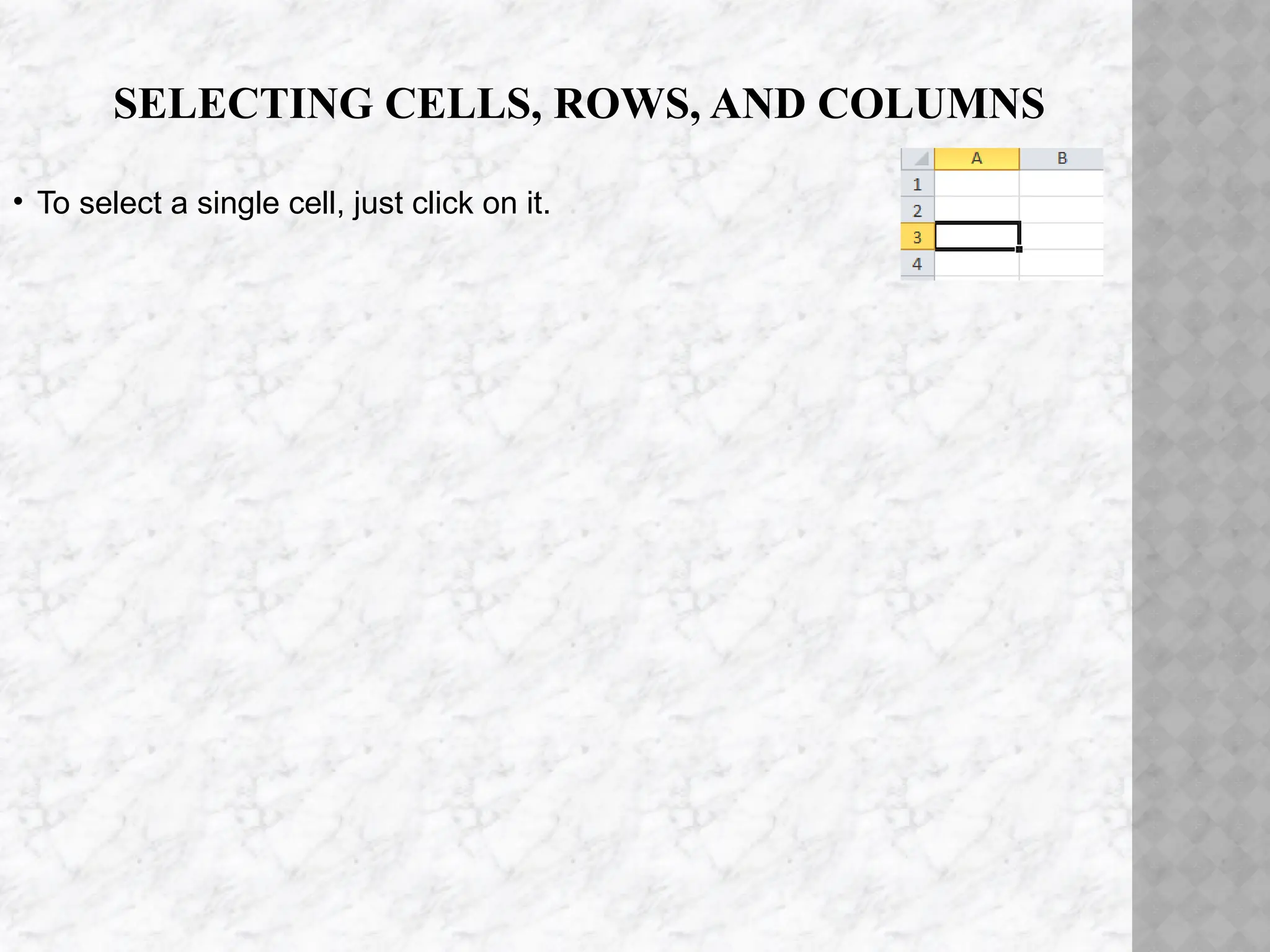
• To select a single cell, just click on it.
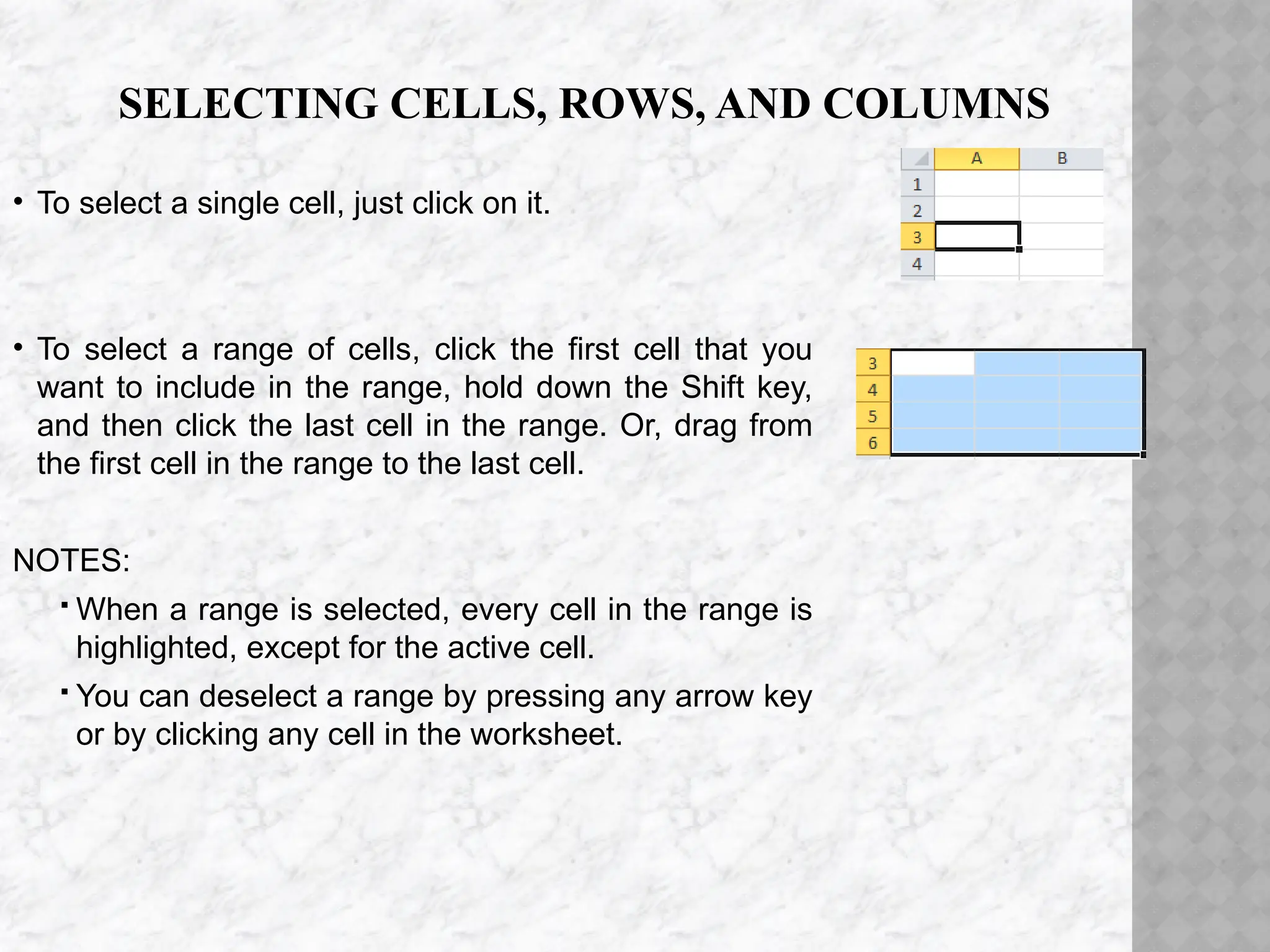
• To select a range of cells, click the first cell that you
want to include in the range, hold down the Shift key,
and then click the last cell in the range. Or, drag from
the first cell in the range to the last cell.
NOTES:
When a range is selected, every cell in the range is
highlighted, except for the active cell.
You can deselect a range by pressing any arrow key
or by clicking any cell in the worksheet.
17.
SELECTING CELLS, ROWS,AND COLUMNS
• To select a single cell, just click on it.
• To select a range of cells, click the first cell that you
want to include in the range, hold down the Shift key,
and then click the last cell in the range. Or, drag from
the first cell in the range to the last cell.
NOTES:
When a range is selected, every cell in the range
is highlighted, except for the active cell.
You can deselect a range by pressing any arrow
key or by clicking any cell in the worksheet.
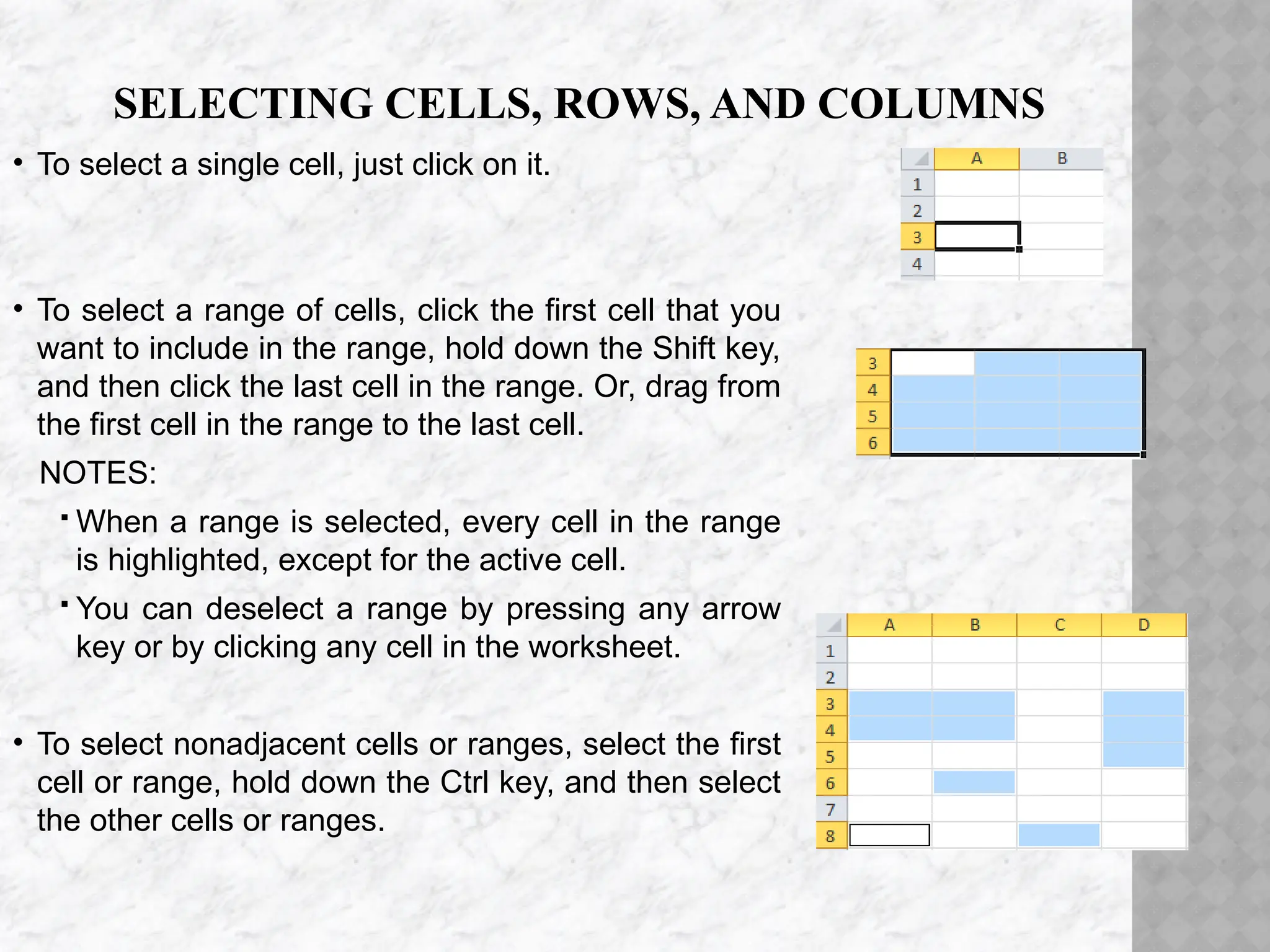
• To select nonadjacent cells or ranges, select the first
cell or range, hold down the Ctrl key, and then select
the other cells or ranges.
18.
SELECTING CELLS, ROWS,AND COLUMNS
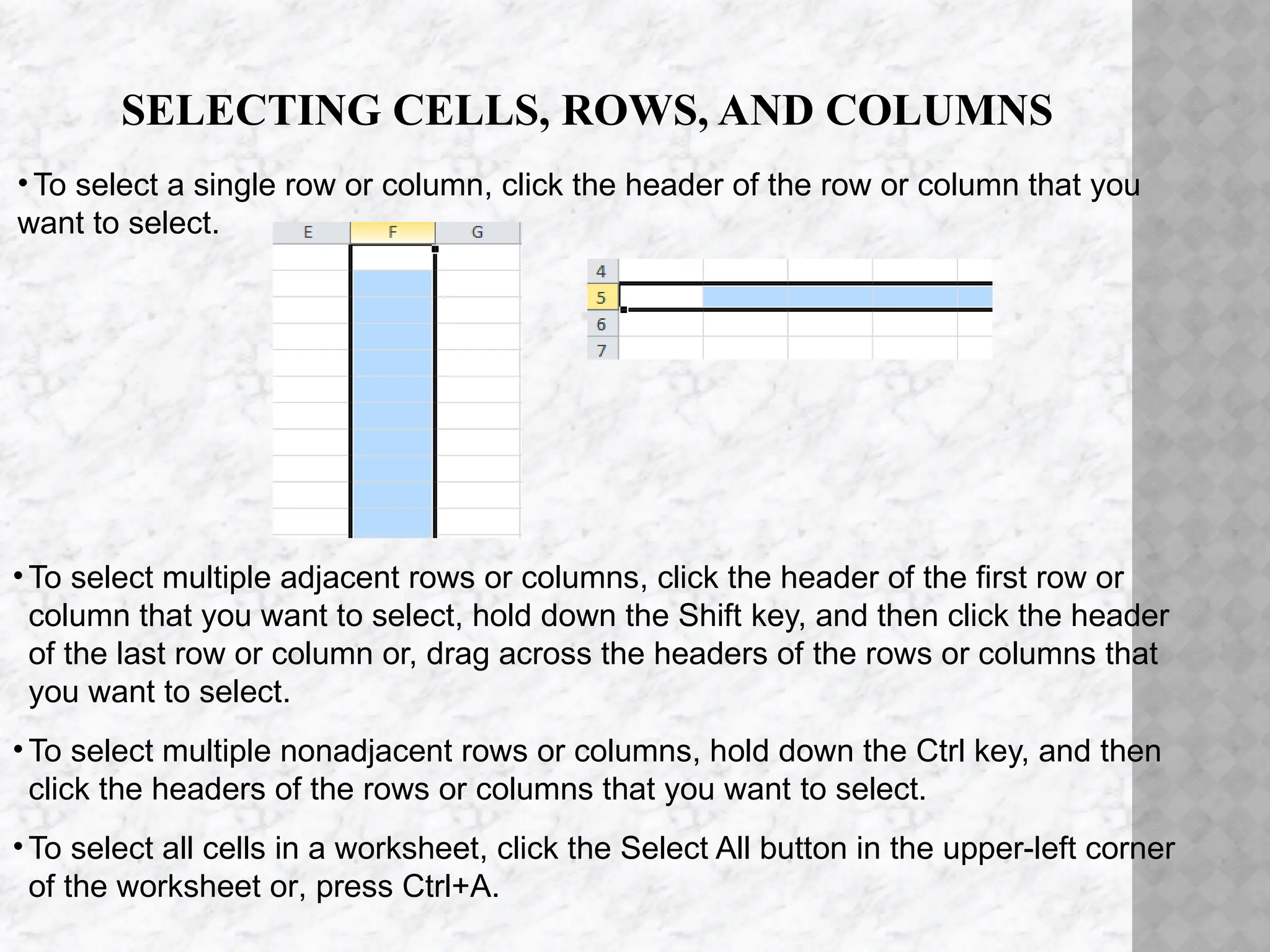
•To select a single row or column, click the header of the row or column that you
want to select.
• To select multiple adjacent rows or columns, click the header of the first row or
column that you want to select, hold down the Shift key, and then click the header
of the last row or column or, drag across the headers of the rows or columns that
you want to select.
• To select multiple nonadjacent rows or columns, hold down the Ctrl key, and then
click the headers of the rows or columns that you want to select.
• To select all cells in a worksheet, click the Select All button in the upper-left corner
of the worksheet or, press Ctrl+A.
19.
EDITING & FORMATTINGWORKSHEETS
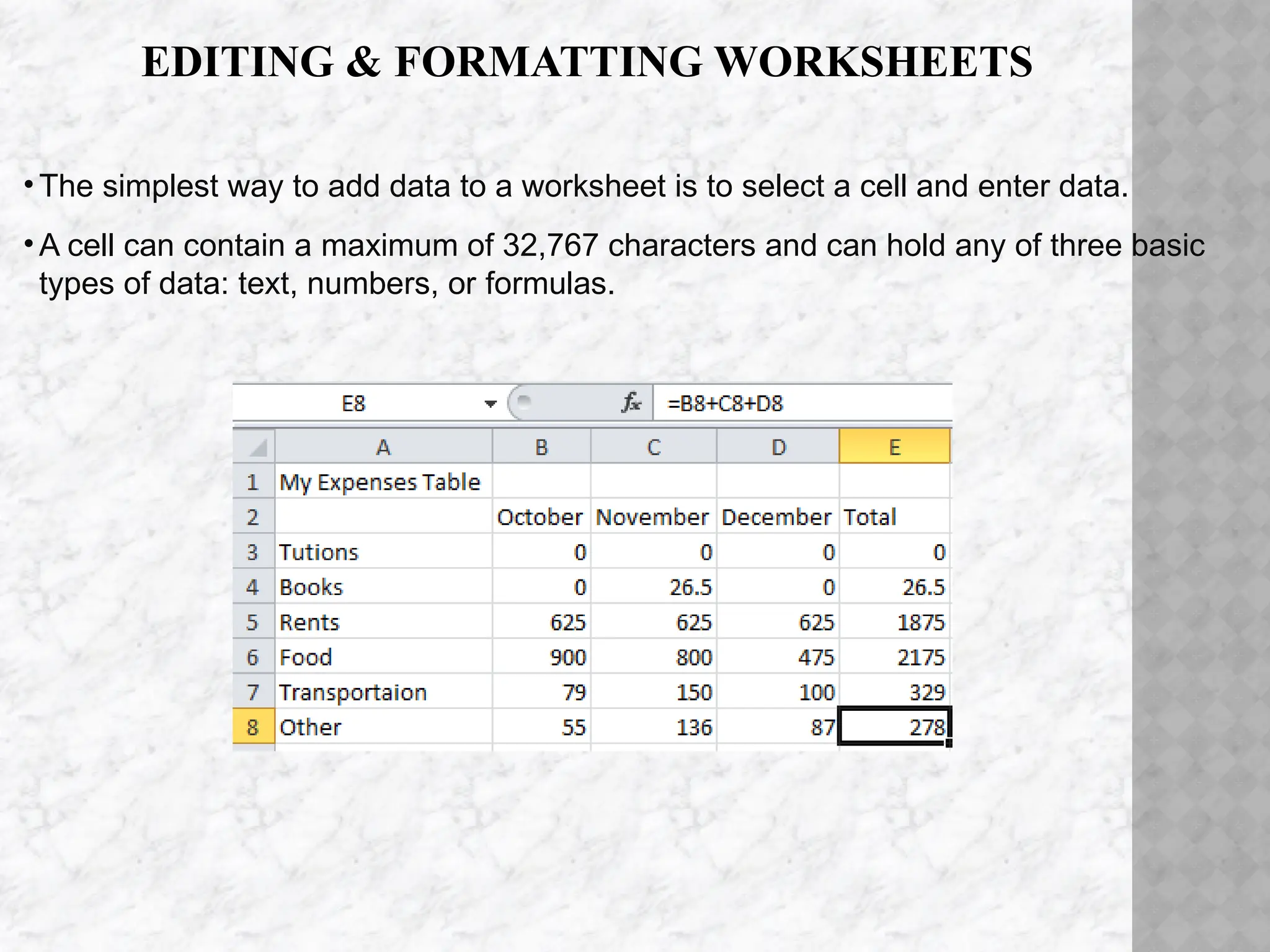
• The simplest way to add data to a worksheet is to select a cell and enter data.
• A cell can contain a maximum of 32,767 characters and can hold any of three basic
types of data: text, numbers, or formulas.
20.
EDITING & FORMATTINGWORKSHEETS
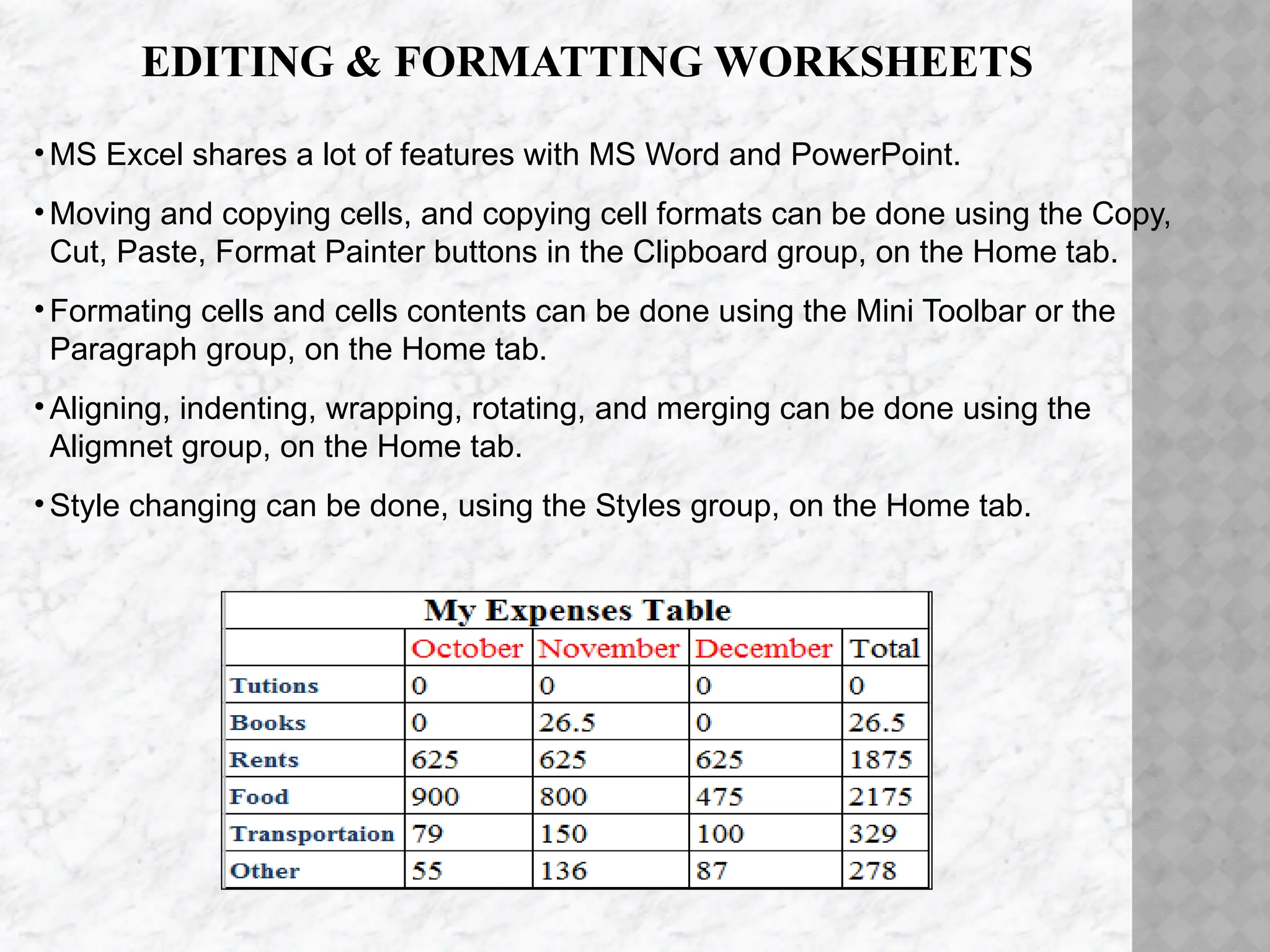
•MS Excel shares a lot of features with MS Word and PowerPoint.
•Moving and copying cells, and copying cell formats can be done using the Copy,
Cut, Paste, Format Painter buttons in the Clipboard group, on the Home tab.
•Formating cells and cells contents can be done using the Mini Toolbar or the
Paragraph group, on the Home tab.
•Aligning, indenting, wrapping, rotating, and merging can be done using the
Aligmnet group, on the Home tab.
•Style changing can be done, using the Styles group, on the Home tab.
21.
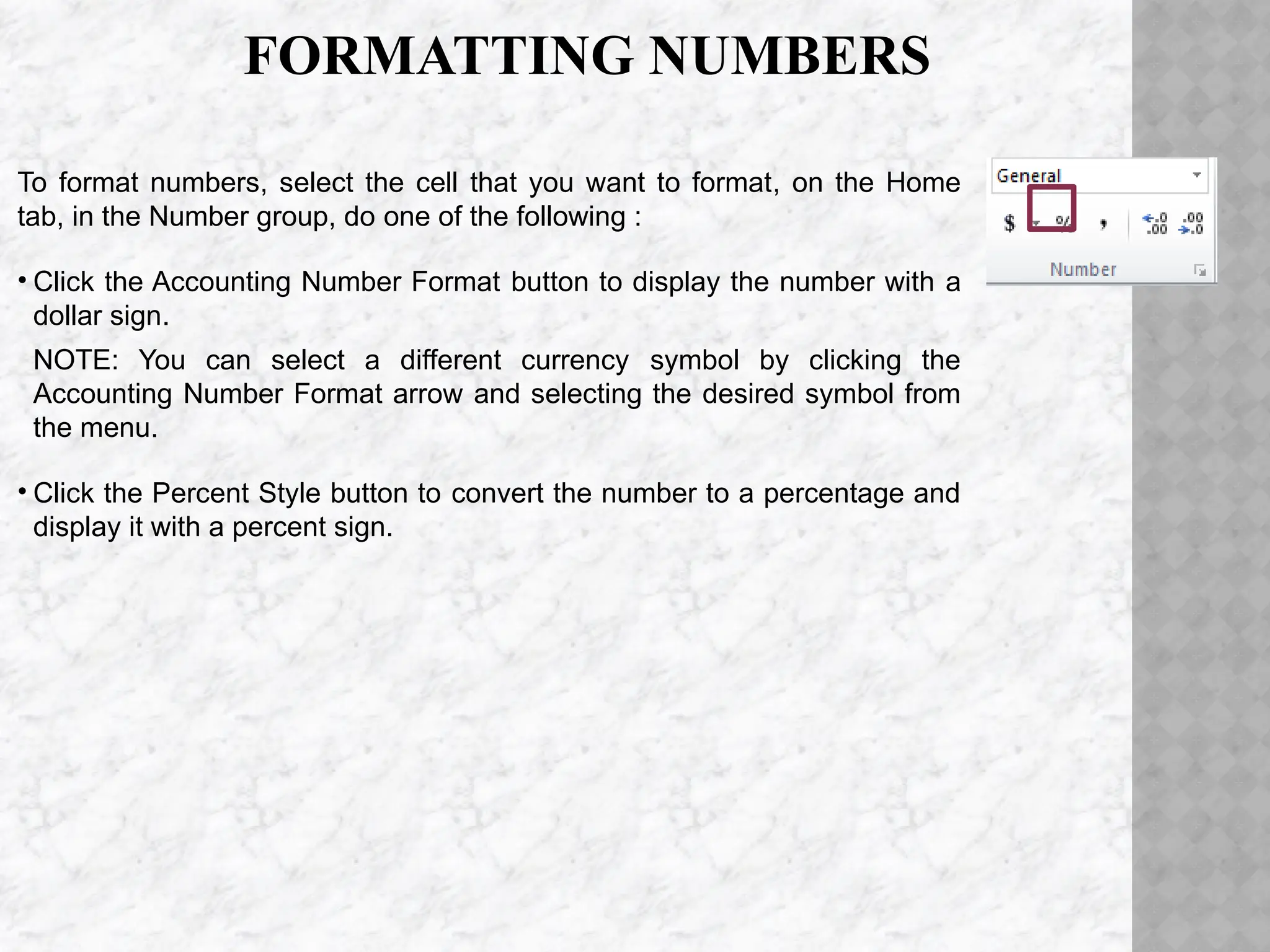
FORMATTING NUMBERS
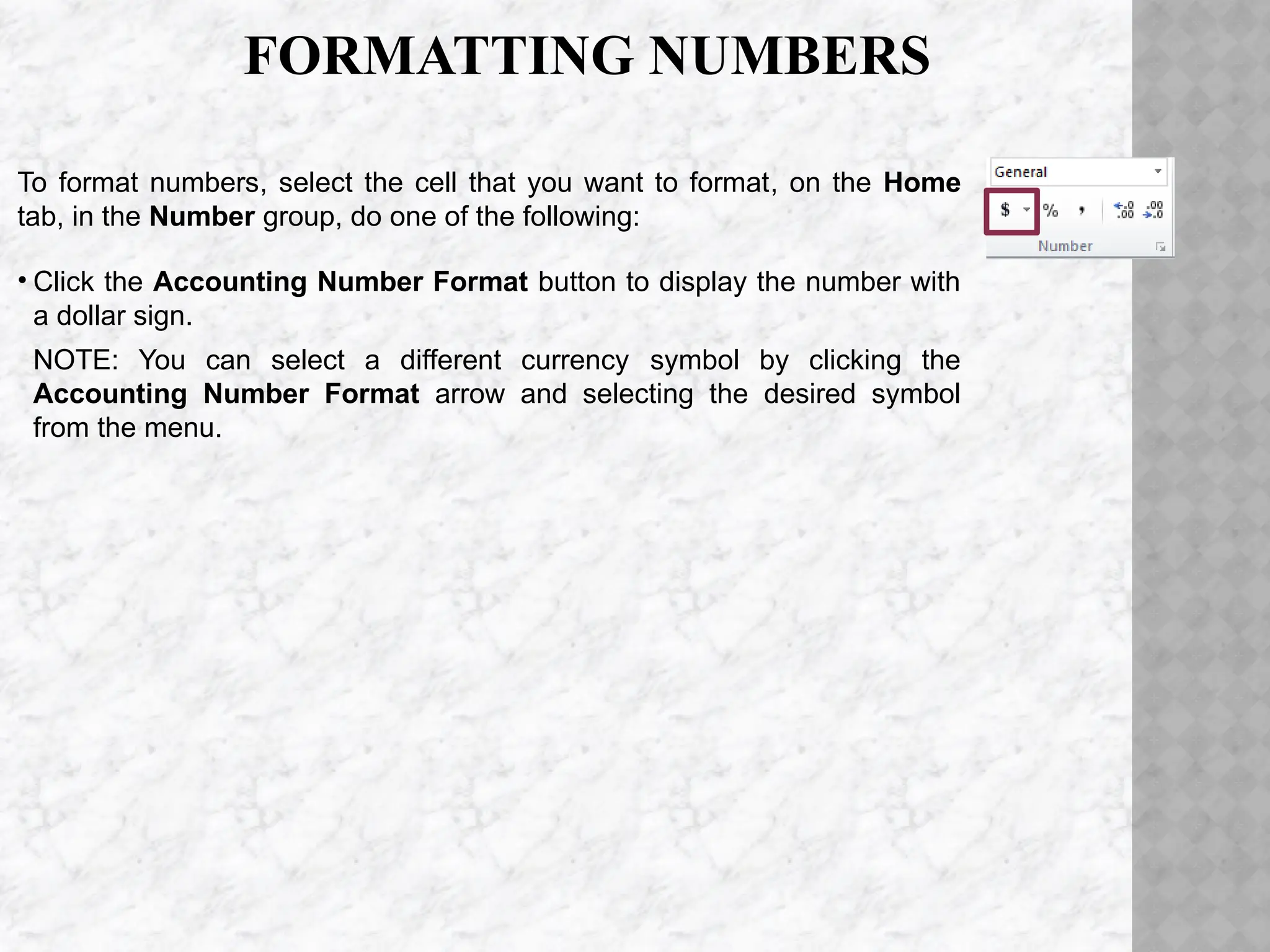
To formatnumbers, select the cell that you want to format, on the Home
tab, in the Number group, do one of the following:
• Click the Accounting Number Format button to display the number with
a dollar sign.
NOTE: You can select a different currency symbol by clicking the
Accounting Number Format arrow and selecting the desired symbol
from the menu.
22.
FORMATTING NUMBERS
To formatnumbers, select the cell that you want to format, on the Home
tab, in the Number group, do one of the following :
• Click the Accounting Number Format button to display the number with a
dollar sign.
NOTE: You can select a different currency symbol by clicking the
Accounting Number Format arrow and selecting the desired symbol from
the menu.
• Click the Percent Style button to convert the number to a percentage and
display it with a percent sign.
23.
FORMATTING NUMBERS
To formatnumbers, select the cell that you want to format, on the Home
tab, in the Number group, do one of the following :
• Click the Accounting Number Format button to display the number with a
dollar sign.
NOTE: You can select a different currency symbol by clicking the
Accounting Number Format arrow and selecting the desired symbol from
the menu.
• Click the Percent Style button to convert the number to a percentage and
display it with a percent sign.
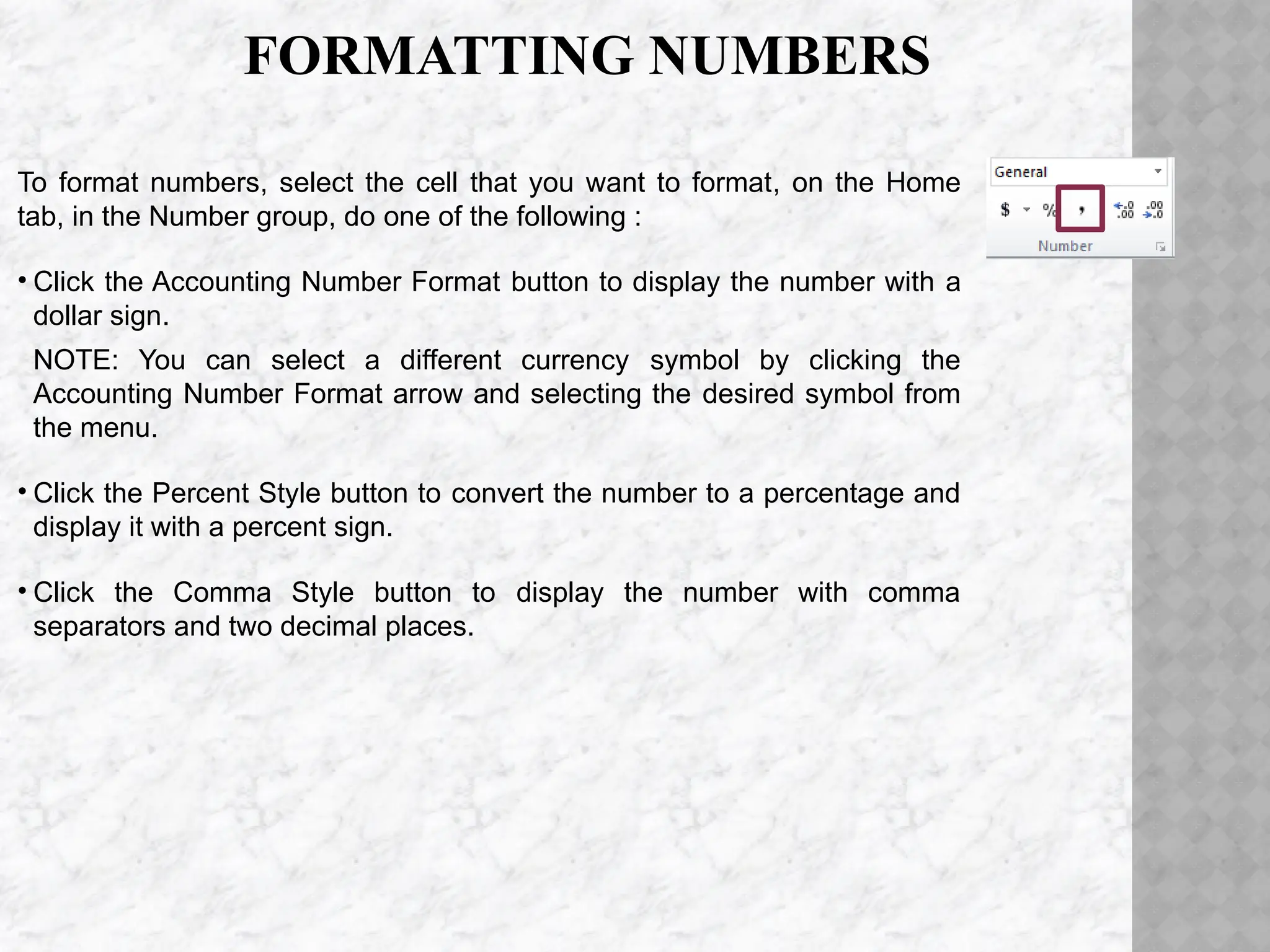
• Click the Comma Style button to display the number with comma
separators and two decimal places.
24.
FORMATTING NUMBERS
To formatnumbers, select the cell that you want to format, on the Home
tab, in the Number group, do one of the following :
• Click the Accounting Number Format button to display the number with
a dollar sign.
NOTE: You can select a different currency symbol by clicking the
Accounting Number Format arrow and selecting the desired symbol
from the menu.
• Click the Percent Style button to convert the number to a percentage and
display it with a percent sign.
• Click the Comma Style button to display the number with comma
separators and two decimal places.
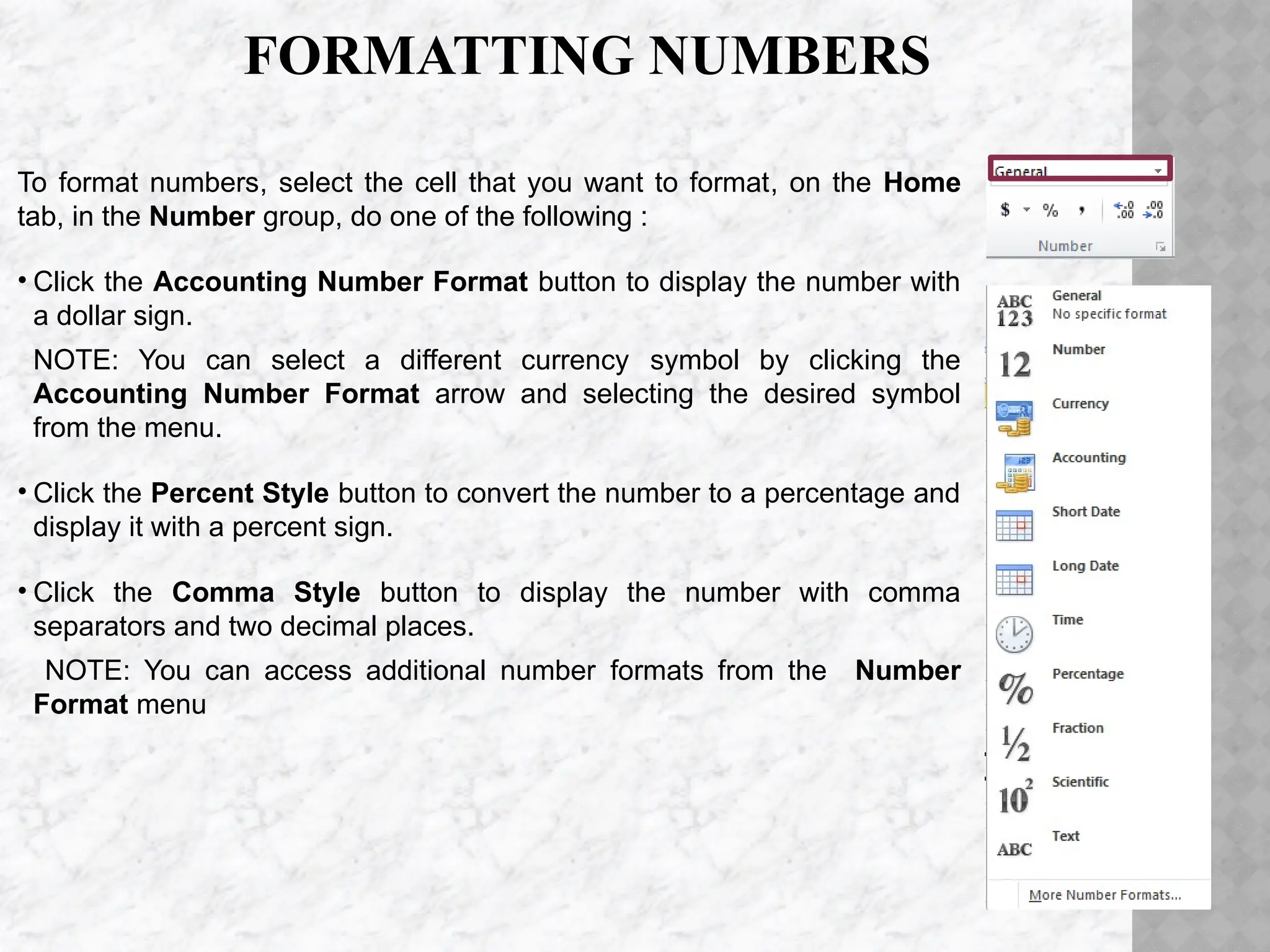
NOTE: You can access additional number formats from the Number
Format menu
25.
FORMATTING NUMBERS
To formatnumbers, select the cell that you want to format, on the Home tab, in
the Number group, do one of the following :
• Click the Accounting Number Format button to display the number with a
dollar sign.
NOTE: You can select a different currency symbol by clicking the Accounting
Number Format arrow and selecting the desired symbol from the menu.
• Click the Percent Style button to convert the number to a percentage and
display it with a percent sign.
• Click the Comma Style button to display the number with comma separators
and two decimal places.
NOTE: You can access additional number formats from the Number Format
menu
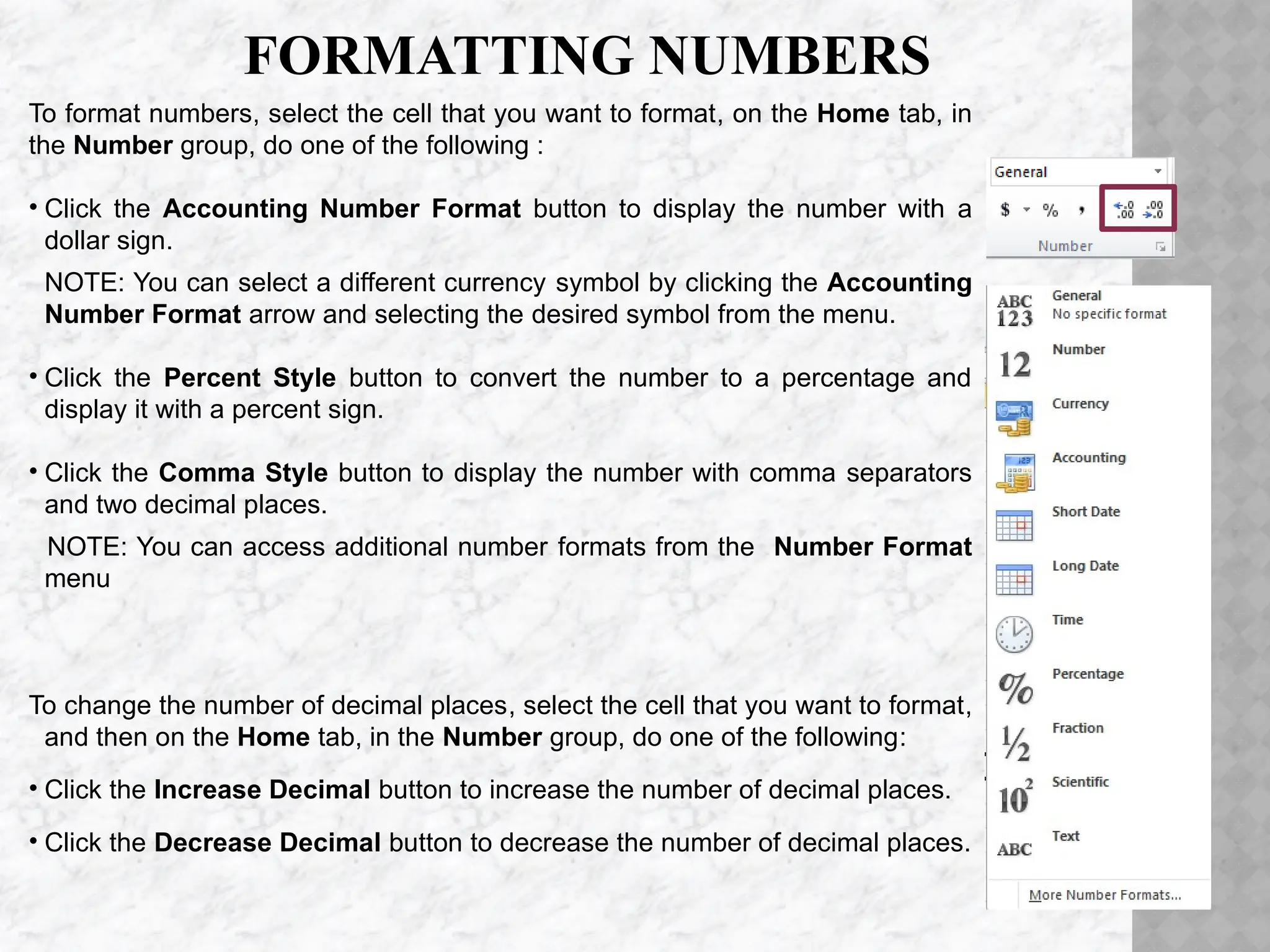
To change the number of decimal places, select the cell that you want to format,
and then on the Home tab, in the Number group, do one of the following:
• Click the Increase Decimal button to increase the number of decimal places.
• Click the Decrease Decimal button to decrease the number of decimal places.
26.
INSERTING ROWS ANDCOLUMNS
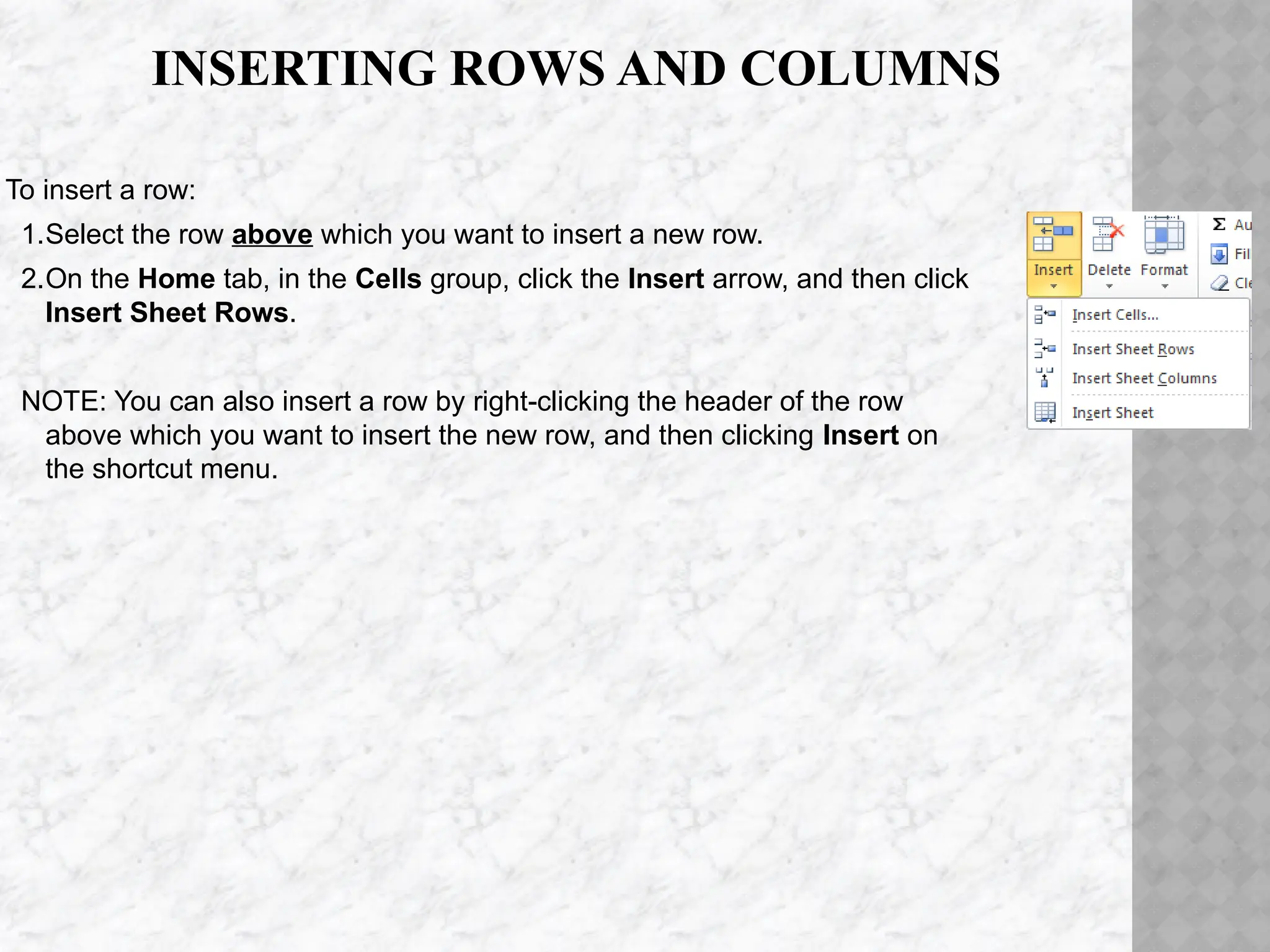
To insert a row:
1.Select the row above which you want to insert a new row.
2.On the Home tab, in the Cells group, click the Insert arrow, and then click
Insert Sheet Rows.
NOTE: You can also insert a row by right-clicking the header of the row
above which you want to insert the new row, and then clicking Insert on
the shortcut menu.
27.
INSERTING ROWS ANDCOLUMNS
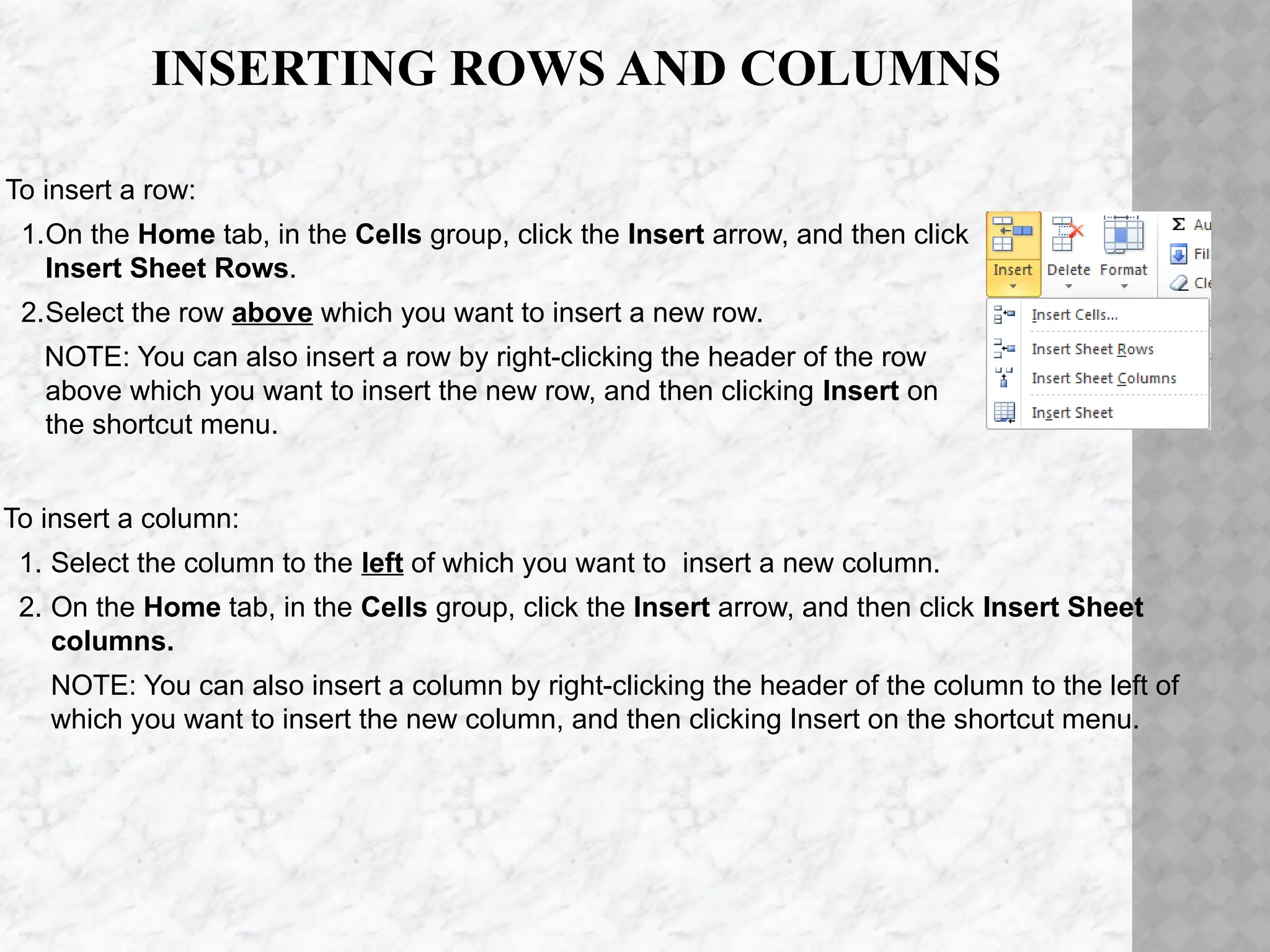
To insert a column:
1. Select the column to the left of which you want to insert a new column.
2. On the Home tab, in the Cells group, click the Insert arrow, and then click Insert Sheet
columns.
NOTE: You can also insert a column by right-clicking the header of the column to the left of
which you want to insert the new column, and then clicking Insert on the shortcut menu.
To insert a row:
1.On the Home tab, in the Cells group, click the Insert arrow, and then click
Insert Sheet Rows.
2.Select the row above which you want to insert a new row.
NOTE: You can also insert a row by right-clicking the header of the row
above which you want to insert the new row, and then clicking Insert on
the shortcut menu.
28.
INSERTING ROWS ANDCOLUMNS
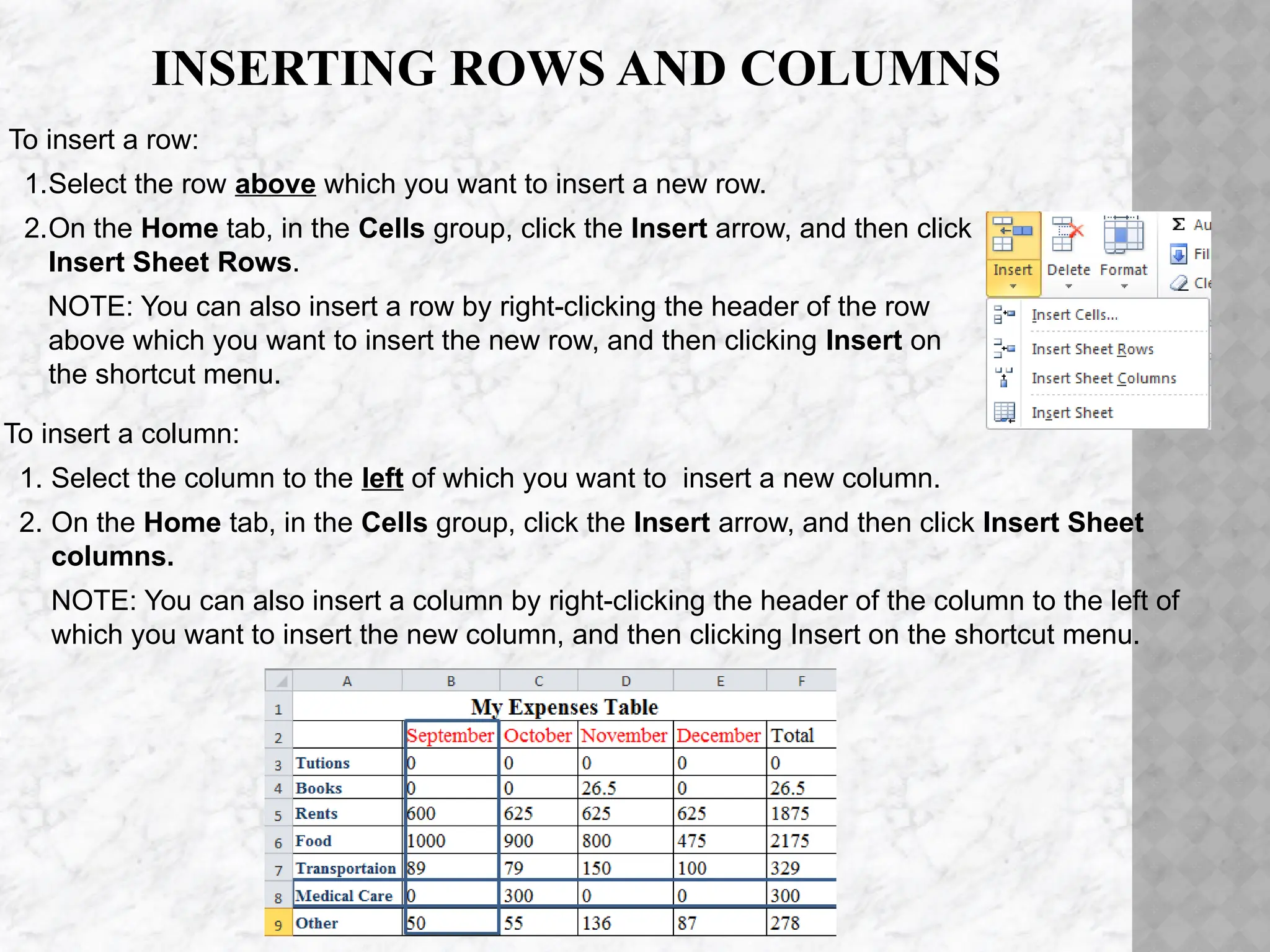
To insert a column:
1. Select the column to the left of which you want to insert a new column.
2. On the Home tab, in the Cells group, click the Insert arrow, and then click Insert Sheet
columns.
NOTE: You can also insert a column by right-clicking the header of the column to the left of
which you want to insert the new column, and then clicking Insert on the shortcut menu.
To insert a row:
1.Select the row above which you want to insert a new row.
2.On the Home tab, in the Cells group, click the Insert arrow, and then click
Insert Sheet Rows.
NOTE: You can also insert a row by right-clicking the header of the row
above which you want to insert the new row, and then clicking Insert on
the shortcut menu.
29.
DELETING ROWS ANDCOLUMNS
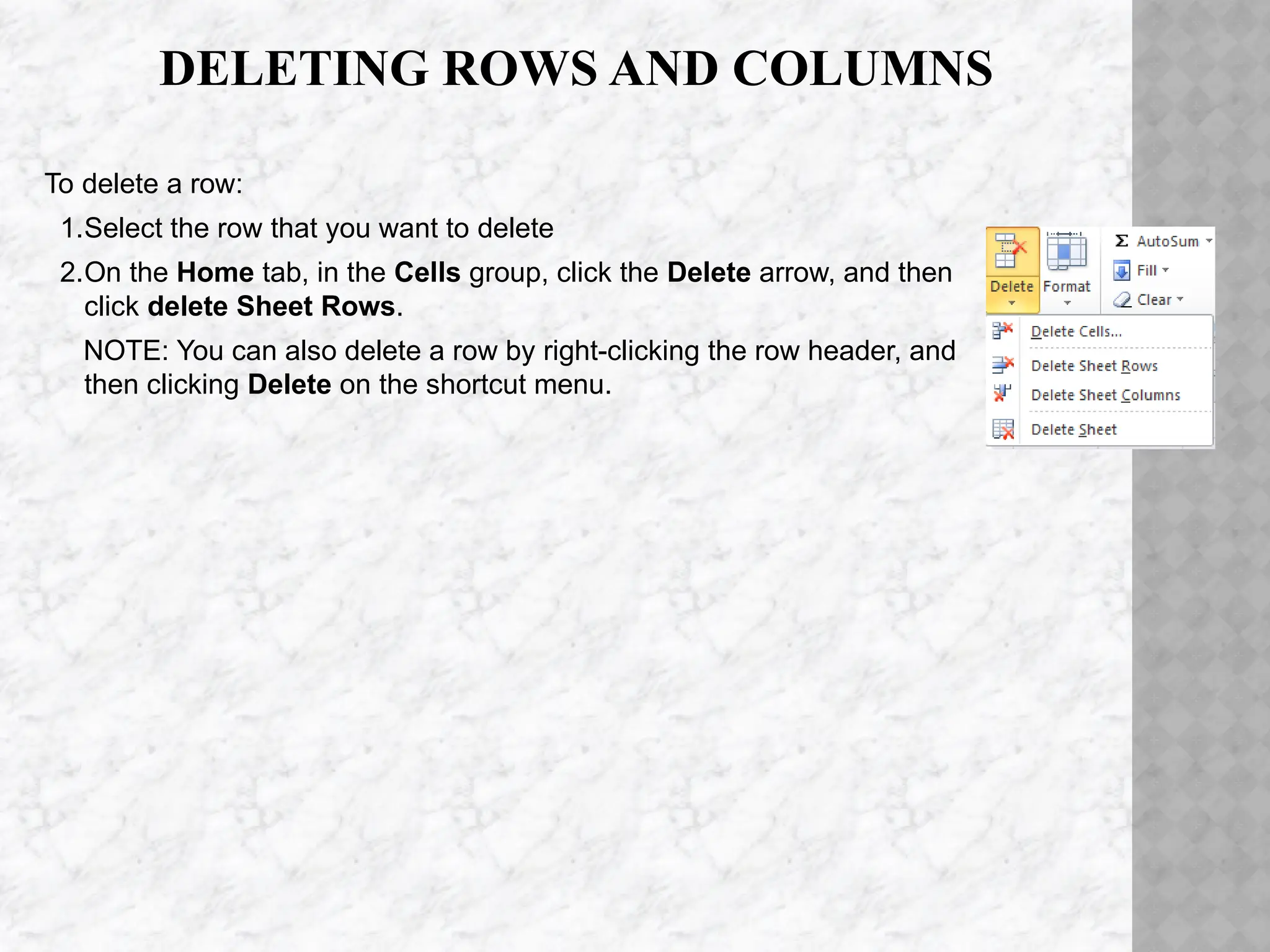
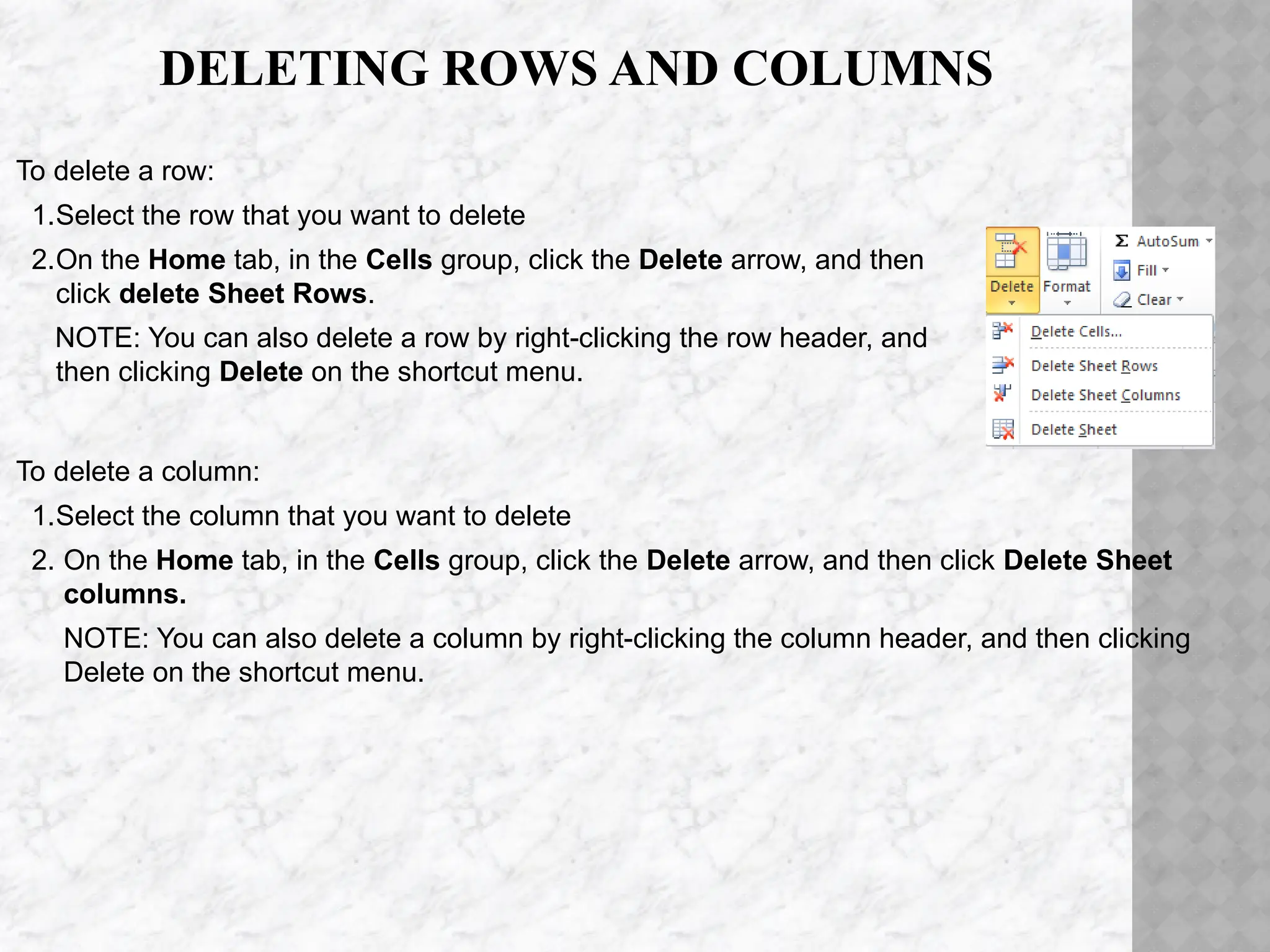
To delete a row:
1.Select the row that you want to delete
2.On the Home tab, in the Cells group, click the Delete arrow, and then
click delete Sheet Rows.
NOTE: You can also delete a row by right-clicking the row header, and
then clicking Delete on the shortcut menu.
30.
DELETING ROWS ANDCOLUMNS
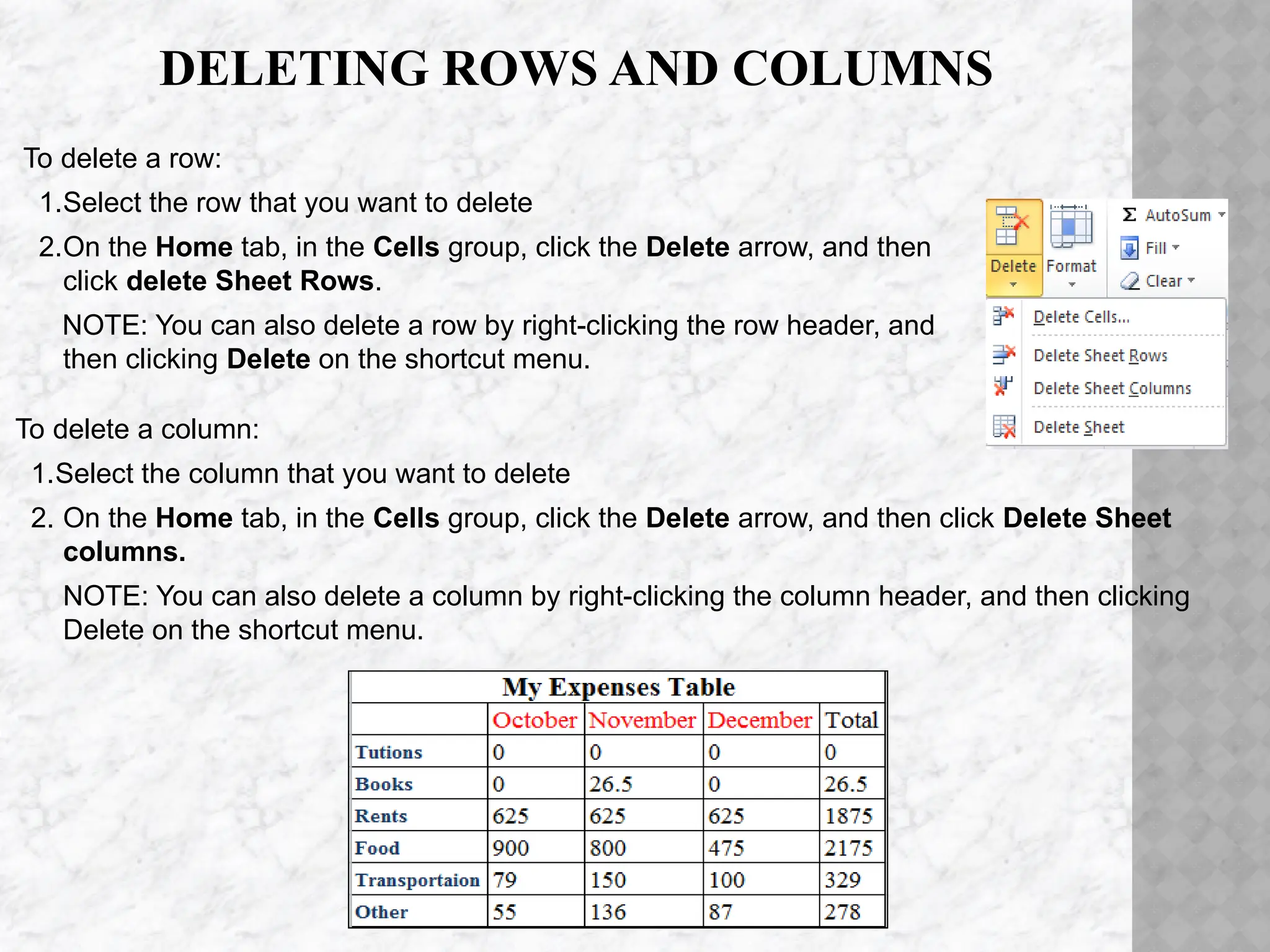
To delete a column:
1.Select the column that you want to delete
2. On the Home tab, in the Cells group, click the Delete arrow, and then click Delete Sheet
columns.
NOTE: You can also delete a column by right-clicking the column header, and then clicking
Delete on the shortcut menu.
To delete a row:
1.Select the row that you want to delete
2.On the Home tab, in the Cells group, click the Delete arrow, and then
click delete Sheet Rows.
NOTE: You can also delete a row by right-clicking the row header, and
then clicking Delete on the shortcut menu.
31.
DELETING ROWS ANDCOLUMNS
To delete a column:
1.Select the column that you want to delete
2. On the Home tab, in the Cells group, click the Delete arrow, and then click Delete Sheet
columns.
NOTE: You can also delete a column by right-clicking the column header, and then clicking
Delete on the shortcut menu.
To delete a row:
1.Select the row that you want to delete
2.On the Home tab, in the Cells group, click the Delete arrow, and then
click delete Sheet Rows.
NOTE: You can also delete a row by right-clicking the row header, and
then clicking Delete on the shortcut menu.
32.
CHANGING COLUMN WIDTHS
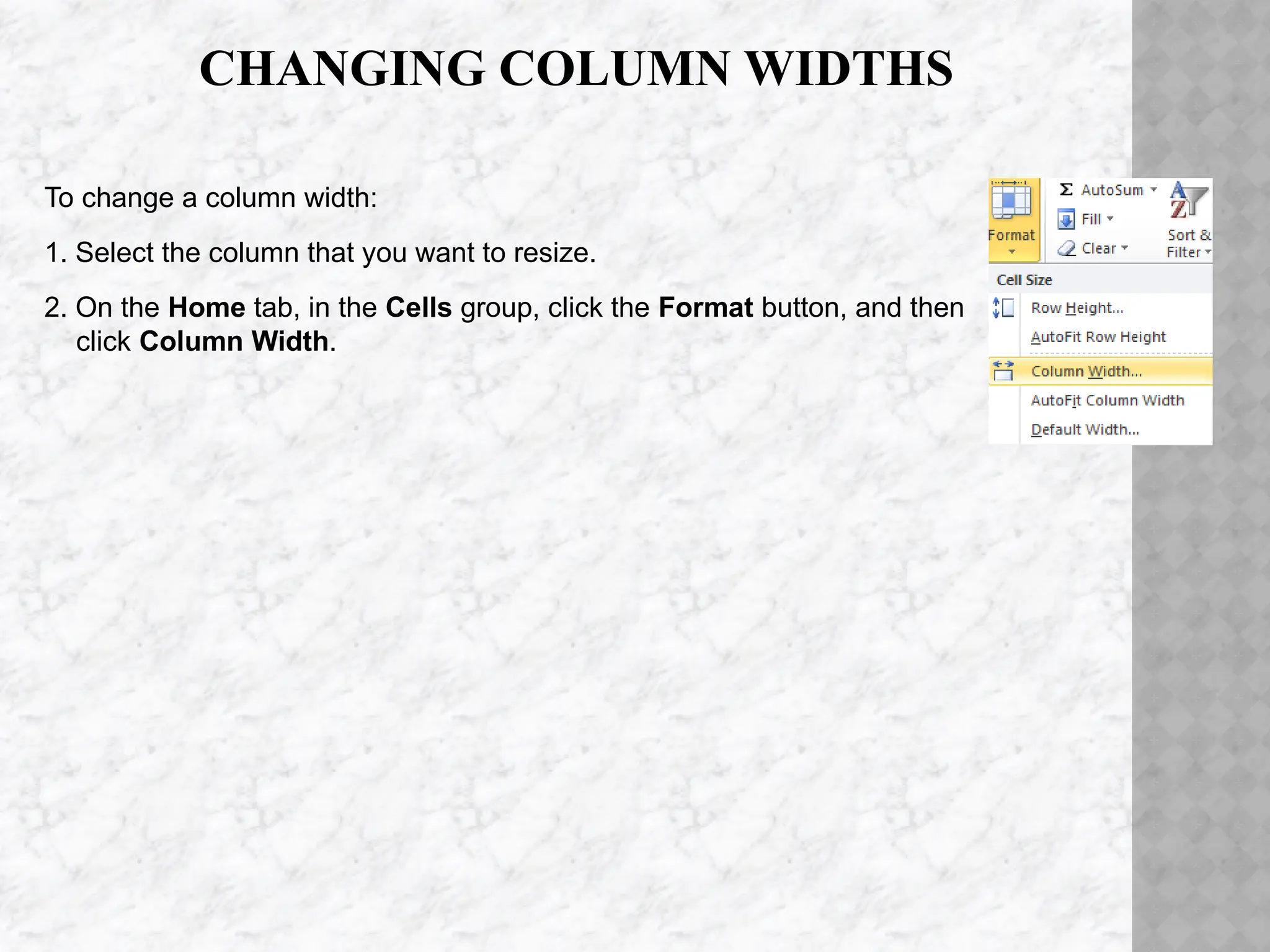
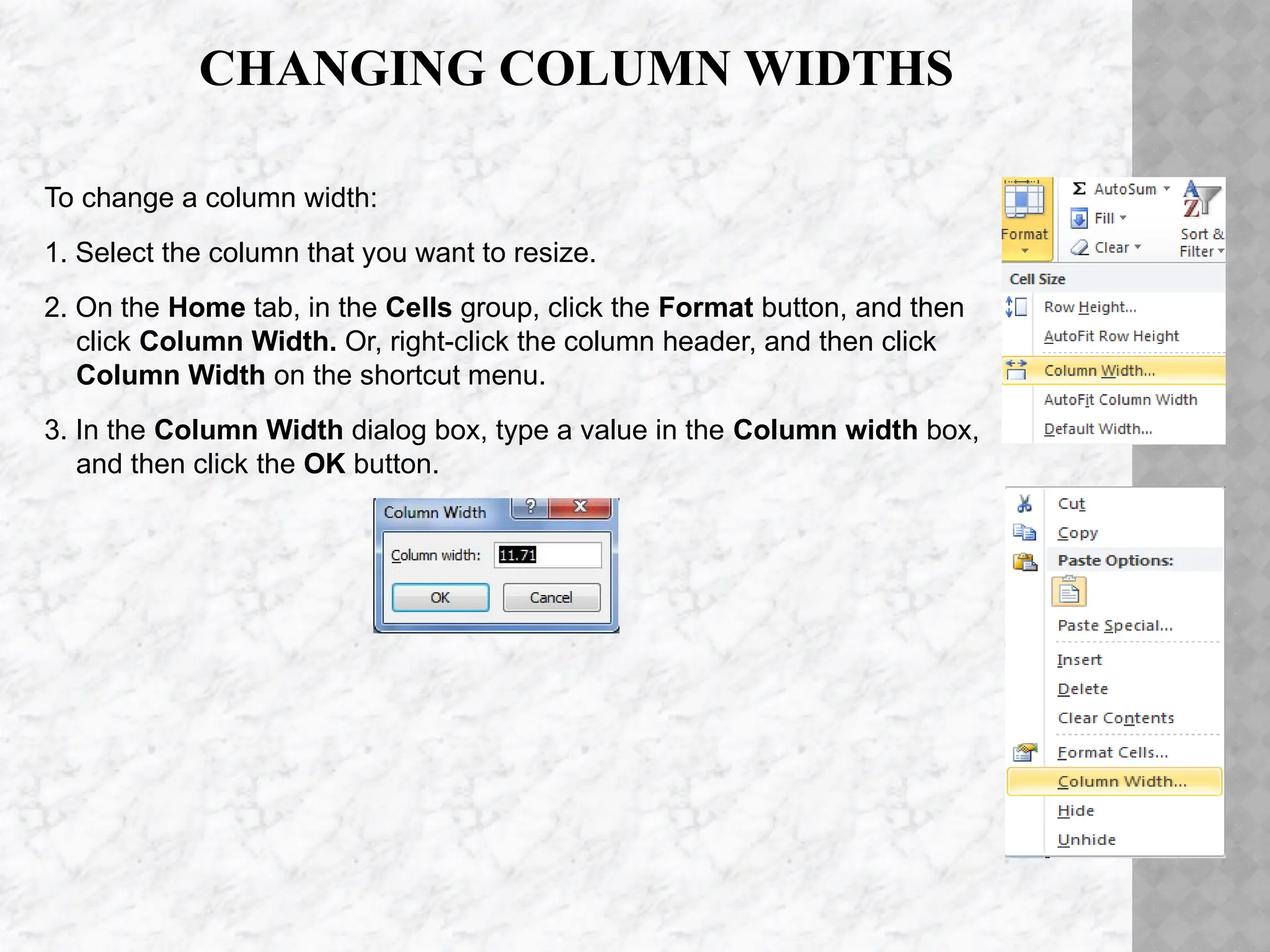
Tochange a column width:
1. Select the column that you want to resize.
2. On the Home tab, in the Cells group, click the Format button, and then
click Column Width.
33.
CHANGING COLUMN WIDTHS
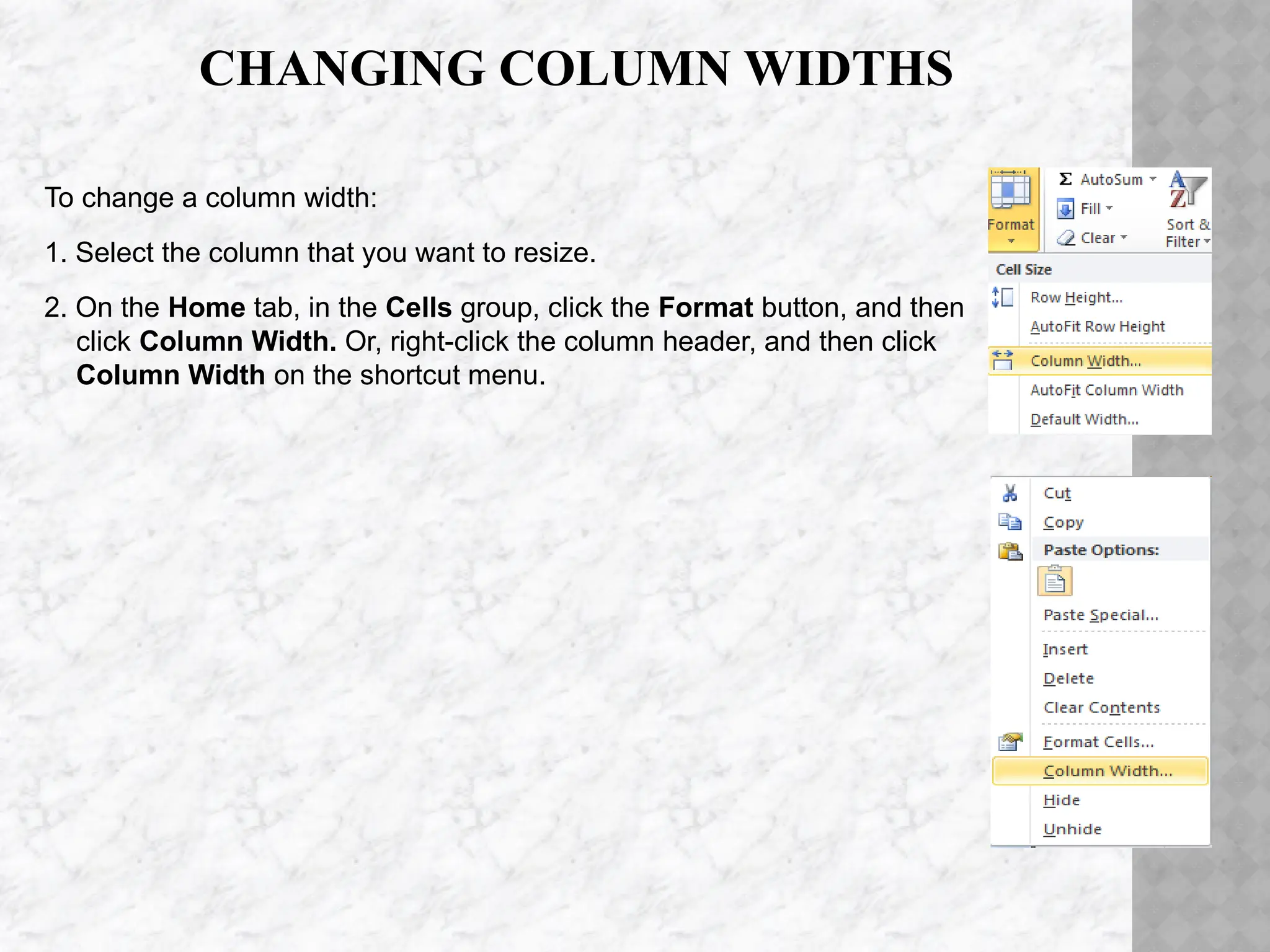
Tochange a column width:
1. Select the column that you want to resize.
2. On the Home tab, in the Cells group, click the Format button, and then
click Column Width. Or, right-click the column header, and then click
Column Width on the shortcut menu.
34.
CHANGING COLUMN WIDTHS
Tochange a column width:
1. Select the column that you want to resize.
2. On the Home tab, in the Cells group, click the Format button, and then
click Column Width. Or, right-click the column header, and then click
Column Width on the shortcut menu.
3. In the Column Width dialog box, type a value in the Column width box,
and then click the OK button.
35.
CHANGING COLUMN WIDTHS
Tochange a column width:
1. Select the column that you want to resize.
2. On the Home tab, in the Cells group, click the Format button, and then
click Column Width. Or, right-click the column header, and then click
Column Width on the shortcut menu.
3. In the Column Width dialog box, type a value in the Column width box,
and then click the OK button.
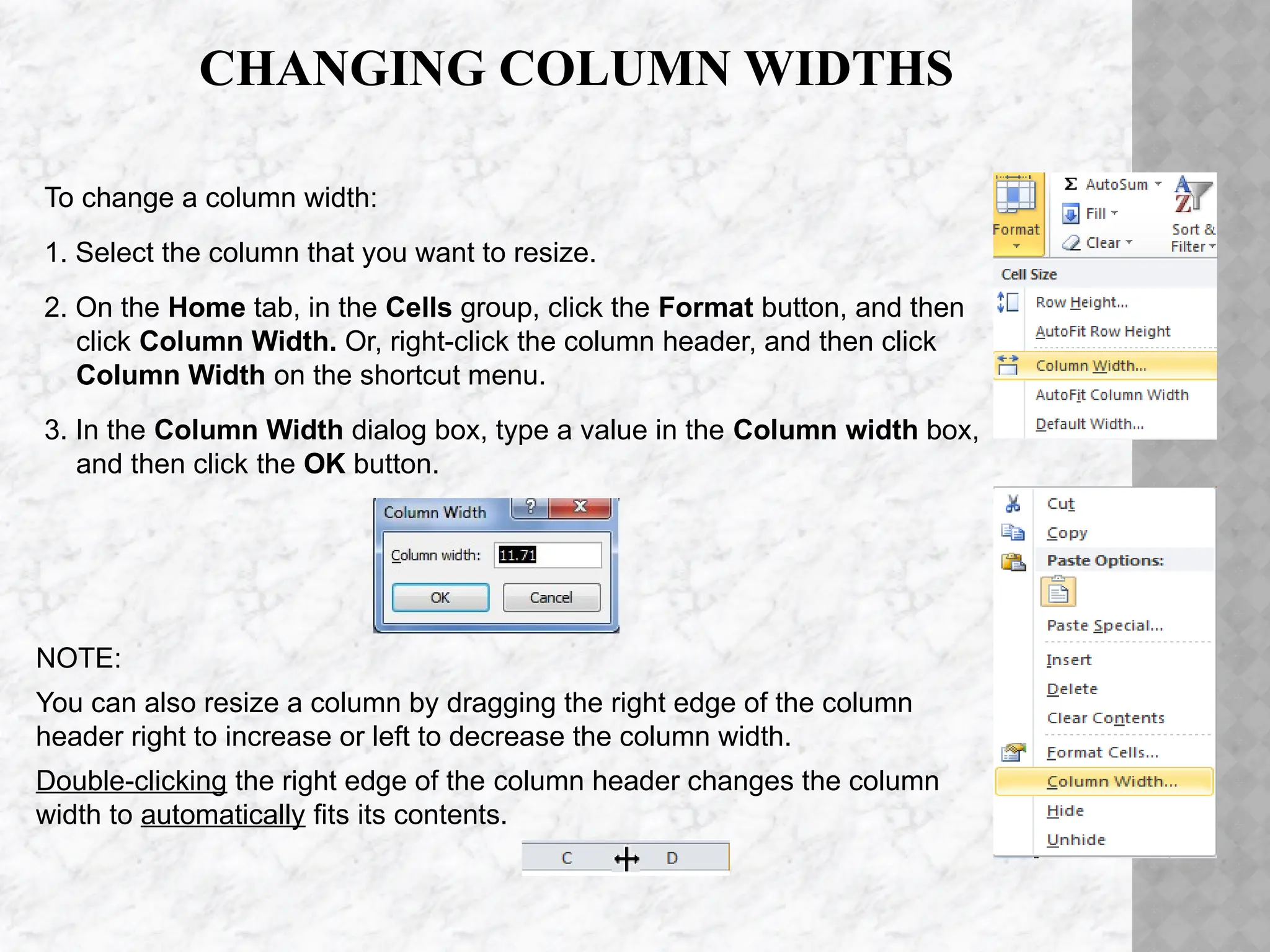
NOTE:
You can also resize a column by dragging the right edge of the column
header right to increase or left to decrease the column width.
Double-clicking the right edge of the column header changes the column
width to automatically fits its contents.
36.
CHANGING ROW HEIGHTS
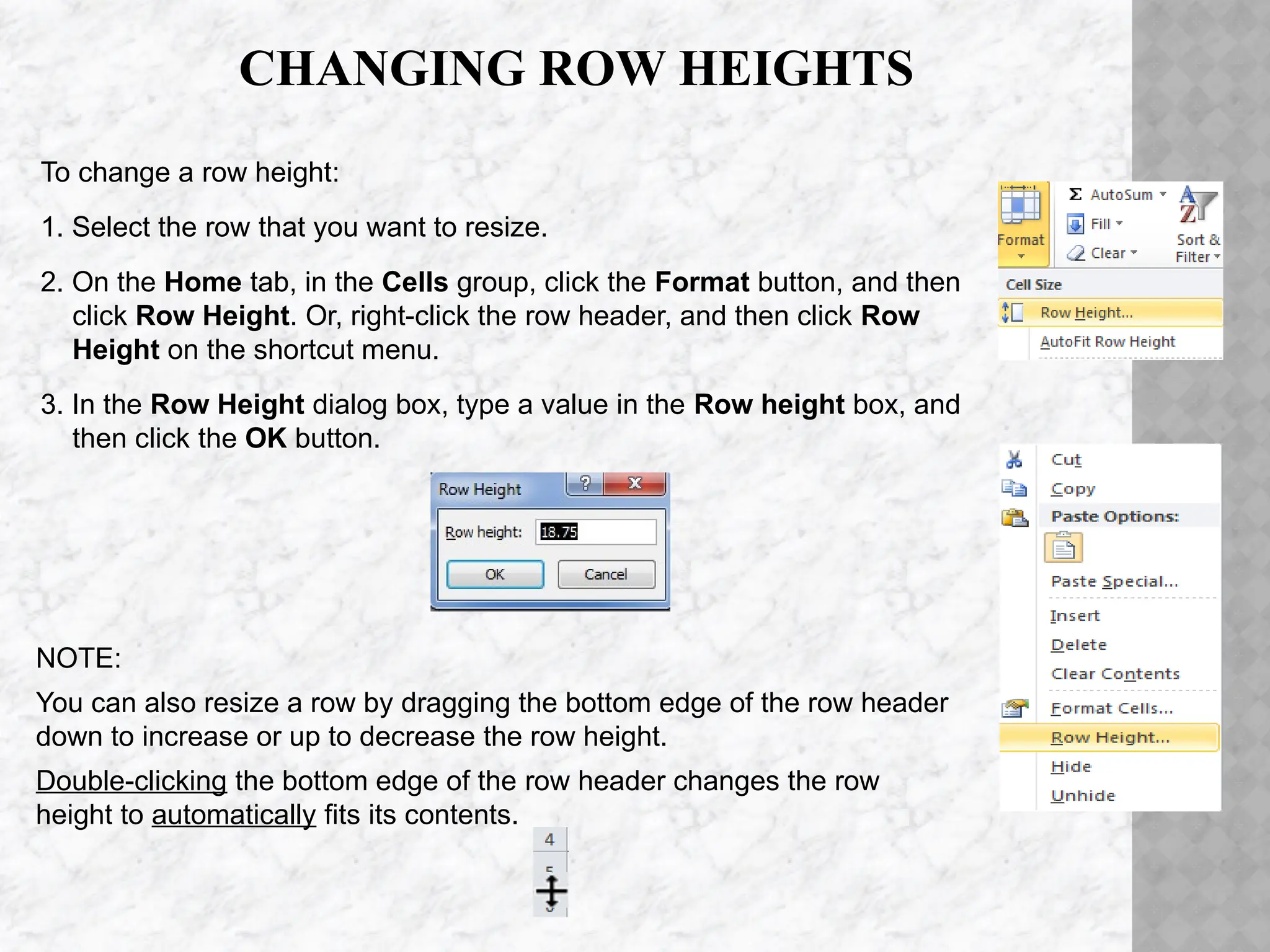
Tochange a row height:
1. Select the row that you want to resize.
2. On the Home tab, in the Cells group, click the Format button, and then
click Row Height. Or, right-click the row header, and then click Row
Height on the shortcut menu.
3. In the Row Height dialog box, type a value in the Row height box, and
then click the OK button.
NOTE:
You can also resize a row by dragging the bottom edge of the row header
down to increase or up to decrease the row height.
Double-clicking the bottom edge of the row header changes the row
height to automatically fits its contents.
37.
HIDING ROWS ANDCOLUMNS
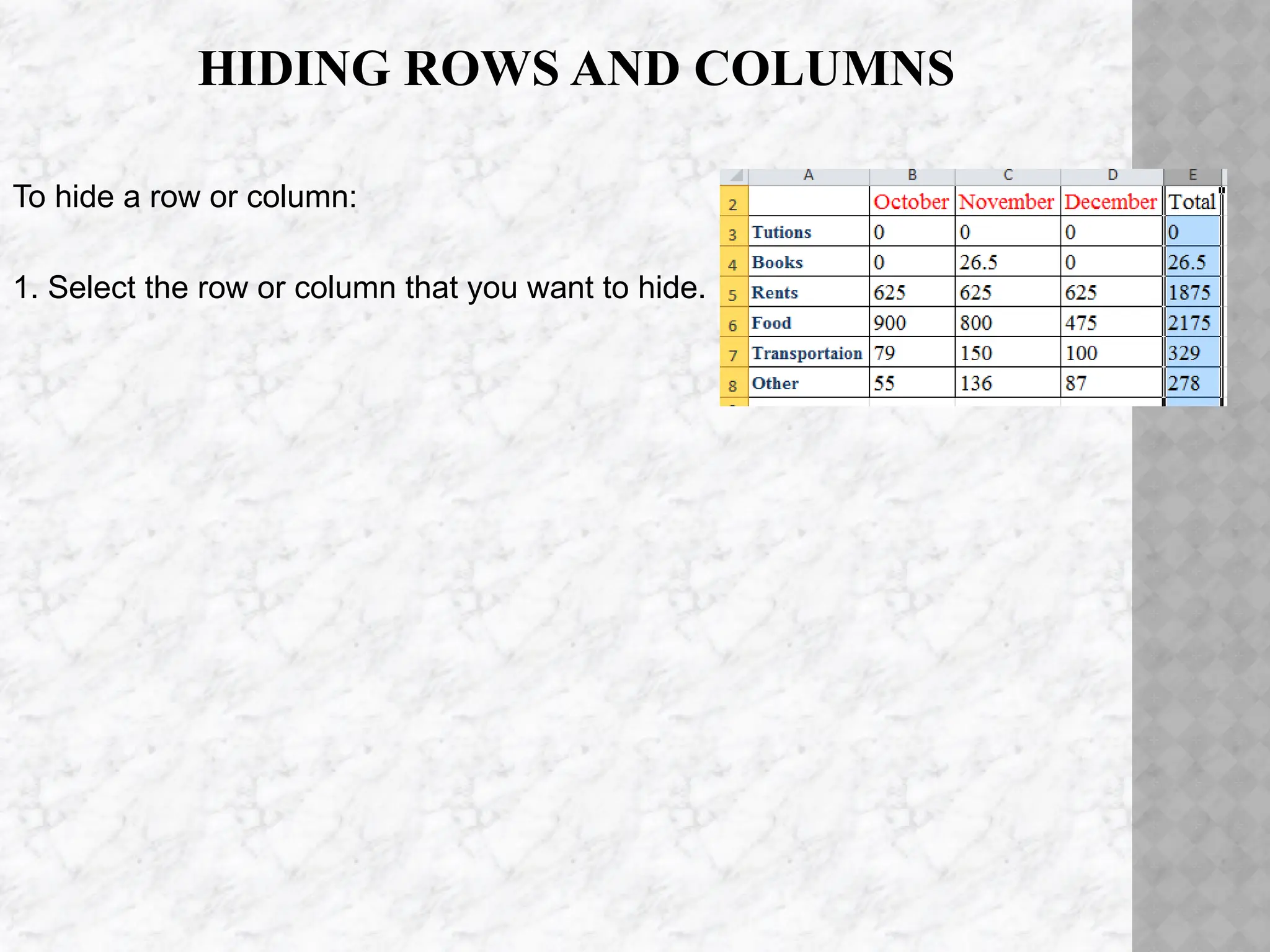
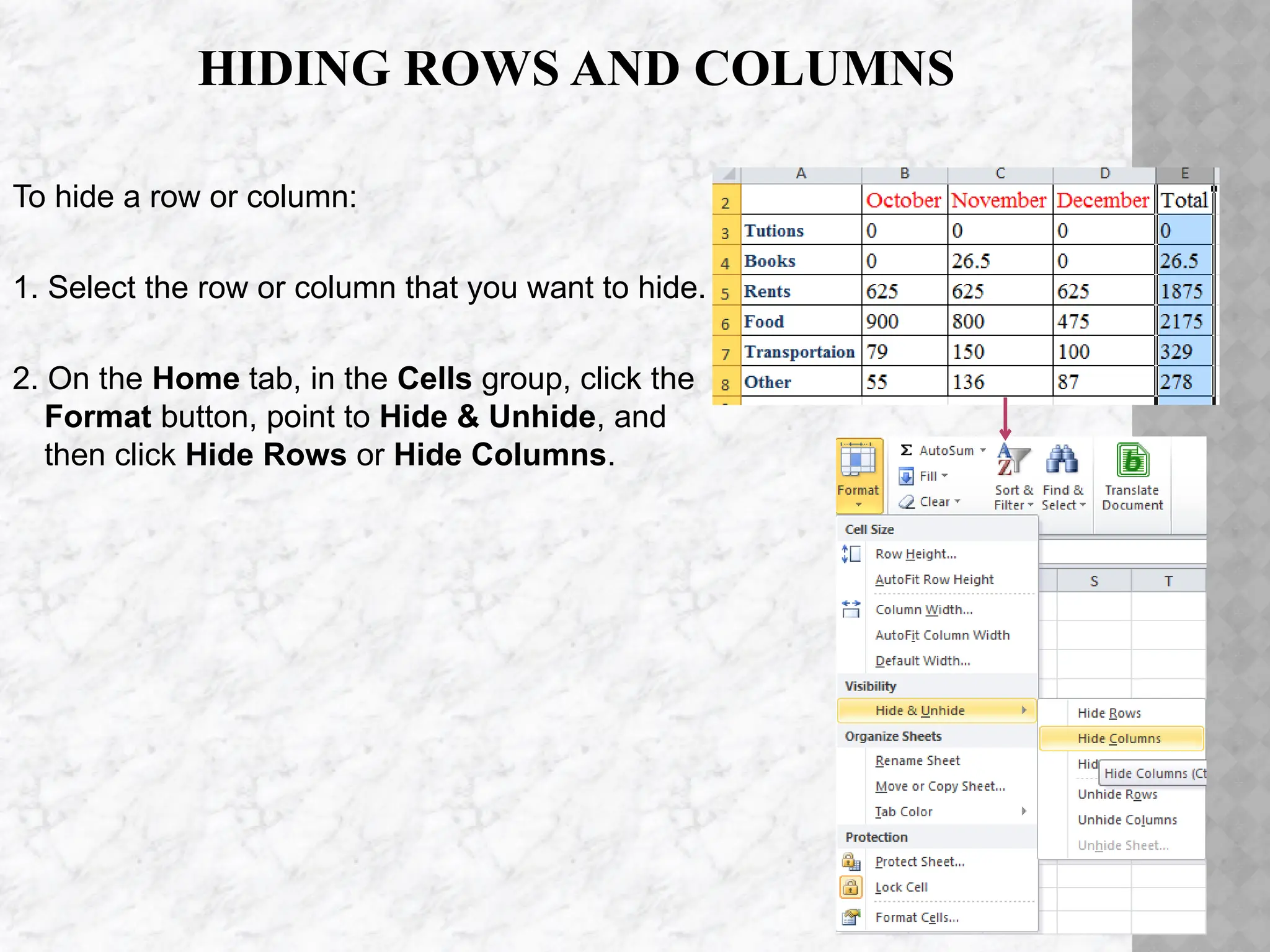
To hide a row or column:
1. Select the row or column that you want to hide.
38.
HIDING ROWS ANDCOLUMNS
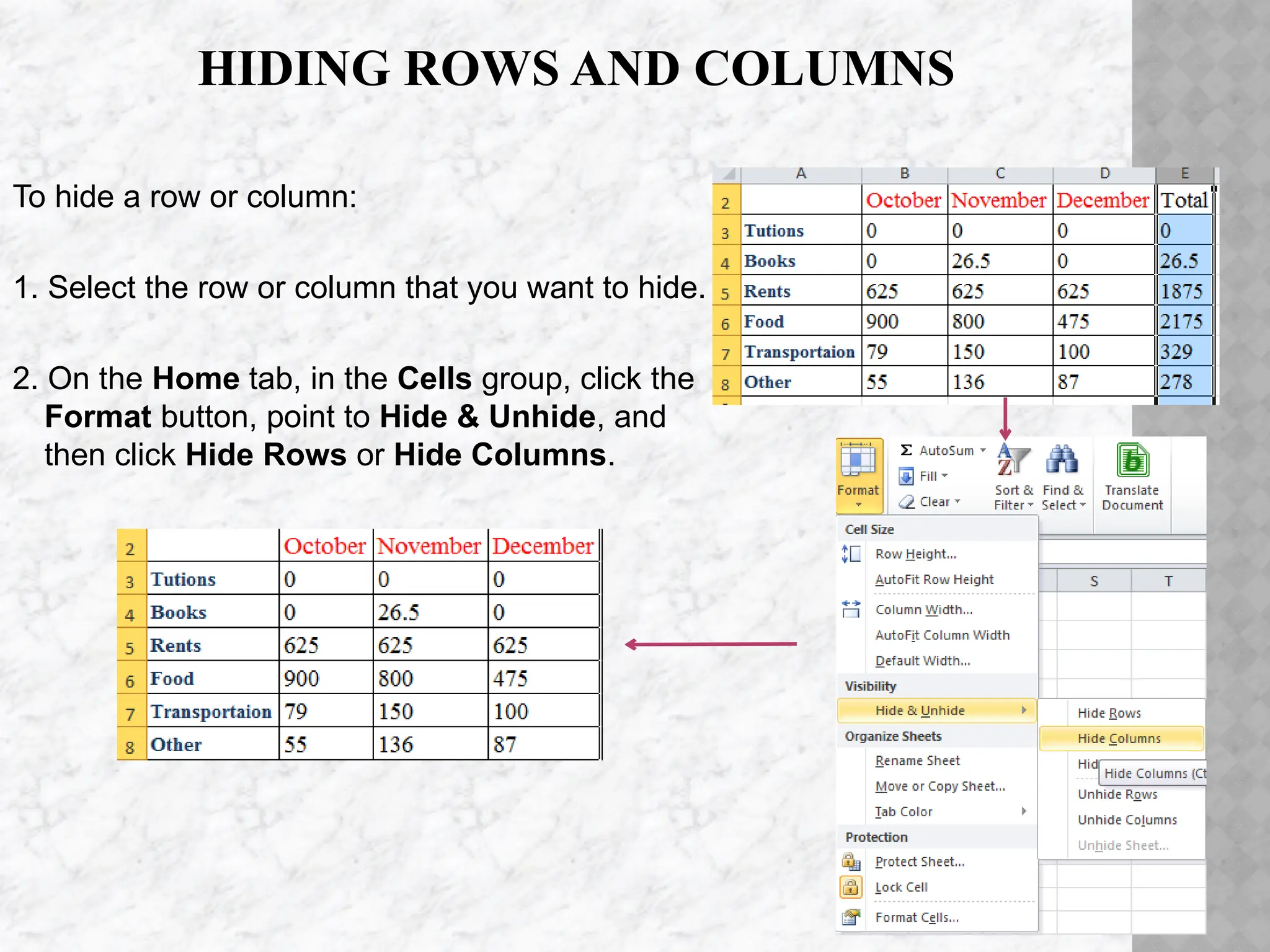
To hide a row or column:
1. Select the row or column that you want to hide.
2. On the Home tab, in the Cells group, click the
Format button, point to Hide & Unhide, and
then click Hide Rows or Hide Columns.
39.
HIDING ROWS ANDCOLUMNS
To hide a row or column:
1. Select the row or column that you want to hide.
2. On the Home tab, in the Cells group, click the
Format button, point to Hide & Unhide, and
then click Hide Rows or Hide Columns.
40.
HIDING ROWS ANDCOLUMNS
To hide a row or column:
1. Select the row or column that you want to hide.
2. On the Home tab, in the Cells group, click the
Format button, point to Hide & Unhide, and
then click Hide Rows or Hide Columns.
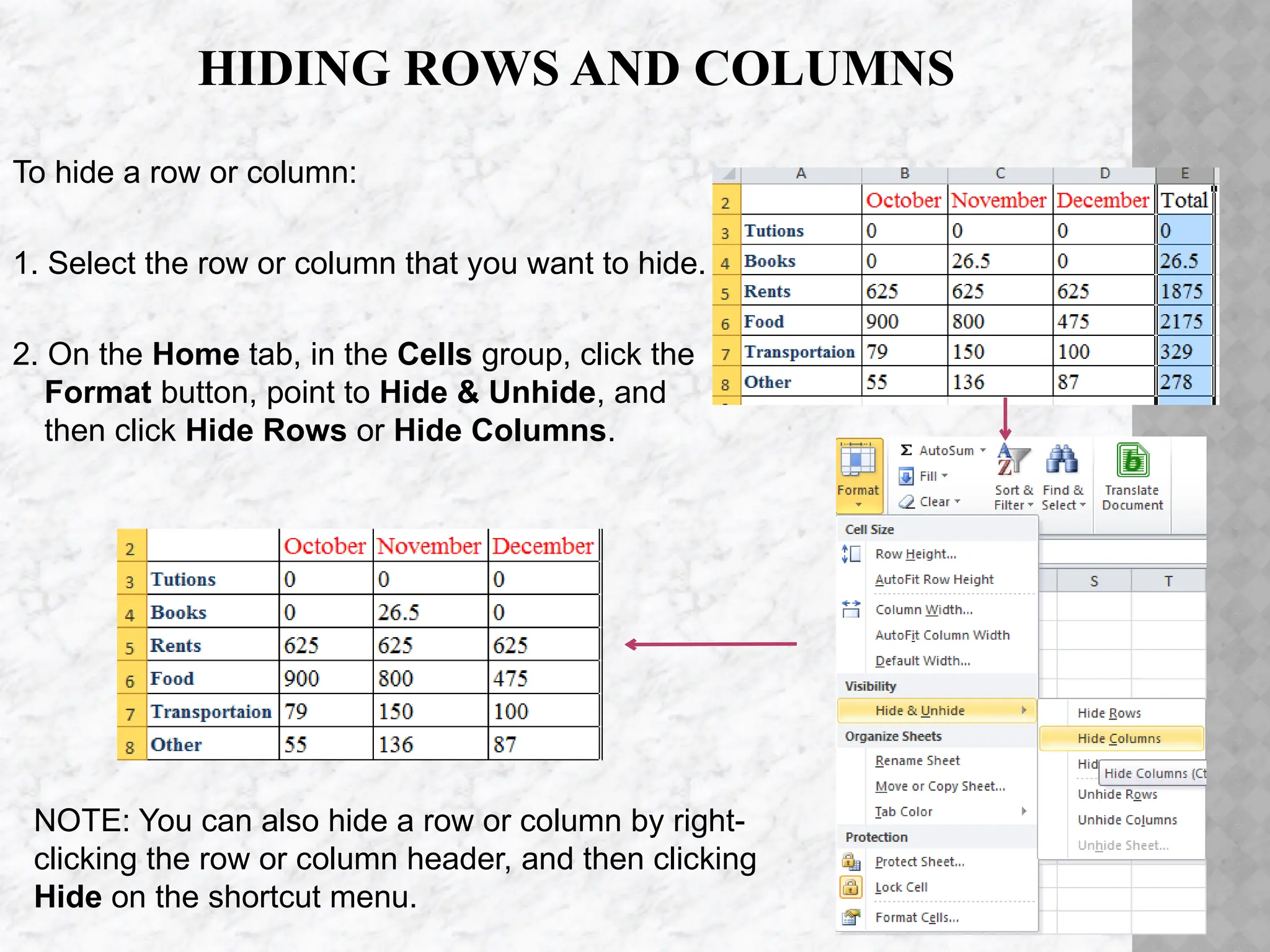
NOTE: You can also hide a row or column by right-
clicking the row or column header, and then clicking
Hide on the shortcut menu.
41.
UNHIDING ROWS ANDCOLUMNS
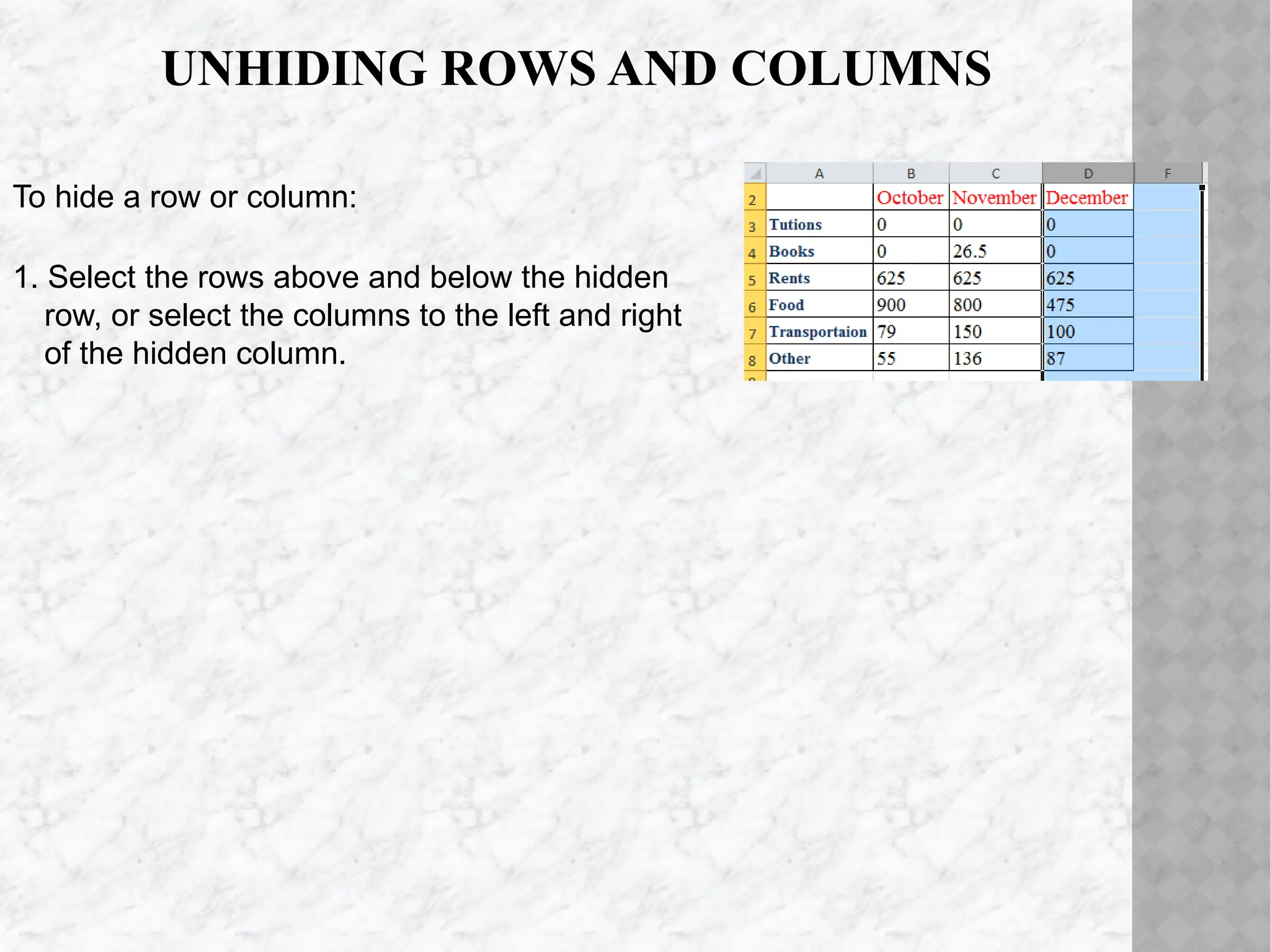
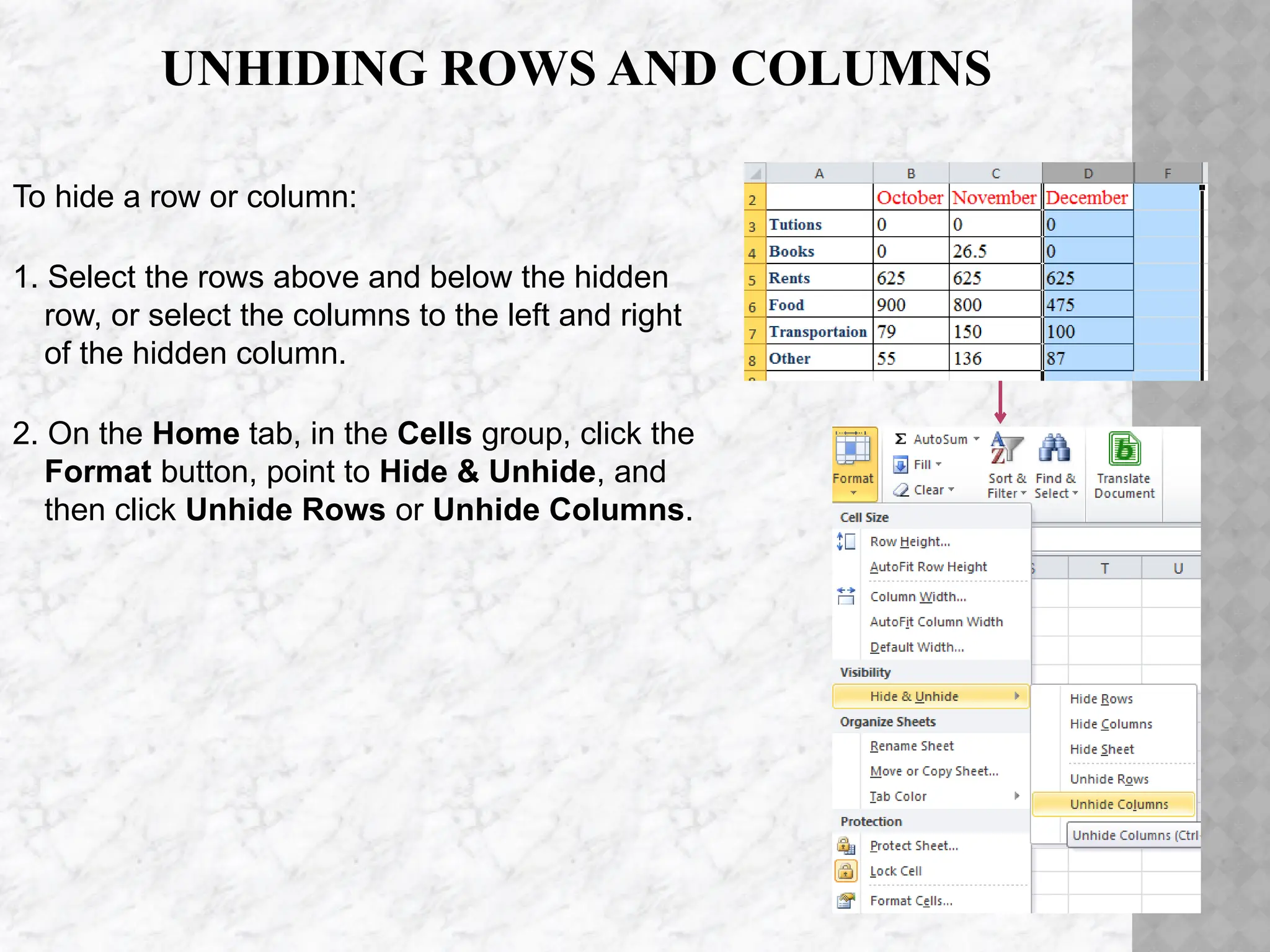
To hide a row or column:
1. Select the rows above and below the hidden
row, or select the columns to the left and right
of the hidden column.
42.
UNHIDING ROWS ANDCOLUMNS
To hide a row or column:
1. Select the rows above and below the hidden
row, or select the columns to the left and right
of the hidden column.
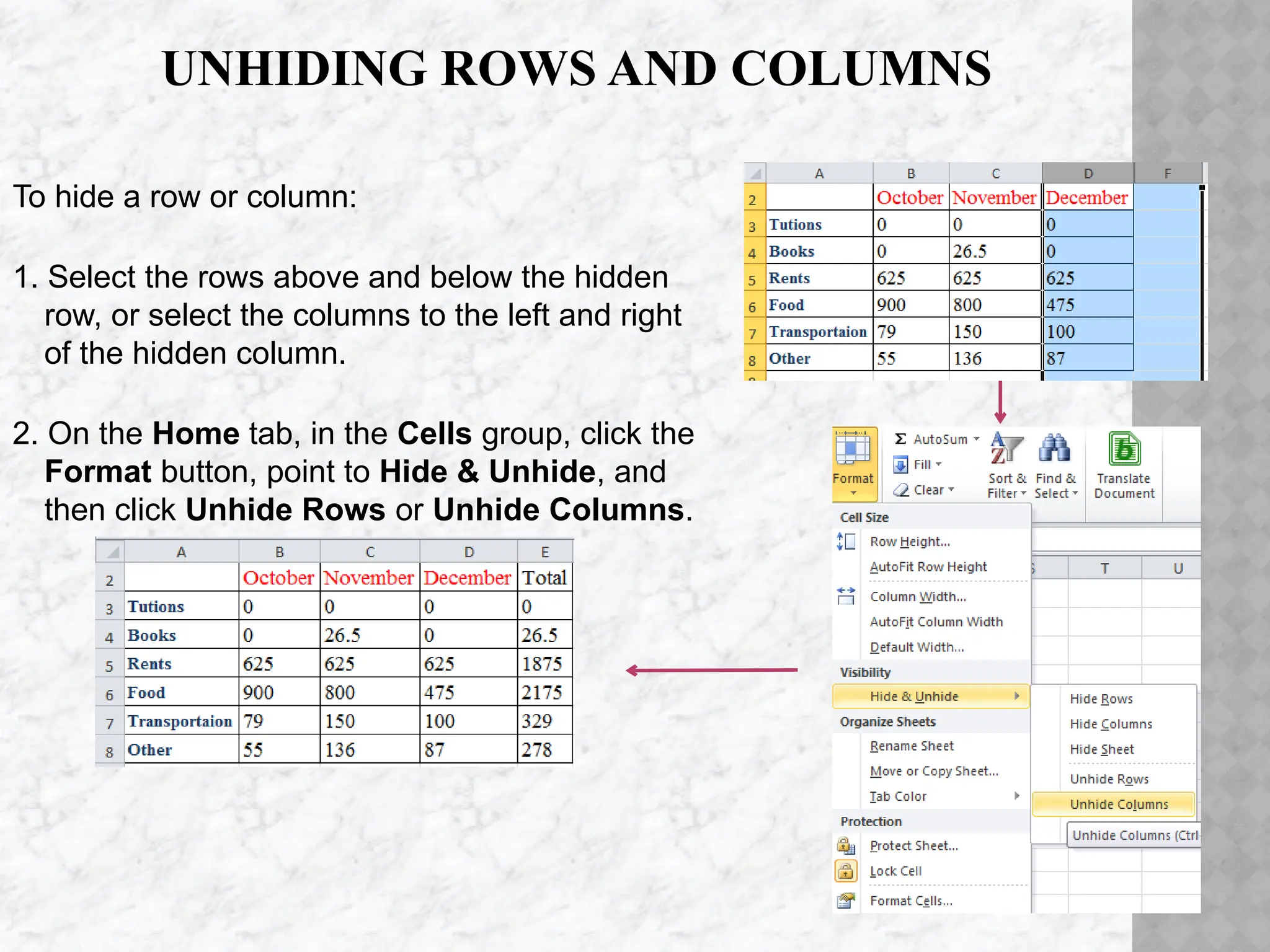
2. On the Home tab, in the Cells group, click the
Format button, point to Hide & Unhide, and
then click Unhide Rows or Unhide Columns.
43.
UNHIDING ROWS ANDCOLUMNS
To hide a row or column:
1. Select the rows above and below the hidden
row, or select the columns to the left and right
of the hidden column.
2. On the Home tab, in the Cells group, click the
Format button, point to Hide & Unhide, and
then click Unhide Rows or Unhide Columns.
44.
UNHIDING ROWS ANDCOLUMNS
To hide a row or column:
1. Select the rows above and below the hidden
row, or select the columns to the left and right
of the hidden column.
2. On the Home tab, in the Cells group, click the
Format button, point to Hide & Unhide, and
then click Unhide Rows or Unhide Columns.
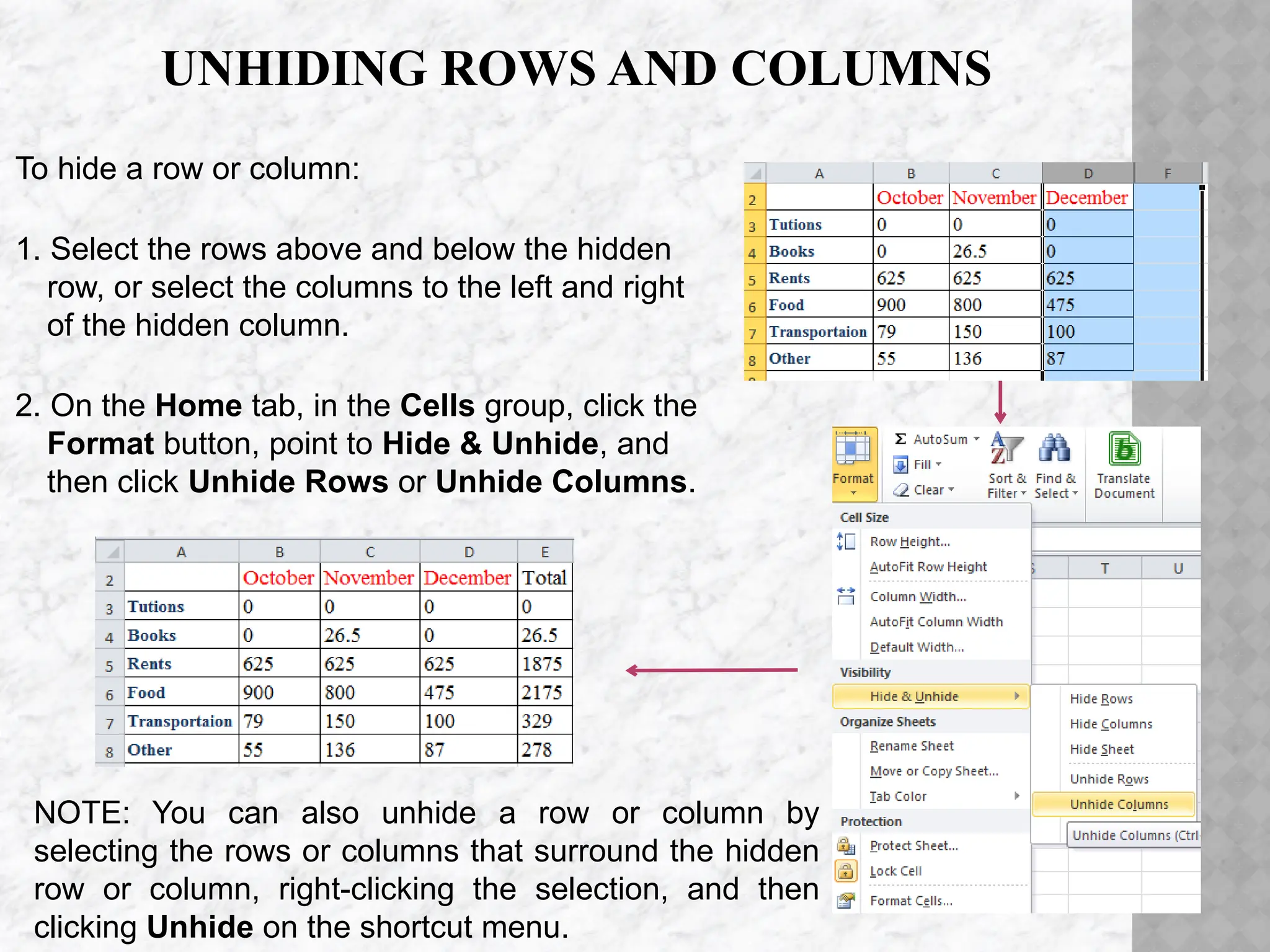
NOTE: You can also unhide a row or column by
selecting the rows or columns that surround the hidden
row or column, right-clicking the selection, and then
clicking Unhide on the shortcut menu.
45.
SELECTING WORKSHEETS
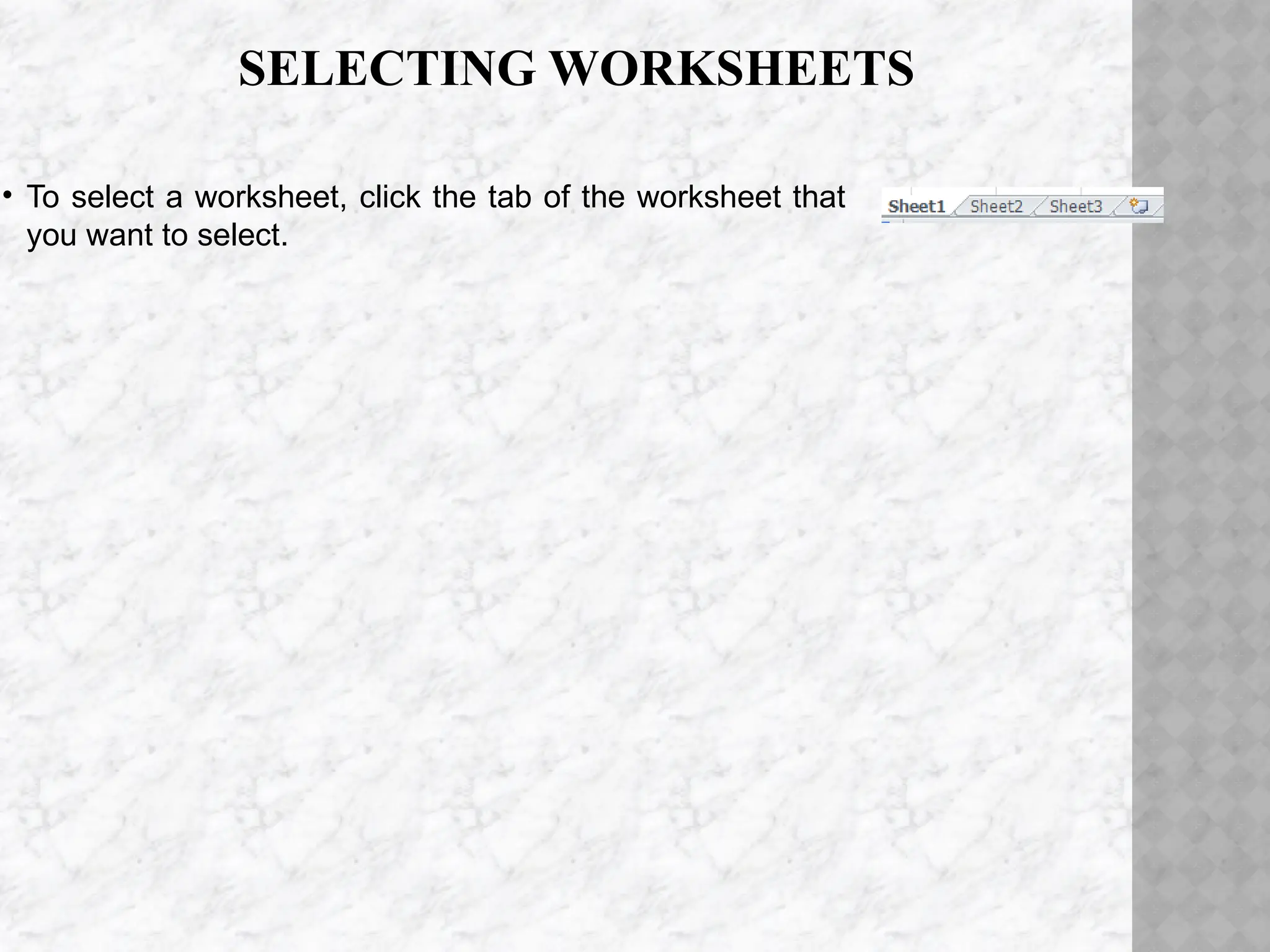
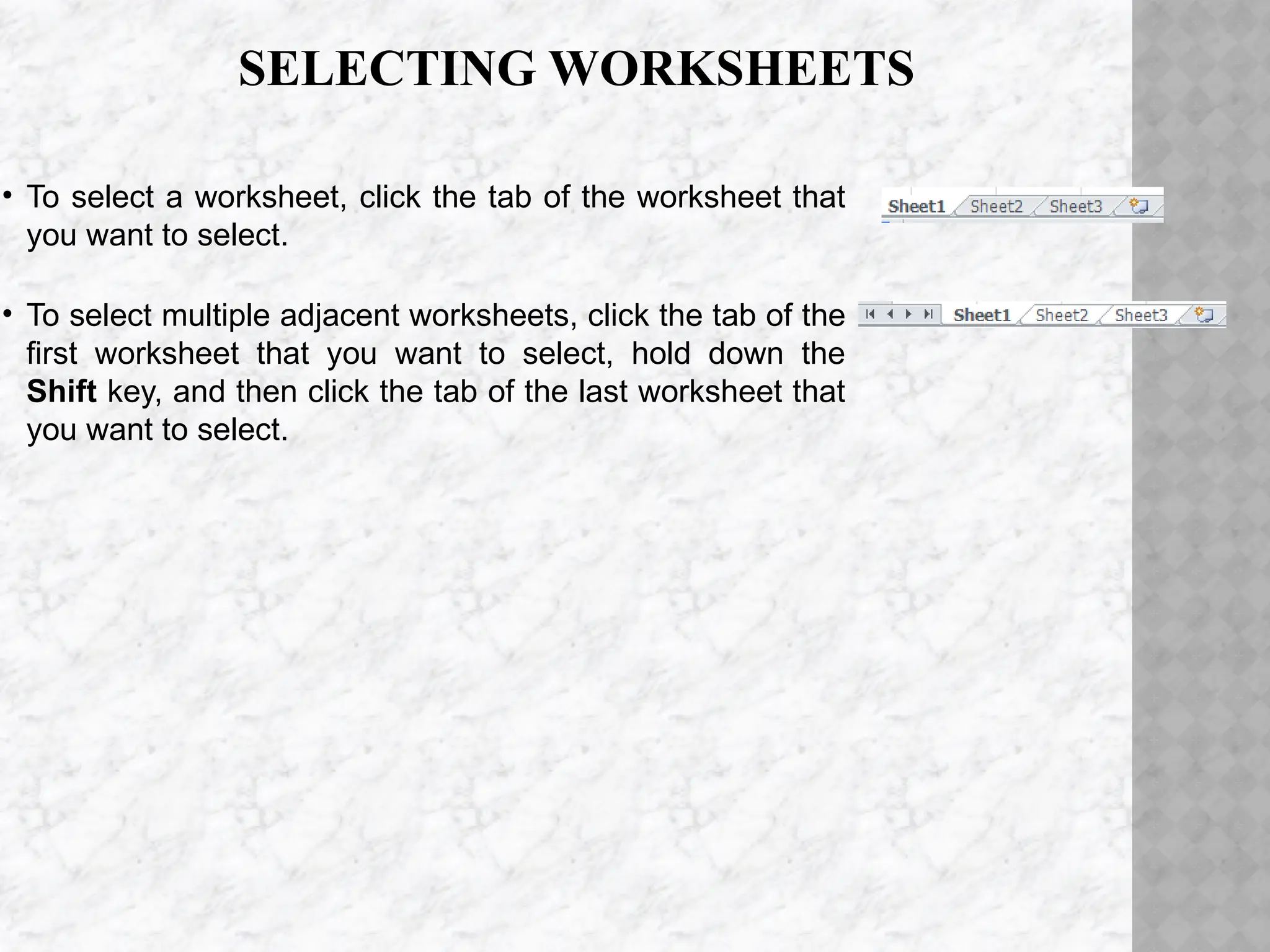
• Toselect a worksheet, click the tab of the worksheet that
you want to select.
46.
SELECTING WORKSHEETS
• Toselect a worksheet, click the tab of the worksheet that
you want to select.
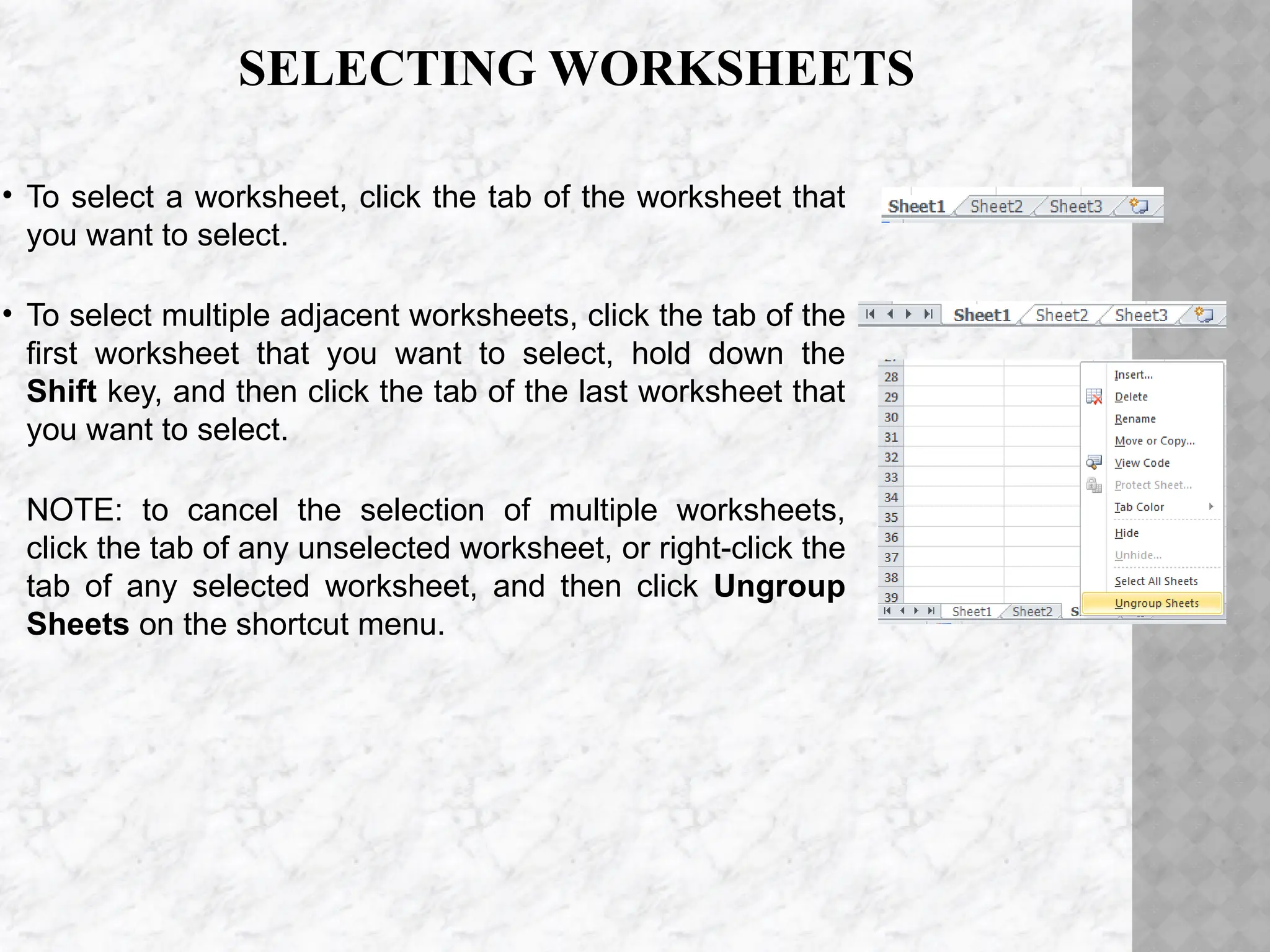
• To select multiple adjacent worksheets, click the tab of the
first worksheet that you want to select, hold down the
Shift key, and then click the tab of the last worksheet that
you want to select.
47.
SELECTING WORKSHEETS
• Toselect a worksheet, click the tab of the worksheet that
you want to select.
• To select multiple adjacent worksheets, click the tab of the
first worksheet that you want to select, hold down the
Shift key, and then click the tab of the last worksheet that
you want to select.
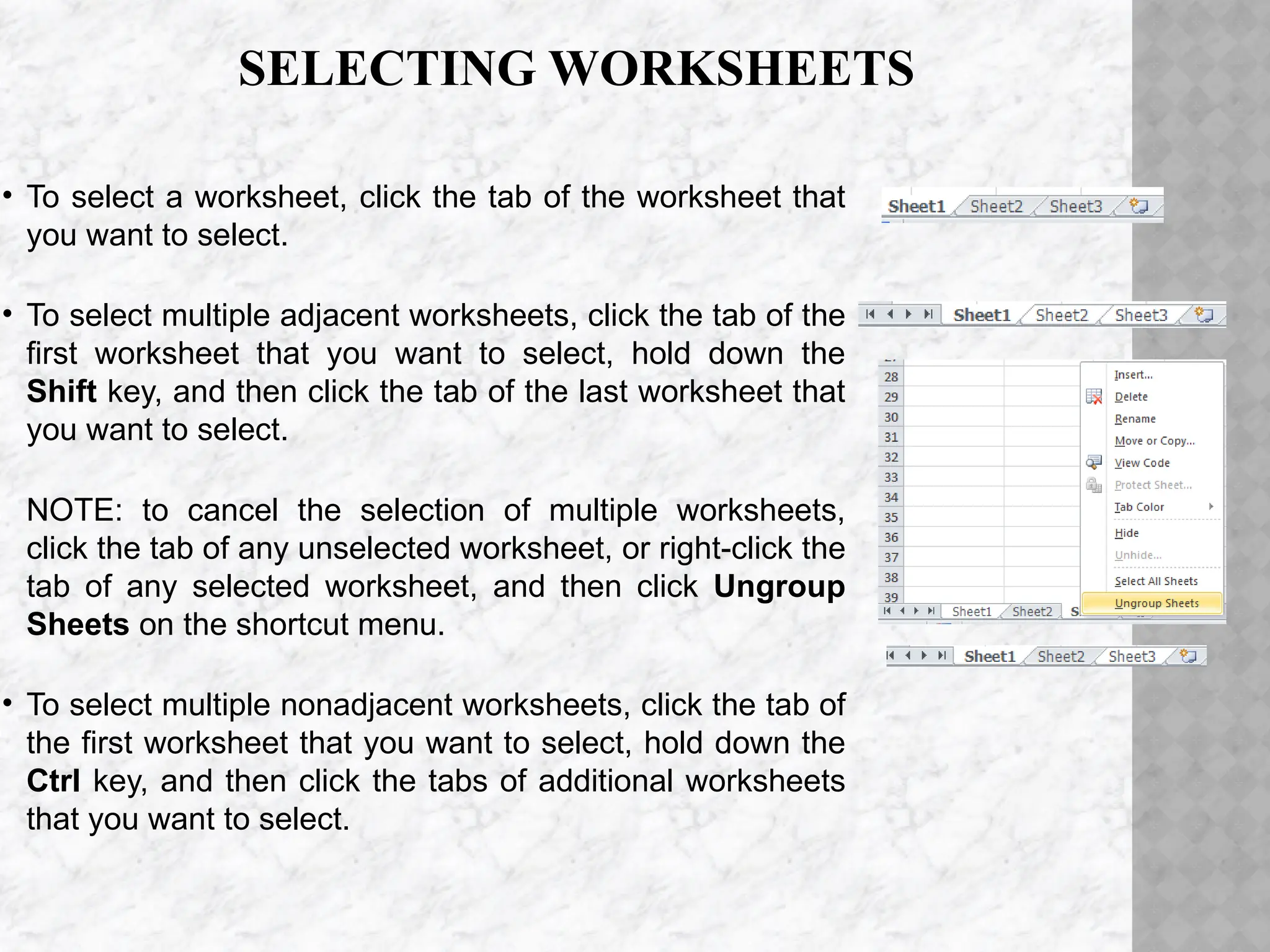
NOTE: to cancel the selection of multiple worksheets,
click the tab of any unselected worksheet, or right-click the
tab of any selected worksheet, and then click Ungroup
Sheets on the shortcut menu.
48.
SELECTING WORKSHEETS
• Toselect a worksheet, click the tab of the worksheet that
you want to select.
• To select multiple adjacent worksheets, click the tab of the
first worksheet that you want to select, hold down the
Shift key, and then click the tab of the last worksheet that
you want to select.
NOTE: to cancel the selection of multiple worksheets,
click the tab of any unselected worksheet, or right-click the
tab of any selected worksheet, and then click Ungroup
Sheets on the shortcut menu.
• To select multiple nonadjacent worksheets, click the tab of
the first worksheet that you want to select, hold down the
Ctrl key, and then click the tabs of additional worksheets
that you want to select.
49.
SELECTING WORKSHEETS
• Toselect a worksheet, click the tab of the worksheet that
you want to select.
• To select multiple adjacent worksheets, click the tab of the
first worksheet that you want to select, hold down the
Shift key, and then click the tab of the last worksheet that
you want to select.
NOTE: to cancel the selection of multiple worksheets,
click the tab of any unselected worksheet, or right-click the
tab of any selected worksheet, and then click Ungroup
Sheets on the shortcut menu.
• To select multiple nonadjacent worksheets, click the tab of
the first worksheet that you want to select, hold down the
Ctrl key, and then click the tabs of additional worksheets
that you want to select.
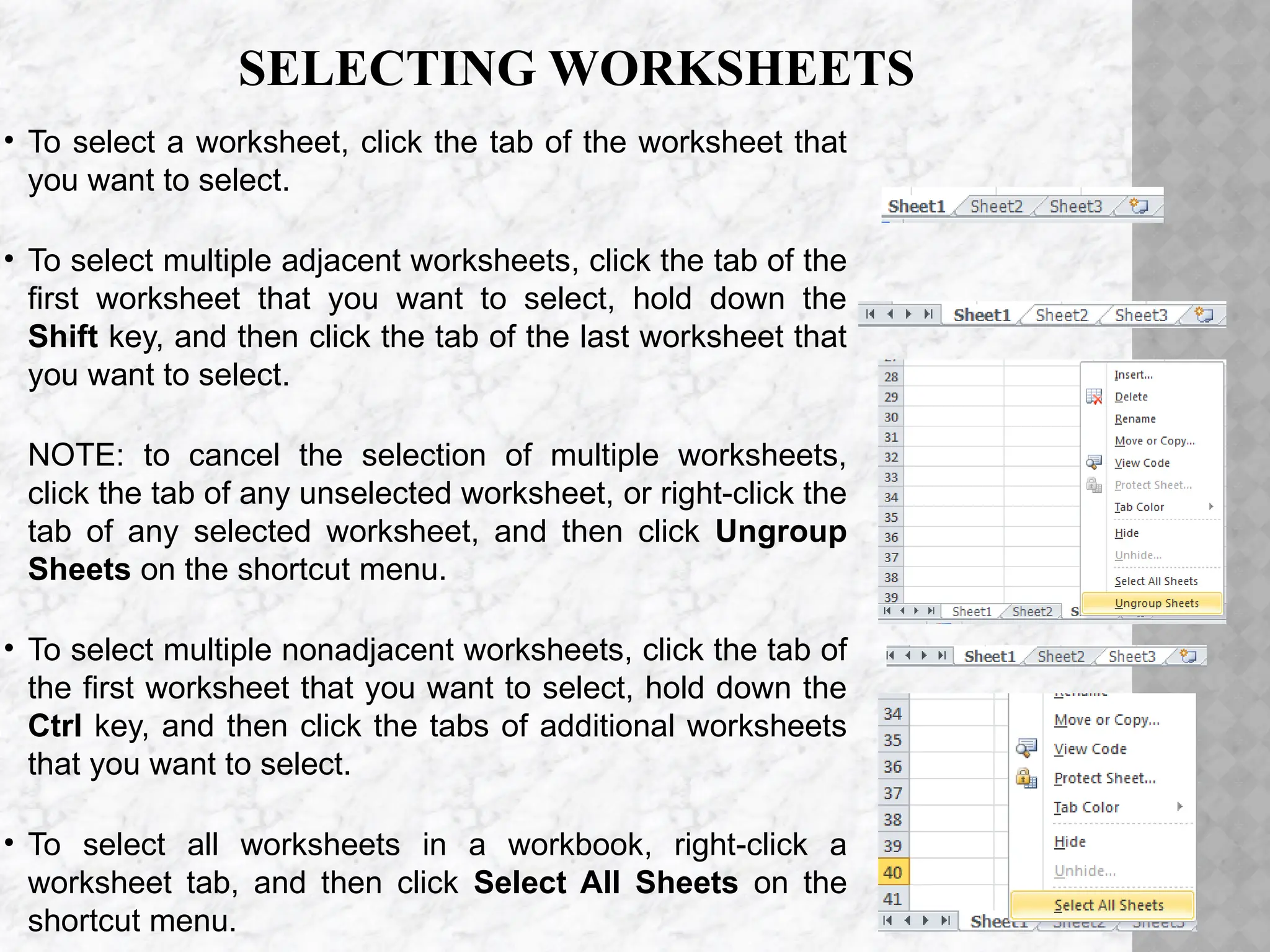
• To select all worksheets in a workbook, right-click a
worksheet tab, and then click Select All Sheets on the
shortcut menu.
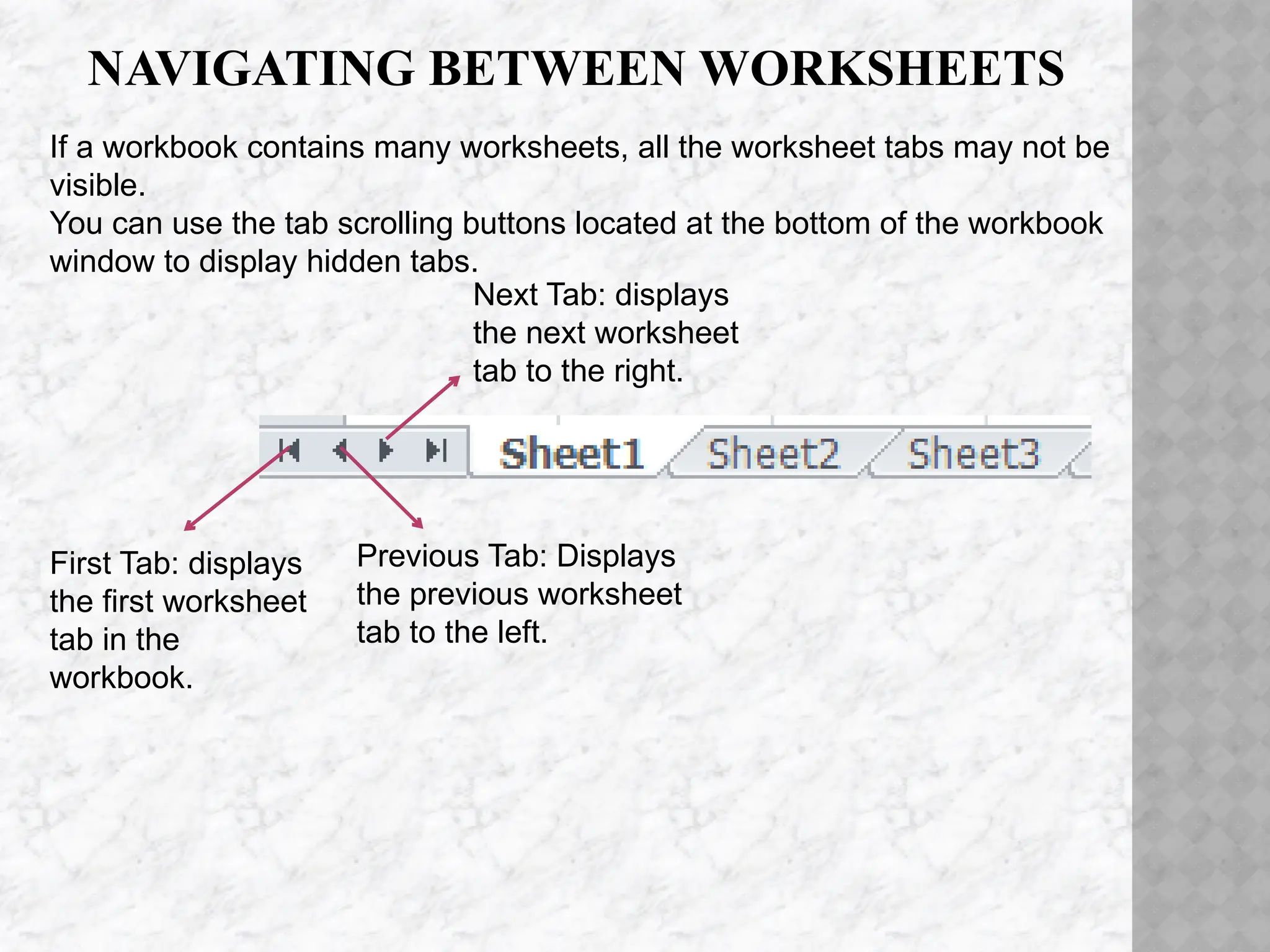
NAVIGATING BETWEEN WORKSHEETS
Ifa workbook contains many worksheets, all the worksheet tabs may not be
visible.
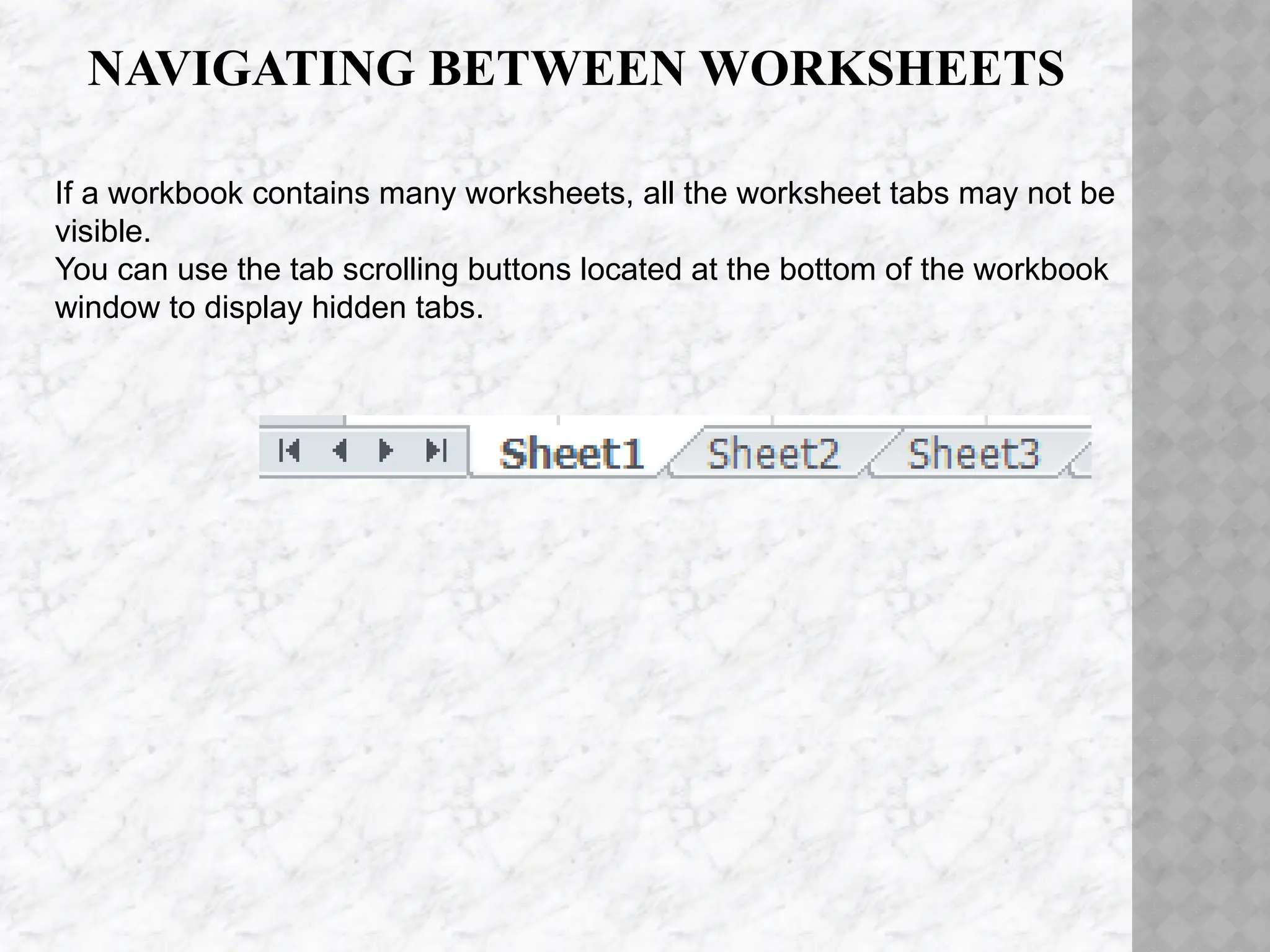
You can use the tab scrolling buttons located at the bottom of the workbook
window to display hidden tabs.
52.
NAVIGATING BETWEEN WORKSHEETS
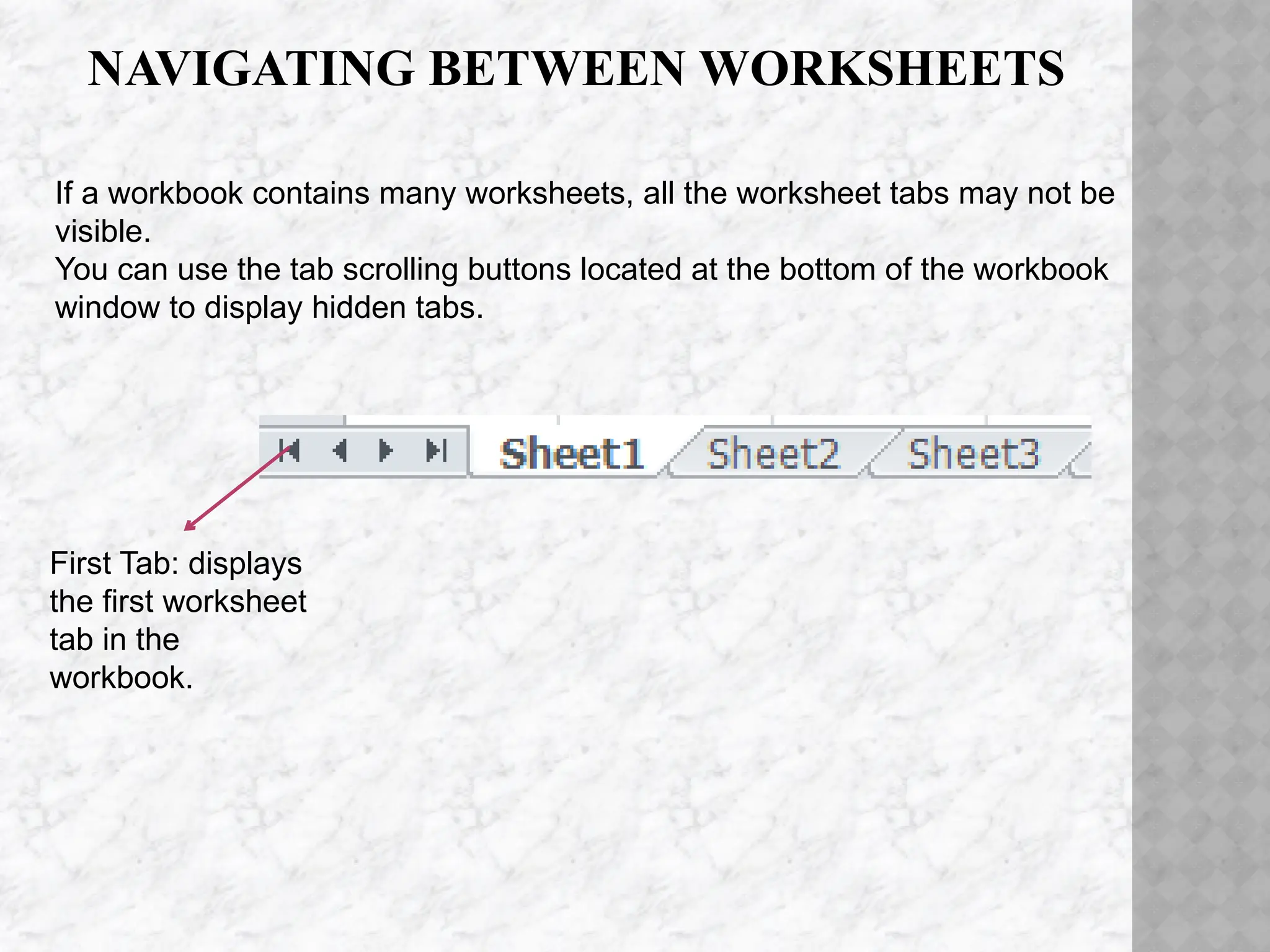
FirstTab: displays
the first worksheet
tab in the
workbook.
If a workbook contains many worksheets, all the worksheet tabs may not be
visible.
You can use the tab scrolling buttons located at the bottom of the workbook
window to display hidden tabs.
53.
NAVIGATING BETWEEN WORKSHEETS
FirstTab: displays
the first worksheet
tab in the
workbook.
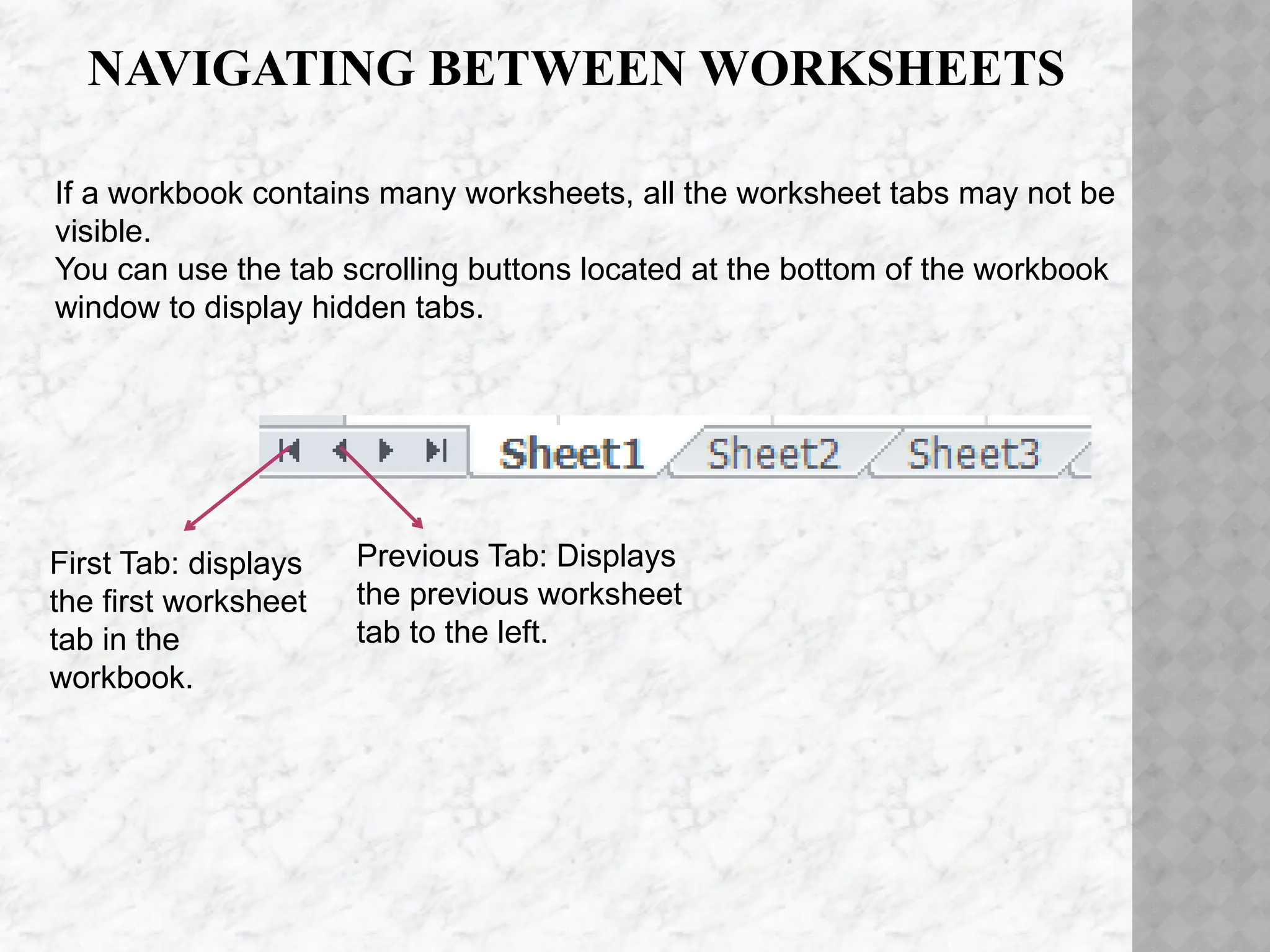
Previous Tab: Displays
the previous worksheet
tab to the left.
If a workbook contains many worksheets, all the worksheet tabs may not be
visible.
You can use the tab scrolling buttons located at the bottom of the workbook
window to display hidden tabs.
54.
NAVIGATING BETWEEN WORKSHEETS
FirstTab: displays
the first worksheet
tab in the
workbook.
Previous Tab: Displays
the previous worksheet
tab to the left.
Next Tab: displays
the next worksheet
tab to the right.
If a workbook contains many worksheets, all the worksheet tabs may not be
visible.
You can use the tab scrolling buttons located at the bottom of the workbook
window to display hidden tabs.
55.
NAVIGATING BETWEEN WORKSHEETS
FirstTab: displays
the first worksheet
tab in the
workbook.
Previous Tab: Displays
the previous worksheet
tab to the left.
Next Tab: displays the
next worksheet tab to
the right.
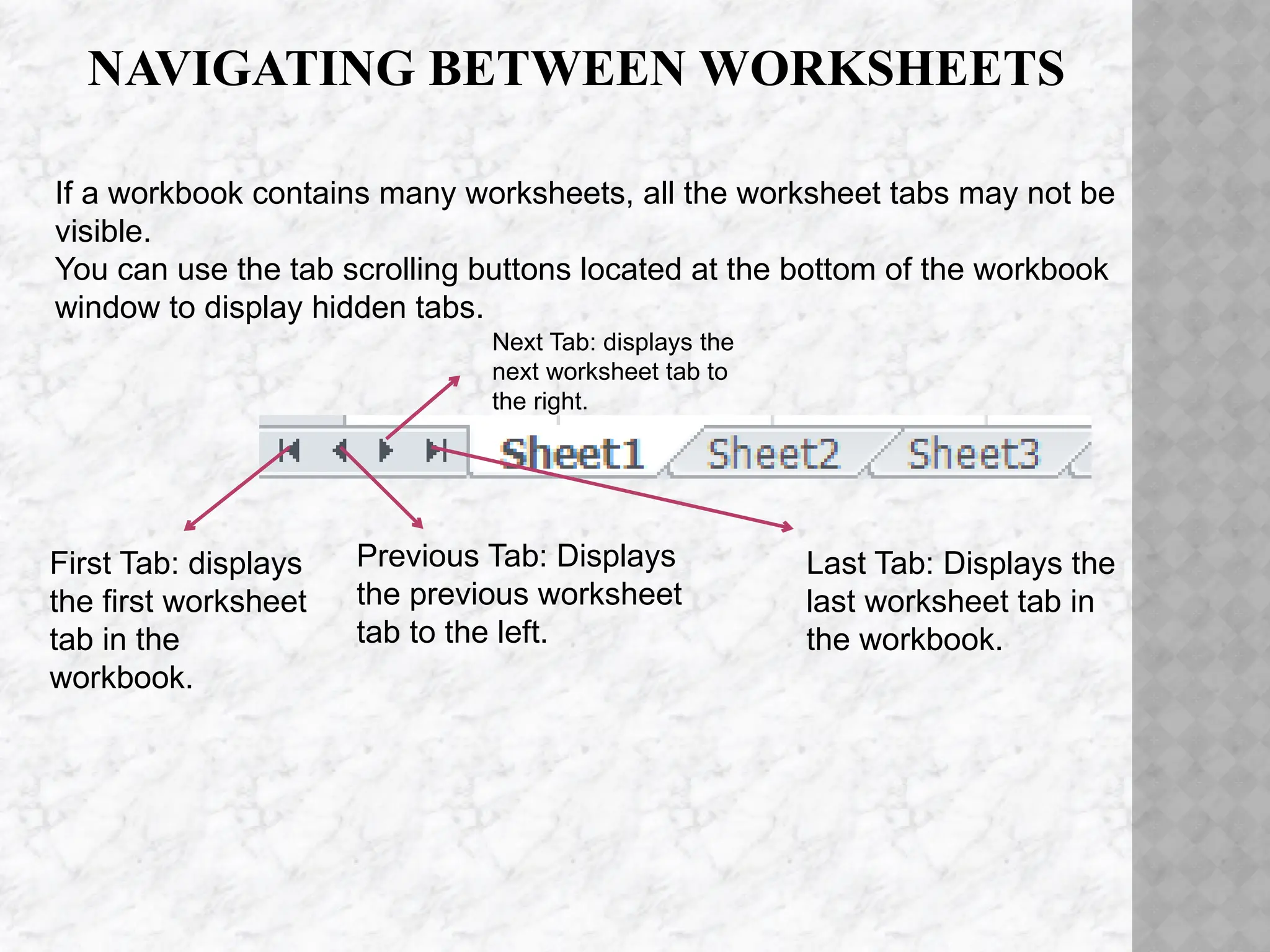
Last Tab: Displays the
last worksheet tab in
the workbook.
If a workbook contains many worksheets, all the worksheet tabs may not be
visible.
You can use the tab scrolling buttons located at the bottom of the workbook
window to display hidden tabs.
56.
NAVIGATING BETWEEN WORKSHEETS
FirstTab: displays
the first worksheet
tab in the
workbook.
Previous Tab: Displays
the previous worksheet
tab to the left.
Next Tab: displays the
next worksheet tab to
the right.
Last Tab: Displays the
last worksheet tab in
the workbook.
If a workbook contains many worksheets, all the worksheet tabs may not be
visible.
You can use the tab scrolling buttons located at the bottom of the workbook
window to display hidden tabs.
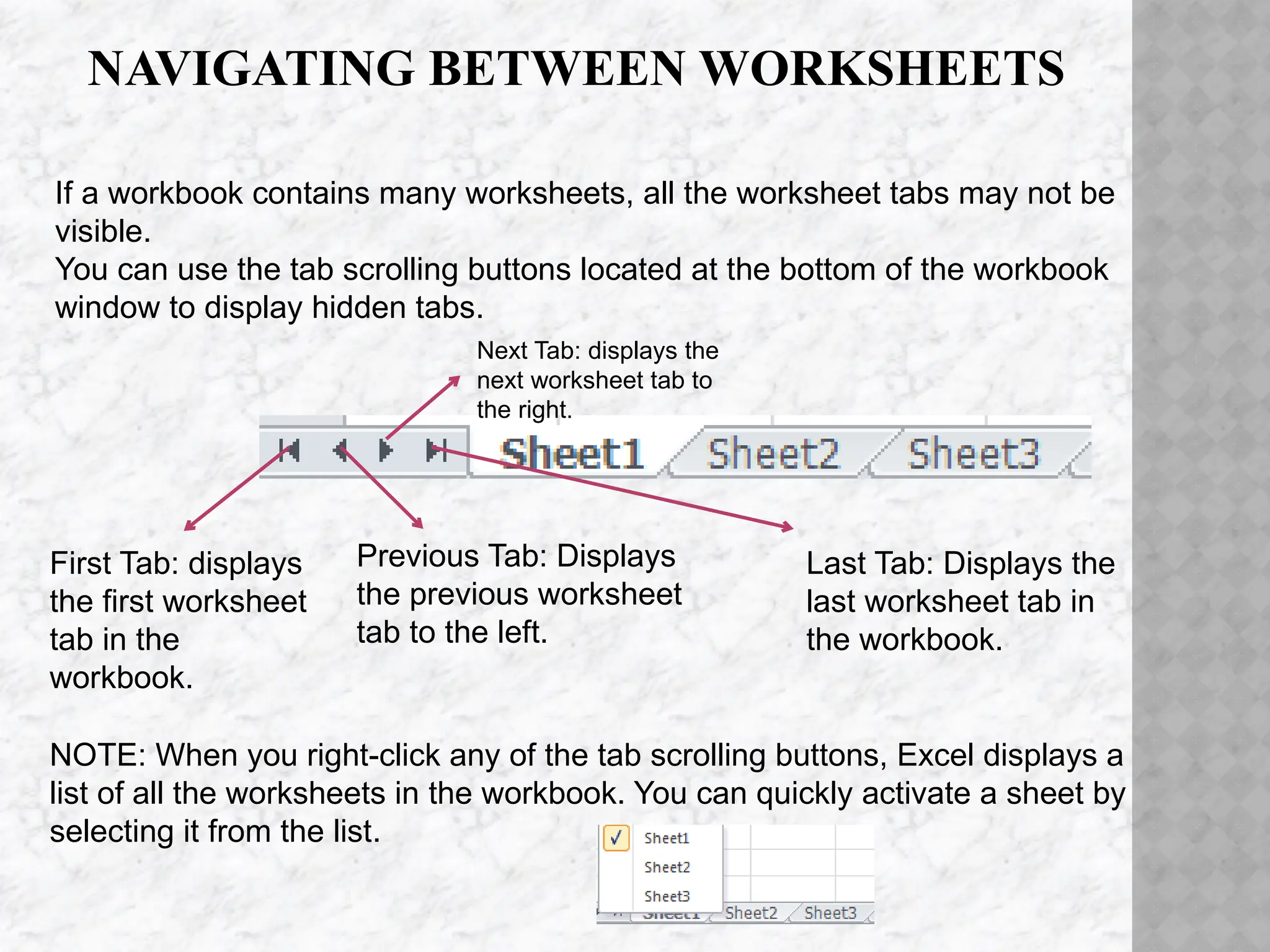
NOTE: When you right-click any of the tab scrolling buttons, Excel displays a
list of all the worksheets in the workbook. You can quickly activate a sheet by
selecting it from the list.
57.
RENAMING WORKSHEETS
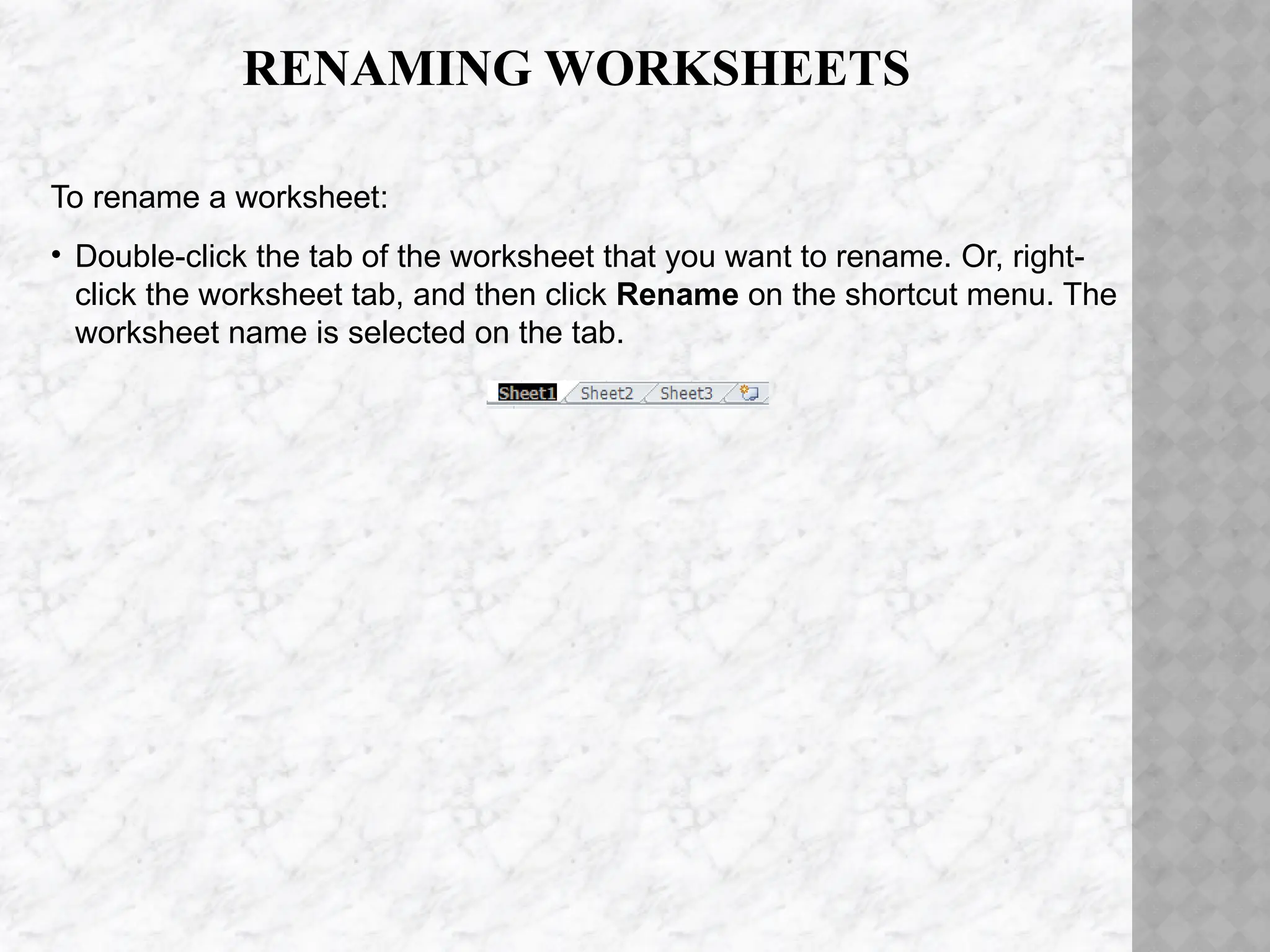
To renamea worksheet:
• Double-click the tab of the worksheet that you want to rename or, right-click
the worksheet tab, and then click Rename on the shortcut menu
58.
RENAMING WORKSHEETS
To renamea worksheet:
• Double-click the tab of the worksheet that you want to rename. Or, right-
click the worksheet tab, and then click Rename on the shortcut menu. The
worksheet name is selected on the tab.
59.
RENAMING WORKSHEETS
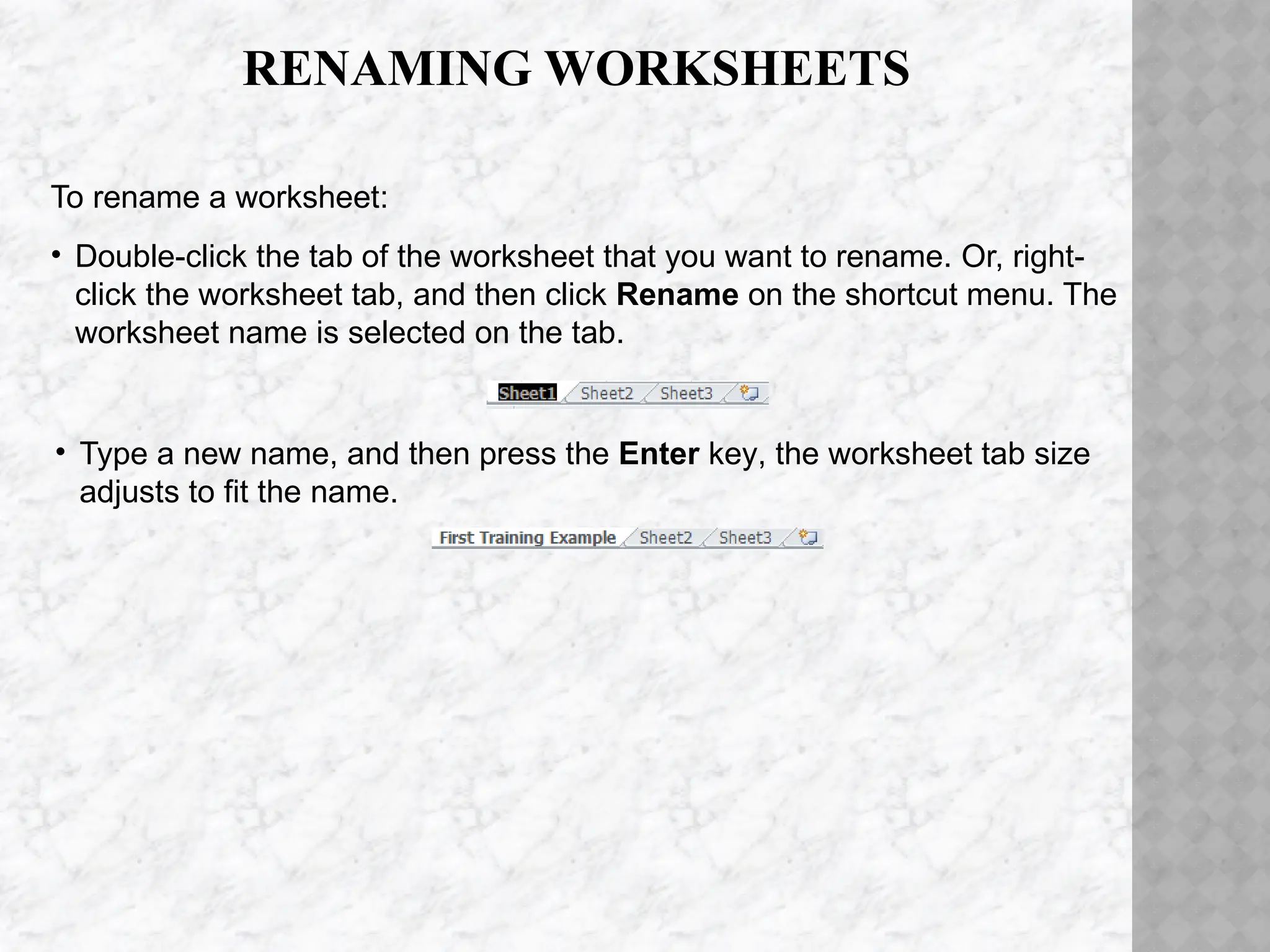
• Typea new name, and then press the Enter key, the worksheet tab size
adjusts to fit the name.
To rename a worksheet:
• Double-click the tab of the worksheet that you want to rename. Or, right-
click the worksheet tab, and then click Rename on the shortcut menu. The
worksheet name is selected on the tab.
60.
RENAMING WORKSHEETS
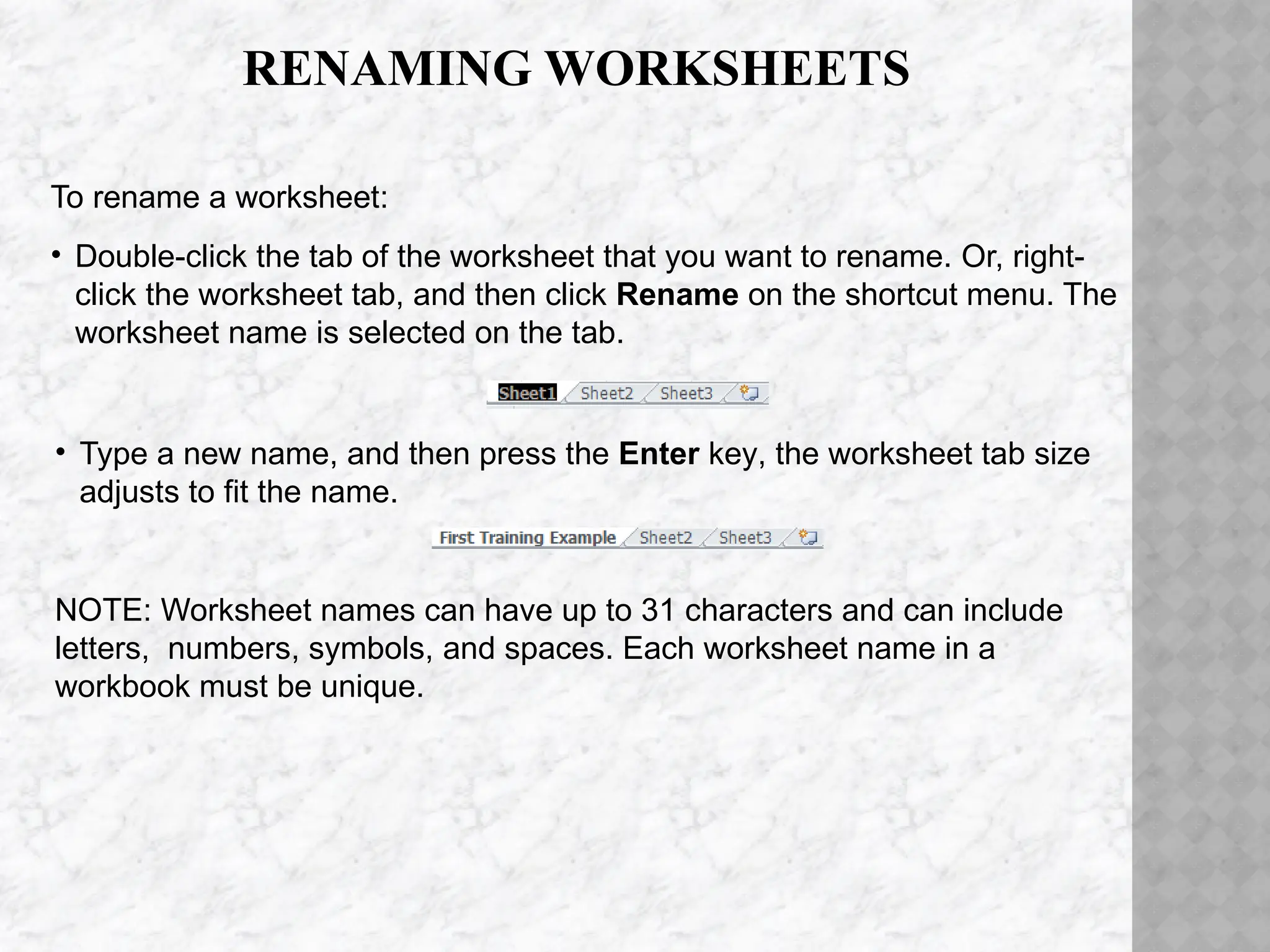
• Typea new name, and then press the Enter key, the worksheet tab size
adjusts to fit the name.
NOTE: Worksheet names can have up to 31 characters and can include
letters, numbers, symbols, and spaces. Each worksheet name in a
workbook must be unique.
To rename a worksheet:
• Double-click the tab of the worksheet that you want to rename. Or, right-
click the worksheet tab, and then click Rename on the shortcut menu. The
worksheet name is selected on the tab.
61.
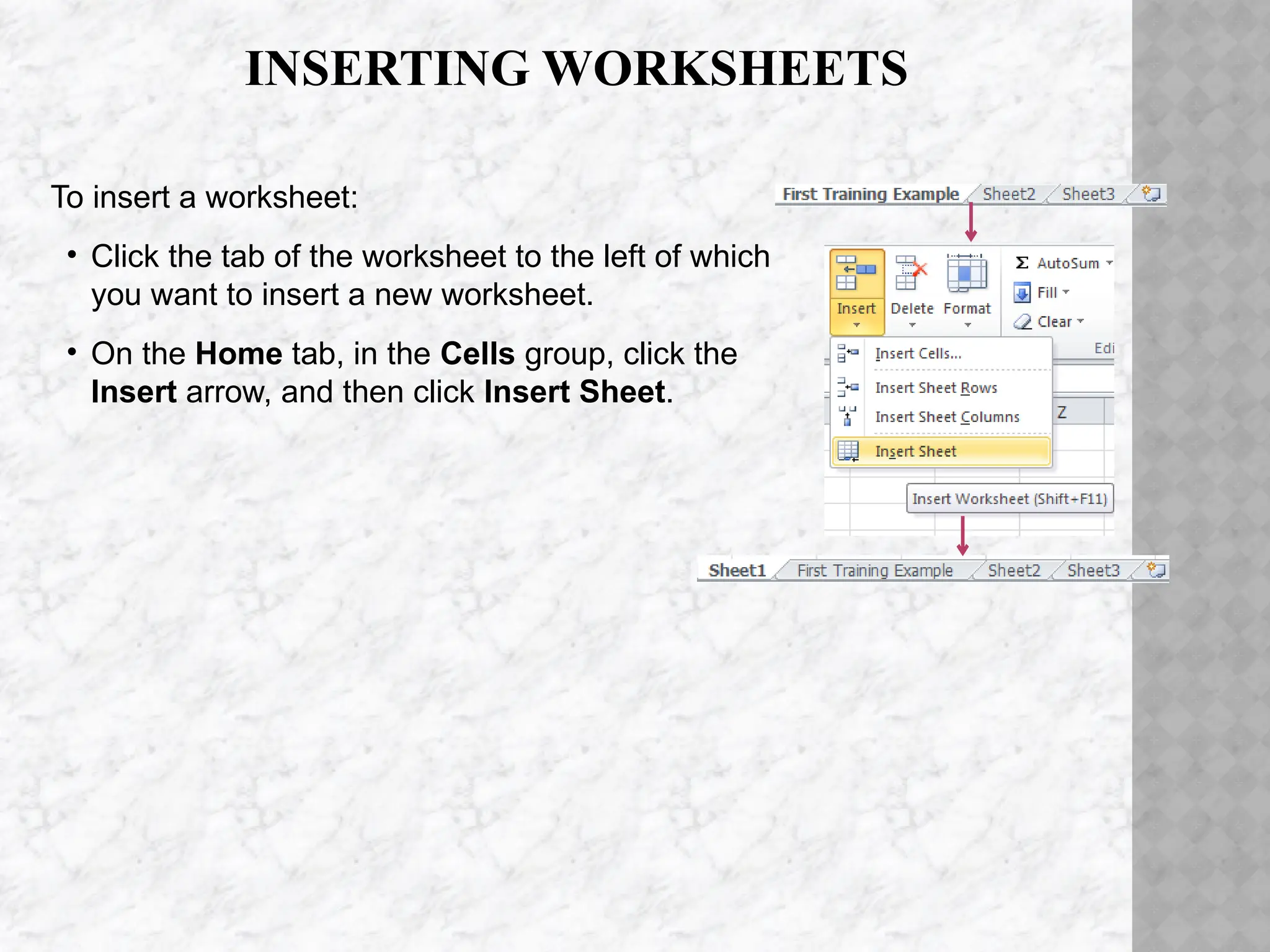
INSERTING WORKSHEETS
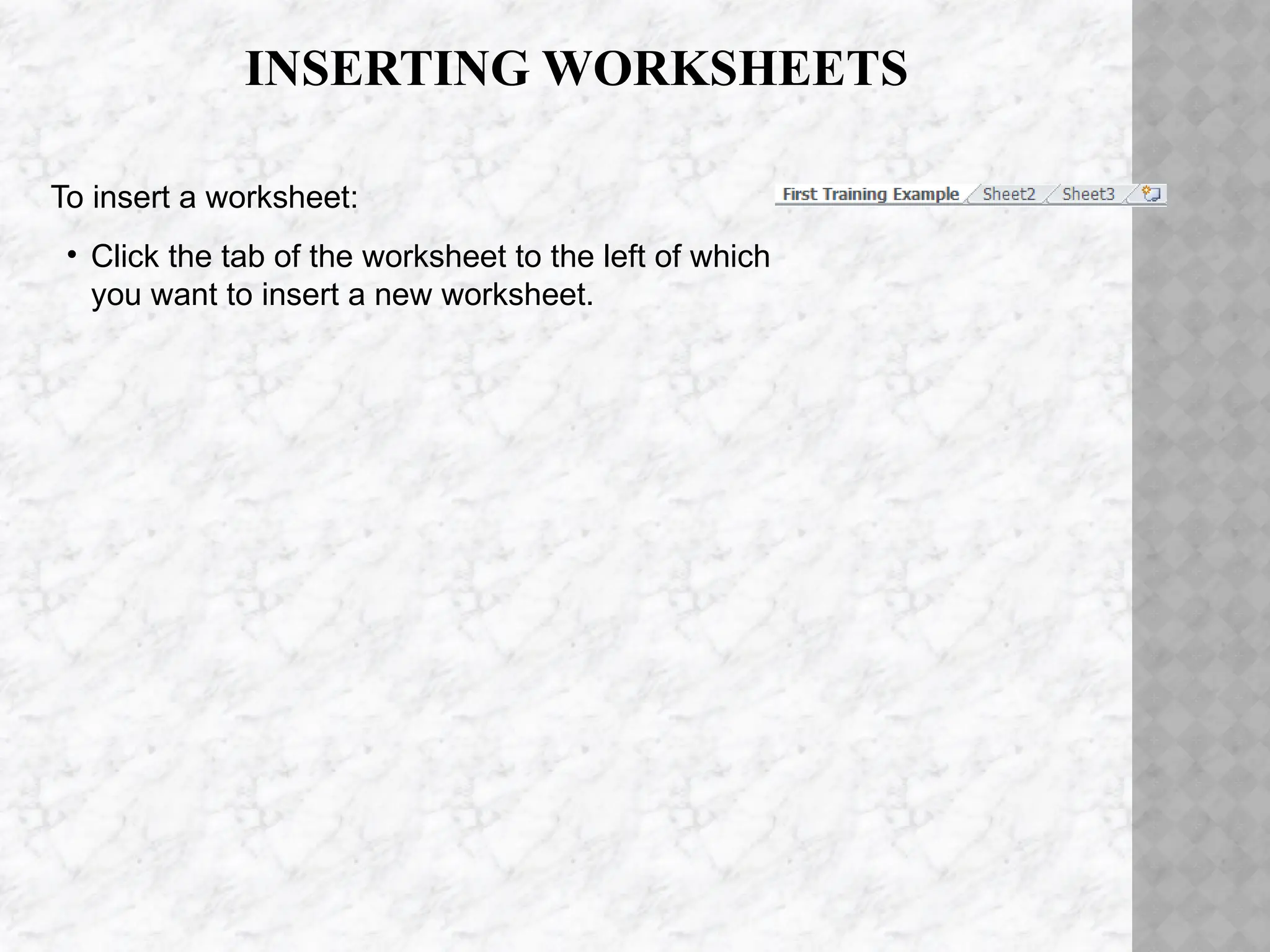
To inserta worksheet:
• Click the tab of the worksheet to the left of which
you want to insert a new worksheet.
62.
INSERTING WORKSHEETS
To inserta worksheet:
• Click the tab of the worksheet to the left of which
you want to insert a new worksheet.
• On the Home tab, in the Cells group, click the
Insert arrow, and then click Insert Sheet.
63.
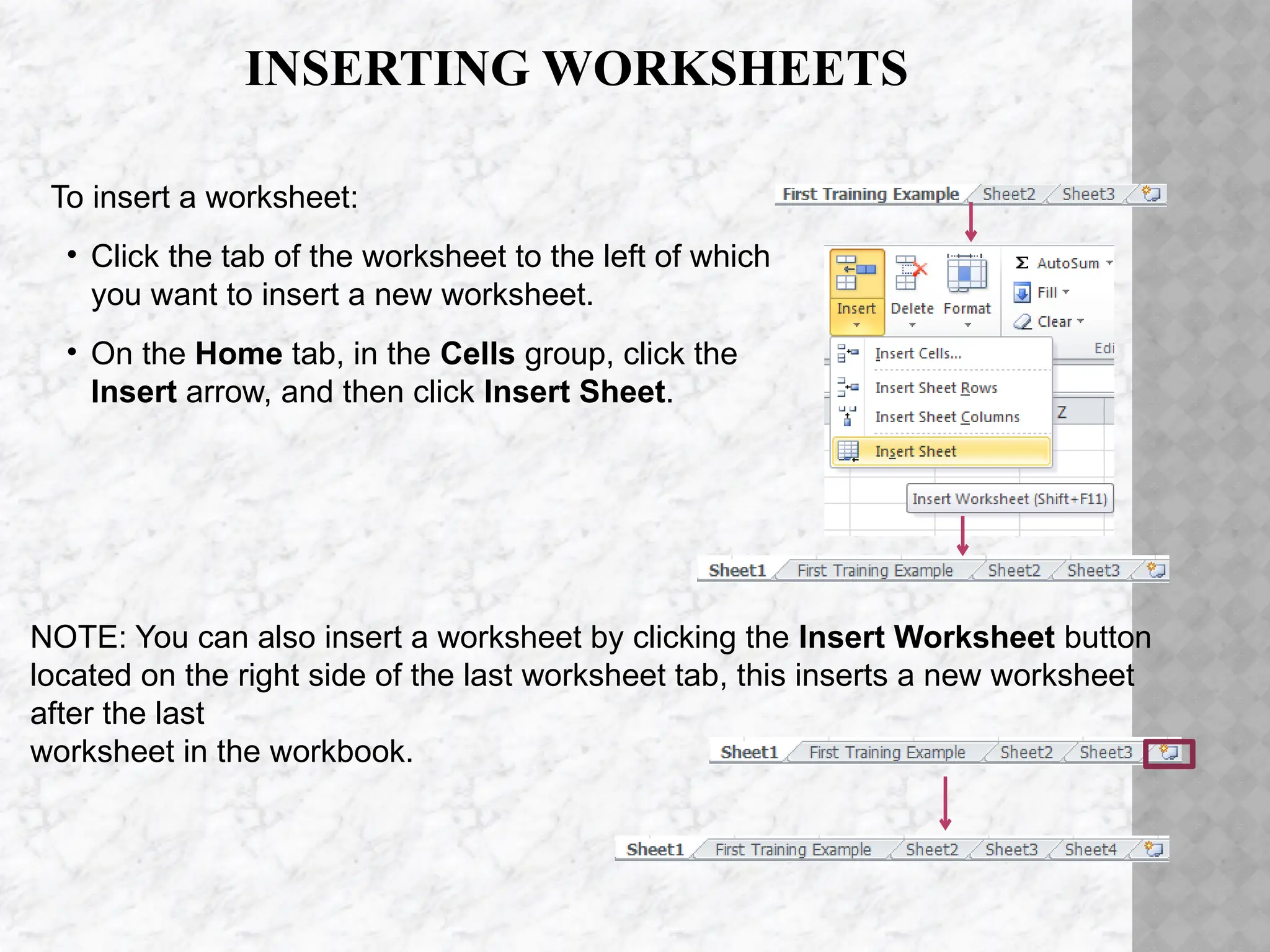
INSERTING WORKSHEETS
To inserta worksheet:
• Click the tab of the worksheet to the left of which
you want to insert a new worksheet.
• On the Home tab, in the Cells group, click the
Insert arrow, and then click Insert Sheet.
NOTE: You can also insert a worksheet by clicking the Insert Worksheet button
located on the right side of the last worksheet tab, this inserts a new worksheet
after the last
worksheet in the workbook.
DELETING WORKSHEETS
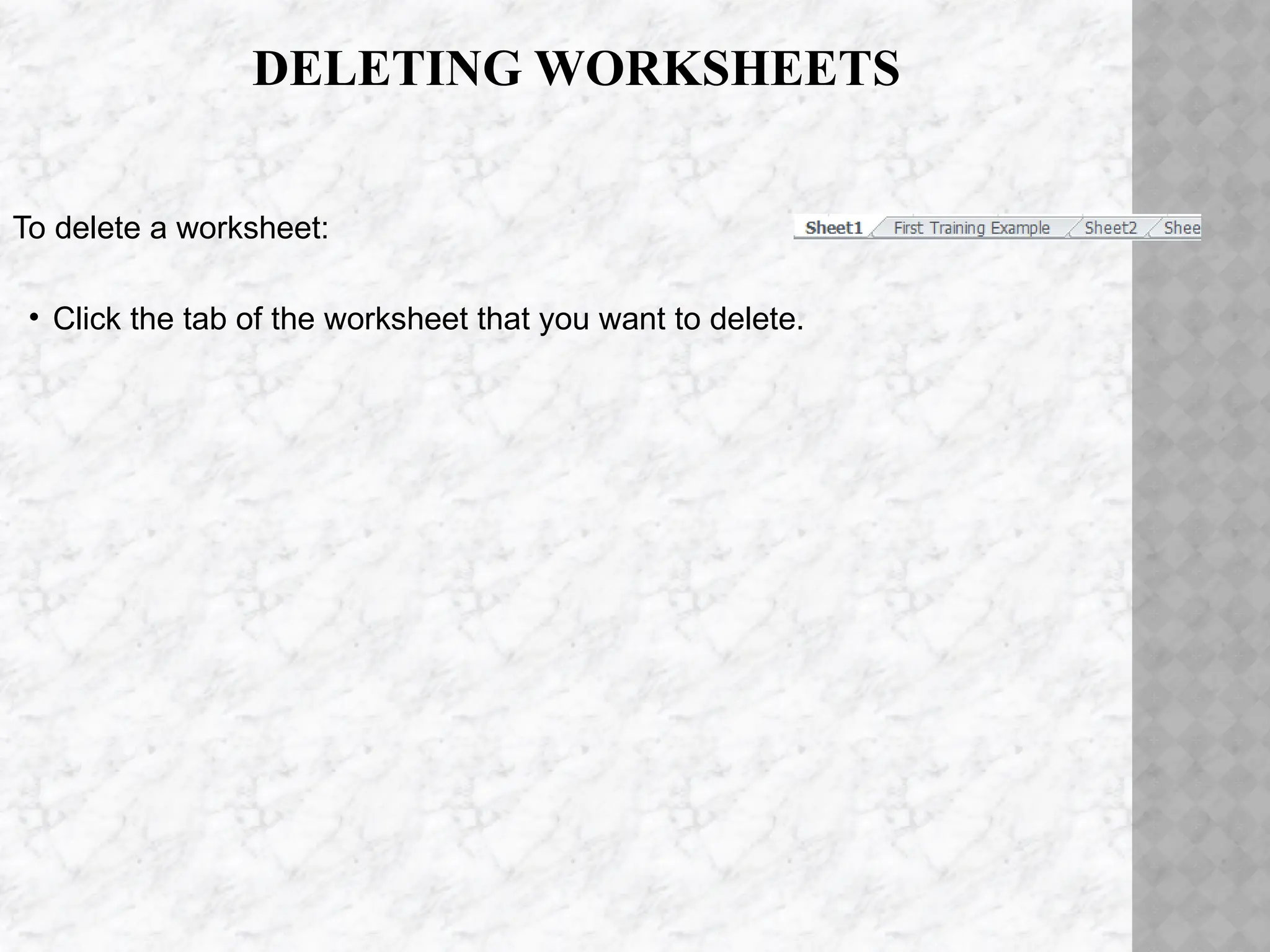
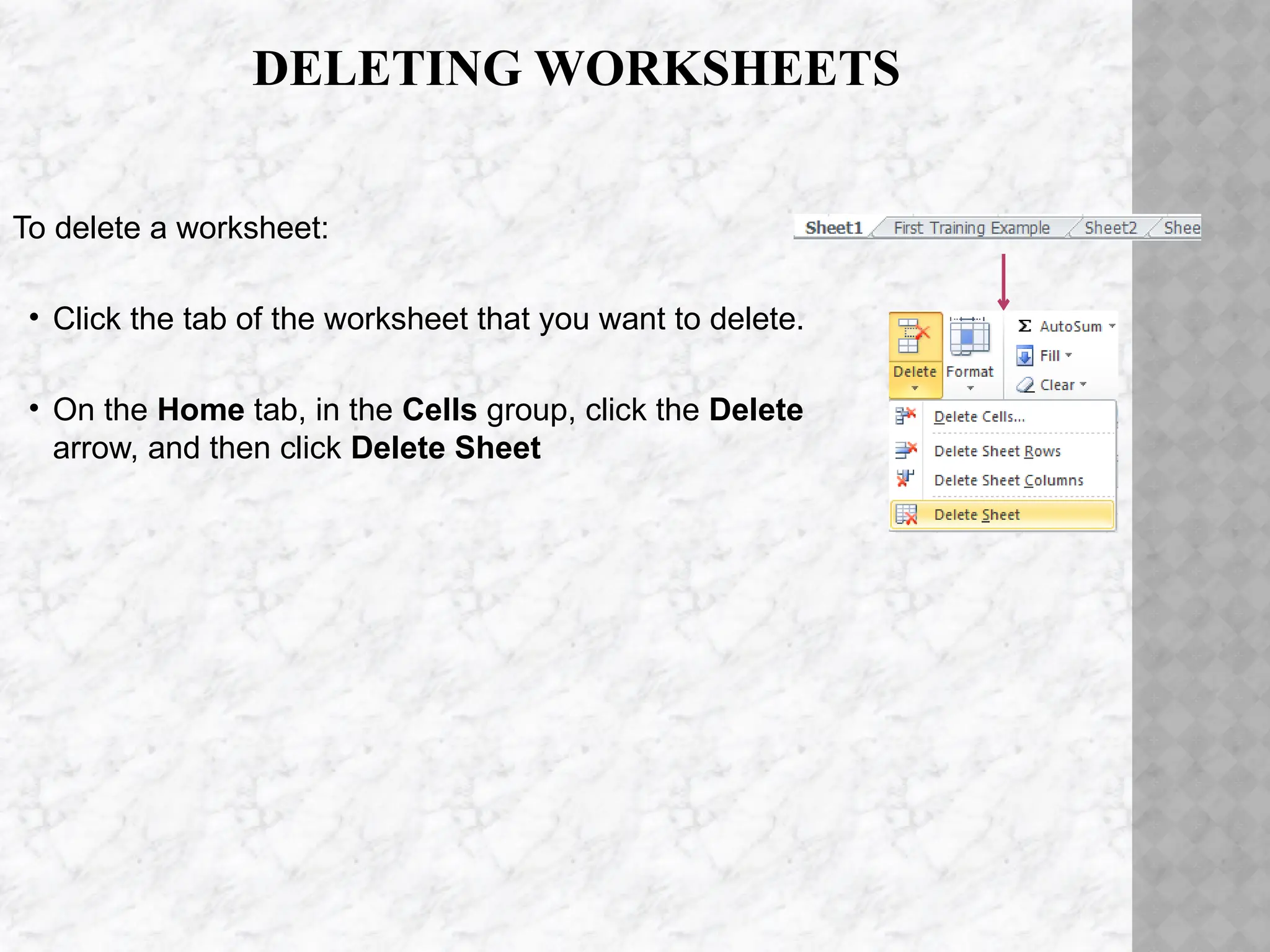
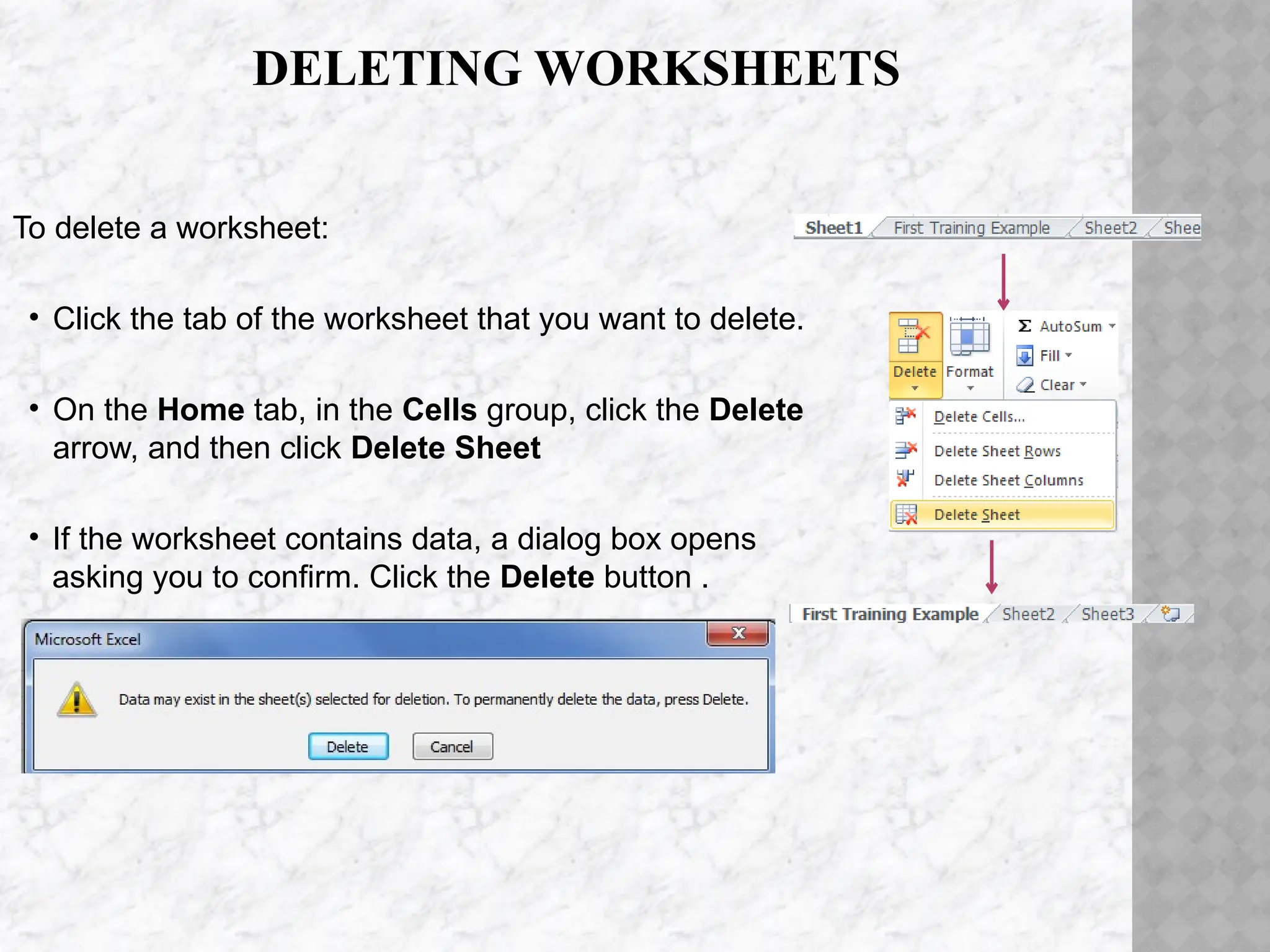
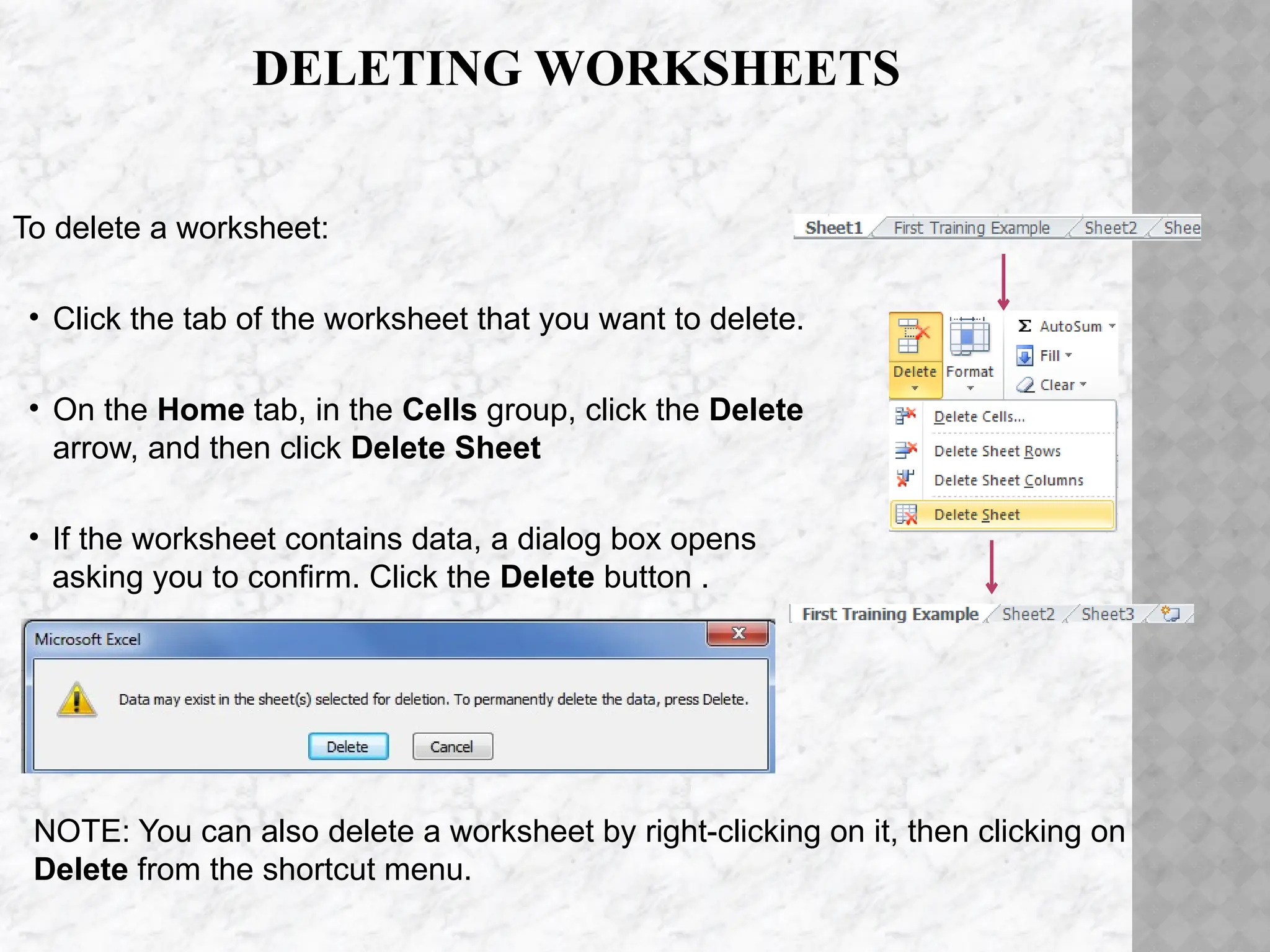
To deletea worksheet:
• Click the tab of the worksheet that you want to delete.
• On the Home tab, in the Cells group, click the Delete
arrow, and then click Delete Sheet
66.
DELETING WORKSHEETS
To deletea worksheet:
• Click the tab of the worksheet that you want to delete.
• On the Home tab, in the Cells group, click the Delete
arrow, and then click Delete Sheet
• If the worksheet contains data, a dialog box opens
asking you to confirm. Click the Delete button .
67.
DELETING WORKSHEETS
To deletea worksheet:
• Click the tab of the worksheet that you want to delete.
• On the Home tab, in the Cells group, click the Delete
arrow, and then click Delete Sheet
• If the worksheet contains data, a dialog box opens
asking you to confirm. Click the Delete button .
NOTE: You can also delete a worksheet by right-clicking on it, then clicking on
Delete from the shortcut menu.
68.
MOVING WORKSHEETS
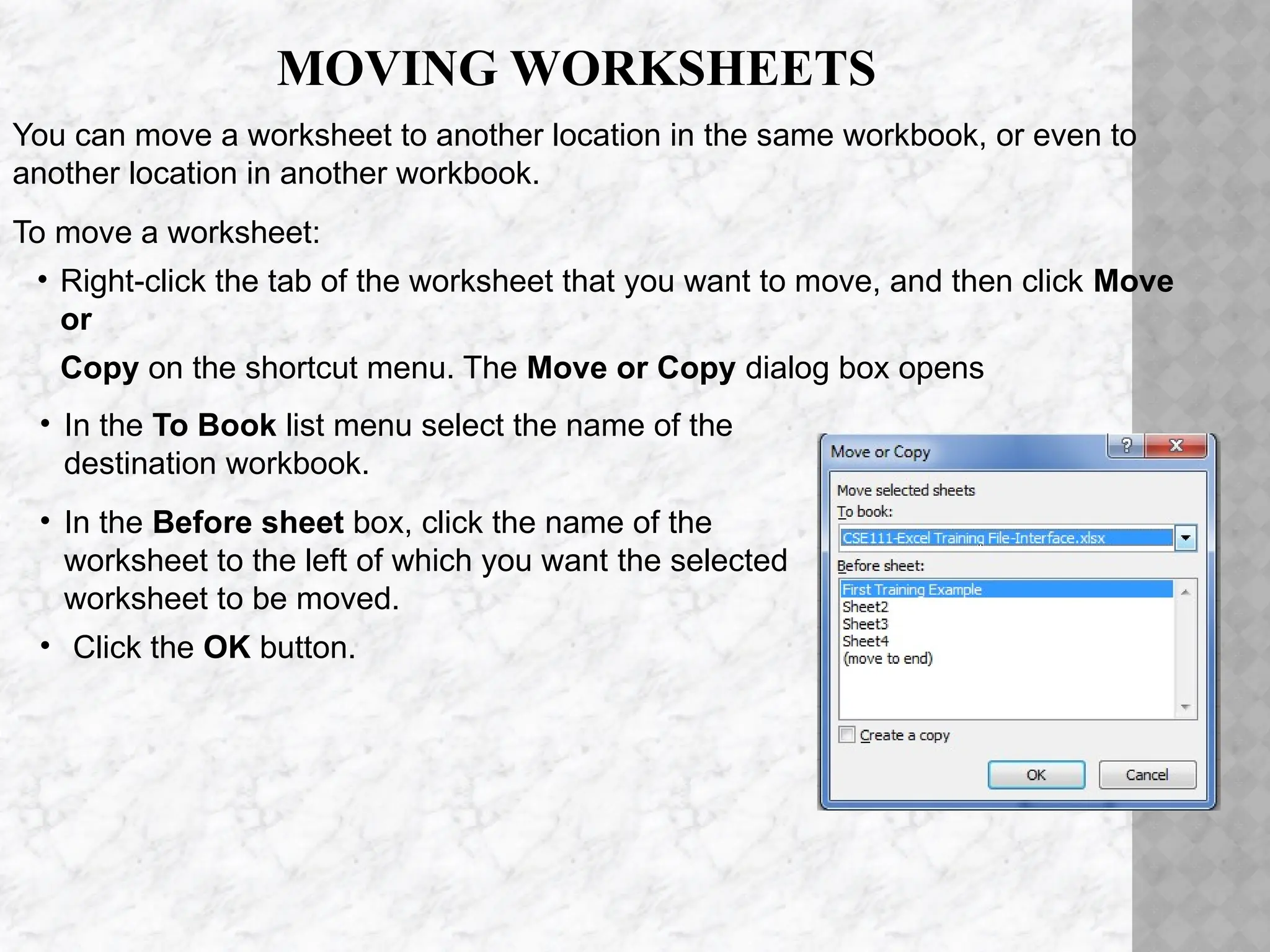
You canmove a worksheet to another location in the same workbook, or even to
another location in another workbook.
69.
MOVING WORKSHEETS
You canmove a worksheet to another location in the same workbook, or even to
another location in another workbook.
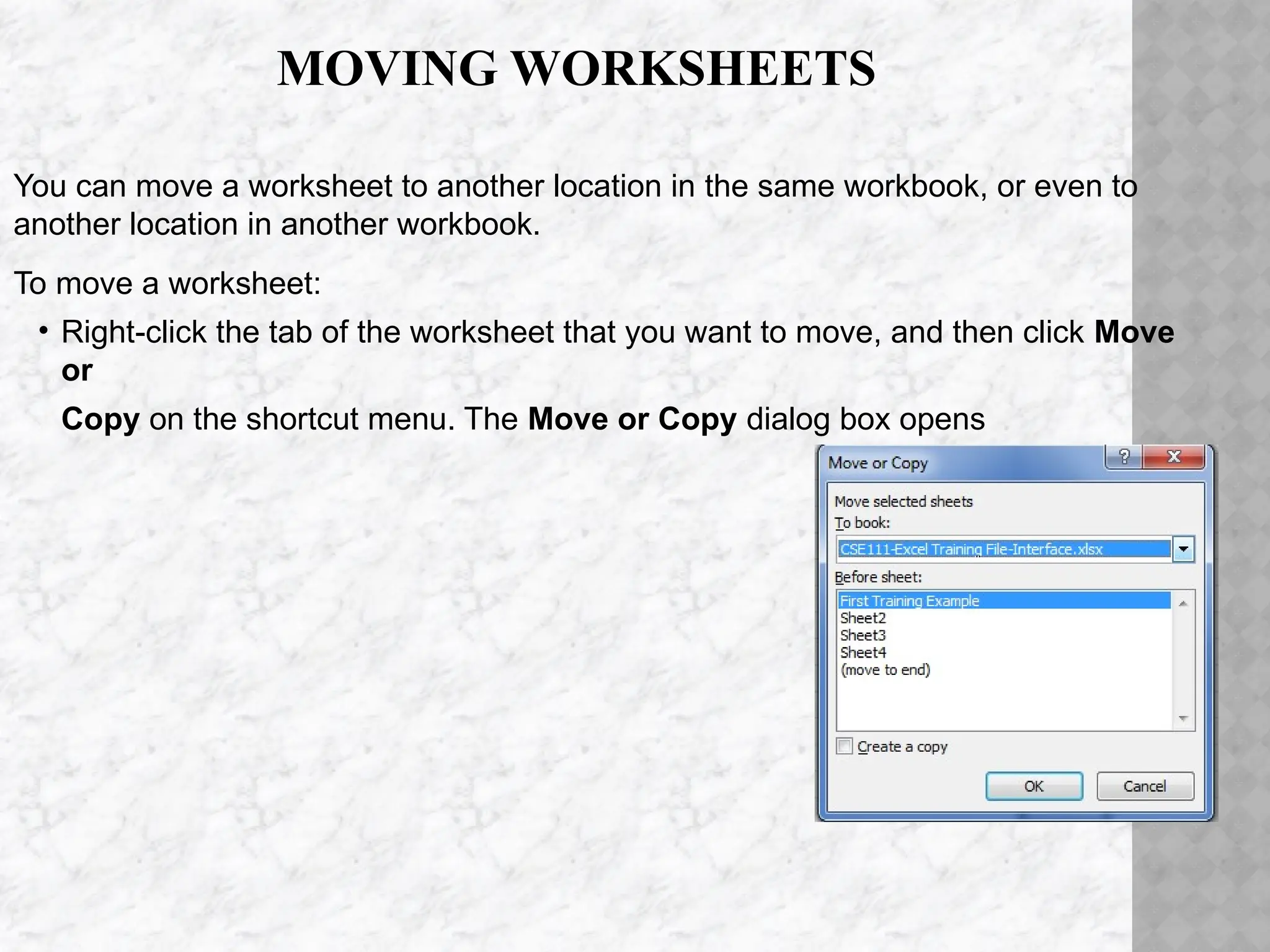
To move a worksheet:
• Right-click the tab of the worksheet that you want to move, and then click Move
or
Copy on the shortcut menu. The Move or Copy dialog box opens
70.
MOVING WORKSHEETS
You canmove a worksheet to another location in the same workbook, or even to
another location in another workbook.
To move a worksheet:
• Right-click the tab of the worksheet that you want to move, and then click Move
or
Copy on the shortcut menu. The Move or Copy dialog box opens
• In the To Book list menu select the name of the
destination workbook.
• In the Before sheet box, click the name of the
worksheet to the left of which you want the selected
worksheet to be moved.
• Click the OK button.
71.
MOVING WORKSHEETS
You canmove a worksheet to another location in the same workbook, or even to
another location in another workbook.
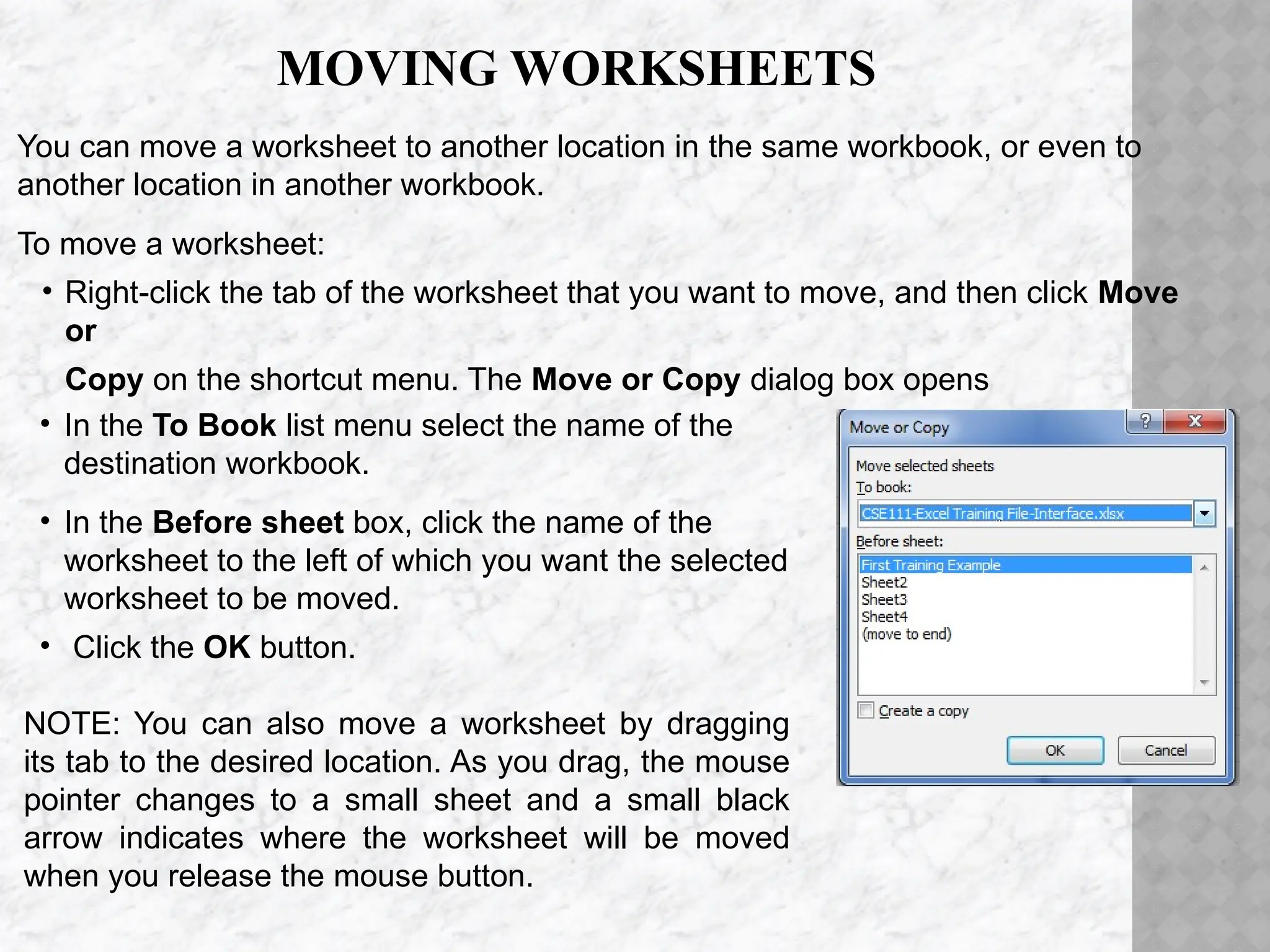
To move a worksheet:
• Right-click the tab of the worksheet that you want to move, and then click Move
or
Copy on the shortcut menu. The Move or Copy dialog box opens
• In the To Book list menu select the name of the
destination workbook.
• In the Before sheet box, click the name of the
worksheet to the left of which you want the selected
worksheet to be moved.
• Click the OK button.
NOTE: You can also move a worksheet by dragging
its tab to the desired location. As you drag, the mouse
pointer changes to a small sheet and a small black
arrow indicates where the worksheet will be moved
when you release the mouse button.
72.
COPYING WORKSHEETS
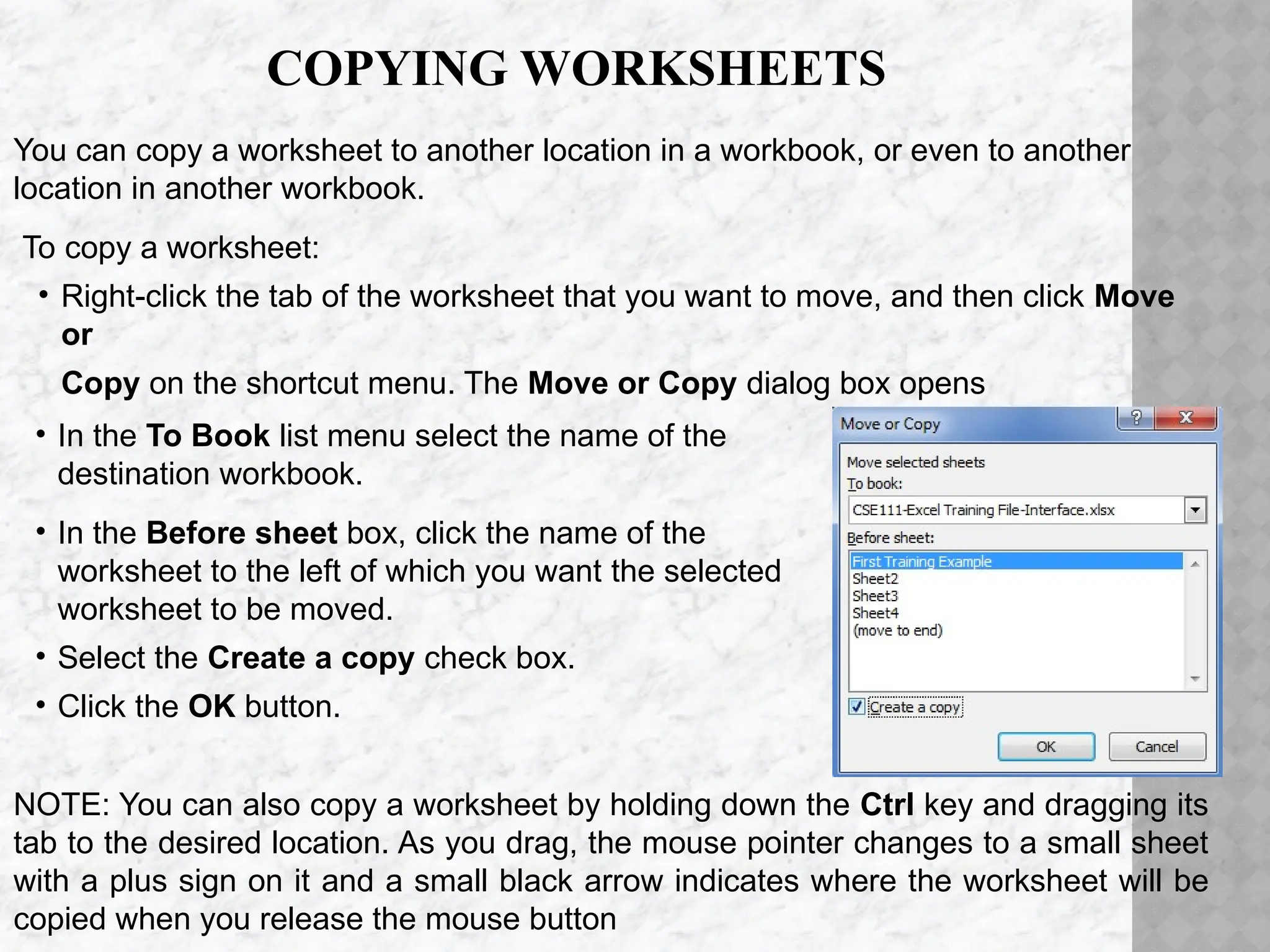
You cancopy a worksheet to another location in a workbook, or even to another
location in another workbook.
To copy a worksheet:
• Right-click the tab of the worksheet that you want to move, and then click Move
or
Copy on the shortcut menu. The Move or Copy dialog box opens
• In the To Book list menu select the name of the
destination workbook.
• In the Before sheet box, click the name of the
worksheet to the left of which you want the selected
worksheet to be moved.
• Select the Create a copy check box.
• Click the OK button.
NOTE: You can also copy a worksheet by holding down the Ctrl key and dragging its
tab to the desired location. As you drag, the mouse pointer changes to a small sheet
with a plus sign on it and a small black arrow indicates where the worksheet will be
copied when you release the mouse button
73.
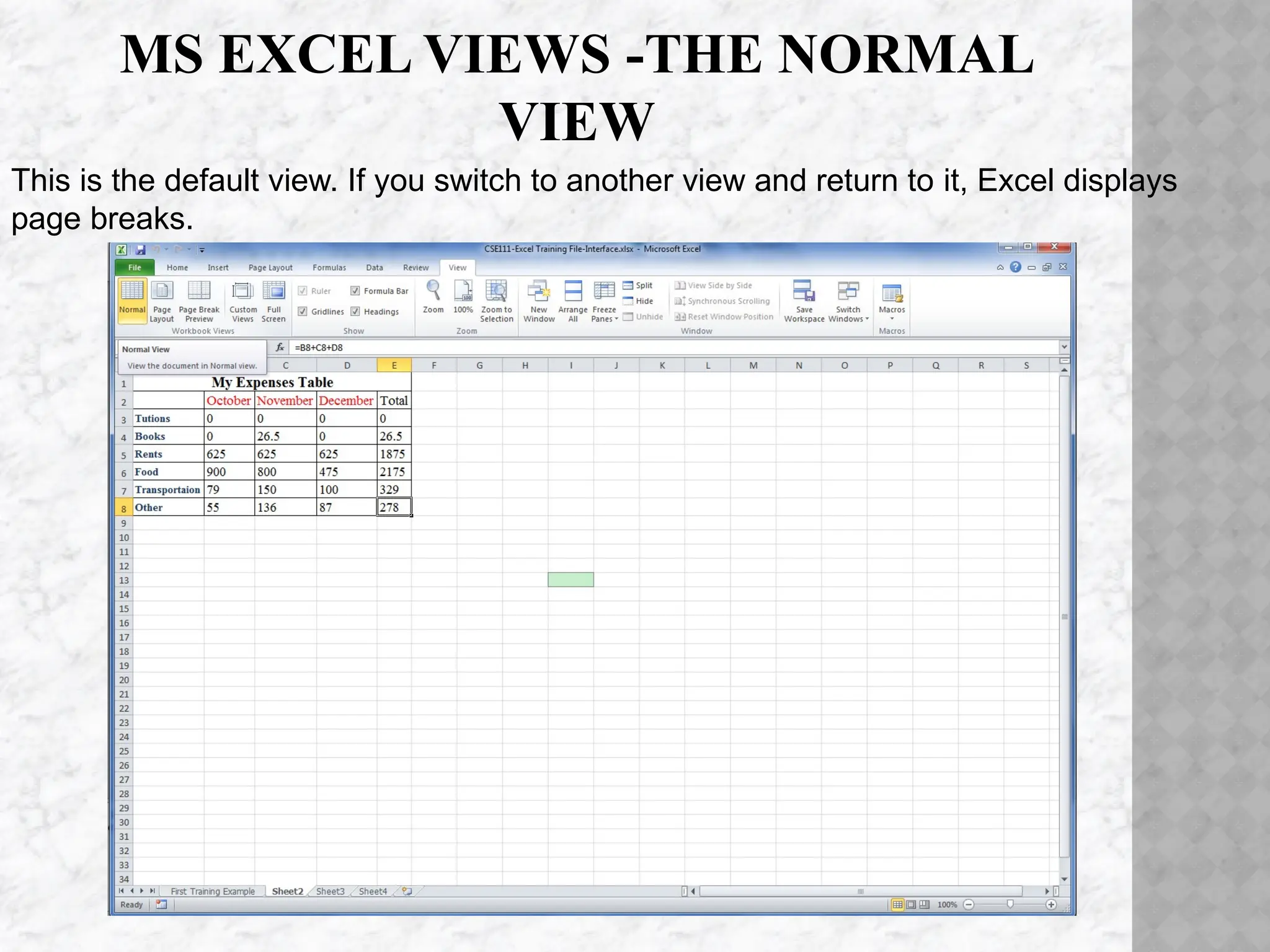
MS EXCEL VIEWS-THE NORMAL
VIEW
This is the default view. If you switch to another view and return to it, Excel displays
page breaks.
74.
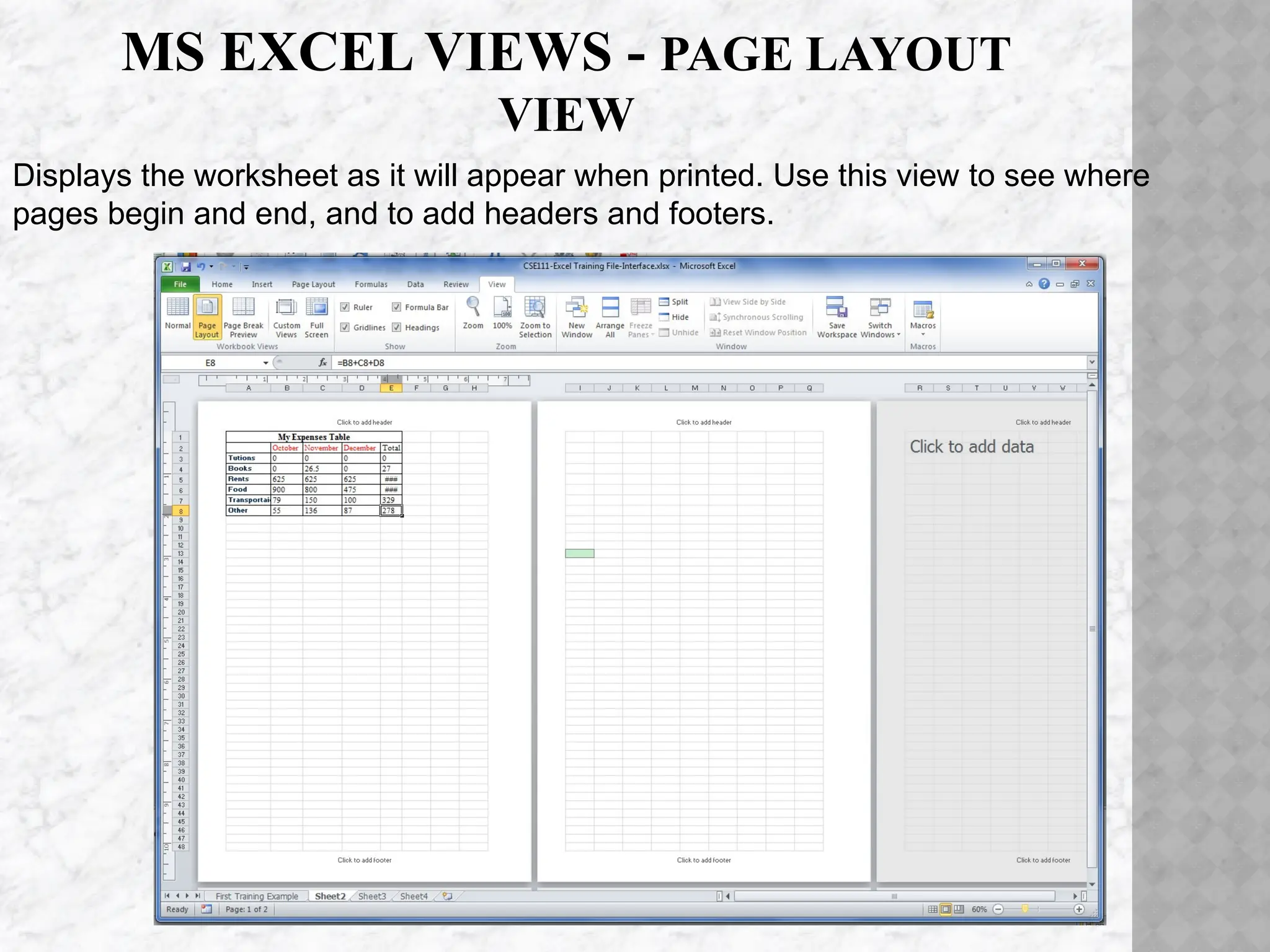
MS EXCEL VIEWS- PAGE LAYOUT
VIEW
Displays the worksheet as it will appear when printed. Use this view to see where
pages begin and end, and to add headers and footers.
75.
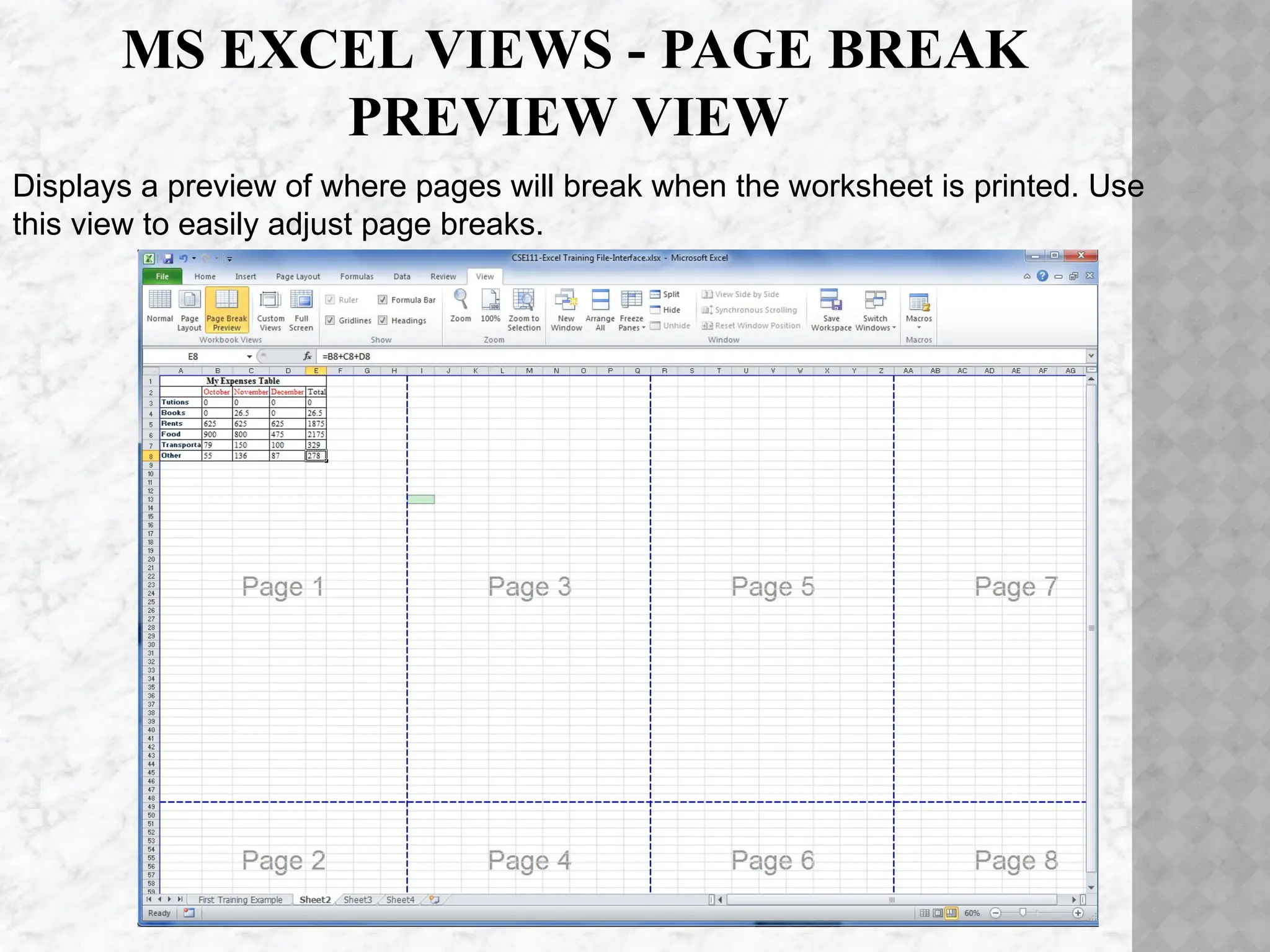
MS EXCEL VIEWS- PAGE BREAK
PREVIEW VIEW
Displays a preview of where pages will break when the worksheet is printed. Use
this view to easily adjust page breaks.
76.
MS EXCEL VIEWS- CUSTOM VIEWS
Allows you to save a set of display and print settings as a custom view, and then
apply it.
77.
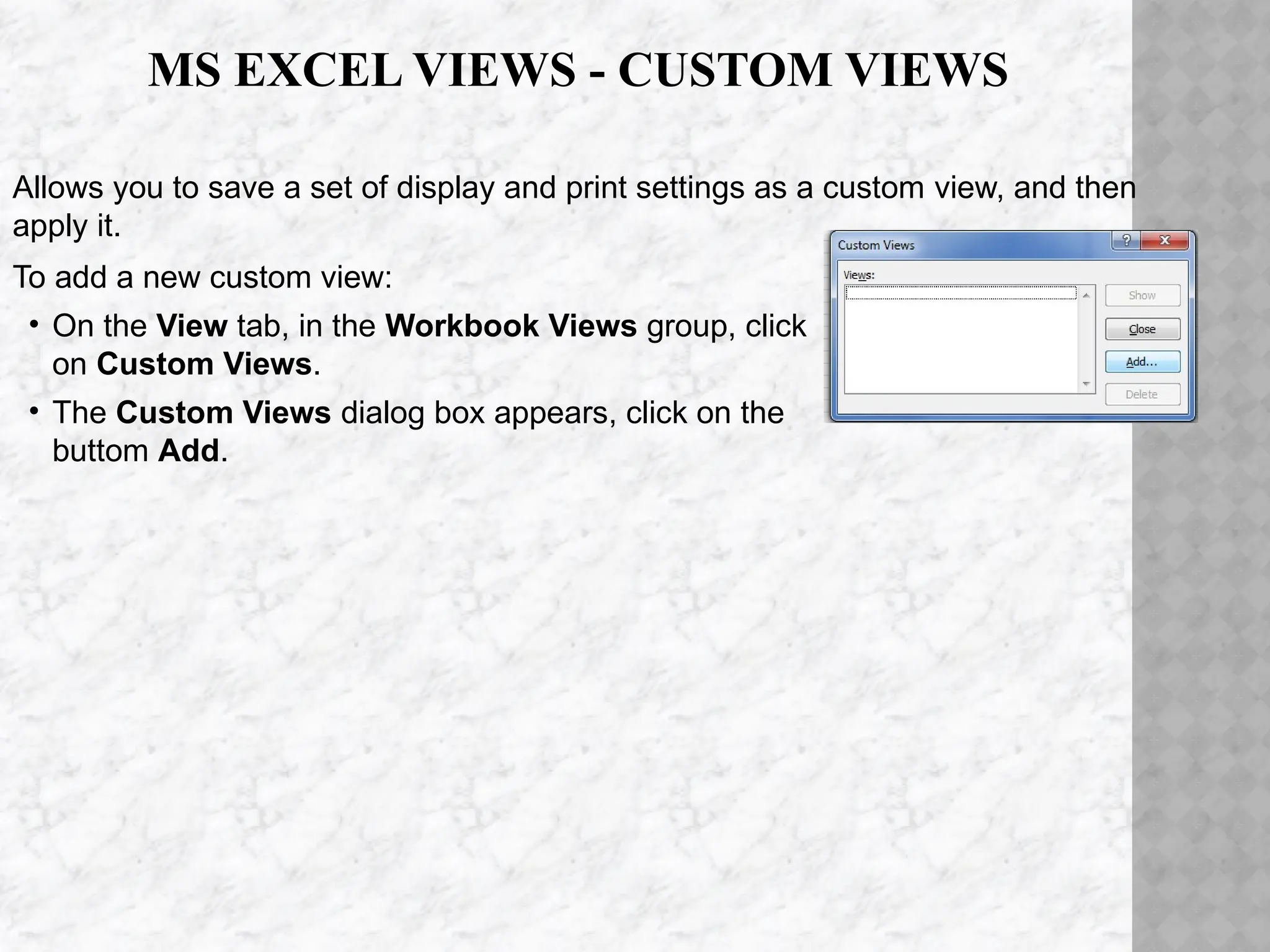
Allows you tosave a set of display and print settings as a custom view, and then
apply it.
To add a new custom view:
• On the View tab, in the Workbook Views group, click
on Custom Views.
• The Custom Views dialog box appears, click on the
buttom Add.
MS EXCEL VIEWS - CUSTOM VIEWS
78.
Allows you tosave a set of display and print settings as a custom view, and then
apply it.
To add a new custom view:
• On the View tab, in the Workbook Views group, click
on Custom Views.
• The Custom Views dialog box appears, click on the
buttom Add.
• The Add View dialog box appears, type a name for
the custom view, and then click OK
MS EXCEL VIEWS - CUSTOM VIEWS
79.
Allows you tosave a set of display and print settings as a custom view, and then
apply it.
To add a new custom view:
• On the View tab, in the Workbook Views group, click
on Custom Views.
• The Custom Views dialog box appears, click on the
buttom Add.
• The Add View dialog box appears, type a name for
the custom view, and then click OK
To apply an existing custom view, custom view:
• On the View tab, in the Workbook Views group, click
on Custom Views.
• The Custom Views dialog box appears, select the
view that you would to apply, then click on the buttom
Show.
MS EXCEL VIEWS - CUSTOM VIEWS
80.
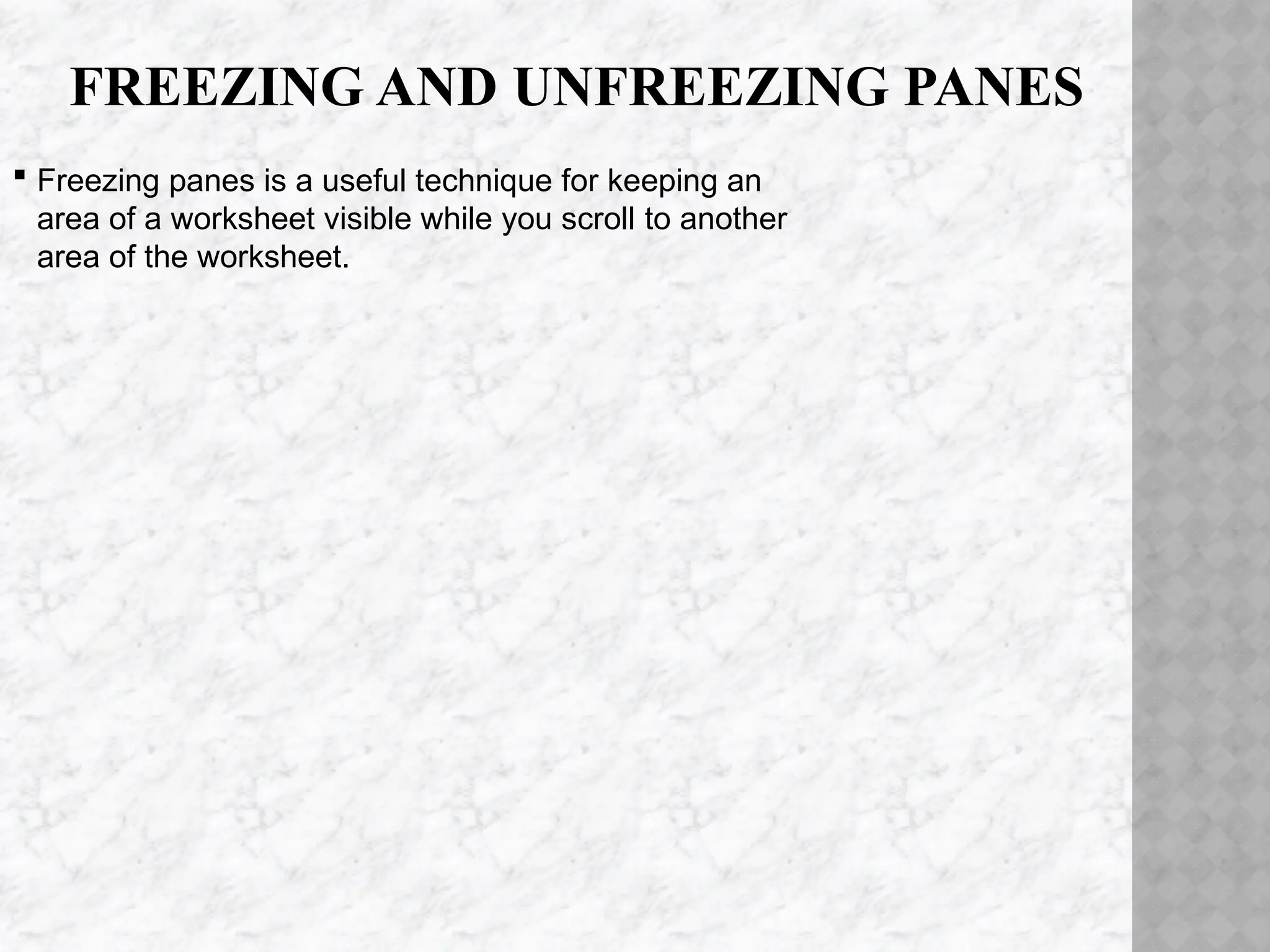
Displays the worksheetin full screen mode which hides the Ribbon, Formula bar,
and Status bar. You can exit the Full Screen view by pressing the Esc key.
MS EXCEL VIEWS – FULL SCREEN VIEW
81.
FREEZING AND UNFREEZINGPANES
Freezing panes is a useful technique for keeping an
area of a worksheet visible while you scroll to another
area of the worksheet.
82.
FREEZING AND UNFREEZINGPANES
Freezing panes is a useful technique for keeping an
area of a worksheet visible while you scroll to another
area of the worksheet.
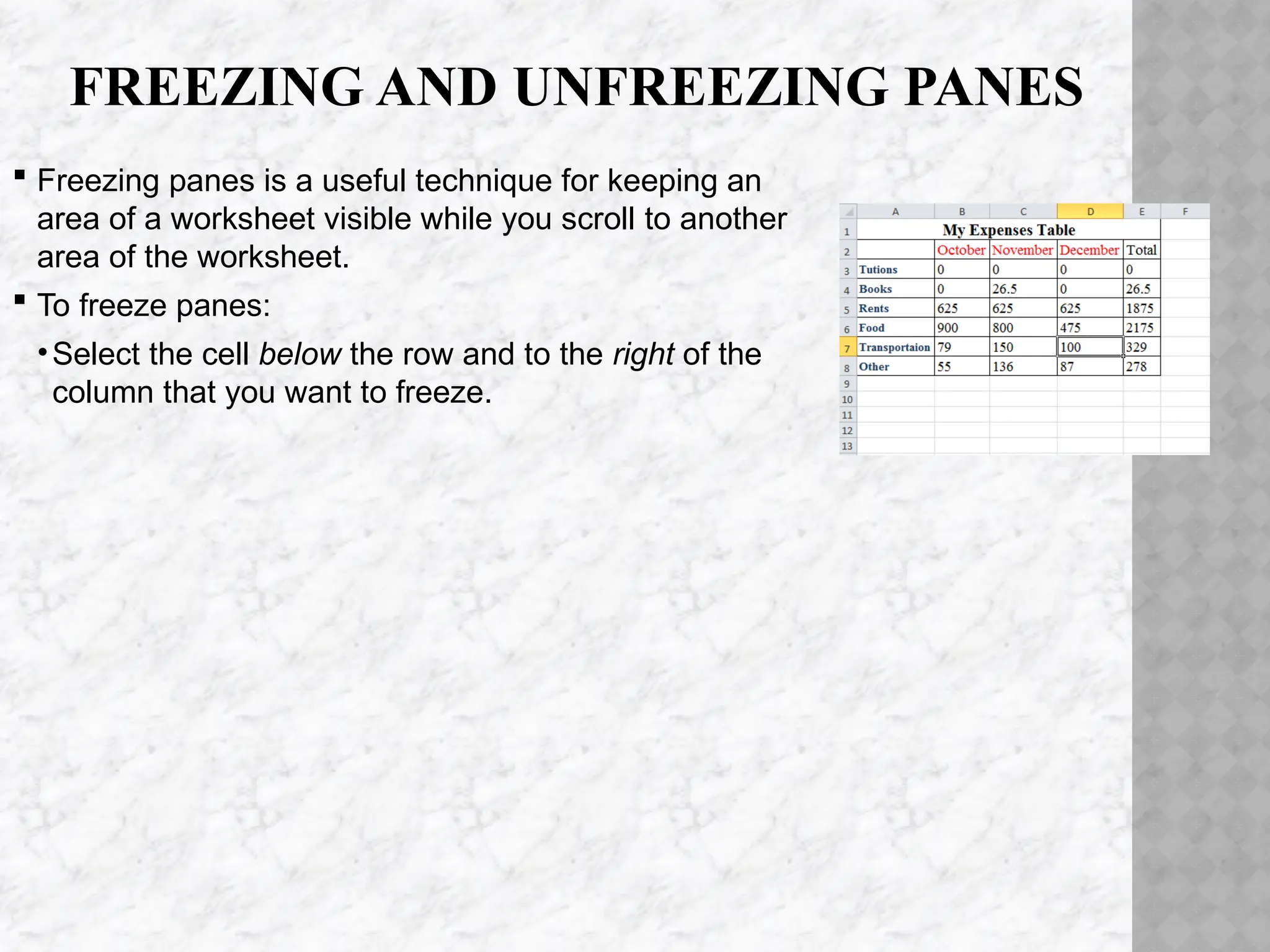
To freeze panes:
•Select the cell below the row and to the right of the
column that you want to freeze.
83.
FREEZING AND UNFREEZINGPANES
Freezing panes is a useful technique for keeping an
area of a worksheet visible while you scroll to another
area of the worksheet.
To freeze panes:
•Select the cell below the row and to the right of the
column that you want to freeze.
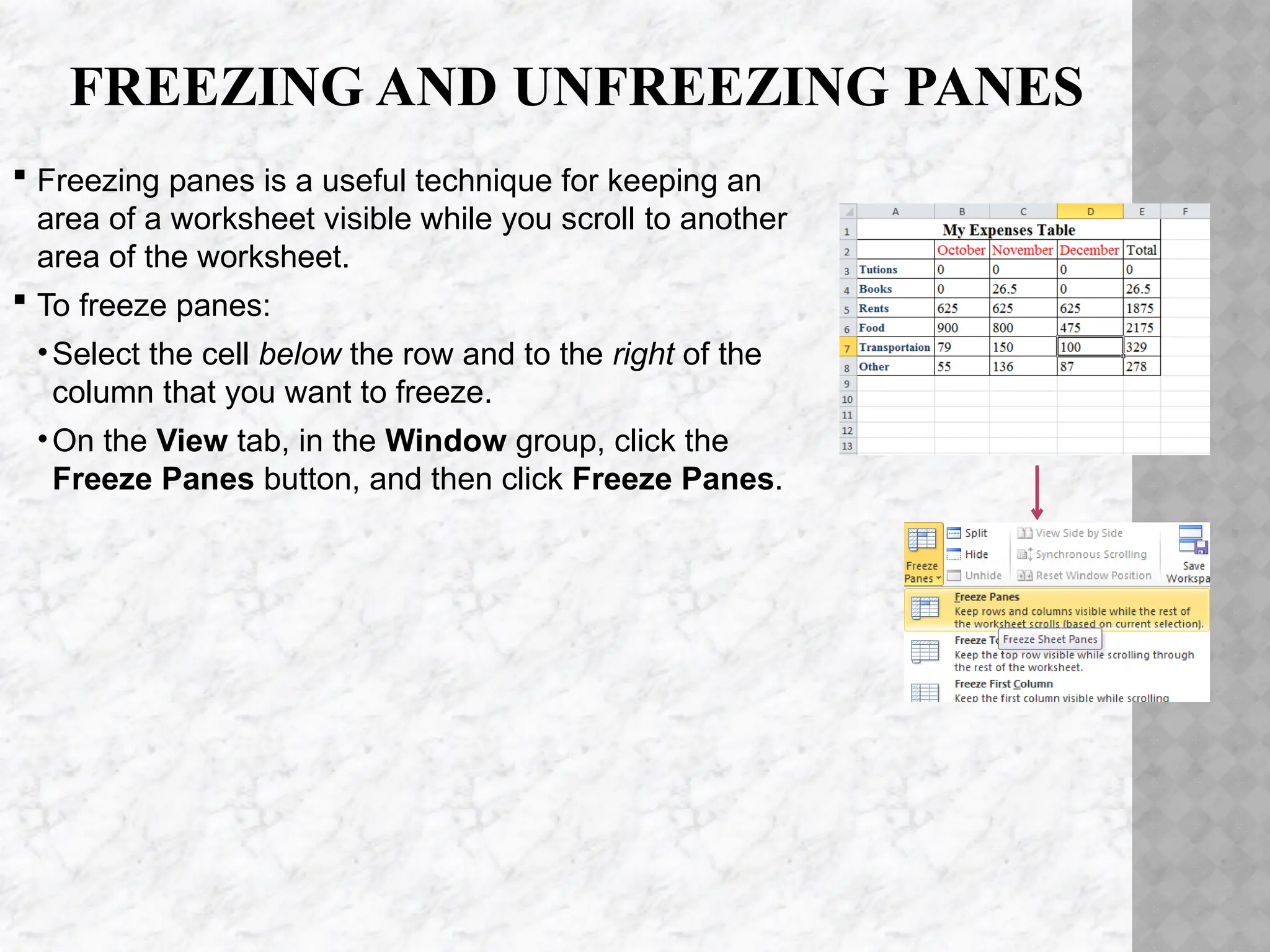
•On the View tab, in the Window group, click the
Freeze Panes button, and then click Freeze Panes.
84.
FREEZING AND UNFREEZINGPANES
Freezing panes is a useful technique for keeping an
area of a worksheet visible while you scroll to another
area of the worksheet.
To freeze panes:
•Select the cell below the row and to the right of the
column that you want to freeze.
•On the View tab, in the Window group, click the
Freeze Panes button, and then click Freeze Panes.
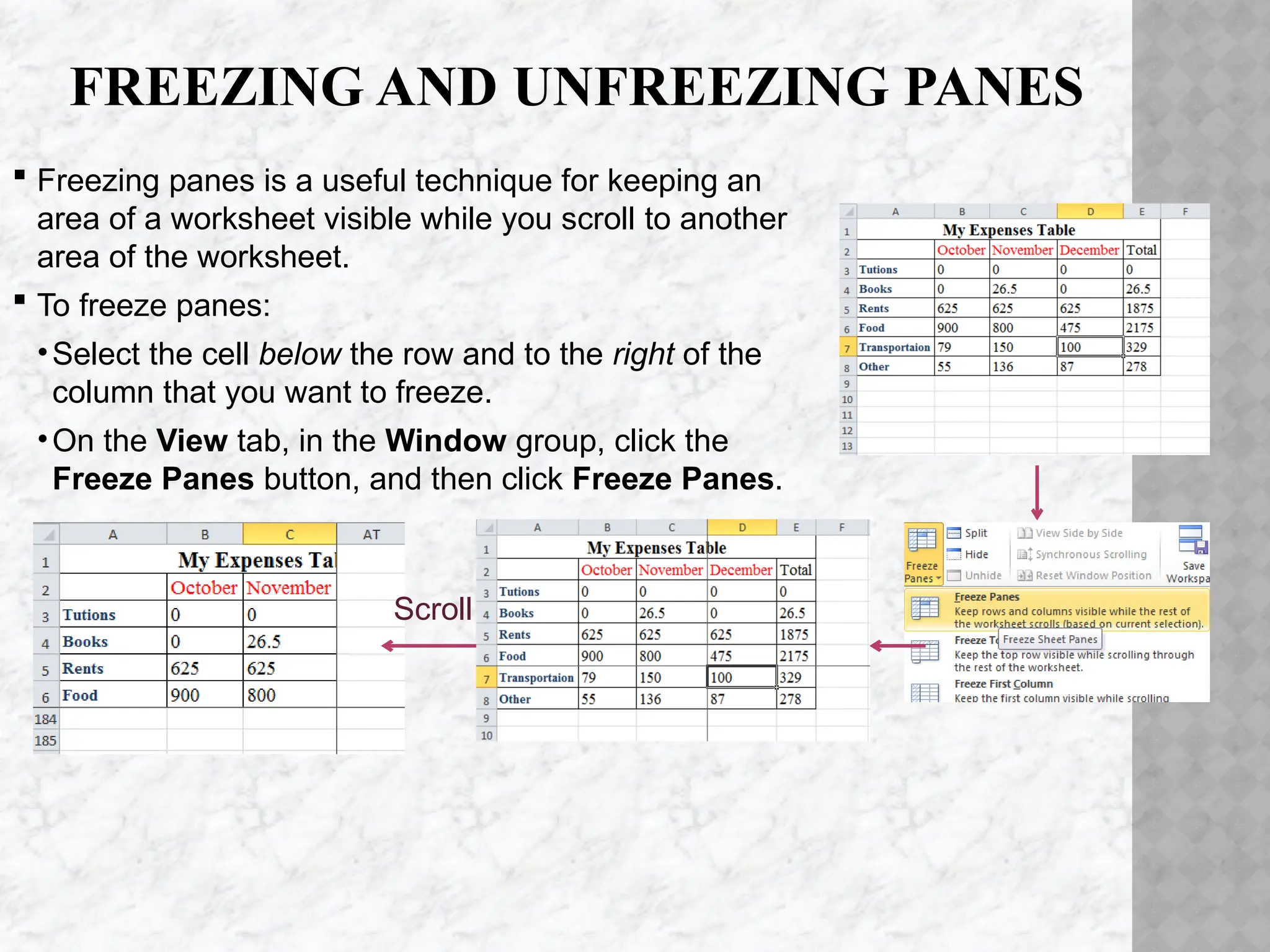
Scroll
85.
FREEZING AND UNFREEZINGPANES
Freezing panes is a useful technique for keeping an
area of a worksheet visible while you scroll to another
area of the worksheet.
To freeze panes:
•Select the cell below the row and to the right of the
column that you want to freeze.
•On the View tab, in the Window group, click the
Freeze Panes button, and then click Freeze Panes.
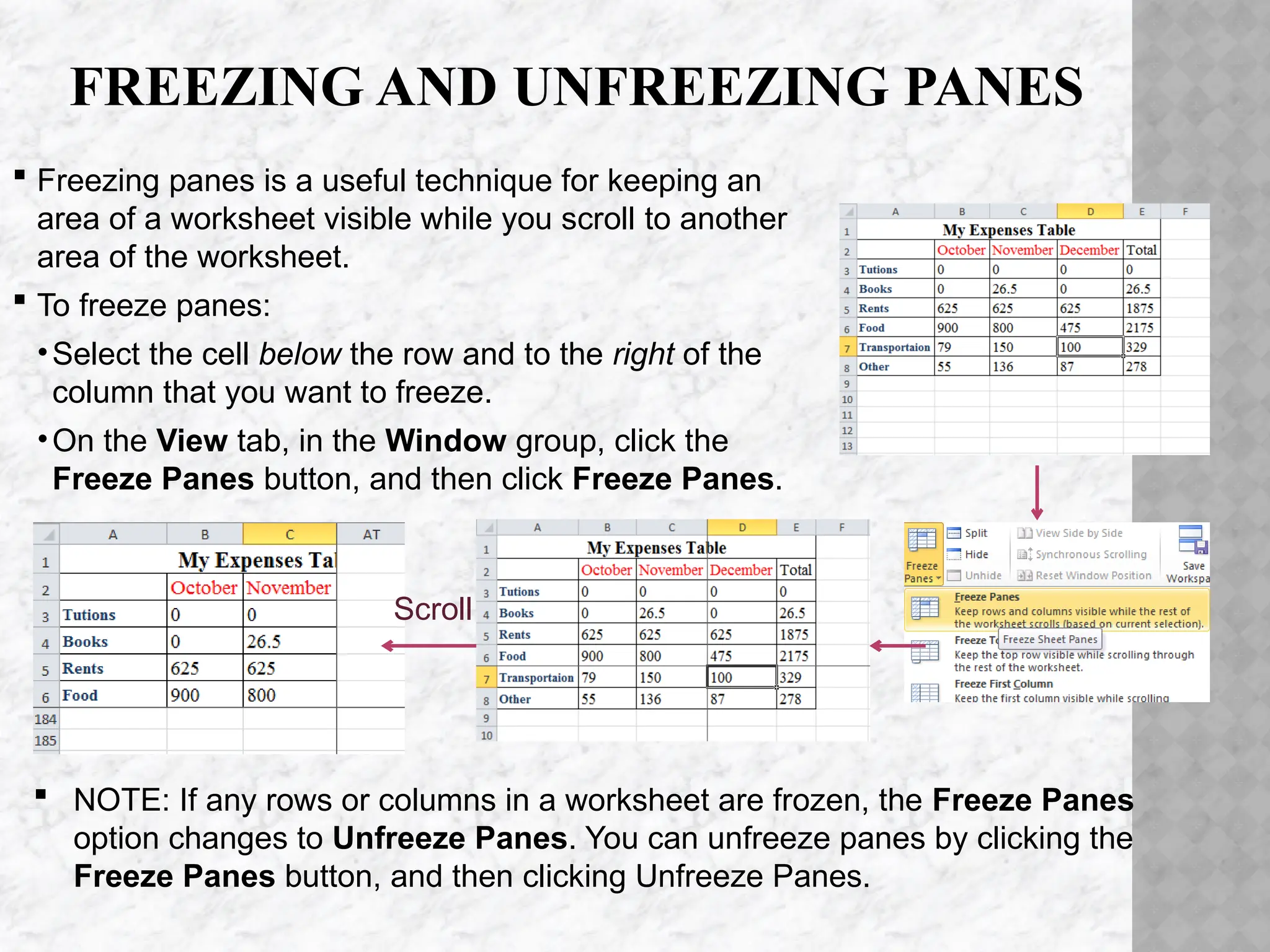
Scroll
NOTE: If any rows or columns in a worksheet are frozen, the Freeze Panes
option changes to Unfreeze Panes. You can unfreeze panes by clicking the
Freeze Panes button, and then clicking Unfreeze Panes.
86.
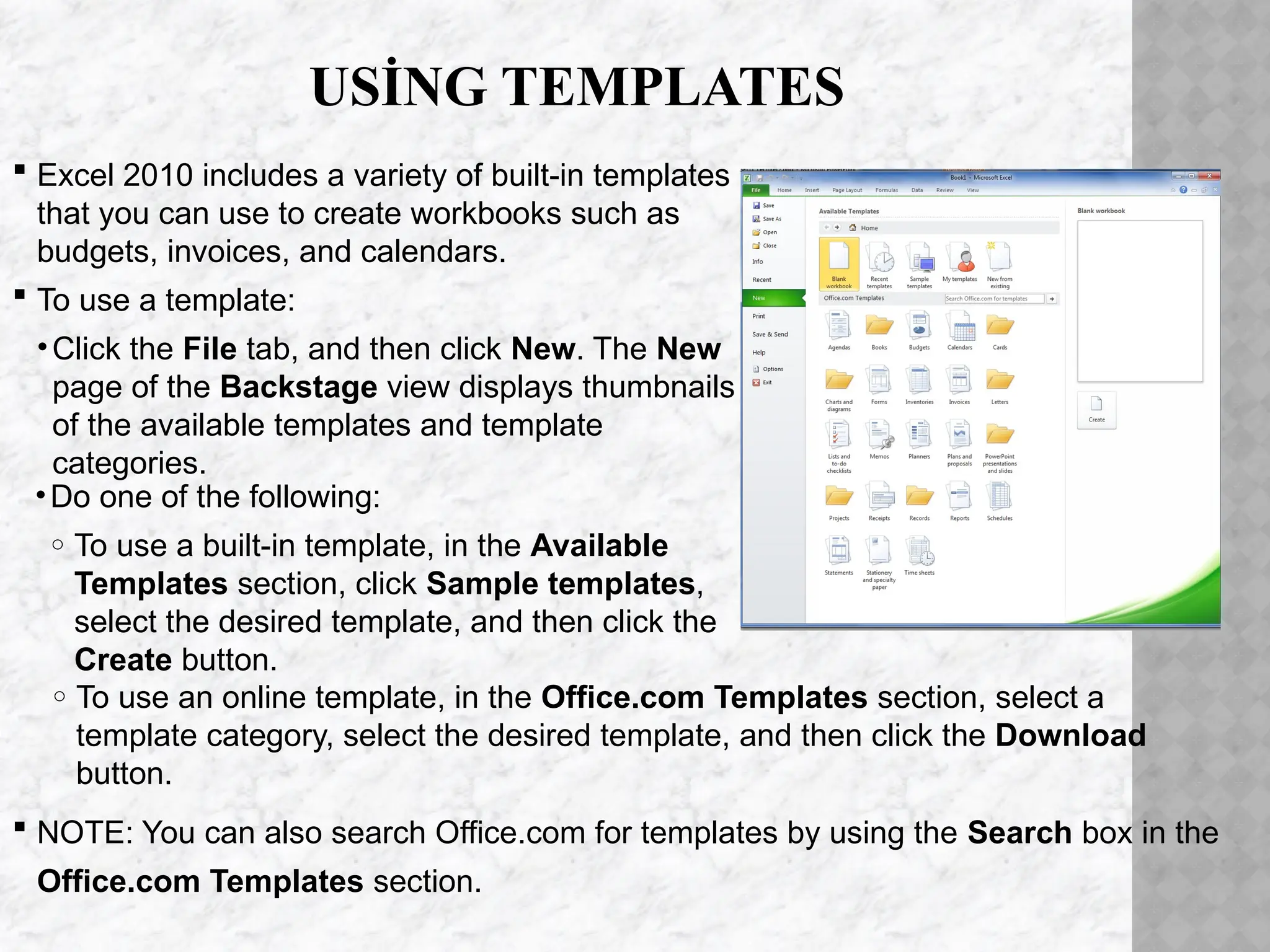
USİNG TEMPLATES
Excel2010 includes a variety of built-in templates
that you can use to create workbooks such as
budgets, invoices, and calendars.
To use a template:
•Click the File tab, and then click New. The New
page of the Backstage view displays thumbnails
of the available templates and template
categories.
•Do one of the following:
o To use a built-in template, in the Available
Templates section, click Sample templates,
select the desired template, and then click the
Create button.
o To use an online template, in the Office.com Templates section, select a
template category, select the desired template, and then click the Download
button.
NOTE: You can also search Office.com for templates by using the Search box in the
Office.com Templates section.
References
California StateUniversity, Los Angelos, Information Technology
Services, Microsoft Excel 2010 Part 1: Introduction to Excel.
http://www.calstatela.edu/sites/default/files/groups/Information
%20Technology%20Services/training/pdf/excel2010p1.pdf
California State University, Los Angelos, Information Technology
Services, Microsoft Excel 2010 Part 2: Intermediate.
http://www.calstatela.edu/sites/default/files/groups/Information
%20Technology%20Services/training/pdf/excel2010p2.pdf
Editor's Notes
#50 If a workbook contains many worksheets, all the worksheet tabs may not be visible. You can use
the tab scrolling buttons located at the bottom of the workbook window to display hidden tabs
#51 If a workbook contains many worksheets, all the worksheet tabs may not be visible. You can use
the tab scrolling buttons located at the bottom of the workbook window to display hidden tabs
#52 If a workbook contains many worksheets, all the worksheet tabs may not be visible. You can use
the tab scrolling buttons located at the bottom of the workbook window to display hidden tabs
#53 If a workbook contains many worksheets, all the worksheet tabs may not be visible. You can use
the tab scrolling buttons located at the bottom of the workbook window to display hidden tabs
#54 If a workbook contains many worksheets, all the worksheet tabs may not be visible. You can use
the tab scrolling buttons located at the bottom of the workbook window to display hidden tabs
#55 If a workbook contains many worksheets, all the worksheet tabs may not be visible. You can use
the tab scrolling buttons located at the bottom of the workbook window to display hidden tabs
#56 If a workbook contains many worksheets, all the worksheet tabs may not be visible. You can use
the tab scrolling buttons located at the bottom of the workbook window to display hidden tabs
#57 If a workbook contains many worksheets, all the worksheet tabs may not be visible. You can use
the tab scrolling buttons located at the bottom of the workbook window to display hidden tabs
#58 If a workbook contains many worksheets, all the worksheet tabs may not be visible. You can use
the tab scrolling buttons located at the bottom of the workbook window to display hidden tabs
#59 If a workbook contains many worksheets, all the worksheet tabs may not be visible. You can use
the tab scrolling buttons located at the bottom of the workbook window to display hidden tabs
#60 If a workbook contains many worksheets, all the worksheet tabs may not be visible. You can use
the tab scrolling buttons located at the bottom of the workbook window to display hidden tabs
#61 If a workbook contains many worksheets, all the worksheet tabs may not be visible. You can use
the tab scrolling buttons located at the bottom of the workbook window to display hidden tabs
#62 If a workbook contains many worksheets, all the worksheet tabs may not be visible. You can use
the tab scrolling buttons located at the bottom of the workbook window to display hidden tabs
#63 If a workbook contains many worksheets, all the worksheet tabs may not be visible. You can use
the tab scrolling buttons located at the bottom of the workbook window to display hidden tabs
#64 If a workbook contains many worksheets, all the worksheet tabs may not be visible. You can use
the tab scrolling buttons located at the bottom of the workbook window to display hidden tabs
#65 If a workbook contains many worksheets, all the worksheet tabs may not be visible. You can use
the tab scrolling buttons located at the bottom of the workbook window to display hidden tabs
#66 If a workbook contains many worksheets, all the worksheet tabs may not be visible. You can use
the tab scrolling buttons located at the bottom of the workbook window to display hidden tabs
#67 If a workbook contains many worksheets, all the worksheet tabs may not be visible. You can use
the tab scrolling buttons located at the bottom of the workbook window to display hidden tabs
#68 If a workbook contains many worksheets, all the worksheet tabs may not be visible. You can use
the tab scrolling buttons located at the bottom of the workbook window to display hidden tabs
#69 If a workbook contains many worksheets, all the worksheet tabs may not be visible. You can use
the tab scrolling buttons located at the bottom of the workbook window to display hidden tabs
#70 If a workbook contains many worksheets, all the worksheet tabs may not be visible. You can use
the tab scrolling buttons located at the bottom of the workbook window to display hidden tabs
#71 If a workbook contains many worksheets, all the worksheet tabs may not be visible. You can use
the tab scrolling buttons located at the bottom of the workbook window to display hidden tabs
#72 If a workbook contains many worksheets, all the worksheet tabs may not be visible. You can use
the tab scrolling buttons located at the bottom of the workbook window to display hidden tabs
#73 If a workbook contains many worksheets, all the worksheet tabs may not be visible. You can use
the tab scrolling buttons located at the bottom of the workbook window to display hidden tabs
#74 If a workbook contains many worksheets, all the worksheet tabs may not be visible. You can use
the tab scrolling buttons located at the bottom of the workbook window to display hidden tabs
#75 If a workbook contains many worksheets, all the worksheet tabs may not be visible. You can use
the tab scrolling buttons located at the bottom of the workbook window to display hidden tabs
#81 You can choose to freeze just the top row, just the left column, or multiple rows and columns of a worksheet. Excel displays thin black lines to indicate frozen rows and/or columns.
NOTE: You can freeze only rows at the top and columns on the left side of the worksheet; you cannot freeze rows and columns in the middle of the worksheet
#82 You can choose to freeze just the top row, just the left column, or multiple rows and columns of a worksheet. Excel displays thin black lines to indicate frozen rows and/or columns.
NOTE: You can freeze only rows at the top and columns on the left side of the worksheet; you cannot freeze rows and columns in the middle of the worksheet
#83 You can choose to freeze just the top row, just the left column, or multiple rows and columns of a worksheet. Excel displays thin black lines to indicate frozen rows and/or columns.
NOTE: You can freeze only rows at the top and columns on the left side of the worksheet; you cannot freeze rows and columns in the middle of the worksheet
#84 You can choose to freeze just the top row, just the left column, or multiple rows and columns of a worksheet. Excel displays thin black lines to indicate frozen rows and/or columns.
NOTE: You can freeze only rows at the top and columns on the left side of the worksheet; you cannot freeze rows and columns in the middle of the worksheet
#85 You can choose to freeze just the top row, just the left column, or multiple rows and columns of a worksheet. Excel displays thin black lines to indicate frozen rows and/or columns.
NOTE: You can freeze only rows at the top and columns on the left side of the worksheet; you cannot freeze rows and columns in the middle of the worksheet
#86 Templates include predefined layouts and styles, as well as labels, graphics, formulas, or other content that you can modify to meet your needs.