Group Members
Saurabh
Sayli
Khushbu
Yuvraj
Nilesh
Sohail
Nitul
MATERIAL MANAGEMENT
Introduction
What do you mean by the
term “Material”?
Introduction
Material is the central item & activity of any organization.
An Organization exists & works for material.
The main purpose of any organization is to make profit
which gets generated due to material.
The International Materials Management Society takes a
lead role in looking after activities in this field.
The Indian Institute of Material Management is working to
promote excellence in Material Management in India.
Organizationof Materials
The Materials department is generally having
following subsections:
• Office & Administration activities.
• Purchase.
• Receiving the incoming material.
• Stores & Warehousing.
• Transport & internal material movement.
• Dispatching the semi-finished & finished
materials.
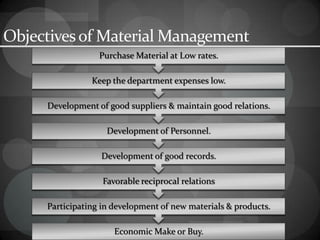
Objectivesof Material Management
Economic Make or Buy.
Participating in development of new materials & products.
Favorable reciprocal relations
Development of good records.
Development of Personnel.
Development of good suppliers & maintain good relations.
Keep the department expenses low.
Purchase Material at Low rates.
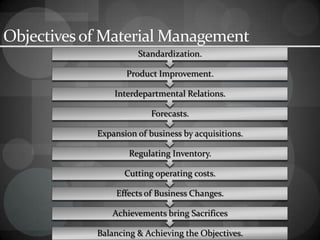
Objectivesof Material Management
Balancing & Achieving the Objectives.
Achievements bring Sacrifices
Effects of Business Changes.
Cutting operating costs.
Regulating Inventory.
Expansion of business by acquisitions.
Forecasts.
Interdepartmental Relations.
Product Improvement.
Standardization.
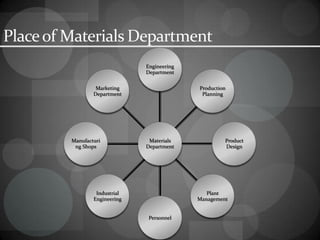
Placeof Materials Department
Materials
Department
Engineering
Department
Production
Planning
Product
Design
Plant
Management
Personnel
Industrial
Engineering
Manufacturi
ng Shops
Marketing
Department
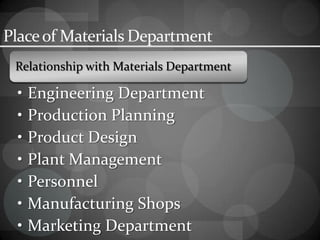
Placeof Materials Department
Relationship with Materials Department
• Engineering Department
• Production Planning
• Product Design
• Plant Management
• Personnel
• Manufacturing Shops
• Marketing Department
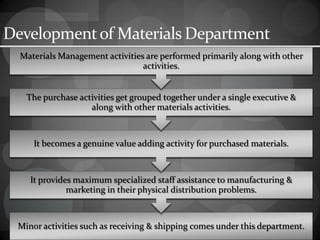
Developmentof Materials Department
Minor activities such as receiving & shipping comes under this department.
It provides maximum specialized staff assistance to manufacturing &
marketing in their physical distribution problems.
It becomes a genuine value adding activity for purchased materials.
The purchase activities get grouped together under a single executive &
along with other materials activities.
Materials Management activities are performed primarily along with other
activities.
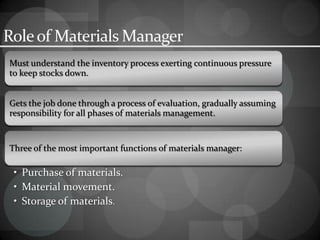
Roleof Materials Manager
Must understand the inventory process exerting continuous pressure
to keep stocks down.
Gets the job done through a process of evaluation, gradually assuming
responsibility for all phases of materials management.
Three of the most important functions of materials manager:
• Purchase of materials.
• Material movement.
• Storage of materials.
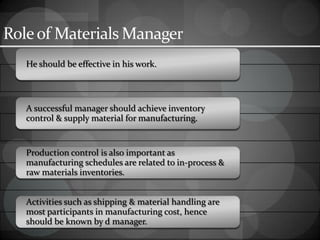
Roleof Materials Manager
He should be effective in his work.
A successful manager should achieve inventory
control & supply material for manufacturing.
Production control is also important as
manufacturing schedules are related to in-process &
raw materials inventories.
Activities such as shipping & material handling are
most participants in manufacturing cost, hence
should be known by d manager.
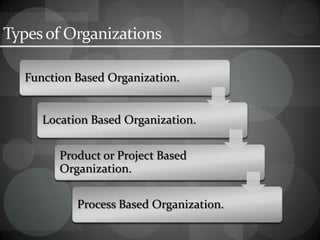
Typesof Organizations
Function Based Organization.
Location Based Organization.
Product or Project Based
Organization.
Process Based Organization.
Typesof Organizations
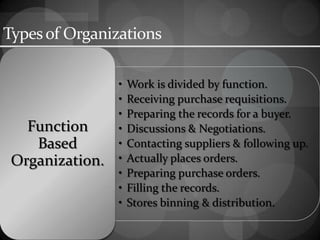
• Work is divided by function.
• Receiving purchase requisitions.
• Preparing the records for a buyer.
• Discussions & Negotiations.
• Contacting suppliers & following up.
• Actually places orders.
• Preparing purchase orders.
• Filling the records.
• Stores binning & distribution.
Function
Based
Organization.
Typesof Organizations
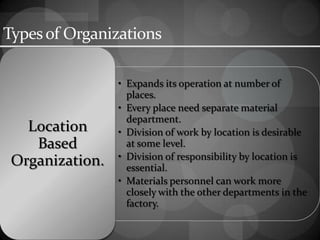
• Expands its operation at number of
places.
• Every place need separate material
department.
• Division of work by location is desirable
at some level.
• Division of responsibility by location is
essential.
• Materials personnel can work more
closely with the other departments in the
factory.
Location
Based
Organization.
Typesof Organizations
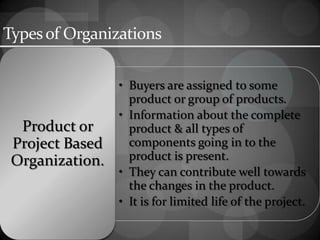
• Buyers are assigned to some
product or group of products.
• Information about the complete
product & all types of
components going in to the
product is present.
• They can contribute well towards
the changes in the product.
• It is for limited life of the project.
Product or
Project Based
Organization.
Typesof Organizations
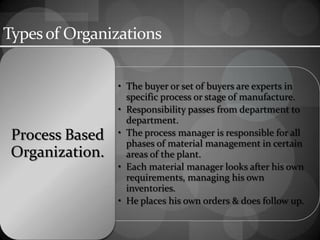
• The buyer or set of buyers are experts in
specific process or stage of manufacture.
• Responsibility passes from department to
department.
• The process manager is responsible for all
phases of material management in certain
areas of the plant.
• Each material manager looks after his own
requirements, managing his own
inventories.
• He places his own orders & does follow up.
Process Based
Organization.
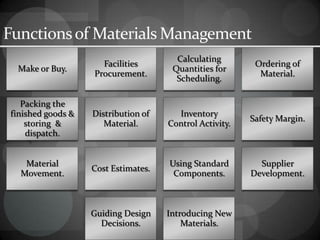
Functionsof Materials Management
Make or Buy.
Facilities
Procurement.
Calculating
Quantities for
Scheduling.
Ordering of
Material.
Packing the
finished goods &
storing &
dispatch.
Distribution of
Material.
Inventory
Control Activity.
Safety Margin.
Material
Movement.
Cost Estimates.
Using Standard
Components.
Supplier
Development.
Guiding Design
Decisions.
Introducing New
Materials.
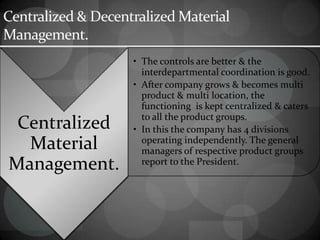
Centralized & Decentralized Material
Management.
Centralized
Material
Management.
• The controls are better & the
interdepartmental coordination is good.
• After company grows & becomes multi
product & multi location, the
functioning is kept centralized & caters
to all the product groups.
• In this the company has 4 divisions
operating independently. The general
managers of respective product groups
report to the President.
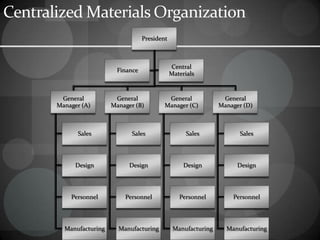
Centralized Materials Organization
President
General
Manager (A)
Sales
Design
Personnel
Manufacturing
General
Manager (B)
Sales
Design
Personnel
Manufacturing
General
Manager (C)
Sales
Design
Personnel
Manufacturing
General
Manager (D)
Sales
Design
Personnel
Manufacturing
Finance
Central
Materials
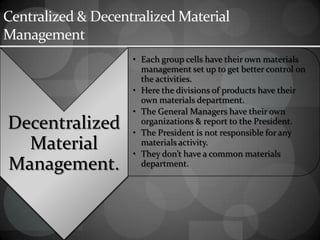
Centralized & Decentralized Material
Management
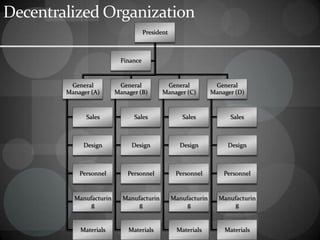
Decentralized
Material
Management.
• Each group cells have their own materials
management set up to get better control on
the activities.
• Here the divisions of products have their
own materials department.
• The General Managers have their own
organizations & report to the President.
• The President is not responsible for any
materials activity.
• They don’t have a common materials
department.
Decentralized Organization
President
General
Manager (A)
Sales
Design
Personnel
Manufacturin
g
Materials
General
Manager (B)
Sales
Design
Personnel
Manufacturin
g
Materials
General
Manager (C)
Sales
Design
Personnel
Manufacturin
g
Materials
General
Manager (D)
Sales
Design
Personnel
Manufacturin
g
Materials
Finance
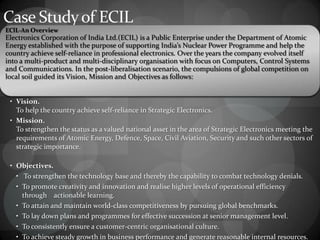
Case Studyof ECIL
EClL-An Overview
Electronics Corporation of India Ltd.(ECIL) is a Public Enterprise under the Department of Atomic
Energy established with the purpose of supporting India’s Nuclear Power Programme and help the
country achieve self-reliance in professional electronics. Over the years the company evolved itself
into a multi-product and multi-disciplinary organisation with focus on Computers, Control Systems
and Communications. In the post-liberalisation scenario, the compulsions of global competition on
local soil guided its Vision, Mission and Objectives as follows:
• Vision.
To help the country achieve self-reliance in Strategic Electronics.
• Mission.
To strengthen the status as a valued national asset in the area of Strategic Electronics meeting the
requirements of Atomic Energy, Defence, Space, Civil Aviation, Security and such other sectors of
strategic importance.
• Objectives.
• To strengthen the technology base and thereby the capability to combat technology denials.
• To promote creativity and innovation and realise higher levels of operational efficiency
through actionable learning.
• To attain and maintain world-class competitiveness by pursuing global benchmarks.
• To lay down plans and programmes for effective succession at senior management level.
• To consistently ensure a customer-centric organisational culture.
• To achieve steady growth in business performance and generate reasonable internal resources.
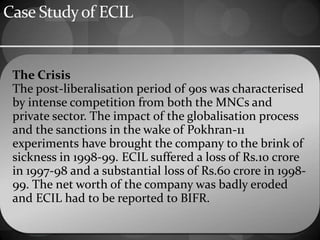
Case Studyof ECIL
The Crisis
The post-liberalisation period of 90s was characterised
by intense competition from both the MNCs and
private sector. The impact of the globalisation process
and the sanctions in the wake of Pokhran-11
experiments have brought the company to the brink of
sickness in 1998-99. ECIL suffered a loss of Rs.10 crore
in 1997-98 and a substantial loss of Rs.60 crore in 1998-
99. The net worth of the company was badly eroded
and ECIL had to be reported to BIFR.
Video Of Firto lay. (Lays)
Lays Commercial
Thank You

Material management

  • 1.
  • 2.
    Introduction What do youmean by the term “Material”?
  • 3.
    Introduction Material is thecentral item & activity of any organization. An Organization exists & works for material. The main purpose of any organization is to make profit which gets generated due to material. The International Materials Management Society takes a lead role in looking after activities in this field. The Indian Institute of Material Management is working to promote excellence in Material Management in India.
  • 4.
    Organizationof Materials The Materialsdepartment is generally having following subsections: • Office & Administration activities. • Purchase. • Receiving the incoming material. • Stores & Warehousing. • Transport & internal material movement. • Dispatching the semi-finished & finished materials.
  • 5.
    Objectivesof Material Management EconomicMake or Buy. Participating in development of new materials & products. Favorable reciprocal relations Development of good records. Development of Personnel. Development of good suppliers & maintain good relations. Keep the department expenses low. Purchase Material at Low rates.
  • 6.
    Objectivesof Material Management Balancing& Achieving the Objectives. Achievements bring Sacrifices Effects of Business Changes. Cutting operating costs. Regulating Inventory. Expansion of business by acquisitions. Forecasts. Interdepartmental Relations. Product Improvement. Standardization.
  • 7.
  • 8.
    Placeof Materials Department Relationshipwith Materials Department • Engineering Department • Production Planning • Product Design • Plant Management • Personnel • Manufacturing Shops • Marketing Department
  • 9.
    Developmentof Materials Department Minoractivities such as receiving & shipping comes under this department. It provides maximum specialized staff assistance to manufacturing & marketing in their physical distribution problems. It becomes a genuine value adding activity for purchased materials. The purchase activities get grouped together under a single executive & along with other materials activities. Materials Management activities are performed primarily along with other activities.
  • 10.
    Roleof Materials Manager Mustunderstand the inventory process exerting continuous pressure to keep stocks down. Gets the job done through a process of evaluation, gradually assuming responsibility for all phases of materials management. Three of the most important functions of materials manager: • Purchase of materials. • Material movement. • Storage of materials.
  • 11.
    Roleof Materials Manager Heshould be effective in his work. A successful manager should achieve inventory control & supply material for manufacturing. Production control is also important as manufacturing schedules are related to in-process & raw materials inventories. Activities such as shipping & material handling are most participants in manufacturing cost, hence should be known by d manager.
  • 12.
    Typesof Organizations Function BasedOrganization. Location Based Organization. Product or Project Based Organization. Process Based Organization.
  • 13.
    Typesof Organizations • Workis divided by function. • Receiving purchase requisitions. • Preparing the records for a buyer. • Discussions & Negotiations. • Contacting suppliers & following up. • Actually places orders. • Preparing purchase orders. • Filling the records. • Stores binning & distribution. Function Based Organization.
  • 14.
    Typesof Organizations • Expandsits operation at number of places. • Every place need separate material department. • Division of work by location is desirable at some level. • Division of responsibility by location is essential. • Materials personnel can work more closely with the other departments in the factory. Location Based Organization.
  • 15.
    Typesof Organizations • Buyersare assigned to some product or group of products. • Information about the complete product & all types of components going in to the product is present. • They can contribute well towards the changes in the product. • It is for limited life of the project. Product or Project Based Organization.
  • 16.
    Typesof Organizations • Thebuyer or set of buyers are experts in specific process or stage of manufacture. • Responsibility passes from department to department. • The process manager is responsible for all phases of material management in certain areas of the plant. • Each material manager looks after his own requirements, managing his own inventories. • He places his own orders & does follow up. Process Based Organization.
  • 17.
    Functionsof Materials Management Makeor Buy. Facilities Procurement. Calculating Quantities for Scheduling. Ordering of Material. Packing the finished goods & storing & dispatch. Distribution of Material. Inventory Control Activity. Safety Margin. Material Movement. Cost Estimates. Using Standard Components. Supplier Development. Guiding Design Decisions. Introducing New Materials.
  • 18.
    Centralized & DecentralizedMaterial Management. Centralized Material Management. • The controls are better & the interdepartmental coordination is good. • After company grows & becomes multi product & multi location, the functioning is kept centralized & caters to all the product groups. • In this the company has 4 divisions operating independently. The general managers of respective product groups report to the President.
  • 19.
    Centralized Materials Organization President General Manager(A) Sales Design Personnel Manufacturing General Manager (B) Sales Design Personnel Manufacturing General Manager (C) Sales Design Personnel Manufacturing General Manager (D) Sales Design Personnel Manufacturing Finance Central Materials
  • 20.
    Centralized & DecentralizedMaterial Management Decentralized Material Management. • Each group cells have their own materials management set up to get better control on the activities. • Here the divisions of products have their own materials department. • The General Managers have their own organizations & report to the President. • The President is not responsible for any materials activity. • They don’t have a common materials department.
  • 21.
    Decentralized Organization President General Manager (A) Sales Design Personnel Manufacturin g Materials General Manager(B) Sales Design Personnel Manufacturin g Materials General Manager (C) Sales Design Personnel Manufacturin g Materials General Manager (D) Sales Design Personnel Manufacturin g Materials Finance
  • 22.
    Case Studyof ECIL EClL-AnOverview Electronics Corporation of India Ltd.(ECIL) is a Public Enterprise under the Department of Atomic Energy established with the purpose of supporting India’s Nuclear Power Programme and help the country achieve self-reliance in professional electronics. Over the years the company evolved itself into a multi-product and multi-disciplinary organisation with focus on Computers, Control Systems and Communications. In the post-liberalisation scenario, the compulsions of global competition on local soil guided its Vision, Mission and Objectives as follows: • Vision. To help the country achieve self-reliance in Strategic Electronics. • Mission. To strengthen the status as a valued national asset in the area of Strategic Electronics meeting the requirements of Atomic Energy, Defence, Space, Civil Aviation, Security and such other sectors of strategic importance. • Objectives. • To strengthen the technology base and thereby the capability to combat technology denials. • To promote creativity and innovation and realise higher levels of operational efficiency through actionable learning. • To attain and maintain world-class competitiveness by pursuing global benchmarks. • To lay down plans and programmes for effective succession at senior management level. • To consistently ensure a customer-centric organisational culture. • To achieve steady growth in business performance and generate reasonable internal resources.
  • 23.
    Case Studyof ECIL TheCrisis The post-liberalisation period of 90s was characterised by intense competition from both the MNCs and private sector. The impact of the globalisation process and the sanctions in the wake of Pokhran-11 experiments have brought the company to the brink of sickness in 1998-99. ECIL suffered a loss of Rs.10 crore in 1997-98 and a substantial loss of Rs.60 crore in 1998- 99. The net worth of the company was badly eroded and ECIL had to be reported to BIFR.
  • 24.
    Video Of Firtolay. (Lays)
  • 25.
  • 26.