MRI TISSUE
SEGMENTATION
1
Presentation by:
Pooja G N
CONTENTS
 Image
 Image processing
 MRI
 MRI tissue segmentation
 Segmentation methods
 Bias field
 Bias field correction methods
 Inhomogeneties
 Energy minimization
 K-means algorithm
 Related work
2
Image
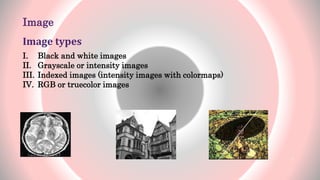
Image types
I. Black and white images
II. Grayscale or intensity images
III. Indexed images (intensity images with colormaps)
IV. RGB or truecolor images
3
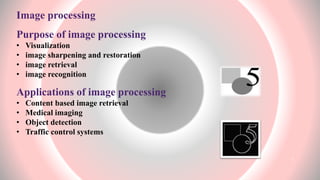
Image processing
Purpose of image processing
• Visualization
• image sharpening and restoration
• image retrieval
• image recognition
Applications of image processing
• Content based image retrieval
• Medical imaging
• Object detection
• Traffic control systems
4
Magnetic Resonance Image[MRI]
It is a tomographic imaging technique that produces images of internal
physical and chemical characteristics of an object from externally measured
nuclear magnetic resonance(NMR) signals.
Applications of MRI
• Diagnosing multiple sclerosis, brain tumours, spinal infections and
strokes in their earliest stages.
• Visualizing torn ligaments in the wrist, knee, and ankle, shoulder injuries.
• Evaluating bone tumors and herniated discs in the spine .
5
Limitations of MRI
• Machine makes a very loud continuous hammering noise when
operating.
• Extreme precautions must be taken to keep metallic objects out of
the room where the machine is operating.
• MRI system are expensive to buy and run.
• People with pacemakers can’t safely be scanned.
• MRI scans require patients to hold very still for long periods of
time up to 90 minutes.
6
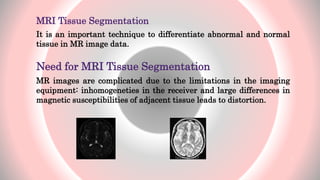
MRI Tissue Segmentation
It is an important technique to differentiate abnormal and normal
tissue in MR image data.
Need for MRI Tissue Segmentation
MR images are complicated due to the limitations in the imaging
equipment: inhomogeneties in the receiver and large differences in
magnetic susceptibilities of adjacent tissue leads to distortion.
7
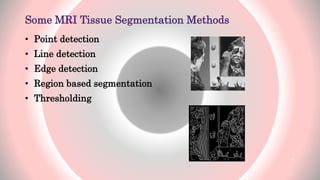
Some MRI Tissue Segmentation Methods
• Point detection
• Line detection
• Edge detection
• Region based segmentation
• Thresholding
8
Bias field estimation for MRI tissue segmentation
A “bias field signal” is a low frequency smooth undesirable signal that
corrupts MR images because of the inhomogeneties in the magnetic field of
the MRI machine.
Bias field correction methods classified into two classes:
 Prospective methods
Main aim is to avoid intensity inhomogeneities in the image
acquisition process.
 Retrospective methods
Rely only on the information in the acquired images and thus they can
remove intensity inhomogeneties regard less of their sources.
9
Inhomogeneities
Inhomogeneity is referred as non-uniformities of intensities over the same
class of tissues or structures which are not caused by random noise.
Some Inhomogeneity correction methods
 Phantom based method
 Multicoil method
 Surface fitting methods
 Maximum –likelihood (ML)
 FCM based methods
 Non-parametric segmentation
 Histogram based methods
 Filtering methods
10
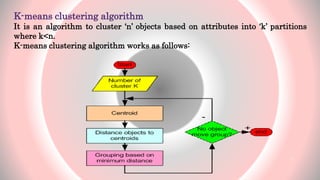
K-means clustering algorithm
It is an algorithm to cluster ‘n’ objects based on attributes into ‘k’ partitions
where k<n.
K-means clustering algorithm works as follows:
11
Related work
Some of the algorithms that were used in the past few years in MRI
Tissue Segmentation are:
 In 1999, Adaptive fuzzy C-means algorithm
 In 2001, Expectation maximization algorithm
 In 2002, Modified fuzzy C-means algorithm
12
Related work(contd.,)
 In 2008, A Gaussian kernel-based fuzzy C-means algorithm with spatial
bias correction.
 In 2009, Coherent Local Intensity Clustering (CLIC) .
 In 2011, A modified possibilistic fuzzy c-means clustering
 In 2012, Fuzzy Logic Gaussian Mixture Model(FLGMM)
13
Any queries?
14
15

MRI Tissue Segmentation basics

  • 1.
  • 2.
    CONTENTS  Image  Imageprocessing  MRI  MRI tissue segmentation  Segmentation methods  Bias field  Bias field correction methods  Inhomogeneties  Energy minimization  K-means algorithm  Related work 2
  • 3.
    Image Image types I. Blackand white images II. Grayscale or intensity images III. Indexed images (intensity images with colormaps) IV. RGB or truecolor images 3
  • 4.
    Image processing Purpose ofimage processing • Visualization • image sharpening and restoration • image retrieval • image recognition Applications of image processing • Content based image retrieval • Medical imaging • Object detection • Traffic control systems 4
  • 5.
    Magnetic Resonance Image[MRI] Itis a tomographic imaging technique that produces images of internal physical and chemical characteristics of an object from externally measured nuclear magnetic resonance(NMR) signals. Applications of MRI • Diagnosing multiple sclerosis, brain tumours, spinal infections and strokes in their earliest stages. • Visualizing torn ligaments in the wrist, knee, and ankle, shoulder injuries. • Evaluating bone tumors and herniated discs in the spine . 5
  • 6.
    Limitations of MRI •Machine makes a very loud continuous hammering noise when operating. • Extreme precautions must be taken to keep metallic objects out of the room where the machine is operating. • MRI system are expensive to buy and run. • People with pacemakers can’t safely be scanned. • MRI scans require patients to hold very still for long periods of time up to 90 minutes. 6
  • 7.
    MRI Tissue Segmentation Itis an important technique to differentiate abnormal and normal tissue in MR image data. Need for MRI Tissue Segmentation MR images are complicated due to the limitations in the imaging equipment: inhomogeneties in the receiver and large differences in magnetic susceptibilities of adjacent tissue leads to distortion. 7
  • 8.
    Some MRI TissueSegmentation Methods • Point detection • Line detection • Edge detection • Region based segmentation • Thresholding 8
  • 9.
    Bias field estimationfor MRI tissue segmentation A “bias field signal” is a low frequency smooth undesirable signal that corrupts MR images because of the inhomogeneties in the magnetic field of the MRI machine. Bias field correction methods classified into two classes:  Prospective methods Main aim is to avoid intensity inhomogeneities in the image acquisition process.  Retrospective methods Rely only on the information in the acquired images and thus they can remove intensity inhomogeneties regard less of their sources. 9
  • 10.
    Inhomogeneities Inhomogeneity is referredas non-uniformities of intensities over the same class of tissues or structures which are not caused by random noise. Some Inhomogeneity correction methods  Phantom based method  Multicoil method  Surface fitting methods  Maximum –likelihood (ML)  FCM based methods  Non-parametric segmentation  Histogram based methods  Filtering methods 10
  • 11.
    K-means clustering algorithm Itis an algorithm to cluster ‘n’ objects based on attributes into ‘k’ partitions where k<n. K-means clustering algorithm works as follows: 11
  • 12.
    Related work Some ofthe algorithms that were used in the past few years in MRI Tissue Segmentation are:  In 1999, Adaptive fuzzy C-means algorithm  In 2001, Expectation maximization algorithm  In 2002, Modified fuzzy C-means algorithm 12
  • 13.
    Related work(contd.,)  In2008, A Gaussian kernel-based fuzzy C-means algorithm with spatial bias correction.  In 2009, Coherent Local Intensity Clustering (CLIC) .  In 2011, A modified possibilistic fuzzy c-means clustering  In 2012, Fuzzy Logic Gaussian Mixture Model(FLGMM) 13
  • 14.
  • 15.