Download to read offline
![B. Ashok Int. Journal of Engineering Research and Applications www.ijera.com
ISSN: 2248-9622, Vol. 6, Issue 1, (Part - 1) January 2016, pp.94-99
www.ijera.com 94|P a g e
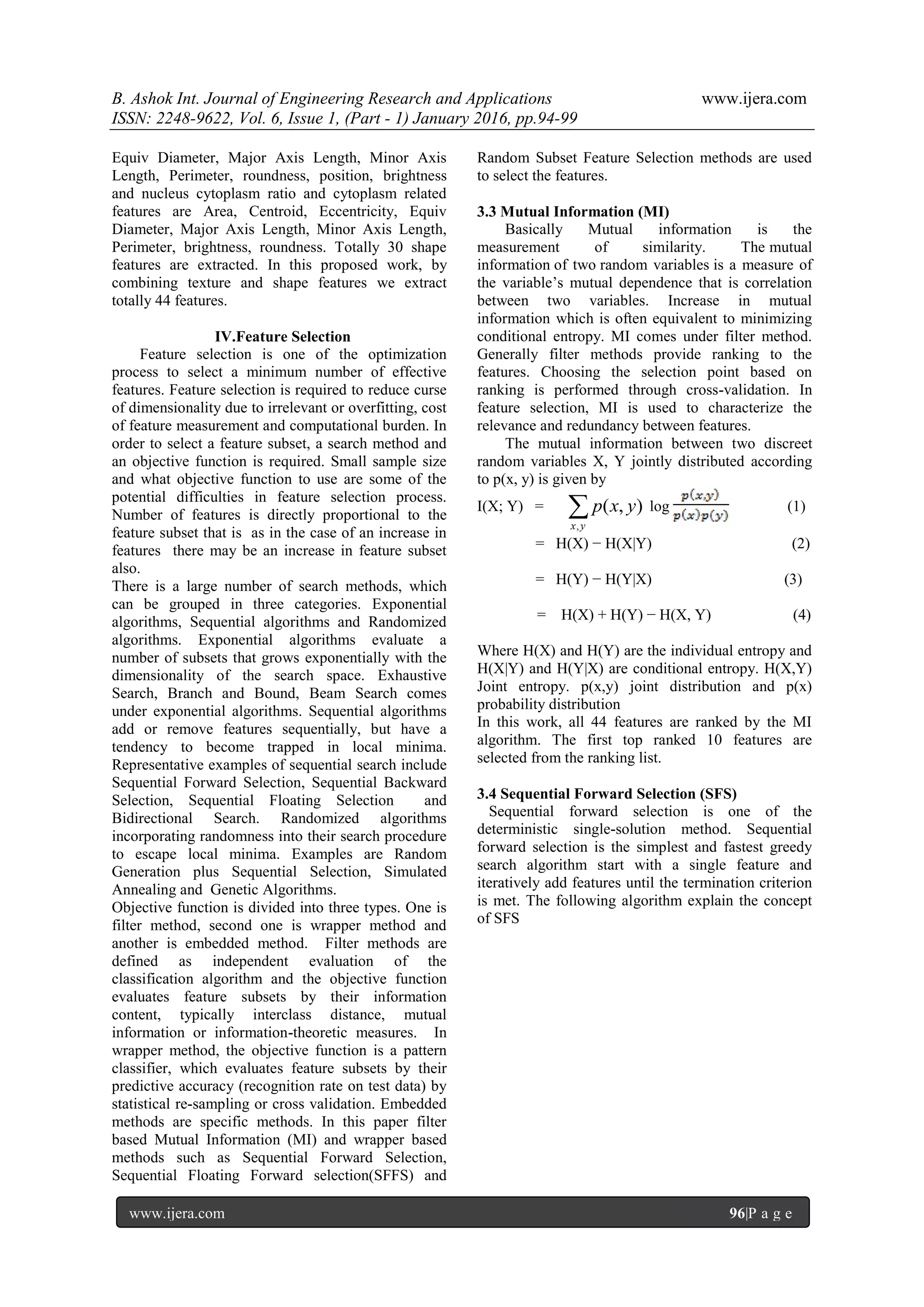
Comparison of Feature selection methods for diagnosis of cervical
cancer using SVM classifier
B. Ashok*, Dr. P. Aruna**
*(Department of Computer Science & engineering, Annamalai University, Annamalainagar, India)
** (Department of Computer Science & engineering, Annamalai University, Annamalainagar, India)
ABSTRACT
Even though a great attention has been given on the cervical cancer diagnosis, it is a tuff task to observe the
pap smear slide through microscope. Image Processing and Machine learning techniques helps the pathologist
to take proper decision. In this paper, we presented the diagnosis method using cervical cell image which is
obtained by Pap smear test. Image segmentation performed by multi-thresholding method and texture and shape
features are extracted related to cervical cancer. Feature selection is achieved using Mutual Information(MI),
Sequential Forward Search (SFS), Sequential Floating Forward Search (SFFS) and Random Subset Feature
Selection(RSFS) methods.
Keywords - Segmentation, Feature Extraction, Feature Selection, Multi-thresholding, Classification
I.INTRODUCTION
Cervical cancer is the fourth common cancer in
women society. In the low-income countries, the
acceptability of increased cervical cancer risk and
cause of cancer death projected. Cervical screening
programs has minimized the death rate in the
developed countries. Human Papilloma Virus (HPV)
is found as the major cause for the cervical cancer.
Although cervical cancer is one of the deadliest
disease, it can be cured if detected in the earlier stage.
Pap smear test is the non-invasive screening and
simple test to find out cervical cancer. Image
acquisition is obtained by applying the smear which
is taken by the pap smear test on the microscope
slide. From microscope attached digital camera
capture the cell image. Image processing is the major
area that includes image enhancement, segmentation
and feature extraction. Feature selection and
classification are the machine learning techniques.
In this paper we have applied image processing, data
mining and machine learning techniques to diagnose
the cervical cancer.
II.RELATED WORK
Feature selection is an important process. The
feature selection methods can be divided into filter,
wrapper and embedded methods [1,2]. Filter methods
are computationally very fast, easy to interpret and
are scalable for high- dimensional datasets like micro
array data. However, most of them are univariate.
Wrapper and embedded methods which always use
machine learning algorithms to compute the
importance scores of the feature or feature subset,
RF-ACC and RF-Gini based on Random Forest(RF)
[3] always achieve better performances than filter
methods on high-dimensional datasets. Premature
time diagnosis of the disease could improve patients’
treatment effect. One of the most important and
indispensable tasks in any pattern recognition system
is to overcome the curse of dimensionality problem,
which forms a motivation for using a suitable feature
selection method [4]. Random based feature
selection[5] using benchmark datasets also discussed
and a frame work of algorithmic randomness based
feature selection has been proposed to measure the
feature importance score using a p-value that derives
from the combination of algorithmic randomness test
and machine learning methods.
Rough Set Theory (RST) and Particle Swarm
Optimization (PSO) methods applied for medical
diagnosis and achieved accuracy to certain extent [7].
Canonical Correlation Analysis (CCA) for uncertain
data streams and an uncertain canonical correlation
analysis (UCCA) method discussed to reduce the
dimensionality of the features [8]. Extracting shape
features, textural features and intensity features [9]
was achieved by watershed transformation and k-
means spectral clustering supervised svm classifiers
applied for feature selection. Multi-Filtration Feature
Selection (MFFS) [10], a approach which was
applied to extract features, feature subset selection,
feature ranking and classification.
A cosine similarity measure support vector
machine CSMSVM [11] for feature selection and
classification presented. Feature selection is
performed by adding weights to features based on
margin verses cosine distance ratio. An unsupervised
feature learning (UFL) framework for basal cell
carcinoma image analysis[12] had been performed on
histopathology images.
The K-SVM had been explained [13]. Missing of
important data and gathering unnecessary
RESEARCH ARTICLE OPEN ACCESS](https://image.slidesharecdn.com/l601019499-160106082020/75/Comparison-of-Feature-selection-methods-for-diagnosis-of-cervical-cancer-using-SVM-classifier-1-2048.jpg)
![B. Ashok Int. Journal of Engineering Research and Applications www.ijera.com
ISSN: 2248-9622, Vol. 6, Issue 1, (Part - 1) January 2016, pp.94-99
www.ijera.com 95|P a g e
information at the time of feature extraction should
be avoided. Multi resolution local binary pattern
(MRLBP) [14] variants based texture feature
extraction techniques had been presented. Image
segmentation performed using discrete wavelet
transform (DWT) further Daubechies wavelet(db2)
used as decomposition filter. Deep Sparse Support
Vector Machine (DSSVM) based feature selection
method had been discussed [15] and further
extraction of color and texture features was
performed using super pixels. The importance of
local texture(LTP) and local shape (MultiHPOG)
features discussed [16] and the further improvement
in performance achieved by adding the global shape
feature (Gabor wavelets). Feature selection based on
information has the drawback such as the interaction
between the features and classifiers. This may lead to
the selection irrelevant features. To overcome this
problem, Mutual Information based techniques used
[17]. Even though new feature extraction, feature
selection and classification methods have been
introduced, there will be a requirement exists for
newer or better techniques. In our previous works
[18][19] various segmentation methods were
analyzed.
III.MATERIALS AND METHODS
The Block diagram of the proposed method
Figure 1: Block Diagram of the proposed method for
diagnosis of cervical cancer
Image preprocessing includes noise removal and
image enhancement. Image resize also performed.
Cell image converted from RGB image to Gray scale
image.
3.1 Image segmentation
Segmentation means split the input image into
desired regions so as to get the features. There are lot
of methods to segment an image such as edge based
methods, region based, watershed method and
thresholding methods. In this work, we used multi
thresholding method to segment the input image.
Nucleus and Cytoplasm of the cervical cell image are
segmented.
RGB
Image
Gray scale
Image
Segmented
Nucleus
Image
Segmented
Cytoplasm
Image
Figure 2: Sample pap smear images & their
corresponding segmented images
3.2 Feature Extraction
3.2.1 Texture features
Texture features are extracted using Gray Level
Co-occurrence Matrix (GLCM). The list of features
are as follows homogeneity, contrast, correlation,
variance, inverse difference moment, sum average,
sum variance, sum entropy, entropy, difference
variance, difference entropy, information measure I,
information measure II and maximal correlation
coefficient. Totally 14 texture features are extracted.
3.2.2 Shape features
The following list of features are the shape
features which are extracted from nucleus and
cytoplasm of the cervical cell. Besides the shape
features, derived features are also included. Nucleus
related features are Area, Centroid, Eccentricity,
Image Preprocessing
Segmentation using
multi-thresholding
Feature Extraction Phase
Feature Selection Phase
Classification using SVM classifier
Shape
Features
Textural
Features
MI SFS SFFS
Input image
Preprocessing
RSFS](https://image.slidesharecdn.com/l601019499-160106082020/75/Comparison-of-Feature-selection-methods-for-diagnosis-of-cervical-cancer-using-SVM-classifier-2-2048.jpg)
![B. Ashok Int. Journal of Engineering Research and Applications www.ijera.com
ISSN: 2248-9622, Vol. 6, Issue 1, (Part - 1) January 2016, pp.94-99
www.ijera.com 97|P a g e
In this work, 8 features are selected by the SFS
method out of 44 features. The selected feature
subset is given in table 2.
Table 2: Selected Feature Numbers by SFS
3.5 Sequential Floating Forward Search (SFFS)
The sequential floating forward search method is
one of the most effective feature selection technique.
This algorithm starts with a null feature set. Then the
best feature in the feature set that satisfies some
criterion function is added with the current feature
set. This is one process of the sequential forward
selection. Further any improvement of the criterion is
searched if some feature is excluded. By this way the
worst feature according to the criterion is eliminated
from the feature set. This is one process of sequential
backward selection. In this method the algorithm
continues by increasing or decreasing the number of
features until the desired feature subset is obtained.
The word floating denotes the increase or decrease in
dimensionality of features in the selected feature
subset.
Algorithm
Step 1: Inclusion. Use the basic sequential feature
selection method to select the most significant feature
with respect to feature set and include it in the
feature subset. Stop if desired features have been
selected, otherwise go to step 2.
Step 2: Conditional exclusion. Find the least
significant feature k in feature subset. If it is the
feature just added, then keep it and return to step 1.
Otherwise, exclude the feature k. Note that feature
subset is now better than it was before step 1.
Continue to step 3.
Step 3: Continuation of conditional exclusion. Again
find the least significant feature in feature subset. If
its exclusion will leave feature subset with at least 2
features, then remove it and repeat step 3. Whenever
this condition finish, return to step 1.only 6 features
are selected by the sequential floating forward
selection method and it is given in table 3.
Table 3 Selected Feature Numbers by SFFS
Serial number 1 2 3 4 5 6
Selected feature
numbers
5 4 6 29 3 9
3.6 Random subset feature selection (RSFS)
Features are selected by classifying the data with
a classifier while applying randomly chosen subsets.
According to the classification performance the
relevance of each feature is computed. Based on the
average usefulness each feature is evaluated in
random subset feature selection. 12 features are
selected by the random subset feature selection
method and it is given in table 4.
Table 4 Selected Feature Numbers by RSFS
1 2 3 4 5 6 7 8 9 10 11 12
3 5 28 20 9 44 12 33 14 24 34 18
V.Classification
Support Vector Machine (SVM) is supervised
learning method and one of the kernel- based
techniques in machine learning algorithms. The
SVM is developed mainly by Vapnik at Bell
laboratories. Basically SVM constructs a high-
dimensional space and then separates according to
the training data. In figure 3, the SVM classification
process is illustrated. The rounded objects are support
vectors.
Figure 3, SVM classifier
VI.Results and Discussion
In this work, 150 images of pap smear test are
collected from Rajah Muthiah Medical College,
Annamalainagar, out of 150 images, 100 images are
used for training the SVM classifier and 50 images
are used for testing.
Serial
number
1 2 3 4 5 6 7 8
Selected
feature
numbers
3 5 4 6 29 18 44 20
Algorithm
Input: the set of all features, F =
f1,f2,...,fn
Initialization: X0 =”null set”, k = 0
Addition: add significant feature
Xj = argmax [J(Xk + Xj)], Xj ∈ F - Xk
where Xj is the new feature to be added
Xk+1 = Xk + X+
k = k + 1
Go to Addition
Termination: stop when ‘k’ equals the number
of desired features
Output : a subset of features, Xk](https://image.slidesharecdn.com/l601019499-160106082020/75/Comparison-of-Feature-selection-methods-for-diagnosis-of-cervical-cancer-using-SVM-classifier-4-2048.jpg)
![B. Ashok Int. Journal of Engineering Research and Applications www.ijera.com
ISSN: 2248-9622, Vol. 6, Issue 1, (Part - 1) January 2016, pp.94-99
www.ijera.com 98|P a g e
The combination of texture and shape features
are extracted from each images. It has 44 features.
The optimal features are selected using feature
selection methods like Mutual Information,
Sequential forward selection, Sequential floating
forward selection and Random subset feature
selection. The cervical cancer affected images are
found using SVM classifier. Different feature
selection methods are compared to find the best
feature selection method suited for the diagnosis of
cervical cancer.
1)Accuracy: Accuracy is obtained by correctly
classified images divided by the total classified
images.
Accuracy = (6)
Where TN is true negative,TP is true positive, FP is
false positive and FN is false negative.
Table 5 Comparison of Accuracy of feature
selection methods
Slno Method Accuracy %
1 MI 92 %
2 SFS 93 %
3 SFFS 98.5%
4 RSFS 94%
2) Sensitivity: Sensitivity is obtained as correctly
classified true positive rate divided by true positive
and false negative samples. Inconclusive results that
are true positives are treated as errors for calculation.
Sensitivity = (7)
Table 6 Comparison of Sensitivity of feature
selection methods
Slno Method Sensitivity %
1 MI 89 %
2 SFS 94.5 %
3 SFFS 98%
4 RSFS 91%
3) Specificity: Specificity is calculated as correctly
classified true negative rate divided by the true
negative and false positive samples. Results that are
true negatives are treated as errors.
Specificity = (8)
Table 7 Comparison of Specificity of feature
selection methods
Sl no Method Specificity %
1 MI 91 %
2 SFS 92 %
3 SFFS 97.5%
4 RSFS 93 %
VII.CONCLUSION
From the table 1 to table 4, it is found that
Sequential floating forward selection method
outperforms the other method. That is the feature
selected from Sequential floating forward selection
method gives the most optimal features to diagnosis
the cervical cancer. Because accuracy 98.5%,
sensitivity 98% and specificity 97.5% obtained from
sequential floating forward selection method which is
higher than other methods.
REFERENCES
[1] Isabelle Guyon, AndreElisseeff, An
introduction to variable and feature
selection, J.Mach. Learn. Res. 3 (2003)
1157–1182.
[2] YvanSaeys, InakiInza, PedroLarranaga, A
review of feature selection techniques in
bioinformatics, Bioinformatics 23(19)
(2007) 2507–2517.
[3] L. Breiman, Random forests, Mach. Learn.
45 (1 ) (2001) 5–32.
[4] N. Rami, N. Khushaba, A. Al-Ani, A. Al-
Jumaily, Feature subset selection using
differential evolution and a statistical repair
mechanism, in: Expert Systems with
Applications, Elsevier, 2011, pp. 11515–
11526.
[5] Huazhen Wang, BingLv, FanYang ,
KaiZheng, XuanLi, XueqinHu, Algorithmic
randomness based feature selection for
traditional Chinese chronic gastritis
diagnosis, Neuro computing, Elsevier 140
(2014) pp. 252–264.
[6] Maria Martinsa, Lino Costab, Anselmo
Frizerac,Ramón Ceresd, Cristina Santos,
Hybridization between multi-objective
genetic algorithm and support vector
machine for feature selection in walker-
assisted gait , computer methods and
programs in biomedicine, Elsevier, 113
(2014) pp.736–748
[7] H. Hannah Inbarania, Ahmad Taher Azarb,
G. Jothi, Supervised hybrid feature selection
based on PSO and rough sets for medical
diagnosis, computer methods and programs
in biomedicine, Elsevier, 113 (2014)
pp.175–185
[8] Wen-PingLi , JingYang , Jian-PeiZhang ,
Uncertain canonical correlation analysis for
multi-view feature extraction from uncertain
data streams, Neuro computing, Elsevier,
149 (2015) pp.1337–1347
[9] Marina E. Plissiti, Christophoros Nikou,
Antonia Charchanti, Combining shape,
texture and intensity features for cell nuclei
extraction in Pap smear images, Pattern](https://image.slidesharecdn.com/l601019499-160106082020/75/Comparison-of-Feature-selection-methods-for-diagnosis-of-cervical-cancer-using-SVM-classifier-5-2048.jpg)
![B. Ashok Int. Journal of Engineering Research and Applications www.ijera.com
ISSN: 2248-9622, Vol. 6, Issue 1, (Part - 1) January 2016, pp.94-99
www.ijera.com 99|P a g e
Recognition Letters, Elsevier 32 (2011) pp.
838–853
[10] S. Sasikala, S. Appavu alias Balamurugan,
S. Geetha, Multi Filtration Feature Selection
(MFFS) to improve discriminatory ability in
clinical data set, Applied Computing and
Informatics (2014)
[11] Gang Chen, JinChen, A novel wrapper
method for feature selection and its
applications, Neuro computing, Elsevier
159(2015) pp. 219–226
[12] John Arevalo, Angel Cruz-Roa, Viviana
Arias, Eduardo Romero, Fabio A. González,
An unsupervised feature learning framework
for basal cell carcinoma image analysis,
Artificial Intelligence in Medicine, Elsevier
64 (2015) pp. 131–145
[13] Bichen Zheng, Sang Won Yoon , Sarah S.
Lam, Breast cancer diagnosis based on
feature extraction using a hybrid of K-means
and support vector machine algorithms,
Expert Systems with Applications 41 (2014)
1476–1482
[14] Arvind R. Yadav, R.S. Anand, M.L. Dewal,
Sangeeta Gupta, Multi resolution local
binary pattern variants based texture feature
extraction techniques for efficient
classification of microscopic images of
hardwood species, Applied Soft Computing,
Elsevier 32 (2015) pp. 101–112
[15] YangCong, ShuaiWang , JiLiu , JunCao ,
YunshengYang , JieboLuo Deep sparse
feature selection for computer aided
endoscopy diagnosis, Pattern Recognition,
Elsevier, 48 (2015) pp. 907–917
[16] Fengyi Song, XiaoyangTan, XueLiu,
Songcan Chen Eyes closeness detection
from still images with multi-scale
histograms of principal oriented gradients,
Pattern Recognition 47 (2014) 2825–2838
[17] Mohamed Bennasar, YuliaHicks, Rossitza
Setchi, Feature selection using Joint Mutual
Information Maximisation, Expert Systems
With Applications, Elsevier 42 (2015)
8520–8532
[18] B.Ashok , P.Aruna, Prognosis of Cervical
Cancer using k-Nearest Neighbor
Classification, International Journal of
Applied Engineering Research ISSN 0973-
4562 Volume 10, Number 9 (2015) 6676-
6680
[19] B.Ashok, Dr.P.Aruna, Analysis of Image
Segmentation Methods for Detection of
Cervical Cancer, International Journal of
Applied Engineering Research, ISSN 0973-
4562 Vol. 10 No.75 (2015), 81-85](https://image.slidesharecdn.com/l601019499-160106082020/75/Comparison-of-Feature-selection-methods-for-diagnosis-of-cervical-cancer-using-SVM-classifier-6-2048.jpg)

The paper discusses various feature selection methods for diagnosing cervical cancer using images from pap smear tests processed through machine learning and image processing techniques. It compares the effectiveness of mutual information, sequential forward selection, sequential floating forward selection, and random subset feature selection methods, with sequential floating forward selection achieving the highest accuracy (98.5%). The study highlights the importance of feature selection in improving the diagnosis and treatment outcomes for cervical cancer.


