Media Planning Project
media planning concepts…
7
Have knowledge and understanding of regulations,
legislation and media consumption
Category spend
two key skills of media planners…
Should be able to judge the communications efforts
of the competition
ONE…
TWO…
Share of Voice
Media Mix
media planning…
media selection has become increasingly complex
…this activity is primarily tactical…
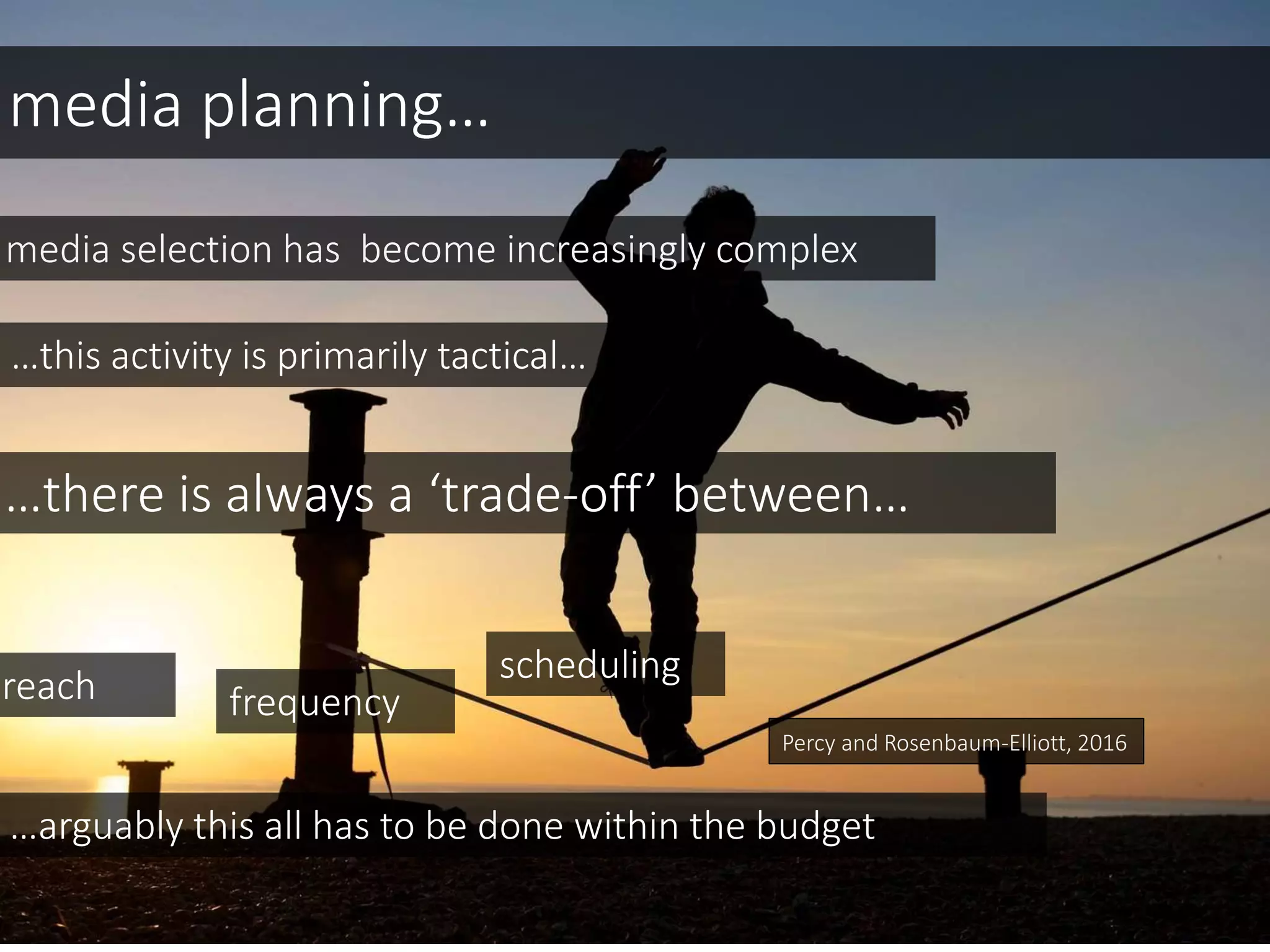
…there is always a ‘trade-off’ between…
reach
…arguably this all has to be done within the budget
Percy and Rosenbaum-Elliott, 2016
frequency
scheduling
media planning…
coverage
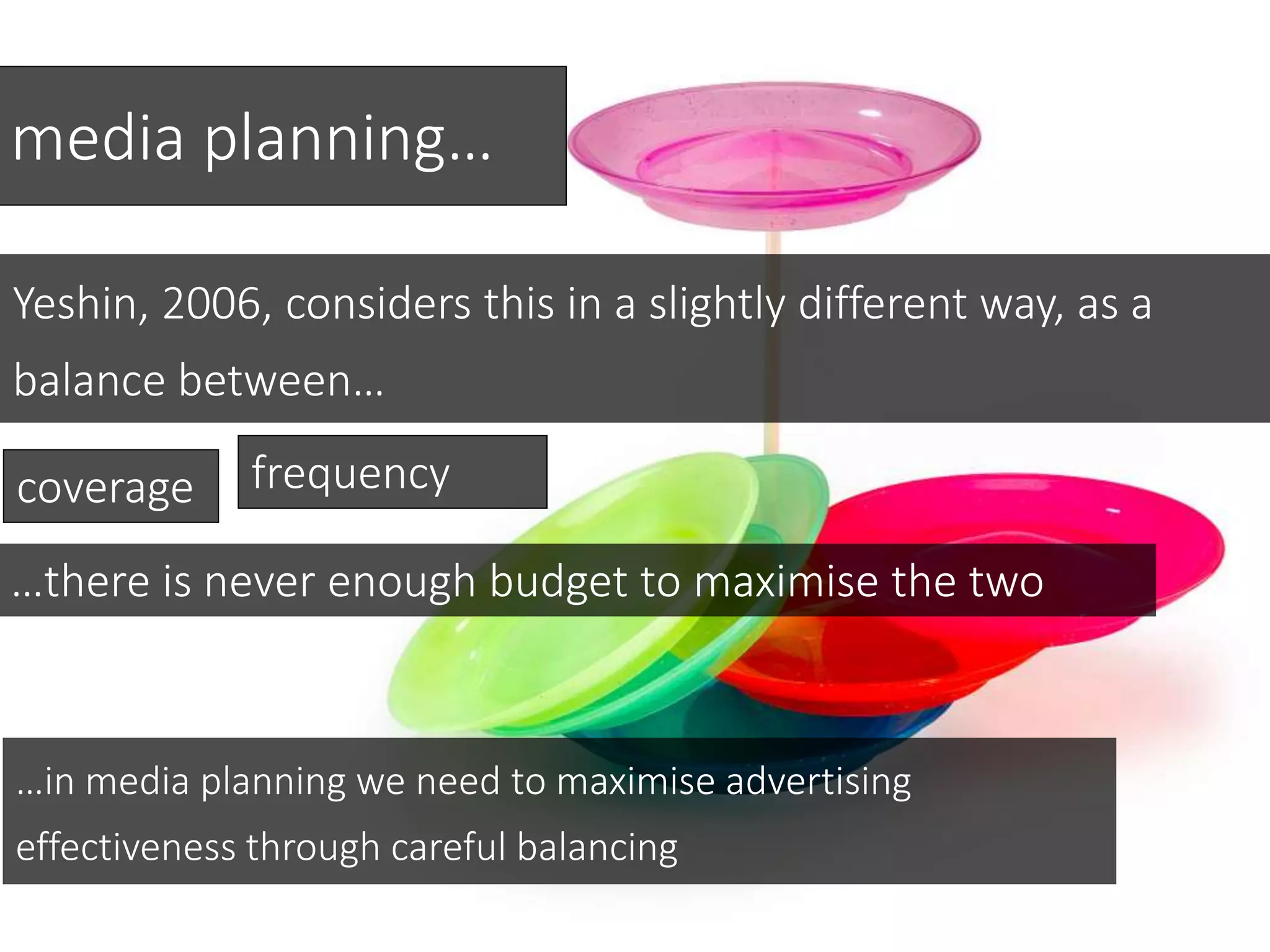
Yeshin, 2006, considers this in a slightly different way, as a
balance between…
…there is never enough budget to maximise the two
…in media planning we need to maximise advertising
effectiveness through careful balancing
frequency
key concepts… frequency
How many times a consumer within the target audience is expected to be
exposed to the message within a certain time period
So… how do we determine frequency?
Yeshin, 2006, states that “there is no consensus as to the ‘correct’ number of
exposures that an advertising campaign should seek to achieve
…what the media planner strives towards is known as…
Effective frequency
De Pelsmaker, et.al., 2017
frequency and effectiveness…
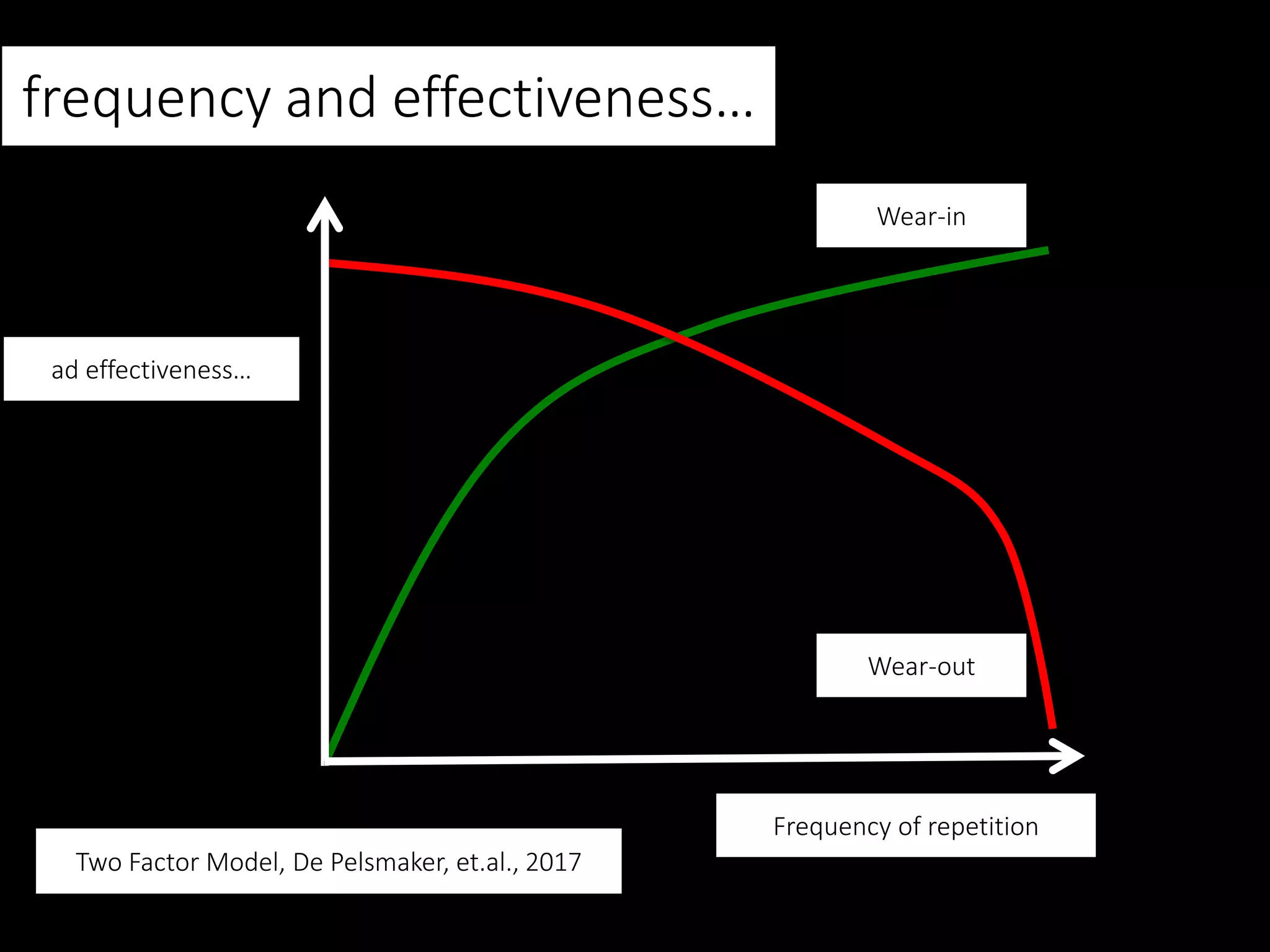
There needs to be a balance between “wear-in” and “wear-out”
Wear-out results in negative responses… such as irritation…
High exposure is beneficial as it can…
Makes attitudes more accessible and increases confidence in that attitude
Leads to greater front of mind awareness
…so minor tweaks to content can be beneficial to overcome this
Make the message more memorable and increase brand recall
Can be a signal for brand quality
Increases believability of claims
De Pelsmaker, et.al., 2017
frequency and effectiveness…
ad effectiveness…
Frequency of repetition
Wear-out
Wear-in
Two Factor Model, De Pelsmaker, et.al., 2017
frequency
Yeshin cites research from Krugman (1972) who put forward that a
consumer only requires 3 exposures for the effect to be achieved
He also cites Philip Jones (1995) who argues that sales are
achieved from one exposure
It is important to note that frequency of exposure should vary by
age… increasing frequency as the audience gets older (Dubow, 1995)
frequency
Optimal, effective frequency is linked to…
The type of message used – format, appeal, content
The level of competition
The advertising objective
The product category
The target audience
The media being used
frequency in action…
frequency in a digital age…
Harder to reach audiences due to mass audience decline, ad avoidance
and multi-tasking behaviour
Frequency has become increasingly problematic
…and over-exposure damages trust and wastes resources
WARC, 2019
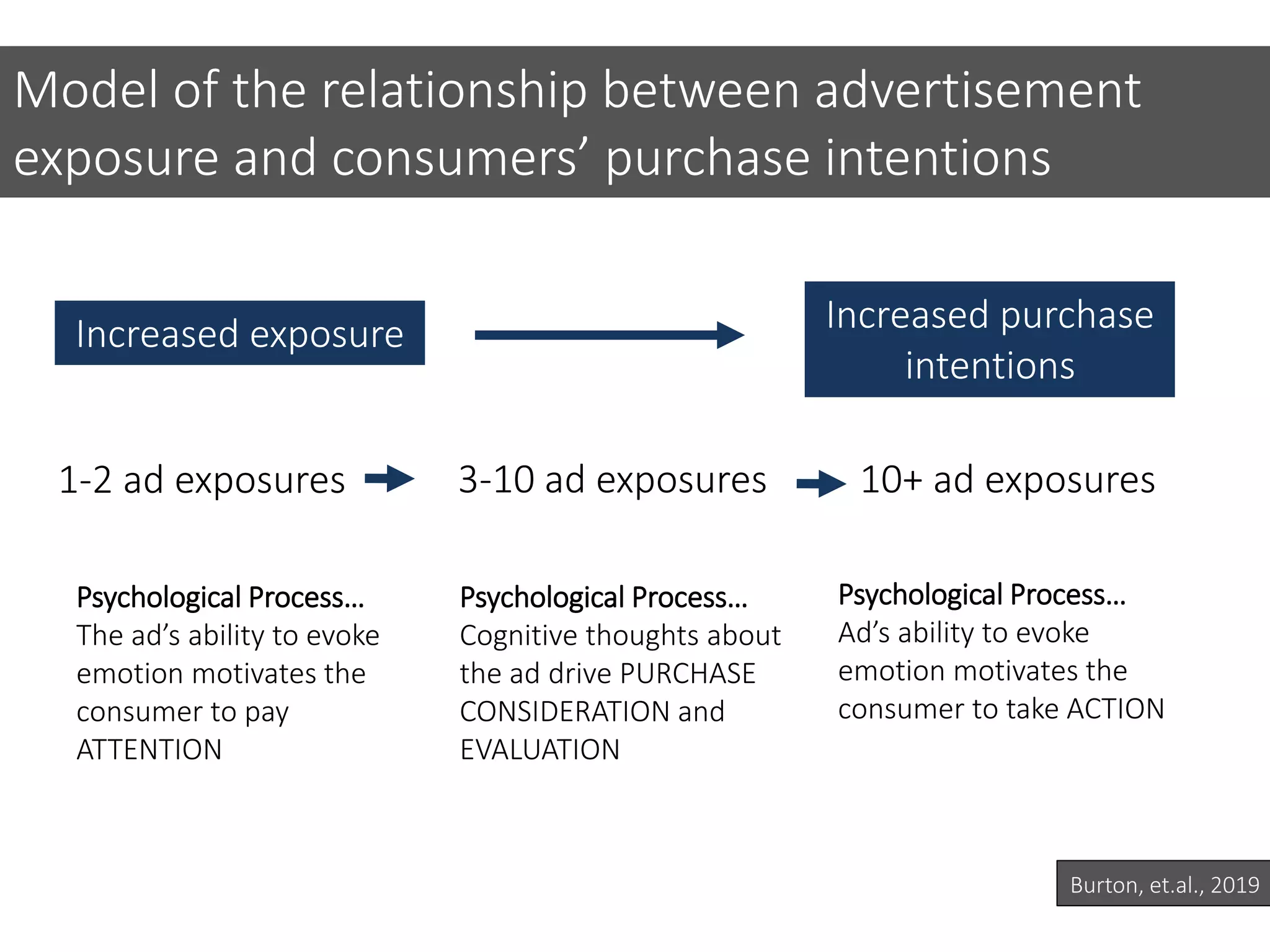
Increased exposure Increased purchase
intentions
1-2 ad exposures 3-10 ad exposures 10+ ad exposures
Psychological Process…
The ad’s ability to evoke
emotion motivates the
consumer to pay
ATTENTION
Psychological Process…
Cognitive thoughts about
the ad drive PURCHASE
CONSIDERATION and
EVALUATION
Psychological Process…
Ad’s ability to evoke
emotion motivates the
consumer to take ACTION
Model of the relationship between advertisement
exposure and consumers’ purchase intentions
Burton, et.al., 2019
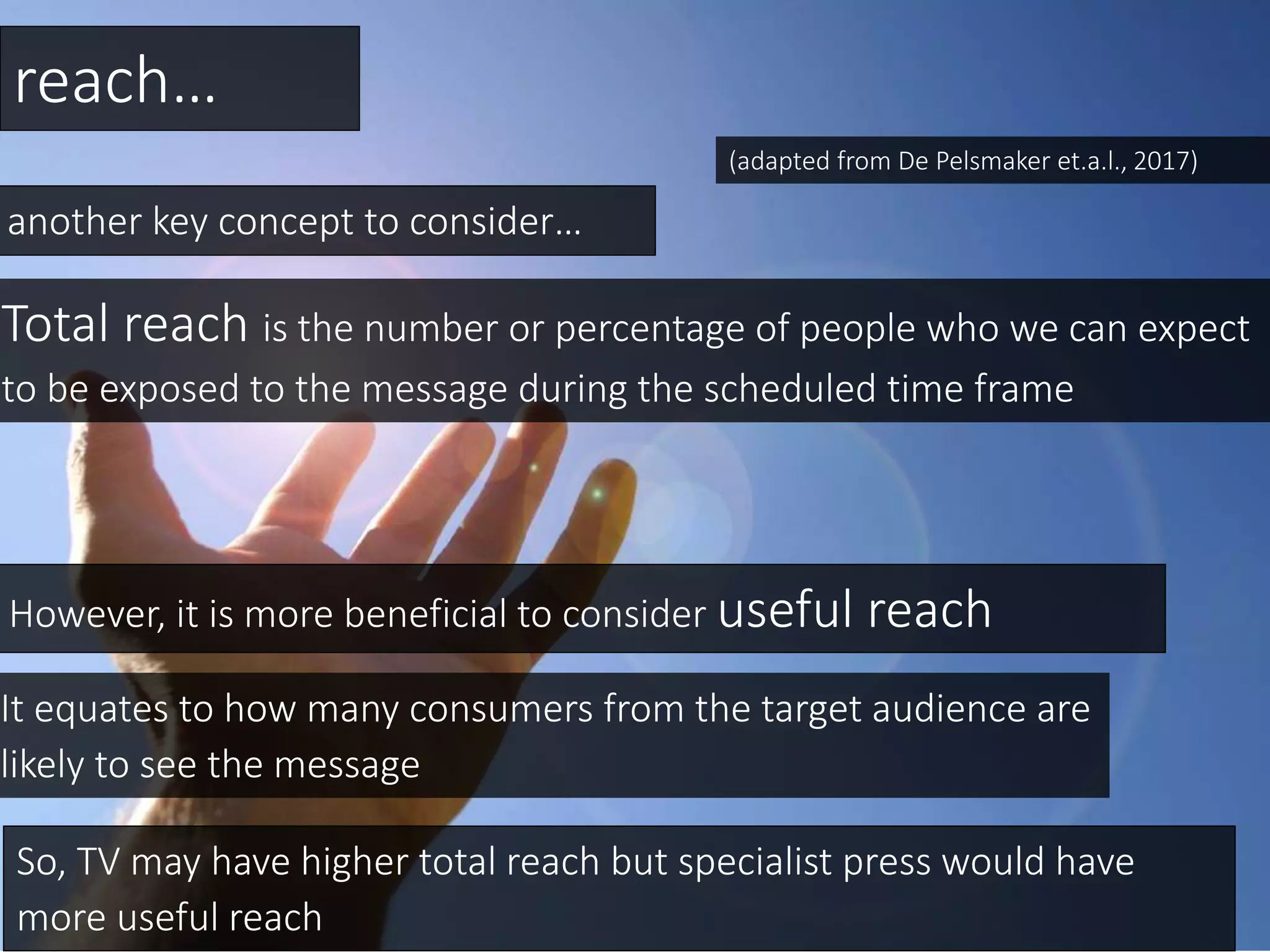
reach…
another key concept to consider…
Total reach is the number or percentage of people who we can expect
to be exposed to the message during the scheduled time frame
However, it is more beneficial to consider useful reach
So, TV may have higher total reach but specialist press would have
more useful reach
It equates to how many consumers from the target audience are
likely to see the message
(adapted from De Pelsmaker et.a.l., 2017)
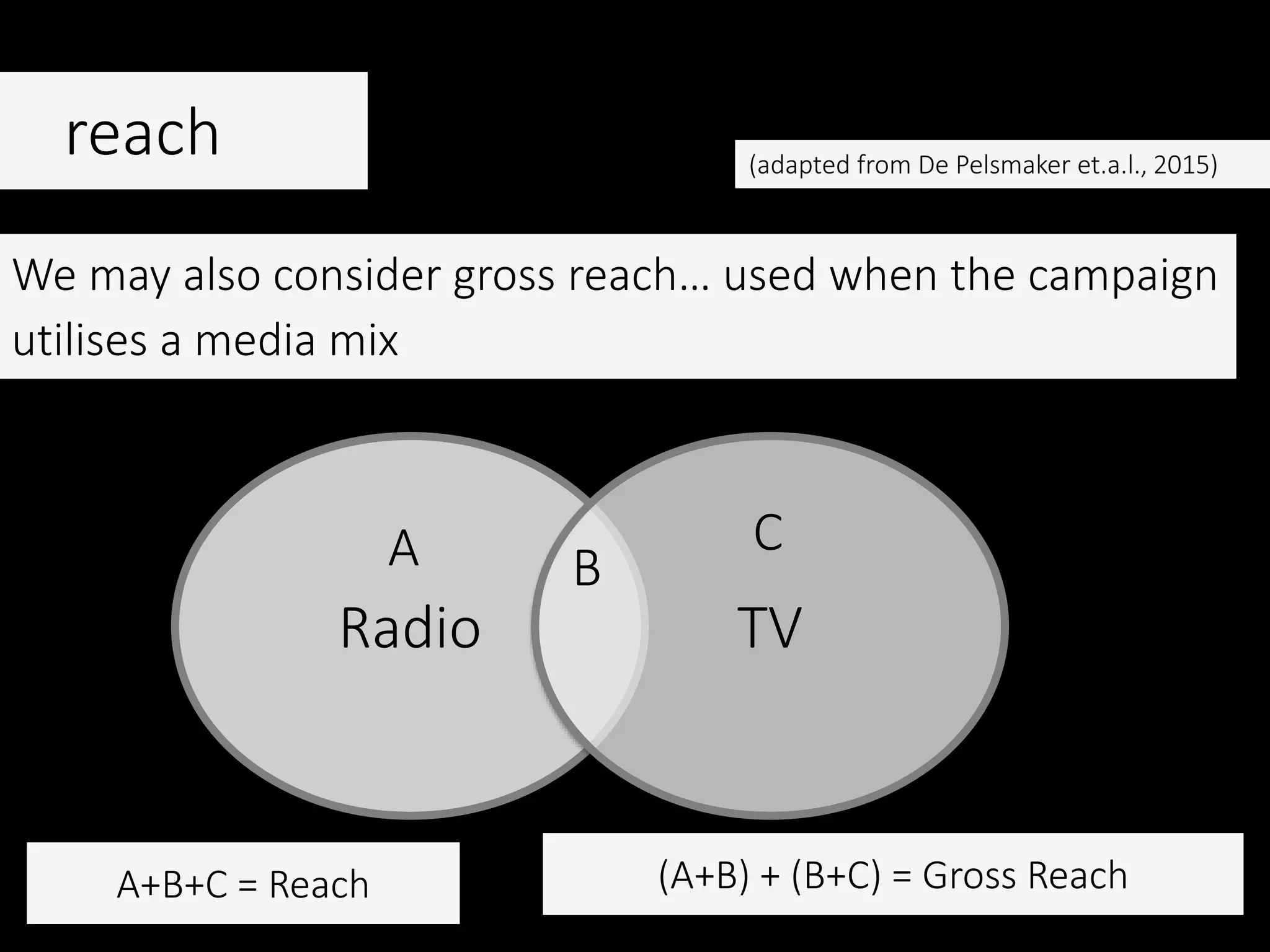
reach
We may also consider gross reach… used when the campaign
utilises a media mix
Radio TV
A B
C
(A+B) + (B+C) = Gross Reach
(adapted from De Pelsmaker et.a.l., 2015)
A+B+C = Reach
Reach…
A more commonly used measure is opportunities to see… OTS
This is the average probability of exposure that the target audience has
This links to Gross Rating Points… GRP’s
You divide gross reach by reach… simple!
Links to impressions which is total number of OTS
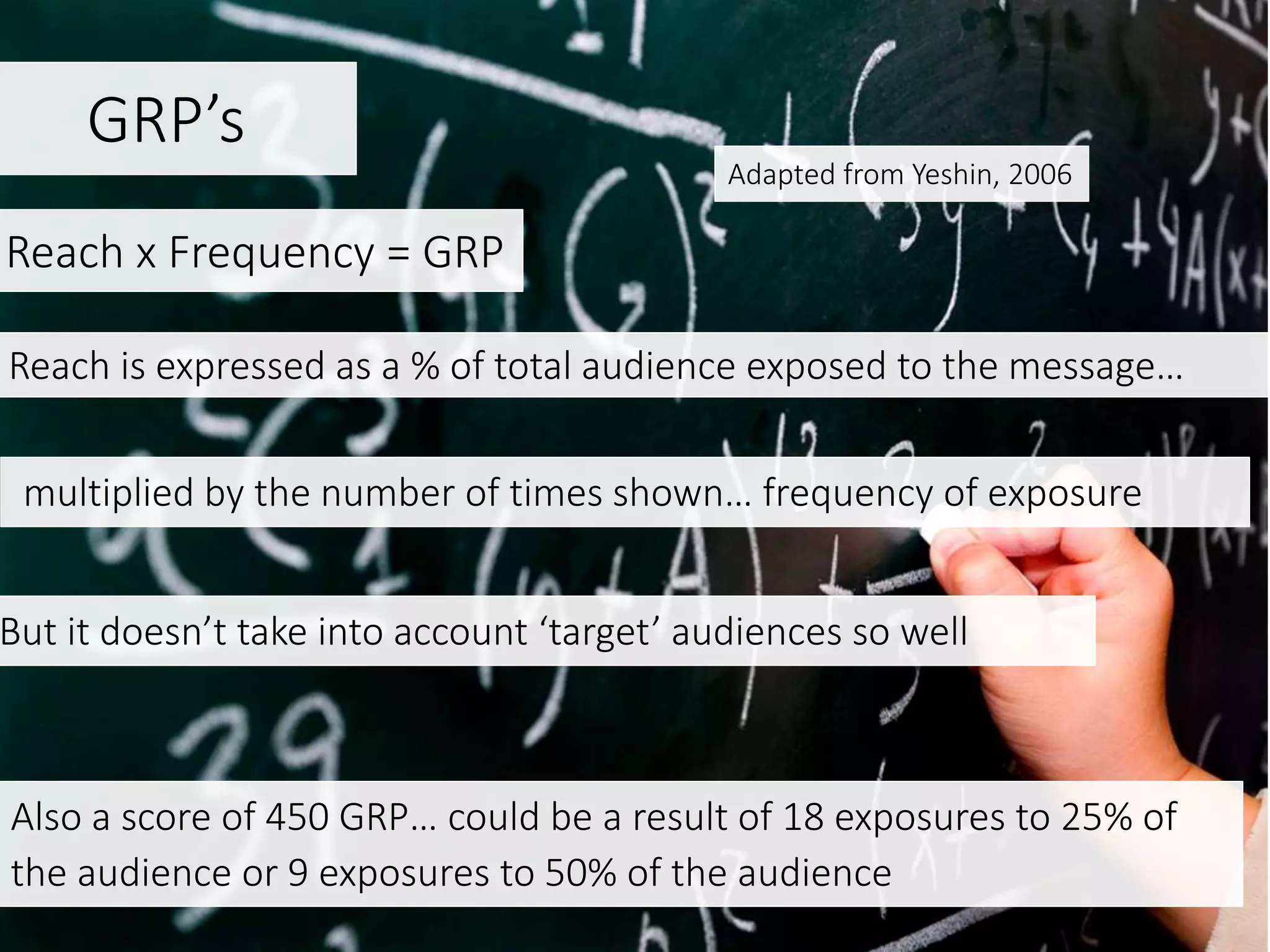
GRP’s
Also a score of 450 GRP… could be a result of 18 exposures to 25% of
the audience or 9 exposures to 50% of the audience
Adapted from Yeshin, 2006
multiplied by the number of times shown… frequency of exposure
But it doesn’t take into account ‘target’ audiences so well
Reach x Frequency = GRP
Reach is expressed as a % of total audience exposed to the message…
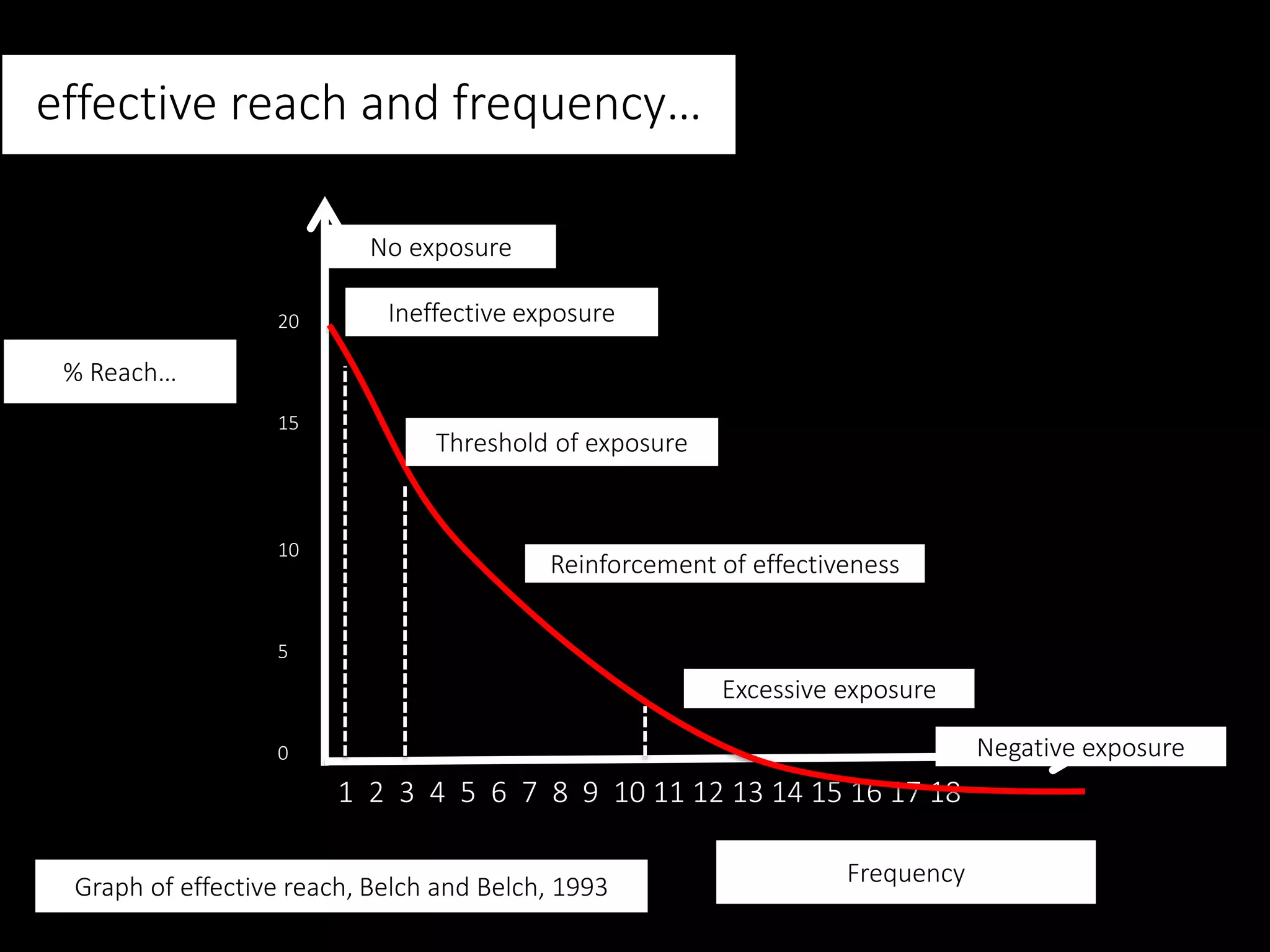
effective reach and frequency…
% Reach…
FrequencyGraph of effective reach, Belch and Belch, 1993
20
15
10
5
0
1 2 3 4 5 6 7 8 9 10 11 12 13 14 15 16 17 18
No exposure
Ineffective exposure
Threshold of exposure
Reinforcement of effectiveness
Excessive exposure
Negative exposure
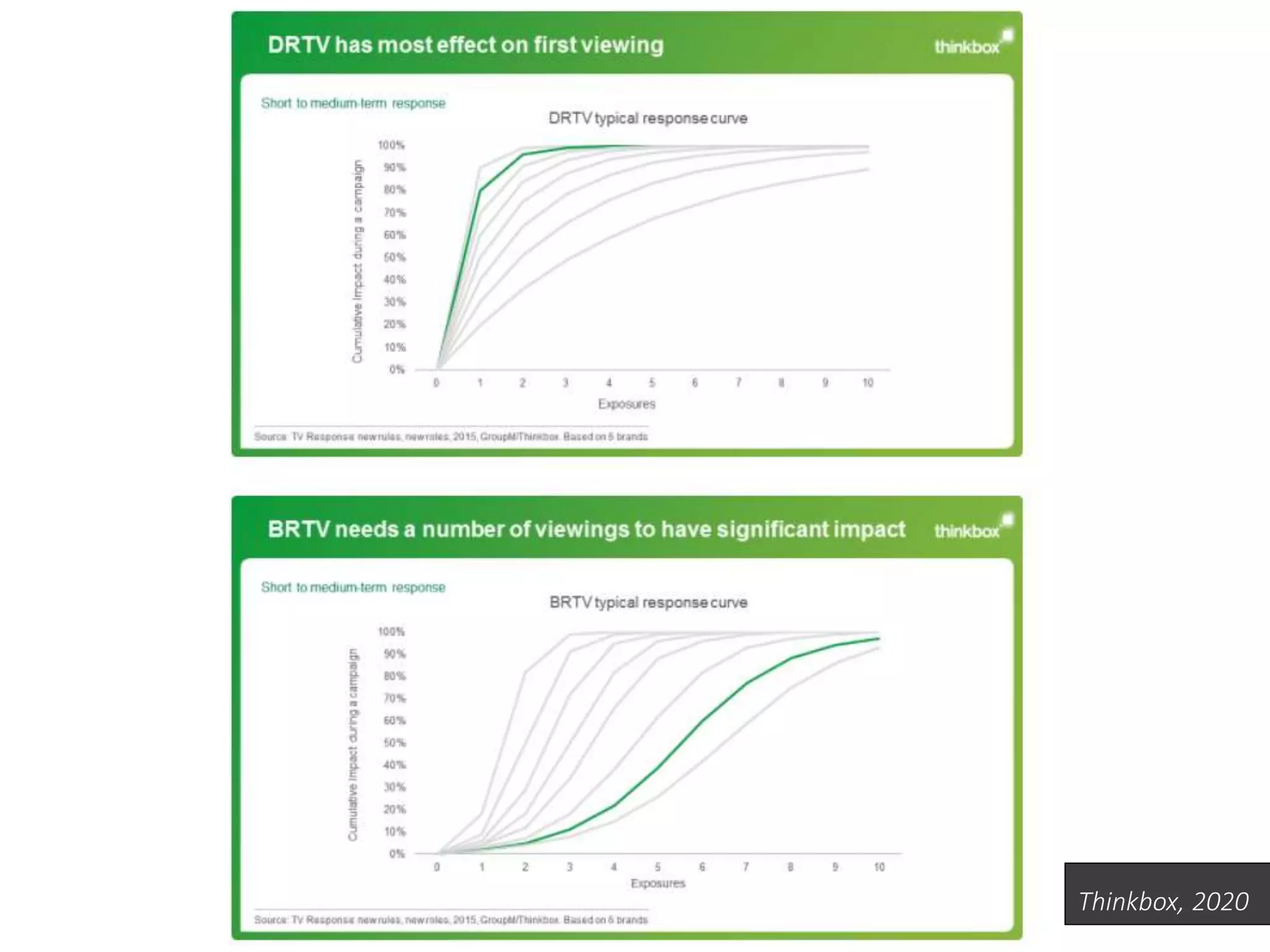
Thinkbox, 2020
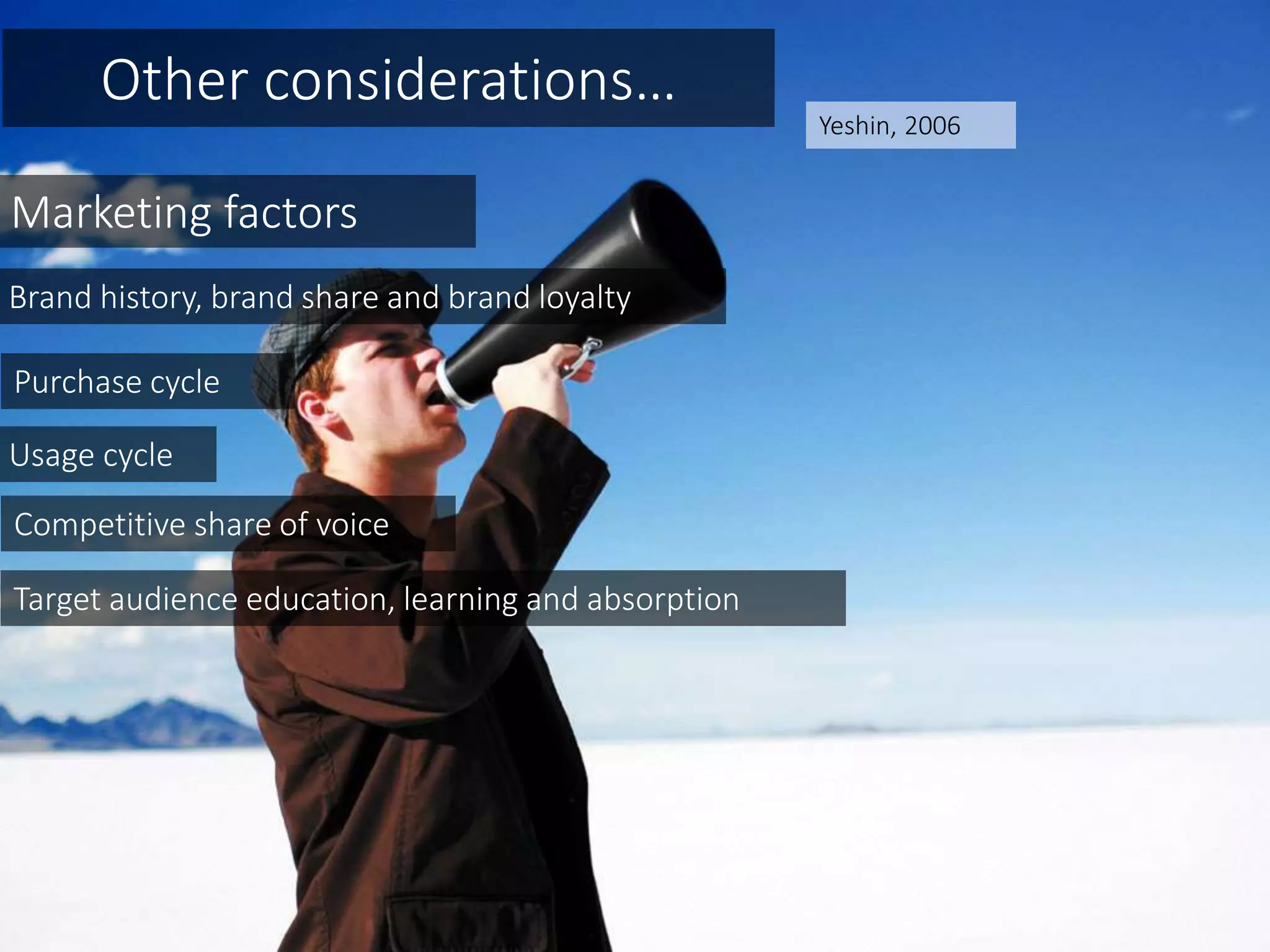
Other considerations…
Brand history, brand share and brand loyalty
Usage cycle
Target audience education, learning and absorption
Marketing factors
Purchase cycle
Competitive share of voice
Yeshin, 2006
Other considerations…
Complexity of message
New campaign or continuous
Variety and volume of messages
Creative factors
Message uniqueness
Image versus selling
Wearout of message
Yeshin, 2006
Other considerations…
clutter
attention
Number of media used
Media factors
‘zipping and zapping’
scheduling
Repetition of exposure
Yeshin, 2006
Contingency planning…
The marketing and media environment is dynamic
Variables that have been used in the development of the plan
may alter…
Change in economic conditions
Change in sales
Change in competition
Ideally the plan should be flexible… so that we can act in response to
changes
methods of media planning…
Traditional media planning
Channel planning
Integrated planning
Communications planning
Media neutral planning
Traditional planning…
Each channel has its own audience research methods
Concerned with the “older” forms of media… TV,
radio, cinema, newspaper, magazines, outdoor
Each channel has its own method of scheduling and buying
So media planning is conducted by channel in relation to
these factors and budget allocated accordingly
Channel planning…
Emerged in the 1980’s
…primarily as a response to the growth and
fragmentation of media choice
Focused on consumer rather than media…
Adopts a holistic approach to ensure there are
multiple ‘touchpoints’ with the brand
…but you really need to understand the behaviour of the target
audience
Integrated planning…
Emerged in the 1990’s
Focuses on the right content, for the right channels linked to a
consistent branded approach with no duplication
Being more effective with a limited budget
There is more of a long-term strategic focus here as opposed to a
short-term campaign
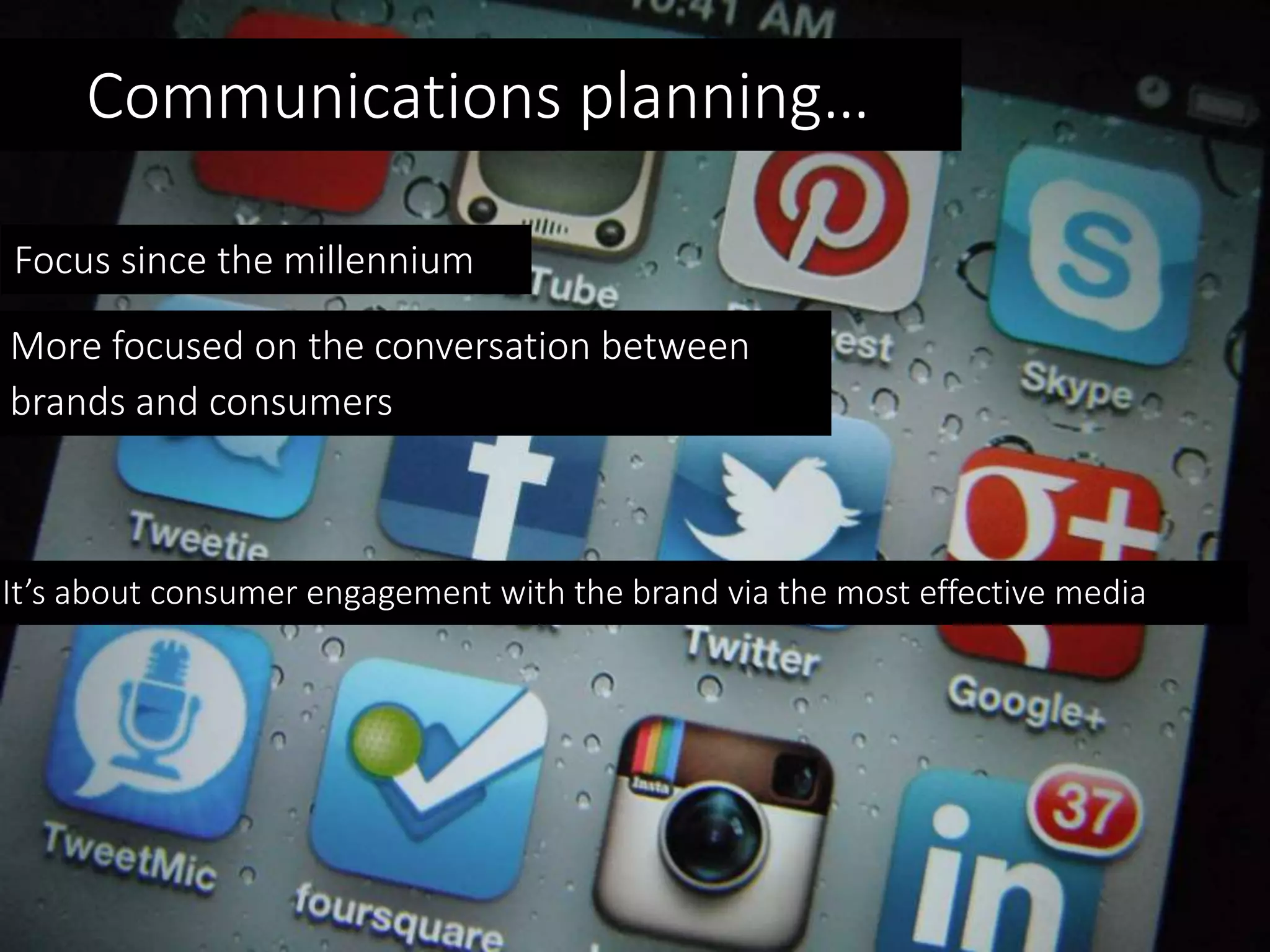
Communications planning…
Focus since the millennium
More focused on the conversation between
brands and consumers
It’s about consumer engagement with the brand via the most effective media
Media neutral planning…
Media-free focus… a more open planning
approach
A relatively recent evolution in media planning
The ‘big idea’ comes first and the media fit around it… traditional
and non-traditional
At first the focus was more on digital media but actually…
…it needs to be integrated
Integration…
The IPA commissioned research into how campaigns use integration…
No integration… either one channel focus or an uncontrolled merging
Participation-led… focuses on dialogue, experience and conversation
Advertising-led… integration via a common creative platform
Brand idea-led… unified by a shared brand concept and/or message
Cox, 2011
References and reading
Burtenshaw, K., Mahon, N. and Barfoot, C. (2006). The Fundamentals of Creative Advertising.
Switzerland: AVA Publishing.
Burton, Gollins, McNeely and Walls, (2019) Revisiting the Relationship between Ad Frequency
and Purchase Intentions: How Affect and Cognition Mediate Outcomes At Different Levels of
Advertising Frequency. Journal of Advertising Research, Vol 59:1
Kate Cox and Denise Turner, (September 2011) New models of integration: Plugging the
advertising effectiveness gap. Warc Exclusive, Advertising Research.
De Pelsmaker, P., Geuens, M. and Van den Bergh, J. (2015) Marketing Communications: A
European Perspective. Harlow: FT Prentice Hall
Fletcher, W. (2010) Advertising: a very short introduction. Oxford: Oxford University Press.
Percy, L. and Elliott, R. (2016) Strategic Advertising Management. Oxford, Oxford University
Press.
Shimp, T. (2007) Integrated Marketing Communications in Advertising and Promotion. USA:
Cengage.
Yeshin, T. (2006). Advertising. London, Thomson

MPP lecture 7

  • 1.
    Media Planning Project mediaplanning concepts… 7
  • 2.
    Have knowledge andunderstanding of regulations, legislation and media consumption Category spend two key skills of media planners… Should be able to judge the communications efforts of the competition ONE… TWO… Share of Voice Media Mix
  • 3.
    media planning… media selectionhas become increasingly complex …this activity is primarily tactical… …there is always a ‘trade-off’ between… reach …arguably this all has to be done within the budget Percy and Rosenbaum-Elliott, 2016 frequency scheduling
  • 4.
    media planning… coverage Yeshin, 2006,considers this in a slightly different way, as a balance between… …there is never enough budget to maximise the two …in media planning we need to maximise advertising effectiveness through careful balancing frequency
  • 6.
    key concepts… frequency Howmany times a consumer within the target audience is expected to be exposed to the message within a certain time period So… how do we determine frequency? Yeshin, 2006, states that “there is no consensus as to the ‘correct’ number of exposures that an advertising campaign should seek to achieve …what the media planner strives towards is known as… Effective frequency De Pelsmaker, et.al., 2017
  • 7.
    frequency and effectiveness… Thereneeds to be a balance between “wear-in” and “wear-out” Wear-out results in negative responses… such as irritation… High exposure is beneficial as it can… Makes attitudes more accessible and increases confidence in that attitude Leads to greater front of mind awareness …so minor tweaks to content can be beneficial to overcome this Make the message more memorable and increase brand recall Can be a signal for brand quality Increases believability of claims De Pelsmaker, et.al., 2017
  • 8.
    frequency and effectiveness… adeffectiveness… Frequency of repetition Wear-out Wear-in Two Factor Model, De Pelsmaker, et.al., 2017
  • 9.
    frequency Yeshin cites researchfrom Krugman (1972) who put forward that a consumer only requires 3 exposures for the effect to be achieved He also cites Philip Jones (1995) who argues that sales are achieved from one exposure It is important to note that frequency of exposure should vary by age… increasing frequency as the audience gets older (Dubow, 1995)
  • 10.
    frequency Optimal, effective frequencyis linked to… The type of message used – format, appeal, content The level of competition The advertising objective The product category The target audience The media being used
  • 11.
  • 12.
    frequency in adigital age… Harder to reach audiences due to mass audience decline, ad avoidance and multi-tasking behaviour Frequency has become increasingly problematic …and over-exposure damages trust and wastes resources WARC, 2019
  • 13.
    Increased exposure Increasedpurchase intentions 1-2 ad exposures 3-10 ad exposures 10+ ad exposures Psychological Process… The ad’s ability to evoke emotion motivates the consumer to pay ATTENTION Psychological Process… Cognitive thoughts about the ad drive PURCHASE CONSIDERATION and EVALUATION Psychological Process… Ad’s ability to evoke emotion motivates the consumer to take ACTION Model of the relationship between advertisement exposure and consumers’ purchase intentions Burton, et.al., 2019
  • 14.
    reach… another key conceptto consider… Total reach is the number or percentage of people who we can expect to be exposed to the message during the scheduled time frame However, it is more beneficial to consider useful reach So, TV may have higher total reach but specialist press would have more useful reach It equates to how many consumers from the target audience are likely to see the message (adapted from De Pelsmaker et.a.l., 2017)
  • 15.
    reach We may alsoconsider gross reach… used when the campaign utilises a media mix Radio TV A B C (A+B) + (B+C) = Gross Reach (adapted from De Pelsmaker et.a.l., 2015) A+B+C = Reach
  • 16.
    Reach… A more commonlyused measure is opportunities to see… OTS This is the average probability of exposure that the target audience has This links to Gross Rating Points… GRP’s You divide gross reach by reach… simple! Links to impressions which is total number of OTS
  • 17.
    GRP’s Also a scoreof 450 GRP… could be a result of 18 exposures to 25% of the audience or 9 exposures to 50% of the audience Adapted from Yeshin, 2006 multiplied by the number of times shown… frequency of exposure But it doesn’t take into account ‘target’ audiences so well Reach x Frequency = GRP Reach is expressed as a % of total audience exposed to the message…
  • 18.
    effective reach andfrequency… % Reach… FrequencyGraph of effective reach, Belch and Belch, 1993 20 15 10 5 0 1 2 3 4 5 6 7 8 9 10 11 12 13 14 15 16 17 18 No exposure Ineffective exposure Threshold of exposure Reinforcement of effectiveness Excessive exposure Negative exposure
  • 19.
  • 20.
    Other considerations… Brand history,brand share and brand loyalty Usage cycle Target audience education, learning and absorption Marketing factors Purchase cycle Competitive share of voice Yeshin, 2006
  • 21.
    Other considerations… Complexity ofmessage New campaign or continuous Variety and volume of messages Creative factors Message uniqueness Image versus selling Wearout of message Yeshin, 2006
  • 22.
    Other considerations… clutter attention Number ofmedia used Media factors ‘zipping and zapping’ scheduling Repetition of exposure Yeshin, 2006
  • 23.
    Contingency planning… The marketingand media environment is dynamic Variables that have been used in the development of the plan may alter… Change in economic conditions Change in sales Change in competition Ideally the plan should be flexible… so that we can act in response to changes
  • 24.
    methods of mediaplanning… Traditional media planning Channel planning Integrated planning Communications planning Media neutral planning
  • 25.
    Traditional planning… Each channelhas its own audience research methods Concerned with the “older” forms of media… TV, radio, cinema, newspaper, magazines, outdoor Each channel has its own method of scheduling and buying So media planning is conducted by channel in relation to these factors and budget allocated accordingly
  • 26.
    Channel planning… Emerged inthe 1980’s …primarily as a response to the growth and fragmentation of media choice Focused on consumer rather than media… Adopts a holistic approach to ensure there are multiple ‘touchpoints’ with the brand …but you really need to understand the behaviour of the target audience
  • 27.
    Integrated planning… Emerged inthe 1990’s Focuses on the right content, for the right channels linked to a consistent branded approach with no duplication Being more effective with a limited budget There is more of a long-term strategic focus here as opposed to a short-term campaign
  • 28.
    Communications planning… Focus sincethe millennium More focused on the conversation between brands and consumers It’s about consumer engagement with the brand via the most effective media
  • 29.
    Media neutral planning… Media-freefocus… a more open planning approach A relatively recent evolution in media planning The ‘big idea’ comes first and the media fit around it… traditional and non-traditional At first the focus was more on digital media but actually… …it needs to be integrated
  • 30.
    Integration… The IPA commissionedresearch into how campaigns use integration… No integration… either one channel focus or an uncontrolled merging Participation-led… focuses on dialogue, experience and conversation Advertising-led… integration via a common creative platform Brand idea-led… unified by a shared brand concept and/or message Cox, 2011
  • 31.
    References and reading Burtenshaw,K., Mahon, N. and Barfoot, C. (2006). The Fundamentals of Creative Advertising. Switzerland: AVA Publishing. Burton, Gollins, McNeely and Walls, (2019) Revisiting the Relationship between Ad Frequency and Purchase Intentions: How Affect and Cognition Mediate Outcomes At Different Levels of Advertising Frequency. Journal of Advertising Research, Vol 59:1 Kate Cox and Denise Turner, (September 2011) New models of integration: Plugging the advertising effectiveness gap. Warc Exclusive, Advertising Research. De Pelsmaker, P., Geuens, M. and Van den Bergh, J. (2015) Marketing Communications: A European Perspective. Harlow: FT Prentice Hall Fletcher, W. (2010) Advertising: a very short introduction. Oxford: Oxford University Press. Percy, L. and Elliott, R. (2016) Strategic Advertising Management. Oxford, Oxford University Press. Shimp, T. (2007) Integrated Marketing Communications in Advertising and Promotion. USA: Cengage. Yeshin, T. (2006). Advertising. London, Thomson