Advertising media
A source to deliver the advertising message
It helps to carry the idea or message of the “Advertiser”
to the masses or target group
Media Planning
 Media planning refers to an analytical method for
taking media decisions and describes the process of
taking the message across to the target audience at the
right time and place, and using the right media vehicle
Questions???????
1. what is our target audience and how to reach it?
2. How many time should we reach it?
3. When should we reach it?
4. Where should we reach it?
5. At what cost should we reach it?
“Media planning is the process designing a course of
action that shows how advertising funds will be used
in purchasing time and space and how they all should
be utilized to contribute for achieving different
objectives of advertising”
“Media planning means taking decisions about the
selection of a media type and the media vehicle”
MEDIA PLANNING
 To decide which media to use
 To decide which specific media vehicle to use
 To decide how to use the media
 To decide when to use them
 To decide where to use them
Good reach ability
Attractive
Cost-effective
Mathematical model
 Liner programming
 Inter-action
 Simulation models
Concept Of Media Planning
• Situation
• Marketing objective
• Marketing strategy
• Action plan
Marketing
plan
• Promotional strategy
• Advertising objectives
• Advertising strategy
• Creative execution budget
Advertising
plan
• Media objectives
• Media strategy
• Media vehicles
• Media schedule
Media plan
Different method of advertising
media
Media of
advertisement
Printer press
media
Newspapers
Magazines &
journal
Broad cast
media
Radio Television
Print media
 NEWS PAPER ADVERTISING
 MAGAZINE &JOURNALS
Newspaper Advertising
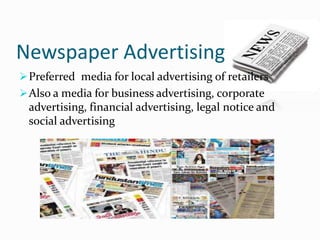
Preferred media for local advertising of retailers
Also a media for business advertising, corporate
advertising, financial advertising, legal notice and
social advertising
Newspaper Advertising
©2005 Pearson Education Canada Inc. 5-20
Local market circulation and readership make newspapers an
attractive medium.
1. Newspapers are ideal for a “key market” media strategy.
2. Newspapers are attractive to national advertisers, and national
and local retailers.
3. Newspapers offer “merchandising” opportunities.
FEATURES
 Types
 Page size
 Audience
 Market
Types of news paper advertising
 Co-operative advertising
 Classified ads
 Pre-printed ads
Planning newspaper ad
 Circulation and readership
 Newspaper ad rate
 Placing the ad in the newspapers
Disadvantages of newspapers
 Having a very short life
 Limited coverage
 Advertisement may go unnoticed
 Suffer s from literacy barrier
 Lack of art work
 Lack of drama &emotion
 Demonstration of product features not effective
 Overtaken by TV in speed
 Average time devoted to news paper reading is very
low
Advantages
1. It is flexible &timely
2. High choice of market
3. Repetitive value
4. Prompt response
5. Message received at home in a relaxed atmosphere
6. Trusted
7. Regular attention
8. Detailed coverage
9. Written words has more credibility
10. Reader loyalty
Magazine Advertising
©2005 Pearson Education Canada Inc. 5-27
Magazines are excellent at targeting precisely defined audiences.
1. Magazines are a “class” medium instead of a “mass”medium.
2. The clustering of ads has a negative influence on message
impact.
3. Magazines are ideal for “profile matching” media strategies.
MAGAZINES & JOURNALS
Published weekly, monthly, quarterly or even annually
Generally read at leisure and with attention
Effective shelf life
general magazines
specialized magazines
special issues
Advantages
1. Meant for a special group of readers
2. Have got a large shelf life
3. Better presentation and display
4. Good number of subscribers
5. Helpful in giving publicity to firms name
Disadvantages
1. Having a high cost
2. Lack of flexibility
3. Limited circulation
4. Limited coverage
5. Not suitable for certain ads
Assessing Media Alternatives
©2005 Pearson Education Canada Inc. 5-31
Medium Pro Con
Newspaper Local Reach Short Life
Key Market Coverage Clutter
Magazine Targeting Clutter
Message Quality Low Frequency
Other forms
 Inland letters
 Post cards
 Water &telephone bill
 Telephone directory
 Electricity bill
 Carry bags
 Match bags
 Gift items
Radio Advertising
©2005 Pearson Education Canada Inc. 5-35
In radio all decisions are usually based on demographics.
1. Station format determines the audience profile.
2. Radio is ideal for reaching targets defined by age.
3. Radio is an important medium if a “key market” strategy is
recommended.
STRENGTH
 Offering local coverage
 Reaching the masses
 Daily frequency
 Repeatedly
 Uneducated villages
Weakness
 audio medium only
Operational limitations
Limited commercial time available
Limited availability of commercial radio
Advantages
 Provide message at home
 Needs less efforts on the part of listeners
 Elements of flexibility and time
 Allow message to masses
 Economical media
Disadvantages
 Requires repetition
 Unsuitable for certain products
 Having no pictorial representation
 It is perishable in nature
TELEVISION ADVERTISING
TV Advertising Alternatives
©2005 Pearson Education Canada Inc. 5-41
Factors such as the budget available and market coverage priorities
influence television decisions. TV is expensive.
• Network Spots
• Selective Spots
• Local Spots
• Sponsorships
• Branded Content
ADVANTAGES
1. Emotional context
2. Image building
3. Creative use of environment and mental make-up of
viewers
4. Evocation of experience
5. Familiar and friendly voice
6. Excellent quality of production
7. High on credibility
8. Larger than life image
Disadvantages
1. Too much viewing bad for eyes
2. Too much sex and violence
3. An immobile medium
4. Difficulty to gain enquiries
Assessing Media Alternatives
©2005 Pearson Education Canada Inc. 5-44
Medium Pro Con
Television Impact High Cost
Reach Clutter
Radio Targeting Fragmentation
Frequency Message (Sound only)
The strengths and weaknesses of all media options are evaluated.
TYPES OF ADVERTISEMENT MEDIA

TYPES OF ADVERTISEMENT MEDIA

  • 3.
    Advertising media A sourceto deliver the advertising message It helps to carry the idea or message of the “Advertiser” to the masses or target group
  • 4.
    Media Planning  Mediaplanning refers to an analytical method for taking media decisions and describes the process of taking the message across to the target audience at the right time and place, and using the right media vehicle
  • 5.
    Questions??????? 1. what isour target audience and how to reach it? 2. How many time should we reach it? 3. When should we reach it? 4. Where should we reach it? 5. At what cost should we reach it?
  • 6.
    “Media planning isthe process designing a course of action that shows how advertising funds will be used in purchasing time and space and how they all should be utilized to contribute for achieving different objectives of advertising” “Media planning means taking decisions about the selection of a media type and the media vehicle”
  • 7.
    MEDIA PLANNING  Todecide which media to use  To decide which specific media vehicle to use  To decide how to use the media  To decide when to use them  To decide where to use them
  • 8.
  • 9.
    Mathematical model  Linerprogramming  Inter-action  Simulation models
  • 11.
    Concept Of MediaPlanning • Situation • Marketing objective • Marketing strategy • Action plan Marketing plan • Promotional strategy • Advertising objectives • Advertising strategy • Creative execution budget Advertising plan • Media objectives • Media strategy • Media vehicles • Media schedule Media plan
  • 16.
    Different method ofadvertising media Media of advertisement Printer press media Newspapers Magazines & journal Broad cast media Radio Television
  • 17.
    Print media  NEWSPAPER ADVERTISING  MAGAZINE &JOURNALS
  • 19.
    Newspaper Advertising Preferred mediafor local advertising of retailers Also a media for business advertising, corporate advertising, financial advertising, legal notice and social advertising
  • 20.
    Newspaper Advertising ©2005 PearsonEducation Canada Inc. 5-20 Local market circulation and readership make newspapers an attractive medium. 1. Newspapers are ideal for a “key market” media strategy. 2. Newspapers are attractive to national advertisers, and national and local retailers. 3. Newspapers offer “merchandising” opportunities.
  • 21.
    FEATURES  Types  Pagesize  Audience  Market
  • 22.
    Types of newspaper advertising  Co-operative advertising  Classified ads  Pre-printed ads
  • 23.
    Planning newspaper ad Circulation and readership  Newspaper ad rate  Placing the ad in the newspapers
  • 24.
    Disadvantages of newspapers Having a very short life  Limited coverage  Advertisement may go unnoticed  Suffer s from literacy barrier  Lack of art work  Lack of drama &emotion  Demonstration of product features not effective  Overtaken by TV in speed  Average time devoted to news paper reading is very low
  • 25.
    Advantages 1. It isflexible &timely 2. High choice of market 3. Repetitive value 4. Prompt response 5. Message received at home in a relaxed atmosphere 6. Trusted 7. Regular attention 8. Detailed coverage 9. Written words has more credibility 10. Reader loyalty
  • 27.
    Magazine Advertising ©2005 PearsonEducation Canada Inc. 5-27 Magazines are excellent at targeting precisely defined audiences. 1. Magazines are a “class” medium instead of a “mass”medium. 2. The clustering of ads has a negative influence on message impact. 3. Magazines are ideal for “profile matching” media strategies.
  • 28.
    MAGAZINES & JOURNALS Publishedweekly, monthly, quarterly or even annually Generally read at leisure and with attention Effective shelf life general magazines specialized magazines special issues
  • 29.
    Advantages 1. Meant fora special group of readers 2. Have got a large shelf life 3. Better presentation and display 4. Good number of subscribers 5. Helpful in giving publicity to firms name
  • 30.
    Disadvantages 1. Having ahigh cost 2. Lack of flexibility 3. Limited circulation 4. Limited coverage 5. Not suitable for certain ads
  • 31.
    Assessing Media Alternatives ©2005Pearson Education Canada Inc. 5-31 Medium Pro Con Newspaper Local Reach Short Life Key Market Coverage Clutter Magazine Targeting Clutter Message Quality Low Frequency
  • 32.
    Other forms  Inlandletters  Post cards  Water &telephone bill  Telephone directory  Electricity bill  Carry bags  Match bags  Gift items
  • 35.
    Radio Advertising ©2005 PearsonEducation Canada Inc. 5-35 In radio all decisions are usually based on demographics. 1. Station format determines the audience profile. 2. Radio is ideal for reaching targets defined by age. 3. Radio is an important medium if a “key market” strategy is recommended.
  • 36.
    STRENGTH  Offering localcoverage  Reaching the masses  Daily frequency  Repeatedly  Uneducated villages
  • 37.
    Weakness  audio mediumonly Operational limitations Limited commercial time available Limited availability of commercial radio
  • 38.
    Advantages  Provide messageat home  Needs less efforts on the part of listeners  Elements of flexibility and time  Allow message to masses  Economical media
  • 39.
    Disadvantages  Requires repetition Unsuitable for certain products  Having no pictorial representation  It is perishable in nature
  • 40.
  • 41.
    TV Advertising Alternatives ©2005Pearson Education Canada Inc. 5-41 Factors such as the budget available and market coverage priorities influence television decisions. TV is expensive. • Network Spots • Selective Spots • Local Spots • Sponsorships • Branded Content
  • 42.
    ADVANTAGES 1. Emotional context 2.Image building 3. Creative use of environment and mental make-up of viewers 4. Evocation of experience 5. Familiar and friendly voice 6. Excellent quality of production 7. High on credibility 8. Larger than life image
  • 43.
    Disadvantages 1. Too muchviewing bad for eyes 2. Too much sex and violence 3. An immobile medium 4. Difficulty to gain enquiries
  • 44.
    Assessing Media Alternatives ©2005Pearson Education Canada Inc. 5-44 Medium Pro Con Television Impact High Cost Reach Clutter Radio Targeting Fragmentation Frequency Message (Sound only) The strengths and weaknesses of all media options are evaluated.