Source, Message, and Channel Factors
  Chapter 6                                                Group 8
  Advertising And Promotion, 6/E - Belch                   Integrated Marketing Communications

Aditya GSN   Indrajit Bage   N Krishna Chaitanya   Neeraj Panghal   Prateek Jaiswal   Silpa Kamath
Chapter Objectives
• To study the major variables in the communication system and how they
  influence consumers’ processing of promotional messages.

• To examine the considerations involved in selecting a source or
  communicator of a promotional message.

• To examine different types of message structures and appeals that can
  be used to develop a promotional message.

• To consider how the channel or medium used to deliver a promotional
  message influences the communication process.
Promotional Planning through the
Persuasion Matrix
•   Persuasion matrix helps marketers see how each controllable element interacts with
    the consumer’s response process.
•   The matrix has two sets of variables. Independent variables are the controllable
    components of the communication process. Dependent variables are the steps a
    receiver goes through in being persuaded.
Source Factors
Source means the person involved in communicating a marketing message, either directly or
indirectly.
A direct source is a spokesperson who delivers a message and/or demonstrates a product or
service. An indirect source, say, a model, doesn’t actually deliver a message but draws attention to
and/or enhances the appearance of the ad.


 Source Credibility
          Credibility is the extent to which the recipient sees the source as      having
relevant knowledge, skill, or experience and trusts the source           to give unbiased,
objective information. There are two important dimensions to credibility, expertise
and trustworthiness.
          Low credibility source may be as effective as a high credibility source
          is the sleeper effect, whereby the persuasiveness of a message
          increases with the passage of time.
Source Factors
 Source Attractiveness
       A source characteristic frequently used by advertisers is attractiveness, which
       encompasses similarity, familiarity and likability.
       Similarity is a supposed resemblance between the source and the receiver of the
       message, while familiarity refers to knowledge of the source through exposure.
       Likability is an affection for the source as a result of physical appearance, behaviour, or
       other personal traits.
       Overshadowing the Product, Overexposure, Target Audiences Receptivity , Risk to the
       advertiser are ways to apply Likability.
 Source Power
       A source has power when he or she can actually administer rewards and punishments to
       the receiver. As a result of this power, the source may be able to induce another person
       to respond to the request or position he or she is advocating.
       The power of the source depends on several factors. The source must be perceived as
       being able to administer positive or negative sanctions to the receiver (perceived control)
       and the receiver must think the source cares about whether or not the receiver conforms
       (perceived concern). The receiver’s estimate of the source’s ability to observe conformity
       is also important (perceived scrutiny).
Message Factors
 Message Structure
       Marketing communications usually consist of a number of message points
       that the communicator wants to get across. An important aspect of message
       strategy is knowing the best way to communicate these points and overcome
       any opposing viewpoints audience members may hold.
       Order of Presentation
                Presenting the strongest arguments at the beginning of the message
                assumes a primacy effect is operating, whereby information
                presented first is most effective. Putting the strong points at the
                end assumes a recency effect, whereby the last arguments
                presented are most persuasive effect.
       Conclusion Drawing
                 Marketing communicators must decide whether their messages
                should explicitly draw a firm conclusion or allow receivers to draw
                their own conclusions.
Message Factors
 Message Structure
      Message Sidedness
             Another message structure decision facing the market involves
             message sidedness. A one-sided message mentions only positive
             attributes or benefits. A two-sided message presents both good and
             bad points. One-sided messages are most effective when the target
             audience already holds a favourable opinion about the topic. They
             also work better with a less educated audience.


       Refutation
              An a special type of two-sided message known as a refutational
             appeal, the communicator presents both sides of an issue and
             then refutes the opposing viewpoint. Since refutational appeals
             tend to “inoculate” the target Audience against a competitor’s
             counterclaims, they are more effective than one-sided messages In
             making consumers resistant to an opposing message.
Message Factors
 Message Appeals
      Comparative Advertising
             Comparative advertising is the practice of either directly or
             indirectly naming competitors in an ad and comparing one or more
             specific attributes. Comparative advertising may be particularly
             useful for new brands, since it allows a new market entrant to
             position itself directly against the more established brands and to
             promote its distinctive advantages.
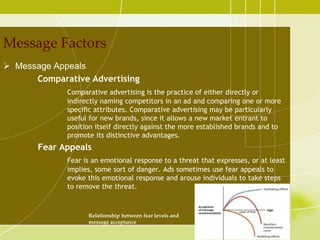
       Fear Appeals
             Fear is an emotional response to a threat that expresses, or at least
             implies, some sort of danger. Ads sometimes use fear appeals to
             evoke this emotional response and arouse individuals to take steps
             to remove the threat.


                   Relationship between fear levels and
                   message acceptance
Message Factors
 Message Appeals
      Humour Appeals
            Humorous ads are often the best known and best remembered of all
            advertising messages.
             Advertisers use humour for many reasons. Humorous messages
            attract and hold consumers’ attention. They enhance effectiveness
            by putting consumers in a positive mood, increasing their liking of
            the ad itself and their feeling toward the product or service. And
            humour can distract the receiver from counter arguing against the
            message.
Channel Factors
 Personal versus Non personal Channels
       There are a number of basic differences between personal and non personal
       communications channels. Information received from personal influence
       channels is generally more persuasive than information received via the
       mass media.
 Effects of Alternative Mass Media
       The various mass media that advertisers use to transmit their messages
       differ in many ways, including the number and type of people they reach,
       costs, information processing requirements, and qualitative factors.
        Differences in Information Processing
       There are basic differences in the manner and rate at which information from
       various forms of media is transmitted and can be processed. Information from
       ads in print media, such as newspapers, magazines, or direct mail, is self
       paced; readers process the ad at their own rate and can study it as long as
       they desire. In contrast, information from the broadcast media of radio and
       television is externally paced; the transmission rate is controlled by the
       medium.
Channel Factors
 Effects of Context and Environment
       A qualitative media effect is the influence the medium has on a message.
       The image of the media vehicle can affect reactions to the message.
       A media environment can also be created by the nature of the program in
       which a commercial appears.
 Clutter
        Another aspect of the media environment, which is important to advertisers,
       is the problem of clutter, which has been defined as the amount of
       advertising in a medium.
Source, Message, and Channel Factors

Source, Message, and Channel Factors

  • 1.
    Source, Message, andChannel Factors Chapter 6 Group 8 Advertising And Promotion, 6/E - Belch Integrated Marketing Communications Aditya GSN Indrajit Bage N Krishna Chaitanya Neeraj Panghal Prateek Jaiswal Silpa Kamath
  • 2.
    Chapter Objectives • Tostudy the major variables in the communication system and how they influence consumers’ processing of promotional messages. • To examine the considerations involved in selecting a source or communicator of a promotional message. • To examine different types of message structures and appeals that can be used to develop a promotional message. • To consider how the channel or medium used to deliver a promotional message influences the communication process.
  • 3.
    Promotional Planning throughthe Persuasion Matrix • Persuasion matrix helps marketers see how each controllable element interacts with the consumer’s response process. • The matrix has two sets of variables. Independent variables are the controllable components of the communication process. Dependent variables are the steps a receiver goes through in being persuaded.
  • 4.
    Source Factors Source meansthe person involved in communicating a marketing message, either directly or indirectly. A direct source is a spokesperson who delivers a message and/or demonstrates a product or service. An indirect source, say, a model, doesn’t actually deliver a message but draws attention to and/or enhances the appearance of the ad.  Source Credibility Credibility is the extent to which the recipient sees the source as having relevant knowledge, skill, or experience and trusts the source to give unbiased, objective information. There are two important dimensions to credibility, expertise and trustworthiness. Low credibility source may be as effective as a high credibility source is the sleeper effect, whereby the persuasiveness of a message increases with the passage of time.
  • 5.
    Source Factors  SourceAttractiveness A source characteristic frequently used by advertisers is attractiveness, which encompasses similarity, familiarity and likability. Similarity is a supposed resemblance between the source and the receiver of the message, while familiarity refers to knowledge of the source through exposure. Likability is an affection for the source as a result of physical appearance, behaviour, or other personal traits. Overshadowing the Product, Overexposure, Target Audiences Receptivity , Risk to the advertiser are ways to apply Likability.  Source Power A source has power when he or she can actually administer rewards and punishments to the receiver. As a result of this power, the source may be able to induce another person to respond to the request or position he or she is advocating. The power of the source depends on several factors. The source must be perceived as being able to administer positive or negative sanctions to the receiver (perceived control) and the receiver must think the source cares about whether or not the receiver conforms (perceived concern). The receiver’s estimate of the source’s ability to observe conformity is also important (perceived scrutiny).
  • 6.
    Message Factors  MessageStructure Marketing communications usually consist of a number of message points that the communicator wants to get across. An important aspect of message strategy is knowing the best way to communicate these points and overcome any opposing viewpoints audience members may hold. Order of Presentation Presenting the strongest arguments at the beginning of the message assumes a primacy effect is operating, whereby information presented first is most effective. Putting the strong points at the end assumes a recency effect, whereby the last arguments presented are most persuasive effect. Conclusion Drawing Marketing communicators must decide whether their messages should explicitly draw a firm conclusion or allow receivers to draw their own conclusions.
  • 7.
    Message Factors  MessageStructure Message Sidedness Another message structure decision facing the market involves message sidedness. A one-sided message mentions only positive attributes or benefits. A two-sided message presents both good and bad points. One-sided messages are most effective when the target audience already holds a favourable opinion about the topic. They also work better with a less educated audience. Refutation An a special type of two-sided message known as a refutational appeal, the communicator presents both sides of an issue and then refutes the opposing viewpoint. Since refutational appeals tend to “inoculate” the target Audience against a competitor’s counterclaims, they are more effective than one-sided messages In making consumers resistant to an opposing message.
  • 8.
    Message Factors  MessageAppeals Comparative Advertising Comparative advertising is the practice of either directly or indirectly naming competitors in an ad and comparing one or more specific attributes. Comparative advertising may be particularly useful for new brands, since it allows a new market entrant to position itself directly against the more established brands and to promote its distinctive advantages. Fear Appeals Fear is an emotional response to a threat that expresses, or at least implies, some sort of danger. Ads sometimes use fear appeals to evoke this emotional response and arouse individuals to take steps to remove the threat. Relationship between fear levels and message acceptance
  • 9.
    Message Factors  MessageAppeals Humour Appeals Humorous ads are often the best known and best remembered of all advertising messages. Advertisers use humour for many reasons. Humorous messages attract and hold consumers’ attention. They enhance effectiveness by putting consumers in a positive mood, increasing their liking of the ad itself and their feeling toward the product or service. And humour can distract the receiver from counter arguing against the message.
  • 10.
    Channel Factors  Personalversus Non personal Channels There are a number of basic differences between personal and non personal communications channels. Information received from personal influence channels is generally more persuasive than information received via the mass media.  Effects of Alternative Mass Media The various mass media that advertisers use to transmit their messages differ in many ways, including the number and type of people they reach, costs, information processing requirements, and qualitative factors. Differences in Information Processing There are basic differences in the manner and rate at which information from various forms of media is transmitted and can be processed. Information from ads in print media, such as newspapers, magazines, or direct mail, is self paced; readers process the ad at their own rate and can study it as long as they desire. In contrast, information from the broadcast media of radio and television is externally paced; the transmission rate is controlled by the medium.
  • 11.
    Channel Factors  Effectsof Context and Environment A qualitative media effect is the influence the medium has on a message. The image of the media vehicle can affect reactions to the message. A media environment can also be created by the nature of the program in which a commercial appears.  Clutter Another aspect of the media environment, which is important to advertisers, is the problem of clutter, which has been defined as the amount of advertising in a medium.