MEDIA STRATEGY – AN INTRODUCTION
BY AAMIR ABBASI-IOBM
Media Planning
Basic Parameters of a Media Plan
Reach
Number of target audience individuals exposed to advertising or
promotion in an advertising cycle.
Effective reach - % of target audience reached by the vehicle
Frequency
Number of exposures per individual target audience member in an
advertising cycle.
Threshold / effective frequency – level of frequency below which
the person would not have been effectively reached - at least 3
exposures
Number of advertising cycles during the year.
Over the entire planning period – one year – 3 months – 1 month.
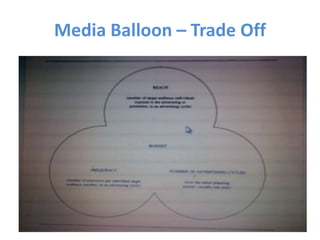
Media Balloon with 3 Ears
• A media plan with fixed budget can be
strategically designed to reach a lot of people
few times or a few people a lot of times.
• Imagine a 3 ear balloon (Reach, Frequency and
No of advertising cycles in a year) is tied off means
The budget is fixed, the media planner can not
make one ear bigger with out squeezing the
other.
Media Balloon – Trade Off
• If the media strategy calls for increase in reach, so
you scatter budget and advertising exposure to
many media types such as TV, Radio, Newspaper,
Magazines, Websites, Social Media etc.
• But if the media strategy calls for increased
frequency i.e same individual getting more
interaction with your ad, you will focus your
budget on single outlet. A magazine, Particular
program on a TV Channel.
Frequency Vs Reach
It is better to sell some people completely than
many people not at all.
When you try to sell it to everyone you end up
selling it to none.
Effects of Reach and Frequency
1. One exposure of an ad to a target group within a
purchase cycle has little or no effect in most
circumstances.
2. Since one exposure is usually ineffective, the central
objective of productive media planning should be to
enhance frequency rather than reach.
3. The evidence suggests strongly that an exposure
frequency of two within a purchase cycle is an effective
level.
4. Beyond three exposures within a brand purchase cycle
or over a period of four or even eight weeks, increasing
frequency continues to build advertising effectiveness
at a decreasing rate but with no evidence of decline.
Effects of Reach and Frequency
5. Although there are general principles with
respect to frequency of exposure and its
relationship to advertising
effectiveness, differential effects by brand are
equally important
6. The data strongly suggest that wearout is not
a function of too much frequency. It is more
of a creative or copy problem.
Marketing Factors Important to
Determining Frequency
Brand history
Brand age
Brand share
Brand loyalty
Purchase cycles
Usage cycle
Competitive share of voice
Target group
Creative Factors Important to
Determining Frequency
 Message complexity
 Message uniqueness
 New vs. continuing campaigns
 Image versus product sell
 Message variation
Media Factors Important to
Determining Frequency
 Clutter
 Editorial environment
 Attentiveness
 Scheduling
 Number of media used
 Repeat Exposures
The Trade off between
Reach & Frequency
– Reach is more important when gaining awareness
for a new product
– Frequency is more important when
communicating product details or building Brand
Attitude (needs more exposures)
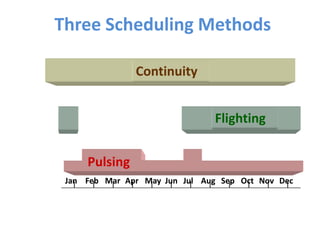
Three Scheduling Methods
Continuity
Pulsing
Flighting
Jan Feb Mar Apr May Jun Jul Aug Sep Oct Nov Dec
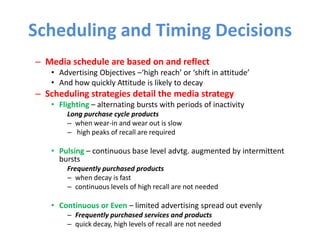
Scheduling and Timing Decisions
– Media schedule are based on and reflect
• Advertising Objectives –‘high reach’ or ‘shift in attitude’
• And how quickly Attitude is likely to decay
– Scheduling strategies detail the media strategy
• Flighting – alternating bursts with periods of inactivity
Long purchase cycle products
– when wear-in and wear out is slow
– high peaks of recall are required
• Pulsing – continuous base level advtg. augmented by intermittent
bursts
Frequently purchased products
– when decay is fast
– continuous levels of high recall are not needed
• Continuous or Even – limited advertising spread out evenly
– Frequently purchased services and products
– quick decay, high levels of recall are not needed
Developing the Media Plan
Following areas are strongly interlinked:
• Situation / Environment Analysis
• Marketing Strategy Plan
• Advertising Strategy Plan
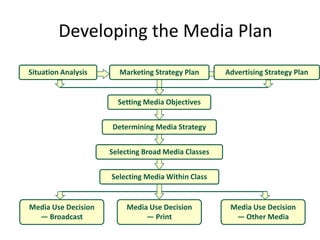
Media Use Decision
— Print
Media Use Decision
— Broadcast
Media Use Decision
— Other Media
Advertising Strategy Plan
Developing the Media Plan
Setting Media Objectives
Selecting Media Within Class
Selecting Broad Media Classes
Determining Media Strategy
Marketing Strategy PlanSituation Analysis
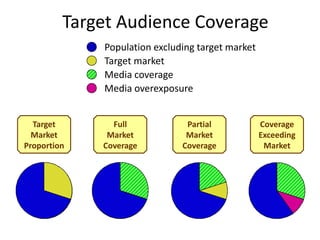
Target Audience Coverage
Population excluding target market
Target market
Media coverage
Media overexposure
Coverage
Exceeding
Market
Partial
Market
Coverage
Full
Market
Coverage
Target
Market
Proportion
Media Planning
Lectures 1 & 2.
Why Media Planning
• Mushroom growth in electronic and print media.
• 10 years back there was PTV and Radio Pakistan only.
Now there are around 70 TV channels and umpteen
radio options.
• Newspapers were Jang, Nawa e waqt, Dawn, Business
Recorder and Nation mainly.
• Budgets dwindling but the desire for exposure is
going up.
• TV Channels and newspapers are very expensive.
• TV Channels and newspapers are showing too much
flexibility.
• This becomes more tricky for companies which are
serving in small/limited territories.
Why Media Planning
• But the most important point is the change in
the profile of the owners of media.
• Now they are owned by business groups who
took an entry with either profit making or
political muscle mindset.
• This change has changed everything on media
scene.
Why Media Planning
• What is more important Media Planning or
Creative Execution?
Media Planning Objectives
There are basically two objectives to have a
media plan.
• Value for money!
• “Top of the mind” positioning.
Advertising Spiral
• The following slide encapsulates the
advertising process where media planning has
a crucial role to play.
• WHY?
Advertising Process & Media Planning
• It starts from new idea generation OR need identification.
• Translation of idea into a brief.
o Target markets identification.
o Research data.
o Territories identification
o Nature of the message
• Creative designs / mood boards.
• Presentation and Approvals.
• Media selection.
• Placements.
• Monitoring
• Droppage Reporting.
• Recording and archiving.
Qs to be Answered
• Do you know where your business is coming
from and where the potential for increased
business lies?
• Do you know which markets offer the greatest
opportunity?
• Do you need to reach everybody or only a
select group of consumers?
• How often is the product used?
• How much product loyalty exists? (Which
brand is the most loyal brand in the world?)
Qs to be Answered
• What does the cost benefit analysis say?
• What volumes we are planning to sell?
• Do you want to reach lots of people in a wide
area (to get the most out of your advertising
rupee)? Then mass media, like newspaper and
radio, might work for you. (School example).
• If your target market is a select group in a
defined geographic area, then direct mail and
outdoor media could be your best bet.
Qs to be Answered
• Which schedules work best with different media.
For example, the rule of thumb is that a print ad
must run three times before it gets noticed.
• Similarly Radio and TV advertising is most
effective when run at certain times of the day or
around certain programs, depending on what
market you're trying to reach.
• During which time of the month there is a sales
surge?
Advertising media generally include:
• Television
• Radio
• Newspapers
• Magazines (consumer and trade)
• Outdoor billboards
• Public transportation
• Social media (Facebook, twitter, linkedin, skype etc.)
• Direct mail
• Giveaway items
• Other media (brochures, newsletters and so on)
A Typical Advertising Model
• What is the biggest handicap we advertisers
or advertising agencies face?
• People don’t buy newspapers, watch tv, listen
to radio and Logon to see our advertisement.
• That attitude changed altered a bit the shape
of advertising or you may say it took it to the
next step.
• Advertisement programs.
A Typical Advertising Model
Advertising Objectives
1. Increasing interest
2. Increasing referrals / making way for word of
mouth.
3. Image building
4. Increasing level of usage
5. awareness
A Typical Advertising Model
A. BUYER: Target audience action objectives
B. BRAND: Communication objectives
C. AD(S): Processing objectives
D. MEDIA: Exposure plan
The Target Audience
• So when we are selling, we are selling to that
somebody.
• Now “WHO” is that somebody is what all the
game is all about.
• Following slide will analyze this aspect in
detail and how it would impact our media
planning process.
A Typical Advertising Model
A1- Target Audience
o new category users -- who can be induced to try the
product category via our brand
o brand loyals, who can be induced via new users to use
more of our brand than they use at present.
o brand switchers -- who can be induced to switch to
our brand more frequently than they do at present.
o other-brand loyals - who can be converted to our
brand from loyalty to another. (Forhans, Dentonic
example).
A Typical Advertising Model
Where lies the biggest effort?
A Typical Advertising Model
A2- Decision-Maker
o Identification of the decision-maker within
target audience.
A3- Personal Profile
o Behavioral and attitudinal definition of target
audience.
A Typical Advertising Model
B. Communication Objectives (Brand)
o In order to take action such as purchase of a brand, a
target audience individual must:
o have the category need, i.e., be "in the market" for the
product class;
o be aware of the brand as an option within the class;
o have at least a tentatively favorable brand attitude toward
it;
o intend to buy it, although this intention may be quite
latent or subconscious until the individual is in the
purchase situation; Has that ever happened to you that all
of a sudden you developed interest in the product/brand?
o experience no barriers to purchase facilitation, such as
distribution unavailability or inability to meet the price or
pricing terms. (PEPSI & COCACOLA example)
A Typical Advertising Model
C. Execution Processing (Making an ad)
o Emotional Portrayal (sequence of emotions i.e
your mood board)
o Message to be communicated
o Use of presenter / Brand Ambassador.
A Typical Advertising Model
D. Exposure (Media)
o Media selection
o Media Scheduling
How are the above two different?
Define and plan out your strategy.
You've identified your target market, you've done
your research and you've set your objective. It's
now time to define and create a strategy.
Your plan should contain the following:
• Where will you buy media? Are there specific
outlets you are interested in?
• What is your budget and where can you allocate
that budget, so that you can achieve the
objectives you have identified?
Define and plan out your strategy
• How much will you spend with each outlet
and why?
• What programming is available?
• How long are the breaks?
• How do ratings move in a break?
A Typical Advertising Model
• Advertising actually moved on from traditional
30 and 60 second slots to different modes.
• What are they?
Face of Communication in Pakistan
Mainly there are 6 categories of
communication agencies in Pakistan:
1. Advertising agencies
2. PR agencies
3. Media buying houses
4. Creative houses
5. Digital media agencies
6. Outdoor media agencies
7. Media monitoring agencies
Being media planners we will be dealing with 1,3,6
and 7.

Aamir abbasi IoBM

  • 1.
    MEDIA STRATEGY –AN INTRODUCTION BY AAMIR ABBASI-IOBM Media Planning
  • 2.
    Basic Parameters ofa Media Plan Reach Number of target audience individuals exposed to advertising or promotion in an advertising cycle. Effective reach - % of target audience reached by the vehicle Frequency Number of exposures per individual target audience member in an advertising cycle. Threshold / effective frequency – level of frequency below which the person would not have been effectively reached - at least 3 exposures Number of advertising cycles during the year. Over the entire planning period – one year – 3 months – 1 month.
  • 3.
    Media Balloon with3 Ears • A media plan with fixed budget can be strategically designed to reach a lot of people few times or a few people a lot of times. • Imagine a 3 ear balloon (Reach, Frequency and No of advertising cycles in a year) is tied off means The budget is fixed, the media planner can not make one ear bigger with out squeezing the other.
  • 4.
  • 5.
    Media Balloon –Trade Off • If the media strategy calls for increase in reach, so you scatter budget and advertising exposure to many media types such as TV, Radio, Newspaper, Magazines, Websites, Social Media etc. • But if the media strategy calls for increased frequency i.e same individual getting more interaction with your ad, you will focus your budget on single outlet. A magazine, Particular program on a TV Channel.
  • 6.
    Frequency Vs Reach Itis better to sell some people completely than many people not at all. When you try to sell it to everyone you end up selling it to none.
  • 7.
    Effects of Reachand Frequency 1. One exposure of an ad to a target group within a purchase cycle has little or no effect in most circumstances. 2. Since one exposure is usually ineffective, the central objective of productive media planning should be to enhance frequency rather than reach. 3. The evidence suggests strongly that an exposure frequency of two within a purchase cycle is an effective level. 4. Beyond three exposures within a brand purchase cycle or over a period of four or even eight weeks, increasing frequency continues to build advertising effectiveness at a decreasing rate but with no evidence of decline.
  • 8.
    Effects of Reachand Frequency 5. Although there are general principles with respect to frequency of exposure and its relationship to advertising effectiveness, differential effects by brand are equally important 6. The data strongly suggest that wearout is not a function of too much frequency. It is more of a creative or copy problem.
  • 9.
    Marketing Factors Importantto Determining Frequency Brand history Brand age Brand share Brand loyalty Purchase cycles Usage cycle Competitive share of voice Target group
  • 10.
    Creative Factors Importantto Determining Frequency  Message complexity  Message uniqueness  New vs. continuing campaigns  Image versus product sell  Message variation
  • 11.
    Media Factors Importantto Determining Frequency  Clutter  Editorial environment  Attentiveness  Scheduling  Number of media used  Repeat Exposures
  • 12.
    The Trade offbetween Reach & Frequency – Reach is more important when gaining awareness for a new product – Frequency is more important when communicating product details or building Brand Attitude (needs more exposures)
  • 13.
    Three Scheduling Methods Continuity Pulsing Flighting JanFeb Mar Apr May Jun Jul Aug Sep Oct Nov Dec
  • 14.
    Scheduling and TimingDecisions – Media schedule are based on and reflect • Advertising Objectives –‘high reach’ or ‘shift in attitude’ • And how quickly Attitude is likely to decay – Scheduling strategies detail the media strategy • Flighting – alternating bursts with periods of inactivity Long purchase cycle products – when wear-in and wear out is slow – high peaks of recall are required • Pulsing – continuous base level advtg. augmented by intermittent bursts Frequently purchased products – when decay is fast – continuous levels of high recall are not needed • Continuous or Even – limited advertising spread out evenly – Frequently purchased services and products – quick decay, high levels of recall are not needed
  • 15.
    Developing the MediaPlan Following areas are strongly interlinked: • Situation / Environment Analysis • Marketing Strategy Plan • Advertising Strategy Plan
  • 16.
    Media Use Decision —Print Media Use Decision — Broadcast Media Use Decision — Other Media Advertising Strategy Plan Developing the Media Plan Setting Media Objectives Selecting Media Within Class Selecting Broad Media Classes Determining Media Strategy Marketing Strategy PlanSituation Analysis
  • 17.
    Target Audience Coverage Populationexcluding target market Target market Media coverage Media overexposure Coverage Exceeding Market Partial Market Coverage Full Market Coverage Target Market Proportion
  • 18.
  • 19.
    Why Media Planning •Mushroom growth in electronic and print media. • 10 years back there was PTV and Radio Pakistan only. Now there are around 70 TV channels and umpteen radio options. • Newspapers were Jang, Nawa e waqt, Dawn, Business Recorder and Nation mainly. • Budgets dwindling but the desire for exposure is going up. • TV Channels and newspapers are very expensive. • TV Channels and newspapers are showing too much flexibility. • This becomes more tricky for companies which are serving in small/limited territories.
  • 20.
    Why Media Planning •But the most important point is the change in the profile of the owners of media. • Now they are owned by business groups who took an entry with either profit making or political muscle mindset. • This change has changed everything on media scene.
  • 21.
    Why Media Planning •What is more important Media Planning or Creative Execution?
  • 22.
    Media Planning Objectives Thereare basically two objectives to have a media plan. • Value for money! • “Top of the mind” positioning.
  • 23.
    Advertising Spiral • Thefollowing slide encapsulates the advertising process where media planning has a crucial role to play. • WHY?
  • 24.
    Advertising Process &Media Planning • It starts from new idea generation OR need identification. • Translation of idea into a brief. o Target markets identification. o Research data. o Territories identification o Nature of the message • Creative designs / mood boards. • Presentation and Approvals. • Media selection. • Placements. • Monitoring • Droppage Reporting. • Recording and archiving.
  • 25.
    Qs to beAnswered • Do you know where your business is coming from and where the potential for increased business lies? • Do you know which markets offer the greatest opportunity? • Do you need to reach everybody or only a select group of consumers? • How often is the product used? • How much product loyalty exists? (Which brand is the most loyal brand in the world?)
  • 26.
    Qs to beAnswered • What does the cost benefit analysis say? • What volumes we are planning to sell? • Do you want to reach lots of people in a wide area (to get the most out of your advertising rupee)? Then mass media, like newspaper and radio, might work for you. (School example). • If your target market is a select group in a defined geographic area, then direct mail and outdoor media could be your best bet.
  • 27.
    Qs to beAnswered • Which schedules work best with different media. For example, the rule of thumb is that a print ad must run three times before it gets noticed. • Similarly Radio and TV advertising is most effective when run at certain times of the day or around certain programs, depending on what market you're trying to reach. • During which time of the month there is a sales surge?
  • 28.
    Advertising media generallyinclude: • Television • Radio • Newspapers • Magazines (consumer and trade) • Outdoor billboards • Public transportation • Social media (Facebook, twitter, linkedin, skype etc.) • Direct mail • Giveaway items • Other media (brochures, newsletters and so on)
  • 29.
    A Typical AdvertisingModel • What is the biggest handicap we advertisers or advertising agencies face? • People don’t buy newspapers, watch tv, listen to radio and Logon to see our advertisement. • That attitude changed altered a bit the shape of advertising or you may say it took it to the next step. • Advertisement programs.
  • 30.
    A Typical AdvertisingModel Advertising Objectives 1. Increasing interest 2. Increasing referrals / making way for word of mouth. 3. Image building 4. Increasing level of usage 5. awareness
  • 31.
    A Typical AdvertisingModel A. BUYER: Target audience action objectives B. BRAND: Communication objectives C. AD(S): Processing objectives D. MEDIA: Exposure plan
  • 32.
    The Target Audience •So when we are selling, we are selling to that somebody. • Now “WHO” is that somebody is what all the game is all about. • Following slide will analyze this aspect in detail and how it would impact our media planning process.
  • 33.
    A Typical AdvertisingModel A1- Target Audience o new category users -- who can be induced to try the product category via our brand o brand loyals, who can be induced via new users to use more of our brand than they use at present. o brand switchers -- who can be induced to switch to our brand more frequently than they do at present. o other-brand loyals - who can be converted to our brand from loyalty to another. (Forhans, Dentonic example).
  • 34.
    A Typical AdvertisingModel Where lies the biggest effort?
  • 35.
    A Typical AdvertisingModel A2- Decision-Maker o Identification of the decision-maker within target audience. A3- Personal Profile o Behavioral and attitudinal definition of target audience.
  • 36.
    A Typical AdvertisingModel B. Communication Objectives (Brand) o In order to take action such as purchase of a brand, a target audience individual must: o have the category need, i.e., be "in the market" for the product class; o be aware of the brand as an option within the class; o have at least a tentatively favorable brand attitude toward it; o intend to buy it, although this intention may be quite latent or subconscious until the individual is in the purchase situation; Has that ever happened to you that all of a sudden you developed interest in the product/brand? o experience no barriers to purchase facilitation, such as distribution unavailability or inability to meet the price or pricing terms. (PEPSI & COCACOLA example)
  • 37.
    A Typical AdvertisingModel C. Execution Processing (Making an ad) o Emotional Portrayal (sequence of emotions i.e your mood board) o Message to be communicated o Use of presenter / Brand Ambassador.
  • 38.
    A Typical AdvertisingModel D. Exposure (Media) o Media selection o Media Scheduling How are the above two different?
  • 39.
    Define and planout your strategy. You've identified your target market, you've done your research and you've set your objective. It's now time to define and create a strategy. Your plan should contain the following: • Where will you buy media? Are there specific outlets you are interested in? • What is your budget and where can you allocate that budget, so that you can achieve the objectives you have identified?
  • 40.
    Define and planout your strategy • How much will you spend with each outlet and why? • What programming is available? • How long are the breaks? • How do ratings move in a break?
  • 41.
    A Typical AdvertisingModel • Advertising actually moved on from traditional 30 and 60 second slots to different modes. • What are they?
  • 42.
    Face of Communicationin Pakistan Mainly there are 6 categories of communication agencies in Pakistan: 1. Advertising agencies 2. PR agencies 3. Media buying houses 4. Creative houses 5. Digital media agencies 6. Outdoor media agencies 7. Media monitoring agencies Being media planners we will be dealing with 1,3,6 and 7.