By
Asst professor
Venkatesh.N
 To gain an understanding of the role of advertising within
the Marketing Communications Mix
 To examine communication and advertising theories and
their relationship with consumer behavior
 To develop knowledge of advertising strategy and
planning
 To examine the importance and uses of creativity in
advertising
 To gain an understanding of various production
techniques
 To appreciate the complexities of evaluation
 Although advertising is an accepted part of
every day life, there is still great debate as to
how advertising works and the role it can and
should perform within the marketing
communication mix. This module enables the
applicants to review this debate and apply the
theories to the advertising in our media today.
They will learn how to put together an
advertising plan and will examine the
ingredients of an effective advertisement and
ways in which this effectiveness can be
measured
 According to “Philip Kotler” & American
Marketing Association. The advertising is any
paid form of non personal presentation of
 Ideas
 Goods
 Services by an identified sponsor that is called
Advertising.
 What is a Brand?
 It is a product whose producer has made every
effert to make it uniquely desirable to potential
buyers, consistently using every element in its
presentation to do so.
 Why do companies do this?
 If done well, it makes the brand difficult to
compete against. It develops an aura making it
appear better than its competition.
 A brand is created by all the elements of the
marketing mix working together.
 Creates a positive prejudice in people’s minds.
 Def’n – Marketing Mix: a range of tools and
techniques that allows businesses to provide
customers with what they want. It acts as a
conduit for consumer demand to reach
businesses. Thusly, turning this demand into
profitable sales.
 These tools include:
- Product formulation and variation
- Packaging
- Sales literature
- The sales force
- Pricing
- Sales promotion
- Direct mail
- Advertising
- Market research
- Branding
 Components of the marketing mix
1) Net sales value
2) Costs and contribution
3) The marketing mix
 Gross margin
 Cost of goods
- Materials
- Packaging
- Manufacturing
 Operating contribution
 Selling costs (the marketing mix)
- Sales
- Distribution
- Communications
- Research
 Sales and distribution costs
 The communications mix
- Advertising
- Direct marketing
- Promotions
- Exhibitions
- Etc.
 Simply put: Advertising exists to help to sell
things.
 It is mainly about brands
 It is mainly designed to create and strengthen
consumer impressions of the brand
 Exception is public service advertising
An Advertising Plan Matches the Right
Audience to the Right Message and Presents It
in the Right Medium to Reach That Audience &
Has Three Elements.
Targeting the Audience: Whom are you trying to reach?
Message Strategy: What do you say to them?
Media Strategy: When & where will you reach them?
 The 6M approach
Merchandise: important benefits to sell
Markets: who to reach
Motives: why people buy or fail to buy
Media: how to reach
Measurements: how to evaluate (time and
change)
Messages: key ideas to convey to move
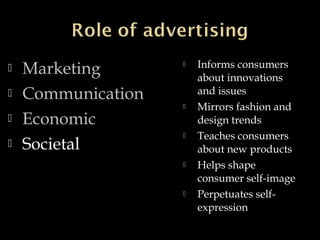
 Marketing
 Communication
 Economic
 Societal
 The process a
business uses to
satisfy consumer
needs by providing
goods and services
 Product category
 Target market
 Marketing mix
 Brand
 Marketing
 Communication
 Economic
 Societal
 Can reach a mass
audience
 Introduces products
 Explains important
changes
 Reminds and
reinforces
 Persuades
 Marketing
 Communication
 Economic
 Societal
 Moves from being
informational to
creating demand
 Advertising is an
objective means for
providing price-
value information,
thereby creating a
more rational
economy
 Marketing
 Communication
 Economic
 Societal
 Informs consumers
about innovations
and issues
 Mirrors fashion and
design trends
 Teaches consumers
about new products
 Helps shape
consumer self-image
 Perpetuates self-
expression
 Advertising is part of total continuum of
communications about the brand. It may have
a leading role and carry the greatest budget:
but it can be merely cast in a supporting role
for a campaign of activity centered around an
event.
 Involves a huge amount of money
 Work is done by relatively few people
 Major expense is for media time/space
 Companies spend only a small percentage of
sales on advertising
 Product advertising—Tries to sell a specific
product to final users or channel members
 Pioneering advertising builds primary demand
 Competitive advertising builds selective demand
 Corporate/institutional advertising—Tries to
promote an organisation's image, reputation or
ideas—rather than a specific product
 Magazine
 Word of mouth
 Television
 Newspaper
 Yellow Pages
 Radio
 Outdoors
 Cinema
 Internet
 Builds awareness of products and brands
 Creates a brand image
 Provides product and brand information
 Persuades people
 Provides incentives to take action
 Provides brand reminders
 Reinforces past purchases and brand
experiences
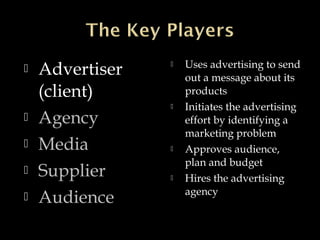
 Advertiser
(client)
 Agency
 Media
 Supplier
 Audience
 Uses advertising to send
out a message about its
products
 Initiates the advertising
effort by identifying a
marketing problem
 Approves audience,
plan and budget
 Hires the advertising
agency
 Advertiser
(client)
 Agency
 Media
 Supplier
 Audience
 Has strategic and
creative expertise,
media knowledge,
workforce talent, and
negotiating abilities
 Advertising
department
 In-house agency
 Advertiser
(client)
 Agency
 Media
 Supplier
 Audience
 The channels of
communication that
carry the message to the
audience
 Are also companies or
huge conglomerates
 Mass media advertising
can be cost effective
because the costs are
spread over the large
number of people the
ad reaches
 Advertiser
(client)
 Agency
 Media
 Supplier
 Audience
 Assist advertisers,
agencies, and the
media in creating and
placing the ads
 Vendor services are
often cheaper than
those in-house
 Advertiser
(client)
 Agency
 Media
 Supplier
 Audience
 The desired audience
for the advertising
message
 Data-gathering
technology improves
accuracy of information
about customers
 Advertisers must
recognize the various
target audiences they
are talking to and know
as much about them as
possible
1-31
•Strategy
•Creative
idea
•Execution
•Media
• The strategy is the logic and
planning behind the ad that
gives it direction.
• Advertisers develop ads to
meet objectives.
• Advertisers direct ads to
identified audiences.
• Advertisers create a
message that speaks to the
audience’s concerns.
• Advertisers run ads in the
most effective media.
1-32
•Strategy
•Creative
idea
•Execution
•Media
• The central idea grabs the
consumer’s attention and
sticks in memory.
• Planning strategy require
creative problem solving.
• Research involves creativity.
• Buying and placing ads
requires creative thinking.
1-33
•Strategy
•Creative
idea
•Execution
•Media
• Effective ads are well
executed reflecting the
highest production values in
the industry.
• Clients demand the best
production the budget
allows.
1-34
•Strategy
•Creative
idea
•Execution
•Media
• Television, Internet,
magazines, and other media
are used to reach a broad
audience.
• Deciding how to deliver the
message requires creativity.
• How you say something and
where you say it is just as
important as what you say.
 Brand advertising
 Retail or Local advertising
 Direct-Response advertising
 Business-to-Business advertising
 Institutional advertising
 Nonprofit advertising
 Public Service advertising
1. If it creates an impression for a product or
brand
2. If it influences people to respond in some way
3. If it separates the product or brand from the
competition in the mind of the consumer
THANK YOU
Thank you all and
best of luck

Advertisingppt 130708233914-phpapp01

  • 1.
  • 2.
     To gainan understanding of the role of advertising within the Marketing Communications Mix  To examine communication and advertising theories and their relationship with consumer behavior  To develop knowledge of advertising strategy and planning  To examine the importance and uses of creativity in advertising  To gain an understanding of various production techniques  To appreciate the complexities of evaluation
  • 3.
     Although advertisingis an accepted part of every day life, there is still great debate as to how advertising works and the role it can and should perform within the marketing communication mix. This module enables the applicants to review this debate and apply the theories to the advertising in our media today. They will learn how to put together an advertising plan and will examine the ingredients of an effective advertisement and ways in which this effectiveness can be measured
  • 4.
     According to“Philip Kotler” & American Marketing Association. The advertising is any paid form of non personal presentation of  Ideas  Goods  Services by an identified sponsor that is called Advertising.
  • 5.
     What isa Brand?  It is a product whose producer has made every effert to make it uniquely desirable to potential buyers, consistently using every element in its presentation to do so.
  • 6.
     Why docompanies do this?  If done well, it makes the brand difficult to compete against. It develops an aura making it appear better than its competition.
  • 7.
     A brandis created by all the elements of the marketing mix working together.  Creates a positive prejudice in people’s minds.
  • 8.
     Def’n –Marketing Mix: a range of tools and techniques that allows businesses to provide customers with what they want. It acts as a conduit for consumer demand to reach businesses. Thusly, turning this demand into profitable sales.
  • 9.
     These toolsinclude: - Product formulation and variation - Packaging - Sales literature - The sales force - Pricing - Sales promotion - Direct mail - Advertising - Market research - Branding
  • 10.
     Components ofthe marketing mix 1) Net sales value 2) Costs and contribution 3) The marketing mix
  • 11.
     Gross margin Cost of goods - Materials - Packaging - Manufacturing
  • 12.
     Operating contribution Selling costs (the marketing mix) - Sales - Distribution - Communications - Research
  • 13.
     Sales anddistribution costs  The communications mix - Advertising - Direct marketing - Promotions - Exhibitions - Etc.
  • 14.
     Simply put:Advertising exists to help to sell things.  It is mainly about brands  It is mainly designed to create and strengthen consumer impressions of the brand  Exception is public service advertising
  • 15.
    An Advertising PlanMatches the Right Audience to the Right Message and Presents It in the Right Medium to Reach That Audience & Has Three Elements. Targeting the Audience: Whom are you trying to reach? Message Strategy: What do you say to them? Media Strategy: When & where will you reach them?
  • 16.
     The 6Mapproach Merchandise: important benefits to sell Markets: who to reach Motives: why people buy or fail to buy Media: how to reach Measurements: how to evaluate (time and change) Messages: key ideas to convey to move
  • 17.
     Marketing  Communication Economic  Societal  The process a business uses to satisfy consumer needs by providing goods and services  Product category  Target market  Marketing mix  Brand
  • 18.
     Marketing  Communication Economic  Societal  Can reach a mass audience  Introduces products  Explains important changes  Reminds and reinforces  Persuades
  • 19.
     Marketing  Communication Economic  Societal  Moves from being informational to creating demand  Advertising is an objective means for providing price- value information, thereby creating a more rational economy
  • 20.
     Marketing  Communication Economic  Societal  Informs consumers about innovations and issues  Mirrors fashion and design trends  Teaches consumers about new products  Helps shape consumer self-image  Perpetuates self- expression
  • 21.
     Advertising ispart of total continuum of communications about the brand. It may have a leading role and carry the greatest budget: but it can be merely cast in a supporting role for a campaign of activity centered around an event.
  • 22.
     Involves ahuge amount of money  Work is done by relatively few people  Major expense is for media time/space  Companies spend only a small percentage of sales on advertising
  • 23.
     Product advertising—Triesto sell a specific product to final users or channel members  Pioneering advertising builds primary demand  Competitive advertising builds selective demand  Corporate/institutional advertising—Tries to promote an organisation's image, reputation or ideas—rather than a specific product
  • 24.
     Magazine  Wordof mouth  Television  Newspaper  Yellow Pages  Radio  Outdoors  Cinema  Internet
  • 25.
     Builds awarenessof products and brands  Creates a brand image  Provides product and brand information  Persuades people  Provides incentives to take action  Provides brand reminders  Reinforces past purchases and brand experiences
  • 26.
     Advertiser (client)  Agency Media  Supplier  Audience  Uses advertising to send out a message about its products  Initiates the advertising effort by identifying a marketing problem  Approves audience, plan and budget  Hires the advertising agency
  • 27.
     Advertiser (client)  Agency Media  Supplier  Audience  Has strategic and creative expertise, media knowledge, workforce talent, and negotiating abilities  Advertising department  In-house agency
  • 28.
     Advertiser (client)  Agency Media  Supplier  Audience  The channels of communication that carry the message to the audience  Are also companies or huge conglomerates  Mass media advertising can be cost effective because the costs are spread over the large number of people the ad reaches
  • 29.
     Advertiser (client)  Agency Media  Supplier  Audience  Assist advertisers, agencies, and the media in creating and placing the ads  Vendor services are often cheaper than those in-house
  • 30.
     Advertiser (client)  Agency Media  Supplier  Audience  The desired audience for the advertising message  Data-gathering technology improves accuracy of information about customers  Advertisers must recognize the various target audiences they are talking to and know as much about them as possible
  • 31.
    1-31 •Strategy •Creative idea •Execution •Media • The strategyis the logic and planning behind the ad that gives it direction. • Advertisers develop ads to meet objectives. • Advertisers direct ads to identified audiences. • Advertisers create a message that speaks to the audience’s concerns. • Advertisers run ads in the most effective media.
  • 32.
    1-32 •Strategy •Creative idea •Execution •Media • The centralidea grabs the consumer’s attention and sticks in memory. • Planning strategy require creative problem solving. • Research involves creativity. • Buying and placing ads requires creative thinking.
  • 33.
    1-33 •Strategy •Creative idea •Execution •Media • Effective adsare well executed reflecting the highest production values in the industry. • Clients demand the best production the budget allows.
  • 34.
    1-34 •Strategy •Creative idea •Execution •Media • Television, Internet, magazines,and other media are used to reach a broad audience. • Deciding how to deliver the message requires creativity. • How you say something and where you say it is just as important as what you say.
  • 35.
     Brand advertising Retail or Local advertising  Direct-Response advertising  Business-to-Business advertising  Institutional advertising  Nonprofit advertising  Public Service advertising
  • 36.
    1. If itcreates an impression for a product or brand 2. If it influences people to respond in some way 3. If it separates the product or brand from the competition in the mind of the consumer
  • 37.
    THANK YOU Thank youall and best of luck