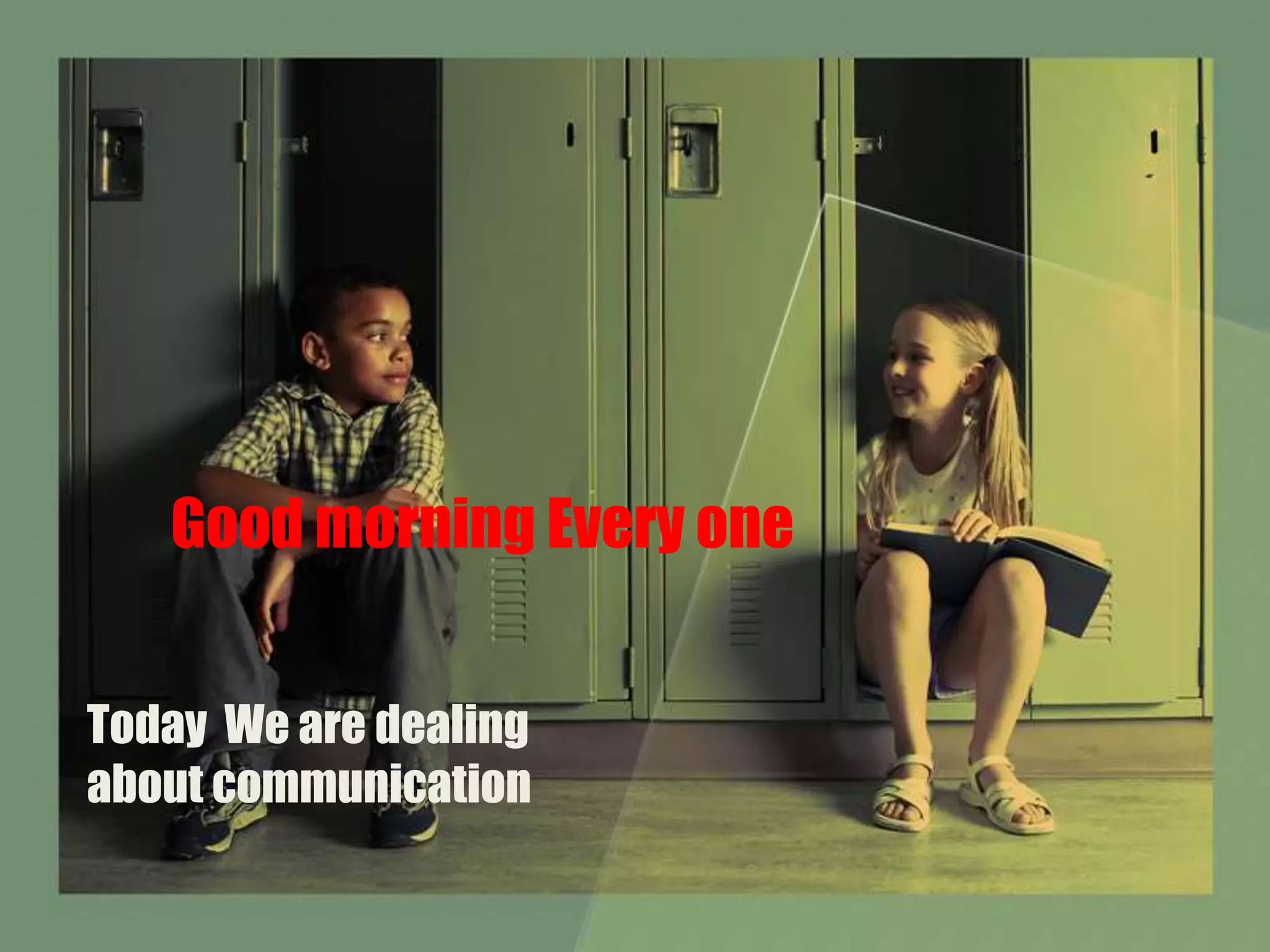



Good morning Every one


Today We are dealing
about communication
Tables of contents
• Communication
• Integrated Marketing Communication process and Mix
• Advertising
Communication


The purpose of communications is to directly or indirectly
influence individual groups,
and organizations to facilitate exchanges by informing and
persuading one or more
audiences to accept a company’s products and/or services. In
any communication there
are three basic components: A source, a medium and a message.
Marketing Communication
Marketing communications is one of the four major
elements of the company's marketing mix. Marketers
must know how to use advertising, sales promotion,
direct marketing, public relations, and personal selling
to communicate the product's existence and value to
the target customers.


             Marketing
           Communication
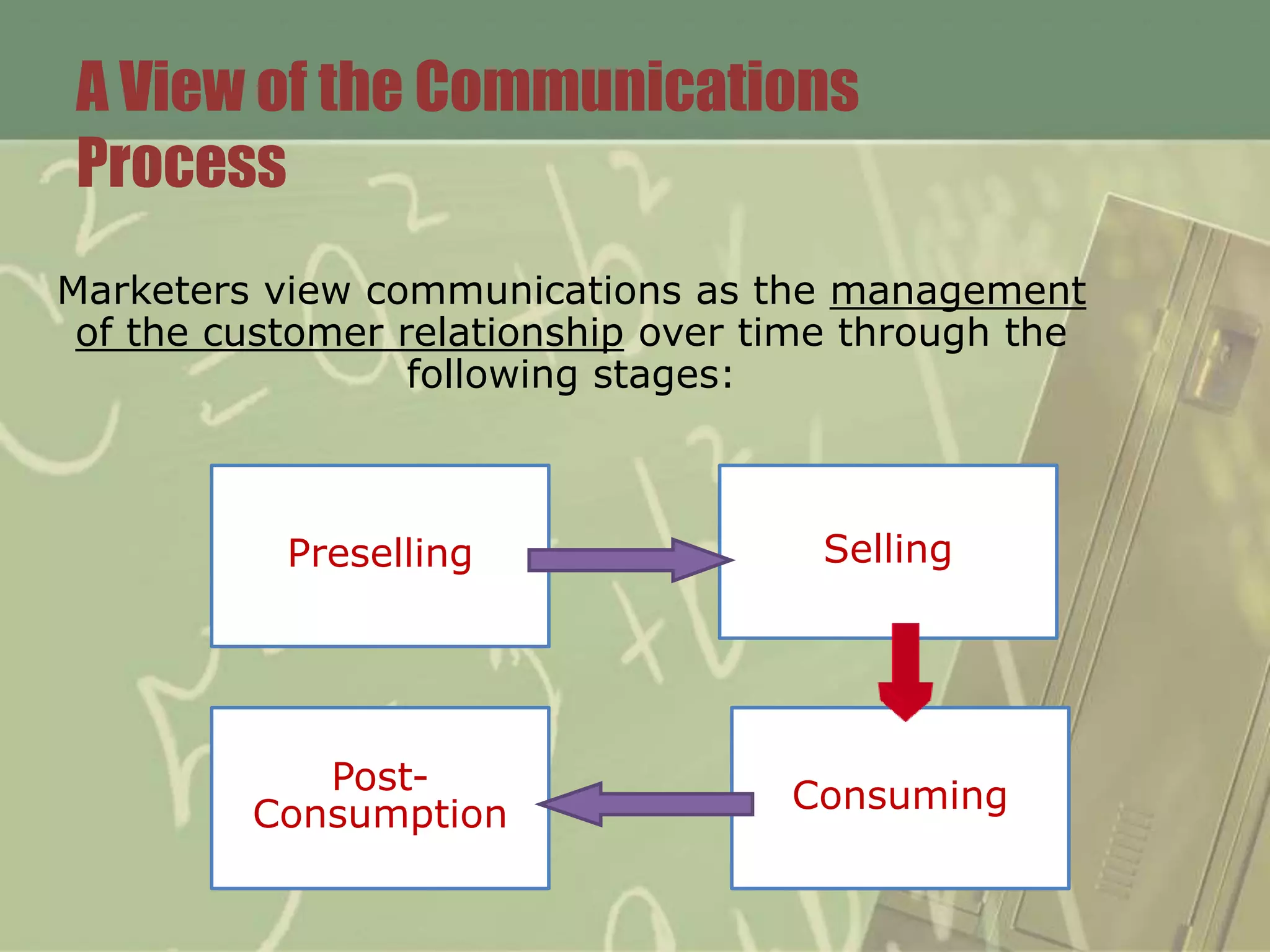
A View of the Communications
Process
Marketers view communications as the management
 of the customer relationship over time through the
                  following stages:


           Preselling                Selling


            Post-                   Consuming
         Consumption
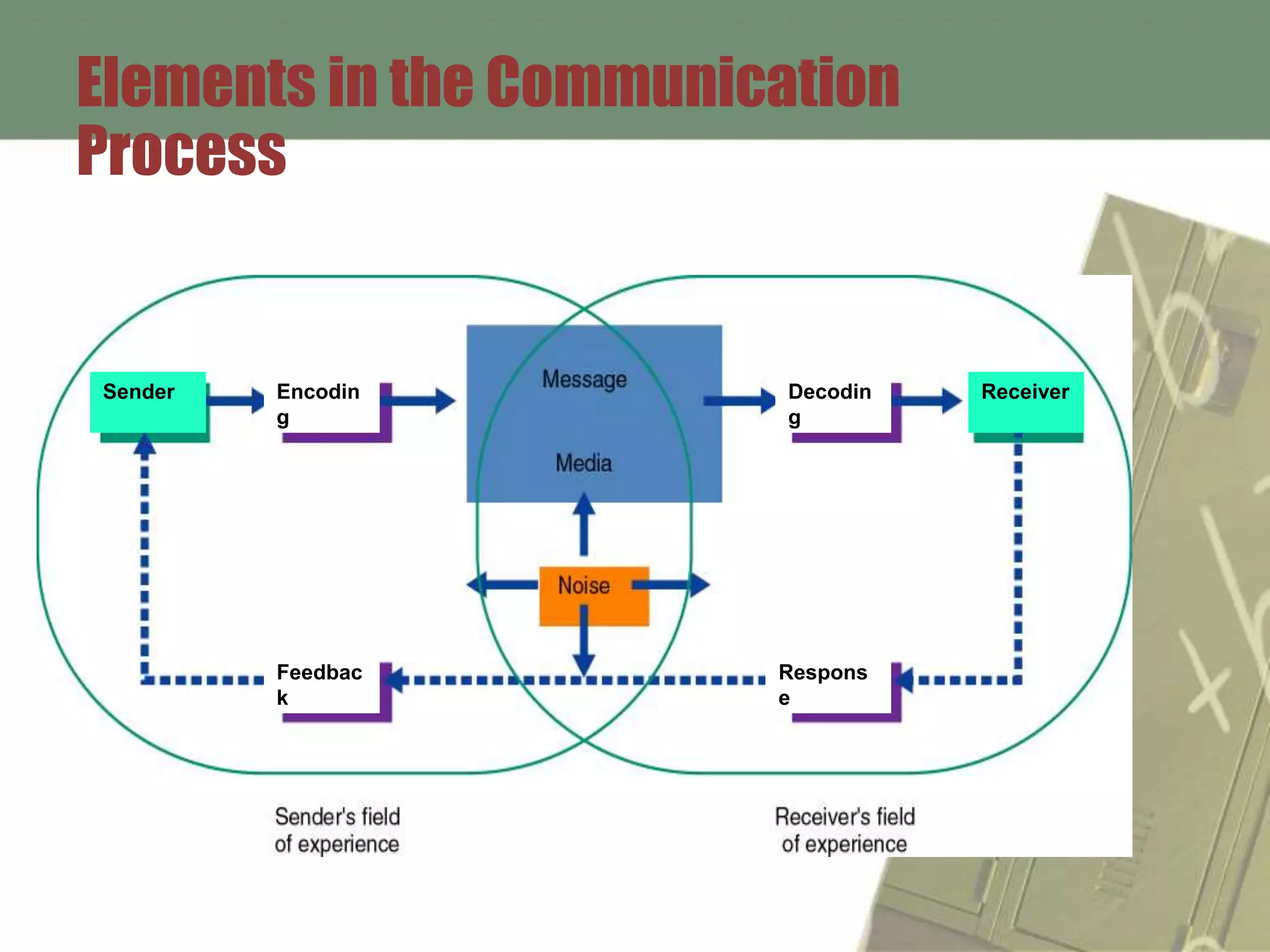
Elements in the Communication
Process


Sender   Encodin         Decodin   Receiver
         g               g


         Feedbac        Respons
         k              e
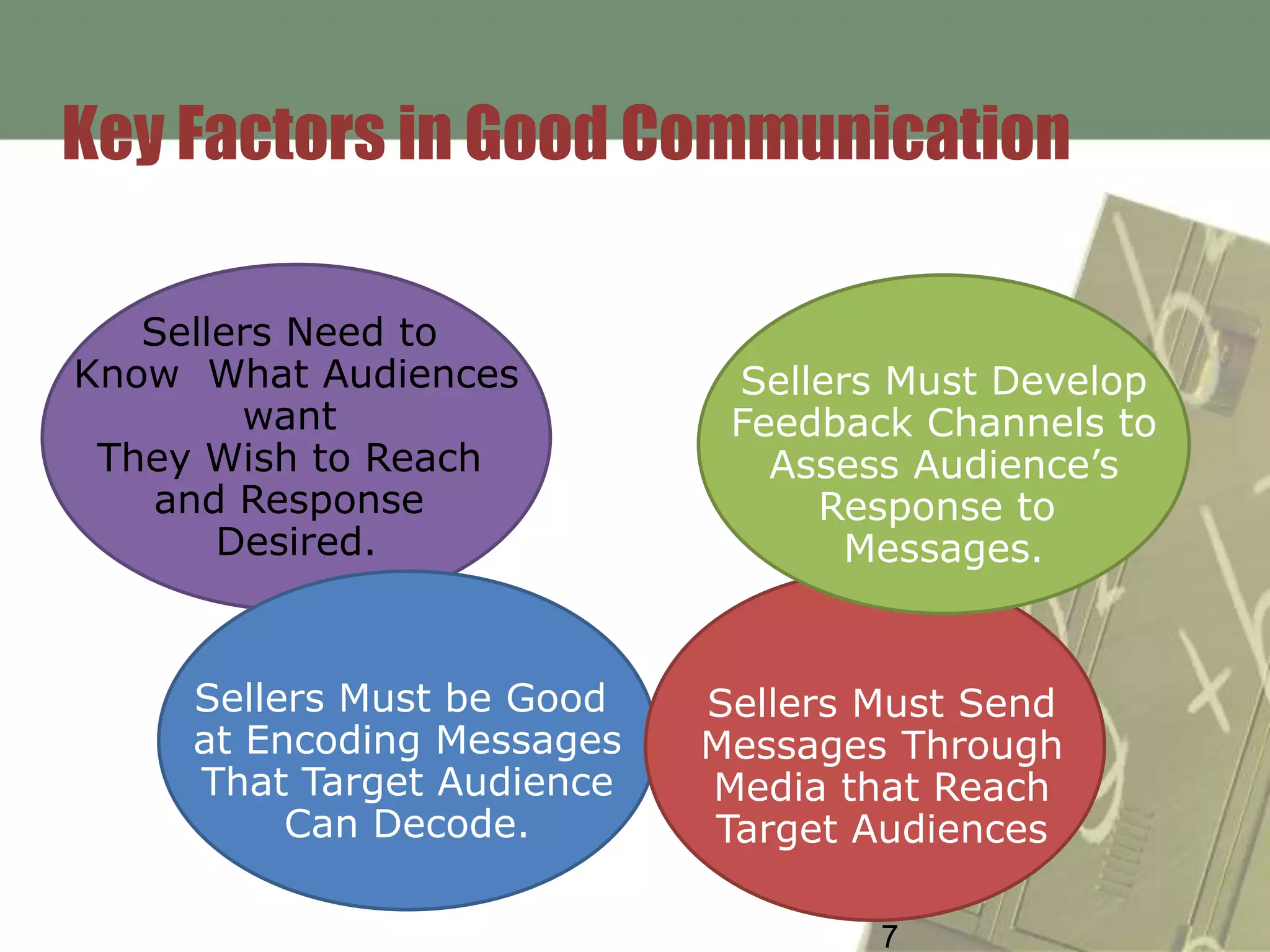
Key Factors in Good Communication

   Sellers Need to
Know What Audiences          Sellers Must Develop
        want                 Feedback Channels to
 They Wish to Reach            Assess Audience’s
   and Response                  Response to
       Desired.                    Messages.


     Sellers Must be Good   Sellers Must Send
     at Encoding Messages   Messages Through
     That Target Audience   Media that Reach
          Can Decode.       Target Audiences

                                    7
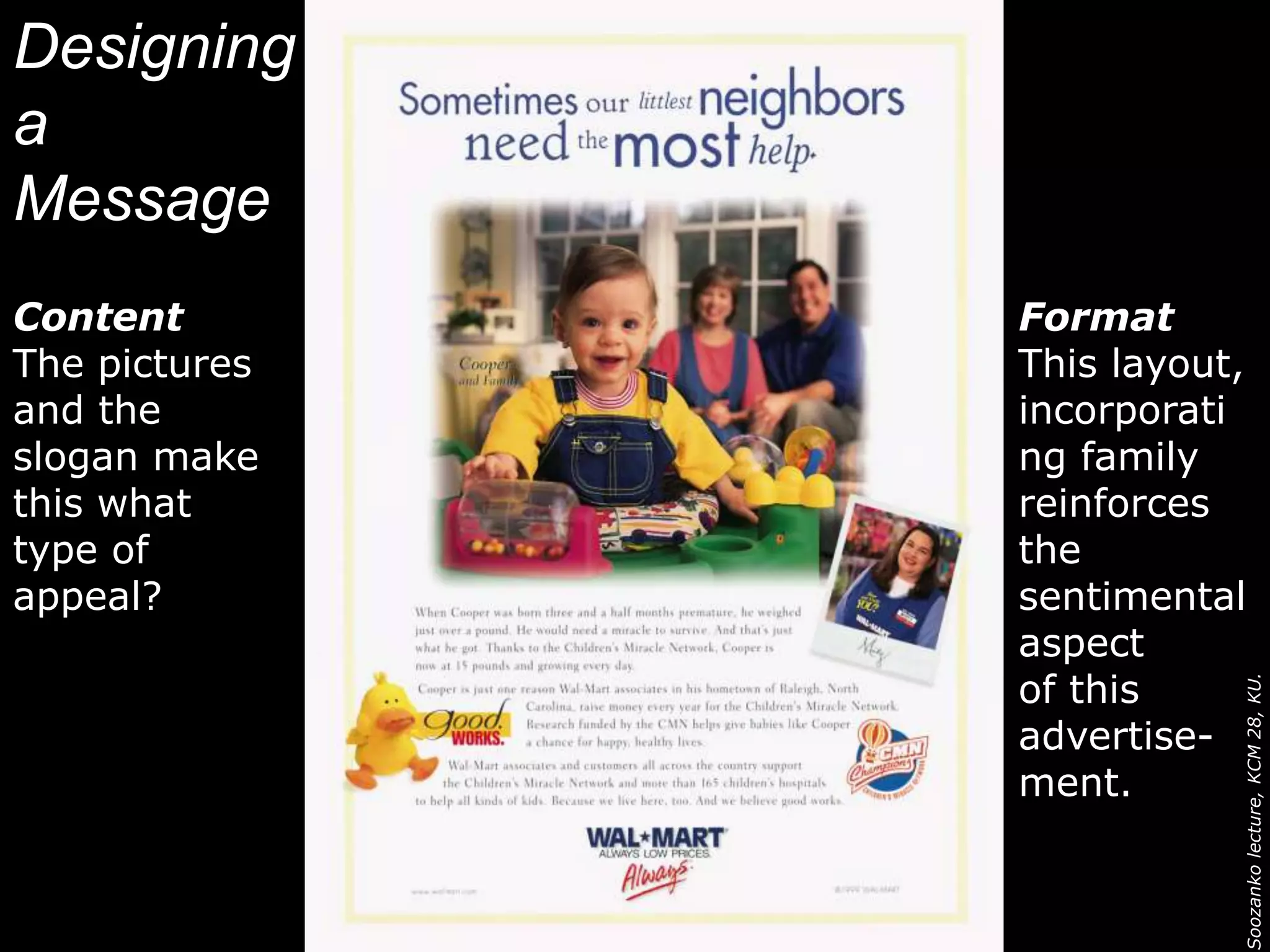
Designing
a
Message
Content            Format
The pictures       This layout,
and the            incorporati
slogan make        ng family
this what          reinforces
type of            the
appeal?            sentimental
                   aspect
                   of this


                                                  Soozanko lecture, KCM 28, KU.
                   advertise-


                             Soozanko, KCM, KU.
                   ment.


               8
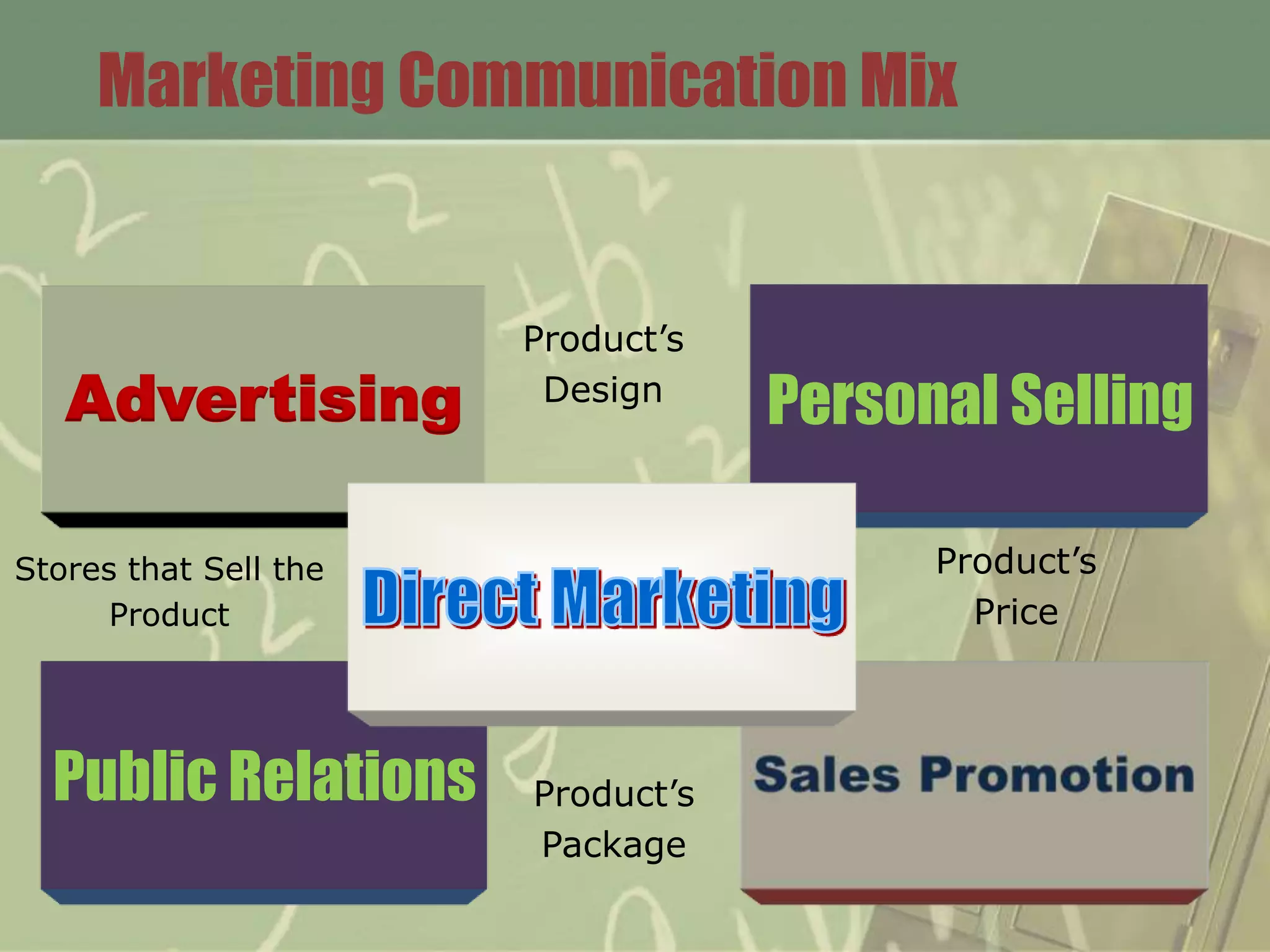
Marketing Communication Mix


                       Product’s
   Advertising          Design
                                   Personal Selling

Stores that Sell the                     Product’s
      Product                              Price


  Public Relations     Product’s
                       Package
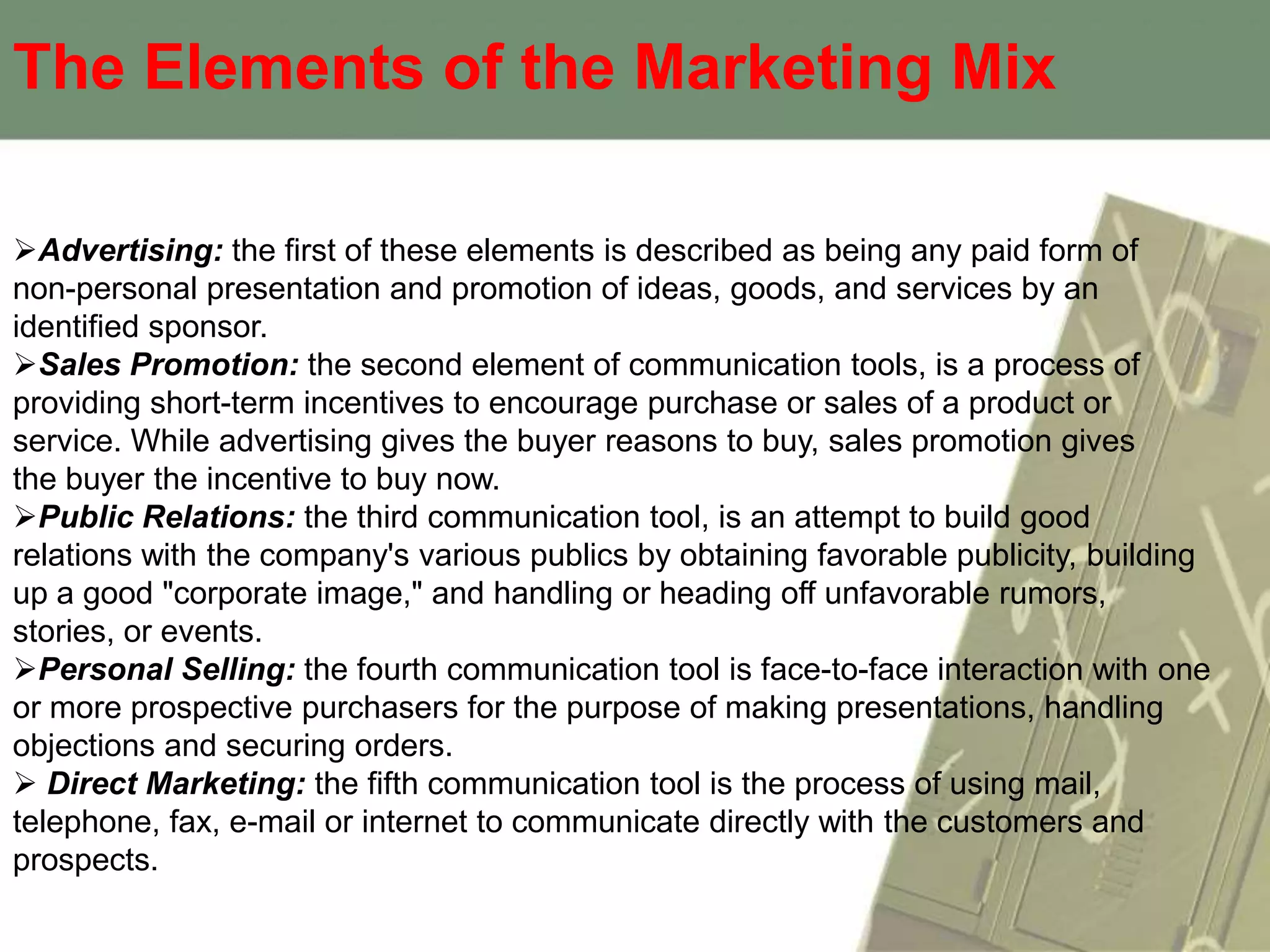
The Elements of the Marketing Mix

Advertising: the first of these elements is described as being any paid form of
non-personal presentation and promotion of ideas, goods, and services by an
identified sponsor.
Sales Promotion: the second element of communication tools, is a process of
providing short-term incentives to encourage purchase or sales of a product or
service. While advertising gives the buyer reasons to buy, sales promotion gives
the buyer the incentive to buy now.
Public Relations: the third communication tool, is an attempt to build good
relations with the company's various publics by obtaining favorable publicity, building
up a good "corporate image," and handling or heading off unfavorable rumors,
stories, or events.
Personal Selling: the fourth communication tool is face-to-face interaction with one
or more prospective purchasers for the purpose of making presentations, handling
objections and securing orders.
 Direct Marketing: the fifth communication tool is the process of using mail,
telephone, fax, e-mail or internet to communicate directly with the customers and
prospects.
Integrated Marketing Communications

 Integrated marketing communications is a way of looking at the
whole marketing process from the viewpoint of the customer.

 Not all product concepts are right for all individuals, which
observation introduces the notion of market segmentation and
targeting. One message does not fit all. Integrated marketing
communications (IMC) focus on discrete customer segments.

 Through integrated marketing communications, the company
carefully integrates and coordinates its many communication channels
to deliver a clear, consistent, and compelling message about the
organization and its products or services.
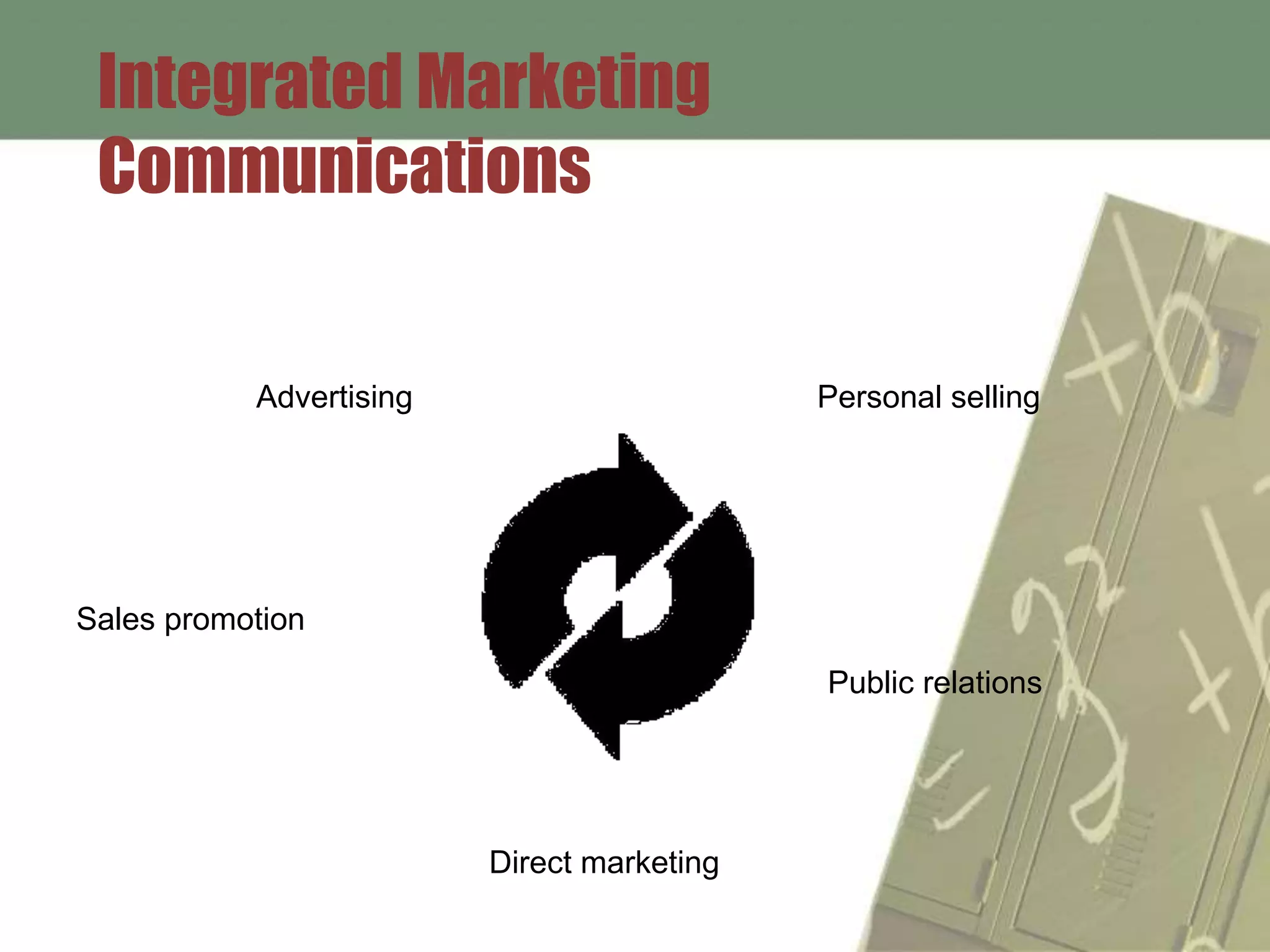
Integrated Marketing
 Communications


           Advertising                      Personal selling


Sales promotion

                                            Public relations


                         Direct marketing
Advertising

Any paid form of non-personal presentation


 and promotion of ideas, goods, or services


          by an identified sponsor.


           Even the best product needs advertising.
Advertising aims at creating awareness and arousing


    interest in the target audience for a product, a


                  service or an idea.


           Thirty years ago , advertising was considered an

            unnecessary evil; ten years ago, a necessary evil,

               today it is considered an absolute necessity.
Characteristics of Advertising

 Public presentation (public mode of communication).

 Pervasiveness (permits seller to repeat the message many times. It also
allows
buyer to receive and compare the message with those of competitors).

Amplified expressiveness (provides opportunities for dramatizing the
company
and its product through the artful use of language, print, sound, color, etc.)

Impersonality (it cannot be as compelling as a company's sales
representatives).
Marketing management must make four
important decisions when developing an
advertising program:
1. Setting advertising objectives
         Communication objectives, Sales objectives

2. Setting advertising budgets
         Affordable approach, Percent of sales, Competitive parity
         Objective and task

3. Developing advertising strategy
i. Message decisions.
          Message strategy Message execution
ii. Media decisions.
          Reach, frequency, impact, Major media types, Specific media
          vehicles, Media timing

4. Evaluating advertising campaigns
        Communication impact, Sales impact
?
Objective of advertising:
1. Informative advertising, which is advertising used to inform
consumers about a new product or feature and to build primary
demand.
2. Persuasive advertising, which is advertising used to build
selective demand for a brand by persuading consumers that it
offers the best quality for their money.
3. Comparative advertising, which is advertising that compares
one brand directly or indirectly to one or more other brands.
4. Reminder advertising, which is advertising used to keep
consumers thinking about
a product.
Setting the Advertising Budget

AFFORDABLE
Based on What the Company Can Afford

PERCENTAGE-OF-SALES
Based on a certain Percentage of
Current or Forecasted Sales

OBJECTIVE-AND-TASK
Based on Determining Objectives & Tasks,
then Estimating Costs

COMPETITIVE-PARITY
Based on Competitors’ Promotion
Budget
Developing Advertising Strategy


Develop a Message Focus on Customer Benefits


Creative Concept “Big Idea” Visualization or Phrase


Advertising Appeals Meaningful, Believable & Distinctive
Media Selection
Deciding on reach, frequency, and impact.
Reach is the percentage of people in the target market.
Frequency is the number of times the average person in the target market is exposed
to an advertising message during a given period.
 Media impact is the qualitative value of an exposure through a given medium.
Media planners consider the following factors when making their
choice:
         The media habits of consumers.
         The nature of the product.
         The types of messages.
         Cost.
 The media planner must now choose the best media vehicles (specific media within
a given type-magazines, radio, television, etc.). This choice is based on which vehicles
give the best reach, frequency, and impact for the money.
Deciding on the media timing is also an important decision. The advertiser must
decide how to schedule the advertising over the course of a year. They also have
to examine the pattern of the ads (some advertisers only do seasonal advertising).
Forms to be considered are:
 Continuity: scheduling ads evenly within a year period.
 Pulsing: scheduling ads unevenly or in sporadic bursts over a certain time
Period.
THANYOU ALL AND MAKE
EFFECTIVE COMMUNICATION

Communication

  • 1.
    Good morning Everyone Today We are dealing about communication
  • 2.
    Tables of contents •Communication • Integrated Marketing Communication process and Mix • Advertising
  • 3.
    Communication The purpose ofcommunications is to directly or indirectly influence individual groups, and organizations to facilitate exchanges by informing and persuading one or more audiences to accept a company’s products and/or services. In any communication there are three basic components: A source, a medium and a message.
  • 4.
    Marketing Communication Marketing communicationsis one of the four major elements of the company's marketing mix. Marketers must know how to use advertising, sales promotion, direct marketing, public relations, and personal selling to communicate the product's existence and value to the target customers. Marketing Communication
  • 5.
    A View ofthe Communications Process Marketers view communications as the management of the customer relationship over time through the following stages: Preselling Selling Post- Consuming Consumption
  • 6.
    Elements in theCommunication Process Sender Encodin Decodin Receiver g g Feedbac Respons k e
  • 7.
    Key Factors inGood Communication Sellers Need to Know What Audiences Sellers Must Develop want Feedback Channels to They Wish to Reach Assess Audience’s and Response Response to Desired. Messages. Sellers Must be Good Sellers Must Send at Encoding Messages Messages Through That Target Audience Media that Reach Can Decode. Target Audiences 7
  • 8.
    Designing a Message Content Format The pictures This layout, and the incorporati slogan make ng family this what reinforces type of the appeal? sentimental aspect of this Soozanko lecture, KCM 28, KU. advertise- Soozanko, KCM, KU. ment. 8
  • 9.
    Marketing Communication Mix Product’s Advertising Design Personal Selling Stores that Sell the Product’s Product Price Public Relations Product’s Package
  • 10.
    The Elements ofthe Marketing Mix Advertising: the first of these elements is described as being any paid form of non-personal presentation and promotion of ideas, goods, and services by an identified sponsor. Sales Promotion: the second element of communication tools, is a process of providing short-term incentives to encourage purchase or sales of a product or service. While advertising gives the buyer reasons to buy, sales promotion gives the buyer the incentive to buy now. Public Relations: the third communication tool, is an attempt to build good relations with the company's various publics by obtaining favorable publicity, building up a good "corporate image," and handling or heading off unfavorable rumors, stories, or events. Personal Selling: the fourth communication tool is face-to-face interaction with one or more prospective purchasers for the purpose of making presentations, handling objections and securing orders.  Direct Marketing: the fifth communication tool is the process of using mail, telephone, fax, e-mail or internet to communicate directly with the customers and prospects.
  • 11.
    Integrated Marketing Communications Integrated marketing communications is a way of looking at the whole marketing process from the viewpoint of the customer.  Not all product concepts are right for all individuals, which observation introduces the notion of market segmentation and targeting. One message does not fit all. Integrated marketing communications (IMC) focus on discrete customer segments.  Through integrated marketing communications, the company carefully integrates and coordinates its many communication channels to deliver a clear, consistent, and compelling message about the organization and its products or services.
  • 12.
    Integrated Marketing Communications Advertising Personal selling Sales promotion Public relations Direct marketing
  • 13.
    Advertising Any paid formof non-personal presentation and promotion of ideas, goods, or services by an identified sponsor. Even the best product needs advertising.
  • 14.
    Advertising aims atcreating awareness and arousing interest in the target audience for a product, a service or an idea. Thirty years ago , advertising was considered an unnecessary evil; ten years ago, a necessary evil, today it is considered an absolute necessity.
  • 15.
    Characteristics of Advertising Public presentation (public mode of communication).  Pervasiveness (permits seller to repeat the message many times. It also allows buyer to receive and compare the message with those of competitors). Amplified expressiveness (provides opportunities for dramatizing the company and its product through the artful use of language, print, sound, color, etc.) Impersonality (it cannot be as compelling as a company's sales representatives).
  • 16.
    Marketing management mustmake four important decisions when developing an advertising program: 1. Setting advertising objectives Communication objectives, Sales objectives 2. Setting advertising budgets Affordable approach, Percent of sales, Competitive parity Objective and task 3. Developing advertising strategy i. Message decisions. Message strategy Message execution ii. Media decisions. Reach, frequency, impact, Major media types, Specific media vehicles, Media timing 4. Evaluating advertising campaigns Communication impact, Sales impact
  • 17.
  • 20.
    Objective of advertising: 1.Informative advertising, which is advertising used to inform consumers about a new product or feature and to build primary demand. 2. Persuasive advertising, which is advertising used to build selective demand for a brand by persuading consumers that it offers the best quality for their money. 3. Comparative advertising, which is advertising that compares one brand directly or indirectly to one or more other brands. 4. Reminder advertising, which is advertising used to keep consumers thinking about a product.
  • 21.
    Setting the AdvertisingBudget AFFORDABLE Based on What the Company Can Afford PERCENTAGE-OF-SALES Based on a certain Percentage of Current or Forecasted Sales OBJECTIVE-AND-TASK Based on Determining Objectives & Tasks, then Estimating Costs COMPETITIVE-PARITY Based on Competitors’ Promotion Budget
  • 22.
    Developing Advertising Strategy Developa Message Focus on Customer Benefits Creative Concept “Big Idea” Visualization or Phrase Advertising Appeals Meaningful, Believable & Distinctive
  • 23.
    Media Selection Deciding onreach, frequency, and impact. Reach is the percentage of people in the target market. Frequency is the number of times the average person in the target market is exposed to an advertising message during a given period.  Media impact is the qualitative value of an exposure through a given medium. Media planners consider the following factors when making their choice: The media habits of consumers. The nature of the product. The types of messages. Cost.  The media planner must now choose the best media vehicles (specific media within a given type-magazines, radio, television, etc.). This choice is based on which vehicles give the best reach, frequency, and impact for the money. Deciding on the media timing is also an important decision. The advertiser must decide how to schedule the advertising over the course of a year. They also have to examine the pattern of the ads (some advertisers only do seasonal advertising). Forms to be considered are:  Continuity: scheduling ads evenly within a year period.  Pulsing: scheduling ads unevenly or in sporadic bursts over a certain time Period.
  • 24.
    THANYOU ALL ANDMAKE EFFECTIVE COMMUNICATION