
   “A plan of action to communicate a
    message to a target market a the right
    time, and right frequency.”


   The goal of a media plan is to be
    efficient: to gain maximum exposure at
    minimum cost.
 It is the process of establishing the exact
  media vehicle to be used for Advertising
 Media planning is connecting a brand to
  the end consumer Via Media Vehicle
 Media planning is the back Bone of any
  product launch
   Media planning: The series of decisions
    involved in delivering the message to the
    target audience.
   Media plan: The actual document detailing
    media planning decisions.
   Media objectives: Objectives of media
    plan.
   Media strategies: action plans to reach
    objectives.
   Medium: channel such as print, broadcast.
   Media vehicle: Specific carrier in a media
    category (television, magazines)
   Generally the task of a media agency
    entails finding the most appropriate
    media platforms for a client's brand or
    product
 Advertising is an investment in future
  sales.
 It’s greatest powers are in short-term
  promotions and its cumulative long-
  range effects.
   . Defining the marketing problem. Do
    you know where your business is coming
    from and where the potential for
    increased business lies? Do you know
    which markets offer the greatest
    opportunity? Do you need to reach
    everybody or only a select group of
    consumers? How often is the product
    used? How much product loyalty exists?
   . Translating the marketing requirements
    into attainable media objectives. Do
    you want to reach lots of people in a
    wide area (to get the most out of your
    advertising dollar)? Then mass media,
    like newspaper and radio, might work for
    you. If your target market is a select
    group in a defined geographic area,
    then direct mail could be your best bet.
   . Defining a media solution by
    formulating media strategies. Certain
    schedules work best with different
    media. For example, the rule of thumb is
    that a print ad must run three times
    before it gets noticed. Radio advertising
    is most effective when run at certain
    times of the day or around certain
    programs, depending on what market
    you're trying to reach
 Who     is the target market?
 What    is the message?
 Where   are the priority markets?
 When    is the best time to
                        advertise?
   How   many, often, long?
1.   Planning media strategy, including the
     specific types of consumers/audiences
     the      messages will be directed to.
2.   Selecting and Buying media vehicles.
      Media planning is both an art and a
     science. An essential part of the
     advertising business
 Where should we advertise?
 Which media vehicles?
 When during the year?
 Should we concentrate our advertising?
 How often should it run?
 What opportunities are there to integrate
  our media planning with other
  Promotion or Communication tools?
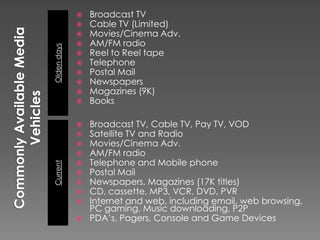
   Broadcast TV
                Cable TV (Limited)
                Movies/Cinema Adv.
                AM/FM radio
Olden days
                Reel to Reel tape
                Telephone
                Postal Mail
                Newspapers
                Magazines (9K)
                Books

                Broadcast TV, Cable TV, Pay TV, VOD
                Satellite TV and Radio
                Movies/Cinema Adv.
                AM/FM radio
                Telephone and Mobile phone
Current


                Postal Mail
                Newspapers, Magazines (17K titles)
                CD, cassette, MP3, VCR, DVD, PVR
                Internet and web, including email, web browsing,
                 PC gaming, Music downloading, P2P
                PDA’s, Pagers, Console and Game Devices
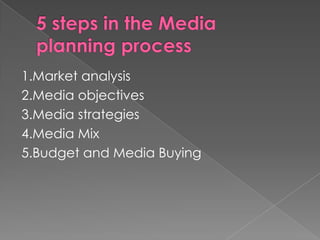
1.Market analysis
2.Media objectives
3.Media strategies
4.Media Mix
5.Budget and Media Buying
To determine the attractiveness
of a market and to understand its
evolving opportunities and threats as
they relate to the strengths and
weaknesses of the firm.
To establish firm objectives for your plan
in order to demonstrate how it will help
your brand achieve its marketing goals
 Media strategy is the way we seek to
  realize our media objectives
 .When formulated correctly, it enables
  an advertiser to rise above the clutter of
  ads , and stand out in the competition
Numerous factors are evaluated and they are
  usually ranked based on priority


•    Target market and media matching
    strategy
•   Creative strategy influences media choices
•   Coverage decisions are based on the
    budget
•   Timing decisions are crucial for scheduling
•   Reach, frequency, and continuity priorities
•   Budget
The advertising strategy encompasses
the use of more than one type
of advertising media to get its message
across the target audience. A
combination of media types is known as
the media mix.
Budget Allocations : classifies spending
my medium , region, and time of year
             Media buyers work in
advertising and media agencies
negotiating, purchasing and monitoring
media space on behalf of their clients.
They aim to reach the highest number of
people in the target audience at the
lowest possible cost.
   . Target Market. Whom are you going to sell to?
     › Demographic, geographic and psychographics
        characteristics

   . Where is product or service distributed?
     › Local, regional, national or selected markets


   . Nature of Message?
     › Electronic/Broadcast
     › Print
     › Color/B&W
     › Demonstration
     › Simple Statements
Frequency
    Average number of times a household
 or a person viewed a given television
 program, station or commercial during a
 specific time period.
   Rating (RTG or %):
       The estimate of the size of a television
    audience relative to the total universe,
    expressed as a percentage. The
    estimated percent of all TV households
    or persons tuned to a specific station. In
    the example, three of the 10 homes in
    the universe are tuned to channel 2. That
    translates to a 30 rating.
   . Media Mix
    › Combination of different media, and   size
      of ads
    › Which Media?
    › Which Schedules?
 1.Conduct media research
 2.Determine media objectives
  and strategies
 3.Determine the media mix
 4.Do the actual media buy

Presentation1 media planning

  • 2.
    “A plan of action to communicate a message to a target market a the right time, and right frequency.”  The goal of a media plan is to be efficient: to gain maximum exposure at minimum cost.
  • 3.
     It isthe process of establishing the exact media vehicle to be used for Advertising  Media planning is connecting a brand to the end consumer Via Media Vehicle  Media planning is the back Bone of any product launch
  • 4.
    Media planning: The series of decisions involved in delivering the message to the target audience.  Media plan: The actual document detailing media planning decisions.  Media objectives: Objectives of media plan.  Media strategies: action plans to reach objectives.  Medium: channel such as print, broadcast.  Media vehicle: Specific carrier in a media category (television, magazines)
  • 5.
    Generally the task of a media agency entails finding the most appropriate media platforms for a client's brand or product
  • 6.
     Advertising isan investment in future sales.  It’s greatest powers are in short-term promotions and its cumulative long- range effects.
  • 7.
    . Defining the marketing problem. Do you know where your business is coming from and where the potential for increased business lies? Do you know which markets offer the greatest opportunity? Do you need to reach everybody or only a select group of consumers? How often is the product used? How much product loyalty exists?
  • 8.
    . Translating the marketing requirements into attainable media objectives. Do you want to reach lots of people in a wide area (to get the most out of your advertising dollar)? Then mass media, like newspaper and radio, might work for you. If your target market is a select group in a defined geographic area, then direct mail could be your best bet.
  • 9.
    . Defining a media solution by formulating media strategies. Certain schedules work best with different media. For example, the rule of thumb is that a print ad must run three times before it gets noticed. Radio advertising is most effective when run at certain times of the day or around certain programs, depending on what market you're trying to reach
  • 10.
     Who is the target market?  What is the message?  Where are the priority markets?  When is the best time to advertise?  How many, often, long?
  • 11.
    1. Planning media strategy, including the specific types of consumers/audiences the messages will be directed to. 2. Selecting and Buying media vehicles. Media planning is both an art and a science. An essential part of the advertising business
  • 12.
     Where shouldwe advertise?  Which media vehicles?  When during the year?  Should we concentrate our advertising?  How often should it run?  What opportunities are there to integrate our media planning with other Promotion or Communication tools?
  • 13.
    Broadcast TV  Cable TV (Limited)  Movies/Cinema Adv.  AM/FM radio Olden days  Reel to Reel tape  Telephone  Postal Mail  Newspapers  Magazines (9K)  Books  Broadcast TV, Cable TV, Pay TV, VOD  Satellite TV and Radio  Movies/Cinema Adv.  AM/FM radio  Telephone and Mobile phone Current  Postal Mail  Newspapers, Magazines (17K titles)  CD, cassette, MP3, VCR, DVD, PVR  Internet and web, including email, web browsing, PC gaming, Music downloading, P2P  PDA’s, Pagers, Console and Game Devices
  • 14.
    1.Market analysis 2.Media objectives 3.Mediastrategies 4.Media Mix 5.Budget and Media Buying
  • 15.
    To determine theattractiveness of a market and to understand its evolving opportunities and threats as they relate to the strengths and weaknesses of the firm.
  • 16.
    To establish firmobjectives for your plan in order to demonstrate how it will help your brand achieve its marketing goals
  • 17.
     Media strategyis the way we seek to realize our media objectives  .When formulated correctly, it enables an advertiser to rise above the clutter of ads , and stand out in the competition
  • 18.
    Numerous factors areevaluated and they are usually ranked based on priority • Target market and media matching strategy • Creative strategy influences media choices • Coverage decisions are based on the budget • Timing decisions are crucial for scheduling • Reach, frequency, and continuity priorities • Budget
  • 19.
    The advertising strategyencompasses the use of more than one type of advertising media to get its message across the target audience. A combination of media types is known as the media mix.
  • 20.
    Budget Allocations :classifies spending my medium , region, and time of year Media buyers work in advertising and media agencies negotiating, purchasing and monitoring media space on behalf of their clients. They aim to reach the highest number of people in the target audience at the lowest possible cost.
  • 21.
    . Target Market. Whom are you going to sell to? › Demographic, geographic and psychographics characteristics  . Where is product or service distributed? › Local, regional, national or selected markets  . Nature of Message? › Electronic/Broadcast › Print › Color/B&W › Demonstration › Simple Statements
  • 22.
    Frequency Average number of times a household or a person viewed a given television program, station or commercial during a specific time period.
  • 23.
    Rating (RTG or %): The estimate of the size of a television audience relative to the total universe, expressed as a percentage. The estimated percent of all TV households or persons tuned to a specific station. In the example, three of the 10 homes in the universe are tuned to channel 2. That translates to a 30 rating.
  • 24.
    . Media Mix › Combination of different media, and size of ads › Which Media? › Which Schedules?
  • 25.
     1.Conduct mediaresearch  2.Determine media objectives and strategies  3.Determine the media mix  4.Do the actual media buy