By
KAUSHAL KUMAR SAHU
Assistant Professor (Ad Hoc)
Department of Biotechnology
Govt. Digvijay Autonomous P. G. College
Raj-Nandgaon ( C. G. )
Contents
 Introduction
 Definition
 History
 Evolution and origin of apoptosis
 Significance
 Purpose of apoptosis
 Steps /process
 Morphological and biochemical changes
 Mechanism of apoptosis
 Caspases
 Regulation of apoptosis
 Disorders of apoptosis
 Application
 Conclusion
 Referances
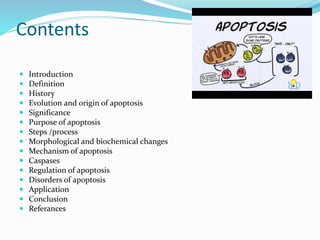
INTRODUCTION
 The word apoptosis comes from the
ancient Greek meaning the;
 “Falling of petals from a flower or of leaves
from a tree in autumn”
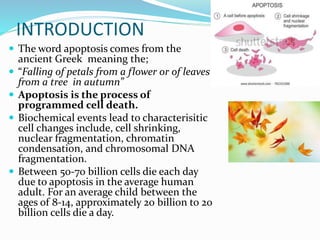
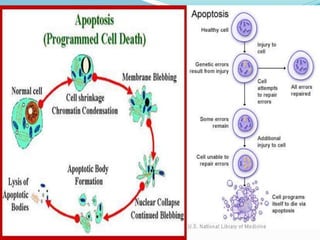
 Apoptosis is the process of
programmed cell death.
 Biochemical events lead to characterisitic
cell changes include, cell shrinking,
nuclear fragmentation, chromatin
condensation, and chromosomal DNA
fragmentation.
 Between 50-70 billion cells die each day
due to apoptosis in the average human
adult. For an average child between the
ages of 8-14, approximately 20 billion to 20
billion cells die a day.
HISTORY
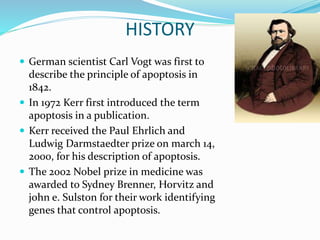
 German scientist Carl Vogt was first to
describe the principle of apoptosis in
1842.
 In 1972 Kerr first introduced the term
apoptosis in a publication.
 Kerr received the Paul Ehrlich and
Ludwig Darmstaedter prize on march 14,
2000, for his description of apoptosis.
 The 2002 Nobel prize in medicine was
awarded to Sydney Brenner, Horvitz and
john e. Sulston for their work identifying
genes that control apoptosis.
Definition
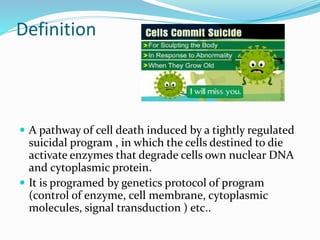
 A pathway of cell death induced by a tightly regulated
suicidal program , in which the cells destined to die
activate enzymes that degrade cells own nuclear DNA
and cytoplasmic protein.
 It is programed by genetics protocol of program
(control of enzyme, cell membrane, cytoplasmic
molecules, signal transduction ) etc..
Evolution of the origin of programmed cell
death
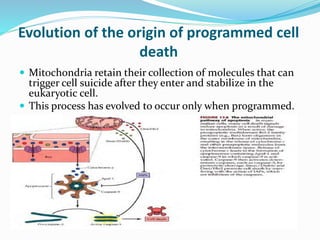
 Mitochondria retain their collection of molecules that can
trigger cell suicide after they enter and stabilize in the
eukaryotic cell.
 This process has evolved to occur only when programmed.
SIGNIFICANCE
 In the human body about 100,000 cells are
produced every second by mitosis and a
similar number die by apoptosis(Vaux and
Korsmeyer, 1999,Cell).
1] Development & morphology
 Massive cell death occurs during early
development of the nervous system (>
50percent of all neurons die)
2] Homeostasis
3] Deletion of damaged and dangerous cells
Purpose of apoptosis
why should a cell commit suicide
 It’s essential for the proper development and
to maintain homeostasis for the organism.
Apoptosis is needed for proper
development;
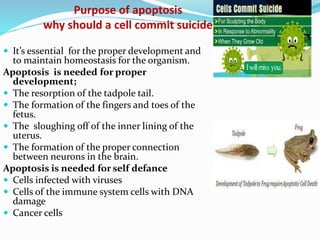
 The resorption of the tadpole tail.
 The formation of the fingers and toes of the
fetus.
 The sloughing off of the inner lining of the
uterus.
 The formation of the proper connection
between neurons in the brain.
Apoptosis is needed for self defance
 Cells infected with viruses
 Cells of the immune system cells with DNA
damage
 Cancer cells
STEPS
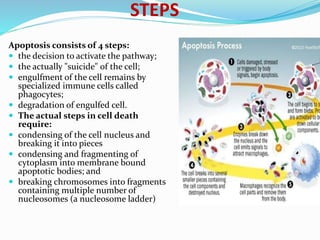
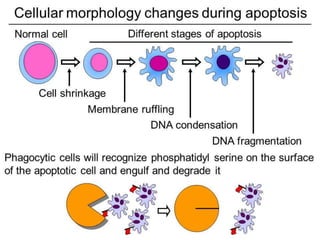
Apoptosis consists of 4 steps:
 the decision to activate the pathway;
 the actually "suicide" of the cell;
 engulfment of the cell remains by
specialized immune cells called
phagocytes;
 degradation of engulfed cell.
 The actual steps in cell death
require:
 condensing of the cell nucleus and
breaking it into pieces
 condensing and fragmenting of
cytoplasm into membrane bound
apoptotic bodies; and
 breaking chromosomes into fragments
containing multiple number of
nucleosomes (a nucleosome ladder)
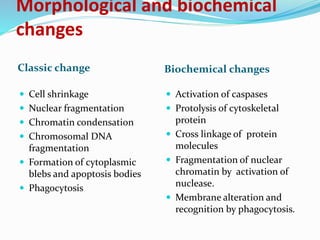
Morphological and biochemical
changes
Classic change Biochemical changes
 Cell shrinkage
 Nuclear fragmentation
 Chromatin condensation
 Chromosomal DNA
fragmentation
 Formation of cytoplasmic
blebs and apoptosis bodies
 Phagocytosis
 Activation of caspases
 Protolysis of cytoskeletal
protein
 Cross linkage of protein
molecules
 Fragmentation of nuclear
chromatin by activation of
nuclease.
 Membrane alteration and
recognition by phagocytosis.
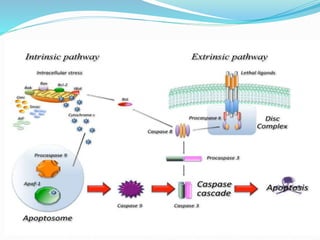
Mechanism of apoptosis
extrinsic pathway- cytochrome c caspases cell
death.
A] External signalling pathway
 Apoptosis is triggered by external (extracellular) stimulus.
 Also known as Receptor mediated apoptosis
2] Intrinsic signalling pathway
Intrensic pathway- death receptor caspases cell death.
 Also called as mitochondria mediated pathway.
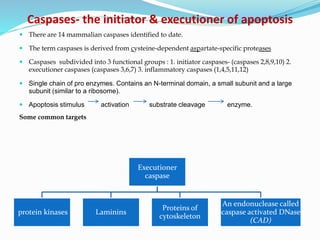
Caspases- the initiator & executioner of apoptosis
 There are 14 mammalian caspases identified to date.
 The term caspases is derived from cysteine-dependent aspartate-specific proteases
 Caspases subdivided into 3 functional groups : 1. initiator caspases- (caspases 2,8,9,10) 2.
executioner caspases (caspases 3,6,7) 3. inflammatory caspases (1,4,5,11,12)
 Single chain of pro enzymes. Contains an N-terminal domain, a small subunit and a large
subunit (similar to a ribosome).
 Apoptosis stimulus activation substrate cleavage enzyme.
Some common targets
Executioner
caspase
protein kinases Laminins
Proteins of
cytoskeleton
An endonuclease called
caspase activated DNase
(CAD)
Regulation of apoptosis
 Regulatory protein – BCL-2, equivalent to CED-9
 Apoptosis depends on binding of BCL-2 with pro
apoptotic and anti apoptotic proteins.
 Situated in the outer mitochondrial membrane.
 Apaf-1 equivalent to CED-4.
Disorder of apoptosis
TOO MUCH- tissue atrophy
- Neurodegeneration , thin skin etc.
TOO LITTLE- hyperplasia
- cancer, athersclerosis etc.
Apoptosis inhibition
 Neoplastic disease
 Autoimmunity [ e.g. systemic lupus
erythematosus]
 Viral infection
Hyperactive apoptosis
 Neurodegenerative disease
Importance of apoptosis
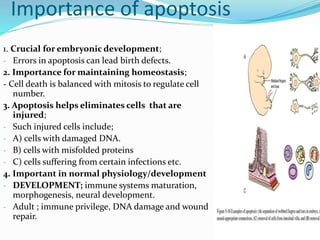
1. Crucial for embryonic development;
- Errors in apoptosis can lead birth defects.
2. Importance for maintaining homeostasis;
- Cell death is balanced with mitosis to regulate cell
number.
3. Apoptosis helps eliminates cells that are
injured;
- Such injured cells include;
- A) cells with damaged DNA.
- B) cells with misfolded proteins
- C) cells suffering from certain infections etc.
4. Important in normal physiology/development
- DEVELOPMENT; immune systems maturation,
morphogenesis, neural development.
- Adult ; immune privilege, DNA damage and wound
repair.
Conclusion
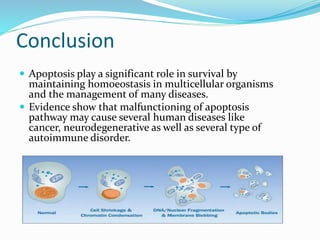
 Apoptosis play a significant role in survival by
maintaining homoeostasis in multicellular organisms
and the management of many diseases.
 Evidence show that malfunctioning of apoptosis
pathway may cause several human diseases like
cancer, neurodegenerative as well as several type of
autoimmune disorder.
References
BOOKS
 The Cell- A molecular approach 4th edition- G.M. Cooper & R.E. Hausman
 Cell and molecular biology 6th edition- Gerald Karp.
Articles
 Apoptosis—an introduction by Alfons Lawen 25:888–896, 2003.
 Apoptosis – reprogramming cell fate. Hoi Hung Cheung et al- Volume 2012,
Article ID 685852, 8 pages.
 Apoptosis and disease- R. Ramírez Chamond et al - Vol. 14, No. 6, pp. 367-
374
 Introduction to Apoptosis - by Andreas Gewies in 2003, pp. 1-26

Apoptosis, program cell death

  • 1.
    By KAUSHAL KUMAR SAHU AssistantProfessor (Ad Hoc) Department of Biotechnology Govt. Digvijay Autonomous P. G. College Raj-Nandgaon ( C. G. )
  • 2.
    Contents  Introduction  Definition History  Evolution and origin of apoptosis  Significance  Purpose of apoptosis  Steps /process  Morphological and biochemical changes  Mechanism of apoptosis  Caspases  Regulation of apoptosis  Disorders of apoptosis  Application  Conclusion  Referances
  • 3.
    INTRODUCTION  The wordapoptosis comes from the ancient Greek meaning the;  “Falling of petals from a flower or of leaves from a tree in autumn”  Apoptosis is the process of programmed cell death.  Biochemical events lead to characterisitic cell changes include, cell shrinking, nuclear fragmentation, chromatin condensation, and chromosomal DNA fragmentation.  Between 50-70 billion cells die each day due to apoptosis in the average human adult. For an average child between the ages of 8-14, approximately 20 billion to 20 billion cells die a day.
  • 5.
    HISTORY  German scientistCarl Vogt was first to describe the principle of apoptosis in 1842.  In 1972 Kerr first introduced the term apoptosis in a publication.  Kerr received the Paul Ehrlich and Ludwig Darmstaedter prize on march 14, 2000, for his description of apoptosis.  The 2002 Nobel prize in medicine was awarded to Sydney Brenner, Horvitz and john e. Sulston for their work identifying genes that control apoptosis.
  • 6.
    Definition  A pathwayof cell death induced by a tightly regulated suicidal program , in which the cells destined to die activate enzymes that degrade cells own nuclear DNA and cytoplasmic protein.  It is programed by genetics protocol of program (control of enzyme, cell membrane, cytoplasmic molecules, signal transduction ) etc..
  • 7.
    Evolution of theorigin of programmed cell death  Mitochondria retain their collection of molecules that can trigger cell suicide after they enter and stabilize in the eukaryotic cell.  This process has evolved to occur only when programmed.
  • 8.
    SIGNIFICANCE  In thehuman body about 100,000 cells are produced every second by mitosis and a similar number die by apoptosis(Vaux and Korsmeyer, 1999,Cell). 1] Development & morphology  Massive cell death occurs during early development of the nervous system (> 50percent of all neurons die) 2] Homeostasis 3] Deletion of damaged and dangerous cells
  • 9.
    Purpose of apoptosis whyshould a cell commit suicide  It’s essential for the proper development and to maintain homeostasis for the organism. Apoptosis is needed for proper development;  The resorption of the tadpole tail.  The formation of the fingers and toes of the fetus.  The sloughing off of the inner lining of the uterus.  The formation of the proper connection between neurons in the brain. Apoptosis is needed for self defance  Cells infected with viruses  Cells of the immune system cells with DNA damage  Cancer cells
  • 10.
    STEPS Apoptosis consists of4 steps:  the decision to activate the pathway;  the actually "suicide" of the cell;  engulfment of the cell remains by specialized immune cells called phagocytes;  degradation of engulfed cell.  The actual steps in cell death require:  condensing of the cell nucleus and breaking it into pieces  condensing and fragmenting of cytoplasm into membrane bound apoptotic bodies; and  breaking chromosomes into fragments containing multiple number of nucleosomes (a nucleosome ladder)
  • 11.
    Morphological and biochemical changes Classicchange Biochemical changes  Cell shrinkage  Nuclear fragmentation  Chromatin condensation  Chromosomal DNA fragmentation  Formation of cytoplasmic blebs and apoptosis bodies  Phagocytosis  Activation of caspases  Protolysis of cytoskeletal protein  Cross linkage of protein molecules  Fragmentation of nuclear chromatin by activation of nuclease.  Membrane alteration and recognition by phagocytosis.
  • 13.
    Mechanism of apoptosis extrinsicpathway- cytochrome c caspases cell death. A] External signalling pathway  Apoptosis is triggered by external (extracellular) stimulus.  Also known as Receptor mediated apoptosis
  • 15.
    2] Intrinsic signallingpathway Intrensic pathway- death receptor caspases cell death.  Also called as mitochondria mediated pathway.
  • 16.
    Caspases- the initiator& executioner of apoptosis  There are 14 mammalian caspases identified to date.  The term caspases is derived from cysteine-dependent aspartate-specific proteases  Caspases subdivided into 3 functional groups : 1. initiator caspases- (caspases 2,8,9,10) 2. executioner caspases (caspases 3,6,7) 3. inflammatory caspases (1,4,5,11,12)  Single chain of pro enzymes. Contains an N-terminal domain, a small subunit and a large subunit (similar to a ribosome).  Apoptosis stimulus activation substrate cleavage enzyme. Some common targets Executioner caspase protein kinases Laminins Proteins of cytoskeleton An endonuclease called caspase activated DNase (CAD)
  • 17.
    Regulation of apoptosis Regulatory protein – BCL-2, equivalent to CED-9  Apoptosis depends on binding of BCL-2 with pro apoptotic and anti apoptotic proteins.  Situated in the outer mitochondrial membrane.  Apaf-1 equivalent to CED-4.
  • 18.
    Disorder of apoptosis TOOMUCH- tissue atrophy - Neurodegeneration , thin skin etc. TOO LITTLE- hyperplasia - cancer, athersclerosis etc. Apoptosis inhibition  Neoplastic disease  Autoimmunity [ e.g. systemic lupus erythematosus]  Viral infection Hyperactive apoptosis  Neurodegenerative disease
  • 19.
    Importance of apoptosis 1.Crucial for embryonic development; - Errors in apoptosis can lead birth defects. 2. Importance for maintaining homeostasis; - Cell death is balanced with mitosis to regulate cell number. 3. Apoptosis helps eliminates cells that are injured; - Such injured cells include; - A) cells with damaged DNA. - B) cells with misfolded proteins - C) cells suffering from certain infections etc. 4. Important in normal physiology/development - DEVELOPMENT; immune systems maturation, morphogenesis, neural development. - Adult ; immune privilege, DNA damage and wound repair.
  • 20.
    Conclusion  Apoptosis playa significant role in survival by maintaining homoeostasis in multicellular organisms and the management of many diseases.  Evidence show that malfunctioning of apoptosis pathway may cause several human diseases like cancer, neurodegenerative as well as several type of autoimmune disorder.
  • 21.
    References BOOKS  The Cell-A molecular approach 4th edition- G.M. Cooper & R.E. Hausman  Cell and molecular biology 6th edition- Gerald Karp. Articles  Apoptosis—an introduction by Alfons Lawen 25:888–896, 2003.  Apoptosis – reprogramming cell fate. Hoi Hung Cheung et al- Volume 2012, Article ID 685852, 8 pages.  Apoptosis and disease- R. Ramírez Chamond et al - Vol. 14, No. 6, pp. 367- 374  Introduction to Apoptosis - by Andreas Gewies in 2003, pp. 1-26