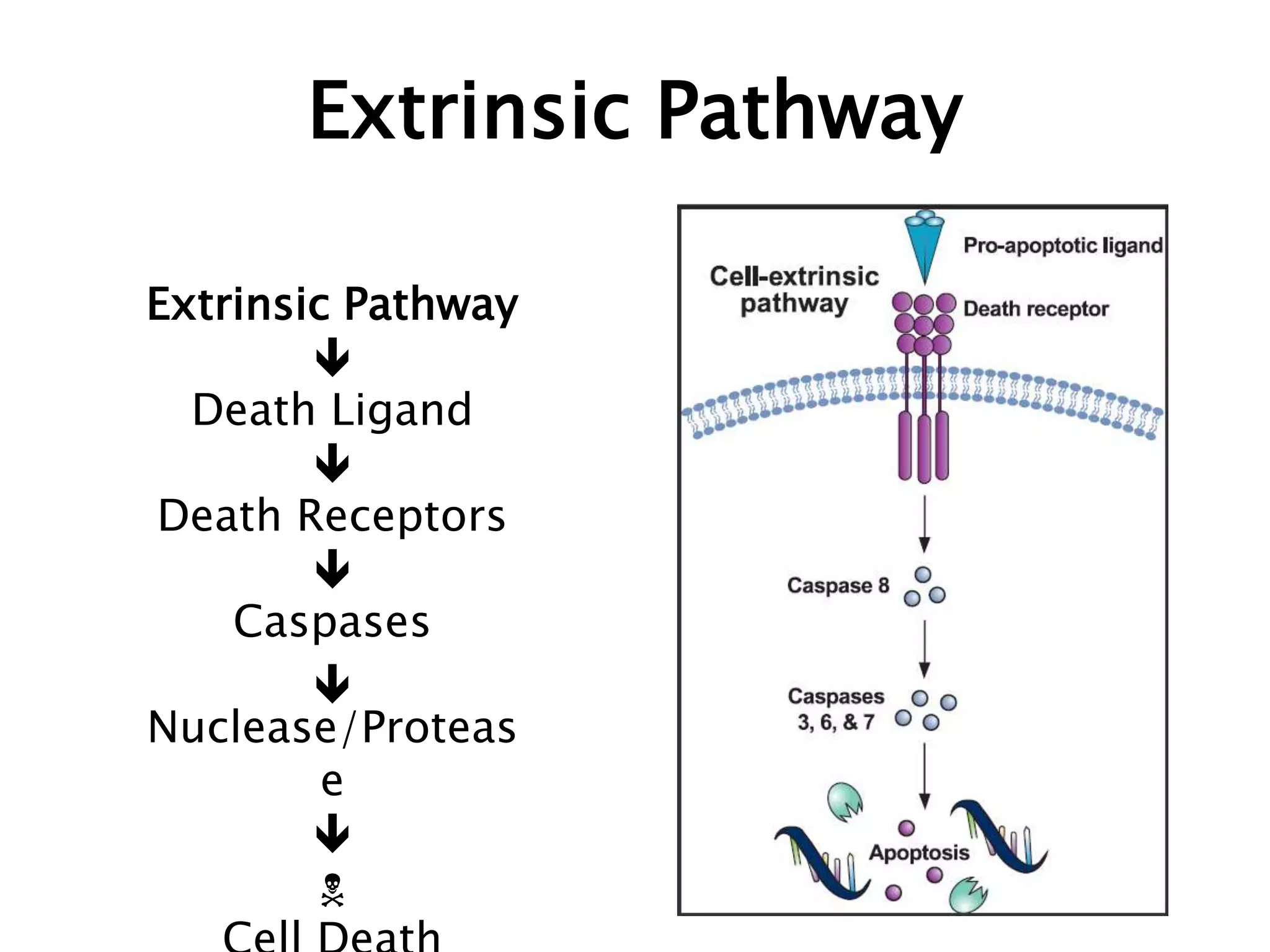
Extrinsic Pathway
Extrinsic Pathway

Death Ligand

Death Receptors

Caspases
Nuclease/Proteas
e

N

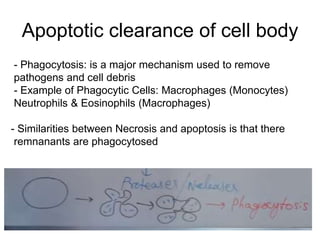
Apoptotic clearance of cell body
- Phagocytosis: is a major mechanism used to remove
pathogens and cell debris
- Example of Phagocytic Cells: Macrophages (Monocytes)
Neutrophils & Eosinophils (Macrophages)
- Similarities between Necrosis and apoptosis is that there
remnanants are phagocytosed
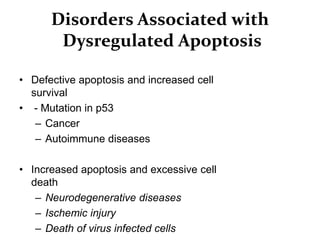
Disorders Associated with
Dysregulated Apoptosis
• Defective apoptosis and increased cell
survival
• - Mutation in p53
– Cancer
– Autoimmune diseases
• Increased apoptosis and excessive cell
death
– Neurodegenerative diseases
– Ischemic injury
– Death of virus infected cells
Question and References
1. Is down-regulation of apoptosis associated with
cancer?
yes
or No
References
https://www.youtube.com/watch?v=TOR7qJsYDKI
https://www.khanacademy.org/science/biology/cellular-molecular
-biology/stem-cells-and-cancer/e/apoptosis
https://drive.google.com/file/d/149Qw1u_Kbs_i5B4v7QuE_kq8ceLS4LZa/view?usp=sharing
https://drive.google.com/file/d/17H0I1psQB6WPRwfTMelnSpkj7QIvRMD8/view?usp=sharing
https://drive.google.com/file/d/1D4V77LkO5i4jXKXwtmuGKpFR3ARtQh7O/view?usp=sharing

Apoptosis extrinsic pathway

  • 1.
    Extrinsic Pathway Extrinsic Pathway  DeathLigand  Death Receptors  Caspases Nuclease/Proteas e  N 
  • 3.
    Apoptotic clearance ofcell body - Phagocytosis: is a major mechanism used to remove pathogens and cell debris - Example of Phagocytic Cells: Macrophages (Monocytes) Neutrophils & Eosinophils (Macrophages) - Similarities between Necrosis and apoptosis is that there remnanants are phagocytosed
  • 4.
    Disorders Associated with DysregulatedApoptosis • Defective apoptosis and increased cell survival • - Mutation in p53 – Cancer – Autoimmune diseases • Increased apoptosis and excessive cell death – Neurodegenerative diseases – Ischemic injury – Death of virus infected cells
  • 5.
    Question and References 1.Is down-regulation of apoptosis associated with cancer? yes or No References https://www.youtube.com/watch?v=TOR7qJsYDKI https://www.khanacademy.org/science/biology/cellular-molecular -biology/stem-cells-and-cancer/e/apoptosis https://drive.google.com/file/d/149Qw1u_Kbs_i5B4v7QuE_kq8ceLS4LZa/view?usp=sharing https://drive.google.com/file/d/17H0I1psQB6WPRwfTMelnSpkj7QIvRMD8/view?usp=sharing https://drive.google.com/file/d/1D4V77LkO5i4jXKXwtmuGKpFR3ARtQh7O/view?usp=sharing

Editor's Notes

  • #2 Nuclease will breakdown nuclic acid (DNA) Protease break down proteins - whenn the lamins and actin filaments are cleaved how will the cell survive then they start forming blebs
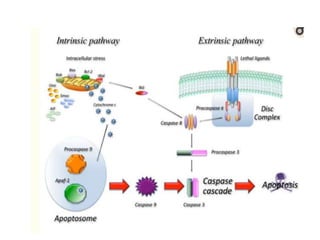
  • #3 How are the intrinsic and extrinsic apoptotic pathways are connected? Activation of caspase 3 via caspase 8 can sometimes be sufficient to induce apoptosis in the extrinsic pathway. Sometimes it isn't though. Caspase 8 is also capable of cleaving and activating BID which induces the intrinsic/mitochondrial pathway (via Bak/Bax), Cytochrome c, apaf1,apoptosome,caspade 9,caspade 3,nuclease
  • #6 Defective apoptosis and increased cell survival- imagine viral infection, DNA damage and the cell keep dividing out of hand its leading to - Cancer